Home Blog Page 27

Hotel for Dogs

0

It’s been a booming season at the movies for dog-lovers, with “Bolt,” “Marley & Me,” and “Beverly Hills Chihuahua” all scoring big grosses with their warm tales of canine companionship and leg-humping. Even the art house circuit got into the act with the somber “Wendy and Lucy.” But if all of this has left your thirst for Fido-centric films still unquenched, “Hotel for Dogs” can pick up some of the slack, though four canine comedies and an indie drama within four months might be considered excessive.

This one has orphans, though! Adorable orphans! They are 16-year-old Andi (Emma Roberts) and her 11-year-old brother Bruce (Jake T. Austin), unspecified-big-city kids whose parents died in an unspecified manner and who now live with apathetic foster parents, the Scudders, played by Lisa Kudrow and Kevin Dillon. To avoid terrifying the target audience, the movie makes the Scudders more amusing than mean, casting them as wannabe rock stars who also just happen to put padlocks on the cupboards and only feed the kids gruel.

Andi and Bruce have a pet dog that they’ve kept secret from Scudders, shoplifting and pulling small-scale scams to pay for the pooch’s food and upkeep. This can’t go on forever, though, and as fate would have it, the kids stumble across an abandoned hotel that already has two stray dogs living in it. They install their own dog here with his peers, and Bruce uses his ingenuity for gadgetry to devise machines that will automatically feed and entertain the dogs when the kids aren’t around. The “riding in the car with your head hanging out the window” simulator is especially nice.

As more and more neighborhood strays join the secret hotel for dogs, Andi and Bruce are joined by human co-conspirators: Dave (Johnny Simmons), a local pet shop clerk and Andi’s inevitable love interest; Heather (Kyla Pratt), Dave’s co-worker; and Mark (Troy Gentile), a random kid who appears out of nowhere and decides to be everyone’s friend. But eventually the hotel will be discovered and there will be trouble with the grown-ups, and then important lessons will be learned and everyone will live happily ever after.

Based on Lois Duncan’s junior novel (she also wrote the book on which “I Know What You Did Last Summer” was based!) and directed by Thor Freudenthal, “Hotel for Dogs” is strictly for the young folks. It has the questionable logic and stock characters (like villainous, over-eager animal-control officers) that one only finds in kids’ movies — and hey, that’s fine. The point is eventually made that Andi and Bruce are doing for dogs what their social worker (played by Don Cheadle) does for orphaned children, but the audience probably won’t be interested in symbolic parallels like that. (Nor will they stop to wonder why Don Cheadle is in this movie.) The whole affair is breezy and easy-going, and the dozens of dogs are all really, really adorable, even more so than the orphans.

Timecop

Timecop

Jean-Claude Van Damme IS … Timecop! He’s the guy they send when you’re wasting time!

TIMECOP: Hey, you! Quit loitering there! You’re wasting time!
CITIZEN: What are you, the “time police”?!
TIMECOP: YES.
CITIZEN: Oh. My bad. Sorry, officer. (moves along)

Or at least that’s what I thought the movie was about. Turns out it’s actually about a meathead who travels through time to arrest other people who are traveling through time, because traveling through time is illegal unless you’re an authorized timecop — but even authorized timecops are only allowed to travel through time if it’s to arrest someone who’s doing it illegally (since “illegally” is the only way it can be done by non-timecops).

So time travel is sort of like murder. You’re not allowed to commit murder, and if you do, the government might arrest you and murder you, because only the government is allowed to commit murder, and only as a punishment for committing murder.

Whew! I’m exhausted, and I haven’t even started talking about the movie yet! “Timecop” stars Jean-Claude Van Damme, one of those oily mumblers whose central acting techniques are “punch” and “kick” and whose constant employment in the 1990s can only be attributed to a robust economy and the continued popularity of cocaine in Hollywood boardrooms. Van Damme plays Max, a Washington D.C. cop whose wife is murdered in 1994 just as she’s obviously about to tell him she’s pregnant. Max doesn’t know that’s what was on her mind, though, because he’s dim. All he knows is that he’s sad, and also fire hot and gun loud.

Then the movie jumps ahead into … THE FUTURE! Well, 2004. It was the future when the movie was made. You can tell it’s the future because now the big, boxy cars are covered in futuristic-looking steel, and because everyone’s 1994 hairstyles look out of fashion. Max is still very sad about his wife being dead, but he has thrown himself into his work, unhindered by his indecipherable Belgian accent. He’s a timecop, employed by the Time Enforcement Commission to go back and stop wrongdoers from altering the past to improve their futures. This is because, in the words of the scientist who first tells the government about the existence of time travel, “It turns out if you go back and change something, it’s serious.” This needed to be said because, I guess, no one listening had ever watched or read a single piece of science-fiction in their lives.

The government has tried to keep a lid on time travel, but people are somehow still doing it — enough that it requires an entire agency to chase them. And the way that TEC agents travel through time is exceedingly complicated: You have to sit in a little car, which speeds down a track toward a brick wall but disappears before it hits it. (There is no reason for there to be a brick wall at the end of the runway, except to manufacture false tension over whether or not the car will disappear in time.) You materialize in whatever time period you specified, only the car isn’t with you. No one knows where the car goes. It just disappears. So how do you get back to the future? You push a button on a remote control that you have in your pocket. This takes you back to where you started, and when you re-materialize, you’re in the car again.

And somehow people are doing this on their own, without the government facilities. They must have found a more streamlined method. I know it’s hard to believe that private industry could run something more efficiently than the government does, but there you go. I happen to know that a couple of dumb California teenagers time-traveled in a phone booth several years before “Timecop” even came out.

Anyway, one of the wrongdoers is a man named McComb (Ron Silver), a U.S. senator running for president in the current year, 2004. He’s a conniving, murderous, Machiavellian schemer, which makes him only slightly less palatable than anyone who actually ran for president in 2004. McComb has been hiring people to go back in time to raise money for his campaign — taking advantage of low stock prices immediately after the Wall Street crash of 1929, for example, or robbing a Confederate wagon train at gunpoint in 1863. Learning of this, Max goes back to 1929 to stop McComb’s lackey from manipulating stocks, and scolds the man about the dangers of causing ripples in time. Even the smallest action in 1929 could have terrible consequences for the future! Max and the guy fight loudly in his Wall Street office, many gunshots are fired, the office is torn apart, and finally they both disappear into the corridors of time in full view of dozens of witnesses. Thank goodness they got out of there before anything unusual happened.

Max can’t prove that Sen. McComb is dirty, but he’s on the case. McComb takes great comfort in knowing that the only thing standing between him and the presidency is Max, the way you would feel if the only thing standing between you and Shangri-La were a plate of ham. Detecting another ripple in time, the TEC sends Max and an internal affairs agent named Fielding (Gloria Reuben) back to Oct. 9, 1994, to see what’s up. Max is so stupid he doesn’t even realize that Oct. 9, 1994, is the day his wife was murdered. The ripple occurring on this date is that McComb is about to dissolve his partnership with a high-tech company, which the 2004 McComb now knows was a huge, costly mistake. The 2004 McComb shows up at the meeting to warn his younger self not to do it, and Max and Fielding are there, too, only it turns out Fielding is on McComb’s payroll, along with basically the rest of Washington D.C., and she double-crosses Max, and then McComb double-crosses her, and oy vey such a mess it is when dishonest people time travel.

Max eventually remembers that, oh yeah, his wife is getting killed tonight, and it finally dawns on him that her never-solved murder was the work of McComb, who traveled back to 1994 to kill Max but got his wife instead. This means that Max is justified in preventing his wife’s death, as he’ll simply be undoing the time-tampering that McComb did, and also because two wrongs make a right.

It also means that there will be two Maxes, a 1994 one and a 2004 one, which means two Jean-Claude Van Dammes. In this space we have already discussed Double Impact, in which Van Damme plays twins despite his proven inability to establish even one believable character, let alone two. In Timecop, he merely plays himself twice, which you’ll agree is much easier. Surely Max’s wife wonders what she did to deserve two Van Dammes in her life, especially when the alternative was to simply be murdered.

The final example of Max’s dumbness comes after he saves his wife and kills Sen. McComb in 1994. These are huge changes to the time continuum, obviously, so you’d expect that when he returns to 2004, things will be very different from how they were when he left. And they are different — the funny thing is, Max doesn’t seem to have expected it. He is baffled to find his boss (who died just as Max was leaving for 1994) alive and well, and astonished that Fielding no longer knows him, and stymied by Sen. McComb’s absence. “He disappeared 10 years ago,” someone tells him. Yeah, remember, Max? You killed him. Ring a bell? It should, because it just happened five minutes ago. How did this dingbat pass his timecop’s exam?

“Timecop” is not the worst film Van Damme ever made. Thanks to “Street Fighter,” it’s not even the worst film he made in 1994. But it is the worst film he ever made involving unnecessarily complicated time travel, and the worst one to include a hilariously gratuitous sex scene (although it could be argued that any sex scene involving Van Damme is gratuitous), and that’s good enough for me.

— Film.com

Eric’s Bad Movies: ‘Timecop’ (1994)

1

With this week’s edition of Eric’s Bad Movies at Film.com we return to the vast, abundant well of Jean-Claude Van Damme movies: “Timecop,” which is actually one of his better offerings yet still manages to be really stupid.

The Killing Room

0

You know those thrillers about a group of strangers who get locked in a room together and have to figure out how to escape? “The Killing Room” is one of those, except that neither the characters nor the things that happen to them are interesting. That kind of un-sweetens the pot, doesn’t it?

The set-up is that four ordinary people have signed up to be psychological test subjects for a government project. A couple of them have done things like this before: You fill out some forms, you do some weird tests, they pay you fifty bucks. No big deal.

But not this time! This time, things are different. This time, the test’s administrator, Dr. Phillips (Peter Stormare), shoots one of the test subjects in the head almost as soon as the test begins. (Is that a pass or a fail?) The remaining three are locked in the room and given a few tricky questions, but the answers don’t matter so much as their reactions to them.

On the other side of the bulletproof one-way mirror, Dr. Phillips explains to a new recruit, played by Chloe Sevigny, that part of the experiment’s goal is to make the subjects think that Islamic terrorists are behind it. The subjects — played by Timothy Hutton, Nick Cannon, Clea DuVall, and Shea Whigham — respond in the expected variety of ways (panic, logic, aggression, etc.), and there are casualties beyond the initial bullet-to-the-head.

The script is from a first-timer named Gus Krieger, reworked by Ann Peacock, and it has exactly one (1) good idea that materializes in the final moments. It’s not a surprise twist, exactly — just the explanation for what’s been going on. And it’s sort of neat, but not neat enough to justify the 90 minutes of derivative tedium that precede it. Also useless are dangling threads like the mention of Chloe Sevigny’s character being an expert at detecting lies — a skill that is never used or referred to ever again.

On the bright side, the director is Jonathan Liebesman, who previously made “Darkness Falls” and “The Texas Chainsaw Massacre: The Beginning,” which means “The Killing Room” is his best film yet!

Art & Copy (documentary)

0

People who live in free-market societies have a love/hate relationship with advertising. We dislike TV commercials in general, yet we’ll watch the Super Bowl specifically to see them. We hate the blight of billboards cluttering the landscape, but we take pictures of funny ones. Radio commercials are annoying … except for when they aren’t.

As the shiny new documentary “Art & Copy” points out, it’s not that we hate advertising — it’s that we hate BAD advertising. If an ad is entertaining, original, or emotionally powerful, we have no problem with it. People don’t mind being advertised to, as long as it’s done in a way that captures their interest.

“Art & Copy” gives a basic overview of the history of American advertising since the 1960s, which is when a major shift brought the copywriters and artists together for the first time. Before that, magazine ads tended to have blocks of text accompanied by an image or two; the writers and designers barely even talked to each other. Now, of course, the words and pictures tend to be inextricably linked, and the film introduces us to the ad pioneers who made it that way.

At its most fascinating, “Art & Copy” tells us the stories behind some of America’s most famous ad campaigns, including “I Want My MTV,” “Just Do It,” “Where’s the Beef?,” “Got Milk,” and the “It’s morning in America” commercial that helped Reagan get re-elected. It’s astonishing to think of how far-reaching some of these have been, far beyond simply boosting sales of a particular product. “I Want My MTV” aired when the cable channel was new and many systems didn’t carry it; those companies were immediately bombarded with phone calls from young people demanding their MTV, which led to MTV defining an entire generation. “Just Do It” became an inspiring credo for many people who never bought Nikes but needed a mantra to motivate them. “Got Milk” and its countless imitators and parodies are ubiquitous.

Somewhat less interesting are the profiles of the ad wizards who dreamed up these campaigns. The film, artfully directed by Doug Pray (“Scratch,” “Hype!,” “Surfwise”), treats some of these creators like rock stars — which they may well be within the industry. To outsiders, they are not particularly interesting, and we are not in awe of them the way people with advertising degrees might be. The one exception is George Lois, an old-school Bronx ad man whose loud, brash demeanor makes him a lively interview. AMC’s “Mad Men” could use a character like him.

The film misses a few opportunities, too. A recurring theme is that most of the hugely successful ad campaigns were nearly vetoed by the clients for being too risky; wouldn’t it have been interesting to look at some risky campaigns that DID fail? Moreover, the ad men and women express disdain for the obnoxious, uncreative commercials one often sees today — but they don’t give any examples. Failures can be just as instructive as successes, and that’s something “Art & Copy” could have delved into. But it’s entertaining as far as it goes, a highly watchable portrait of one of America’s most distinctive communication tools.

Mystery Team

0

Scientists predict that at the current rate, every sketch-comedy troupe in the world will have produced a feature film within five years. The latest to follow in the footsteps of Monty Python and Broken Lizard is Derrick Comedy, a three-man group from New York whose “Mystery Team” is, like the work of their forefathers, hit-or-miss but mostly hit.

And I love the concept. The Mystery Team comprises three naive youths who used to be child sleuths (think Encyclopedia Brown) who would solve minor crimes: playground bullying, stolen pies, that sort of thing. Now they are high school seniors and … still solving these mysteries. All their usual suspects are 7-year-olds. They still operate out of a wooden stand in the front yard, and they still charge a dime.

Jason (Donald Glover) is the “master of disguise,” which usually means absurdly fake mustaches. When the trio infiltrates a “gentlemen’s club,” Jason dresses them like gentlemen, i.e., top hats, tails, and monocles. Duncan (DC Pierson) is the “boy genius,” which means he memorized a book of 1,001 fascinating facts and strongly resembles Napoleon Dynamite. Charlie (Dominic Dierkes) is the “world’s strongest boy,” supposedly, but mostly he’s just dumb and quiet.

The film’s central joke is that, like the Bradys in “The Brady Bunch Movie,” these characters have remained frozen in time even as the world around them has changed dramatically. Despite being 18 years old, none of the Mystery Team has the faintest clue about sex or girls, or anything else beyond what they knew as grade-schoolers.

So it’s very funny indeed when, as the film begins, they are hired by a little girl — for the usual 10-cent rate — to find out who murdered her parents.

The details of this story are irrelevant, of course. It has to do with business dealings and cover-ups and all that stuff, but the fun is in seeing these earnest but dumb kids, with their oversized magnifying glasses, stumbling around town looking for clues. There are many moments of high hilarity, often involving the Mystery Team encountering something more violent or sexual than what they’re familiar with. The Derrick guys, who wrote the film with director Dan Eckman and producer Meggie McFadden, are fully committed performers who work smoothly as a team. They know how to make the funny.

What they could use some practice with, though, is knowing when to stop. There’s no reason a film this shallow — intentionally shallow, centered on intentionally one-dimensional characters — should be 105 minutes long. This is a 90-minute movie, tops. A swifter pace, especially through the details of the murder mystery (which, again, is hardly dramatically compelling), would have significantly improved things.

Don’t take anything out of the scene at the strip club, though. Few things are funnier than three sexless teenagers being annoyed by persistent lap-dancers who keep coming back if you pay them any attention. “They’re like pigeons!” says Charlie. FUNNY.

Mary and Max

0

In this era of computer animation, the art of claymation — hand-molded figures painstakingly shot one frame at a time — is all but lost. It seems only Aardman Studios, responsible for “Wallace and Gromit” and “Flushed Away,” has continued the practice into the 21st century.

It’s quite a charming throwback, then, to see the Australian film “Mary and Max” use stop-motion photography and astonishingly well-crafted clay figures to tell a bizarre and sweet story. The film would have been odd no matter how it was made; the claymation just adds another layer of daftness.

Adam Elliot, whose 2003 short film “Harvie Krumpet” won an Oscar, is the writer, director, and designer behind the story, which he says is based (rather loosely, one gathers) on fact. We begin in 1976 in the small Australian town of Mount Waverley, where 8-year-old Mary (voice of Bethany Whitmore) is bored and lonely. She has eyes the color of mud puddles and, on her forehead, “a birthmark the color of poo.” Her father enjoys taxidermy. Her mother is an alcoholic, a chronic shoplifter, and a fan of cricket. Mary’s only friend is her pet rooster, Ethel.

On a whim, Mary pulls a page out of the New York City phone book and writes a letter to a random American named Max Horowitz (Philip Seymour Hoffman). She asks him a lot of stream-of-consciousness questions and encloses a chocolate bar. Max, a 44-year-old single man who attends Overeaters Anonymous and enjoys chocolate hot dogs (the recipe: put a chocolate bar on a hot dog bun; eat), lacks social skills and, as a result, friends. Even receiving a letter from an unknown little girl inspires a panic attack. Nonetheless, he replies, offering as many random questions and details (“Have you ever been attacked by a crow, or a similar large bird?”) as Mary did. They are kindred spirits.

The rest of the film, which is narrated with droll omniscience by Barry Humphries, spans some 20 years (a little meanderingly at times) and covers the long-distance friendship between Max and Mary (voiced as an adult by Toni Collette). We learn more about Max’s neuroses, including some diagnosable mental conditions, and it’s rather poignant to see the film — as goofy as it is — deal with those things believably. I would call it a comedy overall, yet there’s real pathos and emotion just below the surface, too.

And the comedy tends toward the dark — almost shockingly dark, actually, with death and other serious events occurring in such a matter-of-fact way that it often took me several seconds to register just what I’d been told. This tone doesn’t always work (sometimes it’s just shocking, not funny), but it definitely adds to the film’s uniqueness. Of all the Australian claymation oddball dramedies to come out in 2009, this is almost certainly the best.

Midgets vs Mascots

0

If you combine “Jackass” and “Borat” and remove all semblance of discipline or organization, you get something like “Midgets vs Mascots,” an occasionally very funny but often very sloppy mockumentary that is far too eager to show us how taboo it is.

The premise is that a Texas millionaire named Big Red (Richard Howland) has just died, and his will has unusual stipulations on how his fortune should be dispersed. Big Red was a little person and had great fondness for that group. He had also done work as a mascot early in his career, and always loved mascots. But as adult-film legend Ron Jeremy says, “Big Red knew there was no money in mascotting, so he did what any midget would do: porn.” Yes, Big Red made his money producing skin flicks, many of which involved actors of his height.

Anyway, Big Red wants a team of five mascots to compete with a team of five midgets in a series of ridiculous games and stunts, with the winning squad getting $5 million. (Big Red’s porn career is irrelevant, except that it gives the movie an excuse to show boobies.) He wants the team of little people to be coached by his average-height son, Little Richard (Mark Hapka), who hates midgets, and the mascots to be coached by his gold-digging third wife, Bonnie (Brittney Powell).

Auditions are held to find the competitors. The mascots chosen are a guy in an alligator suit, a Spartan, a cowboy sheriff, a bunny rabbit, and a taco (the kind that hands out fliers for a cheap Mexican restaurant). They generally do not take off their costumes, even when they’re not competing. The midgets — I’m using the word the movie uses most frequently — are a kleptomaniac, a flamboyant gay guy, a swingin’ bisexual man, an ordinary blonde woman, and Gary Coleman. Yes, Gary Coleman, as himself, or at least a version of himself.

The contests range from physical stunts like bull-riding to “How many times do you have to insult a stranger in a bar before he or she punches you?” Many of them take place in front of audiences that, “Borat”-style, didn’t know they were watching something staged. (Others, like the bar scene, obviously used actors.) Some of the slapstick is funny, in that “Jackass” kind of way, though it’s disappointing how often a situation devolves into the mascots and midgets simply fighting each other. That’s supposed to be the laugh, too: Look how funny it is to see a giant taco wrestling a little person! And while I acknowledge the comedic merits of such a sight, it loses its impact around the fiftieth time the film uses it.

Along the way, there is plenty of political incorrectness. One scene — apparently filmed at an actual restaurant, with other customers watching in horror — has the two teams discussing racial epithets and tossing the N-word around casually. Here we can admire the filmmakers (the director is Ron Carlson; the semi-improvised screenplay is credited to Kevin Andounian) for crossing a line that even most “edgy” comedies avoid, but then the realization settles in: There was no reason for it. All these taboos are being exploited, and to what end? None, really. Too frequently we’re meant to laugh at the mere fact that the film is being obnoxious, and not at what’s actually being said so obnoxiously.

The sheer volume of un-P.C. behavior is something of an achievement, though. Little Richard is a sharp parody of a Grade-A douchebag (complete with popped collar on his pink polo shirt); Big Red’s assistant, Deng Mann (Akie Kotabe), is an exaggerated Asian stereotype; the cowboy sheriff mascot is a marijuana enthusiast who can be seen smoking inside his giant foam head. (The vacant smile affixed to the costume seems appropriate in that context.) The film is dirty, vulgar, and sophomoric, and cheerfully so, if not always entertainingly. You’d think that with the success of so many raunchy comedies in recent years, filmmakers would have realized it’s not enough anymore just to be outrageous. You need to be clever, too.

Bomber

0

“Bomber” is a prime example of a movie that feels fresh and insightful even though its individual elements are familiar. It’s about a road trip, an underemployed 30-year-old man-child who lacks direction, a husband and wife who no longer communicate, and a family that must learn to relate to one another again. Not exactly a groundbreaker, obviously, but writer/director Paul Cotter’s feature debut benefits from strong performances and from Cotter’s knack for avoiding the obvious, easy resolutions.

The married couple are Alistar (Benjamin Whitrow) and Valerie (Eileen Nicholas), both British, fairly upper-class, and in their 80s. They are embarking on a road trip to Germany, where Alistar wants to visit a particular small village for reasons the film saves for later. (It doesn’t exactly spoil the movie, but it’s better not to know — which means you shouldn’t read the plot description at IMDb.) Their son, Ross (Shane Taylor), is an artist (read: unemployed) and not a particularly ambitious one. At the last minute, and due to his parents’ doddering incompetence, he joins them on their trip, resentful at having to leave his girlfriend behind.

The tensions, which Cotter mines for both laughs and winces, emerge immediately. Alistar thinks Ross is wasting his life. Ross thinks his dad is a stubborn old fool. Valerie only wants to visit dotty museums and 150-year-old Dutch shoe shops, and to keep things peaceful between her husband and son. She also, we find out, wishes Alistar would pay more attention to her, and Ross’ relationship drama with his girlfriend (conducted via cell phone) inspires her to take action.

What we have here are people who love each other, in their own fashion, but who have lost the ability to communicate. Alistar is haunted by his experiences in World War II, Valerie feels shut out, and Ross feels the frustration inherent in being a grown man with no direction. Cotter gives the two older actors some rich, heartfelt monologues to deliver, which they do with terrific warmth, and there is some real emotional pull under the squabbling and reconnecting.

I note that while the film was obviously inexpensive to make, it doesn’t look amateurish. Shots are framed beautifully, the colors are vivid, the dramatic beats come at the right time, the performances are as good as anything in Hollywood — the only difference is that the actors aren’t as famous and nobody spent $50 million on marketing. But it’s humorous and sweet, a lovely little film that deserves an audience if it can find one.

Monday brings thoughts of HDTV, cannibalism

0

This week’s devotional reading — that’s what I’m going to call “Snide Remarks” from now on — is entitled “The Book of Highdef,” and it’s about that time when I bought a TV. Fans of creaky, archaic syntax will especially enjoy it!

At Film.com, this week’s edition of Eric’s Time Capsule focuses on “Alive,” the true (cannibalism!) story about the South American (cannibalism!) rugby players who had to eat each other (cannibalism!) after their plane crashed in the Andes Mountains. The movie was released 16 years ago this week. I remember being a freshman in college and seeing commercials on TV in the dorm basement and thinking, “A movie about cannibalism? This I gotta see!” Then for some reason I didn’t actually see it until last week. Apparently the subject matter isn’t as compelling as I thought it was.

This week’s “Snide Remarks,” including the audio version, is here.
The audio version (i.e., the podcast) is also here.
Subscribe to the podcast’s feed with this URL.

The Book of Highdef

0
The Book of Highdef

And it came to pass that I, Eric, was desirous that I should obtain a television with high-definition; for behold, my television had waxed old, and had but 27 diagonal inches; and verily, it did not receive high-definition, and it did now befit the lifestyle of a hillbilly.

And so I did venture forth into the wilds of the Internets to obtain knowledge of HDTVs — for I knew that there were plasma and LCD, and all manner of sizes and permutations; and I was desirous that I should not be carried about by every wind of doctrine.

But I knew that within the Internets were only images of HDTVs, and descriptions thereof; and to experience an HDTV with all my senses save taste it must needs be that I should journey into a store of brick and mortar, to see with mine own eyes, and hear with mine own ears, and touch with mine own hands, and OK, maybe not smell, either.

And so it came to pass that I did journey to the City of Circuit, knowing that a knowledgeable salesperson might aid me in discovering which HDTV was most correct above all others. And it came to pass that a salesperson did tell me this; and yea, the most correct HDTV did prove to be the one that costeth more than all the others.

And I did doubt the words of the salesperson, and I spake unto him, saying, “Wait a minute…” And I did realize that he had tricked me with guile, and wo be unto those that trick me with guile, especially when they be but 17 years of age and hath names like “Cody.”

Nevertheless I did tarry in the City of Circuit to view HDTVs with mine own eyes, ears, and hands (but not tongue or nose), and I did forsake Cody and all others who did endeavor to persuade me that I should buy that HDTV which costeth the most; for verily, their efforts did vex me.

And it came to pass that I determined on my own which HDTV should most befit mine own living room and mine own bank account, and I did inscribe the particulars thereof on a scrap of paper that I might return to the wilds of the Internets to obtain further knowledge, that I might find which of all the stores would sell this HDTV for the lowest price; for verily, I knew it would not be the City of Circuit. Art thou kidding me?

And it came to pass that as I left the City of Circuit I did see across the lot for parking the land of Best Buy; and I knew that the land of Best Buy did also sell HDTVs; and knowing which HDTV should be mine, it behooved me to learn what price the land of Best Buy did affix to it.

And as I did enter the land of Best Buy, a young maiden geek did descend upon me and inquire concerning my needs; and I did say unto her that I knew whither I should go to find the HDTV of my choosing. Nevertheless, she did follow me and ask many questions of me, and pester me and harass me, and she did assure me that the land of Best Buy would match any price.

And I said unto her, “Thou matchest any price? Including prices fetched from within the wilds of the Internets? For behold, I have pondered greatly this matter and have considered purchasing my HDTV from deep within the Amazon.”

And the young maiden geek answered and said, “Yea, verily, all prices shall we match. But dost thou think it wise to purchase a product of such largeness and expense in the wilds of the Internets? For behold, thou knowest not what thou shalt actually receive from sellers in the Internets, for oft times they be sketchy.”

And I did say unto her, “The Amazon is a land of great repute and honor, not some guy in his garage.”

And she saith unto me, “Is this so? Is not the Amazon a place where buyers and sellers trade their wares unscrupulously and with deceit?”

And I did reply that this is not so within the Amazon, and that perhaps she thinketh of eBay. And she did say unto me, “I have purchased very little from within the wilds of the Internets, so I know not what manner of merchants there be.” And I did make a mental note not to give my trust to a maiden geek who worketh within the industry of high-tech yet who knoweth not the basic elements of e-commerce. And it came to pass that each thing she did say to me thereafter I did take with salt, and did not trust it to be truthful or authoritative.

And it came to pass that I found the HDTV whose particulars I had inscribed in the City of Circuit; and behold, the price in the land of Best Buy was neither greater nor lesser than the price in the City of Circuit; and I knew not whither I should go to purchase the HDTV.

And behold, as I left the land of Best Buy, I did see also in the same lot for parking a store which is called Video Only, which is a chain of local origin, which selleth nothing save it be televisions and cameras and video equipment, as befits the name Video Only. And I saith to myself: Never before have I entered Video Only. Perchance there are bargains, yea even mighty bargains to be had within.

And it came to pass that I did enter Video Only, whereupon a man of great pleasantness and good cheer did swoop down upon me and befriend me in a loud manner, hailing me with joviality and small talk and tidings of great joy. And I did know that verily, this man worketh on commission.

And I did say unto this man, whose name was Kevin, that I had ventured into the City of Circuit and the land of Best Buy; and now I beseeched him to tell him how it behooveth a man to buy an HDTV from Video Only instead.

And Kevin spake unto me, saying, “Behold, our prices shall be lower than the prices of all other stores; and moreover, our staff shall be in all cases more knowledgeable.”

And he spake further unto me, and he did call me “bro,” and great was the tooliness of Kevin. And he did say unto me, “Dost thou seek a large TV on which to view live sporting events? For verily, if that be the case, thou shouldest consider such a TV as this,” and he specified a particular model which doth produce exceedingly fine images of games of football and baseball, such that the eye can detect in great detail the motion of each athlete, yea, even the jiggling of every butt cheek.

And behold, I saith unto Kevin that I watch not sporting events, and that this was not a consideration for me.

But it came to pass that Kevin did ignore this and did continue to speak glowingly of such an HDTV as befits a sports fan; yea, he did not grasp that a man could own an HDTV and yet not watch sports upon it; for verily, he did consider this to be blasphemy.

And I did grow weary of Kevin, and the tooliness thereof, and I did ask him where I might see the particular HDTV which I had already chosen for myself; and it came to pass that he did lead me to it, and shew it unto me; and I did see that the price thereof was greater than the price in the City of Circuit and the land of Best Buy; yea, verily, two hundred dollars greater.

And it came to pass that I did thank Kevin for his time, and I did depart. And I did note that Video Only selleth also sound systems and speakers, which maketh the name “Video Only” a lie. Behold, I am just saying.

And it came to pass that I was weary and did return home, and thence into the wilds of the Internets. And I did explore deep within the Amazon, and I did find the HDTV I had chosen; and behold, the price in the Amazon was five hundred dollars lower than the price at Video Only, and three hundred dollars less than in the City of Circuit or the land of Best Buy.

And I did cast about the Amazon, seeking knowledge on the price of shipping, and also of handling — for verily, I know from mine own experience that shipping, and also handling, can be exceedingly costly; for behold, that is how they getteth thee. But it came to pass that within the Amazon there were no charges for shipping, nor for handling; nor were there charges of any kind beyond the cost of the HDTV, which was lower than all other stores; nor were there ignorant geek maidens or tooly Kevins or deceitful Codys to ensnare me. And it came to pass that I did see no reason whatsoever that I should not purchase my HDTV from the Amazon, in the wilds of the Internets. And I did purchase it, and it did arrive; and how great was my joy.

But it came to pass that I did mourn somewhat for the stores of brick and mortar; for soon they dieth, for lo, their overhead is great and their income is meager; and their prices are engorged, and great is the apathy of their employees; and wo also unto their “extended warranty” plans, which come from the devil and lie in wait to deceive.

Yea, a store of brick and mortar hath usefulness only to show a man a product with his own eyes and ears and hands, that he may experience it in such a way as he will experience it in his own home. But verily, I say unto you, the time cometh that the Internets shall provide this too. No man knoweth the hour, but it cometh, and when it doth, the City of Circuit and the land of Best Buy and all others like unto them shall be as the dust. And in that day there shall be much rejoicing in the land, for never again shall a man have need to leave his house. And this shall be awesome.


[ The idea to relate my TV-buying experiences in scriptural language occurred to me when the phrase “desirous that I should obtain an HDTV” popped into my head unbidden. The more I thought about it, the more sense it made to use archaic language to tell of brick-and-mortar electronics stores becoming obsolete. Unfortunately, I had forgotten that writing in this style is a total pain. Remind me not to do it again.
My experiences at Circuit City, Best Buy, Video Only, and Amazon.com all occurred as described herein, though obviously I translated the dialogue into King James English. I knew I was through with Best Buy when the girl didn’t know what Amazon.com was. ]

Friday movie roundup – Jan. 9

4

No one bothered to release any films last weekend, so this is the first movie weekend of 2009. And whoops, they didn’t bother to release much today, either. Maybe Hollywood is taking the year off???

The widest (and worst) release is “Bride Wars,” which looked apocalyptically bad but turned out to be merely dreadfully bad. It’s the kind of film that makes you wonder what Anne Hathaway was thinking, and what Kate Hudson– well, OK, this is typical for Kate Hudson.

The Tyler Perry-ish drama “Not Easily Broken” could be worse. (I hope they quote me in the ads!) My review is at Cinematical.

“The Unborn,” a PG-13-rated thriller, was screened in some cities but not others. One of the others is Portland. Review to come, maybez.

A really good movie that’s in limited release that you should either see now or wait patiently for until it arrives in your city is “Last Chance Harvey,” starring the wonderful Emma Thompson and Dustin Hoffman. It’s like a romantic comedy, only not stupid and I don’t hate it. So, not like a romantic comedy at all, then.

Finally, be aware that films such as “Gran Torino,” “The Reader,” “Revolutionary Road,” and “The Wrestler,” which have been in limited release since around Christmas, are starting to expand around the country and may now finally be playing in whatever sleepy burg you inhabit. I know “Gran Torino” is pretty much everywhere as of today, and the others will soon follow. It’s like Christmas in whatever month this is!

Sign up for the “In the Dark” e-zine here.
Listen to this week’s podcast version here.
Subscribe to the podcast’s feed with this URL.

Not Easily Broken

0

Among his other achievements, Tyler Perry can be credited for helping create room at the multiplex for Christian-themed, African-American-targeted melodramas. Just as Judd Apatow has made the R-rated comedy fashionable (and profitable) again, Perry has reminded distributors that there’s a market for tame, moderately enjoyable message films.

“Not Easily Broken” is the latest movie to benefit from Perry’s track record. Granted, its director, Bill Duke (also a recognizable actor), has been at this since before anyone knew who Perry was — but I doubt “Not Easily Broken” would be opening on 800 screens if it weren’t for the success of tonally similar films like “Meet the Browns” and “The Family That Preys.” The chief difference between Duke and Perry seems to be that while Perry’s films idolize women and make most of the men out to be villains, “Not Easily Broken” looks at the current state of black American malehood and gently urges men to be better.

The title comes from a minister’s assertion, in the wedding scene that opens the film, that while a regular marriage can be disrupted by worldly influences, a marriage that includes God as a third partner (not like THAT, you sickos) can withstand almost anything. That’s eventually the main point of the movie, too, though it’s supplemented by other good points that are less religious in nature.

The newlyweds are Dave (Morris Chestnut) and Clarice (Taraji P. Henson), a happy Los Angeles couple with big hopes for the future. Dave was a baseball player before an injury sidelined him; now he’s a contractor with a small building and remodeling company. Clarice, a real estate agent, has become the primary breadwinner, consistently topping the sales charts in her company. It’s a good thing, too, because she’s kind of materialistic and focused on looking successful.

Dave coaches a Little League team with his buddies, comic-relief motormouth Tree (Kevin Hart) and token white guy Brock (Eddie Cibrian), and there runs afoul of Darnell (Wood Harris), the father of one of the players. Dave and Darnell grew up together but went down separate paths when Darnell sold crack and went to jail and Dave got a baseball scholarship and went to college. Now Darnell is bitter at the world and insistent on pitying himself as a victim rather than taking responsibility for his actions.

The screenplay, by Brian Bird (TV’s “Touched by an Angel”) and based on Texas pastor T.D. Jakes’ novel, is all over the place with its plotting. Clarice is injured and requires physical therapy, provided by a single mom named Julie (Maeve Quinlan), whom Brock wants to date; meanwhile, Clarice’s overbearing mother (Jenifer Lewis) moves in to assist her daughter and to harass her son-in-law; then there is some suspected infidelity that will make you roll your eyes; then there’s some cheap melodrama in the form of a minor character’s death, followed by a funeral held at a church that the family in question most certainly did NOT attend, probably because the producers had already secured one church set for the wedding scene and didn’t want to rent another.

The stops, starts, lurches, and tangents caused me to do quite a bit of watch-checking, especially in the final half-hour; the problem with a movie whose plot meanders is that there’s no way of telling when it’s building to a conclusion and when it’s just spinning its wheels. That said, the central concern — strife in Dave and Clarice’s marriage — is well-played by Chestnut and Henson, and Lewis plays the nagging mother-in-law convincingly and with minimal stereotyping. (The same cannot be said of some of the one-scene characters, like the cartoonishly snooty waiter who holds out Dave’s declined credit card as if it were a dirty diaper.)

In the end, what the film offers are a few chuckles, maybe a couple of insightful moments, and general good vibes. The religious themes won’t convert anyone not already onboard with the Lord (though perhaps it’s nice to have a reminder now and then); it’s the film’s earnest delivery and good intentions that give it whatever value it has.

The Unborn

0

For several years, the trend has been for Hollywood to remake Asian horror films into PG-13-rated thrillers that aren’t scary but that sort of entertain teenagers. I am pleased to report that with “The Unborn,” Hollywood has finally graduated — now, at last, we are making crappy horror films entirely on our own, without having to rip them off from Japan! U-S-A! U-S-A!

“The Unborn” was written and directed by David S. Goyer, a fairly good writer of comic-book-based screenplays, but less reliable when left to his own devices. Here he has managed the impressive feat of combining every lifeless cliché from every Asian horror film imported in the last decade into one derivative, dull hodgepodge.

Our requisite nubile heroine is Casey (Odette Yustman), a college student who lives with her mostly absent father (James Remar) after her mother went nutty and killed herself a few years ago. Now Casey is plagued by weird dreams and visions, which of course must include a creepy little boy. She learns fairly soon that she had a twin brother who died in the womb, then contacts an old Holocaust survivor (Jane Alexander) whom her mother spoke to just before she died. The old woman fills Casey in on the evil spirits and the yada yada and how to exorcise them and blah blah.

“Stay away from mirrors,” the old lady says. “If you have any in your home, you must destroy them!” If she has any mirrors? Yes, Casey, if you happen to be one of those extravagant show-offs who have MIRRORS in their homes, get rid of them now! Throw out your opulent jewels and Faberge eggs, too!

Casey finds a rabbi (Gary Oldman, surely a victim of blackmail) who offers help, while her supportive boyfriend (Cam Gigandet) and superstitious best friend (Meagan Good) regard her rapidly deteriorating mental state with alarm. Through it all, the supernatural forces manifest themselves in the usual ways: appearing in medicine-cabinet mirrors, making lights flicker, causing children to behave menacingly, forcing Casey to walk around in a tank top and panties, inspiring her to take showers, etc. The film’s climax, as you may have guessed, takes place in an abandoned mental hospital, one of just over a hundred thousand such facilities that exist within the PG-13 bracket alone.

Apart from the film’s redundancy, it suffers from this simple fact: The things that scare Casey are never actually there. So why should we be afraid of them? You can get us the first few times, but then we catch on. We realize that whatever’s happening exists only in her mind and can’t even hurt her, let alone us. In a couple minutes she’ll snap out of it and everything will be normal again. If you want to scare an audience, you have to make them feel, however irrationally, that what’s on the screen could affect them, too. It’s hard to accomplish that when the only thing on the screens are hallucinations — and shopworn hallucinations, at that.

Bride Wars

0

“Bride Wars” isn’t as bad as it looks, but how could it be? The film’s trailer, packed with scenes of Anne Hathaway and Kate Hudson as screeching brides-to-be sabotaging one another’s weddings, has been horrifying audiences for months. It’s the sort of thing you expect from Hudson, whose bad-to-good film ratio is shockingly high considering her popularity, but Hathaway? Has she no dignity?

As it turns out, the film itself features those unfunny shenanigans for only 30 minutes or so. The rest of the time, it’s trying to convince us that these vain, petty, insecure, treacherous she-devils are actually best friends — and, what’s more, that they’re likable characters who deserve our affection.

Well, they’re not, and they don’t. They’re awful people — and if the film had had the guts to just BE a movie about awful people doing awful things, it could have been funny. Such characters are at the center of many fine dark comedies. The problem is, female moviegoers, as a rule, aren’t big on dark comedies. They like sweetness and happy endings and tearful hugs. And since women are the only people liable to see a film about weddings, 20th Century Fox had to do some pandering.

Didja hear that, ladies? You’re being pandered to! Hollywood thinks you’ll watch anything as long as it involves weddings!

Hudson and Hathaway star as Liv and Emma, lifelong best friends who have always dreamed of having June weddings at New York’s Plaza Hotel. In fact, weddings in general and June-weddings-at-the-Plaza in particular are evidently the only subjects that interest them, or at least it’s the only thing the movie shows them discussing. Liv is an aggressive lawyer (one of many fatuous airheads who are aggressive lawyers, I’m sure) while Emma is a pushover middle-school teacher. They both happen to get engaged to their live-in boyfriends at the same time, and of course each will be the other’s maid of honor — but whoops! A mix-up with New York’s most sought-after wedding planner (Candice Bergen) has them both scheduled for the same day at the Plaza! And it’s the only June date available for the next hundred thousand years or something! And they can’t have a double wedding because, uh, because the movie said so!

Here is where a rational adult says, “Drat! One of them will have to be married at the Plaza in May or July instead, or perhaps stick with June but get married elsewhere.” It just so happens that the only rational adults in the movie are the women’s fiances, whose sane views are ignored or derided. (They quickly learn to stay out of it and let their fiancees kill each other.) Liv and Emma both feel that if they were to get married sometime other than June or someplace other than the Plaza, they might just as well spit in the minister’s face and take a dump on the best man.

But neither will budge from the wedding date. And so these lifelong best friends who love each other more than anything in the world have no option but to sabotage one another’s wedding preparations. It is not enough that neither will be able to attend the other’s nuptials because they’ll be occurring simultaneously. They must also make the other woman miserable. Because that is what best friends do.

One spreads a rumor that the other is pregnant. One secretly dyes the other’s hair blue; one ruins the other’s spray-on tanning session. One tries to trick the other into getting too fat for her Vera Wang dress. Through it all, amazingly, both women are appalled that the other would stoop so low. Emma goes so far as to say she doesn’t know why the marriage-preparation process isn’t as fun as she dreamed it would be. Maybe it’s because your best friend is now your sworn enemy and you’ve turned evil? Do you think?

You can see that there is potential for a farcical comedy of disasters here. Maybe that was the idea at some point. The screenplay was written in 2004 by Greg DePaul (“Saving Silverman”) and has been dusted off and rewritten by sketch comedians June Diane Raphael and Casey Wilson (the latter a recent “Saturday Night Live” addition), and directed by Gary Winick (“13 Going on 30”). In the process, the tone has gotten muddy, ranging from wacky farce to character-driven chick flick; extraneous characters like Liv’s brother (Bryan Greenberg) have been given nothing useful to do; and no one ever found a way to resolve the plot believably or satisfyingly.

I said it’s not as bad as it looks, though, didn’t I? It isn’t. Instead of being claw-your-eyes-out bad, it’s merely run-of-the-mill bad. Liv’s devoted assistant Kevin (Michael Arden) and Emma’s cruel coworker Deb (Kristen Johnston) made me laugh a few times with throwaway deadpan one-liners, and the film’s first half-hour — before it goes off the rails with the wedding idiocy — is tolerable if only because Hudson and Hathaway are genial good sports. It’s all an irredeemable mess in the end, though, make no mistake. Hathaway should be embarrassed, and Hudson should ask Hathaway what it’s like to still be capable of feeling embarrassment.

Just Another Love Story (Danish)

0

“Just Another Love Story” is not just another love story. It is from Denmark, it has elements of film noir, and it has an outlandish batch of twists in its final 20 minutes. There is nothing “just another” about it.

We begin with images of our hero and narrator, Jonas (Anders W. Berthelsen), lying on a sidewalk in the rain, apparently dying. He is a crime-scene photographer by trade, with a wife and two kids at home, the very picture of domestic tranquility. He is happy but somewhat unfulfilled – or at least he’s allowed his middle-aged imagination to convince him that he is. In truth, his family loves him and his job is steady. Many men would be envious of his situation.

Jonas witnesses a car accident in which a desperate young woman named Julia (Rebecka Hemse) is critically injured, and something about her makes him want to check on her progress. At the hospital, through a series of events that would be downright zany if the film weren’t so serious, Jonas comes to be mistaken for Julia’s boyfriend Sebastian. Her worried parents and siblings have never met Sebastian, but they are comforted to know that he is being so supportive during this trying time.

And so the film becomes something of a tender farce. Julia regains consciousness, now nearly blind and mostly amnesia-stricken – which means she can only take Jonas’ word for it that he’s her boyfriend. Quickly realizing that the charade has gone too far, Jonas tries to withdraw from the situation but cannot. He’s in for the long haul now. What’s more, his frequent visits to the hospital have made him start to fall in love with Julia.

The situation is bizarre and improbable, of course, but writer/director Ole Bornedal makes it work by remaining completely committed to it. His visual style is eye-catching, and he employs flashbacks and sidetracks to keep the story interesting. The level of reality is heightened somewhat: It doesn’t really matter that the basic story is strange; what’s important is that the actors play it like they believe it. The cast is uniformly devoted to Bornedal’s weird little world.,

As with all farces and film noirs, the foolish misdeeds of the hero must ultimately be punished. The house of cards has to come down sooner or later. The film goes off the rails then, with crazy, melodramatic twists and a scene of shockingly brutal violence in the last act.

Is it too much? Has the movie stretched our patience too far? My gut reaction is that this is 85 minutes of an enjoyably unusual drama, plus 20 minutes of excess. But on the other hand, it could be that the finale is the only reasonable conclusion to what’s happened so far. Either way, it’s a movie you can sink your teeth into, something a bit different from the norm.

The Beastmaster

0
The Beastmaster

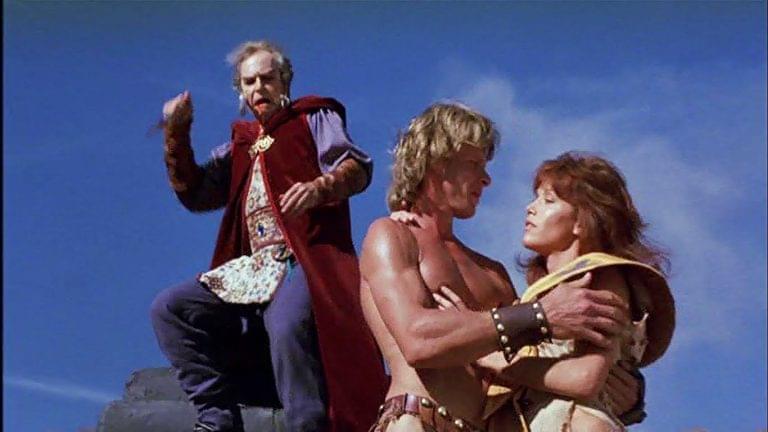
It is no surprise that “The Beastmaster” is goofy and lame, as this is the case with about 95 percent of movies involving swords, wizards, and/or loincloths. A film producer who sees an expenditure for loincloths on his movie’s budget should immediately rethink his investment. What is a surprise is that the film’s real stars are a pair of ferrets, who are smarter and more expressive than the human star and perform more heroic acts than he does. I don’t think any of us saw that coming.

The non-weasel protagonist is named Dar, possibly because this is the sound he utters when asked a difficult question. He is played by Marc Singer, who would later gain notoriety as star of the “V” TV movie and series. Like so many protagonists in so many sword-and-sorcery movies, Dar is beefy, tan, dim-witted, and prone to making unwelcome advances on ladyfolk based on the faulty premise that he is irresistible and charming. In a more enlightened age, Dar and his ilk would be considered sexual predators. But “Beastmaster” is not set in an enlightened age. It’s set in whenever the hell it’s set, like a thousand years ago or something.

We begin with a small coven of hideous witches cackling and making dire proclamations, just as in Shakespeare’s “Macbeth” or ABC’s “The View.” The witches prophesy that the king’s conniving high priest, Maax (Rip Torn), will die at the hand of the king’s son. Maax figures the smart thing to do, then, is to kill the king’s son now, while he has the chance. Only problem: The king’s son is currently residing in the queen’s womb, to which Maax has precious little access.

Maax employs one of his witches to sneak into the royal bedchamber, paralyze the king and queen with a fluorescent green goop, then magically transfer the fetus from the queen’s uterus into a cow’s uterus. Having accomplished that, the witch takes the cow out back and slices it open to remove the baby, which makes you wonder why she didn’t just do that to the queen. For that matter, why not kill the queen AND king, since Maax’s goal is to usurp the throne anyway, and since the royal bedchamber is apparently unguarded and easy to sneak into?

But we can’t waste our time with questions like that or we’ll be here all day. The point is, baby Dar is ripped from the cow’s womb and about to be sacrificed by the witch when he is saved by a passing peasant, who kills the witch using about one-tenth the effort the witch would have needed to kill the royal family in the first place. Honestly, with the incompetence and inefficiency of these evil minions it’s a wonder any thrones ever get usurped. The peasant takes the baby back to his poor village and raises him as a son, taking care to teach him the fine arts of sword-waving and loincloth-wearing.

Back in the city, I don’t know what Maax thinks happened. All he knows is that the queen isn’t pregnant anymore and one of his hags is missing, which sounds like the plot from a “Lord of the Rings” After School Special. At any rate, years pass, and Dar grows up into Marc Singer, and Maax — who has now successfully usurped the throne and imprisoned the king — coincidentally sends his death squad to Dar’s village to slaughter everyone. Dar survives the attack and vows revenge on Maax, unaware that he has other reasons for hating Maax, too, i.e., his forced migration from womb to womb while in utero.

Dar goes off into the wilderness to “train,” which means standing on hilltops and swinging a sword around. He also works on his beast-mastering abilities — it would seem that his brief stint in a bovine uterus has given Dar the power to communicate telepathically with animals. Well, sometimes telepathically, and sometimes vocally, as when he caws to an eagle in what is apparently the eagle’s native tongue, though it sounds to me like he’s just doing a parody of an eagle’s caw in a way that would probably be offensive to real eagles. And Dar doesn’t just communicate with animals, either. The animals OBEY him. That’s why he’s the Beastmaster.

So Dar spends a lot of time master-beasting. In addition to the eagle, he beast-masters a black tiger and a couple of ferrets. He meets these ferrets when they steal his leather loincloth belt, and he pursues them through the woods and falls into some quicksand, whereupon the ferrets rescue him, and one of the ferrets falls into the quicksand in the process, and Dar almost forgets to save it, because Dar the beastmaster is an ungrateful bastard-master.

He next uses his tiger friend in a ploy to frighten a young maiden he finds bathing topless in a lake. Dar “rescues” her from the fierce beast, then kisses her without permission, then is upset when she martial-arts him to the ground and puts her knee to his throat. “I am no danger to you!” he cries, which is more or less what most sexual predators say (or so I understand). The woman’s name is Kiri (Tanya Roberts), and she says she’s a slave belonging to Maax, and that if she doesn’t return home from her topless bathing, Maax will kill her family. This gives Dar even MORE reason to defeat Maax. You start to wish the movie would quit piling up motivations for Dar and just let him get on with the overthrowing.

But no, instead we get scene after scene of Dar and his beast-mastered beasts just walkin’ around, lookin’ at stuff. I confess that this is not particularly interesting. Dar does not have what you’d call a magnetic personality even under the best of circumstances, and wandering alone through the desert would make anyone seem dull, no matter how much master-beasting they do.

Finally he meets Seth (John Amos, aka the dad from “Good Times”), who was the deposed king’s top adviser, and Tal (Josh Milrad), a young boy who says he’s the king’s son, which means the king and queen had another child after Dar mysteriously vanished from the queen’s womb that fateful night. Seth and Tal team up with Dar to fight Maax, returning to the city just in time to find Maax sacrificing a young child to his pagan gods. This violates an unwritten rule of movies about children not being killed; the fact that “The Beastmaster” was rated PG, despite its healthy serving of boobs, violence, and kinderslaughter, is evidence that the MPAA was just as useless in 1982 as it is now.

Dar is glad to witness one child being sacrificed, but he draws the line at two. As Maax tosses the second one into the fire from atop a pyramid, Dar saves the child! Well, OK, he tells the eagle to do it. But it was totally Dar’s idea! Then there’s a lot of time-wasting and Maax-not-defeating, and the king gets rescued from prison (the queen, presumably dead, is not mentioned). All of this is thanks at least partially to Dar’s efforts, though, again, the animals really did most of the work. The king is blind now (echoes of Shakespeare’s “King Lear”!) and rejects Dar’s help on the grounds that Dar is a beast-mastering freak. “Go crawl down a hole with your animals!” the king says, unaware that the freak he rejects is his own son, which is the kind of irony Shakespeare would have enjoyed, particularly if he was stoned.

Eventually there’s a big fight between Maax’s minions and the townspeople, rallied to rebellion by Seth. Maax kills the king (FINALLY) and has a sword fight with Dar, who wounds Maax but does not bother to kill him because he (Dar) is a giant moron. Naturally, Maax regains his strength when Dar’s back is turned. As he comes at him from behind, one of the ferrets leaps to Dar’s aid, biting Maax on the neck, throwing him off balance, and sending both villain and ferret plummeting into the fiery sacrificial barbecue pit. Dar is very sad at the loss of his ferret friend, and so is the other ferret, who I pictured squeaking “I don’t want to live!” and hurling herself after her mate.

Now, if you were paying attention at the beginning of the movie, you’ll recall that the witches’ prophecy was very specific: Maax would die at the hand of the king’s son. Well, unless the king sired a ferret when we weren’t looking (and goodness knows what sort of things went on in this unspecific land in this unspecified time period), this prophecy has proven to be false. Dar didn’t kill Maax. As usual, Dar didn’t really do anything.

That’s the movie in a nutshell: Dar masters some beasts; accomplishes nothing else; takes credit for everything. If you enjoy films about ineffectual leading men whose accomplishments are largely the result of others’ work, then “The Beastmaster” is definitely a movie that you and your pet ferret will enjoy!

— Film.com

Eric’s Bad Movies: ‘The Beastmaster’ (1982)

22

Quite a few men of a certain age will fondly recall the subject of this week’s edition of Eric’s Bad Movies at Film.com: “The Beastmaster,” a goofy sword-and-sorcery tale from 1982 that was thereafter shown endlessly on cable. I say men because this seems like the kind of movie that guys like and girls ignore, but perhaps there is some crossover.

This will disappoint about five of you, but I’m not going to do the thing anymore where I give clues about what next week’s movie is and you make guesses. One of my New Year’s resolutions is to not give clues about things so that people can guess, and that falls under that category, alas. Just enjoy the delightful surprise each Thursday of finding out for yourself what that week’s movie is!

Silent Light (German/Plautdietsch)

0

I feel bad for the poor souls who saw “Silent Light” without knowing anything about it first and came away hating it. They were probably expecting a movie that was, well, normal. You know, with a plot and stuff. A movie where things happen.

“Silent Light” is not that kind of movie. It is exceptionally slow and deliberate, with long, unbroken takes that often contain very little action at all. A man drives his truck away from his farmhouse and down a long dirt road to the highway — and we don’t cut away to another scene until the truck is a speck in the distance. Thirty seconds of watching a truck drive away, where a more conventional movie would have cut the shot after three or four seconds.

I explain all this up front because I think it’s crucial you understand what sort of evening you’re in for if you choose to watch “Silent Light.” If a very slow, 127-minute-long movie containing a plot that could be told in 10 minutes sounds unappealing to you, then by all means, skip it. No one will think less of you.

But if you can sometimes be caught up in the world of a well-crafted movie and enjoy the way it feels as opposed to the story it tells, then you may find it rewarding. Personally, I loved it. Some of the cinematography is breathtakingly beautiful, and there are moments of intense emotion that absolutely would not have worked in a “faster” movie. Certain things require more time and patience to be effective.

Written and director by Mexico’s Carlos Reygadas (“Battle in Heaven”), the film is set in a Mennonite community in northern Mexico, where a dialect of German known as Plautdietsch is spoken. (It is reportedly the first movie ever filmed in that language.) Johan (Cornelio Wall), his wife Esther (Miriam Toews), and their numerous young children live a simple life on a small dairy farm. Their world is full of silence and calm, but there is turmoil in Johan’s soul: He is cheating on Esther with a woman named Marianne (Maria Pankratz).

Johan has told Esther about the affair and has evidently tried to break it off, but the flesh is weak. He tells his friend Zacarias (Jacobo Klassen) that he loves both women. Certainly Marianne is no younger or prettier than Esther; Johan isn’t just having a midlife crisis here. His feelings are deep. Zacarias says maybe it’s his destiny to be caught in the middle like this, but Johan rejects that. “A brave man makes his destiny with what he’s got,” he says.

Johan’s father — likewise a taciturn, old-world fellow, and a Mennonite preacher — says it’s the devil’s work. His point of view is rather the opposite of Johan’s. Where the son believes he can make his own destiny, the father says, “It was all written beforehand.”

And that is the scenario. When the surprises come later in the story — truly unforeseeable, even baffling, events — they occur as methodically and plainly as everything else; nothing in the film is ever underlined or emphasized. The camera is frequently in motion, but always slowly, carefully, like an omniscient being. It is as unrushed as the characters.

And I think that gets at what Reygadas had in mind, and why he shot the film this way, with so much silence and apparent uneventfulness. The opening shot is an impossibly glorious sunrise, captured more or less in real time by cinematographer Alexis Zabe (who generally uses only natural lighting, too, as befits the Mennonites’ simple lifestyle). The shot is long and quiet, perfectly setting the tone for the film. We are meant to be drawn in to this peaceful little world, to feel what the characters feel, to view the world the way they do.

In that way, though the film is certainly slow, I don’t think it’s boring. “Boring,” to me, is when a filmmaker thinks he has made something interesting but in fact has not. In this case, Reygadas has clearly told the story a certain way on purpose — if it is “boring,” it is intentionally that way. Ideally, if the film is effective (as it was for me), we are happy to enjoy the silences, to meditate on the striking visual images, and to share in the thoughts of the characters. It’s not so much a movie as an experience.

Go ruin someone else’s pizza!

16

I snapped a photo of this sign posted on the door at The Huddle, a sports bar near my apartment:

Sorry, 1980s Domino’s Pizza advertising mascot! You’ll have to drink and watch football somewhere else!

Monday things that aren’t ‘Snide Remarks’

6

Apparently I didn’t write a “Snide Remarks” column this week. Huh! Weird.

But last week’s edition of Eric’s Bad Movies at Film.com got lost in the New Year’s Day shuffle, so perhaps you overlooked it. It is “Xanadu,” which is one of those movies that a lot of people love because it’s terrible, which seems like a strange reason to love something, but whatever.

Also at Film.com is Eric’s Time Capsule, which today addresses “Cabin Boy,” released 15 years ago this week. Isn’t it crazy that 1994 is now “15 years ago”?? It’s hard to believe, but math doesn’t lie.

Winter TV premiere dates

12

Here is a list of season premiere dates for your winter TV shows, followed by a list of when the shows that premiered in the fall will return from their winter hiatuses with new episodes. All information is swiped from E! Online’s handy schedule; omissions or errors should be addressed to the good people at E! Online, not me. An asterisk indicates a new series.

SEASON/SERIES PREMIERES:

Monday, Jan. 5
The Bachelor (ABC)
Secret Life of the American Teenager (ABC Family)
*True Beauty (ABC)

Tuesday, Jan. 6
The Biggest Loser: Couples (NBC)
Scrubs (ABC)
Nip/Tuck (FX)

Wednesday, Jan. 7
*13: The Fear Is Real (CW)
Damages (FX)

Friday, Jan. 9
*Flashpoint (CBS)

Sunday, Jan. 11
24 (Fox — 2-hour premiere; 2 more hours on Monday, the show’s regular night)

A Real Hotel for Dogs Would Pose Numerous Logistical Problems

0
A Real Hotel for Dogs Would Pose Numerous Logistical Problems

Look, I can suspend my disbelief as much as the next guy, but I am having a seriously hard time accepting the concept of the new DreamWorks/Nickelodeon movie “Hotel for Dogs.”

A hotel for dogs??! Now I’ve heard everything!

First of all, I question the need for such a thing. Dogs generally don’t do a lot of traveling. They usually stick pretty close to home. Sure, you have the occasional “Incredible Journey”-type story, where a dog is walking across the country to find its owner, and I’m sure pooches in that situation would be grateful for a hotel to stay in. But are there really enough dogs making journeys like that to support an entire industry? Whoever is behind this “hotel for dogs” ought to do some more number-crunching.

But for the sake of argument, let’s say there is a demand for a dog hotel. How on earth do these hoteliers expect a dog to pay for a room? The vast majority of dogs are unemployed and have no steady source of income, let alone disposable income to be used on luxury items such as travel and leisure. And it’s just as well that they don’t, considering they don’t have pockets and would have no place to keep their money.

So presumably the “hotel for dogs” will operate on some sort of barter system. A guest of the hotel will bring something the hotelier wants, and he or she will trade it for a room. This seems reasonable. But there are still many logistical problems to work out.

See also:

Movie review: “Hotel for Dogs” (2009) B-

For example, how will the dogs access their individual rooms? As mentioned, dogs don’t have pockets, so they’d be unable to keep track of room keys — and that’s aside from the fact that a dog, lacking opposable thumbs, would find it difficult to operate a key anyway. And it would be inadvisable to simply let the dogs all sleep together in one big common room, as the mixing of breeds and temperaments could lead to disaster. There’s also the matter of un-neutered and un-spayed dogs mingling with fixed ones. Not that it’s a hotel’s responsibility to promote safe sexual behavior among its guests, but surely putting everyone together in one big room is just asking for trouble.

Would only housebroken dogs be permitted to stay at this hotel? And how would the hotel verify such a thing? For that matter, even if housebroken dogs are the only guests allowed, who will let them out to do their business?

If all these problems can be worked out, though, then a hotel for dogs might be just what Fido needs. Room service would consist of table scraps, accompanied by bowls of toilet water. Each room could be furnished with garbage already strewn across the floor for guests to roll around in. The TVs could all be old black-and-white models (since dogs don’t see in color anyway), and would only need to be tuned to Animal Planet. That would save on costs right there.

But no, I’m sorry, I just can’t get past some of the obvious flaws in the plan. Is this “hotel for dogs” owned and operated by other dogs, or by humans? If it’s dogs, that opens a whole other set of problems, not the least of which is applying for a business license. Dogs have only a rudimentary grasp of the English language and cannot write at all, so I don’t see this ever getting off the ground. Sorry, “Hotel for Dogs,” but I’m not buyin’ it.

— Film.com

Xanadu

0
Xanadu

The 1980 musical/romance/fantasy/trainwreck “Xanadu” is now famous primarily for being one of the few films to start with “X,” which is very handy if you’re playing Scattergories. But when the film was made, it was notable for being Olivia Newton-John’s follow-up to “Grease,” and it was intended to help her break out as a big-time actress.

This was a foolhardy plan, of course, given that Olivia Newton-John, for all her charms, cannot, as it turns out, act. She’d managed to get famous when “Grease” was a hit, but she should have quit while she was ahead. Plunging forward with another starring vehicle was like pulling off a bank robbery by sheer luck and then, as an encore, trying to burglarize the Batcave.

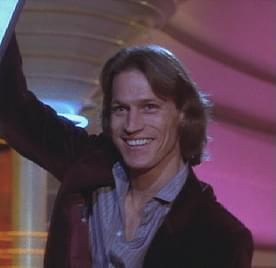
In “Xanadu,” Newton-John plays one of the nine Muses of Greek mythology — Terpsichore, Muse of dance, specifically, though her friends call her Kira. She and her eight sisters live in a mural in a Los Angeles barrio (duh!), and she’s awakened when a struggling artist named Sonny (Michael Beck) gets frustrated, tears up a sketch he’s been working on, and throws the pieces out the window. Why an artist’s torn-up sketch would conjure the Muse of dance, I cannot say. But you will recall that this is more or less the same way Mary Poppins was summoned by Jane and Michael Banks. I don’t want to encourage littering, but it would seem to be an excellent method of contacting supernatural women.

Why

Sonny, the artist, is a skinny, feather-haired, horse-faced young fellow, a slightly more feminine version of Ann Coulter. The movie insists he is a real ladies’ man, which is one of the sure signs you’re dealing with a bad movie, i.e., when it tries to convince you of something that is obviously untrue. Sonny used to work for a record label, but he quit to go freelance; now, his options having dried up, he is going back to work for The Man. “Oh, what the hell,” he says, in the first dialogue of the movie. “Guys like me shouldn’t dream anyway.” He’s right, of course — the dreams of skinny, feather-haired, horse-faced young fellows rarely come true, Sarah Jessica Parker notwithstanding.

So Sonny returns to AirFlo Records, immediately starts arguing with his boss (who has the nerve to expect productivity from him), works for approximately 12 seconds, then leaves to go look for the woman who appears as a model on an album cover and who also roller-skated past him in the park this morning and kissed him. She is Kira, of course, and Sonny finds her hanging around an abandoned theater, where she roller-skates a lot. She wears roller skates most places she goes. Sonny does too, sometimes. The movie thinks there is nothing more interesting than watching people roller-skate, especially if it is accompanied by songs by Electric Light Orchestra. Of the film’s 95 minutes, I would estimate that roller-skating is the primary focus of 93 of them. Even Gene Kelly roller-skates at one point!

Oh, did I forget to mention that legendary Hollywood icon Gene Kelly appears in this film, and that it was the last movie he ever made? I’m sorry if that depresses you. Imagine how it must have made Gene Kelly feel. He plays Danny McGuire, a former big-band clarinetist who now occupies his time sitting on the beach and playing the clarinet for no one in particular, which, let’s be honest, is probably really annoying to his fellow beach-goers, I don’t care if he is Gene Kelly. He meets Sonny, and somehow the two of them decide to open a nightclub together, either in the old 1940s style that Danny remembers, or in the modern rock ‘n’ roll style that Sonny likes. We see fantasy musical numbers involving both concepts, and the movie doesn’t tell us which one they’ve decided on. When the club finally opens, at the end of the film, it turns out to be more of a roller-disco, and it has mimes who juggle bowling pins — so I guess instead of going with Danny’s idea or Sonny’s idea, they went with Satan’s idea. A reasonable compromise, you’ll agree.

But I have roller-skated ahead of myself! Gene Kelly gets to dance in one major sequence, set to an old-timey big-band song, joined by Olivia Newton-John, whom you can ignore by taping a piece of paper over the right half of your TV screen. Kelly is genuinely charming. It is the one legitimately enjoyable part of the film, like a single rose blooming in the middle of an oil-rig fire.

By opening the new nightclub, called Xanadu, Sonny is at last realizing his dream. Earlier we thought his dream was to be a successful artist, but apparently it was actually to open a nightclub. The movie was just kidding about the artist thing. That “Xanadu,” such a prankster! His dream now fulfilled (at least until he changes it to something else), Sonny angrily quits his job at the record label again, where he’s toiled for about five minutes combined ever since he came back. “I’ve worked like a dog!” he shouts at his boss, using the expression in its literal sense to mean that he has worked like an animal that never does any work.

But Sonny’s happiness is not complete yet. There’s still the matter of his being in love with a mythological figure, which is problematic insofar as Kira is immortal and ageless and Sonny will have to be put down the first time he breaks a leg. Kira confesses her true identity to him and heads back to the electric-hued limbo-land where she and her sisters live, pursued by Sonny, who enters the magical realm by running at top speed into the brick wall on which the mural is painted. Why this works for him when it never does for Wile E. Coyote is not clear.

Once inside the Acropolis, or Valhalla, or Purgatory, or wherever it is that the Greek gods chill, Sonny makes an impassioned plea for Kira to return to Earth and be his girlfriend, even though it is against the rules for immortals to mingle with mortals. Kira responds by singing a song, I think. I sort of lost interest here. Zeus and Mrs. Zeus, represented by disembodied voices in order to avoid protests and death threats from the hardcore Greek polytheists who consider visual depictions of the gods blasphemous, decide to send Kira back to Earth, and they all live roller-skatingly ever after.

Note: If you’re wondering whether the director of “Xanadu,” Robert Greenwald, also directed the Farrah Fawcett made-for-TV movie “The Burning Bed” or the salacious ’70s TV films “Katie: Portrait of a Centerfold” and “Sharon: Portrait of a Mistress” or the hilariously titled 1979 flick “Flatbed Annie & Sweetiepie: Lady Truckers,” the answer is yes.

— Film.com

Defiance

0

Every year, Hollywood produces about a dozen movies about Nazis, and every year there’s one that stands out as being the one that you can just disregard altogether. This year those honors go to “Defiance,” an unengaging, emotionally distant drama from socially conscious director Edward Zwick.

Having already addressed racism, war, poverty, and whatever “Legends of the Fall” was about in such films as “Glory,” “Courage Under Fire,” “The Last Samurai,” and “Legends of the Fall,” it was probably only a matter of time before Zwick took a run at the Holocaust. Here, co-writing the screenplay with Clayton Frohman from a book by Nechama Tec, Zwick tells the true story of the Bielski brothers, Belarussian Jews who helped save a large group of fellow-sufferers by hiding in the forest during World War II. Perhaps befitting the bleak setting, Zwick’s film is cold and unsubtle.

The two oldest Bielski brothers are Tuvia (Daniel Craig) and Zus (Liev Schreiber), the former struggling to cling to his decency and humanity despite the Nazis’ atrocities against his family, the latter having long since given up and now eager to kill whoever (in his view) needs killing. The other Bielskis are Asael (Jamie Bell) and Aaron (George MacKay), the latter a young teen in poor health at the film’s outset.

With Tuvia as the de facto leader, the Bielskis convince a small group of Jews to hide with them, reasoning that if they wait in the ghettos, the Nazis will simply kill them. Zus wants to keep their numbers small, owing to the scarcity of food and supplies, but it’s hard to say no when a new squad of ragtag Jews comes straggling by.

Much of the film is devoted to the power struggle between the saintly Tuvia and the vengeance-minded Zus, who have very different ideas of how best to survive. Zus aligns himself with a squad of Russian soldiers, on the assumption that his enemy’s enemy is his friend, and prepares for armed combat, while Tuvia tries to maintain order back in the forest as winter approaches.

I have no quarrel with the performances from Craig, Schreiber, or Bell — all three do the best they can with what they’re given. The problem is the screenplay, which has weak, unforceful dialogue and tends to substitute dramatic events for characterization. Beyond the loose descriptions I’ve given, it’s hard to say what any of the men are like as people; they’re defined only by what happens to them. This is mediocre World War II storytelling at its mediocrest.

The Best and Worst Movies of 2008

0
The Best and Worst Movies of 2008

As 2008 gets taken off the Current Events shelf and moved to History, let us contemplate the seismic changes the year has brought us. The United States elected its first black president. The economy took its worst turn in decades. A stripper won a screenwriting Oscar. And a movie about a rubber-clad sadomasochist earned $531 million.

It was a strange year, both in the movies and in real life. “The Dark Knight,” the most popular film of the year (and the second-highest-grossing film in history), also happened to be one of the year’s best, a confluence that’s rarer than you’d think. Comic book movies got darker and smarter, animated films got ever more complex, senior citizens Rambo and Indiana Jones both came out of retirement, New York got destroyed a few times, and several films managed to be huge hits based on — get this! — predominantly female audiences. What a country!

I reviewed 241 of 2008’s theatrical releases and watched but didn’t review (mostly at festivals) another 43 new films. Of the ones I reviewed, 136, or 56%, got a grade of B- or better. That’s pretty good, don’t you think? To enjoy your job more than half the time? Heck, some of those C+ and C movies have their entertaining moments, too. For that matter, even the D and F movies, while excruciating to watch, are fun to write about. I guess my point is that this is a sweet gig, all things considered. The pay isn’t great, but you get to see some pretty cool stuff.

The Best Movies of 2008:

1. “WALL-E” Pixar’s computer-animated tales have always been marvels of smart, efficient storytelling, filled with unfailingly engaging characters — even when, as in this case, they aren’t human (they’re not even biological), and they barely speak. It’s strange to be brought to tears by a romance between two robots, but here we are. When WALL-E and Eve hold hands, everything else about the movie — its sublime pop-culture references, its sophisticated sight gags, its subtle satire — is almost beside the point.

2. “Synecdoche, New York” Charlie Kaufman once wrote a movie about people climbing inside John Malkovich’s head. I know I’m not the first person to say this, but I’d really like to spend a few minutes inside Kaufman’s. What must it be like in there? Does it resemble the surreal, wistful, hilarious, multi-layered, brilliantly constructed story of “Synecdoche, New York”? Would I make it out with my sanity intact? At any rate, his directorial debut is wonderfully bizarre, and the rare film that truly rewards repeat viewing.

3. “Dear Zachary: A Letter to a Son About His Father” Kurt Kuenne’s documentary about his slain friend is part tribute, part true-crime story, and part scathing indictment. What I remember most, though, is the ennobling story of the murdered man’s saintly parents. Their grief is unimaginable — you really need to see the film to learn the extent of their suffering — but their continued faith and decency are inspiring. Kuenne makes no effort to be fair or even-handed, nor is it a requirement that a documentary do so. This one is raw, personal, and completely unforgettable.

4. “Son of Rambow” This delightfully mischievous English comedy, about two young boys setting out to film their own “Rambo” movie, got very little attention stateside, and only a cursory DVD release that has now rendered it hard to find. Yet “Mamma Mia!” sits on every Blockbuster shelf in the country. Where is the justice?

5. “The Wrestler” Mickey Rourke’s comeback does not interest me. What interests me is his honest, unself-conscious performance in this sweetly affecting film about a washed-up pro wrestler trying to make sense of his life outside the ring. Darren Aronofsky, whose films have tended toward the artsy and abstract in the past, brings it down to earth here, and the result is something beautiful and moving.

6. “Tropic Thunder” I’m in awe at the sheer number of gags in this pitch-perfect Hollywood satire, and at the different types of humor employed, and at how well-oiled the whole machinery is. The director’s cut on the DVD adds about 13 minutes to what was already an excellent film, and actually improves it in the process.

7. “Young@Heart” A documentary about a chorus of senior citizens who sing rock songs could have been full of “look at the silly old people” jokes. Instead, this British production about the Massachusetts-based Young@Heart Chorus is joyous and uplifting, brimming with vital oldsters you’ll want to adopt as grandparents. It has something to say about the power of music, too.

8. “The Dark Knight” Hells yeah it’s too long. WHAT ARE YOU GONNA DO ABOUT IT?? Heath Ledger’s performance transforms every scene he’s in, and the rest of the film is a treasure trove of popcorn thrills, heady socio-political ideas, and good old-fashioned superheroism. The film raises the bar on comic book movies to a ridiculously high level.

9. “Cloverfield” If the shaky camera makes you queasy, you’re excused. For the rest of us, it’s a scarily effective technique for bringing us directly into the action. The ebb and flow of the story — intense thrills, quiet regrouping, more intensity — holds up nicely on repeat viewings. It’s also pretty amazing from a technical standpoint.

10. “Boy A” This melancholy story about a young man released from prison after serving 10 years for a crime he committed as a child is bolstered by Andrew Garfield’s heartbreaking, award-winning performance. It’s the stuff of high drama, and it asks some tough questions about forgiveness and second chances — like, for example, do such things really exist?

Honorable Mentions:

11. “American Teen”
12. “The Promotion”
13. “Rachel Getting Married”
14. “Hamlet 2”
15. “Doubt”
16. “Let the Right One In”
17. “Frozen River”
18. “Funny Games”
19. “Snow Angels”
20. “The Signal”

The Worst Movies of 2008:

1. “Witless Protection” It’s easy to say Larry the Cable Guy is a one-trick hack who appeals to the dumbest class of moviegoer. Easy, and also true.

2. “Disaster Movie” and “Meet the Spartans” Jason Friedberg and Aaron Seltzer, the talentless, incompetent boobs who write and direct these “spoof” films, are to comedy what barnacles are to a boat: prolific, irritating, and hard to get rid of.

3. “College Road Trip” Martin Lawrence’s reign of terror continues unabated.

4. “Made of Honor” It’s one of those “chick flicks” — you know, comedies where every single female character is dumb, fat, angry, or one-dimensional, and where the final message is that the man should get whatever he wants. You go, girls!

5. “College” It was a total box-office flop, but I saw it. Now I cannot unsee it. In fact, I saw it back-to-back with “Disaster Movie.” That was not a good day.

6. “Welcome Home Roscoe Jenkins” Two Martin Lawrence films in one year? Which deity did we provoke, and how do we appease him?

7. “Chapter 27” Jared Leto put on 50 pounds and a hilarious accent to play the man who killed John Lennon. Because really, wouldn’t you love to spend 90 minutes with a delusional assassin?

8. “Star Wars: The Clone Wars” At this point, George Lucas is actively trying to enrage and alienate his fan base.

9. “First Sunday” As if Tyler Perry weren’t bad enough, now there are Tyler Perry rip-offs.

10. “Mamma Mia!” Picture a barn full of braying donkeys. Now picture someone trying to make those donkeys bray to the tune of an ABBA song. Now ask one of those donkeys to write a script, too. Whatever the result is, it’s probably better than “Mamma Mia!”

Hollywood’s Shameful Secrets

These are films that are not screened for critics before they open, which is almost always a sign that the studios know they’re bad and want to avoid negative opening-day reviews.

“An American Carol”
“Babylon A.D.”
“Bangkok Dangerous”
“College”
“Doomsday”
“The Eye”
“The Family That Preys”
“The Hottie and the Nottie”
“Igor”
“In the Name of the King: A Dungeon Siege Tale”
“Meet the Browns”
“Meet the Spartans”
“Mirrors”
“My Best Friend’s Girl”
“The Pirates Who Don’t Do Anything: A VeggieTales Movie”
“Rambo”
“Strange Wilderness”
“Superhero Movie”
“Witless Protection”

These secrets are slightly less shameful: They were screened, but not until the night before they opened, sometimes as late as 10 p.m., and sometimes without the press being invited.

“10,000 B.C.” (press)
“Disaster Movie” (press)
“One Missed Call” (press)
“Prom Night” (no press)
“Quarantine” (no press — in fact, critics were specifically told there wasn’t a screening — a lie, obviously — and the person running the screening was told that if any critics showed up, under no circumstances should they be allowed to see the film.)
“The Ruins” (no press)
“Shutter” (press)

Finally, these films were screened in some markets but not in others. I guess the studios are only ashamed of them in some regions.

“Be Kind Rewind”
“Nothing Like the Holidays”
“Soul Men”

Miscellaneous data:

Longest movie: Steven Soderbergh’s Che Guevara biopic “Che” (review to come), at 257 minutes — unless the two halves are counted as separate films, in which case the longest is a tie between “The Curious Case of Benjamin Button” and “Australia,” both at 165 minutes.

Shortest movie: “Wendy and Lucy,” 80 minutes.

Most enjoyable bad movie: “Punisher: War Zone”

Least enjoyable good movie: “Dear Zachary: A Letter to a Son About His Father”

Longest title: “The Pirates Who Don’t Do Anything: A VeggieTales Movie”

Shortest title: (tie) “W.” and “21”

Movies whose titles have no obvious connection to the content: “Cloverfield,” “Definitely, Maybe,” “Yeast,” “Snow Angels,” “The Fall,” “Kabluey,” “Made of Honor” (at least not with that spelling), “Quantum of Solace” (Quantum is the name of a sinister organization in the film, but what does “Quantum of Solace” have to do with anything?)

Movies that would like to introduce you: “Meet the Browns,” “Meet Dave,” “Meet the Spartans”

Movies in which someone beats a guy to death by bashing him in the head with a rock repeatedly: “Falling,” “Rambo”

Movies about teenagers who participate in a secret competition, the time and location of which they learn about at the last minute via text message, where the final round winds up taking place outdoors instead of inside: “Step Up 2 the Streets,” “Never Back Down”

Movies about heists and robberies: “Mad Money,” “Flawless,” “The Bank Job”

Steve Carell movies in which someone’s forehead gets stapled: “Horton Hears a Who!,” “Get Smart”

Movies in which an odd couple is forced to live together and one of them pees in the sink: “Baby Mama,” “What Happens in Vegas”

Movies about college professors who have lost interest in teaching: “Smart People,” “The Visitor”

Movies in which a man receives a very expensive watch as a gift, and then sells it: “Redbelt,” “Priceless”

Movies about unskilled martial-arts enthusiasts who are brought into the world of fighting: “Kung Fu Panda,” “The Forbidden Kingdom”

Movies set in Lebanese-owned beauty salons: “Caramel,” “You Don’t Mess with the Zohan”

Movies about people tormented in their vacation homes: “The Strangers,” “Funny Games”

Movies in which plants try to kill people: “The Ruins,” “The Happening,” “Journey to the Center of the Earth,” “Hellboy II: The Golden Army,” “Space Chimps” (OK, plants try to kill chimps)

Movies in which someone successfully impersonates a substitute school teacher: “Drillbit Taylor,” “Meet Dave”

Movies about girls trying to figure out which of three possible choices is their parent: “Definitely, Maybe,” “Mamma Mia!”

Chick flicks with scenes set on gorgeous Greek islands: “Mamma Mia!,” “The Sisterhood of the Traveling Pants 2”

Comedies in which children are beaten up by adults: “The Foot Fist Way,” “Step Brothers,” “Tropic Thunder,” “Four Christmases”

Movies in which Ben Kingsley makes out with a woman far too young for him who has a big head on a tiny stick-figure body: “The Wackness” (Mary-Kate Olsen), “Elegy” (Penelope Cruz)

Movies in which Catherine Keener plays the hilariously unsupportive wife of a hapless theater director: “Hamlet 2,” “Synecdoche, New York”

Movies with references to “Lawrence of a Labia” as a porno title: “Zack and Miri Make a Porno,” “My Best Friend’s Girl”

Movies in which a bomb is planted in a musical instrument and set to go off when a certain note is played, as part of an assassination attempt: “Get Smart,” “Eagle Eye”

Movies produced by Walden Media that are set primarily in subterranean worlds: “Journey to the Center of the Earth,” “City of Ember”

Movies in which the main characters have Eastern European landlords: “How to Lose Friends & Alienate People,” “Eagle Eye”

Movies with hasty baptisms: “The Family That Preys,” “The Haunting of Molly Hartley”

Movies in which chimpanzees attempt to repair an aircraft: “Space Chimps,” “Madagascar: Escape 2 Africa”

Movies in which the main characters attend a performance of the opera”Tosca”: “Quantum of Solace,” “Milk”

Movies about Jason Statham having to drive a car really fast in order to gain his freedom: “Death Race,” “Transporter 3”

Movies about controversial political figures of the 1970s whose careers ended early: “Frost/Nixon,” “Milk”

Ultra-violent movies featuring villains named Jigsaw: “Saw V,” “Punisher: War Zone”

Movies in which the girl impresses the boy by solving a Rubik’s Cube: “WALL-E,” “Let the Right One In”

Movies about lost dogs: “Bolt,” “Wendy and Lucy,” “Beverly Hills Chihuahua” (Extra credit to “Marley & Me” for being about a dog that manages to only get lost for a couple minutes.)

Movies about Hollywood actors finding themselves in situations similar to the ones they portray in their movies: “Tropic Thunder,” “JCVD”

English films about timid young boys who are befriended by troublemakers: “Boy A,” “Son of Rambow”

Movies that consist mainly of a guy telling bedtime stories to children, with the imaginary roles played by people from their lives: “The Fall,” “Bedtime Stories”

Directors who released two films this year: Woody Allen (“Cassandra’s Dream,” “Vicky Cristina Barcelona”) Clint Eastwood (“Changeling,” “Gran Torino”), Jason Friedberg & Aaron Seltzer (“Meet the Spartans,” “Disaster Movie”)

* * * * *

Past Best & Worst Lists.

Media Inventory: What I Watched and Read in 2008

0
Media Inventory: What I Watched and Read in 2008

For the fifth consecutive year, I kept careful track of everything I watched and read. As always, this inventory may not be of interest to anyone other than me, and you are excused if you don’t want to read it. For the rest of you, it will be like being granted access to my diary! A really boring diary that only lists names of movies, TV shows, and books!

MOVIES

I watched more movies this year than ever before: 430. Saints preserve us, 430! What’s especially alarming is that there were 107 days where I didn’t watch anything. All the film festivals, where you see four or five or six films a days, really add up. I added Toronto to my roster of festivals this year, too, which definitely boosted the tally.

I launched two new weekly columns at Film.com this year, Eric’s Bad Movies and Eric’s Time Capsule. The former requires me to watch awful films (but write amusing things about them), while the latter gives me an excuse to watch films that interest me that I haven’t seen before. Of the 75 new-to-me pre-2008 movies I watched this year, 42 of them were for Eric’s Bad Movies or Eric’s Time Capsule — which means I was getting paid for it. Getting paid is definitely the way to go when it comes to watching movies, especially if one of them is “Bio-Dome.”

I got on a Disney kick for a while, watching some of the classic and recent animated films, including a few (like “The Aristocats”) that I’d never actually seen before, at least not that I remembered. I went through a Hitchcock phase, too, watching (or re-watching) classics like “Vertigo,” “Notorious,” and “The 39 Steps.” I even caught a few silent films, including “Nosferatu” and “Battleship Potemkin,” both of which are required viewing for students of film history and are actually kind of fun anyway.

One of the most useful tools for me this year was Netflix, and in particular its improved functionality for letting you skip the DVDs altogether and watch movies over the Internet. Up until the end of the year, this feature wasn’t available on Macs, and I don’t like watching movies on my computer anyway. But I fell in love with a new device called Roku, which streams Netflix’s on-demand movies straight to your TV, skipping both the DVD and the computer. The Roku box costs $99, and beyond that there are no fees — as long as you have a Netflix account, you can watch as much stuff as you want, for free. Only about 10% of Netflix’s offerings are available this way (they’re adding titles as fast as they can get the copyright holders onboard), but I still found quite a few things I wanted to watch: “Rushmore,” “Team America: World Police,” “Eternal Sunshine of the Spotless Mind,” “The Jerk,” “Young Frankenstein,” and a vast assortment of older films. The new Xbox 360 has this functionality, too, as do the TiVo HD DVR and a couple of LG and Samsung Blu-Ray players. All you need is a Netflix account and you’re set.

I haven’t upgraded to Blu-Ray yet, and probably won’t for a while. The players and discs are still unjustifiably expensive, and while the enhanced picture quality is noticeable, it’s not so great that I feel like a savage watching regular DVDs. (If the difference in quality were as significant as it was between VHS and DVD, I’d make the leap.) Furthermore, as Roku and other on-demand services flourish, it seems likely that all discs, DVD or Blu-Ray, are going to become obsolete anyway. Right now Netflix’s streaming services aren’t in high-definition, nor do they offer the bonus features that DVDs do. But once those hurdles are overcome — and you better believe the nerds are working night and day to make that happen — there will be as little reason to own a physical copy of a DVD as there is to own a CD. If the content is all digital, and can be stored (or streamed) digitally, why take up space with a shiny disc?

As I have always maintained, the best way to watch movies is with friends and/or loved ones. Even if you’re not talking during the movie (which of course you shouldn’t be, if you’re in public) it’s still rewarding to share the experience with someone. I’m lucky to have colleagues-turned-friends at the film festivals I go to, and it definitely helps prevent the endless movie-watching from becoming a slog.

Watching “The Promotion” at South By Southwest is one of my favorite memories from this year, because every member of my group of friends, myself included, thought it was pants-wettingly funny. Isn’t it great to enjoy something like that with a group? (A second viewing, by myself, confirmed that it was as funny as I’d thought the first time, by the way — it wasn’t just groupthink.) We had a great time with the teen-zombie flick “Dance of the Dead,” too — think John Hughes meets George Romero — going so far as to watch it twice during SXSW. The filmmakers had arranged with the Alamo Drafthouse to fire a cannon of confetti into the audience at a climactic moment in the film, a gimmick that never fails to delight. More movies should do this, just as more movies should punctuate their closing credits with hilarious outtakes. “United 93,” I am looking at you.

(By the way, “United 93” is the new “Schindler’s List” when you want to name a movie that is inappropriate for the context. Please update your templates accordingly.)

I have loved Will Ferrell’s “Anchorman” since it came out in 2004, and fate dictated that I would watch it twice this year. The first time was while visiting friends in Houston, when we were sitting around and felt like, well, we should just watch “Anchorman.” The second time was about a month later, when Portland radio guys Cort and Fatboy were hosting a midnight screening of it. I wouldn’t have bothered with it except that they were showing an actual print from the film’s theatrical release — which meant it would be the original theatrical version, not the “unrated” DVD version, which has extra scenes and changes a few punchlines. I hadn’t seen the original cut since it was in theaters, and I must say it vexes me when films are released on DVD with bonus footage inserted without giving you the option of seeing how it went out originally. This late-night viewing also allowed me to introduce the film to a friend who had NEVER SEEN IT, if you can imagine. Sixty percent of the time, it made him laugh every time.

My 4-year-old niece got “WALL-E” on DVD for Christmas, which naturally meant she needed to watch it two days in a row. I liked this, because it meant I got to watch it two days in a row, too. How many movies are just as delightful to 4-year-olds as they are to 34-year-olds? And I wonder if she would like “Anchorman”?

Other fun movie memories of 2008: Watching “The Birdcage” on a giant inflatable screen, for free, with a friend, in Portland’s Pioneer Square one August night; watching the new “Rambo” and “Let the Right One In” with my old movie-watchin’ buddy Brett in Utah; dragging another friend to see “The Happening” on opening day, then amusing ourselves afterward by doing impressions of the stilted, mannered way all the characters speak; the moment in a serious French drama called “Mark of an Angel,” which I saw at the Toronto fest, where a little girl falls while ice-skating, slides across the ice, and hits her head on the wall, and I thought it was funny, and laughed loudly, and was the only person in the theater to do so; the astonished reaction from the packed theater in Austin when Jason Segel first went full monty in “Forgetting Sarah Marshall”; noting that the two young gentlemen seated in front of me at “Pineapple Express” had obviously, shall we say, gotten into the proper spirit of things beforehand.

2008 releases that I saw and reviewed:
If you want to see the whole list, just go to the Archives and filter the date to only include “2008.”

2008 releases that I saw but did not review:
Sundance Film Festival:
“The Broken”
“Donkey Punch”
“The Escapist”
“Good Dick”
“The Great Buck Howard”
“The Merry Gentleman”
“Phoebe in Wonderland”
“Stranded: I’ve Come from a Plane That Crashed on the Mountains”
“Sugar”
“Timecrimes”

Portland International Film Festival:
“4 Months, 3 Weeks and 2 Days”
“Jar City”
“Paranoid Park”

South By Southwest Film Festival:
“Assassination of a High School President”
“Bama Girl”
“Body of War”
“Bulletproof Salesman”
“Crawford”
“Dance of the Dead” (twice)
“Frontrunners”
“Nights and Weekends”
“Not Your Typical Bigfoot Movie”
“Second Skin”
“Shuttle”
“Southern Gothic”

CineVegas Film Festival:
“Big Heart City”
“Deficit”
“Go Go Tales”
“Memorial Day”
“South of Heaven”

Toronto International Film Festival:
“The Burning Plain”
“The Burrowers”
“Dean Spanley”
“Il Divo”
“Edison & Leo”
“Genova”
“The Mark of an Angel”
“Passchandaele”

Elsewhere:
“America Unchained”
“Futurama: The Beast with a Billion Backs” (direct-to-DVD)
“Futurama: Bender’s Big Score” (direct-to-DVD)
“Momma’s Man”
“Paranormal Activity”
“[REC]”
“The Sinking of Santa Isabel”
“Take”
“Thou Shalt Not: Sex, Sin & Censorship” (TV movie)
“Spielberg on Spielberg” (TV movie)

2008 releases that I watched twice:
“American Teen”
“Boy A”
“Choke”
“Cloverfield”
“The Dark Knight”
“Forgetting Sarah Marshall”
“Hamlet 2”
“The Promotion”
“Rachel Getting Married”
“Redbelt”
“Semi-Pro”
“Slumdog Millionaire”
“Snow Angels”*
“Son of Rambow”*
“Synecdoche, New York”
“Tropic Thunder”
“WALL-E”
“The Wrestler”
“Young@Heart”

*First viewing was in 2007

Pre-2008 releases that I had seen before, and reviewed, that I re-watched this year:
“The 40-Year-Old Virgin”
“Anchorman: The Legend of Ron Burgundy” (twice)
“Batman Begins”
“Batman & Robin”
“The Brothers Solomon”
“Eternal Sunshine of the Spotless Mind”
“Finding Nemo”
“Hercules” (1998)
“Home on the Range”
“The Incredibles”
“Mean Girls”
“Mulan”
“Once”
“The Royal Tenenbaums”
“Team America: World Police”
“Teeth”

Pre-2008 releases that I had seen before but did not review, that I re-watched this year:
“Anaconda”
“Beast of Yucca Flats”*
“The Birdcage”
“Cabin Boy”
“The Deadly Bees”*
“Dumbo”
“Glitter”
“The Hudsucker Proxy”
“The Hunchback of Notre Dame” (1996)
“Indiana Jones and the Last Crusade”
“Inspector Gadget”
“The Jerk”
“Mitchell”*
“Patch Adams”
“The Phantom Planet”*
“Planes, Trains & Automobiles”
“The Projected Man”*
“Puma Man”*
“Raiders of the Lost Ark”
“Raising Arizona”
“Rushmore”
“Santa Claus”*
“The Silence of the Lambs”
“Smiley Face”
“Space Mutiny”*
“Speed 2: Cruise Control”
“Superman IV”
“Umbrellas of Cherbourg”
“Vertigo”
“Werewolf”*
“Young Frankenstein”

*Watched as part of a “Mystery Science Theater 3000” episode

Pre-2008 releases that I saw for the first time this year:
“1941”
“2001: A Space Odyssey”
“The 39 Steps”
“The Adventures of Pluto Nash”
“The African Queen”
“Aguirre, the Wrath of God”
“The Aristocats”
“The Avengers”
“Baby: Secret of the Lost Legend”
“Battleship Potemkin”
“The Beautician and the Beast”
“Beavis and Butt-Head Do America”
“Beverly Hills Cop”
“The Big Lebowski”
“Bio-Dome”
“Breakin’ 2: Electric Boogaloo”
“Cocktail”
“The Day the Earth Stood Still” (1951)
“The Delta Force”
“Ernest Saves Christmas”
“Double Impact”
“Fistful of Dollars”
“From Here to Eternity”
“Funny Games” (1998)
“Grease”
“Grease 2”
“Gymkata”
“Hello, Dolly!”
“High School Musical” (TV movie)
“High School Musical 2” (TV movie)
“Hollywood After Dark”
“Hoop Dreams”
“Howling II: Your Sister Is a Werewolf”
“I Know What You Did Last Summer”
“Indiana Jones and the Temple of Doom” (I know!)
“Jacob’s Ladder”
“Jack Frost” (1998)
“Jaws: The Revenge”
“Julius Caesar” (1953)
“Kazaam”
“Killers from Space”
“Kull the Conqueror”
“The Last Picture Show”
“Leaving Las Vegas”
“Leprechaun”
“Mac and Me”
“The Mangler”
“Manhattan”
“The Man Who Knew Too Much”
“Marty”
“Masters of the Universe”
“Midnight Express”
“Mortal Kombat: Annihilation”
“Mother of Tears”
“My Fair Lady”
“Naked Lunch”
“Nosferatu”
“Notorious”
“Over the Top”
“Peter Pan”
“The Pink Panther”
“The Plow That Broke the Plains”
“Quiet City”
“Ragtime”
“Rambo III”
“Silent Night Deadly Night”
“Soul Man”
“Spice World”
“Staying Alive”
“Super Mario Bros.”
“Suspicion”
“Tarzan, the Ape Man”
“Treasure of the Sierra Madre”
“The Wiz”
“Xanadu”

TELEVISION

My TV watching trends look like the economy: steadily diminishing each of the last few years, and totally bottoming out in 2008. I watched only 281 hours of TV all year, which with TiVo-faciliated commercial-skipping amounts to only about 210 hours of viewing time. That’s barely half an hour in front of the tube per day. In the entire month of June I watched only TEN HOURS of television. Can you imagine?

I did cram a lot in near the end of the year, primarily due to obsessive-compulsiveness. I made the switch to HDTV, which required a new DirecTV satellite and DVR — which meant I really needed to watch everything still sitting on my old DVR. For the first two months that I had HDTV, I mostly ignored it (except for key, must-watch-every-week programs) in favor of watching the old, non-HD shows. I’m pleased to say I finally polished off that old DVR’s stockpile in mid-December, so now I am TRULY in the high-definition world.

Shows I watched regularly (at least 6 episodes) in 2008:

“30 Rock”
“Aliens in America”
“Family Guy”
“Friday Night Lights”
“Fringe”
“Generation Kill”
“Heroes”
“It’s Always Sunny in Philadelphia”
“Law & Order”
“Law & Order: SVU”
“Life on Mars”
“Lost”
“Mad Men”
“The Mentalist”
“The Office”
“Pushing Daisies”
“Reaper”
“Rescue Me”
“Saturday Night Live”
“Scrubs”
“The Shield”
“The Simpsons”
“South Park”
“Tim and Eric Awesome Show Great Job”
“The Whitest Kids U Know”
“Worst Week”

My favorites:

1. “30 Rock” (NBC). I fancy myself something of a wordsmith, and I marvel at the efficiency and compactness of these brilliant, 21-minute scripts. They’re packed!

2. “The Shield” (FX). May it rest in peace. The final season, right up to the jaw-dropping (and satisfying!) finale, was some of the most intense TV I’ve ever seen.

3. “Mad Men” (AMC). Missed it the first time around, so I caught Season 1 on DVD in time to watch Season 2 as it unfolded. What a well-written, well-acted, well-produced drama. Everything you’ve been hearing is true.

4. “Lost” (ABC). “Lost” was on its game this year! Giving themselves a finish line to work toward really lit those writers on fire.

5. “Friday Night Lights” (DirecTV; soon to be repeated on NBC). Decent, noble characters engaged in the dramas of life have seldom been as engrossing and relatable as these folks are. This show is good for your heart.

BOOKS

Hey, what do you know? My TV watching is down, but my reading is up! I read 30 novels this year, helped somewhat by joining a book club that made me read a few I never ever would have finished otherwise. Here’s what I read (links go to Amazon), with titles I particularly recommend starred.

“All Shall Be Well, and All Shall Be Well, and All Manner of Things Shall Be Well,” by Tod Wodicka. I think I liked the title more than anything, though the book was OK, too. It’s about a goofy man who’s obsessed with medieval reenactments and lives his life that way, to the detriment of, well, everything else in his life.

**“An Arsonist’s Guide to Writers’ Homes in New England,” by Brock Clarke. A terrifically funny novel about a hapless young man who accidentally burned down the historic Emily Dickinson house as a teenager, went to prison, and is just now getting out … only to discover that other writers’ homes are being burned down, too, and naturally he’s the prime suspect.

**“The Astonishing Life of Octavian Nothing, Traitor to the Nation, Vol. 1: The Pox Party,” by M.T. Anderson. This might be my favorite of the year. It’s about a young slave boy in Colonial Boston who’s given a top-notch education in literature and language as part of a strange experiment to see if Africans are as intelligent as Europeans. Meanwhile, the Revolutionary War is beginning, and Octavian must figure out where his best chances at true freedom lie. It’s written as if by Octavian himself, in erudite 18th-century vocabulary, which delights me. For some reason it’s classified as “young adult” fiction, but ignore that.

“Atomic Lobster,” by Tim Dorsey. One of those South Florida crime capers with a million characters whose lives all wind up intersecting in hilarious ways. Moderately amusing.

“Be Near Me,” by Andrew O’Hagan. A fairly solid drama about a middle-aged Scottish priest recounting his youthful vigor as compared to his quiet life now, which is interrupted by a pair of delinquent teenagers in his parish.

**“The Book Thief,” by Markus Zusak. Oh, what a poetic and touching novel this is! It’s set in Germany in World War II, and focuses not on the Nazis or the Allies but on a family of regular ol’ Germans, consisting of an orphaned girl and her foster parents. The story is narrated by Death himself, which is an interesting twist, and the goodness and humanity of the tale are heartbreaking.

“Boomsday,” by Christopher Buckley. The author (son of William F. Buckley) is conservative, but ain’t anybody getting off easy in this funny and alarmingly plausible political satire. It’s about a young woman who, as a means of solving the Social Security crisis, satirically suggests the government start paying people to kill themselves when they turn 65, only to have her proposal gain traction as a legitimate option.

“Bowl of Cherries,” by Millard Kaufman. I mostly enjoyed this comi-tragic novel about a teenage prodigy who gets mixed up with a dotty Egyptologist doing experiments in his crumbling mansion, where the prodigy falls in love with the professor’s daughter.

**“The Brief Wondrous Life of Oscar Wao,” by Junot Diaz. This sucker won the Pulitzer, and it’s hard to disagree. It’s about a few generations of a Dominican-American family now living in New Jersey, focusing on the title character, a fat nerd with a big heart. The narrator’s voice is clear and original, telling a story full of humor and heartbreak in an unforgettably stylish way.

“Extra Large Medium,” by Helen Slavin. I’m pretty sure she thought of the title first, then the story. It’s about a woman who sees dead people and has to help them sort out their unfinished business. Could have been a terrific story, but everyone at the book club agreed it’s badly written and desperately in need of an editor. Bleh.

**“Fablehaven: Grip of the Shadow Plague,” by Brandon Mull. Part three in this young adult fantasy series (Harry Potter comparisons are inevitable) is just as fun as the last two. If you haven’t been following along, you should start.

**“Gentlemen of the Road,” by Michael Chabon. My favorite author cranked out this little gem, a 10th-century adventure story about a couple of ne’er-do-wells galloping through the Middle East. The prose is intricately written — you gotta pay attention to Chabon’s long, grammatically impeccable sentences — but it’s worth it, even for an insignificant lark of a story like this one.

“The Girls,” by Lori Lansens. Siamese twins! In Canada!

“Hairstyles of the Damned,” by Joe Meno. I really enjoyed Meno’s “The Boy Detective Fails” but was rather disappointed in this one, a fairly pedestrian comic novel about misfit teenagers that too closely resembles all the other comic novels about misfit teenagers.

**“Hartsburg, U.S.A.,” by David Mizner. A very timely political novel about a small-town school board election. I blogged about it earlier this year.

“Heart Sick,” by Chelsea Cain. It’s set in Portland! And the author lives here! I know her! Well, I met her. Her husband is a local film critic. Anyway, now I’m afraid of her, having seen the dark depths of her imagination in this creepy “Silence of the Lambs”-ish novel about a cop seeking tips on a new serial killer from the now-imprisoned serial killer who once tortured him. One of the victims gets abducted right down the street from my apartment! Which is totally plausible, by the way. I’ve abducted many a teenage girl there myself.

**“Heyday,” by Kurt Andersen. Another one of my favorites of 2008, an epic adventure/romance/comedy set in the 1840s, mostly in New York City. I blogged about it here.

**“I Love You, Beth Cooper,” by Larry Doyle. A loving homage to the cheesy teen comedies of the 1980s. Denis Cooverman is a nerdy high school valedictorian who blurts out the title declaration during his graduation speech. The problem: Beth Cooper is the most popular girl in school, and she barely knows who Denis Cooverman is. The book covers the events of graduation night as Denis and his movie-geek best friend Rich interact with Beth, her friends, her angry coke-head boyfriend, and various other classmates. The details of the story are implausible, and some of the jokes are sitcom-ish. But I laughed out loud many, many times while I read the book, particularly in response to Doyle’s droll descriptions of high school angst and the absurdity of the teenage caste system.

“The Invention of Everything Else,” by Samantha Hunt. This was another book club selection, about scientist Nikola Tesla’s final days in New York City. Many of the historical facts are accurate, while Tesla mingles with fictional characters like a hotel maid whose crazy father is trying to invent a time machine. A pretty good read, overall, addressing the conflicts between fantasy, science, and reality.

**“Last One In,” by Nicholas Kulish. This would make a good companion piece to HBO’s excellent “Generation Kill” miniseries. The book is fictional, but the author drew on his real experiences as a journalist embedded with the U.S. military during the 2003 invasion of Iraq to tell this engrossing, sometimes satirical story. It’s about a shallow gossip columnist who gets sent to Iraq with a Marine convoy; his character arc is standard (he learns what’s really important in life), and Kulish’s occasional dips into “Catch-22”-style wartime satire don’t mesh with the rest of the book’s more earnest tone. But his believable descriptions of Marine culture and the daily routine of waiting in the desert for marching orders are compelling, and his vivid, humane treatment of the characters will give you a new appreciation for the military and perhaps give clarity to the often-vague idea of “supporting the troops.”

“The Midnight Choir,” by Gene Kerrigan. A hard-boiled Irish police procedural novel with some shocking plot twists and vivid characters. Very readable.

**“On Chesil Beach,” by Ian McEwan. Somehow McEwan manages to write an entire novella (albeit a slim one) based primarily on the thoughts and memories of a newlywed couple on their wedding night. Events that take only a few seconds to transpire can be packed with pages and pages of meaning, and McEwan describes them expertly and poetically.

“Out Stealing Horses,” by Per Patterson. I do believe this was the book club’s least favorite selection of the year, a Norwegian novel about an old man recalling his childhood.

**“Rant: The Oral Biography of Buster Casey,” by Chuck Palahniuk. This guy has so many insane ideas, and I love him. This time, it’s about a guy who gets off on being bitten by poisonous creatures, and there’s a rabies epidemic, and there’s a fad called “party crashing” where cars smash into each other, and somehow time travel is involved. Palahniuk lives in Portland, too, and I’m also afraid of him.

**“The Ruins,” by Scott Smith. The movie version was pretty good, but the book — about a small group of Americans trapped by a supernatural menace in Mexico — is even more terrifying and horrific.

**“Slaughterhouse-Five,” by Kurt Vonnegut. I finally got around to reading the novel I was assigned in 12th grade. Me likey.

“Snuff,” by Chuck Palahniuk. More Palahniuk, though this one didn’t grab me as much as “Rant” did. It’s about an aging porn star who wants to break the world record for most partners in one film. It’s pretty filthy, as you might imagine, and it lacks some of the narrative deftness of Palahniuk’s other stuff.

**“The Testament of Gideon Mack,” by James Robertson. An enthralling account of religious faith and doubt, about a disbelieving Scottish minister who changes his tune after he meets the Devil — the actual, honest-to-goodness Devil.

“Travel Writing,” by Peter Ferry. This one, about a writer who becomes obsessed with a woman after he witnesses her car-crash death, never really grabbed me. Too many diversions from what I thought were the more interesting elements of the story.

**“Watchmen,” by Alan Moore and Dave Gibbons. Yep, the graphic novel. I hadn’t read it before, and there’s (hopefully) a movie coming out. Turns out it’s pretty fantastic stuff. I can see why so many people, even non-nerds, love it.


Monday’s items of interest

2

The final “Snide Remarks” of 2008 is, as is customary, a clip show featuring my favorite parts of all of this year’s columns. So put on your reminiscing hat!

Eric’s Time Capsule at Film.com is off this week, but I forgot to tell you about last week’s, which was “Naked Lunch,” so maybe you can read that now if you’re not doing anything else.

Finally, this item at Cinematical — The Worst MPAA Ratings of 2008 — might hold your attention for a few minutes, especially if you often find yourself thinking that a particular R-rated film should have been PG-13, or vice versa. Or maybe you were one of the millions who walked out of “Prince Caspian” thinking, “Holy crap, how did that only get a PG?!” The MPAA ratings board is such a failure that if they were to rate themselves, they’d get an NC-17 for “pervasive failure, and some smoking.”

This week’s “Snide Remarks,” including the audio version, is here.
The audio version (i.e., the podcast) is also here.
Subscribe to the podcast’s feed with this URL.

The Best of ‘Snide Remarks’: 2008

0

In the spirit of laziness that seizes us all this time of year, and in the spirit of tradition that also holds sway in late December, let’s take a look back at some of the chunks of “Snide Remarks” columns from 2008 that were slightly less unfunny than the other chunks.

I’d never seen anyone make a curb before. I guess I’d never thought much about it. It turns out they put the curb in before the sidewalk, which surprised me — real men right now are saying, “Well, duh” — and they do it with this vehicle that drives very slowly down the street while smoothly and steadily excreting cement in the shape of a curb. It looks like the Play-Doh Fun Factory, or like the time I had food poisoning. — “Male Pattern Badness”

[From Mike Huckabee.] The United States is a Christian nation. It always has been. All of the candidates in this election are Christians, though of course I have to put sarcastic finger quotes around the word “Christian” when I refer to Mitt Romney. Oh, I know he SAYS he’s a Christian, in the sense that he worships Jesus Christ as his Lord and Savior. But we true Christians know that there’s a lot more to being a Christian than merely believing Jesus is the son of God, praying in His name, and seeking to follow His teachings. Being a true Christian also means home-schooling your children, fearing science, and hating foreigners. And in those areas, my friends, Mitt Romney falls short. — “A Message from Mike Huckabee”

The Ajax Diner is locally famous, and the fare is hearty, traditional Southern grub like your momma used to make, assuming your momma was a buttery short-order cook in a diner. I got something called The Big Easy. It’s chicken-fried steak on an oversize bun, with mashed potatoes and gravy — not on the side, but on the sandwich. Pickle chips and butter beans are on it, too. It comes with fries and a defibrillator. I used to look down on Mississippi for having the highest obesity rates in the country, but not anymore. Now I nod understandingly and salivate at the thought of shoving another plateful of Ajax Diner food down my gullet. — “A Visit to Mississippi Part 2”

Utah state senator Chris Buttars is in favor of outlawing abortion. He would make exceptions for cases where the mother’s life is threatened — but only if it’s her life at stake, not merely her health. He said in 2007, “If you just consider the health of the mother, is it ‘Will she just be tired more often?’ or is it something much more serious in the ladder of health deterioration?” Because as you know, the main reason the liberal media is always encouraging women to have abortions is that they hate listening to pregnant women whine about how tired they are. No more of those hasty, tiredness-alleviating abortions under Chris Buttars’ watch! — “A Crock of Buttars”

One of the fun things about Ikea is that they give their products made-up Swedish-sounding names. So my love seat was actually called a klobo, my desk was a johan, and my bookcase was a flärke. The klobo, johan, and flärke are sturdy, well-designed pieces of furniture, and like all of your finest furniture, they come in a box and you have to put them together. That’s how it’s possible to make impulse buys at Ikea. You’re about to check out and you think, “Hey, you know, I should grab a box of bed before I go.” But I was strong and did not buy anything not on my list. Klobo, johan, flärke, that’s it. OK, and a footstool, because it was only 20 bucks, and I’d been putting my feet up on a stereo speaker. So klobo, johan, flärke, and solsta pällbo, that was it. Sure, I was tempted by the pflüng, and the poorg, and the velm, and the jarkolg, and the glaven — who doesn’t need a glaven? — but I remained steadfast. It takes more than just a handsome and stylish klarng to make me go off my budget! — “Artificially Swedened”

A group of witches is a coven. A group of gay men is a cast, a group of lesbians is a munch, and a group of drag queens is a tuck. — “Little-Known Facts”

So for better or worse, it’ll be a Chinese Olympics this year. Beijing is ready. The Chinese have been practicing their fire drills, which it turns out are quite different from what I thought, and they’ve beefed up security. (All they had before was that really long wall, which anyone with a ladder could get past.) I say we should give China the same benefit of the doubt that the world gave Salt Lake City back in 2002: We’ll give ’em a chance to prove they’re not as hilariously backwards as everyone thinks … and then we’ll get the hell out of there before they kill us all. — “The China Monologues”

Lou Dobbs is a cranky-looking man who is very angry all the time about two things: illegal immigration, and the fact that some people are not as angry about illegal immigration as he is. — “Defence Is De Answer”

Anything would be better than this never-ending primary season. The current presidential election is already annoying, and we don’t even know who the two candidates are yet. Before this year, did anyone even realize how many individual state primaries there were? OK, I guess we probably knew there were 50. But we never had to pay attention to them before! They would just happen in the background, and then the TV news people would finally tell us who the two candidates were, and then in November we would vote for whichever one belonged to the same party we did. It was simple. — “Between Barack and a Hard Place”

I refer to Thomas Beatie, famous in recent weeks as the “pregnant man” who has appeared on Oprah and numerous news programs. When I first heard there was a pregnant man, my reaction was the same as most men’s: WHERE IS THAT BABY GOING TO COME OUT OF?!! (Secondary reaction: IS HE GOING TO BREAST FEED?!!) If men can get pregnant now, that changes everything. For one thing, it means men will actually be concerned about birth control, instead of giving it two seconds of thought during eighth-grade sex-ed class and then forgetting all about it. If men can get pregnant, we’ll start seeing baby showers held at Hooters. Prenatal vitamins will be added to certain brands of beer. Taco Bell’s new slogan: “You’re eating for two, dude.” Men will get high-definition ultrasounds on wall-mounted flat-screen plasma TVs, and then change the channel after 30 seconds. To educate their unborn children, pregnant men will press their bellies up against the TV when Eli Manning is playing. — “Brovaries, Duderus, Sirvix, Vaguyna, and Fellow-pian Tubes: A Guide to Male Pregnancy”

Most people figure you don’t get to choose whether you’re a man or a woman; you are what you are. And most of us feel like if you have ovaries and Fallopian tubes and a uterus and all that paraphernalia, you’re a woman. Having facial hair and a flat chest doesn’t make you a man. If it did, half the women in Germany would be using different bathrooms. — “Brovaries, Duderus, Sirvix, Vaguyna, and Fellow-pian Tubes: A Guide to Male Pregnancy”

I love New York. This probably comes from not living there. — “YM I So Tired?”

I was considering booking a room at this discount hotel when I looked at the reviews it had gotten from other travelers. They were filled with alarm and horror. “THE FILTHIEST PLACE I’VE EVER STAYED!” “THERE WAS STILL POLICE TAPE AROUND THE BED!” “A RAT ATE MY WALLET!” “MY HOOKER DIED!” The litany of complaints against this hotel encompassed every possible aspect of the place, and it convinced me not to stay there, at least eventually. At first I thought it might be fun to stay there just for the stories I would get from it. Then I remembered that it is unwise to spend so much money for the sake of a joke, as Nicolas Cage’s hairpiece will tell you. — “YM I So Tired?”

What they say: “Gwyneth Paltrow turned heads in a Stella McCartney jumpsuit at ‘Iron Man’s’ L.A. premiere.”
What they mean: “Gwyneth Paltrow turned heads because people wondered why someone had put a jumpsuit on an ironing board.” — “A Good Sense of Rumor”

TIPS FOR REDUCING YOUR GASOLINE USAGE: Public transportation is a great way to get around, especially if you like homeless people and being late. — “Gas Pains”

“Sex and the City”: If a woman gains five pounds and develops just the merest hint of a slight “tummy” — you know, like 95 percent of all women have — then her closest, dearest friends will openly mock and laugh at her for being such a big fat pig. This includes the friend who has the body of a praying mantis and the face of a racehorse. — “I Learned It from Watching You”

All of this makes it difficult for drivers and bicyclists to co-exist. This tension has led to the rise of bicycle activism, a movement that, like most forms of activism, seems to attract primarily the strident, the humorless, and the unemployed. — “Bike Curious”

Arguing with a Wal-Mart employee is like arguing with the bookie at a cockfight: You might win the debate, but what were you doing there in the first place? — “Bike Curious”

My niece Emily, who is so adorable she makes you want to poop your pants in sheer ecstasy, is notable for the fact that she is almost always playing a pretend game. She is usually a princess or an animal of some kind, and if you wish to interact with her you will need to adopt a fantasy persona that is appropriate for her situation. (That last part is key. If she is pretending to be a mermaid, it will not be helpful for you to pretend to be a character from a Chekhov play.) Someday a therapist may diagnose this as a dangerous mental condition, but for the time being it is merely adorable. — “Uncle Morning Shift”

Would the Belgians actually sell SeaWorld to PETA? Probably not, but maybe! You never know with the Belgians! The prospect of it has put some SeaWorld employees on edge as they contemplate their job security. For example, read what Shamu wrote on his blog last week:
    Whassup homies? It’s your favorite killa whale comin’ atcha from SeaWorld, and lemme tell ya, things is TENSE up in this joint right about now. Errybody who work here be like, “Damn, PETA be takin’ over our jobs? Shoot.” If PETA be buyin’ up SeaWorld and firin’ us, what they think we gon’ do from there? File for unemployment? Ain’t like no damn orca gonna get himself a job at Old Navy. I got skillz, but those skillz is limited to the followin’: jumpin’ up outta the water, eatin’ fishes, and splashin’ fools what be sittin’ in the front rowz. PETA say they all concerned about animals. Well if they so concerned, how they gonna come take away a sea mammal’s job from him? Ain’t no way to show respect to nobody, puttin’ him out in some damn sanctuary, floatin’ around all day, bored as hell. Shoot. Sounds like PETA be watchin’ too much “Free Willy.” Them seals is probably all happy about it — damn seals be kissin’ up to whoever wave a fish at ’em — but us killa whales ain’t gonna stand for it! If I needs to, I be cashin’ in my 401(k) and moving up to Alaska! Holla! — “That’s So PETArded”

I had the same reaction to Canadian money that most Americans have, which is to giggle and offer to buy Park Place and Boardwalk with it. Canadian currency is multi-coloured and fanciful. It’s a rainbow of cash! Working in a bank must be like working in Willy Wonka’s candy factory. At the bottom of each bill it says, “Congratulations to Mrs. Jensen’s grade 3 class at Beaver Tail Elementary School in Saskatoon for coming up with the winning design!” On the front are pictures of elderly white people, as expected, while on the back are images of famous Canadian things (geese, hockey players, inferiority complexes, etc.). Then there is the matter of Canadian television, which I sampled in small bites late at night in my hotel room. Everything about Canadian television looks like it was made in the 1970s. In the 1970s, Canadian television looked like it was made in the 1950s. In the 1950s, Canadian television consisted of a still image of a moose wearing a hat. It was Canada’s most popular programme, with upwards of 10 viewers a week. When the moose died, the Canadian flag flew at half-mast at all government buildings, and the hunter who shot it was charged with treason. — “Oh, Yeah. Canada.”

Elephants having babies is a big deal in the zoo world. For one thing, while you lazy human mothers can pop out a baby in nine months, elephants work on it for 22 months. For another thing, breeding elephants in captivity is difficult. Apparently elephants are so big and hideous that even other elephants don’t like to have sex with them. But the Oregon Zoo has been quite proficient at it, with 28 baby pachyderms born there since 1962. It’s actually the most successful elephant-breeding program in the world. The only thing that comes close to the Oregon Zoo’s knack for getting enormous, baggy-skinned mammals to copulate is when Wal-Mart has a sale on lingerie. — “The Elephant in the Womb”

Rock Band is a game which allows you to spend many hours practicing a fake instrument without the burden of developing any actual musical skills. There’s a plastic guitar that has five different colored buttons on it, and whichever color appears on the screen, you press that button on your guitar, and it causes the game to play music. It is an excellent game for teaching people how to recognize different colors and press buttons that correspond to those colors. Don’t think it’s super-easy and that even a mouse in a laboratory can be taught to press a sequence of buttons in order to procure food, though! Sometimes in Rock Band you have to press the buttons really fast. — “Boys Nintendon’t Cry”

Well! There has been quite a rhubarb over this whole gay marriage thing! On the one side, you have the fags. The fags, the queers, the dykes, and the lesbos. They want the government to let them marry each other the same way people of the opposite sex marry each other, i.e., expensively, and followed by a lifetime of sexless drudgery. The homos also want to require kindergarten teachers to promote homosexuality to their students, complete with visual aids and in-class demonstrations; they want to destroy the traditional family unit and replace it with a society where everyone just walks around naked all the time, sometimes pausing in the street to do it with a stranger; they want the First Amendment rewritten to make all churches illegal except for the ones with fashionable interior design; and they want the national anthem replaced with something by Sondheim.
    On the other side, you have the religious nutjobs — the zealots, the whackos, the crusaders, the cultists. These bigots want to enforce Christianity — their particular brand of it, of course, since all the other kinds of Christianity are wicked — throughout the land, first by putting up Nativity scenes in federal courthouses, and eventually by replacing every American city’s street lights with giant crucifixes and all state constitutions with copies of Guideposts magazine. They believe that gays are second-class citizens whose deviant behavior strips them of any rights under the Constitution, and that if the gays want to get married they should all just move to an island somewhere, start their own little gay-marriage colony, and eventually kill each other with AIDS (which religious people believe is spontaneously generated, like fire, when you rub two gays together). — “The Gay Marriage Column”

Gays and Mormons should focus not on their differences but on what they have in common. They both love being persecuted and telling the world what martyrs they are, for example. They both love Disneyland. They both prefer Mitt Romney over John McCain. They’re both always well represented on “American Idol.” They’re both unwelcome in Alabama. They’re both suspicious of Catholic priests. The list goes on and on. — “The Gay Marriage Column”

EDWARD: Hi, I’m Edward. I’m every girl’s fantasy boyfriend: moody, humorless, violent, capable of snapping your spine with my bare hands, liable to do creepy things like watch you while you’re sleeping, but also really cute.
BELLA: There is something strange about you.
EDWARD: (recoils at her garlic breath) I don’t know what you mean.
BELLA: I just can’t put my finger on what it is.
EDWARD: (lifts automobile with one hand) You’re imagining things.
BELLA: I feel like you’re hiding something from me.
EDWARD: (grabs passing rabbit with lightning speed; drinks rabbit’s blood) Don’t be silly!
BELLA: It’s like you’re different somehow.
EDWARD: (turns into bat; flies away)
BELLA: Hmm. I bet he’s gay.
— “My Rejected ‘Twilight’ Screenplay”

Revolutionary Road

0

The first scene in “Revolutionary Road” is of a young man and a young woman meeting at a party and charming one another with small talk, clearly destined, in the shorthand of movies, to fall in love. The next scene jumps forward several years, to when they are married with children and completely miserable. A close-up of the man’s face shows lines of weariness, cynicism, and exhaustion, a complete reversal from the youthful vigor he showed just moments earlier.

This is all the more startling when you consider the face belongs to Leonardo DiCaprio, who heretofore has looked so babyish that he’s often had to wear facial hair in movies just to look like a grown-up. This is the first time he’s looked like the 34-year-old man that he is — heck, I’m the same age and rarely party till all hours of the night with supermodels, and I don’t look nearly as weather-beaten as he does in that close-up. How much of it is Leo and how much is makeup, I don’t know, but it’s perfect for setting the tone of the film, which is that holy crap, being in a loveless marriage can really suck the life out of a person.

Based on Richard Yates’ acclaimed 1961 novel, this is the fourth film by director Sam Mendes, and like his others — “American Beauty,” “Road to Perdition,” and “Jarhead” — it deals with the disintegration of the American Dream. Alienation and disillusionment are the watchwords here; this is not the film to see if you’re looking for light, frivolous entertainment. But it reflects humanity, as great art often does, in a way that can be cathartic, and this is largely thanks to the central performances by DiCaprio and his old “Titanic” buddy (and Mendes’ wife), Kate Winslet.

They play Frank and April Wheeler, a middle-class suburban couple in the mid-1950s with a lovely home on the titular street. Frank has some kind of sales-related job with Knox Business Machines in New York City. It’s the same company his father worked for, and it’s the same type of company that thousands of other men Frank’s age work for now, all of them dressed in drab suits and boring hats and identical ties as they scuttle out of trains and into skyscrapers every weekday morning at 8:55. April stays at home with the kids, a young boy and a girl, and diverts herself by acting in atrocious community-theater productions.

Carefully placed flashbacks show Frank and April in happier times, but now they are stagnant and resentful, at least under the surface. Outwardly, they’re still trying to be happy, deciding on a whim to take the kids and move to Paris later in the year. April can get a well-paying job as a government secretary, and Frank can figure out what it is he wants to do, since working at Knox Business Machines apparently isn’t it. This change is something to look forward to, a reason to keep going.

The Wheelers are friends with their neighbors, Milly (Kathryn Hahn) and Shep (David Harbour), and they take perverse pleasure in the scandalized looks on their faces when they announce their unorthodox Paris plans. They are also friendly with Helen Givings (Kathy Bates), the Realtor who sold them their house. Helen, one of those talkative upper-class New England types who uses words like “dollop” and “toodle-oo,” has an adult son, John (Michael Shannon), who’s been in a psych ward recently. It is John who acts as the catalyst for some of the film’s most intensely emotional scenes.

While on a walk in the woods, John, Frank, and April get into a conversation about life, in particular the “hopeless emptiness” (Frank’s words) of it. John is impressed. “Plenty of people are on to the emptiness,” he says, “but it takes real guts to see the hopelessness.”

It apparently also takes a crazy man to hold a mirror up to the Wheelers’ relationship. John spits out things in a psychotic dinner-table outburst that sum up, a bit too perfectly, what the movie is trying to say. The novel plays out the same way, but I have to ask: Are there not subtler ways of doing this? With actors less skilled than DiCaprio, Winslet, Bates, and Shannon, and with dialogue less pointed than what Yates (by way of screenwriter Justin Haythe) came up with, these pivotal moments would be howlers. Let’s just say it’s a weak narrative device that’s been well executed.

Winslet and DiCaprio, no strangers to critical accolades, are both terrific again here. Winslet’s performance is consistently on-target, with just enough showiness here and there to remind you that you’re watching a professional. DiCaprio stands out a bit more in my memory, mostly because of his work in that crucial argument scene. It’s easy enough to play one emotion; here, DiCaprio plays several at once — hurt, angry, betrayed, embarrassed — with raw, fearless vulnerability.

The film’s recreation of the martinis-and-cigarettes era, coincidentally now reminiscent of the “Mad Men” TV show, is superb, adding another layer of quality to what is already a polished, accomplished production. If you’re looking for a sad, well-crafted time at the movies, this is your best bet.

Last Chance Harvey

0

“Last Chance Harvey” is a film that brims with small delights. For example, did you know that Dustin Hoffman plays jazz piano? Maybe that’s one of the things I should have known about him, but I didn’t. His character in the movie is a musician, too, so the opening shots make sure we understand that those are Hoffman’s own fingers tickling those ivories.

Did you also know that Hoffman is a full three inches shorter than Emma Thompson, and that this height difference is even more pronounced when she wears heels, which she does for most of the film? It is true!

And what about Emma Thompson? I don’t wish to be unreasonable, but I’m afraid I must insist that she appear in more films. She’s too elegant and talented, beautiful yet down-to-earth, to appear onscreen so infrequently. She is one of the few actors who instantly improve everything they touch. Going forward, I wish to see Emma Thompson in at least 10 movies per year. Let’s make this happen, people.

Hoffman and Thompson, both justifiably revered in the acting community, do work in “Last Chance Harvey” that should be studied by their peers as an example of how to shine without shouting “Look how shiny I am!” The movie is small in scope: Two middle-aged singletons have a chance encounter, spend time together, and develop a relationship. That’s it. This simplicity could be the film’s downfall, but Hoffman and Thompson (aided by a good screenplay) make it sublime, a genuinely pleasant 90 minutes spent with two thoroughly engaging characters. It’s a romantic comedy, technically, but it doesn’t rely on dumb misunderstandings or petty self-absorption, which makes it unlike 99 percent of other romantic comedies.

Written and directed by Joel Hopkins (whose only previous film, 2001’s “Jump Tomorrow,” is another small-scale pleasure), our two main characters are at slightly different stages of desperation. Harvey Shine (Hoffman) is a commercial jingle writer who’s quickly being replaced by younger, more technologically proficient musicians. (“It’s sound design now, not music,” he says.) He’s in London to attend the wedding of his daughter (Liane Balaban), who feels closer to her stepfather (James Brolin) than she does to Harvey, to the extent that she prefers the other man walk her down the aisle. Harvey’s ex-wife (Kathy Baker) regards him with something approaching pity.

Meanwhile, native Londoner Kate Walker (Thompson) has a thankless job conducting surveys at Heathrow and lives too close to her clingy mother (Eileen Atkins). She seems to be at the age where she’s too old to hang out with the trendy bar crowd but too young to give up on the singles scene altogether. Hopkins cuts between two sequences of awkwardness: Harvey at the pre-wedding dinner, where he discovers the anti-theft tag is still on his suit coat; and Kate being set up with a slightly younger man and failing to fit in with his friends. There’s nothing wrong with Harvey or Kate; they just don’t belong where they are.

After a couple of near misses, the two meet at an airport bar. His flurry of setbacks has emboldened him (or made him feel like he’s got nothing to lose), and he gradually gets the reticent Kate (who is practical-minded and doesn’t talk to strange men in bars) to warm up to him.

Hopkins’ screenplay is witty and vivid enough, grounded in reality and human emotion; any two actors of ordinary competence could have made it watchable. (I only have a beef with the dumb subplot involving Kate’s mother and her suspicious new next-door neighbor, which adds fat to an otherwise lean script.) Hoffman and Thompson elevate the material, though. Harvey and Kate don’t even really meet until the film is a third over, yet we’re happy to watch them separately because even on their own they’re compelling characters.

Sometimes it’s hard to define the difference between actors who are great and those who are merely good, but you can see it in Thompson and Hoffman, who masterfully inhabit their characters in ways that are not showy or grand — Harvey and Kate have no “quirks” about them — but that establish them as fully formed, recognizable human beings. Harvey’s speech at his daughter’s wedding reception might be the best example. On the page, it’s a good, not great, monologue. On the screen, it’s surprisingly touching, thanks to Hoffman’s quiet, humble performance. He and Thompson are some of the best in the biz, kids. See ’em now while they’re still cranking out winning stuff like this.

Ernest Saves Christmas

0
Ernest Saves Christmas

As a comic actor, Jim Varney’s only major flaw was that he wasn’t funny. He had energy to spare, he could make silly faces, and he was really good at convincing viewers that he was a clueless redneck who said “KnowwhatImean?” a lot. He apparently managed to make some of those viewers laugh, too, despite the aforementioned shortcoming of not being funny. Not everyone can overcome odds like that. For example, Carson Daly isn’t funny, and sure enough, he’s never made anyone laugh.

Varney’s lasting contribution to the world of cinema is his series of “Ernest” films, which include “Ernest Goes to Camp,” “Ernest Goes to Jail,” “Ernest Goes to Darfur,” “Ernest Goes to the Free Clinic to Have Someone Look at This Rash,” and, near the end of his career, “Ernest Goes on Welfare.” These are by all accounts lighthearted, family-friendly comedies unfettered by quality or innovation.

That is certainly true of “Ernest Saves Christmas,” Varney’s 1988 foray into the genre of un-amusing but harmless holiday films. Like most of these syrupy concoctions, “Ernest Saves Christmas” is meant to remind viewers of the true meaning of the season, which has something to do with snow, Santa Claus, and capitalism. (Ernest is briefly shown to have a “Put the Christ Back in Christmas” bumper sticker; ironically, that’s the only time Jesus is referred to in the entire film.)

Ernest is a Mr. Magoo type who causes destruction everywhere he goes but fails to realize it. We are supposed to laugh at the mayhem he provokes, despite the thousands of dollars in property damage and Ernest’s utter lack of remorse for (or even awareness of) his crimes. One of this film’s centerpieces has Ernest showing up at his unseen friend Vern’s house and completely annihilating his living room in an attempt to set up a Christmas tree. Throughout the entire Ernest canon of films and TV commercials, Vern is frequently the victim of Ernest’s friendship, and it’s wise that we never see him. If we did, we would surely see the despair in his eyes, the hopelessness in his soul. The film doesn’t show us that later, on Christmas Day, Vern put a gun in his mouth and pulled the trigger.

But ho ho ho! There are merrier things to discuss! The plot of “Ernest Saves Christmas” concerns Santa Claus (Douglas Seale) arriving in Orlando on Dec. 23 in order to anoint his successor in the Santa Claus business. As would later be more fully explored in Tim Allen’s scholarly “Santa Clause” trilogy, “Santa Claus” is not really a name but a title. The current St. Nick has been at it for 150 years, and it’s time for him to retire. He’s been forgetting some of the kids’ names, he frequently drives the sleigh for miles at a time with the blinker on, and his struggles with incontinence have led the elves to start calling him “Kris Tinkle” behind his back.

The replacement he has chosen is a children’s TV show host named Joe (Oliver Clark). Santa, who is sometimes cagey about his identity and sometimes very forthright, depending on the needs of the plot, shows up at the children’s museum where Joe is making an appearance, then is hauled away by the police for being a crazy old man before he gets a chance to tell Joe his plans. Somewhere in all this, Santa misplaces his enchanted bag of toys, leading him to declare, “I lost my sack!” Much subsequent dialogue centers around the need to reunite Santa with his magic sack. I submit that, while unintended, the constant references to Santa’s sack are the most entertaining element of the film, particularly if you are a seventh-grade boy.

So how is Ernest involved in all this? Well, he was the cab driver who picked Santa up at the airport, and he’s now in possession of the aforementioned sack. He also has with him, for some reason, a teenage runaway named Harmony Starr (Noelle Parker), which obviously is not her real name but the name of a stripper she once knew, or perhaps the stripper she one day hopes to be. Harmony is street-wise and cynical and has forgotten the true meaning of Santaclausmas. She and Ernest go to the county lockup, where Santa’s being held, and get him out by pretending to be representatives from the governor’s office on a surprise inspection. For reasons the movie doesn’t deign to share with us, this is apparently easier than just posting his bail. Then again, maybe no bail was set, considering he was neither charged with nor guilty of any crime.

At any rate, he’s out, and time’s a-wastin’! He has to find Joe and convince him to take over the Santa duties before 7 p.m. on Christmas Eve. If Joe doesn’t accept prior to that deadline, then, according to Santa, “the magic of Christmas, the joys, the feelings, will be gone forever.” Just like that! Evidently a lapse in the succession of Santa Clauses will result in Jesus never having been born!

You would think that given the dire situation at hand, Santa would have started working on all this a little sooner than the day before. I’m just sayin’.

Everything turns out OK, obviously; we’ve had 20 Christmases since the film came out, and none of them suffered from a lack of magic, joys, or feelings. Christmas has indeed been saved, though I note that despite the film’s title, Ernest had very little to do with it. And that’s just as well. I’m not sure I’d have much faith in a holiday so flimsy that it needed rescuing by an ignorant hillbilly anyway.

— Film.com

Marley & Me

0

“Marley & Me” would probably be a fine man-and-his-dog film if it actually were a man-and-his-dog film. But it isn’t. It’s an anemic comic-drama about a dull couple searching for happiness, and they happen to have a dog. Sometimes the dog takes over the movie, and the movie perks up for a while. Then the dog becomes a background character, and the movie flatlines. The lesson we learn: Either be a dog movie, or be something else, but don’t try to be both.

It’s based on the bestselling memoir by John Grogan, the “Me” of the title, and it begins in 1990 with newlyweds John (Owen Wilson) and Jennifer (Jennifer Aniston) buying an adorable yellow Labrador puppy named Marley. The dog’s sale price is discounted, presumably because even though he is only a few weeks old, he is already known by the owner to be disobedient and mischievous.

Many of the early scenes focus on Marley’s energetic but unmalicious refusal to conform to domestic dog norms. He tears up everything he can get his mouth on. He barks ceaselessly during thunder storms, which occur frequently in South Florida, where the Grogans live. He is notorious among dogsitters and neighbors. There is leg-humping, naturally. Some of this stuff is precious and amusing, liable to entertain young children — but children really shouldn’t be watching this movie, since it’s actually for adults.

The Grogans adore Marley but are exasperated by his rambunctious, destructive behavior. They put forth almost no effort to train him — and sure enough, he turns out to be a terrible dog! They remind me of parents who do nothing to discipline their children, then act like the kids’ awful behavior was completely unpreventable.

John and Jennifer work at competing newspapers, he as a news reporter, she as a features writer. John is promoted by his boss (Alan Arkin, in a thankless role) to be a columnist, which disappoints John because he wants to write hard news, bring down corruption, infiltrate drug cartels, etc. But columns are popular, especially when they’re about naughty dogs, and John allegedly has a knack for telling humorous stories. Meanwhile, he and Jen start having kids, which means Jen has to give up her career and stay home and grow resentful.

The film covers a span of about 15 years, from 1990 to the mid-2000s, though none of the characters seem to age or change their hairstyles, except for the young Grogan children. And speaking of them, the film provides exactly one brief scene showing their devotion to Marley, then expects us to feel their sorrow when Marley gets sick. Were it not for that scene, we’d have thought the kids considered Marley a piece of furniture that they happen to share a house with.

And that is the film’s basic problem: it doesn’t know what kind of movie it is. Sometimes Marley is the focal point; other times he is merely a detail barking offscreen. The director, David Frankel (“The Devil Wears Prada”), tries to have it both ways, hoping we’ll be as interested in John and Jen’s marital struggles as we are in Marley’s hijinks. It probably goes without saying that, well, we aren’t. Wilson and Aniston are Hollywood’s version of Wonder bread — familiar, likable, but bland — and the film’s final assertion that Marley has taught the Grogans something about life rings hollow, since nothing leading up to that point has indicated any such thing.

The Spirit

0

Watching “The Spirit,” it’s hard to tell whether writer/director Frank Miller intended it as an homage to Will Eisner’s classic comic book character, or whether Miller hated it and wanted to sully its reputation. You could make a strong case for either theory.

Miller, a comic book writer and artist himself, who created “Sin City” and co-directed the film version of it, has made a mess of “The Spirit.” In his hands, the film — his solo directorial debut — is a befuddling wreck of disparate tones and styles, with broad slapstick one minute, arch-ironic dialogue the next, and supposedly thrilling action scenes after that. Worse, these (and other) elements are often crammed uncomfortably into the same scene, leading the viewer to wonder whether he is meant to be laughing at or with the film — or, for that matter, whether he is supposed to be laughing at all.

The Spirit (Gabriel Macht) is a masked crusader who follows Batman’s crime-fighting modus operandi and Superman’s Boy Scout-ish code of conduct. He has no real super powers, though he is immortal and heals quickly due to an incident that occurred some time ago at the hands of his archenemy the Octopus (Samuel L. Jackson). In the film, the Spirit is eager to learn what the Octopus did to him, while also seeking to prevent the Octopus from obtaining a legendary artifact that will make him invincible.

The Octopus, a maniacal villain whose dialogue inexplicably includes frequent references to eggs, is assisted by femme fatale Silken Floss (Scarlett Johansson) and a squad of imbecilic clones (all played by Louis Lombardi). These bumbling stooges are not ever funny, not even once, and while they get on Silken’s nerves a lot, I’d wager it’s not nearly as much as they get on mine.

Thwarting both the Octopus and the Spirit is another femme with fatale tendencies, Sand Saref (Eva Mendes). As a youth (played in flashbacks by Seychelle Gabriel), she was the Spirit’s childhood sweetheart, back when he was just Denny Colt (Johnny Simmons), a regular kid who wanted to be a cop when he grew up. Speaking of cops, the film also includes a gruff police commissioner, Dolan (Dan Lauria), whose daughter Ellen (Sarah Paulson) is the medical examiner and the non-fatale femme in the Spirit’s life.

And, um, you know, et cetera. The fights between the Spirit and the Octopus boil down to little more than two guys punching each other; none of the other action scenes offer much in the way of originality or excitement, either. The plot is vague and goofy (something about the blood of Heracles), and the Spirit himself is a bland, uninspiring hero. Only the Octopus offers any real entertainment (isn’t that always the way with super-villains in bad movies?), but he’s no Joker. Heck, he’s not even Mr. Freeze in “Batman & Robin.”

There’s no life anywhere in the film, and that extends to its visual presentation. Miller sticks to his wheelhouse by giving everything a bold “Sin City,” old-style comic book look, with lots of blacks, whites, and reds. It makes for some striking compositions. The problem is that rather than bringing to life the action implied by a comic book panel, Miller has simply recreated it: Even when characters are in motion, the film looks like a series of static, flat images. Nothing appears natural — it’s too sterile, too computerized.

I’ve never read the Spirit comic books, but I can’t imagine they’re bad like this — if they’re bad, it must be in different ways. This movie has a modern kind of badness to it, the kind that’s only possible in an era of mind-boggling technological advancements and de-emphasized storytelling. Frank Miller: How about we get back to work on those “Sin City” sequels, OK?

The Curious Case of Benjamin Button

0

The subject of death has been addressed so often in art and entertainment that it’s hard to find anything new to say about it. “The Curious Case of Benjamin Button,” which is all about Life and Death, doesn’t come up with any new insights, perhaps, but it does put a new twist on the cradle-to-grave journey that we all take. It also tells a grand, eloquent tale full of romance and melancholy, the kind of old-fashioned love story that would have been produced during Hollywood’s Golden Age if they’d had the right technology for it.

The title character is born, in New Orleans, just as the horrifically deadly First World War is ending, and there is something peculiar about him: He is a normal size for a baby, but he has all the health symptoms of an 80-year-old man. Abandoned by his father, his mother dead in childbirth, Benjamin is taken in by a barren black woman named Queenie (Taraji P. Henson) who cares for the elderly residents at an old folks’ home — a good environment, you’d think, in which to raise a little boy who looks like a little old man.

As Benjamin gets older, he starts to look and feel younger. He has all the natural curiosity and immaturity of a youth, stuck in a body that borders on decrepit. Through it all, he is played by Brad Pitt, his makeup-aged face seamlessly attached digitally to bodies of the appropriate smallness. The effect is mesmerizing, almost distracting: How did they DO that? And how did they do it so well? Special effects are now so common in movies that we hardly notice them anymore, but these stand out as exceptional.

But back to the story. When he’s about 15 (and looking 65), Benjamin meets Daisy, the granddaughter of one of the old folks he and Queenie live with. She realizes it’s only his body that’s old, that his mind and soul are her own age, and they become partners in mischief. Later, when she is grown up and played by Cate Blanchett, there will be love between them.

In the meantime, Benjamin’s life — already like that of a Dickens character for being an orphan who narrates his own story — becomes even more Dickensian as he sets out to see the world. He joins a tugboat crew run by the affably drunk Capt. Mike (Jared Harris), goes to Russia, attracts the admiration of a British envoy’s wife (Tilda Swinton), then becomes part of the U.S. war effort after Pearl Harbor is bombed and Capt. Mike’s ship is enlisted by the Navy. Daisy, meanwhile, becomes a dancer in New York and gets caught up in the worldliness of the post-war era, reading D.H. Lawrence and hanging out with beatniks.

The director is David Fincher, whose previous films — “Seven” and “Fight Club,” to name the two most famous — have not exactly been tenderhearted ruminations on love and mortality. (On the other hand, they’ve always featured plenty of death.) “Benjamin Button,” inspired by an F. Scott Fitzgerald short story with a screenplay by Eric Roth (“Forrest Gump,” “Munich”), combines Fincher’s well-known fondness for technology — this film wouldn’t have been possible even 10 years ago — with a previously unseen compassion and wistfulness. What could have been a freak show about a man who ages backwards is instead a beautifully sad and often very moving story.

It’s a long film, though, and it’s hard not to wonder, once something exceeds the 150-minute mark, whether the length is justified. Benjamin’s early life receives more attention than it needed, maybe; it’s not until he and Daisy are both adults, meeting in the middle of their opposite lifespan trajectories, that the story really comes to life. The film is punctuated by scenes of an elderly Daisy, in the hospital just as Hurricane Katrina hits New Orleans, having Benjamin’s diary read to her by her daughter (Julia Ormond) — which suggests all the more that the parts of the film that are Daisy-free are tangential to the real story.

Pitt and Blanchett are excellent, of course; it’s been years since Pitt gave a bad performance, and I don’t know that Blanchett ever has. Pitt gets to relive every part of his career (including the parts that haven’t happened yet), from young heartthrob to old dignitary, all the while playing Benjamin as a soft-spoken Southern gentleman with an endearing touch of fragility about him. Blanchett, I need hardly tell you, is graceful and magnificent in all she does.

The only surprise is how much we are able to care for their characters despite their peculiar circumstances. I think Benjamin’s attitude toward life is inspirational: “We can change or stay the same. There are no rules to this thing.” He was dealt an unusual, perhaps cruel, hand by fate, but it’s still up to him to determine his destiny. And if he can find a way to be happy in spite of his extraordinary situation, well, then what’s stopping you?

Valkyrie

0

Tom Cruise, his reputation defamed, his career desperately in need of a makeover, has chosen as his comeback vehicle a film in which he plays a Nazi officer who tries to kill Hitler. C’mon, Tom, you’re not making this easy on us. Couldn’t you have gone with a story that would allow your character to, oh, I don’t know, succeed?

“Valkyrie” is the film, nimbly directed by Bryan Singer (“X-Men”) and based on a true story about an elaborate, complicated, almost-successful assassination attempt that occurred in 1944. Cruise plays Nazi Col. Claus von Stauffenberg, who at the film’s outset has already been sent to the North African front as punishment for his outspokenness against Hitler (although he must not have been too outspoken, since he’s still alive). He’s one of a growing number of officers who believe that, as he puts it, “We can serve Germany or the Fuhrer, but not both.” Germany is losing the war under Hitler’s direction; the only hope is to remove him from power, cut their losses, and make peace with the Allies.

Once Stauffenberg’s opinions become known throughout the underground, he’s brought into the inner circle of coup plotters, whose numbers include a lot of high-ranking German officers — a lot more than you’d think a cabal could have and still remain secret. Unfortunately, with their similar uniforms, their matching British accents, and their near-universal middle-aged-white-maleness, it’s hard to keep track of them all in the film, but they’re led by Major-Gen. von Tresckow (Kenneth Branagh) and Gen. Beck (Terence Stamp), now retired from duty but still keenly interested in the future of Germany. Gen. Olbricht (Bill Nighy) is onboard but overly cautious; Gen. Fellgibel (Eddie Izzard) is a communications officer whose cooperation will be vital; and Gen. Fromm (Tom Wilkinson) — by far the most interesting of the lot — manages to endorse the plot without doing so openly, thus remaining sufficiently two-faced to save his own neck.

More participants are involved than I have named, played by less famous actors and given less screen time; the film, feeling obligated to remain true to life, introduces more characters than it knows what to do with. It even presents von Stauffenberg’s wife, Nina (Carice van Houten), only to whisk her away again before she has a chance to add anything to the story.

This shadowy group’s plan involves planting a bomb in Hitler’s bunker, killing him, then quickly gaining control of the government by misapplying a back-up plan called Valkyrie, which Hitler designed to be employed in the event of civil unrest following a catastrophic Allied attack. It’s actually a rather brilliant scheme to use the government’s own strength against itself — and it would have worked, too, if it hadn’t been for you meddling kids!

Written by frequent Singer collaborator Christopher McQuarrie (“The Usual Suspects”) and Nathan Alexander, “Valkyrie” is gutsy for telling a story that we know won’t end well, and admirable for telling it in a way that’s occasionally suspenseful. Like all good espionage dramas, it’s full of furtive glances, knowing looks, and hiss-whispered conversations, and that’s moderately enjoyable as far as it goes.

What it’s lacking is a human element. The still-charismatic Cruise and the others give adequate performances, but there’s just too much plot, and too many characters to contend with, for it to hit home with us. Furthermore, it rarely rises to the level of entertainment you expect from a wartime thriller — there’s something rote and foregone about the whole affair. The only real thrill is in discovering how, exactly, the assassination attempt will fail, and what terrible consequences it will lead to for the perpetrators. The destination doesn’t need to be happy, but the film ought to make the journey more lively than this.

Bedtime Stories

0

The thing about Disney movies is that no matter what the hero does, we’re supposed to accept that it’s OK, even when it’s actually kind of jerky. That’s Adam Sandler in “Bedtime Stories,” a simple-minded kid comedy directed by Adam Shankman (“Hairspray”) that takes two bad genres — live-action Disney dreck and lowest-common-denominator Sandler humor — and blends them into one unfunny mess.

Sandler plays Skeeter, an “average guy” (Sandler translation: a dumb, crass guy) who grew up with his sister, Wendy (Courteney Cox), in a modest hotel in Los Angeles owned by their father (Jonathan Pryce). Dad was a terrible businessman, though, and he sold the place to a wealthy investor, Barry Nottingham (Richard Griffiths), who turned it into a luxury hotel but kept Skeeter on as a handyman. Wendy, meanwhile, become an elementary-school principal and is one of those moms who won’t let their kids eat sugar, watch TV, or enjoy life.

Wendy has to go to Arizona for job interviews (her school is being closed), leaving Skeeter to tend his niece and nephew for a week, a duty he alternates with Wendy’s friend Jill (Keri Russell). The kids, Bobbi (Laura Ann Kesling) and Patrick (Jonathan Morgan Heit), are pleasant tykes, glad to have fun Uncle Skeeter around, and eager to hear some fanciful bedtime stories.

And at last we get to the point. Skeeter discovers that whatever happens in the bedtime stories that he improvises happens to him for real the next day. It rains gumballs in his story, it rains gumballs in his life. The catch is that it only applies to the story elements suggested by the kids; his own wishes remain unfulfilled. So it doesn’t work for him to say “… and then the handsome Prince Skeeter won a hundred million dollars in the lottery” — he has to get one of the kids to suggest it. In short, he must manipulate his niece and nephew’s imaginations for his own gain.

His desires in life are pretty basic. He wants Nottingham’s hot Paris Hilton-y daughter, Violet (Teresa Palmer), to fall in love with him. He wants a Ferrari. And when Nottingham builds his new luxury hotel, expected to be the largest, grandest hotel in the country, Skeeter wants to be installed as manager. The outrageous part — which we’re supposed to accept without question because, remember, it’s the hero we’re talking about here — is that Skeeter thinks he deserves to be manager solely because he’s been the handyman for 25 years. Never mind that the manager Nottingham has his eye on, smarmy rich dude Kendall (Guy Pearce, embarrassing himself), actually has experience and training in this area. Skeeter is the film’s protagonist, and as such he is entitled to whatever he wants.

I should also mention that Skeeter is a rude lout to Jill for no reason at all. Their first meeting is when he has parked his truck across two spaces, forcing her to park far away while carrying a heavy package. When she quite justly criticizes him for this, he reacts like a snotty brat — but, again, since he’s the star of the movie, we’re supposed to consider it “funny” and “in your face” and say, “Yeah! Tell that uptight chick what’s up!,” even though he’s wrong and a jerk and she is nice and reasonable. And later, when they inevitably fall in love, we’re supposed to cheer for them, stifling our first impulse, which is to despair at how Jill has lowered her standards and settled for a cretin.

The humor, such as it is, remains steadfastly family-friendly; it’s also bland and obvious, centered mostly on humiliating Kendall or making fun of Wendy’s strict parenting techniques. There’s also, for some reason, a CGI guinea pig with bugged-out eyes that gets A LOT of screen time.

The film’s only strong points are the bedtime stories themselves, which take place in the Old West, outer space, and other locales, and are shown to us with dazzling special effects and a lot of creative whimsy. Skeeter, Violet, Jill, the kids, and others show up in the stories, of course, with Skeeter always playing the triumphant hero. Now that I think of it, maybe “Bedtime Stories” itself is just a bedtime story that someone’s making up for Sandler. (“… and then Adam gets to kiss the pretty girl and have his picture on the movie poster!”)

These stories are a chance for Sandler to do his “funny” voices, which the kids seem to like a lot. And don’t worry — Rob Schneider shows up in one of them as a stereotypical John-Wayne-movie Indian. If you’re scoring along at home, Schneider has played offensive caricatures of a Chinese man, a Japanese man, a Pacific Islander, an Arab, and now a Native American. My prophecy that he will one day appear in a Sandler movie wearing blackface and singing “Mammy” is even closer to being fulfilled.

Mother Nature thwarted, & other news

5

It’s a Christmas miracle! When I called the airline Monday night to see how to proceed with my refund after my flight was canceled, the ticket agent did some checking and found ONE seat on ONE flight Wednesday at 6:50 a.m. She booked me on the flight, but I still wasn’t holding out much hope, since the weather forecast called for more snow and ice in the wee hours leading up to the departure time.

But the flight wasn’t canceled, the snow held off long enough for us to take off, and now I’m home in California for Christmas, just like I’m supposed to be! Huzzah!

This doesn’t mean Mother Nature is on our side again, though. That’s exactly what that duplicitous tart wants us to think. My war against her continues unabated, and she will know of my wrath.

Now, on to the movies!

This week’s edition of Eric’s Bad Movies at Film.com features the 1988 headache-inducer “Ernest Saves Christmas,” in which a two-thousand-year-old holiday is somehow saved by the efforts of an imbecilic moonshiner. Enjoy.

This is also your Friday Movie Roundup, by the way, but ‘cept a little early to cover the Christmas Day releases, which are as follows:

“The Curious Case of Benjamin Button,” a technically marvelous epic story starring Brad Pitt and Cate Blanchett.

“Valkyrie” (review at Film.com), in which Tom Cruise wears an eyepatch and tries to kill Hitler and has much better luck with one task than with the other.

“Bedtime Stories” (review at Film.com), starring Adam Sandler as Adam Sandler.

“The Spirit,” based on an old comic book and a complete train wreck from start to finish.

“Marley & Me,” which screened at the same time as “Bedtime Stories.” I chose the latter only because it was closer to my house. I’ll hit “Marley & Me” (which stars Jennifer Aniston, Owen Wilson, and a dog) at some point.

“Doubt,” which has been in limited release, is expanding wider this weekend. I just barely got my hands on a DVD screener and will review it shortly.

And there you go. I’m nestled within my family’s bosom for Christmas, having escaped Portland’s winterpocalypse, and Santa’s on his way! Merry Christmas!

Sign up for the “In the Dark” e-zine here.
Listen to this week’s podcast version here.
Subscribe to the podcast’s feed with this URL.

Four videos to brighten your spirits

17

Sure, we’re sequestered in Portland, unable to spend Christmas with the family in Southern California, but that’s no reason to be gloomy! Here are four videos that will spread good cheer throughout the land.

First of all, while I was disappointed by Mother Nature’s recent treasonous acts, at least I wasn’t quite as devastated as these girls were when David Archuleta lost on “American Idol”:

[youtube:http://www.youtube.com/watch?v=0vxzIamlzoA]

Next, did you know that if you take a video of Jeff Goldblum and slow it down to half-speed, he sounds totally drunk? Here is the evidence. Imagine getting this phone call at 2 a.m. some Saturday night:

An Open Letter to Mother Nature

29
An Open Letter to Mother Nature

Dear Mother Nature:

You are a filthy whore. You are a wanton, depraved trollop devoid of all virtue. Your scandalous harlotry surpasses human understanding. So utterly putrid are your offenses that decent humankind is sickened by the vile rankness that emanates therefrom.

I have always admired your beauty and majesty. I have respected your power. I have sought to avoid the needless sullying of your pristine charms.

And this is how you repay me?

With the worst snowfall Portland has seen in a decade, just before Christmas, just in time to cancel every flight out of Portland International Airport?

I, who have done you no wrong, am to be prevented from being with my family on Christmas Day because of YOUR rancid excretions. I, who have never polluted your oceans or befouled your forests, and who usually remembers to recycle his newspapers, am to be denied the fellowship of my family for one reason and one reason alone: because YOU chose to void your infernal bowels and contaminate the land with over a foot of your heinous ordure.

“Can’t you just get a flight on standby?” I hear you ask, your raspy strumpet’s voice scratching across your cankerous lips. You and I both know that you caused most flights Saturday and Sunday to be canceled too, putting me in line behind hundreds of others also seeking standby seats. You know full well that any flight lucky enough to escape the now ruined precincts of this once fair city will be filled to capacity with the fortunate souls who happened to book tickets on it in the first place, accompanied by at most one or two standby passengers. You heard the representative from the airline tell me that, quite frankly, I don’t stand a snowball’s chance in hell of getting on standby anytime before Dec. 26 — an ironic choice of euphemism, given that your perverse actions have turned Portland into an unholy admixture of both snow and hell.

Do not think that your fiendish abominations will go unanswered, Mother Nature. From this moment forward I shall litter your beaches with Styrofoam, set fire to your prairies, and defecate in the walking paths of your state parks. You are now my sworn enemy, you malevolent shrew, you noxious harridan, you shameful, scabrous, fetid she-whore. May the glad tidings of the season find you grief-stricken and forlorn, and may you never cross me again or so help me I WILL END YOU.

Most sincerely,
Eric D. Snider


[ Postscript: I managed to get home for Christmas after all, no thanks to Mother Nature. ]

New ‘Snide Remarks,’ new ad pimping

7

Having done a column in July about things we learned at the movies in the first half of 2008, it was only proper that I should do another one now, covering the second half of the year. That is, as you know, how I roll.

Speaking of movies, allow me to draw your attention to an ad that’s been running on this site for something called Cowrite. This is a contest where basically a screenplay is being written by committee: Given a basic premise for a movie, you write what you think should be the first 10 pages of the script, the judges choose the best entry, it gets posted online, and then people can submit the next 10 pages (having read the first 10, of course), and so on, until the story is finished. Each of the biweekly winners gets $3,000 cash and prizes, and theoretically the final product will be shopped around and maybe get made into a movie that I will write a bad review of, because honestly, who ever heard of a screenplay written by 11 people being any good?

But the point is, it sounds like fun if you’re at all serious about getting some screenwriting experience, and it could be lucrative. Personally, coming up with ideas is always the hardest part for me, so having the basics already laid out is appealing to me. So perhaps I shall enter and WIN and then write a good review, at least of the part of the movie that I wrote.

This week’s “Snide Remarks,” including the audio version, is here.
The audio version (i.e., the podcast) is also here.
Subscribe to the podcast’s feed with this URL.

The Latest in Edutainment

0

Things the Movies Taught Us in the Second Half of 2008

“Hancock”: The drunk hobo who sleeps on the bench at the bus stop might have superpowers, so think twice before beating him up and stealing his bourbon.

“Journey to the Center of the Earth”: The technology behind 3-D movies has become so advanced that viewers are now getting headaches faster than their grandparents could have ever imagined.

“Mamma Mia!”: It is possible to tell a coherent, entertaining story using only the songs of ABBA. Theoretically, I mean. No one’s done it yet, but they could.

“The Dark Knight”: All those nifty gadgets on his utility belt, and Batman still can’t find a place to keep a throat lozenge.

“The Mummy: Tomb of the Dragon Emperor”: You don’t have to worry about the third installment of a film franchise being a disappointment if the first two weren’t any good, either.

“Pineapple Express”: Marijuana is funny. I don’t know why no movie ever thought to point this out before. It seems so obvious now!

“Star Wars: The Clone Wars”: George Lucas could film a dead dog lying on a sidewalk, stick the name “Star Wars” on it, and people would pay to see it without even having to be talked into it.

“An American Carol”: The reason so much comedy has a liberal slant is that, as it turns out, conservatives aren’t funny.

“Religulous”: The only thing more annoying than a self-righteous Christian is a self-righteous atheist.

“Saw V”: This was not, as I originally suspected, a biopic about the 15th-century English king who unified the crowns of England and France and was married to Catherine of Valois. That was Henry V.

“High School Musical 3: Senior Year”: It is important for kids to learn to be themselves and do what makes them happy — especially if what makes them happy is something that all the popular kids are already doing anyway.

“Zack and Miri Make a Porno”: You can put the word “porno” right there in the title and people STILL won’t pay to see a Kevin Smith movie.

“Quantum of Solace”: When James Bond grows up, he wants to be Jason Bourne.

“Twilight”: The best way for a vampire to subtly blend into regular society is to be the town’s only doctor and wear kabuki makeup.

“The Day the Earth Stood Still”: Space aliens who come to New York City are treated the same as any other tourist, i.e., they get shot.

“Valkyrie,” “The Reader,” “Defiance,” “The Boy in the Striped Pajamas,” “Miracle at St. Anna,” “Australia”: If it weren’t for World War II, everyone in Hollywood would be unemployed. Thanks, Hitler!

[The first half of 2008 was covered here.]

Friday movie roundup – Dec. 19

2

Your three pre-Christmas wide releases are varying degrees of so-so. ‘Tis the season to be middle-of-the-road!

“Yes Man” (review at Film.com) is the best of them, and it’s only OK. Jim Carrey keeps it fairly reined in as a man who decides to accept every single opportunity that comes to him, no matter how irresponsible or dangerous. I believe this condition is also known as “college.”

“The Tale of Despereaux,” an animated fairy tale with the voices of Matthew Broderick, Dustin Hoffman, Emma Watson, and Tracey Ullman, among others, is kinda cute in places but overall mediocre. If your kids haven’t heard of it, don’t mention it to them.

Finally, “Seven Pounds,” starring Will Smith and Rosario Dawson, is seven pounds of fail in a six-pound bag. It’s hard to like a movie that won’t tell you what it’s about until it’s almost over.

Lots of movies opening on Christmas Day to help people escape from their families, and I’ll have reviews of most of them. Enjoy your last weekend of pre-holiday capitalism!

Sign up for the “In the Dark” e-zine here.
Listen to this week’s podcast version here.
Subscribe to the podcast’s feed with this URL.

The Class (French)

0

“The Class” stars a non-actor named François Bébaudeau as a fictionalized version of himself, a teacher in the rough part of Paris dealing with a rowdy, multi-ethnic class of middle-schoolers. The film was written by Bébaudeau and is based on his book, which loosely recounts his real-life experiences as a teacher with just this sort of class.

That description of the film’s unusual provenance hints at how engrossing the movie generally is, though it does suffer from an excess of runtime. It was directed by Laurent Cantet, and he uses the same quiet, contemplative approach as he did in “Human Resources” and “Time Out,” his other working-stiff dramas. Cantet, whose parents were schoolteachers, seems fascinated by the often all-consuming relationships people have with their jobs. In “The Class,” we never learn anything about the main character’s personal life, nor do we see him away from school property. For all intents and purposes, he IS his job.

It’s a shame he’s not better at it, then. His name is Mr. Marin, and as the school year starts he seems promising. He teaches French, which the kids find as boring as American students tend to find English, what with all the grammar lessons and vocabulary tests. (French students are spared Shakespeare, but they get Voltaire instead.) But Marin is young and friendly and has a good rapport with the kids. He takes control while remaining approachable. When one student mocks another for not knowing a word’s definition, Marin finds a way to chastise the mocker and reassure the mockee without hurting either boy’s feelings.

But if you’re going to talk to kids on their level, you have to subtly remind them that you’re still in charge, too — that you’re NOT on their level, basically. That proves to be Marin’s undoing when he carelessly uses a vulgar slang term (oh, the irony of a language teacher being caught in a word trap!) the way a student would, then tries to excuse it by saying he’s a teacher, and teachers are allowed to say things students aren’t. Logic and justice are against him here: A teacher wouldn’t have used that word at all, let alone make a student the object of it. Monsieur Marin is in the wrong.

Before we get to that drama, however, we have many wonderfully candid scenes set in the classroom (the French title of the film is “Entre Les Murs,” or “Between the Walls”) that are written, performed, and shot with total authenticity. The film could be a documentary for as natural as it feels, and the students — all non-actors, too — charmingly convey the silly, reckless enthusiasm of youth. The kids think they know everything, as kids tend to do, and that their teacher is wrong. As it happens, maybe he is wrong now and then, but how can he ever admit that and still retain any sense of authority?

There is ultimately not much plot. Even the threads that sound like they will become plots, like a student’s mother facing deportation, fade into the background unresolved. This is perhaps a reflection of Marin’s own stream of thought — once he stops thinking about something, so do we — but it makes it hard to continue paying attention during the slow parts in the second hour, before things pick up again.

That being said, I mostly enjoyed being caught up in the world of the classroom, witnessing the mini-dramas that unfold as Marin interacts with his students. There are Arabic, Asian, and African kids, as well as native Parisians, and a variety of mindsets that’s far too diverse for one classroom to address — especially when that classroom is bent on unifying the students by teaching them archaic rules of French grammar. Is that the only way to create commonality? Is creating commonality even desirable? I came away from the film thinking about the perils of public education, and what a delicate balance teachers have to strike if they’re going to educate the kids without alienating themselves from them. It’s a wonder anyone ever learns anything.

Yes Man

0

After a string of misfires and strange choices, Jim Carrey has returned to familiar territory with “Yes Man,” a genial comedy that seeks to duplicate the normal-guy-turns-nutty formula of “Liar Liar” and “Bruce Almighty.” The film’s structure is unsound, as we will see, but the laughs are there. As much as I try to convince myself I’m tired of Jim Carrey, darn it, he almost always amuses me.

He plays Carl Allen, a boring Los Angeles loan officer who tends to say no to everything. He never wants to go out, doesn’t like parties, and avoids his friends. The film spends four or five seconds implying Carl’s negative attitude stems from his wife dumping him a few years ago, but then other dialogue suggests his boringness is WHY she left him. At any rate, this is how he is now. Just go with it.

He gets dragged to a positive-thinking seminar by his buddy Nick (John Michael Higgins), where the charismatic Terrence Bundley (Terence Stamp, in a sharp spoof of platitude-spouting seminar-givers) rants about the power of “YES.” Say yes to everything! Never say no! Even if the thing being suggested is dangerous, irresponsible, or illegal, do it anyway! This way lies happiness!

For reasons just as unclear as why he was a naysayer in the first place, Carl becomes a yeasayer. And it works — giving a homeless guy a ride (which he never would have done before) goes poorly at first, but it leads to Carl meeting Allison (Zooey Deschanel), a free-spirited woman who kisses him on their first encounter and soon thereafter becomes his girlfriend, their 18-year age difference notwithstanding. As he continues to say yes to every opportunity that presents itself — joining his pals for a late-night party, going bungee-jumping, learning Korean, etc. — Carl finds his life happier and more fulfilled. When he chickens out and says no, bad things happen. Hooray for yes!

The film is loosely based on a memoir by Danny Wallace, who really did spend six months saying yes to everything; it’s been fictionalized by Nicholas Stoller (director of “Forgetting Sarah Marshall”), Jarrad Paul, and Andrew Mogel, and directed by Peyton Reed (“Bring It On,” “The Break-Up”). For about 75 minutes, it’s an affable and funny story, buoyed by Carrey and Deschanel’s likability and by the various oddball supporting characters, including Rhys Darby as Carl’s eager-to-please boss, and Bradley Cooper and Danny Masterson as Carl’s friends.

But then something happens. The film remembers that it’s technically a romantic comedy, and that as such it is required by California statute to include a scene where the girl finds out the guy has been lying about something, feels betrayed, and breaks up with him. But Carl hasn’t been lying about anything, so the movie has to stretch. It decides that when Allison learns Carl has been forcing himself to say yes to everything, even things he doesn’t want to do, she’ll be crushed. Maybe he never wanted to spend ANY time with her! Maybe he was only doing it because that stupid ol’ seminar told him to!

Yep, that’s the “conflict” in the story, and it’s a serious detriment to what is otherwise a perfectly suitable comedy. While it’s not as solid as “Liar Liar” and “Bruce Almighty” (both of which used supernatural forces, not weakly explained willpower, to change the protagonist), it does use Carrey’s gift for physical comedy without overdoing it. The rubber-faced old ham might have some life in him yet.

Nothing But the Truth

0

The political drama has a good friend in Rod Lurie, who makes intelligent, earnestly liberal movies that are meaty and watchable, if not always great. He has a thing for strong female protagonists, too. He was first noticed for “The Contender,” about a female vice-presidential candidate being grilled about her past, and he created the lady-president TV drama “Commander in Chief” for ABC. His latest, a spiritual sister to “The Contender,” is the arbitrarily titled “Nothing But the Truth,” in which thorny ethical dilemmas once again mess up the life of a woman.

She is Rachel Armstrong (Kate Beckinsale), a Washington D.C. newspaper reporter who learns that America’s recent missile strike against Venezuela may have been unjustified. It was done in retaliation for that country’s supposed involvement in an assassination attempt against the U.S. president, but Rachel has learned that a CIA agent filed a report indicating Venezuela was not to blame — a report that the president ignored, ordering the military strike anyway.

Rachel’s news story makes waves in Washington, not just for its damning evidence against the president, but for outing the CIA agent who made the report. She is Erica Van Doren (Vera Farmiga), the wife of an ambassador and supposedly just an ordinary soccer mom. Her undercover profession as a government spy is over now, of course; nobody wants a spy whose name has been plastered all over the news.

Now the question is which high-level government employee leaked Erica’s identity to the press? A special prosecutor named Dubois (Matt Dillon) is appointed to find out; Rachel refuses to reveal her sources; Rachel is held in contempt of court and sent to jail; stubbornness and principle-upholding ensue.

It might be impossible to make a film like this without resorting to some pontificating and speechifying, but Lurie (who wrote the screenplay, too) keeps it to a minimum. Most of the heated conversations — between Rachel’s crackerjack lawyer (Alan Alda) and various judges, between Rachel and her supportive editor (Angela Bassett), between Rachel and her less-than-supportive husband (David Schwimmer) — are intense without going over the top. I cringed only a couple times, including the moment when Erica confronts Rachel about her story and says, “You are an unpatriotic little c***, and you’re gonna walk right off the plank into the bowels of hell.” There might be no way of delivering that line without it sounding campy.

The film was clearly inspired by the Valerie Plame case from a few years ago, with parallels close enough that Lurie (or Lurie’s lawyers) felt it necessary to put a this-is-fictional-we-promise disclaimer at the beginning of it. The similarities dissolve about two-thirds of the way through, when Lurie has to introduce some purely fictional events for storytelling purposes: raise the stakes, intensify the drama, etc. It’s a smart choice, as it gives Beckinsale — who’s terrific as the dogmatically principled Rachel Armstrong — more opportunities to express the character’s self-doubt and personal torment.

Alan Alda, who is one of the most instantly likable people in show business, was a great choice to play Alan Burnside, Rachel’s shrewd and well-paid attorney. Burnside’s appearance before the Supreme Court may not be very realistic (things like that are pointed out to you when you watch movies with friends who are lawyers), but Alda’s performance is passionate, somehow coming across as both immensely self-confident and humble. Matt Dillon and Noah Wyle, who plays the newspaper’s attorney, are suitably serious and intense, too, in what is otherwise a female-driven film.

It’s no accident that both people at the center of the controversy are women, and Erica and Rachel each have moments of righteous indignation over the treatment they get. Erica’s comes when her CIA handlers badger her about whether she leaked her own identity — hey, maybe even accidentally, maybe while she was drunk, or in bed with someone, heh heh. Surely, she points out, the Agency would not jump immediately to the conclusion that she’s an incompetent spy or a slutty alcoholic if she were a man.

Still, for all its strengths, “Nothing But the Truth” falls under the umbrella of good but not great. Lurie might be too headstrong, with ideas that are loftier and more advanced than his ability to express them. It takes great skill to address political and ethical matters without getting preachy, and Lurie has not quite mastered that. But you can overlook an occasional soapbox moment or clunky speech when it’s contained in a thoughtful, mature drama like this one.

Seven Pounds

0

This is going to be one of those reviews where people say I went easy on what they consider to be a terrible, terrible movie. I can certainly see that point of view, though I think the movie leans more toward mediocre than terrible. It’s definitely not good, though. That’s the important thing.

Oh! The movie. It’s “Seven Pounds,” and it stars Will Smith as a man who does some things, and Rosario Dawson as a woman he meets, and that’s just about all I can tell you without spoiling anything. You see, the movie itself doesn’t really tell you what it’s about until near the end. You gotta watch 100 minutes of … miscellaneous activity … before you get a sense that it’s actually going anywhere. And then, where it goes? Not very interesting.

Here’s what we learn early enough in the film that revealing it here is fair. Smith plays an IRS agent named Ben Thomas who, in a flash-forward snippet from later in the story, seems to be suicidal. He’s looking for people whose taxes are in arrears due to major medical problems, apparently in search of someone who deserves leniency from the IRS. One of the people he meets is Emily Posa (Dawson), who has heart problems. One of those problems might be that it’s gonna get broken by Ben Thomas.

In one scene, Ben speaks in a cruel, haughty fashion to a blind customer-service representative (Woody Harrelson), then hangs up the phone, seems furious with himself, and chants a litany of seven names. In other scenes, he spends a lot of time with Emily yet refuses to tell her anything about his past, though flashbacks shown to us include visions of a wife or girlfriend.

Ben’s insistence on remaining an enigma is troublesome. You know how people in real life who go out of their way to seem mysterious or interesting are really just annoying? Turns out that applies to fictional people, too. Movies that insist on hiding their plots for three-quarters of their running time are also a trial of one’s patience.

Everything is melancholy and weepy, directed by Gabriele Muccino, who also made Smith’s “The Pursuit of Happyness,” and blandly written by Grant Nieporte (a TV transplant). Smith and Dawson work awfully hard to make it tolerable, though, and they nearly succeed — Smith because of his natural charm (even in the service of a movie that only wants him to be a saintly martyr), and Dawson because she manages to be soulful and honest even when surrounded by a vague, second-rate story.

The Tale of Despereaux

0

Anyone trying to market an animated film without the words Disney, Pixar, or DreamWorks attached faces an uphill battle, and Universal’s “The Tale of Despereaux” is a prime example of why that is: because cartoons by upstarts tend to be mediocre.

Based on Kate DiCamillo’s children’s book that I’ve never heard of but that I assume is beloved because all children’s books that get turned into movies are described as “beloved,” “Despereaux” is set in a far-off kingdom such as those seen in fairy tales. There’s a castle, a royal family, a narrator (Sigourney Weaver), the whole nine yards. It’s not one of those satirical “Shrek” kingdoms, either. This is G-rated, irony-free family fare.

The story starts off being about Roscuro (voice of Dustin Hoffman), a rat from a sailing ship who stops off in the kingdom of Dor and accidentally causes major trouble on national Soup Day. Soup is a big deal in Dor, you see, prepared by the exacting Chef Andre (Kevin Kline), but the Roscuro-caused tragedy leads the king to ban both rats and soup. Why rats weren’t banned in the first place, I don’t know.

So the kingdom is super-sad, especially Princess Pea (Emma Watson), and it’s during this period of mourning that the actual star of the film, Despereaux (Matthew Broderick), comes around. He’s a wee mouse, wee even by mouse standards, who is distinct among his peers for being unafraid of all the things mice are usually afraid of. That makes him an outcast, as mice are very proud of their cowardice. “You can’t be a mouse if you don’t learn to be afraid!” says the principal at his mouse school (Richard Jenkins). “There are so many wonderful things in life to be afraid of, if you just learn how scary they are!”

Despereaux’s temperament makes him ideally suited for the heroic tasks that lie before him, which include befriending Princess Pea. Meanwhile, Roscuro is plotting revenge for his banishment — I see that in the book he’s a flat-out antagonist, while the movie makes him more of a flawed hero — and an ugly maid named Miggery (Tracey Ullman) is looking for happiness.

The film takes a long time to find its way, with everything before Despereaux’s introduction feeling like an overlong prologue; even once it’s on track, it has a hard time juggling the shifting story lines and characters. But it’s well-served by its fairy-tale whimsicality and energetic computer animation, and there are some pleasant chuckles to be had in the particulars of the cute story. If your kids have been clamoring to see it, allowing them to do so won’t hurt you any.

Silent Night Deadly Night

0
Silent Night Deadly Night

With regard to “Silent Night Deadly Night,” two things are indisputable. One, it’s a great title for a horror film. I would also suggest “It Killed Upon a Midnight Clear” and “Deck the Halls with Boughs of Murder.” Two, the idea of Santa Claus being a killer holds a lot of promise: He has supernatural abilities, he’s apparently immortal, and he has unfettered access to people’s houses. The only difference between Santa and Freddie Krueger is that Santa dresses more stylishly.

But with regard to the actual film “Silent Night Deadly Night,” two other things are indisputable. One, it’s disappointing that the killer isn’t actually Santa but merely a guy wearing a Santa costume. Two, the movie blows. It’s ho-ho-horrible. It’s Krap Kringle. It’s completely St. Ri-nick-ulous.

Like 98 percent of all cheaply made slasher films from the 1980s (and scientists estimate their numbers at well over 100,000), “Silent Night Deadly Night” is about a traumatized youngster who grows up to be a psychotic killer. Our hero in this case is Billy, who is 5 years old in the film’s 1971 prologue. It’s Christmas Eve, and he and his parents and baby brother are going to visit Grandpa, who is catatonic and lives in a Utah rest home. (This is unusual for Utah, where catatonic elderly people are generally elected to public office.) While he’s alone with the old man, Billy is surprised by his grandfather’s sudden lucidity, and more so by the fact that Grandpa has chosen to spend this rare moment of wakefulness to terrify the child with talk of a malevolent, vengeful Santa Claus. I urge you to watch this excerpt:

Grandpa says: “Santa Claus only brings presents to them that’s been good all year, to the ones that ain’t done nothin’ naughty. All the other ones, all the naughty ones, he punishes!” Needless to say, this vision of an Old Testament Santa Claus alarms young Billy, who, like all children, has occasional bouts of naughtiness on his record. If Santa has a zero-tolerance policy for naughtiness, he’ll have a lot of punishment to dole out — and Billy will be on his list!

To further complicate matters, later that night Billy’s parents are murdered by a roadside bandit dressed like Santa Claus. What a way to ruin Christmas! Witnessing the slaughter of your parents is even worse than getting socks! Billy sees the whole thing, including the part where the killer rips open his mother’s blouse before slitting her throat. This is a key moment for the film’s fanbase, which comprises people for whom the sight of naked breasts is not erotic unless they (the breasts) are bathed in blood. Billy hides in the bushes from the killer while his baby brother screams in the car. The killer goes looking for Billy … and then the movie cuts to three years later, when Billy and the baby are living at an orphanage, having been snatched from the jaws of death by fortuitous film editing.

The orphanage is run by a severe, vaguely foreign nun that everyone calls Mother Superior even though her mothering skills are actually quite inferior. On the other hand, at least she isn’t dead, unlike some mothers I could name. But she fails to see why Billy is so traumatized by Christmas and Santa Claus. She thinks he should quit being a baby and get over it — and she has a good point. I mean, it’s not like his parents were murdered by Santa Claus on Christmas Eve or anything.

So some boring things happen, and then the movie jumps ahead in time again to the present (well, 1984), where Billy is a big, dumb, inarticulate, 18-year-old slab of damaged goods. He gets a job at a toy store at Christmastime, which is obviously the perfect career choice for a person terrified of Santa Claus. He’s a good employee, though, and there’s a montage of him working that’s accompanied by a watery Dan Fogelberg-style holiday song whose chorus goes, “It’s always Christmas on the warm side of the door,” whatever the hell THAT means. The warm side of the door would presumably be the one that faces inside the house, but that would mean it’s always Christmas inside every house that has a door, i.e., every house that isn’t an igloo. And I’ve been in a lot of houses in my day, and they’ve all had doors, and I’ve never seen one where it’s ALWAYS Christmas. So this song is a liar and I hate it.

Anyway, the store’s Santa Claus gets injured and the manager convinces Billy to put on the costume and take his place, which proves to be an easier sell than you’d think, since it turns out Billy is a a marble-mouthed lunk who won’t speak up for himself. After doing his duty as a sullen, unenthusiastic Kris Kringle for the kiddies, Billy remains in costume (why?) during the toy store’s staff Christmas party, which mostly involves the middle-aged manager and a woman known only as Mrs. Randall drinking shots of liquor and singing royalty-free Christmas carols.

Bored with these festivities, Santa Billy wanders back to the stockroom, where he sees Andy, his vile and swarthy co-worker, attempting to have his way with Pamela, another co-worker, whom Billy has a crush on. Andy has clearly passed the point of drunken-office-party inappropriateness and into the realm of sexual assault, and it’s all too much for Billy’s fragile psyche. His last remaining shred of sanity finally snaps, and he strangles Andy to death with a string of Christmas lights. This upsets Pamela, who is apparently angry at having her rape prevented (?), and Billy responds to her ingratitude by killing her, too. For good measure, and perhaps in response to my own requests, he also kills the manager and Mrs. Randall. Sleep in heavenly death, suckers!

Santa Billy goes on a bit of a rampage at this point, if half-heartedly killing a few townspeople at a leisurely pace can really be considered a “rampage.” He busts into a house where a couple of horny teens are goin’ at it in the basement, impales the female teen on the antlers of a deer’s head mounted on the wall, and throws the male teen through a window. Somehow this results in his death, marking the first time I’ve ever seen someone smash through a window in a movie and receive any injury at all. Then Billy is confronted by the now-dead female teen’s little sister, who believes he is the real Santa Claus (she is dim) and asks for her present. Billy inquires as to whether her conduct has been 100 percent naughtiness-free, and she says it has. As a reward, Billy gives her the bloody box cutter he used to kill Pamela back at the toy store. You can’t make this stuff up, folks.

Once word gets out that a man dressed like Santa Claus is murdering people, the local police spring into action and start screwing things up. For example, when two cops see a Santa climbing a ladder into a house’s second-story window, they rush in and almost shoot the guy before realizing it’s the homeowner sneaking into his sleeping daughter’s bedroom to … wait, why is he doing that? Since when does Santa enter children’s bedrooms? What was he going to do, leave a present under her pillow? And why does he need the ladder if the girl’s asleep anyway? Can’t he just walk in through her bedroom door? Never mind, the cops should have shot this guy after all.

Aided by a nice nun named Sister Margaret, the police determine that maybe — just maybe! — Billy will head back to the orphanage to get his revenge on mean ol’ Mother Superior. “The kid may be nuts, but he’s not stupid,” the police captain says, making it obvious he knows nothing about Billy, whose stupidity is easily the most noticeable thing about him.

Back at the orphanage, the kids are eagerly awaiting their annual visit from a local priest dressed as Santa Claus. I’m a little offended that you would even think I was going to make a joke about a Catholic priest scheming to get kids to sit on his lap. Honestly, how dare you? Anyway, he doesn’t get a chance, because a cop shoots him, right there in front of the kids. Turns out the priest, one Father O’Brien, didn’t hear the cop yelling at him to freeze because he was deaf. Yes, a deaf priest. Who gets recruited every year to play Santa Claus. Because kids love nothing more than sharing their Christmas wishes with a man who can’t hear them.

The cop who killed kindly old Father O’Brien apologizes profusely for the mix-up, but Mother Superior is pretty upset. To be honest, she’s being kind of a hard-ass about it. The cop goes outside so he can check around the property and make sure it’s safe, and also so he can be killed by Billy, which happens on schedule. Then Billy Claus enters the orphanage and is once again greeted by happy children, who seem to have recovered pretty quickly from the trauma of seeing a priest gunned down not 10 minutes earlier. Billy makes for Mother Superior and is shot dead by another cop, the one who didn’t think Billy was stupid, who arrived just in time to see how wrong he was. If you’re keeping score, this is two Santas executed in full view of the children today. Living at an orphanage is not nearly the tuneful, merry existence portrayed in “Annie.”

Oh, and remember how Billy used to have a baby brother? Well, after disappearing for the entire film, he’s back again in this final scene, still living in the orphanage and angry at seeing his big bro killed. The movie implies that he will carry on Billy’s murderous legacy. What the movie forgets to imply is that this kid is, in fact, Billy’s little brother. He was only 4 the last time we saw him, so this 14-year-old in the final scene is completely unknown to us. The only reason I know it’s him is that the credits say so. Which, just FYI, is not a good place to reveal a character’s identity.

“Silent Night Deadly Night” spawned a theatrical sequel and some straight-to-video sequels that are by all accounts even worse, which is hard to imagine, so I prefer not to. This one is bad enough. On the other hand, it’s better than “Christmas with the Kranks,” so there’s that.

— Film.com

The Wrestler

0

Much has been made of Mickey Rourke’s career-reviving performance in “The Wrestler,” where he plays a washed-up Hulk Hogan type trying to make sense of his life outside the ring. As eye-opening as that performance is, I’m also intrigued by the work of the director, Darren Aronofsky, for whom “The Wrestler” is a complete departure — and a completely successful one, too.

Aronofsky’s first three movies, “Pi,” “Requiem for a Dream,” and “The Fountain,” established him as a master of visual poetry, albeit one who is sometimes baffling and obtuse. Those are not necessarily bad qualities — I consider “Requiem” one of the best films of the decade — but they do tend to make Aronofsky an acquired taste. “The Wrestler,” on the other hand, is entirely straightforward in its visual style and story line. The camerawork is intimate, almost documentary-like, and the characters resonate as regular, identifiable people. The film’s genius is in its subtleties, which combine to make it more than just a “Rocky”-style underdog drama. If you look a little deeper, the film has a lot to say about America’s entertainment and celebrity culture, and it tells a poignant story in the process.

Rourke plays Randy “The Ram” Robinson, a major pro-wrestling hero in the 1980s whose best days are now far behind him. Living alone in a trailer in New Jersey, he does small-scale shows on the weekends, where he’s invariably the top dog and can still command some respect from the has-beens and not-yets of his profession. To pay the bills, he works part-time on a grocery store’s loading dock, ignoring the jokes made by his smarmy boss (Todd Barry) about his weekend activities (on his request for more hours: “What, did the price of tights go up?”), and he spends his spare evenings at a strip club, flirting with his favorite, Cassidy (Marisa Tomei). Cassidy’s best days are behind her, too.

As much as possible, Randy prefers to live in the past. He drives an old van and listens to the hair-metal bands from his heyday (he and Cassidy agree that “the ’90s sucked”), and he spends a lot of money on steroids and other enhancements to fight the aging process. But his body has been abused over the years, both in and out of the ring, and he has the scars — and the hearing aid, and the reading glasses — to prove it.

The pinnacle of his career was a now-legendary match in 1989 between him and a character called The Ayatollah (Ernest Miller, a real-life wrestler). The 20th anniversary is coming up, and Randy’s promoter thinks a rematch could be just the thing to help him recapture some of his youth and glory. (The Ayatollah now sells cars in Arizona.) Randy’s health problems, which now include a heart bypass surgery, have led his doctor to urge him away from wrestling, but come on — what else is he gonna do?

That is the film’s central, existential dilemma: What else can a guy like Randy “The Ram” Robinson do? He and Cassidy the stripper are kindred spirits. They both have physically demanding jobs that require stage names and have little use for anyone older than about 30. Neither profession is taken seriously except by its audience, and often not even then. Cassidy doesn’t want to be a stripper forever, though, while Randy is slowly realizing that wrestling is his destiny. “The only place I get hurt is out there,” he says, meaning the world outside the ring.

Which is an ironic thing to say, given how much he gets hurt inside the ring. Aronofsky peers unflinchingly into the world of professional wrestling, bemused by the backstage choreographing and gobsmacked by the torture these guys — especially the up-and-comers — inflict upon themselves for the sake of entertainment. One brutal sequence shows Randy grappling with a sado-masochist called Necro Butcher (a real-life wrestler, born Dylan Summers) and suffering wounds from broken glass, barbed wire, and a staple gun. Cassidy jokingly points out that Randy “The Ram” Robinson is something of a Christ figure — “You have the same hair,” she says, calling him a “sacrificial Ram” — but there’s truth behind it. To misquote Isaiah, Randy was wounded for our enjoyment, he was bruised for our amusement: the chastisement of our bloodlust was upon him; and with his stripes we are entertained.

Aronofsky (working from a lean, well-constructed screenplay by Robert D. Siegel) directs the film with restraint and compassion, never mocking his characters’ career choices or questionable life decisions. He frequently shoots Randy from the back, suggesting the way cameras follow performers as they walk from their dressing rooms to the stage — except that Randy’s stages are a trailer, a meat counter, and a strip club.

The film’s heart and soul are in Rourke’s three-dimensional portrayal of Randy not as a big dumb goon but as a real guy trying to find his purpose in the world. Numerous small touches in his performance (his walk, his voice, his mannerisms) bring the character to life in a way that’s incredibly moving, and I don’t think there’s a single false or contrived moment of “acting” anywhere in the film. Even his attempt to reconnect with his estranged college-age daughter, Stephanie (Evan Rachel Wood), whom he abandoned years ago, doesn’t feel like the cliché it could have been. Randy’s desire for reconciliation stems from his inner goodness. He’s sincere, and he means well. He has a good heart, metaphorically if not physically.

One of the film’s simplest, most memorable scenes has Randy good-naturedly working the deli counter at the grocery store, jesting with customers and generally enjoying himself. You start to think the same thing he’s thinking, which is that he really could leave wrestling behind and live happily as a wage-earner. But once you’ve been a celebrity, the public will always view you that way. If you have the audacity to leave showbiz, you’re a failure. We want you in the limelight, or we don’t want you at all. Randy “The Ram” Robinson is struggling with that harsh truth, and “The Wrestler” brings us along for the heartbreaking journey.

Warm tidings on a frosty Monday

7

Portland is experiencing some of its coldest weather EVER, with highs below freezing expected all week. Right this minute it’s 21 degrees, with the wind chill making it feel like 1 degree. Yes, one degree. How many degrees are there today? Just the one. I think we can all agree that this definitively proves that there’s no such thing as global warming.

In merrier news, today’s “Snide Remarks” is about U.S. Postal Service regulations!

And hey, look over here! It’s Eric’s Time Capsule at Film.com, which today addresses “Beavis and Butt-Head Do America,” released 12 years ago this week. The film’s lasting legacy: Red Hot Chili Peppers’ cover of “Love Rollercoaster” on the soundtrack.

This week’s “Snide Remarks,” including the audio version, is here.
The audio version (i.e., the podcast) is also here.
Subscribe to the podcast’s feed with this URL.

Going Postal

0

I had a run-in with my local post office recently that I’m hesitant to share because I don’t want you to think that I’m a U.S. Postal Service hater. On the contrary, I generally have no problem at all with sending or receiving mail, and while it’s trendy to complain about the ever-increasing price of stamps, 42 cents is still quite a bargain for getting my rent check to my landlady without having to encounter her directly. So I’m a USPS supporter.

But there are occasionally some snags in the system, which led to the run-in that I’m about to describe. It started with this rule they have where you can’t mail something weighing more than 13 ounces from your corner mailbox. You have to actually go inside a post office and hand it to a clerk. If you look at a mailbox, you’ll see a sticker warning you about this rule. It says:

Alt text

Attention: 13-Ounce Rule

Stamped Mail Over 13 Ounces Prohibited

Due to heightened security, all mail that bears postage stamps and weighs more than 13 ounces must be taken by the customer to a retail service counter at a Post Office.

Failure to do so will result in the return of your mailpiece.

Now, first of all, obviously: mailpiece? That’s what the post office calls an individual piece of mail? A mailpiece? That’s fantastic. What a great made-up word! And so effective — the last thing any of us wants is for his mailpiece to be returned.

I also want to point out that the sign has the words “by the customer” italicized and in bold type. That heavy mailpiece must be taken BY THE CUSTOMER into the post office! Don’t even think about having a robot or a trained monkey do it for you.

But to get to my real point, you can tell that it’s a bogus rule because it begins with the words “due to heightened security.” That phrase, which did not exist before 9/11, is only used to justify bogus rules. If the rule made sense on its own, they wouldn’t have to explain it to you. “You may not bring bombs on the aircraft.” See, that’s self-explanatory. You don’t have to add a phrase at the beginning explaining WHY bombs are not allowed on the aircraft; it just makes sense. It’s only when the rule is stupid and arbitrary that they bring in “due to heightened security” to make it sound legitimate. It’s supposed to make you think, “Oh, well, of course I can’t have a bottle of water within a hundred yards of an airplane. It’s due to heightened security!” You can practically hear the announcement’s tone of voice:

“Due to heightened security, all visitors to the DMV are subject to strip search.”

“Wait, why?”

“Due to heightened security.”

“But that doesn’t make any–”

“DUE … TO HEIGHTENED … SECURITY.”

When I first noticed the 13-ounce rule, I decided to treat it the same way I treat all rules that I don’t like or don’t see a need for: ignore it until forced to do otherwise. And that actually worked. The 13-ounce rule is laxly enforced in my neighborhood, and nothing I dropped in the mailbox ever came back to me — until a couple weeks ago, when, at long last, my luck ran out and I was surprised by the return of my mailpiece, shoved by my mailman into my mailslot. They don’t cancel the postage or anything; they just put a sticker on it informing you of the 13-ounce rule and exhorting you to take it into a post office personally. (No robots!)

As it happens, I needed to go to the post office anyway, to ship something that was physically too big to cram into a mailbox, so I took this scorned mailpiece with me. The problem was that all of this occurred last week, and you may have noticed that it was December last week, and December is when the post office is overrun by elderly people who only use the postal service once a year, to send Christmas packages to their grandchildren. These people invariably have no idea how the postal service works, and they irritate those of us who are post office veterans and know what we’re doing.

Lady, you can’t mail a box that’s tied up with string! It jams the machines! Everyone knows that!

Nor can you reuse the box your toaster came in and just write the recipient’s address in tiny letters in one corner! How is the mailman supposed to see that?!

So I avoid the post office this time of year if I can help it, but obviously I couldn’t in this case. And sure enough, when I got there, there was only one clerk working, and the line was really long, and ahead of me was an old man trying to mail a hammer wrapped in tinfoil, or an open bucket of lobsters, or whatever. And then they get very concerned about the price. They’re always surprised at how much it costs, and they ask a lot of questions. And that’s annoying, too, because, what, are you gonna haggle? You’re gonna try to talk the post office down a few bucks? It costs what it costs! Discussing it won’t make it any cheaper. Pay it and get out.

Finally I got to the counter, and the clerk was this friendly man in his 50s whom I’d dealt with many times before, and I handed him my rejected mailpiece and told him what had happened.

“Oh, yeah,” he said, “if it’s more than 13 ounces you gotta have one of these on it or it’ll be sent back to you.” And as he’s saying this, he’s printing out an official bar-coded label to stick on it.

“Yeah, I know,” I said. “Because 12-ounce bombs are unheard of, but 14-ounce bombs are all the rage.” I was trying to be jovial about the rule, but he missed my point. He said, “Well, it used to be 16 ounces.”

“Right,” I said, “I’m just saying, it’s funny how they choose a number arbitrarily for the cut-off. It could have been 12 or 14 or 16, and they chose 13.” I gave a little chuckle here, but he remained silent as he went about handling my package. I mean, handling my mailpiece. I mean, handling the thing I was mailing. So I added, “It’s like at the airport, where you can’t have more than exactly 3.2 ounces of liquid, you know?”

Finally he said, “Well, it’s a different world now. And I, for one, am glad to have people like them, and like me, watching out for everyone.”

That’s right: By insisting that parcels weighing more than 13 ounces be shipped in person rather than through a public mailbox, the man at the post office believes he is fighting terrorism.

This was eye-opening for me. I always assumed that the rank-and-file enforcers of arbitrary rules knew the rules were silly but went along with them out of obligation — hence my attempt to banter on the subject. But not this guy. He’s a true believer. And as it turns out, the thing I was mailing actually was a bomb, so it’s a good thing I took it inside and blew up the entire post office, rather than just taking out a mailbox. That’s the last time they’ll disrespect my mailpiece!

Friday movie roundup – Dec. 12

1

The onslaught of December movies continues apace with the usual blend of Oscar bait, populist fare, and family flicks. Put on your movie pants, b-cuz there’s lots to talk about today!

“The Day the Earth Stood Still” takes place on a day on which the Earth does not stand still, though Keanu Reeves does. He stands still quite a bit. He plays an alien who comes to Earth and throws everyone into a panic. It’s based on the 1951 sci-fi classic, which was short on action and long on ideas. The remake is short on both.

“Nothing Like the Holidays,” a comedy about a Puerto Rican family in Chicago gathering for Christmas, was not screened for critics in Portland. What, are we too white to appreciate Latino movies?? Review to come this weekend.

The other new wide release is “Delgo,” a computer-animated fantasy adventure that’s been sitting around for four years and should have gone straight to DVD. It’s harmless, but certainly not worth taking your kids to see.

In limited release is the fantastic “Let the Right One In,” a haunting, moody Swedish thriller about a 12-year-old boy and girl who become friends even though one of them is a vampire. It’s by far the best film about vampire-human relationships this year. Look for it at your local art house.

“Frost/Nixon” (review at Film.com), which opened last weekend and is slowly expanding, is an engrossing and very entertaining account of the famous TV interviews Nixon did in 1977 with British entertainment journalist David Frost. Frank Langella, as the disgraced ex-president, is awe-inspiring.

And hey, remember Jean-Claude Van Damme? He has a new movie, called “JCVD,” in which he plays a slightly fictionalized version of himself getting caught in a real-life hostage crisis. The film, which is mostly in French, is a clever, deadpan self-satire that shows Van Damme to be fairly capable as an actor, believe it or not.

“Dark Streets” (review at Cinematical) is a so-so film noir set in a New Orleans nightclub in the 1930s, enlivened by fantastic cinematography and a scorching blues soundtrack.

“What Doesn’t Kill You” stars Mark Ruffalo and Ethan Hawke as low-level organized crime goons and is based on the real life story of Brian Goodman, who wrote and directed it. Still, being true doesn’t make it interesting; it feels like a generic, gritty film about big-city criminals.

Finally, don’t forget to TiVo “Dear Zachary” on MSNBC on Sunday and sob while watching it later!

Sign up for the “In the Dark” e-zine here.
Listen to this week’s podcast version here.
Subscribe to the podcast’s feed with this URL.

The Day the Earth Stood Still

0

“The Day the Earth Stood Still,” from 1951, is considered a sci-fi classic in part because it eschewed the cheesy “invaders from Mars!” B-movie tropes of that era and didn’t have a lot of action — its focus was its ideas. The new remake, predictably, has washed out most of those ideas, but there still isn’t much action. Which is pretty strange — the one thing Hollywood can usually be counted on to do when remaking old films, especially when dumbing them down, is to boost their action quotient, and these guys have failed to do even that.

The new screenplay, by David Scarpa (“The Last Castle”), bears only a superficial resemblance to the original, with a few details included as a nod to the fans. The story concerns Helen Benson (Jennifer Connelly), a Princeton astrobiology professor who is summoned — more accurately abducted — by the U.S. government, along with experts in several other fields, when an unidentified flying object is discovered to be hurtling toward Earth. It turns out to be a spaceship, which lands in Central Park and whose occupants are Klaatu (Keanu Reeves), a human-looking extra-terrestrial, and his 35-foot robot bodyguard.

Klaatu, having been shot upon landing his UFO in Manhattan (New York parking enforcement is hardcore), is taken into custody by the military and questioned by Secretary of Defense Regina Jackson (Kathy Bates), who naturally wants to know what he’s doing here and why he brought that giant robot with him. People who travel with giant robots are seldom to be trusted. Klaatu says he has a message, but he’ll only deliver it to all the nations of the world at once, not just one measly leader of one measly country. He also urges his captors to let him go.

He’s on the loose soon enough, don’t you worry — aided by Helen Benson, who believes he means us no harm, and by Helen’s stepson, Jacob (Jaden Smith), who is much more skeptical. “They didn’t come here to hurt us!” Helen tells him. He replies, “We should kill them anyway, just to be sure.” I believe that’s as subtle as the film gets in its commentary on international diplomacy.

It’s even more heavy-handed in other areas. Those ideas that the original film had, the ones that aren’t really present in the remake? They’ve been replaced by a generic “save the Earth” message that’s so hollow and mishandled it would embarrass even Greenpeace.

In the acting department, not much is required of Connelly other than looking awestruck and worried, and she handles that with the usual aplomb, while young Jaden Smith shows off the sassy attitude he picked up from his Fresh Prince father, who knows a thing or two about chasing aliens himself. Good actors like John Cleese, Kyle Chandler, Robert Knepper, Jon Hamm, and James Hong are used for a few scenes apiece as scientists, colonels, and other alien-invasion-movie stock characters, then set aside. Meanwhile, as Klaatu, Keanu Reeves uses the fact that his character is an alien as an excuse to be even more wooden than usual, if such a thing is possible. He’s not inscrutable. He’s boring.

The first half of the film feels like it’s building to something, creating tension for an inevitable clash, and director Scott Derrickson (“The Exorcism of Emily Rose”) finds suspense in the scenes involving the military’s interaction with the giant robot. The disappointment is when that clash never really comes, or at least not in great measure. The film builds to nothing, in other words — very little action, very few ideas, very little to recommend it. To paraphrase the original, klaatu barada nothankyou.

(Note: At no point in “The Day the Earth Stood Still” does the Earth stand still.)

Nothing Like the Holidays

0

There are no ingredients in “Nothing Like the Holidays” that you’re not already familiar with from other big-crazy-family Christmas movies. Then again, so what? The Christmas breakfast my mom makes every year never has anything new either — in fact, there would be open rebellion if it did — and that suits everyone just fine.

“Nothing Like the Holidays” is warm and comfortable in that way, mostly pleasant, mostly well acted, and moderately entertaining. Directed by Alfredo De Villa (“Washington Heights”), it boasts a luminous ensemble of Latino actors as two generations of Puerto Ricans living in Chicago’s Humboldt Park neighborhood. It captures the cultural flavor of their yuletide festivities and intra-family squabbling without being so specific that non-Latino audiences can’t appreciate it. Details aside, anyone with a family can relate to most of what happens here.

What happens is that the Rodriguez family gathers for Christmas. Edy (Alfred Molina) and Anna (Elizabeth Peña), married for 36 years, own a neighborhood bodega and eagerly anticipate the reunion of their three children. Their oldest, Mauricio (John Leguizamo), is married to a Jewish girl, Sarah (Debra Messing), and they both work for a law firm in New York. The youngest, Roxanna (Vanessa Ferlito), has been trying to break into showbiz in Hollywood. The middle child, Jesse (Freddy Rodriguez), is a Marine who has been discharged after three years in Iraq, just in time for the holidays. Buffoonish lothario and electronics store owner Cousin Johnny (Luis Guzman) is there, too, and so is Ozzy (Jay Hernandez), a former thug who now works for Edy.

After about 20 minutes of lighthearted banter and joviality — all of which feels authentic, like we’ve been invited to a place at the Rodriguez family table — the little dramas begin to unfold. The main one: Anna suddenly wants a divorce from Edy, who she believes has cheated on her. The other dramas, some more dramatic than others, include Mauricio and Sarah’s disagreement on when to have a baby and Jesse’s interaction with his ex-girlfriend, Marissa (Melonie Diaz), who at one point was almost part of the family.

I’m a little surprised that the screenplay, credited to Alison Swan and Rick Najera, with producers Robert Teitel and Rene M. Rigal getting story credit, took so many brains to write. The plot itself is basic, and none of the dialogue is particularly witty or memorable. On the bright side, at least none of it is particularly stupid or groan-worthy.

What makes the film work, at least modestly, is the spirit of camaraderie and familiarity among the cast members. The relationships feel natural. Elizabeth Peña may only be three years older than John Leguizamo, but I believe their mother-son connection. I buy that Freddy Rodriguez could be Alfred Molina’s pride and joy, that the old man could want the younger one to take over the family business. When the three siblings gather in the attic late one night to drink tequila and talk about their parents, you get a sense of their shared history, and of the shorthand that family members use to express their feelings.

There are three or four movies like this every holiday season, some good, some bad, some spawned from hell itself (the Broderick/De Vito abomination “Deck the Halls,” for example). “Nothing Like the Holidays” will not become a perennial favorite; it will probably be forgotten in a few weeks. But it’s an honest, friendly movie, and infinitely more human than, say, “Four Christmases.” It deserves credit for that.

Gran Torino

0

There is a palpable thrill in seeing Clint Eastwood stand in his front yard with a rifle and growl, “Get off my lawn!” at some punk kids. It’s a stereotypical thing for a cranky old man to say, and Eastwood — now comfortably settled into the Cranky Old Man phase of his career — embraces it.

The film is “Gran Torino”; Eastwood is both its star and director; I can point to a number of problems with its tone, structure, and style; and yet ultimately I have no beef with it. It pleases me. It has characters I like and dialogue that is funny, usually intentionally. An actor with less pre-existing rapport with the audience might have made this seem dumber and shallower, but Eastwood takes advantage of the fact that we already like him, and that we enjoy seeing him bring comeuppance to hoodlums, no matter how improbably or didactically. It is a Clint Eastwood Movie. If it were not, it would fail.

Eastwood plays Walt Kowalski, a retired Detroit autoworker, a Korean War veteran, and an inveterate racist. Yet that trait alone doesn’t define his character. Like “NYPD Blue’s” Andy Sipowicz — what is it with these Polacks? — Walt is at heart a decent person who was raised with some old-fashioned attitudes. The war screwed him up pretty bad, too. He has horrific memories of combat deaths, and his wife, whom he loved dearly, has just passed away when the film begins. He tells a busybody Catholic priest (Christopher Carley) that he knows plenty about death. The priest asks, “What do you know about life?” Walt doesn’t have an answer for that.

Walt now lives alone with his dog, his guns, his beer, his chewing tobacco, and his 1972 Ford Gran Torino. His house is on a suburban street that was probably very much middle-class when he and his wife moved there but has since been pulled into a lower bracket. Walt blames this on the foreigners, naturally, including the multi-generation family of Hmong immigrants in the house next door. Sometimes Walt talks to himself (or is he talking to us?) about how much he hates the matriarchal old witch who likes to sit on her porch, same as Walt does, and glare at the world. In subtitled Hmong, the old witch (Chee Thao) wonders aloud why Walt doesn’t just move away.

Walt has two grown sons and a few grandchildren, all of them disrespectful and coarse. The film’s first few scenes are devoted to nothing more than establishing these facts: Walt is old, he is cranky, he is annoyed by everything, and his family members disappoint him. His granddaughter (Dreama Walker), who shows up at Grandma’s funeral with a prominent ring in her belly button, is already calling dibs on Walt’s belongings for when he dies, too.

In that house next door live two teenagers, Sue (Ahney Her) and her younger brother Thao (Bee Vang). Sue is outgoing and Americanized; Thao is subdued and desperate to fit in, which makes him easy prey when his delinquent cousins try to initiate him into their gang. Potential violence along those lines is what draws Walt into things, and it’s where we see that his racism isn’t based on any actual beliefs he has about the relative superiority of the races. Asians aren’t lower than whites in Walt’s view — they’re just different. And Walt, like many of his generation, automatically puts up barriers against things that are different.

At his core, Walt is more honorable than he is bigoted. Like almost every character Eastwood has ever played, Walt has a strong sense of justice, believing most choices to be either categorically Right or unmistakably Wrong. Because it is the Right thing to do, he reluctantly becomes a father figure to Sue and Thao (their own father is absent). He likes that Sue responds to his jibes by laughing him off; she’s brassy, she’s smart, and she stands up for herself. Walt respects that. Thao, on the other hand, is a wimp, and Walt sees a chance to shape the kid, to teach him to work, and to make a man out of him the way he failed to do with his own sons.

Gradually, Thao stops looking so downcast and starts behaving manfully. Looking askance at Walt’s tobacco, Thao says, “You should quit. That’s bad for you.”

“Yeah?” Walt snarls. “So’s being in a gang, dips***.”

Far from being a two-dimensional caricature of elderly impatience, Walt emerges as a genuine, recognizable person, probably similar in many ways to your own grandfathers. His exterior is gruff, his ideas shaped by attitudes that are sometimes embarrassingly pre-modern, and he is demanding. But once you understand how he operates, you can relate to him. Witness the scenes between him and his much younger barber (John Carroll Lynch), their vulgar sparring done out of affection, not hostility. The moments of Walt teaching Thao how to be a man — i.e., to swear, and to complain about @&*&!@ auto mechanics trying to *@&*# him over — are also endearing.

Nick Schenk’s screenplay (for which he shares story credit with Dave Johannson) must cop to the charge of being over-simplified, boiling down conflicts with the Hmong gang members into easy-to-digest but hard-to-believe nuggets. It’s peripatetic, too: At first it’s Walt’s interaction with the priest, who makes him confront his demons, that seems to be the focus; then it’s Walt and Sue; finally it’s Walt and Thao, while the priest all but disappears from the film. Some of the early dialogue establishing Walt’s personality is so contrived you’d think it was part of a comedy sketch, particularly since Eastwood has this habit of literally growling his lines, the way a young person doing a parody of an old person might do.

But like I said, none of this matters much in the end. Eastwood, a cautious and efficient director, doesn’t do any grandstanding, but he knows how to play to our expectations of him. In rescuing Sue from some African American teens who are accosting her, he says in that guttural whisper of his, “Ever notice how you come across somebody once in a while that you shouldn’t have f***** with?” (Here he spits tobacco juice.) “That’s me.” Heaven help the punk who doesn’t tremble with terror at being thus addressed by Clint Eastwood, and pity the viewer who doesn’t delight in watching it.

Though Eastwood the director is astonishingly active (“Gran Torino” is his second film of 2008, after “Changeling”), Eastwood the actor shows up infrequently these days. This is only his fourth onscreen appearance of the 2000s; there’s nothing on the horizon; and the man is, after all, 78 years old: This could be his final performance. It has an elegiac quality to it, like a swan song, and while I hope Eastwood is around for a long time to come, he could do worse than this for a farewell number. Walt Kowalski has many of Eastwood’s iconic qualities, and even if the movie isn’t perfect, the character just might be.

Dark Streets

0

There are many things to admire about “Dark Streets,” a film noir set against a 1930s backdrop of jazz, blues, and booze. Unfortunately, the story isn’t one of them. It’s your basic “Chinatown”-inspired tale of double crosses and femmes fatales, with dialogue that has the form of the classics but not the content. Take this exchange, for example, between a nightclub owner and the singer who has been displaced in his affections by a new girl:

HIM: You’re a great belter, but we’ve got a real chanteuse now.
HER: She can chanteuse my ass!

Yeah. Humphrey Bogart and Gloria Grahame you ain’t.

But plot and dialogue aside (and sometimes those elements really are secondary), “Dark Streets” effectively creates its world in other ways. Sharone Meir’s sumptuous cinematography and smooth, fluid camera movements bring the nightclub performance scenes to life, while the rest of the film plays with light, shadows, and colors. Director Rachel Samuels, in her third feature, shows a singularity of vision that will serve her well later, when she gets a better script to work with. (This one is by Wallace King, based on a play by Glenn Stewart.)

The nightclub at the center of the story is called the Tower, and it’s owned by Chaz Davenport (Gabriel Mann), the pencil-mustached scion of a wealthy industrialist family. His father, CEO of Consolidated Power Company, recently committed suicide; worse, he left Chaz out of the will. Now Chaz’s uncle Nathaniel (Michael Fairman) runs the company while Chaz tries to stay ahead of the mobsters he owes money to. Adding irony to Chaz’s misfortunes are the frequent blackouts that plunge the city into darkness. You’d think the son of the guy who owned the power company could keep the lights on.

Chaz’s quais-girlfriend is his top singer, Crystal (Bijou Phillips), but she is yesterday’s news the moment he meets Madelaine (Izabella Miko). She’s a friend of a police lieutenant (Elias Koteas) who keeps an eye on Chaz’s place, and he auditions her as a favor.

But Chaz’s life becomes even more complicated when he discovers a note sent by his father to a female acquaintance, intended to be delivered after his death. Digging around, Chaz starts to question the facts surrounding Dad’s death and the dealings of Consolidated Power in general. More than once I was reminded of the Enron affair, albeit with slightly more murder and corruption. I assume those parallels are intentional, making this a modern noir set in the 1930s but with 21st-century applications. Neat!

That doesn’t make it original, though, and the film’s reworking of familiar noir elements seems like exactly that: a reworking. Gabriel Mann, a bit player in several films heretofore, cuts a bland figure as the nightclub-owner-turned-investigator. He never convinces us that he’s anything close to hard-boiled, or even interesting. Bijou Phillips and Izabella Miko, meanwhile, are terrific in the club’s production numbers, just passable in the other scenes — the perfect embodiment of the movie’s superficial successes covering its deeper flaws.

The soundtrack, with a mixture of period numbers and new material by some of today’s blues greats, might be the film’s best feature. Aided by the camerawork and costumes, it sets the mood better than any of the dialogue does. So while I can’t heartily recommend “Dark Streets,” it does have enough going for it to be worth a look if you get a chance.

Doubt

0

You should take the title “Doubt” seriously. Uncertainty hovers over nearly every part of this riveting, mature film, including the central question of whether a priest did or did not behave inappropriately with a young boy. Doubt is the point, you see: So much of what all people, but particularly people with religious convictions, do is based on what they’re sure is correct. But how certain can we ever really be?

Based on the Pulitzer Prize-winning play and directed by its author, John Patrick Shanley, “Doubt” is set at a Catholic grade school in the Bronx in 1964. Father Flynn (Philip Seymour Hoffman) is a relatively young priest who has a good rapport with the kids and has taken a particular interest in Donald Muller (Joseph Foster II), a recent transfer and the school’s only black student. The principal, Sister Aloysius (Meryl Streep), a rheumy-eyed disciplinarian who’s so old-school she objects to ballpoint pens and hair barrettes, is put off by Father Flynn’s modernism and eager to find fault with him.

She is particularly motivated by the sermon he gives at the beginning of the film, on the topic of religious doubt. “Doubt can be a bond as powerful and sustaining as certainty,” he says, with great conviction. “When you are lost, you are not alone.” Sister Aloysius is appalled to think that Father Flynn could be speaking from personal experience — who ever heard of a priest having doubts?!

Caught between Father Flynn’s easygoing nature and Sister Aloysius’ take-no-prisoners approach to Catholicism is Sister James (Amy Adams), a new eighth-grade teacher who still brims with so much optimism (some would say naivete) that she almost has to be played by Amy Adams. She observes a couple small details that make her wonder if something is amiss with Father Flynn’s relationship with Donald, and though she hesitates to tell Sister Aloysius, knowing she’ll make a big deal out of it, she eventually does so.

This leads to a direct confrontation with Father Flynn that is marked (as is the whole film) by powerful, carefully constructed dialogue and incisive performances. It’s the only scene with all three major characters together, and it’s a masterpiece of subtext, righteous anger, and outright hostility. What begins as a discussion about the school’s upcoming Christmas program (Sister Aloysius has much to say about the heresies of “Frosty the Snowman”) turns into a general debate over Father Flynn’s progressivism, and then the specifics of Sister Aloysius’ accusations.

The work’s theatrical origins are clear; most movies, especially ones about potentially sensational topics, don’t bother with nuanced language in the accusation scenes — they just jump right to the yelling. “Doubt” lets it simmer for a while, with electrifying results.

The stage play has only four characters — Father Flynn, Sister Aloysius, Sister James, and Donald’s mother, here played by Viola Davis — with the students only referred to, not seen onstage. Not having seen the play, I can only imagine how much more powerful it is when it’s boiled down to its essential elements like that, though the additions Shanley has made are not unreasonable.

Some of his directorial choices are a little much, however. Though Shanley has been a successful writer for both stage and screen (he won an Oscar for “Moonstruck”), this is only the second film he has directed — and the first was 18 years ago. And it was “Joe Versus the Volcano.” With “Doubt,” he is occasionally given to excessive metaphoring, as with the frequent references to wind both figurative (“The wind has changed”) and literal that become heavy-handed quickly. As another example, just at the moment when Sister Aloysius has set her sights on wringing the truth out of Father Flynn, a school employee mentions that she’s solved the mouse problem by bringing in a cat. “Yes,” Sister Aloysius says, her voice fraught with double meaning. “It takes a cat.” What is this, “Desperate Housewives”?

As unsubtle as the film’s metaphors can be, the acting is uniformly complex. Sister James’ gradual adoption of Aloysius’ cynical teaching practices grants the character some depth, marvelously conveyed by Amy Adams, and Viola Davis is unforgettable in her brief appearance as Donald’s mother. It’s a challenge for an actor to make something of a role with so little screen time, and Davis knocks it out of the park. Philip Seymour Hoffman is likewise excellent, letting his natural oiliness seep through just enough to make us think the accusations against Father Flynn could have some merit, while using his everyday good humor to make us think nah, there’s no way. Few actors could pull off that duality so believably.

Finally, I note that Sister Aloysius could easily have been a stereotypical scary nun, and her dialogue, as written, could be played that way. (I cringe to think of community theaters and high schools butchering this play with black-and-white acting.) But in Meryl Streep’s hands, the nun is three-dimensional. She’s not a monster, nor is she unreasonable, nor is she engaged in a witch hunt. In small moments here and there you can see Sister Aloysius pondering the information she has received, listening to the other characters, and speaking what she believes to be the truth. She is a real person driven by devotion and certainty — and it’s that certainty, whether she’s actually right or not, that makes her so powerful.

Delgo

0

Work on “Delgo,” an independently produced animated film, began in 1999. Here’s an article from CNN in 2004 saying it was “due out in the spring of 2005.” And now here it is finally being released at the tail end of 2008. It features voice work by Anne Bancroft, for crying out loud, and she died 3 1/3 years ago.

I wish I could say that all the time and effort put into the film had resulted in something special, but that would make me a filthy liar. It’s an exceedingly generic fantasy adventure that borrows from the usual sources (“Lord of the Rings,” “Star Wars,” etc.) to tell a forgettable story involving the expected mix of usurped thrones, double-crossing royal advisers, cross-cultural romances, brave young heroes, and Jar Jar Binksian sidekicks.

It’s set in the land of Jhamora (no relation to Sodom and Jhamora), where there is an uneasy truce between the two major races. The Lockni are reptilian folks who use the Force to move rocks telekinetically, while the Nohrin are winged (but still kind of scaly-looking) people who are a little haughty toward the down-to-earth Lockni. Sedessa (Bancroft), the exiled sister of the Nohrin king, is plotting to take over by fomenting war between the groups.

Meanwhile, the Nohrin princess, Kyla (Jennifer Love Hewitt), meets Delgo (Freddie Prinze Jr.), a Lockni boy whose parents were killed in the Lockni-Nohrin wars years ago. Romance blossoms between them, hampered only by the fact that Freddie Prinze Jr. and Jennifer Love Hewitt are among the two least interesting voice actors of their generation. Well, that and the cut-rate script, which doesn’t give them anything useful to say anyway.

Eventually there is war and treachery and treason and stuff. Val Kilmer voices a noble Nohrin warrior; Malcolm McDowell is a traitor; Michael Clarke Duncan plays Delgo’s Obi-Wan; and Chris Kattan is Delgo’s craven, whining best friend and alleged comic relief. It’s all been stiffly animated in a way that probably wasn’t even state of the art when they started, let alone now.

You’re probably thinking: Why am I ignoring this film in theaters? Shouldn’t I be ignoring this film on the straight-to-DVD shelf? Probably so. While it’s not aggressively bad, it is vapid and unimaginative, the type of thing you’d let the kids watch on TV for free, not in theaters for an arm and a leg. It’s terrific that the filmmakers were able to get the funding necessary to make their movie outside the Hollywood system. Unfortunately, money isn’t all it takes to make a good movie — you gotta have a story, too.

What Doesn’t Kill You

0

The bookstores are filled with memoirs by ex-cons, drug addicts, and all varieties of perverts, many of them believing that because their personal histories are unusual, that automatically means they are interesting. The problem, of course, is that when a lot of people have the same unusual story, it stops being unusual. Moreover, even if your experiences are genuinely unique, merely recounting them isn’t enough. You have to do it with some skill.

That’s the trouble with “What Doesn’t Kill You,” a film memoir by Brian Goodman, who directed and co-wrote the screenplay based on his own life in South Boston. Goodman’s history, assuming it happened more or less the way it does in the film, must have been traumatic and life-changing for him. But as it’s been laid out on the big screen, the story is generic and uncompelling, coming across as just another gritty drama about a major city’s criminal underbelly.

Goodman has cast Mark Ruffalo to play the fictionalized version of himself, also named Brian. The movie Brian and his lifelong best friend, Paulie (Ethan Hawke), have been running errands for a South Boston crime boss, Pat (played by Goodman himself), since they were teenagers. Now in their 30s, the two have failed to rise any higher on the food chain, a fact that irks the jittery Paulie. When Pat goes to prison, Paulie sees an opportunity to take over some of his business. That doesn’t sit well with Pat, who, though incarcerated, still has plenty of control over his racket.

Brian isn’t quite as criminally ambitious as Paulie, and he’s better at showing respect to those with authority over him (i.e., Pat). But Brian is interested in drinking, smoking crack, and otherwise upsetting his weary wife (Amanda Peet). The bulk of the film is about Brian and Paulie’s run-ins with the cops, the penal system, and Brian’s wife. It makes the point that there aren’t a lot of options for a career criminal or ex-con, that it’s easy to fall back into bad habits — all of which is true, but which we’ve seen before in movies more scintillating than this one.

Donnie Wahlberg (who also has a writing credit on the film) has a brief, mostly useless cameo as a cop. This is in accordance with the Massachusetts state law that says any crime film set in Boston must contain at least one (1) Wahlberg. But it also speaks to the movie’s earnest but off-kilter logic that if something happened in the real story, it must be included in the screen version. There was a cop in real life; hence, there needs to be a cop in the movie, even if the story doesn’t need him.

Ruffalo and Peet are the best things about the film. Both are natural and un-showy, not the type of performances that win awards, maybe, but the type that give a film respectability and honesty. The story isn’t much, but the mature acting makes the whole thing tolerable as a so-so adult drama.

Eric’s Bad Movies: ‘Jack Frost’ (1998)

15

This week’s edition of Eric’s Bad Movies at Film.com continues the seasonal festivities with “Jack Frost,” a heartwarming family comedy from 1998 about a boy’s dad being reincarnated as a snowman. It’s one of those films that never had a chance of being good, doomed for failure from the moment someone thought of it.

There was another film called “Jack Frost” just two years earlier, a horror comedy about a serial killer who becomes a murderous snowman. Never having seen either “Jack Frost” but knowing they both had Eric’s Bad Movies potential, it was hard to choose which one to do. I ultimately went with the schmaltzy one because I figured it had a better chance of being outrageously wrongheaded. The horror “Jack Frost” actually sounds like it might be a good idea, at least for a tongue-in-cheek slasher movie.

Next week’s film will be Christmas-related again — in fact, the word “Christmas” is right there in its title! Its star was in some beloved movies, too, and he is dead now. Those are your hints.

Jack Frost (1998)

0
Jack Frost (1998)

I’ve written before about how some movies had a chance at success and just turned out bad, while others were obviously going to be bad from the moment they were conceived. “Jack Frost” falls into the latter category. It might be the best example of it that I’ve ever seen. From now on, when we see a movie that was clearly doomed for failure the instant someone thought of it, we should call it a Jack Frost. For example:

YOUR FRIEND: Hey, do you want to see the new romantic comedy about the girl who falls in love with a lizard, and the girl is played by Tara Reid and the lizard is the voice of Robin Williams?
YOU: Nah, c’mon, that movie’s a total Jack Frost.

The actual “Jack Frost” is about a young boy who is sad that his father has died, and so the father is reincarnated as a snowman, which obviously can only last for so long, whereupon he will have to go away again. And you think: Thanks, universe! Thanks for bringing Dad back just long enough to die again! Oh, and it’s a Christmas movie — because surely there is nothing families enjoy more during the holiday season than watching films about awful tragedies. I know my own family gathers around the TV every Christmas Eve to watch our well-worn copy of “United 93.”

You almost have to admire the stubbornness necessary to make a movie like this. From conception to finished product, movies take months, even years, to complete. With “Jack Frost,” there were surely dozens of people second-guessing the very idea of the movie (to say nothing of its actual screenplay, which is also bad), casting skeptical glances at one another, taking the producers aside for concerned, whispered conversations. (“… and do you really want to be responsible for a movie about a computer-animated snowman terrifying his grieving son?”) Yet through it all, those dogged filmmakers persisted, never pausing to acknowledge that, as sure as snow melts in the springtime sun, this movie was going to be bad.

The title character is, in fact, a man named Jack Frost, played by Michael Keaton. Jack is about 40 and still trying to be a rock star, which is sad. It’s even sadder when you realize the movie’s going to kill him any minute now. His generic blues-rock band is on the road a lot, playing at the kinds of places where generic blues-rock bands are welcome (prisons, dive bars, Bruce Willis’ house, etc.), leaving his wife and son back home in Colorado to miss and resent him.

When he is home, Jack is devoted to his wife, Gabby (Kelly Preston), and their 11-year-old son, Charlie (Joseph Cross), a budding hockey player. Jack gives Charlie a harmonica and teaches him a hockey maneuver and talks about his butt a lot and builds a snowman with him and — what’s that? Oh, yeah. The movie is obsessed with the word “butt.” Jack uses it more than any other character, though it’s a close race. He says it 10 times in the first 20 minutes alone, in such contexts as “You hit me in the butt!” and “Get your skinny little butt in bed!” and “I saved your butt!” Later, when he (spoiler alert) becomes a snowman, he twice references the largeness of his new frozen posterior. What’s with Jack’s fixation on buttocks? I like to think it was actually Michael Keaton’s own fascination, and that he ad-libbed it into the script himself.

(“… and on top of everything else, we can’t get Keaton to quit talking about people’s butts!”)

Then Jack gets in a car accident on Christmas Eve and dies. The end.

No! Not the end! It only feels like it because the movie’s been on for 32 minutes and nothing has happened yet. But no, this is just beginning. Fast forward a year. Charlie is still being a real Gloomy Gus about his dad being dead, and even the bullies who used to throw snowballs at him have lost interest. “He’s no fun to pick on anymore ever since his old man died,” one of them says. Stupid grieving children ruin everything.

But then, one magical night a few days before Christmas, Charlie builds a snowman in his front yard, play’s Dad’s old harmonica, and WHAM-O! Wham-O is the legendary toy company behind the hula hoop and the Frisbee. Great company, great products. But that’s beside the point. The point is, KABLUEY! The snowman becomes quickened with the soul of Jack Frost, contradicting all the world’s major religions and baffling theologians for generations to come!

(“… plus, you’ll be flying in the face of 6,000 years of organized religion!”)

Jack, I have to say, takes being a snowman in stride. He’s more annoyed than anything, and disappointed not to have a penis. (Yep, there’s a quick joke about it.) The snowman is computer-animated (pretty well, too, for 1998), with Michael Keaton providing the voice, which means at least we don’t have to look at Jack’s attempts to be a “rocker” anymore. The earring, frosted tips, and necklace were embarrassing.

We do have to listen to his voice, though, and the snowman version of Jack Frost likes to make jokes, particularly ones that aren’t funny, and particularly when there is no one around and he is speaking only to himself. For example, when his snow-head becomes dislodged from the two snowballs that comprise the rest of his body, Jack says, “Talk about your separation anxiety!” Ha ha, yes. Talk about it indeed! Later, after Charlie has gotten past his initial horror at his dad’s new state of being, the two of them are sledding when Jack says, “You da man!,” and Charlie says, “No, you da man!,” and Jack says, “No, I’m da snowman!” And part of you dies inside.

I should mention Charlie’s reaction to the living snowman. At first, of course, he is frightened beyond measure, and surely more traumatized than he was at his father’s death in the first place. But then snowdad helps him beat the bullies in a snowball fight (being a snowman gives you a supernatural talent for making and throwing snowballs, it turns out), and Charlie warms up to him. He’s still not convinced it’s actually his father, though, forcing the movie to include a scene where Charlie asks Jack questions that only his dad would know the answer to. Bleh. And anyway, geez, kid, what’s your deal? A talking, ambulatory snowman that knows your name makes perfect sense to you, but the idea of it being your reincarnated father is hard to swallow?

Jack goes out of his way to stay hidden from his widow, who naturally thinks Charlie is insane for talking to the snowman in the front yard all the time. (The snowman that is sometimes in the front yard and sometimes parading through town, that is.) Jack says, “She can’t see me like this!” This leads to the obvious question of “Why not?” This question goes unanswered (and unasked, for that matter); the movie assumes we will take Jack’s word for it. Oh, and then, at the end, she sees him like that after all, and it’s OK. So, uh, never mind.

After a few days of father-son bonding, the sun comes out and starts to melt Colorado’s frozen landscape, which landscape now includes Charlie’s dad. I assume this is God’s way of eliminating the grotesque abomination that’s been defying His laws. Charlie takes snowdad up into the mountains to keep him frozen, but Jack knows this is only a temporary solution and decides to call it quits now. He says goodbye and then … sort of … goes away. He doesn’t melt. His spirit simply leaves his snowman body, temporarily revealing itself in its original, Michael Keaton-y form, and disappears into the ether.

The whole point is that Jack never spent enough time with Charlie when he was alive, so now he’s trying to make up for all those years of neglect. A fine idea, except that he only gets a few days, at which point the movie says, “Eh, that’s enough. Charlie’s totally fine now.” Who knew a few afternoons spent with a nightmarish monster who sounds like your father would be enough to get you through the mourning process? The psychologists, along with the theologians, will be studying this for years to come.

— Film.com

Suggestions for ‘Speed 3’ (Other Than Not Making It)

0
Suggestions for ‘Speed 3’ (Other Than Not Making It)

The folks at 20th Century Fox, having abandoned all hope of ever conceiving an original idea again, are allegedly looking at making “Speed 3.” After all, the 1994 original was a big hit starring two no-longer-bankable actors, and the 1997 sequel was an unmitigated disaster. Why not wait a dozen years and try it again?!

You’ll notice I said “allegedly.” While the idea of making “Speed 3” is bad enough to be plausible as something a studio executive would actually endorse, it might not be true. The source of the story is one of the anonymous writers at Ain’t It Cool News, who in turn was citing an anonymous informant who emailed him. In other words, “Speed 3” currently exists primarily in rumor form, and a badly punctuated rumor at that:

aicnscreenshot

… we heard rumblings that Fox wanted to drag the SPEED franchise out of retirement;. Do two films constitute a “franchise”?.

(Ain’t It Cool’s in-house style is to use as many punctuation marks as possible.)

The alleged sequel would allegedly involve the alleged return of Keanu Reeves‘ character, Jack Traven, who was absent from the second film. But Reeves told IGN that he hadn’t heard anything about it, and that if they do make another Speed movie, they’ll be doing it without him. SO THERE.

But they replaced Reeves once before, and they can do it again. Surely, there’s a plank of wood that could use the work, or a sedated monkey. And I assume Sandra Bullock will gladly agree to appear. It beats all the movies she’s been making, where she snorts when she laughs, spills coffee on herself, and falls down all the time. In fact, I read that in France, “Miss Congeniality 2” was actually called “She Snorts When She Laughs, Spills Coffee on Herself, and Falls Down All the Time.” So I can’t imagine Sandy would turn down “Speed 3.”

Just in case this sequel really is in the works, we thought we’d offer some suggestions for the plot. It’s the least we can do after all the hours of enjoyment the “Speed” “franchise”(?!) has given us:

“Speed 3: Glacier!”

Since the first film was set on a city bus, and the second one on a cruise ship, it makes sense that the third would be set on something that moves even slower. Keanu and Sandy are on vacation in the Arctic Circle when a terrorist threatens to blow up the very glacier on which they are camping! Can they get to safety before time runs out? (Spoiler: Yes.)

“Speed 3: Auto-Pilot”

Our heroes are on a passenger jet over the Atlantic when a terrorist informs them that if the plane slows down to less than 150 mph, it will fall from the sky and plummet into the ocean! They are panicked until they realize that’s what would happen if the plane slowed down that much anyway. And it doesn’t. So everything’s cool.

“Speed 3: SPEED!!!!”

With midterms coming up, college students Keanu and Sandy have to stay awake for 36 hours straight so they can study. To aid them in this, they buy amphetamines (aka speed) from the stringy-haired guy who lives down the hall in their dorm. Then they forget about studying and go to a rave instead.

“Speed 3: Career Control”

A mystifyingly popular actor, at the peak of his career after appearing in a groundbreaking film called “The Matrix,” must act fast if he’s going to ruin everything. Quickly he makes two disappointing, inscrutable sequels that sully his reputation, and voila — success averted!

— Film.com

The Reader

0

Stephen Daldry has directed two very different feature films, “Billy Elliot” and “The Hours,” and earned Oscar nominations for both of them. One was joyful, one was somber, but both were full of humanity: You believed in the characters, and you related to them.

How, then, has Daldry managed to make something as soulless and hollow as “The Reader”? Based on a very popular German novel by Bernhard Schlink and adapted by “The Hours” scribe David Hare, whatever legitimacy it once had must have been lost in translation, because what appears on the screen is a cold, artless lump about the Holocaust, the Nazis, and the scourge of illiteracy. (Yes, really.)

What it has going for it is a characteristically sharp performance by Kate Winslet, naked most of the time as she plays Hanna Schmitz, a secretive German woman who initiates an affair with a 15-year-old boy in Neustadt in 1958. The boy, Michael (David Kross, also naked a lot of the time), can barely believe his good fortune at having scored with a beautiful older woman, and he pursues the relationship (which is little more than a friends-with-benefits situation) with enthusiasm, rushing to her apartment every day after school to the exclusion of his friends and family. He doesn’t notice that Hanna doesn’t seem to have any other friends or connections, nor does he mind that she always wants him to read to her before they get down to business.

The actor, David Kross (who was of legal age when the naughty parts were filmed) has a youthful, innocent smile that we know is bound for frownsville when the May-December romance comes to its inevitable conclusion. Jump ahead to 1966, when he’s a law student observing a trial of war criminals, one of whom is none other than Hanna Schmitz. Michael is stricken. You can practically see the pulp novel hitting the shelves: “I Was Deflowered by a Nazi War Criminal!”

Framing all of this are scenes set in 1995 with a middle-aged Michael, now played by Ralph Fiennes, reflecting on his youth and dealing with some of its aftermath. These scenes, like about 90% of such scenes in movies like this, are unnecessary, and they are further diminished by a fact that we have been loath to admit thus far: Ralph Fiennes is one of the dullest actors ever built. He needs to be given interesting things TO DO. By himself, sitting around having flashbacks, he is a black hole of ennui.

But back to 1966. With the titillation of the film’s first half now a distant memory, Michael is grappling with his still-tender feelings for this woman and what the new facts that have come to light really say about her — and, by extension, what they say about Germany of the 1930s and ’40s. There are ethical and legal dilemmas to consider; as Michael’s law professor says, “The question is never was it wrong, but was it legal?”

Was Hanna a bad person? Was she simply “following orders”? Did she exercise compassion with the prisoners she oversaw? For Michael, it’s a civics lesson, an episode of Schoolhouse Reich. For us, it’s a squandered opportunity to examine these thought-provoking themes, wasted on characters that the movie — despite Winslet and Kross’ best efforts — won’t let us get close to.

Wendy and Lucy

0

Kelly Reichardt’s new film, “Wendy and Lucy,” is a lot like her last film, “Old Joy” (and presumably like the two before that, which I haven’t seen), in that it contains very little action and the barest wisp of a plot. The word “boring” will be applied to it by those find its minimalism exasperating, and I have no quarrel with them. But as I said about “Old Joy,” the fact that nothing really happens in it is only a liability if you go into it expecting something to happen.

And things DO happen in “Wendy and Lucy,” rather poignantly and hauntingly; it’s just that they mostly happen on the inside. The film stars Michelle Williams as Wendy, a willowy young woman driving a beat-up car through Oregon on her way to Alaska, where she hopes to find work for the summer. While stopped in an unnamed town (played by Portland), she’s hit with two major setbacks: her car breaks down, and her dog, Lucy, goes missing.

Almost penniless and already starting to resemble a street urchin, Wendy has been carefully keeping track of how much her trip is costing her, eating cheap food and sleeping in her car. Auto repairs are not in the budget. She has no phone, either, which makes the process of finding Lucy (checking in at animal shelters, etc.) even harder.

The rest of the film follows Wendy’s efforts to get back on track. She experiences the kindness of some strangers, including a helpful old Walgreen’s security guard (Wally Dalton), and the unkindness or indifference of others. Her efforts are marked by a sense of quiet desperation; we get the feeling, watching the beaten-down but resilient woman now, that her moments of loud, furious desperation already happened, back in her former life, before she hit the road.

Reichardt, who co-wrote the screenplay with Jonathan Raymond, shows a sympathetic interest in the victims of a downbeat economy. While some of Wendy’s problems are of her own making, Reichardt withholds judgment. (Let’s face it, we all create at least SOME of our problems ourselves.) How does someone in Wendy’s situation, trying to find employment but currently destitute, get a foothold? “You can’t get a job without an address or a phone,” she says to the security guard, who replies, “You can’t get an address without an address, you can’t get a job without a job. It’s all fixed.” Of course, when you do have a job, a phone, and an address, it’s easy to commiserate with those who don’t.

The film’s other major theme is more emotional: It’s the story of a girl and her dog. Lucy is currently Wendy’s only friend, and now she is lost — both of them are lost, really — in an unfamiliar city. Williams’ performance isn’t showy or grand, but it’s surprisingly effective for how low-key it is. Like Reichardt, Williams does a lot with very little, culminating in a bittersweet, quietly moving finale.

A pile of Monday stuff

0

Today’s “Snide Remarks” is “A Message from Claus Inc.,” in which I make the bold comedic choice to pretend Santa Claus is having financial problems! See that cutting edge over there? Yeah, I’m on it.

Meanwhile, Eric’s Time Capsule at Film.com features “1941,” Steven Spielberg’s “disaster” that opened 29 years ago this week. “1941” is a very noisy movie. I’ll say that much for it.

Also, if you’re on the Twitter, you can follow my updates, if you want. My Twitter name is the same as my real name: EricDSnider. I promise that I will never use Twitter for anything useful. That is my pledge to you.

This week’s “Snide Remarks,” including the audio version, is here.
The audio version (i.e., the podcast) is also here.
Subscribe to the podcast’s feed with this URL.

A Message from Claus Inc.

0
A Message from Claus Inc.

Ho ho ho! Santa Claus here, just checking in from headquarters at the North Pole to let you know about some changes we’re making. This recession has hit us all a little hard, and like everyone else, we’ve had to adjust. But don’t worry! I’ll still be bringing presents to all the good little boys and girls on Christmas Eve, just as I’ve done every year since Clement Clarke Moore created me in 1823! I’m still a right jolly old elf! We’re just making some minor changes.

First of all, I will now be 25% less jolly. Being jolly requires energy, which requires calories, which requires food, which, frankly, we’re a little short on lately.

On a somewhat related note, I regret to announce that Blitzen is no longer with the team.

Now, my accountants tell me that part of the reason Claus Inc. is hurting right now is that as it turns out, I have no discernible source of income. Man alive, I don’t know how I overlooked that. Seems obvious, doesn’t it? Sure, in hindsight. But when we first set up shop here at the North Pole, we were able to get by on nothing more than children’s wishes, Christmastime magic, visions of sugarplums, and food stamps. That system won’t cut it anymore, though, so we have to adjust a few things.

Effectively immediately, I will no longer be delivering presents to non-Christian children. A lot of atheists, agnostics, and non-observant Jews have been suckin’ on old Santa’s teat for a long time, and I’ve let it slide. But I can’t afford it anymore. From now on, if you don’t actually believe in some significant portion of the original Christmas story, I’m not coming to your house. I’m not saying you need to go to church every Sunday. I’m just saying no more of this generic “celebrate the spirit of giving” crap.

And don’t even get me started on “Chrismukkah.” Pick a side, folks! Ho ho ho!

Traditionally, I’ve punished naughty children by leaving lumps of coal in their stockings — which is pretty ridiculous, considering what it costs to heat my cottage these days. I might as well be leaving them lumps of gold! Starting this year, naughty children don’t get squat, not even joke gifts, not even socks. And we’re broadening the definition of “naughty,” too. Let’s be honest, a lot of you little bastards have been slipping through the cracks. You’ll be monsters all year long, then suddenly act sweet starting around Thanksgiving, and so I’ll cave in and bring you something. Uh-uh. That’s not gonna cut it anymore. No more of this deathbed repentance.

I’m talking to you, Jayden Rasmussen, age 6, in Sacramento! You may have temporarily suspended your reign of terror as the neighborhood’s most foul-mouthed brat, but I’m not falling for it. You might as well give up the charade and go back to being a bully, because Santa is not coming to your house this year. Start behaving now, and see if you can last until next Christmas, and then we’ll talk.

And you, Molly McIntyre, age 8, of Tampa? Becoming a mean girl already? A little young, aren’t you? I’ve seen the way you talk behind the other girls’ backs in school. I don’t care how many good deeds you pretend to do for your mother this month — I know you’re only doing it to get on my good side. And I don’t have a good side anymore. I can’t afford it.

We’ve streamlined things back at the workshop, too. Had to let a few elves go. It was awfully sad. You know how my belly shakes when I laugh, like a bowlful of jelly? Well, it shakes like that when I cry, too. A lot of those elves had been with us since the company was founded, but we had no choice. Had to lay them off. It’s made things a little awkward, since we had to evict them from employee housing, too, and they don’t have anyplace else to go. It’s not like you can just take a bus from the North Pole down to Toronto and get a job at Starbucks. So there are all these homeless, unemployed elves hanging around Santa’s Village, living on the picturesque cobblestone streets, begging for spare change, spending everything they get on eggnog, getting into brawls, abusing the reindeer. It’s very sad.

I’m also scaling back on the types of presents I can deliver. Do you have any idea how hard it is to make an Xbox? In the old days, we’d make toy trains and dolls and Lincoln logs, and the kids were happy with that. But now I gotta bring in consultants every year to re-train the elves on how to build these crazy new toys with microchips and megabytes and whatnot, and it costs me an arm and a leg. No more of that. From now on, if my elves can’t build it with cobbler’s tools, you can’t have it for Christmas. So take your wish list and cross off anything that starts with a lowercase “i.”

Finally, I know this won’t go over well, and I’m hesitant to even bring it up, but I feel I don’t have any other choice. You know how you tend to leave out milk and cookies for old Saint Nick to munch on when he comes to visit? Well, would it kill you to leave out a few dollars instead? It’s not that I don’t appreciate the cookies, because surely I do! It’s a lovely gesture. But at every single house? I may be chubby, and I may laugh a lot, but I’m not a stoner. I don’t need to eat 10 million cookies in one night. And what I DO need is to pay for the elves’ healthcare plan.

Look, everyone in the industry is making cutbacks. The Easter Bunny is laying all the eggs himself this year — and believe me, that’s not gonna be pretty. Jack Frost was already downsized due to global warming. And the Tooth Fairy has had to reduce her payout amount by 30%. A lot of kids have started hanging on to their teeth as an investment, hoping to cash them in when prices go back up. That’s smart. It’s good that children are thinking about the future. I wish I had! Ho ho ho!


[ Though it did cross my mind for Santa to ask Congress for a bailout, I quickly rejected it as obvious and unfunny. Jokes along those lines became overused several weeks ago. I knew they’d really been beaten to death when I started seeing them in the newspaper comic strips — kids with lemonade stands saying they need a bailout, etc. When the comic strips get around to making jokes about a current event, you know it must really be played out. ]

Friday movie roundup – Dec. 5

0

The only super-wide release today is “Punisher: War Zone,” a quasi-sequel to the lousy celebration of murder from 2004. This one’s funnier, though not intentionally. Honestly, we were stunned that they screened it for critics at all. My review is at Cinematical.

In limited release is “Slumdog Millionaire,” a very charming and exhilarating story about a street urchin who makes it to the top of India’s version of “Who Wants to Be a Millionaire.” I saw it at Toronto back in September and would have reviewed it then, but I wanted to wait until I could see it a second time. The film is rated R, which is absolutely ludicrous. You can read my rant about it here.

Two films in semi-wide release (about 800 screens) did not screen for critics, or at least not in Portland. They are “Cadillac Records,” the true story of the pioneering Chess record label; and “Nobel Son,” a dark comedy about a kidnapping.

Also for your edification: my review of “Australia,” which opened last weekend. It sure is long! The movie, I mean, not the review.

I haven’t posted much here this week on account of I didn’t really do any work last week, and so I’ve been catching up for the various slave drivers and taskmasters I work for. Hopefully next week will be back to normal. Keep your fingers crossed!

Sign up for the “In the Dark” e-zine here.
Listen to this week’s podcast version here.
Subscribe to the podcast’s feed with this URL.

Frost/Nixon

0

As the reign of a once popular but now unpopular wartime president draws to a close, it feels timely to look back at another such commander-in-chief, one Richard Milhous Nixon. Watergate has been done to death in the movies, but “Frost/Nixon” is a superbly enjoyable examination of one of its postscripts: the 1977 conversations between the erstwhile president and a lightweight TV interviewer named David Frost. Thanks to an executive pardon, this was the closest thing to a trial Nixon would ever face, and the dramatization of it is electrifying.

It’s based on a successful play by Peter Morgan, who adapted it for the screen after penning the similarly fact-based political dramas “The Queen” and “The Last King of Scotland.” The director is Ron Howard, whose workmanlike approach — he tends to set the stage, then let the actors do their thing — serves him well here, where a flashier style would only get in the way.

Nixon is played by Frank Langella, with the Frost role taken by Michael Sheen, who played Tony Blair in “The Queen.” That’s the same configuration as the original London production of the play, as well as the Broadway version, for which Langella won a Tony. In other words, these two have played these characters at least 300 times. Can it still have any vitality after so much repetition? To misquote another president, yes it can!

The bulk of the film actually focuses not on the interviews but on the preparation for them. Frost, a British TV host with his fingers in several different entertainment pies, is eager to make a dent in the American market after his first stab at a U.S. talk show proved unsuccessful, and he fixates on the idea of interviewing Nixon after seeing how many hundreds of millions of people worldwide watched his resignation speech in August 1974. Surely a one-on-one with the disgraced ex-president would be just the thing Frost needs to jump-start his Stateside career.

The problems are manifold. For one, Nixon isn’t exactly doing a press tour these days, and he certainly doesn’t want to discuss Watergate. For another, no one takes Frost seriously as a political journalist. He’s more Ryan Seacrest than Edward R. Murrow, and his cavalier attitude toward preparation once Nixon signs on only reinforces his associates’ misgivings.

Those associates include his producer, John Birt (Matthew Macfadyen), whose primary concern isn’t that Frost’s approach will be shallow but that they won’t be able to find an American network to air it. A post-resignation Nixon interview sounds like a no-brainer, but the broadcasters all fear it will be a debacle, like having Carson Daly interview Kim Jong Il. Nobody wants to foot the bill for a train wreck (or at least they didn’t in the ’70s; they all seem eager enough to do it now).

Frost also has a pair of researchers on board to help him prepare for the four two-hour interviews. James Reston (Sam Rockwell) is an ardent Nixon hater who sees this as a shot at vengeance against his mortal enemy; Bob Zelnick (Oliver Platt) is somewhat more pragmatic though still a dogged investigator. In Nixon’s corner, he has his press agent, the gloriously named Swifty Lazar (Toby Jones), who convinces the ex-prez to do the Frost interviews the old-fashioned way: by getting him a $600,000 paycheck. Nixon is also aided by his chief of staff, Jack Brennan (Kevin Bacon), an angry strategist who refers to liberals as “hippies, draft-dodgers, and dilettantes.”

If it sounds like a high-profile boxing match, with weeks of preparation leading up to the main event, that’s exactly right. That metaphor is even clearer when the actual interviews begin, as the trainers hiss advice to their fighters during breaks and urge them to follow the right strategies to bring their opponents down. Nixon is a scrapper who loves a challenge, while Frost is the underdog who seems mismatched against such a formidable foe.

Morgan’s screenplay and the outstanding lead performances manage to create suspense even when we already know the outcome. It’s not a foregone conclusion that Frost will wrangle a confession out of Nixon — who, don’t forget, is not on trial and is free to walk out anytime. Frost has to be cagey, and he has to overcome Nixon’s knack for manipulating conversations.

Sheen plays Frost perfectly as a man whose ambitions may or may not outrun his abilities, and while Nixon is ultimately the focus, I marvel at how Morgan establishes commonality between the two men. Both will stop at almost nothing to achieve success in America; one is still striving for it while the other has suffered the consequences of striving too hard. There is a healthy respect between Frost and Nixon, and between Sheen and Langella.

There’s no question Langella is the heavyweight, though. His impersonation of Nixon’s voice and mannerisms is, you’ll excuse the term, unimpeachable, but it goes beyond that, well into the realm of legendary performances that will stand the test of time. It’s safe to say no one will ever play Nixon as effectively as Langella does here, with all the nuance and subtlety befitting one of the 20th century’s most important leaders.

In the climactic moments, Langella takes advantage of what cinema can offer that Broadway theaters can’t — the intimacy of the close-up — to present Nixon as a tragic, sad, and remorseful figure. Who would have thought we’d come away feeling so touched by Nixon’s humanity? It’s not that we feel bad for him; he’s only lying in the bed of his own making, after all. It’s that we see him not as a hunchbacked caricature but as a flesh-and-blood human being who fell from grace the way anyone could.

Punisher: War Zone

0

“Punisher: War Zone” is proof of just how tenacious the people at Marvel Comics are. They’re going to keep remaking and rebooting their characters’ franchises whether anyone likes it or not!

This is the third time they’ve taken a stab at Frank Castle, aka the Punisher, the sourpuss vigilante who’s been murdering villains in comic books for over 30 years. The first film, in 1989, starred Dolph Lundgren. It turned out as well as could be expected, considering it starred Dolph Lundgren. The reboot, in 2004, starred Thomas Jane and was ridiculed by critics and ignored by audiences.

But hey, third time’s the charm, right? “Punisher: War Zone,” which is as laughably campy and violent as ever, follows the same procedure as this summer’s “Incredible Hulk” in that it’s not another origin story, but it’s not really a sequel to the last entry, either. 2004’s “Punisher” had Castle’s entire extended family being murdered; here, it was only his wife and children. Maybe they realized it’s hard to relate to a guy being upset that his mother-in-law was killed.

Castle, now played personality-free by Ray Stevenson (HBO’s “Rome”), has been living in the shadows of New York City and killing bad guys for either four years or five years, depending on which character in the movie you ask. He has an endless stockpile of weapons and some military training. He also has a serious grudge against organized crime — not just the specific Mafiosi who murdered his family (he dispatched them long ago), but all Italian-named thugs, gangsters, and racketeers.

His primary opponent this time is Billy “the Beaut” Russoti (Dominic West), who renames himself Jigsaw after suffering a Punisher-related accident that tears up his face. An undercover FBI agent is killed during the same scuffle, which Castle feels incredibly guilty about. That guy had a wife and kid, after all! Of course, so did many of the hundreds of criminals Castle has murdered over the last four/five years, but never mind.

The police aren’t terribly interested in stopping the Punisher from his vigilantism, since he only punishes people they want off the streets anyway. But the death of the FBI man brings federal attention in the person of Paul Budiansky (Colin Salmon), a no-nonsense agent (he calls the local cops “Krisy Kreme motherf*****s”) who will stop at nothing — nothing! — to capture Frank Castle and put an end to his reign as self-appointed judge, jury, and executioner.

Directed by Lexi Alexander (“Green Street Hooligans”) from a much-rewritten screenplay eventually credited to Nick Santora, Art Marcum, and Matt Holloway, “War Zone” — with its cheesy dialogue, over-the-top Brooklyn accents, and violence that violates that laws of physics — might be the most enjoyable bad movie of the year. I laughed at it more than I did at, say, “Four Christmases.” It’s hard not to be entertained, on some level, by the sight of Castle punching a hole in a man’s skull with his fist, or literally blowing people’s heads off with pistols. In this world, a bad guy’s physical stamina always correlates to how useful he is to the plot. No-name henchmen have craniums made of glass; the leading villains, on the other hand, are immortal (even when Castle bashes their heads against brick walls and concrete floors) until the story is done with them, at which point they are easily murdered. Castle himself, who has no supernatural powers of any kind, is shot several times, always in some part of his body covered by a bulletproof vest. (Whew!)

But as Roger Ebert is fond of saying, it’s not what a movie’s about that matters; it’s how it’s about it. All the humor in “War Zone” is unintentional; indeed, the more serious it tries to be, the funnier it gets. Somber scenes set in churches and at grave sites suggest the film actually wants us to ponder its moral and ethical implications — which is sort of like a stripper telling you she wants to go to law school. Yeah, sure, whatever you say, movie. I’m not paying you to talk.

These crazy-violent shoot-em-ups are a lot better when they don’t have such delusions of legitimacy. Show us the bloody revenge, give us a few scenery-chewing performances (I quite like Doug Hutchison as Jigsaw’s lunatic brother), and leave the moral quandaries to Martin Scorsese. It’s “War Zone’s” laughable desire to be taken seriously that makes it enjoyable to watch but a failure at what it was trying to do.

Eric’s Bad Movies: ‘Inspector Gadget’ (1999)

23

It’s generally held that 1999 was a great year for movies, but there were some notable exceptions. One such misfire was “Inspector Gadget,” which is the subject of this week’s edition of Eric’s Bad Movies at Film.com. I actually remember seeing this in the theater. I had just started writing reviews for the newspaper I worked for, mostly on my own time and at my own expense, and I must have written a brief, capsule-length review of this one. Alas, those mini-reviews have not survived into the digital age, so I don’t know what I said about the movie at the time. My feelings were probably no more charitable then than they are now, though.

Next week we’ll be getting into the Christmas films, starting with a family flick that sounds terrible as soon as you hear its premise. It shares a title with a completely unrelated movie of a wholly different genre. Guesses?

Inspector Gadget

Inspector Gadget

My personal theology allows for the existence of Movie Hell, a fiery place where bad films go when they die, to be torn apart and ridiculed for all eternity by movie critics, who of course also go there. (It’s our trade-off for being so beloved and revered while we’re alive.) Surrounding the gates of Movie Hell, skewered on pikes, are the severed heads of all the live-action movies based on TV cartoons. They are there to ward off travelers of the underworld who might otherwise stumble into Movie Hell and never be able to escape.

“Look out!” one might say to his traveling companion. “It’s that Flintstones movie — not the one with John Goodman, but the sequel, with Mark Addy!”

“How horrifying!” the other would say. “There’s Fat Albert, right next to Josie and the Pussycats!”

“I’ve heard of people claiming to enjoy Josie and the Pussycats ironically,” the first says, “mostly because it stars camp icons Parker Posey and Alan Cumming.”

“Yeah, but it’s still a terrible movie,” the second replies. “Besides, I’m kind of tired of people enjoying things ironically. I don’t know, once you’re over the age of 30, it’s time to grow up and quit calling terrible things ‘awesome,’ you know?”

“I hear you. Anyway, we better get out of here — Mr. Magoo starring Leslie Nielsen is staring at us, and it’s creeping me out.”

Anyway, my point is, Inspector Gadget is awful.

It was made by the Disney people in 1999, at a time when studios were racing to see who could make the worst live-action film based on a cartoon, with Brendan Fraser almost single-handedly keeping the industry alive. In every case, audiences watched the miserable results and responded: “YAY! WE HAVE WASTED OUR MONEY AND TIME! LET’S COME BACK AND WATCH THE NEXT ONE TOO! WE ARE FAT, STUPID IDIOTS! LOL!” But what I kept thinking, especially with Inspector Gadget, was this: With all the goofy sound effects and colorful computer-generated images, you obviously wanted to make a cartoon. So why didn’t you just make a cartoon?

Inspector Gadget wouldn’t be nearly as annoying if it were animated, because you expect a certain level of whimsicality and mindlessness from a children’s cartoon. It would also be less annoying if I didn’t have to watch it. If I didn’t have to watch it, there would always be the chance that it was really good. It would be like Schrödinger’s cat, locked away in the Netflix queue, either good or bad, possibly both at once. It’s not until I watch it that it becomes one or the other, and then there’s no going back.

Based on a 1980s cartoon that was itself an homage to Get Smart, the Inspector Gadget film stars Matthew Broderick as a dopey security guard named John Brown who really wants to be a police officer but is told, rather improbably, that he’s under-qualified, presumably because he lacks a mustache and a superiority complex. But as luck would have it, he is murdered in cold blood by a billionaire villain named Sanford Scolex (Rupert Everett)! This is presented in a horrific explosion that ends with John in a full-body cast — but it’s underscored by jaunty music, so it’s totally lighthearted and fun! Wheee!

Without his consent or permission, John is rebuilt, RoboCop-style, as a mechanized superman. He now has an infinite number of devices built into his body — roller skates, parachutes, blow torches, marital aids, etc. — which he can summon by saying, “Go go gadget [whatever]!” He does not appear to have a gun, which would be handy. He can also extend his arms, legs, and neck by 20 or 30 feet. The obvious gadget device, the one that juveniles who watched the show in the ’80s giggled about on the playground, is ignored. If you don’t know what I’m talking about, ask a boy.

Now John is a cop, sort of, or at least he gets to pretend to be one, screwing up cases through his obliviousness and naivete while the real police clean up his messes. “You’re not a real policeman,” says Chief Quimby (Dabney Coleman). “You’re just a publicity stunt that we have to put up with.” Chief Quimby is 100 percent correct, but since he’s the curmudgeon and not the hero, the movie has to pretend that he’s unfairly persecuting Inspector Gadget. You will find if you watch a lot of Disney movies that they follow this rule uniformly: Whatever the heroes do is OK and whatever the villains do is wrong, even in cases where the opposite is obviously true. You will also find if you watch a lot of Disney movies that you’ll start thinking Tim Allen is the biggest movie star in the world.

Inspector Gadget’s love interest is Brenda (Joely Fisher), a scientist whose father invented the robo-technology. She helps Gadget adjust to his new abilities by practicing with him in the park. He says, “Go go gadget oil slick!” but instead of oil, a tsunami of toothpaste comes gushing out of his finger, covering Brenda and himself. They laugh and roll around in it, which is gross, but wait — why does he even HAVE that feature? A little bit of toothpaste would be useful, but enough to fill a swimming pool? Why would he need that? And where is it coming from? Did the scientists alter one of his glands or organs to produce it biologically? Is there just a massive store of it somewhere in his body? Whose idea was this? What were they thinking? The whole thing reeks of malpractice and inefficiency, and I can’t abide it.

The rest of the movie is loud and stupid and unfunny, as usual, but it does have a hidden message that I discovered on the DVD. There’s a montage of newspaper stories showing Inspector Gadget fighting low-level crime, and this is one of them:

Gadget

Read the first word of every line in the middle column, starting with “Art,” and you get this: “Art Repola can blow me the cheap arrogant jerk off ass wipe tightwad idiot he sucks.” Art Repola is a Disney visual effects producer. This must be an inside joke from someone. But who? Well, in the final piece of the montage, we see this:

Gadget

Reading down the second column, we learn “Headlines Montage By Van Ling,” and sure enough, Van Ling was a visual effects supervisor on the film. Van and Art probably had a good laugh about the hidden message, making them the only two people to have been entertained by any aspect of the film. And now the film’s severed head adorns the outer gates of Movie Hell. Go go gadget damnation!

— Film.com

Monday linkage and self-pimpage

5

The Monday after Thanksgiving is what the sports world calls a “bye week” for “Snide Remarks,” also known as “I didn’t write one.” Who can work when he’s surrounded by adorable nieces and nephews and vaguely appealing siblings and parents? The only part of me that got anything done last week was my digestive tract.

We do have a new edition of Eric’s Time Capsule at Film.com, however, featuring “Beverly Hills Cop,” which was released 24 years ago this week and became a smash hit in spite of not being very good.

And hey, look at this — an article at E! Online about the “Twilight” phenomenon quotes me! I’m huge!

Support this site by doing almost nothing!

10

With the Unspecified Holiday Season having descended upon us, you have perhaps wondered, “How can my gift shopping benefit Eric D. Snider?” And the answer lies in the Amazon affiliate program, of which I am a member.

It’s simple. Every time you plan to buy something on Amazon.com, come here to EricDSnider.com first. Under the “Buy Stuff” tab at the top of the page is an option to “Shop on Amazon.com.” Click that, and it takes you to Amazon’s home page, just like normal — except that now there is code embedded in it that will result in a small commission for me on everything you buy in that session.

It’s not a huge amount of money, but it helps cover the web-hosting fees, and it pays the salaries of the Laotian children who work in my sweatshop. It also helps me justify the time spent writing the columns and reviews that nobody’s paying me for, beyond the fact that I like typing and my chair is comfortable.

And hey, you’re shopping at Amazon anyway, so why not? It doesn’t affect anything at all in your shopping experience. It only produces a warm glow in your heart. And that’s really what this season is all about: redirecting incremental portions of holiday-based capitalism to me, Eric D. Snider.

P.S. If you want to bookmark the Eric-encoded Amazon link so you don’t have to come here first every time, bookmark this URL.

P.P.S. It only works for Amazon.com, not Amazon.ca or Amazon.co.uk or any of the other crazy foreign Amazons. If you shop with one of those non-American Amazons, I don’t want your filthy money.

Kull the Conqueror

0
Kull the Conqueror

“Kull the Conqueror” answers the question, “How bad does a movie have to be for Arnold Schwarzenegger to turn it down?” For you see, it was originally intended as a third Conan movie (after “Conan the Barbarian” and “Conan the Destroyer”), but Schwarzenegger, who played the sword-wielding, clothing-eschewing barbarian, wanted no part in a third entry. This was the mid ’90s, after all. He was beyond the fantasy silliness and had moved on to more substantive films like “Junior” (where he was pregnant) and “Jingle All the Way” (where he wasn’t funny). If he had made “Conan the Conqueror,” he wouldn’t have been able to appear in “Batman & Robin”! A man must have his priorities.

So it was changed to “Kull the Conqueror,” which was easy, because Kull and Conan were both created by pulp-novelist Robert E. Howard in the 1920s, and Howard was now quite dead, so what did he care if some movie studio wanted to treat his characters as interchangeable? Let’s be honest: One long-haired, sandal-wearing swordsman with a funny name is about the same as any other.

“Kull the Conqueror” is your basic goofy fantasy movie about a dumb hero in a land where everyone has made-up names that sound like they were created by nerdy Tolkien zealots writing “Lord of the Rings” fan fiction. It begins with a narrator telling us that “at the dawn of time, the world was covered in flames, and demons ruled over men.” Sure, sure. Everyone knows that. Then the gods destroyed the demons and left a fire burning to always remind people of the awful “godless times,” because if there’s one thing a healthy society needs, it’s to be constantly reminded of something terrible.

Along comes Kull, played by Kevin Sorbo, who’d been playing Hercules on TV at this point and seemed a natural fit. (Studio executive: “Hercules, Conan, Kull, whatever. Put a loincloth on him and start shooting.”) Kull is a barbarian whose lack of noble blood means he can’t join the kingdom’s official army, for surely only those with the right pedigree have earned the right to slaughter villagers with axes. But then the king goes nutty and starts killing his heirs, whereupon Kull barges into the palace to stop the bloodshed and winds up shedding the king’s blood. (Whoops.) Somehow Kull is now the king. This upsets Taligaro (Thomas Ian Griffith), a bemulleted warrior who had been hoping for the throne himself.

Taligaro and some like-minded traitors figure the best plan is to reawaken the demon goddess, Akivasha (Tia Carrere), which apparently is very easy. You have to wonder why no one thought of it before. Restored from her mummified state to that of a vaguely hot witch, Akivasha promptly beguiles King Kull into marrying her, then poisons him on their wedding night. Now she is the queen. Alarmingly, no one in the kingdom is the least bit suspicious of any of this. Of course, they got behind a king who 1) wasn’t even one of their citizens, and 2) turns out to be quite easily deceived and murdered. So maybe it’s true that people get the government they deserve. It’s a government by the idiots, for the idiots.

But wait! Akivasha has not actually killed Kull! She has merely made it look to the royal doctors (who are idiots, remember) like he is dead while secretly imprisoning him back in her temple. Her decision not to finish the job will surely come back to bite her, just as it always does for villains who choose not to kill their enemies. Will people never learn that murder is always the best answer?

Kull escapes, naturally, and disrupts his funeral (in disguise) in time to prevent the execution of the woman Akivasha framed for his murder. Her name is Zareta (Karina Lombard) and she is one of the royal slaves/concubines. Kull is an honorable man who will not take a woman against her will, however, so they never did the naughty. In fact, if rape is off the table, I’m not sure how someone like Kull ever has sex. At any rate, he likes her, which is why Akivasha was jealous, and now Kull is pretty steamed about the whole thing. “When I get my hands on the b**** demon I will rip out her evil heart!” he declares.

The only way to defeat Akivasha is to acquire the Breath of Valka and use it to extinguish the eternal flame I mentioned earlier. This means Kull, Zareta, and Zareta’s priest brother Ascalante must journey across the ocean of yada yada and through the mountains of blah blah, and so on and so forth, and then there’s a lot of ice, and for some reason Harvey Fierstein plays a mercenary pirate, and a camel pees on Kull, and Kull gets tricked some more, and eventually they get the Breath of Valka and go back to the kingdom to overthrow Akivasha.

Then comes the best part: Akivasha has by now transformed into her true shape, a reptilian monster that looks not unlike the title character in “Alien,” and it turns out the Breath of Valka must be administered orally — which means Kull has to kiss the monster. The movie tells us this is what has to happen, but you figure Kull will find some way around it. Surely the sight of him kissing this big rubbery beast would be too hilarious to feature as the climax of a movie that’s meant to be taken seriously. But nope! He does it! Full on the lips! I think there’s even a little tongue.

Your king, ladies and gentlemen! He usurps thrones in foreign lands, is frequently captured, fooled, and poisoned, lets camels urinate on him, and has no problem making out with hell-spawned demon-beasts! He never does rip out her evil heart the way he promised, either, thus adding to his list of failures. Most disappointing of all: Schwarzenegger’s presence wouldn’t have made this any better.

— Film.com

Eric’s Bad Movies: ‘Kull the Conqueror’ (1997)

8

Eric’s Bad Movies at Film.com has your Thanksgiving turkey: “Kull the Conqueror,” a goofy sword-and-sandals caper starring Kevin Sorbo in what was supposed to be the Arnold Schwarzenegger role, back when it was going to be a third Conan movie. Apparently Kull and Conan are interchangeable; I suspect all they really had to do was change the title and execute a “search and replace” in the script.

Next week’s film was based on a TV show and stars someone who had previously starred in a much-beloved teen comedy. This star has subsequently found his or her greatest success not in film but in a different medium altogether. Guesses?

Wednesday movie roundup – Nov. 26

5

With today’s batch of Thanksgiving releases, the Holiday Movie Season is officially underway! Get ready for Oscar bait, family-friendly shenanigans, and three-hour movies starring Kate Winslet.

First up this week: “Four Christmases,” a lowest-common-denominator comedy about a couple who have to visit all four of their divorced parents for the holidays. Vince Vaughn and Reese Witherspoon star; strangely enough, the interaction between these two total opposites is one of the movie’s stronger points (which isn’t saying much). My review is at Film.com. (You might have thought you saw it here in its entirety earlier, but your mind was playing tricks on you. I swear.)

Then you got your “Transporter 3,” an action film with almost no action, and a total disappointment compared to the dumbly entertaining first “Transporter” film.

“The Boy in the Striped Pajamas,” in limited release, is a valiant effort to tell an almost untellable story, in which a young German boy befriends a concentration camp prisoner without realizing what’s actually going on in the camp (which he thinks is a “farm”). Hilarity, um, ensues.

Finally, in limited release before it expands next week, is “Milk,” Gus Van Sant’s biopic of the San Francisco politician who crusaded for gay rights in the 1970s and was assassinated for his trouble. It’s a great return to form for Van Sant: accessible, entertaining, and engaging without sacrificing intelligence or style. And Sean Penn is amazing in the lead — he actually smiles and laughs and is likable.

Happy Thanksgiving to one and all! I’ll be back Friday, bloated and groggy, more so than usual.

Sign up for the “In the Dark” e-zine here.
Listen to this week’s podcast version here.
Subscribe to the podcast’s feed with this URL.

Milk

0

The only way Gus Van Sant’s “Milk,” a biopic of America’s first openly gay public official, could have been more timely is if it had been released before the election, not after. The parallels between Harvey Milk’s crusading against anti-gay Proposition 6 in 1978 and the campaign against anti-gay-marriage Proposition 8 in 2008 are uncanny. The only difference is the outcome — but who knows, Prop 8 might have gone differently if “Milk” had come out in time to earn more voters’ sympathy.

Make no mistake: If you believe the mainstreaming of homosexuality is wrong, then “Milk” is a dangerous film. In its depiction of the problems gays faced in San Francisco in the 1970s, including police harassment and blatant civil-rights violations, it shows how much things have changed while subtly reminding us of how they haven’t. It would be hard to watch it and not come away with more sympathy for the gay community and indignation over the injustices it has faced. And that makes the film either an inspiring biography or a shrewd chunk of propaganda, depending on your views.

Sean Penn, in what might be the most likable performance of his self-serious career, plays Harvey Milk, a gay New Yorker who moved to San Francisco in the early 1970s, when he was in his early 40s. He’s accompanied by his younger boyfriend, Scott (James Franco), and soon finds that he wants to do something useful with his life. He sets up a camera shop on Castro Street, at the center of what is starting to be San Francisco’s gay community, then fights back against the anti-gay business owners nearby who harass him.

Harvey quickly becomes a local activist and organizer, the “mayor of Castro Street” (“I may have invented the term myself,” he confides), making inroads even with traditionally heterosexual groups like truck drivers and labor unions. He persuades people of the power of the gay voting bloc. Gays are not to be marginalized and disregarded anymore, not on Harvey’s watch. Meanwhile, at home, the apolitical Scott just wants his boyfriend back.

Harvey’s dedication to public life only increases, though, as he starts running for office and becomes surrounded by campaign managers, strategists, volunteers, and activists. After a few failed tries he’s elected to the San Francisco Board of Supervisors in 1977, thus becoming, in the words of Time magazine, “the first openly gay man elected to any substantial political office in the history of the planet.”

The historical significance of this is not lost on Harvey’s detractors. These include the shrill harridan Anita Bryant (seen in archival footage) and State Sen. John Briggs (Denis O’Hare) — the man behind Proposition 6, which would make it legal for schools to fire employees solely for being gay. Briggs’ ignorance of homosexuality (he seems to think it’s contagious) would be hilarious if it weren’t so alarmingly common in the 1970s and not totally unknown today. (A nice touch: The actor who plays Briggs is openly gay, a fact that would surely horrify the real Briggs, which is probably why Van Sant cast him.)

The film is punctuated by snippets of Harvey alone in his apartment in 1978, recording a tape to be played in the event of his assassination. He is well aware of the dangers of his notoriety, and he faces it even among his fellow board members, including Dan White (Josh Brolin), a family man who seems to desire Harvey’s friendship as much as his downfall.

Penn’s performance is key, of course. The best testimonial I can give is to point out how much I dislike his dour, humorless real-life persona, then weigh that against how much I love his character in “Milk.” Some actors excel at playing people who aren’t much different from themselves; Penn, it seems, is playing a man who is his polar opposite — outgoing, charismatic, optimistic, and smiling — and doing a fantastic job of it. Acting, ladies and gentlemen! Acting!

Speaking of acting, there are some good examples of it in the other roles, too. James Franco’s sweet, understated turn as Harvey’s longtime partner is quietly effective; Diego Luna shines in his few scenes as one of Harvey’s slightly less stable lovers; and Josh Brolin, who just played another in-over-his-head politician in “W.,” actually earns some empathy as Harvey’s nemesis.

Van Sant, working from a screenplay by gay ex-Mormon Dustin Lance Black, has constructed a flawless re-creation of the sights and sounds of the 1970s. It’s nearly impossible to tell where the archival footage stops and the re-enactments begin. After a series of obtuse, difficult movies, it’s great to see Van Sant making something that’s accessible — entertaining, emotional, and vibrant — without forsaking depth and intelligence. “Milk” hits the usual biopic notes, including the career-focused protagonist whose ambition causes him to neglect his spouse or partner, but does it without indulging in too much cliché or formula. This middle ground between the avant-garde weirdness of “Last Days” and the total commercial sell-outism of “Finding Forrester” is a good place for Van Sant. I hope he stays here for a while.

Transporter 3

0

Remember “The Transporter”? It was a silly but effective high-energy butt-kicker starring Jason Statham as a taciturn military-trained fighter named Frank whose skills included evasive driving and the efficient delivery of illicit goods. It was good, dumb fun, and it was wall-to-wall action. “Transporter 2” lost a lot of momentum but was still generally watchable.

Can you guess where I’m going with this? Yes, we come now to “Transporter 3,” a stiflingly dull and useless caper that’s all the more aggravating when you recall how giddy the original film was.

Here is a movie that manages to go wrong at almost every turn. It is, for starters, an action film that has only three or four legitimate action scenes. This is perplexing in any event, but especially for a franchise that began as pure action and nothing else. Taking the action out of “Transporter” is like taking the sugar out of cotton candy: pointless, ill-advised, and liable to lead to bankruptcy.

This time around, Frank is coerced by a baddie named Johnson (Robert Knepper) to drive his own car all over Europe with a mysterious woman named Valentina (newcomer Natalya Rudakova) as his passenger. The material Frank is transporting is supposedly in the trunk, but smart people realize that Valentina herself is the real cargo. To prevent escape, she and Frank are both wearing bracelets that will explode if they move more than 75 feet away from the car.

All of which sounds good enough for a “Transporter” movie, and the screenplay is by the same duo behind the first two films, Luc Besson and Robert Mark Kamen. Yet for some reason, the story’s focus is on Frank and Valentina — and Valentina is a singularly irritating character. She is petulant, childish, and devoid of all personality. I don’t know that I’ve ever seen a flatter, more vacant major character in a movie. The worst part: Her interactions with Frank comprise half the running time.

This is baffling. Believe me, we do not care what Frank does when he’s not driving fast or beating people up. Why would we care about his obligatory, implausible romance with this plank of Russian-speaking wood? Show us more action! The action we do get, directed by French fake-name-user Olivier Megaton, with fight choreography by the great Corey Yuen, is perfectly suitable. The problem is that there simply isn’t enough of it. I can’t imagine what they were thinking. What a terrible waste.

Four Christmases

0

Who thought it was good idea to put Vince Vaughn and Reese Witherspoon together? He’s 15 inches taller than she is, with a receding hairline that makes his gargantuan head seem even larger, while her tiny little noggin is all but covered by her bangs, which hang down into her eyes. Vaughn is known for his loosy-goosy, improvisational comedic style, while Witherspoon is a more controlling, Type-A personality who likes lots of structure and rehearsal. And yet their interaction as Brad and Kate, the couple at the center of “Four Christmases,” is convincing, an opposites-attract dynamic that actually works. Who would have thought?

Meanwhile, the film’s premise seems like a slam-dunk: Brad and Kate both come from divorced parents, and they’re obligated to visit all four of them on one Christmas Day. Hectic holidays are a fertile source of comedy, and so are crazy parents. Who would have thought such a promising idea would turn out so lousy?

Such are the vicissitudes of the movie biz, where nobody knows nothin’ and where anything can be ruined if you try hard enough. “Four Christmases” — attributed to four writers, or an average of one writer per Christmas — seems intent on being as generic and lowbrow as possible, with broad slapstick (here’s Vaughn falling off a roof; there’s Witherspoon fighting children in an inflatable castle) emphasized over witty dialogue or interesting characters.

Brad and Kate have been together for three years and seem perfectly matched. Neither wants to get married, neither wants kids, and both favor lying to their families and taking tropical vacations for Christmas. On this particular holiday, however, their getaway flight is grounded by weather, and once that fact becomes known they have no choice but to visit all four parents. Here they will learn secrets about one another’s childhoods and discover they’re not as suited for each other as they thought.

The presentation of the four parents feels like it came out of the “Saturday Night Live” writers room. Brad’s dad (Robert Duvall) and brothers (Jon Favreau, Tim McGraw) are white trash who live in a house with shag carpeting and wood paneling, and Brad’s pregnant sister-in-law asks if they want any “hore-doovras.” Kate’s mom (Mary Steenburgen) lives in a “cougar den,” where she and Kate’s other female relatives make advances on Brad — which means, yes, there are “horny old grandmother” jokes. (Is there a more worn-out gag in all of comedy?) Brad’s mother (Sissy Spacek) is an aging hippie who makes “special” brownies, wears a necklace made of giant beads, and is sleeping with a much younger man.

Only Kate’s dad (Jon Voight) is spared the jokey character description, and that’s because by the time we get to him, the movie has turned serious so it can focus on Brad and Kate’s relationship troubles — which, truth be told, we’re not all that interested in. You horse around for an hour, crackin’ wise and parading one-dimensional stock characters in front of us, and suddenly we’re supposed to be concerned when you put on a somber face for the last 20 minutes? Sorry, movie, it doesn’t work that way.

This is director Seth Gordon’s second feature film; the first, “The King of Kong,” was a documentary about video-game champions that was one of the more entertaining nonfiction movies of 2007. (I didn’t review it, but take my word for it.) It was also, I must point out, quite a bit funnier than “Four Christmases.” The obsessives and nerds in “King of Kong” were larger-than-life, but they were, in fact, real people. There isn’t much reality to the buffoons in “Four Christmases.”

The film isn’t totally without merit, though. The cast is obviously fantastic (Witherspoon and all four parents are Oscar winners), and it also includes, in what might be the year’s most inspired casting, human dynamo Kristin Chenoweth as Kate’s sister. The film has one truly excellent scene, involving the board game Taboo, that is both hilarious and crucial to the story — something that, ideally, ALL scenes in a comedy should be. Most of the scenes here are laden with jokes that are amusing at best, producing the occasional odd chuckle or brief burst of laughter. If soupy, bogged-down, unremarkable comedy is on your Christmas list, then ’twill be a festive holiday for you indeed!

Australia

0

Can it be that “Australia” is only Baz Luhrmann’s fourth film? His uniquely Australian style, which mixes broad comedy and campy performances with sweeping romance and beautiful photography, is so clearly defined that it feels like it must have taken more than just “Strictly Ballroom,” “Romeo + Juliet,” and “Moulin Rouge” to establish it.

But nope, “Australia” is only No. 4 for Baz, and it’s easily his most ambitious project to date, a 165-minute epic adventure that’s part Western, part war drama, all Aussie. It incorporates the country’s notorious treatment of its aboriginal peoples — until the 1970s, children, especially those of mixed race, were still being taken from their homes by the government — into a lively, rollicking, overlong, overstuffed movie that tries my patience as much as it entertains me.

It begins in 1939, which for much of Australia apparently looked and felt a lot like the American Old West of 60 years earlier: cowboys, saloons, dusty prairies, and a cattle-based economy. Like many American Westerns, “Australia” concerns a prim aristocrat lady teaming up with a rough-and-tumble cowpoke, whereupon hilarity and opposites-attract romance ensue. Luhrmann has not exactly reinvented the wheel here; he has merely re-spun it (counterclockwise, of course, owing to the Coriolis effect).

The fancy lady is Sarah Ashley (Nicole Kidman), a Brit whose husband owns a ranch called Faraway Downs in northern Australia. Compelled by the family’s crumbling finances to sell the place, Sarah heads south (dragging numerous pieces of luggage and hatboxes) and discovers that Faraway Downs has been the object of sabotage and treachery by the Carney Cattle Company, which has a near-monopoly on beef production and has sought to devalue the Ashley property in order to buy it cheap. Lady Sarah will not stand for this!

The task that must be accomplished in order to save Faraway Downs and the Ashley family is to drive 1,500 head of cattle all the way to the city of Darwin, where they can be sold to the army. To help, Sarah enlists a man whose name and occupation are both Drover (Hugh Jackman). He’s a freelance mercenary in the old style, beholden to none, reluctant to help anyone other than himself, and so forth. You know the type. He and Sarah are opposed not necessarily by Carney Cattle Company’s namesake, King Carney (Bryan Brown), but by his minion, Fletcher (David Wenham), who behaves nefariously and twirls his mustache, at least metaphorically.

The film is rife with stooge-like humor at first as the opposing characters are introduced, then eventually settles in to a more traditional Western sensibility. It remains distinctly Australian, however, with the inclusion of an aborigine boy, Nullah (Brandon Walters), a precocious lad who, like many of his generation, is the offspring of a black woman and a white, adulterous man who now lives it up in the city, his secret progeny safely hidden in the outback. Nullah and his mother have worked at Faraway Downs for who knows how long, and he’s eager to help “Mrs. Boss” and Drover fight back against the goliath Carney company.

As a 90-minute old-fashioned Western, “Australia” is just fine. Alas, it goes on for at least another hour. Yes, once the Western portion of the evening’s entertainment has concluded, “Australia” launches into its World War II segment, focused on the Japanese Navy’s attack on Darwin not long after Pearl Harbor. Thematically, the film needs this chunk to fill out its Nullah-related ideas; from an entertainment standpoint, it really would have been better if it had just been a story about Sarah and Drover movin’ cattle across the plains. The rest feels like an afterthought, an extension whose length is unjustified by its content.

Luhrmann has tried to tell too much of a story in one movie, and his enthusiasm far outpaces the audience’s. Many of the special effects look plastic, which might be Luhrmann’s style — “Moulin Rouge” looks artificial, too — but it’s more likely the result of budgetary concerns and time constraints. Luhrmann was still tinkering with the film days before its release, further evidence of his overreaching ambition.

“Australia” turns out to be a little messy and a lot too long, and Nicole Kidman doesn’t register much personality. Hugh Jackman is a lot more fun to watch, grinnin’ and ridin’ and horsin’ around; so is 12-year-old Brandon Walters, in a very natural, unforced performance as Nullah. In the end, the big ol’ goofy flick is more good than bad, a dazzlingly sunny attempt that may tide Baz fans over until project #5 comes along.

Eric helps make fun of Police Beat

12

Over at the Mormon-themed blog By Common Consent, a few of the merry jesters occasionally do a feature where they read items from the Police Beat column in the BYU newspaper and make fun of them. Which is what everyone who reads Police Beat does, of course; these guys just do it online, for everyone to read.

I was their special guest this week, and you can read the transcript of our observations here. Be forewarned: Some of the talk is fairly PG. I also made a joke about rape, which apparently some people don’t think is funny. Which is news to me! But they went back and bleeped that part after some of the readers complained, replacing it with “do something highly objectionable.” Is that all rape is? “Highly objectionable”? The people on “Law & Order: SVU” always make it out to be a lot worse than that. Huh.

Anyway: Enjoy the Police Beat Roundtable! And be sure to scold me for making jokes about taboo things!

My Rejected ‘Twilight’ Screenplay

0

The movie “Twilight” opened this weekend to the delighted squeals of teenage girls and sexually frustrated middle-aged women everywhere. The novel it’s based on has been enjoyed by millions of readers, and hailed as the best book they’ve ever read by people who don’t read a lot of books, so anticipation for the movie was running high. I thought it turned out OK — but frankly, I was disappointed they didn’t use the screenplay adaptation that I submitted. Since they didn’t, here it is. To everyone who saw the movie this weekend: Do you think mine is better???

MY SCREENPLAY ADAPTATION OF STEPHENIE MEYER’S “TWILIGHT”
By Eric D. Snider
Scene 1

BELLA: I’m sad to leave the hellish, uninhabitable wasteland of Phoenix to live in a rain-soaked town full of rubes. I wish everything about my comfortable and privileged life were completely different!
DAD: Hi, Bella! Welcome to Forks, Washington. I’m glad you’ve stopped playing mother to your own flighty, irresponsible mom and come here to be my mother instead.
BELLA: It will be my pleasure to cook and clean for you.
DAD: I bought you an old truck from an Indian in a wheelchair!
BELLA: I … have no response for that.

* * * * *

Scene 2

BELLA: It’s tough being the new kid in school! Especially when everyone is so friendly and helpful and interested in me. Why can’t they just leave me alone so I can sit in the corner and cut myself?
CLASSMATE: You’re awesome, Bella!
BELLA: See what I have to put up with? Hey — who are those hot people over there?
CLASSMATE: Those are the Cullens. They avoid direct sunlight, they don’t eat food, they sleep in coffins in a graveyard, and holy water burns them. I think they’re Canadians.
BELLA: They sure are spectacularly gorgeous.
CLASSMATE: Yes, they are.
BELLA: I mean seriously, those people are BEAUTIFUL. Especially the one who keeps looking at me. Man alive, that guy is stunning. I mean, wow. He is hot buttered seduction on a stick. I’m not interested in him sexually, of course, because sex is dirty, but wow — LOOK AT HIM! Yee-ikes! Hubba hubba! If you don’t mind, I’d like to spend the next 75 pages talking exclusively about how attractive he is, and then bring it up again every paragraph or so for the remaining 400 pages.
CLASSMATE: Knock yourself out.

* * * * *

Scene 3

EDWARD: Hi, I’m Edward. I’m every girl’s fantasy boyfriend: moody, humorless, violent, capable of snapping your spine with my bare hands, liable to do creepy things like watch you while you’re sleeping, but also really cute.
BELLA: There is something strange about you.
EDWARD: (recoils at her garlic breath) I don’t know what you mean.
BELLA: I just can’t put my finger on what it is.
EDWARD: (lifts automobile with one hand) You’re imagining things.
BELLA: I feel like you’re hiding something from me.
EDWARD: (grabs passing rabbit with lightning speed; drinks rabbit’s blood) Don’t be silly!
BELLA: It’s like you’re different somehow.
EDWARD: (turns into bat; flies away)
BELLA: Hmm. I bet he’s gay.

* * * * *

Scene 4

JACOB: You should be careful with those Cullens. Many moons ago, our tribe’s elders, who were werewolves, made a pact with the Cullens, who were vampires. They’re not allowed on our land, not even at our casinos.
BELLA: What, still? Even after all this time has passed?
JACOB: Nope.
BELLA: Since when do white people honor treaties with Indians?
JACOB: I know, right?
BELLA: Let me guess — you’re a character whose only job is to provide exposition, and you won’t be useful until the next book.
JACOB: Yes. At the earliest.

* * * * *

Scene 5

BELLA: Thanks for saving me from that mob of guys who attacked me in the street! It’s a good thing you obsessively stalk me while simultaneously insisting you want nothing to do with me.
EDWARD: No problem. If anyone’s going to tear you limb from limb and gorge themselves on your sweet, delicious, life-giving blood, it’s going to be me.
BELLA: Aw, you say the nicest things! I’m pretty sure you’re a vampire, that I’m in love with you, and that part of you wants to kill me.
EDWARD: Don’t be silly. It’s not just part of me.
BELLA: LOL!

* * * * *

Scene 6

EDWARD: You know what vampires love? Baseball!
BELLA: Really?
EDWARD: Sure! Haven’t you ever heard of vampire bats?

(Crickets.)

EDWARD: Anyhoo, these are the vampire friends I live with, the Cullens. They’ve been very eager to eat you.
BELLA: You mean meet me?
EDWARD: Meet you. What did I say?
ALICE: I’m Alice! I can see the future, but only when it’s useful to the plot. For example, right now: Look out for those mean vampires barging in from the forest!
MEAN VAMPIRE JAMES: Fe-Fi-Fo-Fum! I smell the blood of a human!
EDWARD: Stay away from her! Bella, you’d better go. I don’t want you to have to see me fight this guy for your honor, our muscles straining as we grapple, the air thick with testosterone and the sounds of our throaty snarling.
BELLA: Right! I wouldn’t want to see that! Especially not if your shirts got torn off!

* * * * *

Scene 7

MEAN VAMPIRE JAMES: You puny humans are so predictable and weak. Now I’ve got you alone, free to toy with you and torture you and deliver lengthy explanatory monologues to you! I just hope I don’t waste so much time fartin’ around that when I finally do decide to kill you it’s too late because Edward and the Cullens have arrived to save you!
BELLA: That would certainly be an unusual twist!
MEAN VAMPIRE JAMES: I must say, I can see why Edward likes you. Your smell is overpowering!
BELLA: Oh, you can smell that? Sorry, I thought I could sneak one out….
MEAN VAMPIRE JAMES: Never mind! At last it is time for me to–
EDWARD: Not so fast, Count Jerkula!
MEAN VAMPIRE JAMES: Edward! And the Cullens! Who could have foreseen your perfectly timed arrival?!
ALICE: I could have! Didn’t, but could have!

(Fighting ensues. MEAN VAMPIRE JAMES is vanquished.)

EDWARD: Bella! Are you OK? He bit you! I’ve got to suck out the vampire poison!
BELLA: Edward, you don’t have to make up excuses to put your mouth on me. I mean honestly, who ever heard of “vampire poison”?
EDWARD: I’m serious! It’s coursing through your veins as we speak!
BELLA: Uh-huh. Whatever you say, Powder.

* * * * *

Scene 8

BELLA: Why did you bring me to the prom, Edward? You know I can’t dance, and that I hate it when people tell me I’m beautiful, which happens all the time.
EDWARD: I don’t want your dangerous psychological infatuation with a vampire to interfere with your regular life.
BELLA: But I want to BE a vampire! I want you to do it to me. It will strengthen our love for each other. I want to become one with you. And what better night than prom night? We can do it in the back of the limo.
EDWARD: Wait, what are we talking about?
BELLA: I don’t know. All the metaphors have started to run together.
EDWARD: You’re sure you want to be a vampire?
BELLA: Yes.
EDWARD: Well, how about if I press my lips against your throat in an ambiguous way, just enough to ensure that readers come back for the sequel?
BELLA: It’s a deal.

(Fade to black; roll credits; send in ushers to mop up audience’s tears and drool.)


[ Longtime readers may recognize this format as the one used to mock another teen-girl-friendly film, “Titanic,” way back in 1998 (although that parody was more biting, while this one is more silly). In fact, a few readers expressed disappointment that my review of “Twilight” didn’t take this form, the line between “movie review” and “satire column” having become blurred in their eyes. I was working on this anyway, but I was glad to know some people were already thinking of it. (Yeah, I used the “vampire bat” joke in the review too. I should have saved it.)
“Twilight” author Stephenie Meyer and I were at BYU at the same time, and apparently she was an Eric D. Snider fan back in the day. She once named me her favorite movie critic on her website, although that page, her “unofficial bio,” is gone now. (The link goes to an archived copy.) ]

Friday movie roundup – Nov. 21

7

Today was originally going to be when the new Harry Potter film came out, so of course no other movies wanted to open this weekend. Then Harry got pushed back to next July, and two movies dashed in to take his place: “Twilight” and “Bolt.” Apart from that, it’s a light weekend.

Of course, it’s hard to call it a “light weekend” when at 9:00 tonight there was already a line of girls outside the movie theater waiting for their midnight screenings of “Twilight.” Hundreds of those screenings have sold out all over the country. By the time you read this, the film will have already made several million dollars. Who needs Harry Potter?

The “Twilight” movie (my review is at Cinematical) captures the feel of the book pretty well, at least as far as I recall. (It’s been 2 1/2 years since I read it.) An informal discussion with two other critics after the screening suggested that the less detailed our memory of the book was, the better we liked the movie. Then again, maybe someone could remember every detail of the novel but still accept the fact that the movie is bound to be different in some ways.

All I know is, Stephenie Meyer says on her website that my movie reviews are her favorite. I am very proud of this. I brag about it regularly. I hope I will continue to hold that position even after reviewing a movie based on her book. It didn’t affect my opinion of the movie, of course, nor did it influence what I wrote. I only mention it because I wanted to brag some more.

Then there’s “Bolt,” a Disney cartoon about a dog who plays a superdog on TV and is startled to discover he doesn’t actually have super powers. I think we’ve all been there. The movie is fairly funny and reasonably entertaining. My review is at Film.com.

Sign up for the “In the Dark” e-zine here.
Listen to this week’s podcast version here.
Subscribe to the podcast’s feed with this URL.

Twilight

0

Look, I know the drill. If any element of the “Twilight” movie varies even slightly from the way you pictured it in your head, then it is the worst film ever made and you hate it and Catherine Hardwicke has ruined your childhood. Or, alternatively, you’ve built up so much anticipation for the movie that you’re going to love love LOVE it no matter what, even if it’s bad, you don’t care, you refuse to listen to any criticisms LA LA LA I CAN’T HEAR YOU. I know how it goes.

The book’s most devoted fans are seeing the film anyway, so I guess I’m talking to everyone else — those who haven’t read the book, or who (like me) read it, mostly enjoyed it, then didn’t give it another thought. Is the “Twilight” movie of any use to those people? Or, as a friend asked me, does it work purely as a vampire movie?

Oh, heavens, no. Noooooo. This is not a vampire movie. This is a somber teen romance that happens to have some vampires in it. Little attempt is made to establish the mythology of the bloodsuckers, and the supernatural elements are downplayed — a wise move, since the special effects, when they are necessary, are at about the level you’d expect from a movie that is more focused on romance than sci-fi action.

All of which is in keeping with the tone of Stephenie Meyer’s book, which is eight parts romance and two parts action/fantasy. That’s why it’s been such a phenomenal success with women, and why the male-dominated geek industry — the Nerderati, if you will — has been so skeptical of that success. “What?” they scoff. “A super-popular vampire book that we, as men, AREN’T interested in? Inconceivable! It must be terrible, and its popularity is probably being over-reported!”

The screenplay, adapted by Melissa Rosenberg (TV’s “Dexter”), is faithful to the plot of the book, if not to all the details. Bella (Kristen Stewart), a somewhat introverted 17-year-old Arizona girl, moves to her dad’s house in a podunk Washington town that exists in a perpetual gloom of rain and fog — the perfect place for a clan of vampires to call home. A few of them attend Bella’s high school (incognito, of course), where they are held in awe by the other students for their physical beauty and aloofness. They claim to be the foster children of the good-hearted Dr. and Mrs. Cullen, and they keep to themselves.

Yet one of their group, Edward (Robert Pattinson), is smitten with Bella, and she with him. A tentative romance develops, punctuated by much secrecy and awkwardness on Edward’s part. The Cullens are a noble camp of vamps who refrain from feeding on humans, but the urge is still there, and it means Edward can’t let himself get too passionate with Bella lest he lose control of himself and get all bitey-sucky-killy. If nothing else, “Twilight” is a compelling ode to the benefits of chastity.

So the plot remains mostly intact — but more importantly, what Hardwicke captures extremely well is the FEEL of the book. The director of such gritty teen fare as “Thirteen” and “Lords of Dogtown,” Hardwicke has a knack for wistful, angst-ridden teenage melancholy, and it’s in full bloom in “Twilight,” where the overcast skies complement the stormy, forbidden romance. The soundtrack is stocked with moody acoustic-guitar tracks, and Bella’s contemplative narration takes us into her confidence like a diary. I think Hardwicke has got the tone of the film exactly right.

One of the reasons I only liked Meyer’s novel rather than loving it was that it felt bogged down by endless descriptions of how beautiful Edward was. Don’t get me wrong — I love hearing about hot 17-year-old boys as much as the next person. But the continual mooning and swooning made me impatient.

In the film, of course, this is mostly eliminated. There is no need to tell us about Edward’s beauty when he’s right here in front of us and we can see for ourselves (assuming we are not distracted by his tall, disorderly hair, that is). But in the process, the film has trimmed down Edward and Bella’s interaction, or at least it feels that way. Their love seems to be assumed rather than demonstrated, and there’s some stilted, clunky dialogue in their early scenes together. It doesn’t help that Pattinson’s version of “awkward” looks and sounds like most people’s version of “stoned,” or that he is required to say things like “I don’t have the strength to stay away from you anymore” and “You’re like my own personal brand of heroin.”

There are other problems, too, mostly with the Cullens, who always appear to be practicing their Zoolander Blue Steel faces. Edward’s vamp-sister Rosalie (Nikki Reed) is antagonistic toward Bella, but the film doesn’t explain or do anything with that fact. The vampires’ pale skin is represented by too much powdery face makeup, which makes Dr. Cullen (Peter Facinelli) in particular look like a mime. The crucial baseball scene, with the Cullens whacking one homer after another out in a forest clearing, is underwhelming. (In a game of vampire baseball, do they use vampire bats? Get it? Vampire bats? I got a million of ’em!) Other elements, like the mere presence of Bella’s friend Jacob (Taylor Lautner), were apparently included only because 1) they were in the book, and 2) they’re needed to set up the sequels.

With only a few moments of levity, “Twilight” is by and large a serious story about serious things — things like love and death and vampires, that is. Anyone who can’t accept such a silly premise as fodder for sober contemplation would do well to steer clear of it, but those willing to consider a vampire-based teen romance should find this one suitable, if not everything they dreamed it would be. As Bella could tell you, life doesn’t always turn out the way you wanted it to.

Bolt

0

Remember when you saw “The Truman Show” and thought, “Gee, this would have been better if instead of Jim Carrey it was a dog”? Well, the fellows at the Disney animation studios have taken your desires to heart and created “Bolt,” a jaunty action comedy about a Hollywood pooch who has lived his entire life thinking he actually has the mighty powers of the superdog he plays on TV.

His name is Bolt (voice of John Travolta), and he lives in a comfortable trailer on the Hollywood set where his show is filmed. But he doesn’t know it’s a set, or that he’s on a show, or that the show is filmed. The cameras are hidden, the stunt work carefully orchestrated so as to never require more than one take. It’s an elaborate (and, let’s be honest, cruel) ploy to wring better “performances” out of Bolt. If he truly believes his owner, Penny (Miley Cyrus), is in trouble every week, he’ll look extra-convincing to the viewing audience when he rescues her.

I question the wisdom of this system, not to mention the necessity of it. I don’t recall ever seeing a dog do something in a TV show and thinking, “Geez, I DID NOT buy that. That dog’s performance has failed to convince me.” As a storytelling device for the movie, it’s a needlessly elaborate way of setting up the meat of the plot, which is that Bolt winds up out in the real world and is crestfallen to discover he doesn’t actually have super powers. Surely there were simpler ways of getting to that.

Anyway, he winds up lost in New York City, still convinced that Penny is in actual danger. Believing that evil cats are to blame (“degenerate creatures of darkness,” he calls them), he takes a cynical alley cat named Mittens (Susie Essman) as a hostage and forces her to help him get back to L.A. Thus begins an “Incredible Journey”-style trek across the country, with Bolt and Mittens gradually becoming friends as she helps him learn how to be a regular dog. Can you imagine a puppy who never knew the joys of sticking one’s head out the window of a moving car? So sad.

Along the way they meet Rhino (Mark Walton), a hamster who basically steals the film from them. Rolling along in an plastic ball, Rhino is a devoted fanboy who watches Bolt’s TV show every week and is thrilled beyond measure to assist his hero in a real live caper. His earnest enthusiasm, Mittens’ wry cynicism, and Bolt’s ingrained heroism provide the kind of combo that buddy comedies always strive for but seldom achieve. “Bolt,” written and directed by a team of regular Disney crew members, finds good chuckles in the central trio, as well as in many of the peripheral characters, both on the Hollywood set (Penny’s agent is a great parody of wormy Tinseltown types) and in the animal world (including dialect-appropriate pigeons for every region of the country).

It’s even better when things get adventurous. The imaginatively exciting prologue, which is a sequence from the “Bolt” TV show, doesn’t just translate an action movie into cartoon form — it uses the animation medium to expand the scene’s potential. People, vehicles, and dogs can move much faster and more dangerously when you don’t have to worry about logistical things like stuntmen or camera placement. Putting the film in 3D only enhances the adrenaline effect, and there are several high-octane scenes like that sprinkled throughout the movie.

The story is shamelessly derivative, not just of “The Truman Show” and “The Incredible Journey” but of both “Toy Story” movies, not to mention the many films about people’s fantasy lives colliding with reality. In that regard, it’s less clever than many Disney cartoons have been. You won’t mind much, though, because it’s gentle and warm-hearted, and because you love dogs, and because you like to see them reunited with their owners.

The Avengers (1998)

0
The Avengers (1998)

At no point in “The Avengers” does any avenging occur. This is remarkable on its own, and yet it is surpassed by another curious fact: The movie does not contain a single interesting moment. You could choose any segment at random, any 10-second stretch of film, and I can guarantee that whatever is depicted on that film will not be interesting. There is a good chance it will involve people dressed in brightly colored bear costumes, though, so there’s that.

People being dressed in brightly colored bear costumes, which really does happen at one point in “The Avengers,” is the kind of thing that would be interesting if it occurred in a movie that was capable of being interesting. Alas, “The Avengers” lacks the basic biological components necessary to produce interesting material. Putting brightly colored bear costumes in it to liven things up is like putting a party hat on a dead guy.

The film was part of the trend, common especially in the 1990s, where old TV shows were converted into terrible movies. Apparently that’s what people were clamoring for: new, unsatisfying entertainment based on old, stale ideas. I don’t recall clamoring for any such thing, but someone must have been. Was it you? Look long and hard at your own soul and answer truthfully.

If you’ve never seen the 1960s British TV series “The Avengers,” I’ll summarize it for you — but keep in mind, I’ve never seen it either. I’m just assuming the movie is a faithful reproduction of it. So apparently the TV show was about two irritating government agents who speak entirely in flirtatious repartee yet somehow manage not to have any chemistry together. They spend their days halfheartedly pursuing mad villains who have only a mild interest in killing them and who mostly just let them escape. One of the agents always wears a bowler hat and carries an umbrella. He is vaguely handsome, in the bland way that the men in the photos that come with picture frames are handsome. The other agent, the lady agent, is “sexy” — but again, only in an unremarkable, Sears catalog sort of way.

Did people really watch this in the 1960s? I guess they were British people, not regular people, but still.

In the movie, the secret agents, John Steed and Emma Peel, are played by Ralph Fiennes and Uma Thurman. (If you can’t quite picture who Ralph Fiennes is, think of Liam Neeson.) Their government boss, played by Jim Broadbent, is called Mother even though he is a man, and Mother’s supervisor is called Father even though she is a woman!!!! Already you can see how zany and madcap this adventure will be! Also, “Mother” is in a wheelchair, although I don’t think that’s supposed to be funny. Not “Mac & Me” funny, anyway.

The bad guy is Sir August De Wynter, played by Sean Connery, the “I’ll do any film as long as there’s Scotch on the craft services table” phase of his career now in full bloom. Knowing that this movie is imbecilic, you might guess that a character named Sir August De Wynter is greatly interested in the weather. And you would be right! He has figured out a way to control the Earth’s weather — the explanation involves saying the words “ions” and “protons” a lot — and he intends to use this power to blackmail various countries’ governments. Note that he is doing this in 1998, predating Al Gore’s use of the same plan by several years.

At one point De Wynter holds a board meeting in which everyone is dressed in brightly colored bear costumes. This is so that none of the members of his diabolical organization will know who the other members are. I guess nobody speaks at these meetings, or takes their bear heads off in the elevator on the way back to the parking garage. Carpooling to work would be out of the question. Anyway, De Wynter downsizes the staff by shooting a poison dart at one of the bear suits, instantly killing its occupant even though the dart is only a couple inches long and hardly penetrates the costume’s fur, let alone the flesh of the person inside. Here is an employee so dedicated to his work, so at one with his bear costume, that he actually feels its pain.

It’s up to Steed and Peel to stop De Wynter, and they do it without really ever breaking a sweat. This leaves them plenty of times to have maddeningly cute conversations like this:

PEEL: I suppose Mother warned you about women like me.
STEED: Until now I didn’t know there WERE women like you.
PEEL: I’m the sort that doesn’t take no for an answer.
STEED: I think that would depend entirely on the question.
ERIC D. SNIDER: (shoots self in head)
FLOOR: (sound of ERIC D. SNIDER’s body hitting it)
911 OPERATOR: 911, what is your emergency?
NEIGHBOR: I just heard some annoying banter coming from my neighbor’s apartment, followed by a gunshot.
911 OPERATOR: Did the banter sound like it was being spoken by former Oscar nominees working joylessly for paychecks?
NEIGHBOR: Yes, quite.
911 OPERATOR: Looks like we’ve got another “Avengers”-related incident. (sadly) When will they learn? (more sadly, and a bit reflective) When will they ever learn?

Steed and Peel also get chased by a squadron of robot bumblebees; get rescued by an old lady named Alice who shows up randomly to save them; suffer an attack by Eddie Izzard as De Wynter’s goon; and arrive at De Wynter’s estate traveling in giant plastic bubbles, with no explanation about where the bubbles came from or why they are a preferred method of transportation. Also, though the Internet slang term “WTF?” didn’t exist yet, it is surely what went through many viewers’ minds when they watched the scene where Steed talks to a fellow agent who happens to be invisible.

But wait! I’m afraid what I have just described might make the movie sound interesting. I apologize for this. The film’s director, Jeremiah S. Chechik (“Christmas Vacation”), initially brought Warner Brothers a 150-minute cut of the movie. The early test screenings of it were disastrous, in the sense that the film was so bad it actually caused earthquakes. So Warner Brothers chopped it down to a svelte 87 minutes, figuring that when people hate your movie, the best thing to do is to make it so there’s less movie for them to hate. This cutting, which must have been done indiscriminately, deleting scenes at random, accounts for the numerous continuity errors and non sequiturs like the invisible guy and the giant bubbles showing up out of nowhere.

I’d be curious to watch the 150-minute version — not because I suspect it would be any better, but because it would be interesting to see the story told in a way that’s actually intelligible. In its current form, it’s as if the film were made by aliens who knew that movies should contain “excitement” and “sexiness” and “coherent stories,” and this is their best guess at approximating those things. The result is like looking at a drawing made by a 5-year-old: You get what they were going for, but man, that kid sure is stupid.

— Film.com

Eric’s Bad Movies: ‘The Avengers’ (1998)

19

This week’s edition of Eric’s Bad Movies at Film.com is “The Avengers” — but don’t get your hopes up for descriptions of exciting avenging action, for the movie contains no avenging whatsoever. It does have bear costumes, though.

I really got a kick out of you guessers last week! As you’ll recall, I gave you these clues:

“Next week’s movie, from the 1990s, was directed by a man who had previously made a very well regarded Christmas comedy. This film’s three leading stars were all prior Oscar nominees (and one was a winner); a fourth would later win an Oscar for something else. This film was based on previous source material and was universally derided as a flop.”

Someone guessed “Baby Geniuses” right off the bat, which isn’t a bad guess. It was directed by the same man, Bob Clark, who had previously directed “A Christmas Story” (and, um, “Porky’s), but it doesn’t meet the Oscar criteria. Neither does Clark’s “Loose Cannons,” which someone else guessed. What we’re learning is that, “A Christmas Story” aside, Bob Clark really didn’t make any good movies.

Then someone guessed — nay, was certain — that the answer was “Diabolique.” It was from Jeremiah Chechik, who had directed “National Lampoon’s Christmas Vacation”; its top three stars were Oscar nominees; it was based on a book; it was a flop. Surely this was it! But no, it was not. As someone else observed, it didn’t meet the qualification of a fourth star who subsequently won an Oscar. Someone else, convinced “Diabolique” was right, even suggested that I had made a mistake in my clue-giving! As if!

It took our old friend Randy to look a little more closely at Jeremiah Chechik’s IMDB page and see that “Diabolique” was not the only terrible movie he directed. He later made “The Avengers,” which stars Oscar-nominees Ralph Fiennes, Uma Thurman, and Sean Connery, with Jim Broadbent as the future Oscar winner (for “Iris,” 2002).

Next week’s movie was originally intended as a sequel to another franchise but was reconfigured (and retitled, and recast) when the franchise’s star decided not to make it. The new star they wound up with was a logical choice because the role was very similar to one he’d been playing on TV already anyway. Guesses?

Hey, everyone! It’s Backwards Day!

44

I wrote a little piece of satire. Tell me what you think.

Obama thinks he is a good talker, but he is often undisciplined when he speaks. He needs to understand that as President, his words will be scrutinized and will have impact whether he intends it or not. In this regard, President Bush is an excellent model; Obama should take a lesson from his example. Bush never gets sloppy when he is speaking publicly. He chooses his words with care and precision, which is why his style sometimes seems halting. In the eight years he has been President, it is remarkable how few gaffes or verbal blunders he has committed. If Obama doesn’t raise his standards, he will exceed Bush’s total before he is inaugurated.

Hilarious, right? Except wait — I didn’t write it. Blogger and pundit John Hinderaker wrote it, and not as satire. He was being completely serious.

What? Bush never gets sloppy when he speaks publicly? He almost never makes verbal blunders?! I’m living in a cuckoo clock! I thought even Bush’s supporters acknowledged that yeah, he ain’t the most eloquent speaker, heh heh. Part of his folksy charm and all that. Collecting examples of Bush’s mangling of the English language and general gaffes is a cottage industry. (Here’s a fun list of them!)

I understand supporting an unpopular leader until the bitter end, no matter what. But you’re supposed to do it by accentuating the leader’s positive aspects, not by pretending the negative ones — particularly the most famous ones — don’t exist. I mean, when people stick up for Bill Clinton, they focus on America’s strong economy and general prosperity during his administration. They don’t say, “It’s too bad more politicians don’t follow in Clinton’s footsteps by being morally upright family men who never cheat on their wives!”

The specific reason Hinderaker brought it up is a stretch, too. He was responding to an incident last week where president-elect Obama spoke with Polish president Lech Kaczynski on the telephone. Afterward, Kaczynski reported that Obama had told him the missile-defense project would continue. Obama’s people responded that actually, Kaczynski had raised the issue but Obama had made no commitment one way or the other on it. Hinderaker assumes that Obama spoke ambiguously to the Polish leader, not choosing his words carefully, and hence the confusion. There are several other equally plausible explanations, but Hinderaker disregards them. From there he goes to Obama being a poor speaker in general and not nearly as polished and eloquent as Bush. Whisky tango foxtrot?

Shaming Live Universe into paying what they owe you actually works!

32

The story so far: My website was an ad affiliate for the Peerflix Media Network, and my payments arrived regularly each month. Then Peerflix was bought by Live Universe, whereupon the checks immediately stopped coming. E-mails to my contact at Peerflix, who was now a Live Universe employee, yielded no answers. When she responded at all (about one response for every three e-mails I sent), it was to say she still didn’t know when I’d be getting paid.

With no way of contacting anyone else at Live Universe, and having no recourse short of filing a lawsuit, I wrote about it on my blog, here and here. I hoped that a little public shaming would spur Live Universe to action. This got a little bit of attention, but not much.

Last week, I set up a new website: www.Live-Universe-Owes-Me-Money.com. The idea was that people who were in the same position as me (and there are dozens, if not hundreds, of us) could tell their stories, and we’d keep a running tally of how much money Live Universe owed its affiliates. I posted my own story, got a colleague of mine to post hers, and then started sending out e-mails to relevant blogs and message boards, trying to get some more publicity.

On Friday, I got an e-mail from someone at Live Universe! Someone other than the worthless contact I already had, I mean. This guy wrote:

Just recently became aware of the situation of an outstanding balance with your site and Peerflix/LiveUniverse.

Want to work with you to better understand the situation & resolve it for you.

Can you please advise what the best # to reach you at on Monday is?

I wrote back and said, well, the situation is pretty easy to resolve: pay me the $600 you owe me. There’s not much to discuss. But sure, here’s my phone number, call me anytime Monday, etc.

Attention Hollywood: No More Nazi Movies, Please!

0
Attention Hollywood: No More Nazi Movies, Please!

I cannot back this up with actual statistics, but I believe more movies have been made about World War II than any other historical event. Dozens were made while the war was still ongoing, and hundreds more have been made in the 63 years since it ended. WWII occurred in a decade when the American film industry was booming anyway, which might explain why it was addressed so often at the time. And it was such a large-scale war, lasting for so many years and having so many facets, that there seems to be no limit to the number of stories it can inspire.

So why does it seem like it’s always just about the Nazis?

Yeah, you’ll get the occasional film about the war in the Pacific or Italy, or about the Japanese-American internment camps in the U.S., or about the bombing of Pearl Harbor. But those are all vastly outnumbered by movies about Nazis. And while I understand that the Third Reich was so monstrously evil that we can scarcely comprehend its enormity, I also know that I’m tired of watching movies about Nazis.

Look at what’s coming to theaters in the last few months of 2008 alone. “Valkyrie” (Tom Cruise tries to kill Hitler), “Defiance” (Jewish brothers fight Hitler), “Miracle at St. Anna” (American soldiers face Nazis in the Italian countryside), “The Boy in the Striped Pajamas” (kids in Nazi camps), “The Reader” (Kate Winslet is a Nazi).

WE GET IT. The Nazis were bad.

A lot of these movies are good, of course, but others are preachy and didactic. A lot of times I feel like the movie’s whole point is just to remind me how awful the Nazis were, and like I’m an uncaring jerk if I fail to applaud it for doing so.

Oh, thank you, movie! Thank you for refreshing my memory! I’d forgotten about the horrors of war since the last time I watched a movie about it, four days ago! Good thing you were here to say the same thing the last movie said! I didn’t believe it the other 150,000 times, but now I do! THANK GOODNESS FOR YOU, MOVIE!

I understand the tendency for filmmakers to think their project is special and not exactly like all the others. It’s the same reason parents think their children are special and not exactly like all the others. But in fact, most of the time the children are not special, and they are exactly like all the others.

So to all the filmmakers who read this (and I know there are hundreds of you), here are some questions you should answer for yourself, with brutal honesty, before proceeding with your Nazi movie.

1.) Is your movie awesome in some way? For example, does it involve Nazis fighting dinosaurs? Are there robots? Could Will Ferrell star in it?

2.) If you had to summarize your movie’s theme in one sentence, would it be “The Nazis perpetrated heinous crimes against mankind, but in the end good triumphed over evil”? If the answer is yes, get a sheet of paper and start writing down other movies you have seen that have the same theme. Keep writing down titles until you reach 1,000, or until you get the point of the exercise, whichever comes first.

3.) If your movie seems to be rather generic, is there something you could do to make it different? Could it be set in outer space? Could it be a musical? Could Will Ferrell star in it?

4.) As you have pondered your film, has the thought “I bet this might get some Oscar attention…” ever crossed your mind? If so, stop what you are doing immediately and make a stoner comedy instead. Trust me, the world will be a better place.

— Film.com

Piping hot Monday goodness

3

Happy Monday to one and all! Or, to those who are on the East Coast and only check this site during work hours, happy Tuesday! (The early part of the day slipped away from me while I was doing Important Things. Sorry.)

This week’s edition of “Snide Remarks” — #600, as it happens — is entitled “The Gay Marriage Column,” and it is fairly self-explanatory.

Elsewhere, this week’s chapter of Eric’s Time Capsule at Film.com addresses “Ragtime,” released 27 years ago this week. Eric’s Time Capsule was on hiatus last week, but the previous week’s entry was on “Jacob’s Ladder,” in case you missed that. As always, comments and “Recommend” clickings at Film.com are most welcome. And take notes, because all of this will be on the midterm.

This week’s “Snide Remarks,” including the audio version, is here.
The audio version (i.e., the podcast) is also here.
Subscribe to the podcast’s feed with this URL.

The Gay Marriage Column

0

Well! There has been quite a rhubarb over this whole gay marriage thing! If you’ll permit me, I’d like to employ my usual measured, careful analysis of this controversy to see if I can help us understand both sides a little better.

On the one side, you have the fags. The fags, the queers, the dykes, and the lesbos. They want the government to let them marry each other the same way people of the opposite sex marry each other, i.e., expensively, and followed by a lifetime of sexless drudgery. The homos also want to require kindergarten teachers to promote homosexuality to their students, complete with visual aids and in-class demonstrations; they want to destroy the traditional family unit and replace it with a society where everyone just walks around naked all the time, sometimes pausing in the street to do it with a stranger; they want the First Amendment rewritten to make all churches illegal except for the ones with fashionable interior design; and they want the national anthem replaced with something by Sondheim.

On the other side, you have the religious nutjobs — the zealots, the whackos, the crusaders, the cultists. These bigots want to enforce Christianity — their particular brand of it, of course, since all the other kinds of Christianity are wicked — throughout the land, first by putting up Nativity scenes in federal courthouses, and eventually by replacing every American city’s street lights with giant crucifixes and all state constitutions with copies of Guideposts magazine. They believe that gays are second-class citizens whose deviant behavior strips them of any rights under the Constitution, and that if the gays want to get married they should all just move to an island somewhere, start their own little gay-marriage colony, and eventually kill each other with AIDS (which religious people believe is spontaneously generated, like fire, when you rub two gays together).

There. Have I summed everything up?

California’s recent vote on Proposition 8, which banned gay marriage in the state, was a close one — 52% in favor of the ban, 48% against. What especially frustrated those opposing the proposition was that early polling had indicated a handy majority of voters agreed with them. It wasn’t until a certain church got involved — a certain church known as the Latter-day Saint LDS Church of the Mormons — that the tide turned the other way. For those in favor of gay marriage, it was like playing a game of basketball where your team is outperforming the other team until the fourth quarter, when suddenly they bring in 750,000 extra players. The analogy is imperfect, because in this case the extra players did not violate the rules of the game, and because of course gays don’t play basketball, but you get the idea.

The LDS Church made the unusual move of specifically encouraging its members in California to not just vote for Prop 8, but to donate their time and money to encourage others to vote for it, too. And for the most part, rank-and-file Mormons responded to their leaders’ directions the way they usually do: they had a meeting, served refreshments, ran over by about 10 minutes, declared Democrats evil, talked about BYU football for a while, and then went out and did what had been asked of them. About $40 million was raised in support of Prop 8, and at least half of that was contributed by Mormons. Many church members also canvassed neighborhoods and made phone calls for Prop 8. It was an all-out effort, and there’s no disputing it was the Mormon involvement that got Prop 8 passed. Mormons should be proud to know that their efforts paid off.

Strangely, however, now that gay-marriage proponents are expressing outrage and anger at the Mormons, many church members are acting like their involvement was inconsequential. They’re celebrating on Election Night, and then the next day saying, “What? Why are you mad at US? We weren’t the only ones!” There have also been several instances where it has become known that someone donated money to Prop 8 — political contributions are a matter of public record — and people have boycotted their businesses in response. This, too, has left some Prop 8 supporters hurt and confused.

What people failed to realize, I guess, is that when you get involved in a political issue, you don’t get to choose what kind of response you get. You don’t get to accept the congratulations for your victory but refuse the jeers from the losing side. That doesn’t excuse the illegal reactions, of course. The physical threats, the vandalism, that’s all out of bounds, obviously. But refusing to patronize a business whose owner contributed to a political cause you disagree with is a perfectly legal and reasonable thing to do. If you’re going to take a stand for something, you have to accept that there’s going to be a negative reaction from those who disagree with that stand.

A man named Dave Leatherby, owner of an ice cream shop in Sacramento and a devout Catholic, contributed, with his family, about $20,000 in support of the gay-marriage ban. He’s now shocked and bewildered that the people who view his contribution as an attack on their civil rights are boycotting his business. According to an article in the Sacramento Bee, “he is particularly confused because his business has participated in the annual gay pride Rainbow Festival.” Which is sort of like saying, “Sure, I punched you in the face and threw you in a ditch. But don’t forget — I also came to your birthday party last year!”

Some of the boycotting takes things too far, though. Some activists are calling for a boycott of the entire state of Utah, including the gay-friendly Sundance Film Festival, which is held in Utah’s most liberal town, Park City. That’s like boycotting Nevada because you don’t like hookers. I guess “Utah” equals “Mormonism” in the same broad, stereotypical, mostly-true-but-not-entirely sense that “gay” equals “un-athletic.”

Then there was the head of the Los Angeles Gay and Lesbian Center organizing a drive to send protest postcards to LDS Church “president Thomas Munson,” whose last name is actually Monson. Or gay columnist Dan Savage saying on CNN that a letter in support of Prop 8 had been read over the pulpit at all Mormon “temples,” unaware that Mormon temples are quite different from the regular Mormon churches, which is where the letter was actually read. (Ask any Mormon — the difference is huge.) Or the various calls to hold protests at Mormon temples on a Sunday, apparently unaware that Mormon temples are closed and empty on Sundays, because all the Mormons are at their churches. (See? Told you there was a difference.)

What we’re finding is that the average gay activist knows as much about Mormons as the average Mormon knows about gays, i.e., mostly unflattering half-truths that they once heard from someone who doesn’t like them.

There are some legal misunderstandings, too. Many Prop 8 opponents are saying the LDS Church’s involvement in this political issue means it should have its tax-exempt status revoked. This refers to section 501(c)(3) of U.S. Title Code 26, which a lot of people didn’t read because they heard it wasn’t as good as U.S. Title Code 25, so I’ll summarize it. It’s laying out which groups are exempt from taxation, and it includes:

“Corporations … organized and operated exclusively for religious … purposes … no substantial part of the activities of which is carrying on propaganda, or otherwise attempting to influence legislation.” (The ellipses are to simplify the sentence by removing the parts that don’t apply here.)

Now, I’m not a lawyer, but the church’s lawyers are lawyers, and I’m guessing their defense lies in the word “substantial.” You’d have a hard time showing that the church’s attempt to influence the passage of Prop 8 constituted a “substantial” part of its activities, given that it’s a worldwide church with billions of dollars in holdings and 13 million members. Only a small fraction of that money and those members reside in California. “Revoke their tax-exempt status!” makes sense until you actually read what the law says. Then you can see it’s not so cut-and-dried.

But some Prop 8 supporters have been misunderstanding the law, too. I’ve been hearing a lot of this lately: “Prop 8 opponents should just drop it. The people have spoken and the measure has passed! It’s over!” And that’s a lame argument. Are you saying that if the outcome had been the other way around, you’d be saying, “Oh well! We lost. Time to move on and just accept gay marriage”? Of course not. “You lost! Get over it!” reeks of gloating and smugness, and it’s as unhelpful as a lesbian in the kitchen on Thanksgiving.

Most of these people were upset that there even had to be a vote, considering Californians had already banned gay marriage once before, only to have that law struck down by the state Supreme Court. They complain that it’s not fair for the court to go against the will of The People. Well, that argument’s as useless and hollow as Bill O’Reilly’s head. There’s not a gentle way of saying this, so I’ll just spit it out: It doesn’t matter what The People want. Part of what the U.S. Supreme Court and the individual state supreme courts do is compare the will of The People against the state and U.S. constitutions. Those documents trump everything else. If The People vote for something that the Supreme Court determines is a violation of the Constitution, then it doesn’t matter how many of The People voted for it. It’s out, period.

So the issue isn’t whether the state Supreme Court should be overruling The People, because the answer is yes, it should, if what The People want is unconstitutional. The issue is whether the Supreme Court was correct when it determined that a ban on gay marriage was unconstitutional. That’s the question, and obviously there are strong arguments on both sides. Even the court itself was divided, 4-3, and if seven robe-wearing old people whose names you wouldn’t recognize can’t agree on something unanimously, then what hope is there for the rest of us?

As usual with these things, both sides are convinced of their own moral rightness, and each side is upset that its intolerance is not being greeted with more tolerance by the other side. Everyone claims to want to reach an “understanding” or a “compromise,” but all they really mean is that they want the other side to give up and back down.

This is all wrong! Gays and Mormons should focus not on their differences but on what they have in common. They both love being persecuted and telling the world what martyrs they are, for example. They both love Disneyland. They both prefer Mitt Romney over John McCain. They’re both always well represented on “American Idol.” They’re both unwelcome in Alabama. They’re both suspicious of Catholic priests. The list goes on and on.

As these emotionally charged debates continue, it’s important to remember what we share — our desire for happiness, our inherent worth as human beings, and our gratitude to live in a country that lets us hash these things out without anyone having to raise an army or execute any dissenters. In the stirring words of our national anthem, let’s send in the clowns.

Seven Outrageous Oscar Disqualifications

0
Seven Outrageous Oscar Disqualifications

With the news that the musical score from “The Dark Knight” has been disqualified from Academy Awards consideration on the grounds that too many people were credited with composing it, outrage against the Academy’s stringent, complicated rules has erupted afresh. In the interest of fueling this indignation and making the world an angrier place, let’s take a belligerent march down memory lane and look at seven other controversial disqualifications. [Note: The Academy reversed its decision a few weeks later and the “Dark Knight” score was eligible after all, but it still didn’t got nominated.] 

“The Jazz Singer” disqualified for being a talkie. When the very first Academy Awards were held in May 1929, honoring films released between August 1927 and July 1928, everyone was talking about “The Jazz Singer” — the first feature-length movie to use recorded sound in some of its talking and singing scenes. So great was the attention that the Academy disqualified the film from the inaugural Best Picture category, reasoning that its use of sound put it on an uneven playing field against the films still stuck in silence. Instead, the Academy gave Warner Bros. a special award “for producing ‘The Jazz Singer,’ the pioneer outstanding talking picture, which has revolutionized the industry.” It’s true, too! I don’t know if you’ve noticed, but pretty much all movies nowadays have talking in them.

“Young Americans” disqualified from Best Documentary category … after it already won. Whoops. This is a sad case, and a unique one. The documentary, about the peppy Young Americans show choir, won the Oscar at the 1969 ceremony for being the best feature-length documentary of 1968. But a few weeks later, the Academy discovered that the film had screened at a theater in October 1967, making it eligible for that year’s awards and not for 1968. The Academy actually took back the Oscar statues from the filmmakers, Alex Grasshoff and Robert Cohn, and gave the award to the film that had been first runner-up. When Grasshoff died earlier this year, his widow told the Los Angeles Times how heartbroken he’d been. Can you imagine?

Musical score from “The Godfather” disqualified because some of it was from an earlier score. Nina Rota’s haunting score from “The Godfather” actually got as far as being nominated for an Oscar before someone discovered that its love theme had been previously used in another film Nona had scored, “Fortunella.” The rules say the music must be written specifically for the movie at hand, so Nona was disqualified and the score from “Sleuth” was added as a nominee in its place. Two years later, Rota was co-nominated with Carmine Coppola for their “Godfather Part II” score, and actually won. How could that be, though, when much of the music was simply reused from the first “Godfather”? Because the Academy had changed the rules in the meantime. Arrgh!

“Come What May” from “Moulin Rouge” disqualified because it was actually written for a previous project. This is the one that irks me, personally, the most, since the song is gorgeous and actually fit the story of the film. But to be eligible for the Best Song category, the song must have been written specifically for the movie. (That’s why screen versions of Broadway musicals usually toss in a couple of new, just-for-the-movie tunes — because the preexisting songs can’t win Oscars.) “Come What May,” as it turns out, had been written for “Moulin Rouge” director Baz Luhrmann’s “Romeo + Juliet.” He wound up not using it, but it didn’t matter. The fact that it hadn’t been written with “Moulin Rouge in mind” made it ineligible. I always wondered why “Come What May” songwriter David Baerwald didn’t just, you know, lie about it. I mean, who would have known that he’d actually written it for something else? Apparently he’s a more honest person than I am. Oh, and as usual, the Best Song winner that year was something that played over the closing credits and had nothing to do with the movie. Happy, Academy?

“Fahrenheit 9/11” disqualified because it aired on TV too soon. The Academy gets a break on this one — it was Michael Moore’s own damn fault. The rules said that to be eligible, a documentary cannot air on television any sooner than nine months after its theatrical debut. “Fahrenheit 9/11” was released in the summer of 2004, and Moore chose to show it on pay-per-view TV on Nov. 1, hoping it would influence the election in John Kerry’s favor over George W. Bush. He knew it would disqualify him from the documentary category, though he hoped it might still get a Best Picture nomination. (The eligibility rules are different in that category.) Well, as it turns out, the film didn’t get nominated for anything, and Bush still won the election. Nice try, though, Mike.

“The Band’s Visit” disqualified from the Best Foreign Language Film category for having too much English. In the foreign-language category, the rules are pretty simple. The film must be predominantly in a language other than English, and it must come from a country other than the United States. “The Band’s Visit,” an optimistic, can’t-we-all-get-along? comedy from Israel in 2007, seemed like a shoo-in for a nomination, and many considered it a good bet for the win. The problem was this: The movie is about an Egyptian police band getting lost in a small Israeli town. The characters don’t speak each other’s languages, so they communicate in the smattering of English that they do have in common. It makes sense, and it enhances the film’s overall theme of learning to understand and communicate with one another. Doesn’t matter, the Academy said. Since the English spoken in the film adds up to more than 51% of the dialogue — and yes, people from the Academy sat there with stopwatches — it didn’t qualify as a “foreign-language” film.

Jonny Greenwood’s “There Will Be Blood” score disqualified for not being original enough. It would seem that the music categories are the ones that cause the most trouble, and this sting from last year is still fresh in a lot of people’s minds, especially fans of the Radiohead guitarist Greenwood. The Academy ruled that his haunting, unusual score for “There Will Be Blood” was ineligible because it was “diluted by the use of tracked themes or other pre-existing music.” Greenwood wrote about 35 minutes of original material, used about 15 minutes of some of his own previously written music, and incorporated music by the likes of Arvo Pärt and Johannes Brahms. Whatever the combo was, the Academy nixed it — but not before the preliminary ballots had already gone out with the score listed as being eligible. Still, at least they made up their minds before the thing actually got nominated — or, heaven forbid, before Greenwood actually went home with the trophy. One take-back in an 80-year history is enough.

— Cinematical

Friday movie roundup – Nov. 14

0

Wow, there is not much happening in Movieland this weekend. The Hollywood magic makers have given us only one new wide release, the James Bond escapade, “Quantum of Solace,” and it’s kind of generic. Entertaining, but nothing special. It’s especially disappointing given how good “Casino Royale” was. And is it too much to ask for a handful of dirty puns? I mean, honestly.

In limited release, however, is an excellent movie called “Synecdoche, New York,” written and directed by Charlie Kaufman (“Adaptation,” “Being John Malkovich,” etc.). It’s one of my favorite movies of the year, and if it’s not playing yet where you live, keep an eye out for it as it expands over the coming weeks. It contains this line, in reference to someone who has died after being riddled with cancer: “There was so little of him left they had to fill the coffin with cotton balls to keep him from rattling around.” Awesome.

Sign up for the “In the Dark” e-zine here.
Listen to this week’s podcast version here.
Subscribe to the podcast’s feed with this URL.

Quantum of Solace

0

Though the character has remained basically the same, the James Bond movies have always been products of their time. “From Russia with Love” (1963) came at the height of the Cold War; “Moonraker” (1979) arrived just in time to capitalize on the recent popularity of space-age films. “Casino Royale” reinstalled Bond in a modern, realistic setting, and now, with “Quantum of Solace,” the transformation is complete: The 007 series has achieved total Bournification.

The influence of Matt Damon’s Jason Bourne films is obvious in “Quantum of Solace,” which comes off as an exciting but shallow impersonation of them. Picking up the action mere minutes after the events of “Casino Royale” (it’s the first Bond movie to really function as a direct sequel), the story follows Bond (Daniel Craig) as he seeks revenge on those responsible for the death of his “Casino Royale” lady friend. This vengeance-driven 007 is a sourpuss; the film has very little humor or levity. What there is mostly comes from M (Judi Dench), who tells an over-violent Bond, “If you could avoid killing every possible lead, it would be much appreciated.” She’s snarky, you see.

Tangled up with Bond’s agenda is a new evil organization called Quantum. (That word is mentioned twice; the phrase “quantum of solace” is never uttered, alluded to, or laughed at, except in the audience.) Led by a dastardly European fellow named Dominic Greene (Mathieu Amalric), who has the chilling Bond-villain characteristic of being European, Quantum is a surprise to Her Majesty’s MI6, which up till now has been completely unaware of its existence. Quantum is in the business of destabilizing governments, with Bolivia as its latest client. As payment, Greene wants an expanse of Bolivian desert to use however he wants.

The film is as globetrotty as ever, with Bond bouncing from Italy to Haiti to Austria to Bolivia and various points in between. He woos the requisite Bond Girl, Camille (Olga Kurylenko), and dallies with a fellow government agent, Strawberry Fields (Gemma Arterton). CIA agent Felix Leiter (Jeffrey Wright) is still an ally. Still no sign of Miss Moneypenny or Q, and the nifty gadgets and dirty wordplay are as scarce as they were last time around. You know the routine.

And it does feel like a routine at times. Mark Forster, having directed non-action flicks like “Monster’s Ball” and “Finding Neverland,” comes to the Bond franchise determined to show skeptics just how much action he can cram into one film. The first half-hour is thrilling, the violence gritty and realistic, the sound effects suitably crunchy. But then the realization settles in that this is all you’re going to get: one action sequence after another, a little bit of plot, and only scant traces of Bond’s rakish wit, much less any of the complicated psychology that started to emerge in the last film. (It’s a little strange, considering the screenplay is by the same team that wrote the far superior “Casino Royale,” Neal Purvis, Robert Wade, and Paul Haggis.)

This is the shortest Bond film yet, and one of the more action-packed. Daniel Craig, who won over the naysayers with his performance last time around, will probably continue to curry favor here. He’s proven himself more than capable of playing the suave but rattled secret agent — more than capable especially because in “Quantum of Solace,” not much is required of him beyond the physical. This is a lesser Bond outing, squandering some of the potential suggested by its predecessor but still worth seeing for its energetic fight scenes and chase sequences. It’s no Bourne, though.

Gymkata

0
Gymkata

I don’t know about you, but I’ve always felt that the one thing missing from gymnastic events at the Olympics was violence. What’s the point in having all that upper-body strength if you’re not going to use it to punch people? And when it comes to martial arts, sure, it’s fun to watch guys fight — but if there aren’t pommel horses involved, I’M NOT INTERESTED.

Recognizing that there were millions of people just like me, the dream-makers in Hollywood created “Gymkata,” a movie that combines the grace and discipline of gymnastics with the hitting and kicking of martial arts. It is undoubtedly the finest film ever made about gymnasts who fight in Middle Eastern death tournaments in order to advance American interests, not counting “Howard’s End.”

The film stars Kurt Thomas, a member of the 1976 U.S. Olympic team who, being a gymnast and not an actor, was the obvious choice when producers went looking for a gymnast who could not act. Standing 5’5″ and wearing a feathery near-mullet, Thomas cuts quite a dashing figure in “Gymkata,” where he plays an Olympic gymnast named Jonathan Cabot who is recruited by the CIA (or something) to help beat the Russkies in the Cold War.

It seems there is an isolated country called Parmistan (which you will think of as Parmesan every time it is mentioned), located between Afghanistan and Pakistan, where the U.S. wants to install a satellite station. But the Soviets want the land, too, and the only way for anyone to get it is to participate in a weird contest known as The Game, in which the winner is granted one request by the khan of Parmistan. For reasons not explained or even alluded to, Cabot is deemed America’s greatest hope at winning The Game. All he needs is some martial-arts training, which he receives in a brief montage that is heavy on showing him walk up a flight of stairs on his hands and light on coherence. In one shot, a member of his training team is holding a falcon for no reason whatsoever.

You have to wonder why the CIA didn’t just find someone who already knew martial arts, but I guess that person probably wouldn’t know gymnastics. But how will gymnastic ability be useful in The Game? Surely there are not horizontal bars or pommel horses involved in whatever The Game is. Because if there were, I mean, that would be really stupid. They wouldn’t make The Game involve gymnastic equipment just because the star of the film is a gymnast, right? RIGHT?

Overseeing Cabot’s training is Rubali (Tetchi Agbayani), who is the princess of Parmistan, which seems like a conflict of interest, but whatever. For no discernible reason, Rubali does not talk for the first several days she and Cabot are together. This annoys Cabot, making him the first man in history to be irritated by a woman not speaking. (KA-ZOING!) Then, in a random turn of events, Rubali and Cabot become lovers.

At last they head to Parmistan, with a stopover in Turkey to gather supplies for the trek. The only way to get into Parmistan is to ride a pack mule and then float on a raft down a river, so I reckon Parmistan’s tourism industry is not exactly thriving. (And what do you do with the pack mule when you get on the raft? Just leave it there for when you come back?) While in Turkey, Rubali gets kidnapped, resulting in a boring action sequence where Cabot runs around the city to rescue her, gets chased by bad guys, gets shot at a lot, then beats up the bad guys thanks to a narrow alleyway that has a horizontal bar affixed between its walls JUST LIKE THEY USE IN GYMNASTICS!! Cabot grabs hold of it and swings around like gymnasts do, and the bad guys very helpfully stand there and let him kick them in the face. Somehow this helps him rescue Rubali.

FINALLY they actually get to Parmistan and meet the colorful villagers, and by “colorful” I mean they are grim-faced, snaggletoothed illiterates who wear babushkas and eat goats. The competitors for The Game, one from each nation of the world, are celebrated at a big banquet hosted by Rubali’s father, the Khan (Buck Kartalian). A guy named Thorg (Bob Schott) shows up, and Cabot excitedly says, “I’ve admired you since Munich!,” which implies he’s an Olympic athlete of some kind, but that’s all the movie tells us. Overall, the movie seems to think it doesn’t need to explain anything to us. Maybe the movie thinks we already read the syllabus.

So what is The Game? It’s like a combination of an obstacle course and the Ironman Triathlon. You run around, you climb over things, you swing across a ravine, and there are Khan-approved ninjas stationed all along the way to ensure no one gets lost or takes a shortcut. These ninjas are very helpful in that regard, less helpful in the fact that they are also allowed to shoot you with arrows if they want to. Zamir (Richard Norton), a cocky Parmistani warrior to whom Rubali is unwillingly betrothed, recognizes Cabot as his competition both romantically and The Game-wise, and encourages the ninjas to target him specifically. This is blatantly unfair, as is Rubali’s sleeping with Cabot and being engaged to another participant. Frankly, I’m disappointed that Parmistan’s The Game commissioner allowed this kind of nonsense.

The Game’s course leads Cabot into a village where Parmistan puts all of its criminally insane people, leaving them to fend for themselves. There aren’t any bars or walls around this village, so I guess the crazies are just on the honor system not to leave town. The differences between these people and the regular Parmistani citizens are not readily apparent until one of the crazies slices off his own hand for no reason whatsoever. They all harass Cabot like zombies in a George Romero film, but he fends them off with the help of — yes! — a pommel horse in the middle of the village square. You don’t need to ask why there’s a pommel horse in the middle of the village square. The answer has already been given several times in this column: for no reason whatsoever.

But wait! I forgot the surprise twist! Cabot’s father participated in The Game some time ago and died during it — but then Cabot Jr. finds him hiding among the corps of ninjas! Dad is alive after all! There is a joyous father-and-son reunion, whereupon Dad is shot with an arrow and killed. Except he’s STILL not dead, making him literally the only person in the entire film to be shot with an arrow and not die instantly. Dad is apparently unkillable. You’d think the CIA would try to harness THAT power in its fight against the Soviets.

“Gymkata” (a word that is never uttered in the movie, by the way) might have been the kind of film whose badness made it entertaining were it not for its long, long stretches where there’s no dialogue and all that’s happening is Cabot running around. He’s not a very interesting person even when he’s speaking, let alone when he’s silent and scampering like a bunny through the forests of Parmistan. This is tedium at its most tedious, especially because we know he’s not going to die. Ninety minutes of Kurt Thomas performing gymnastics would have been more entertaining. At least then there’d be a chance he’d fall and hurt himself.

— Film.com

Eric’s Bad Movies: ‘Gymkata’ (1985)

16

Eric’s Bad Movies at Film.com returns after a one-week hiatus with “Gymkata,” a film that, as promised, combines two sports: gymnastics and martial arts. The star is Kurt Thomas, who actually was a gymnast, though not a martial artist or an actor. It’s one of those legendary bad movies that has gained cult status, at least in part because for many years it was not available on home video. Not being able to see something always increases its notoriety.

Next week’s movie, from the 1990s, was directed by a man who had previously made a very well regarded Christmas comedy. This film’s three leading stars were all prior Oscar nominees (and one was a winner); a fourth would later win an Oscar for something else. This film was based on previous source material and was universally derided as a flop. Any guesses?

Slumdog Millionaire

0

Poverty, deprivation, murder, love, family bonds, and TV game shows are among the unlikely combination of ingredients in the enchanting “Slumdog Millionaire,” a movie full of familiar elements that somehow feels wholly original, not to mention entertaining and inspiring. It’s the latest offering from British director Danny Boyle (“Trainspotting,” “28 Days Later,” “Sunshine”), one of the best filmmakers currently working, who seems bent on exploring new genres every time he makes a movie. The amazing thing is that he almost always succeeds.

Boyle went to India this time around, shooting about a quarter of the film in subtitled Hindi and using a lot of local actors to tell the story, which turns out to be deceptively simple. It is as follows: 18-year-old Jamal Malik (Dev Patel), a one-time street urchin who now works as a gofer at a telemarketing center, has made it to the final question on the Indian version of “Who Wants to Be a Millionaire.” Suspicious that an uneducated nobody could possibly know all those answers, the police interrogate Jamal, who explains, one question at a time, the events of his life that gave him the knowledge that wound up being so useful.

That means lots of flashbacks for us, starting with the rambunctious young Jamal (Ayush Mahesh Khedekar) and his slightly older brother Salim (Azharuddin Mohammed Ismail) living in the slums of Mumbai. They lead a Dickensian existence, including a brief stint with a sinister Fagin-like leader who teaches street kids to sing for spare change and will do anything to make his earners more pathetic and thus more profitable. We see early on that though Salim and Jamal are in the same circumstances, they’re responding to them in opposite ways. Jamal is gentle, resourceful, and sly; Salim is opportunistic and desperate.

They meet a girl their age, Latika (Rubiana Ali), whom Jamal wants to include as their “third musketeer” despite Salim’s unspecified objections. Time passes. Latika is out of their lives, but Jamal has not forgotten her. He and Salim continue to live on the streets, Jamal hustling tourists at the Taj Mahal, Salim getting involved with gangster types. Soon enough (and with Salim now played by Madhur Mittal and Latika by the lovely Freida Pinto), the three young people’s lives intersect again through Javed (Mahesh Manjrekar), a cruel racketeer with a stranglehold on the slum they grew up in.

It’s in the midst of this turmoil that Jamal has become a contestant on “Who Wants to Be a Millionaire,” though we don’t learn all the details of how and why until later. The film is based on the novel “Q and A,” by Vikas Swarup, and adapted by Simon Beaufoy, who wrote “The Full Monty” and this year’s overlooked charmer “Miss Pettigrew Lives for a Day.” From the moment of its premiere at the Telluride Film Festival over Labor Day Weekend it’s been pegged as this year’s Feel-Good Independent Film (think “Little Miss Sunshine” or “Juno”), and while it certainly does inspire good feelings and general happiness — anyone who is not smiling by the time the Bollywood-style closing-credits dance number arrives is surely dead inside — it gets there only after journeying through numerous crises and setbacks. No wonder Dev Patel, in the lead role, looks so stone-faced and un-charismatic for most of the film.

It is a testament to Boyle’s talents, both technical and storytelling-related, that the movie works so well. He juggles three different timelines flawlessly: Jamal on his second night of the game show, Jamal being interrogated while watching a videotape of his first night, and Jamal’s life story leading up to this point. As usual, Boyle finds creative ways to make ordinary filmmaking devices like flashbacks seem lively and innovative. For example, as Jamal sits down to face his final question on the “Millionaire” set, he remembers being questioned and slapped around the night before, still reeling from it. To enhance this feeling of disorientation, Boyle has the slap occur in the present — a hand literally reaches up from under Jamal’s chair on the TV soundstage — as a segue to the flashback of when it actually happened. You’ll miss it if you blink, but the effect is perfect: You feel Jamal’s dazedness, and the sensation that time has run together, that everything in his life is happening all at once.

Boyle’s general skill, which extends to hiring competent staff like editor Chris Dickens and cinematographer Anthony Dod Mantle, helps compensate for the plot’s occasional implausible or predictable element, and for Patel’s often plain performance. The tykes who play the lead characters as children are infectiously enthusiastic, the way only non-professional child actors can be. Overall, it’ll make you feel like a million bucks, or 20 million rupees.

Monday: New ‘Snide Remarks’

0

I mentioned my grandfather’s death a couple times on the blog last week, but today’s “Snide Remarks,” entitled “I’ll Be Darned,” is officially on the subject. I wrote a funny column when my other grandfather died, and I wouldn’t want ol’ John to feel left out. I just noticed that the columns have a few things in common, too, like mentioning both grandfathers’ work ethics. Which is funny, because that’s probably the only thing the men had in common, apart from one’s son having married the other’s daughter.

This week’s “Snide Remarks,” including the audio version, is here.
The audio version (i.e., the podcast) is also here.
Subscribe to the podcast’s feed with this URL.