Home Blog Page 28

I’ll Be Darned

0

My grandfather, John L. Merrifield, died on Nov. 1, just 46 days shy of his 82nd birthday. His life spanned 29,905 days, and he probably worked on about 29,000 of them. He was always working. He loved work. This was one of many things that he and I did not have in common. Growing up during the Great Depression is probably what instilled that work ethic in him. It’s too late for me, but maybe the next generation, growing up in the new Depression, will get it. Grandpa would like that.

I actually worked as one of Grandpa’s employees for several years when I was a teenager. He had a business in downtown Lake Elsinore, Calif., where I grew up (and where he grew up, and where his grandfather had been one of the first settlers). This business, John’s Service Center, was a bizarre catch-all. We sold and repaired new and used appliances, as well as second-hand furniture and miscellaneous junk. We rented medical equipment like oxygen tanks and wheelchairs. We did photocopies (this was before Kinko’s), and printed fliers and programs and so forth. It was also the Greyhound bus depot. It was also a 24-hour telephone-answering service for about 60 local clients, including doctors’ offices, plumbers, and the cable company. (That was mostly where I worked — answering phones, not fixing refrigerators.) At various times Grandpa also ran a taxi service, limousine service, and ambulance service. His attitude was basically that if you needed something done, and it wasn’t one of the services he already provided, he would figure out a way to do it.

My mom told a story at the funeral about how one time a customer came in looking for a particular kind of curtain rod, and Grandpa didn’t have it — but he knew that the very rod in question was currently at his house, holding up the curtains on his living room window. So he went home, took it down, and sold it, much to the consternation of my grandmother.

Alt text

Grandpa Merrifield: Yes, he did look like a giant turtle. So?

That was Grandpa to a T: always wanting to help, always wanting to be of service, his heart always in the right place, even if it sometimes led him to do crazy things like sell his wife’s home furnishings. He would literally have given you the shirt off his back. He’d rather have sold it to you, but if you were really hard up, he’d give it to you for free. He was a soft touch like that.

Grandpa closed his business several years ago but continued to work, partly out of financial necessity, and partly because that’s just what he did. Until very recently, he worked part-time as a dispatcher for a towing company and had become friendly with the drivers. You and I would not associate with such people, of course, but Grandpa was not an elitist snob like you and I are. A confederation of these tow-truck drivers attended the funeral. They were on call, so they drove a tow truck to the church and wore their grubby tow-truck-driver clothes, which made them look out of place, technically, but no one minded. It was like Dumbledore’s funeral, where you had all these ordinary wizards and witches but then also forest gnomes and water nymphs crawling in from their realms to pay their respects.

But that was fitting. Grandpa had worked in so many fields, and dealt with so many people, that he had friends in every station of life. A true representation of his circle of acquaintances would have included not just tow-truck drivers but doctors, lawyers, religious leaders, mayors, drug addicts, hobos, car mechanics, businessmen, sailors, mailmen, Boy Scouts, bus drivers, schoolteachers, crack whores, Catholics, Mormons, Baptists, Jews, Hindus, whites, blacks, Asians, Mexicans, midgets, paraplegics, amputees, skydivers, racists, Nazis, monks, schizophrenics, paranoiacs, serial killers, hooligans, layabouts, ne’er-do-wells, no-accounts, and Canadians. He had spent 95 percent of his life in Lake Elsinore, yet all of those (and more) had crossed his path at some point, and had all come away thinking, “That John’s a stand-up guy.”

Grandpa was a life-long Boy Scout. He even started a Scout troop with the locals in Guam when he was stationed there with the Navy in World War II. He loved all the elements of Scouting, particularly camping and knot-tying, two activities for which I had little use. I also didn’t care much for “regulation” or “structure” or “having to perform specific tasks in order to acquire patches of fabric that I could sew to a shirt.” So my involvement in Boy Scouting was minimal. But I remember one occasion when for some reason my brother Christopher and I had been prevailed upon to attend a Court of Honor, and Grandpa was more than happy to drive us there. He wore his full Boy Scout uniform, the adult version, which looks just like the youth version, only hilarious, because an adult is wearing it. Chris and I wore civilian clothing.

After the Boy Scout ordeal was over, Grandpa offered to buy us a treat. This was around 1988, when frozen yogurt was all the rage, so we stopped at a local TCBY. Being about 14 years old at the time, I was hideously embarrassed to discover that employed behind the counter of this shop were two pretty teenage girls, and here I was with my grandfather, who was dressed in a Boy Scout shirt and neckerchief, a pair of green shorts, pasty old-man legs, and knee-high green socks with red bunting. To make matters worse, Grandpa had not experienced the wonder and magic of frozen yogurt before, and he was amazed to see the buffet of toppings available. He asked the counter girl a lot of questions.

“So you can get any of this and put it on the frozen yogurt?”

“Yes.”

“How many different toppings can you get?”

“As many as you want. The first one is free, and then it’s 50 cents for each additional one.”

“And you can get as many as you want, any of ’em?”

“That’s right.”

“Well, I’ll be darned.”

And I’m standing there wanting to melt into the floor because my absurdly costumed grandfather is acting awestruck by frozen yogurt, like a rube who’s just wandered in from the country and can’t believe how tall the buildings are in the big city. Now, of course, I can look back at the incident with fondness, at least in part because I no longer care what teenage girls think of me. You can really free up a lot of mental space by not caring what teenage girls think of you.

Grandpa said “I’ll be darned” a lot. It’s a major catchphrase in my brothers’ and my impersonations of him. It wasn’t until this week that I really reflected on why he said it so much. It’s because he was always learning something new, and he liked learning something new, and he was a humble man who wasn’t afraid to acknowledge that he had learned something new. He was a tinkerer, a mechanic, an explorer, an experimenter. He admired industry and efficiency, even though his own business practices tended to be slipshod and haphazard, rarely profitable but always resulting in those he dealt with being happy. All 11 of his grandsons acted as pallbearers at his funeral, even though only six were needed to carry the casket. Grandpa would have appreciated the gesture while noting that the efforts of five guys were being wasted. Shouldn’t they be digging or something?

You know, maybe Grandpa and I had more in common than I thought. I’m looking at a stack of CDs that a friend of mine gave me when he moved. He was going to take them down to a used CD place and try to sell them, but he hadn’t had time. I suggested he leave them with me, I’d list them on Half.com (which is usually more profitable than a CD shop anyway), take care of the organizing and shipping, then split the proceeds with him. That’s exactly the kind of resourceful attitude that Grandpa had toward business: always look for new opportunities to make a few bucks. Also, my friend gave me these CDs two months ago, and I haven’t actually done anything with them yet, which might also be something Grandpa would have done. I guess I can relate to him after all. I’ll be darned.

Friday movie roundup – Nov. 7

5

First of all, thank you to everyone who offered condolences about my grandfather earlier in the week. I’ve had a nice few days in California with my family, celebrating Grandpa’s life, enjoying one another’s company, and seeing how many “too soon” jokes we could make. (Turns out it was a lot.) Grandpa loved to see the whole family assembled — he had six children, 18 grandchildren, and 21 great-grandchildren — so I’m sure he would have appreciated such a large gathering in his honor.

Now then. Back to work. The biggest wide release this weekend is the oddly titled “Madagascar: Escape 2 Africa,” whose goofy slapstick and talking monkeys Grandpa probably would have liked. (He was a sucker for physical comedy.) It’s better than the first one, though still not terrific. My review is at Cinematical.

“Role Models,” on the other hand, is quite funny, a ribald and self-aware comedy about two guys (Paul Rudd and Seann William Scott) who are court-ordered to volunteer as Big Brothers to a couple of troubled kids. Grandpa would not have cared for the bawdy language in this one, I can tell you that. Back when he was in the Navy, sure. But not as a respectable family man. Me, I found it hilarious.

The other wide release is “Soul Men,” Bernie Mac’s final screen role. (Coincidentally, he also provided a voice in “Madagascar: Escape 2 Africa.”) This film was apparently only shown to critics in the largest markets. At any rate, not Portland. What up with that?

My travels prevented my recording the “In the Dark” podcast this week, but you can subscribe to the feed using this URL. To sign up for the “In the Dark” e-mail, check here. And no, Grandpa wouldn’t have understood a single word I just said.

Madagascar: Escape 2 Africa

0

I didn’t think much of “Madagascar,” which had an unfocused story, no internal logic, and only a few laughs, scattered mostly among the minor characters. It relied too much on pop-culture references, too, a common problem these days in animation. So I’m glad to report that the sequel, “Madagascar: Escape 2 Africa,” is an improvement. The story has a clear protagonist (instead of the lion and zebra battling for screen time), it’s a bit more straightforward, and the movie references are all but gone. It’s still primarily the supporting cast that’s funny, not the leads — but hey, if Dreamworks were capable of doing EVERYTHING right it would have to change its name to Pixar.

The sequel, again directed by Eric Darnell and Tom McGrath, finds our heroes having repaired a dilapidated airplane and now preparing to fly themselves back to New York. But instead, they crash-land not far from the island of Madagascar: on the continent of Africa, in fact, and in the very animal preserve where Alex the lion (voice of Ben Stiller) was born. He is joyfully reunited with his parents (Bernie Mac and Sherri Shepherd), and his friends are thrilled with their ancestral homeland, too. Marty the zebra (Chris Rock) is able to run with a herd for the first time, Melman (David Schwimmer) finds his hypochondria to be a hit with his fellow giraffes, and Gloria (Jada Pinkett Smith) loves that with hippos, fat equals attractive.

Alex’s problem is that he’s never actually tried to be a real lion before, having lived most of his life in a zoo as a performer. His family’s pride is easily overtaken by Makunga (Alec Baldwin), a swaggering alpha male with a ridiculously pompadoured mane. Meanwhile, Melman’s forbidden love for Gloria (I’m pretty sure a giraffe-hippo coupling violates the laws of God) continues to weigh upon him, especially as she is wooed by a sexy (i.e., obese) hippo male (Will i Am, who loves her humps, her humps, her lovely lady lumps). As for Marty, running with a herd? Not all it’s cracked up to be.

All of this is modestly entertaining, but it seems that when the film sticks to its central stories, it can’t find a good comedic groove. It also assumes the audience has greater affection for the main characters than is warranted. A lot of people saw “Madagascar,” but didn’t anyone LOVE it? Are Alex, Marty, Melman, and Gloria iconic characters that we instantly sympathize with when the sequel commences? “Escape 2 Africa” sure thinks so.

The real laughs are with the insane penguins, who crash-landed with the others and are using chimpanzee labor to repair the plane. (Those opposable thumbs are crucial, you know.) King Julien of the lemurs (Sacha Baron Cohen) and his doubting assistant Maurice (Cedric the Entertainer) are good for some chuckles, too — again, not as part of the main story, but as a sidebar. Julien’s reckless ideas about volcano-based sacrifices to appease water gods are particularly funny.

With the first “Madagascar,” the best thing I could say about it was that the kids in the theater seemed to like it. That wasn’t much of an endorsement; kids like anything that has bright colors and talking animals. This time, I can say that I enjoyed it, too. It’s smarter, gentler, and funnier than its predecessor. At this rate of improvement, maybe “Madagascar: 4 the Birds” will be grade-A material.

The Boy in the Striped Pajamas

0

Go big or go home, that’s what the athletes say. No point in batting unless you’re going to swing for the fences. “The Boy in the Striped Pajamas” takes that attitude to heart. It’s about a little boy who becomes friends with another little boy who is in a Nazi concentration camp, their camaraderie conducted almost entirely through an electrified barbed-wire fence, with the outsider unaware of his pal’s predicament. A film like this will either succeed terrifically at bringing the Holocaust down to a junior level, or it will fail appallingly. Either way, there’s no question: At least they swung hard.

Because of that, while I don’t think the film succeeds at all, I do find its shortcomings interesting. Based on a novel by John Boyne and adapted by Mark Herman (“Little Voice”), it establishes its themes in its first images: young boys frolicking in a public square in front of Nazi headquarters in Berlin, their carefree laughter at odds with the ominous swastikas in the background. Will this be a film about the loss of innocence? Indeed it will!

The year is 1941-ish, and 8-year-old Bruno (Asa Butterfield) is one of those boys. He and his Nazi officer father (David Thewlis), mother (Vera Farmiga), and 12-year-old sister Gretel (Amber Beattie) are transferred to a new home out in the country when Father is promoted, and from his new bedroom Bruno can see a strange farm off in the distance. The farmers wear striped pajamas. One of them comes to his family’s house to do menial gardening and other labor, and he seems sickly, terrified, and beaten-down. What strange farmers these are!

Bored with his new surroundings, Bruno sneaks away from his house and down the road to the farm. Inside the fence is a boy his age with the funny name of Shmuel (Jack Scanlon), and they become friends. When you’re 8, you can be friends with someone based solely on the fact that you’re both 8. Shmuel tends to hide over in this corner of the yard, away from the more rigorous labor that goes on in the main section. He’s baffled, almost offended, when Bruno thinks the number on his shirt has to do with a game of some kind. Yet he doesn’t explain what the real situation is, either.

Neither do Bruno’s parents or anyone else. There is a conscious effort to shield the children from what’s happening around them; for a while, even Mother isn’t fully aware of what goes on at the “farm” (which is actually Auschwitz, of course). She is shown to be a good-hearted woman who treats the aforementioned prisoner-turned-gardener, Pavel (David Hayman), with decency.

Meanwhile, Gretel develops a crush on a young soldier and starts putting up militant Nazis posters in her bedroom. (You know how teen girls are with their infatuations! One week it’s swing music; the next week it’s Nazism.) Gretel even renounces all her dolls as childish playthings, and there’s an odd moment when Bruno goes into the basement and discovers the discarded dolls piled up like a stack of bodies — a dollocaust, if you will.

The way Herman films this image suggests the parallel is intentional. It’s a movie about a child’s understanding of the Holocaust; it makes sense, at least theoretically, to use a child’s toys as a metaphor. But there’s too much of this kind of silliness — or, rather, things that are supposed to be deep and thought-provoking that come off as silliness. Keeping Bruno in the dark about what’s happening on the “farm” eventually requires so much convoluted lying and misdirection that you can’t take it seriously anymore.

It leads to a finale that is … well, I can honestly say it’s the right ending for this story. If the point is to warn of the dangers inherent in shielding our children from the evils of the world, then this conclusion is perfect. While I can’t say the film had much emotional impact on me — I get the point, but it’s sloppily executed — it’s definitely an unusual attempt.

JCVD (French)

0

The days of mocking Jean-Claude Van Damme as a washed-up meathead who makes cheesy, terrible movies might be over. In “JCVD,” the muscles from Brussels demonstrates stunning self-awareness, proves to be adept at self-deprecation, and — are you sitting down? — performs credibly as an actor of some range and subtlety. It’s kind of disappointing, in a way. I always hoped he would turn out to be a big, dumb slab of cement, not a savvy self-parodist. (But Steven Seagal is still an idiot, right?)

Van Damme plays a slightly fictionalized version of himself who’s in danger of losing custody of his daughter because of the violent movies he makes — and yes, he still makes them, though they’re mostly straight-to-DVD affairs now. “JCVD” has him anxious to make a comeback, still trying to get good scripts, constantly losing parts to Steven Seagal. It’s on top of this career uncertainty that he must deal with his daughter’s custody issue.

In the midst of it all, while visiting his hometown of Brussels, Van Damme becomes caught in a hostage situation exactly like the ones from his films. Only it’s real life this time, so the tricks his characters know don’t work. Plus, he doesn’t actually know those tricks — he’s an actor, not a cop or detective or bad-ass or whatever it is that he usually plays. He’s just some ordinary joe being held with several other captives in a bank by a couple of lowlifes.

Flashback scenes show Van Damme worrying about his career, and paint an interesting picture of the nature of fame, which he understands all too well. He has absorbed every blow to his career like a body check, completely aware of his status as a D-list kitsch celebrity. Rather than laughing at how delusional the has-been is, we’re invited to sympathize with him and root for him to find a way back into showbiz. It leads to a jaw-dropping scene in the climax when Van Damme speaks to the camera directly like a confessor and, in a monologue several minutes in length, pours his heart out. It’s one of the mostly strangely fascinating scenes of any movie this year.

Slyly directed by Mabrouk El Mechri, a hip young French fellow of Algerian extraction who wrote the screenplay with Frederic Benudis and Christophe Turpin, “JCVD” is utterly deadpan, always examining Van Damme’s existential angst with a straight face. Desaturated colors and a melancholy jazz score add to the impression that we’re watching some erudite neo-realist film from the ’60s, while other elements suggest a “Dog Day Afternoon” sort of ’70s action thriller. The way the hostage situation plays out is more clever and suspenseful than most straightforward movies of this genre, and I appreciate that kind of effort. A witty self-parody/comeback vehicle for Van Damme would have been easy enough to make; El Mechri goes the extra mile to make it a good film, too.

Role Models

0

The absurdist writer/director/actor David Wain, having scored cult hits with “Wet Hot American Summer” and “The Ten,” seeks to bring his odd genius into the mainstream with “Role Models,” and whaddaya know, it actually works. He and his pals from The State, the bizarre sketch-comedy troupe that had a show on MTV in the mid ’90s, are involved on both sides of the camera, bringing a subversive streak to what is otherwise essentially a very formulaic comedy.

The plot is simple: Two screw-ups are court-ordered to perform community service by being Big Brothers to troubled boys. Danny (Paul Rudd) is 35 years old and embittered over the realization that he has wasted 10 years of his life working for Minotaur, an energy drink that Danny promotes at schools as part of an anti-drug presentation. Furthermore, his lawyer girlfriend, Beth (Elizabeth Banks), has just broken up with him. His best friend, Wheeler (Seann William Scott), is perfectly content working for Minotaur — he’s the one who gets to wear the minotaur costume — and has no use for introspection. He loves the rock band KISS, and he loves scoring with hot chicks. That is his life.

Danny and Wheeler are involved in a bit of public recklessness and, to avoid jail, agree to work with Sturdy Wings, a Big Brothers-style organization run by Gayle Sweeny (Jane Lynch), a former drug addict with a propensity for sharing too much about her past. Danny, a snarky nit-picker who misses Beth because “where am I gonna find a girl who hates all the same things I do?,” is assigned to work with Augie (Christopher Mintz-Plasse), a hopelessly nerdy teenager who devotes all his time and energy to a live-action role-playing group of knights, warriors, and wizards. (The film’s climax occurs at one of this group’s key battles, where the soldiers whack each other with foam swords while spouting faux-medieval dialogue.) Meanwhile, Wheeler gets Ronnie (Bobb’e J. Thompson), a smooth-talking 10-year-old from a broken home who has burned through several Sturdy Wings volunteers already, each one lasting an average of one day.

You know what happens next: grudging cooperation, eventual respect, everybody learns and grows and hugs, yada yada. There are about two dozen movies like this every year: movies about contrasting characters thrust together by circumstances who learn to like each other. Most of these don’t even try to break out of their cookie-cutter structures. “Role Models,” on the other hand is self-aware. It knows its story is a cliché — for example, Wheeler, having grown attached to Ronnie but fearing he’ll be locked up for failing to complete his Sturdy Wings obligation, asks the boy’s mom, “When I get out of prison, can I hang out with your 10-year-old son?” I admire a movie that can summarize its own ridiculousness so casually.

Danny, Wheeler, and the two boys are all blissfully immature, providing a symphony of sarcasm, obscenity, and orneriness. The humor isn’t raunchy just for the sake of being raunchy, either — it’s genuinely hilarious. (The screenplay, originally written by Timothy Dowling, was significantly overhauled by Rudd, Wain, and Wain’s old State buddy Ken Marino.) Rudd and Scott have honed their skills — sneering mockery and frat-boy idiocy, respectively — in many prior films and work so well together that I won’t be surprised if Scott becomes part of the Judd Apatow crew (where Rudd is a member in good standing, of course). Bobb’e J. Thompson, at 12 years old already a veteran of half a dozen films and several TV shows, is a firecracker as the motor-mouthed Ronnie. And Christopher Mintz-Plasse, in his first post-McLovin role, continues to make his intrinsic nerdiness work to his advantage.

Wain and company aren’t afraid to let their surreal, post-modern sense of humor creep in here and there, with occasional oddball supporting characters and non sequitur punchlines to keep the audience pleasantly baffled. In what has already been an unprecedentedly successful year for extremely funny R-rated comedies, “Role Models” manages to carve out a niche of its own: the formulaic, mildly post-modern, potty-mouthed After School Special.

In which I’m no prophet

33

Five years ago, a Utah senator suggested amending the U.S. Constitution so that instead of requiring presidents to have been born in America, foreign-born naturalized citizens could be eligible too. The idea never got much traction, but it did create a brief controversy in Utah, where it brought the foreigner-haters out of the woodworks.

I wrote a column about it. I made the point that simply letting foreign-born naturalized citizens be eligible for the presidency doesn’t mean one would ever actually get elected. I wrote:

“Do you honestly think anyone with an Arabic name or ethnic look about him could ever be elected president in this country? Please.”

And now, only two election cycles later, we have elected as president a black man named Barack Hussein Obama.

I’ve never been happier to be wrong!

It’s interesting to note how many other elements of that five-year-old column came into play this year. I mentioned that one of the objections some people had to foreign-born U.S. citizens running for president was that a Muslim terrorist could come to America, become a citizen, win the White House, and destroy us all! Which actually sounds like some of the crackpot ranting you heard a lot of in the earlier stages of Obama’s campaign.

I’m glad that in the end, all the nonsense didn’t matter. I think most of the people who didn’t vote for Obama made that choice based on perfectly valid reasons such as not liking his tax plan or preferring a candidate with more political experience. My general feeling is that the ignorant voters — the ones who couldn’t get past his name, or his race, or some other molehill that they made into a mountain — were relatively few.

There is reason to be upbeat even if you didn’t want an Obama presidency. Obama has unquestionably inspired more enthusiasm and optimism, particularly among young people, than any candidate in recent memory. And as any political, business, or military leader can tell you, positive morale among the rank and file can make all the difference in the world between an operation that slugs along inefficiently and one that hums with energy and vitality.

Obama has been elected by a constituency that is genuinely passionate about him — and, by extension, about America and her potential. People who were once apathetic or cynical about government have found a reason to be interested and hopeful. Increased hopefulness and positive thinking is good for the country, regardless of who inspired it.

I don’t think they will follow Obama blindly. The honeymoon will end, the daily grind will settle in, and even Obama’s supporters will find they don’t agree with him on every subject. The point is that we love our president. We’re proud of him. We like what he stands for. We like the idea of him representing America to the world. It’s been a long time since we’ve been able to say that about our leader.

Just this once, I’m going to ask that there not be any thread-crapping in the comments below. If you didn’t support Obama and are grieving over his election, please keep it to yourself in this thread. Let’s let the rest of us enjoy it.

Goodnight, old man

28

A bit of sad news at headquarters today: My grandfather died over the weekend. It wasn’t a surprise — his health had been failing for the last year or so, and everyone was preparing for the inevitable — but of course it’s still hard when it happens.

I’m flying down to the homestead in Lake Elsinore, Calif., for a few days. That’s where I grew up, and where my mom grew up, and where my late grandfather grew up (and where his father grew up). Grandpa was 81, had numerous children, grandchildren, and great-grandchildren, and was for decades a fixture of Lake Elsinore’s downtown business district. Everyone knew ol’ John Merrifield, always willing to lend you a hand, do you a favor, or give you a loan. He was a terrible businessman but a great person. The people he personally helped over the years must number in the thousands.

So no “Snide Remarks” today. Some of the regularly scheduled merriment might also be forgone this week, what with the traveling and the mourning and such. Actually, no — not mourning. Grandpa lived a long, full life, was at peace with himself, and is certainly better off now than he was three days ago. We’re sorry to see him go, of course, but the family gathering will be to celebrate his life, not rend our clothes and weep and sit amongst the ashes, as productive as that sounds.

In the meantime, here’s a column I wrote back in 1998 after my grandmother died and Grandpa remarried. Grandpa would want you to enjoy it, and then possibly also to explain the jokes to him.

I love you, Grandpa!

Grandpa and my nephew, Logan, inspect one another earlier this year.

Friday movie roundup – Oct. 31

0

Happy Halloween! I hope you are able to spend this special holiday season with family and loved ones. If not, at least you can go to the movies and watch a story about two friends making pornography!

“Zack and Miri Make a Porno” is mostly funny, a little weak in the last act, overall a decent effort from Kevin Smith and friends. It’s a good title for a movie because it explicitly tells you what’s going to happen in it, thus leaving viewers with no excuse if they are offended. No excuse!

Angelina Jolie’s “Changeling” (reviewed at Film.com) is long and rambly, clearly the work of an old man who forgot what he was saying — oh, right, the director was Clint Eastwood. That explains it.

“The Haunting of Molly Hartley,” the requisite Halloween horror flick, was not screened for critics. Boo (as in opposite of hooray)! I’m reviewing it for Cinematical later today.

The chipper and upbeat “Happy-Go-Lucky,” in limited release, is worth seeking out.

Even more worth seeking out: “Dear Zachary,” which is one of the most heartfelt and emotionally devastating films I’ve ever seen. It opened in New York today and will probably only play in a few other major cities before its TV premiere on MSNBC (of all places) in December. I’ll definitely keep you posted, because it’s an amazing movie.

That’s it for the movies. Enjoy the day’s satanic merriment!

Sign up for the “In the Dark” e-zine here.
Listen to this week’s podcast version here.
Subscribe to the podcast’s feed with this URL.

Zack and Miri Make a Porno

0

You have to feel a little sorry for Kevin Smith. His first film, “Clerks,” set the modern standard for vulgar, talky comedies, initially earning an NC-17 rating for its dialogue alone. Yet mainstream success has eluded Smith — none of his seven films has grossed more than $30 million. Meanwhile, here comes this Judd Apatow character, directing and producing the same kind of R-rated sex-and-weed comedies but pulling in $100 million grosses almost every time.

“Zack and Miri Make a Porno” finds Smith playing catch-up. He cast two Apatow alumni, Seth Rogen and Elizabeth Banks, as his title characters, which makes comparisons even more unavoidable, but it was a smart move. If anyone can mix smut with sincerity, it’s Rogen and Banks.

Zack and Miri are lifelong best friends and platonic roommates in Pittsburgh who can barely pay the bills with their dead-end jobs. Depressed and on the verge of being evicted, they attend their high school reunion — yeah, that’s always great for lifting your spirits — and run into Bobby Long (Brandon Routh), Miri’s one-time crush who’s now out of the closet and whose boyfriend, Brandon (Justin Long), makes a nice living as a porn star. And thus the seeds of an idea are sown.

Miri points out to Zack that you don’t see other people making porno films in order to pay the bills. Zack points out to Miri that “other people have options! And dignity!” Zack and Miri have neither, and they know it. It’ll be easy money.

They don’t just want to make a sex tape, though; those are a dime a dozen on the Internet. They want to make an actual porno film, with a lame plot and terrible acting and everything, and to that end they recruit several willing actors and actresses (including Kevin Smith mainstay Jason Mewes) to assist. There is ample humor in the casting process, and in Zack’s cameraman friend Delaney’s (Craig Robinson) gratitude at being able to participate in a job that lets him look at naked women. Zack’s first concept is a “Star Wars”-themed porn, but this proves to be nothing more than Smith’s excuse to make dirty “Star Wars”-themed puns. It’s eventually scrapped, and the cast and crew produce a more generic skin flick after hours in the coffee shop where Zack works.

Zack and Miri supervise as the other cast members film scenes together (of which Smith gives us plenty of hard-R-rated footage), putting off the segment that will require them to perform with each other. When the time arrives, it becomes emotionally complicated, and yet another friendship is ruined (or nearly ruined) by sex.

It hurts Smith’s film, too. The laughs are plentiful, the obscene observations witty and well delivered, for two-thirds of the running time. But when Zack and Miri’s feelings for each other become the focus, “Zack and Miri” becomes soggy and trite, and the rift between the two friends is dragged out for so long that the plot grows tiresome. Get back to the dirty jokes already!

Of course, real human emotions have never been Smith’s strong suit (Exhibit A: “Jersey Girl”), so it shouldn’t be too hard for fans to overlook “Zack and Miri’s” weaknesses and just laugh at the raunchiness — which, for all of Smith’s posturing in interviews and promotions, isn’t as outrageously envelope-pushing as it would like to be. (Zack and Miri don’t even take off their clothes in their pivotal sex scene, making them the worst porn actors in history.) There are times when Smith is obviously being gross just for the sake of being gross, a tactic that’s beneath a skilled filth-monger such as himself.

But the Justin Long cameo is hilarious, Jason Mewes is crudely, blithely funny as always, and of course there’s Rogen and Banks, two of the most capable actors you’ll find for this kind of thing. It’s not their fault that the emotional components don’t resonate. Come to think of it, the mushy stuff is always the weakest part of the Apatow films too.

Dear Zachary: A Letter to a Son About His Father (documentary)

0

In November 2001, a man named Andrew Bagby died in Pennsylvania. His lifelong best friend, Kurt Kuenne, a filmmaker, set out to honor Andrew’s memory by interviewing everyone who loved him and compiling it into a little movie. The result, “Dear Zachary: A Letter to a Son About His Father,” is one of the most heart-wrenching, emotionally exhausting films I’ve ever seen — and not for the reasons you’d expect.

Andrew, who was 28 when he died, was apparently adored by all who knew him. He was easy-going, charming, self-effacing, and eminently good-hearted. He had just become a doctor and was doing his residency in the small community of Latrobe, Penn. Kuenne, demonstrating an admirable knack for film editing and compilation, rapidly shows us one testimonial after another from Andrew’s friends, relatives, and co-workers. Before you know it, you’re a little misty-eyed over the memory of a decent man who tried to make the world a better place. And you didn’t even know the guy!

But in addition to being a memorial for a lost friend, “Dear Zachary” is also an account of Kuenne’s own moviemaking process. It took months to travel the world and interview all these people, and during that time an extraordinary series of events took place that changed the whole project. Kuenne expertly weaves these facts with Andrew’s life story, revealing crucial bits of information piece by piece.

What kind of events are we talking about? Well, for one thing, Andrew was murdered. We learn that right away. The killer was a mentally unstable ex-girlfriend, the sort of woman who is frequently the object of restraining orders. What’s more (and hence the film’s title), that ex-girlfriend was pregnant with Andrew’s child when she killed him.

I’m not going to tell you anything else about the film’s story, and you should avoid people who want to. See it unspoiled and let the full weight of it hit you in the gut like it did me. Rare is the film that can reduce a room full of movie critics into a sobbing mess, but this one does it.

In addition to being a tribute to Andrew, the film also becomes a true-crime documentary, following the mishandled case of Andrew’s killer through one frustrating turn after another. Having fled to her native Canada, she is let out on bail pending extradition, even though she’s been accused of first-degree murder. In the logic of the judge, she’s not a danger to the general public because her alleged crime was specific — in other words, she’s already killed the one person she wanted to kill, so there’s no need to fear her now.

But the movie is also a portrait of Andrew’s parents, David and Kate, one of the most saintly, perfectly matched pairs you’ll ever see. They move to Newfoundland to oversee the legal proceedings. They want the best life for their unborn grandchild, even if it means interacting with the child’s mother, who killed their son. The trials and tribulations these two experience would break most people, yet they persist. As one friend of the family says, “I think God put some people down on Earth just to be examples for the rest of us.”

Kuenne has no interest in making a fair, objective documentary of the murder case, nor in presenting an unbiased view of the Bagby family. Nor should he — this started as a personal project, and it remains one even though it’s now of interest to outsiders, too. His method of storytelling is clear and concise, and he’s unafraid to use music and editing to maximize the story’s emotional impact.

We cry at movies for a variety of reasons. We cry when they feature tragic events, or when they depict good people triumphing over adversity, or when they remind us of our own treasured friends and family. “Dear Zachary” hits all those buttons and more. It is almost indescribably painful, yet just as powerfully inspiring, a mix of good and evil and victories and setbacks that are sure to move even jaded viewers.

The Haunting of Molly Hartley

0

“The Haunting of Molly Hartley” isn’t bad as far as movie titles go, though it would be a lot better if the movie contained any actual haunting. The girl is plagued by voices that say “Molly!” and “I know what you are!,” but is that really a “haunting”? It’s more like “The Annoying of Molly Hartley” or “The Messing Around with Molly Hartley’s Mind.”

At any rate, this lame, tame psychological thriller stars Haley Bennett as Molly, who has just moved with her father (Jake Weber) to a new house and new school after an unsettling incident in which Molly’s mother tried to kill her. (Oops!) Mom (Marin Hinkle) is now in the loony bin, which at least reduces the awkwardness around the house, but Molly fears she might be starting to suffer from the same craziness that made her mother go all stabby. She’s been having hallucinations both visual and auditory (or “aditory,” according to the book she reads; nice work, props department!), and that’s cause for concern.

Molly’s new school is a fancy prep academy for rich kids, notably Joseph Young (Chace Crawford), who is dreamy and friendly, and Alexis (Shanna Collins), who is friendly and poor. She’s there on scholarship and is a pariah for being un-rich, and also for being a devout Christian. (Like most movie Christians, Alexis is portrayed as being humorless, strident, and irrational.) Molly is also befriended by Leah (Shannon Marie Woodward), the Bad Girl who wears fishnet stockings and smokes cigarettes in the bathroom. Joseph’s ex-girlfriend, Suzie (AnnaLynne McCord), is the requisite blond Mean Girl. If it weren’t for time constraints, I’m sure we’d have been introduced to the Nerd, the Jock, and the Drama Queen, too. You get the idea.

The plot concerns itself primarily with Molly’s growing fears about her own sanity, and her recurring visions of her mother, who her father insists is still safely locked up and NOT appearing in Molly’s bathroom. Assertions are made about what will happen when Molly turns 18 next week; the film’s prologue, set a decade earlier, focused on another girl Molly’s age whose father didn’t want her reaching that pivotal birthday, either.

The filmmaker, Mickey Liddell, a producer who’s taking his first crack at directing, uses the common tricks — sudden loud noises, creepy dreams, etc. — to create suspense, but it’s futile. The screenplay (by John Travis and Rebecca Sonnenshine) is so simplistic and unimaginative that there’s not much even an experienced, talented director could do to make it scary. That’s to say nothing of the finale, which is baffling and unsatisfying — I had to call a friend afterward to make sure I hadn’t missed something that would have made it all make sense. (I hadn’t. It doesn’t.)

I think some good ideas might be lurking underneath all the blandness. Molly’s having a crazy mother who sees evil in her daughter’s physical maturation reminds me of “Carrie,” and surely there’s a lot to be explored in the balance between religious belief and religious insanity. Molly’s English class is studying “Paradise Lost,” which deals with (among other things) the highly relevant theme of destiny vs. free will, but that angle goes unmentioned. It’s as if the filmmakers sought to strip the story of every possible nuance and make something that was truly generic.

None of the characters are compelling or even particularly realistic, including Molly herself. Twenty-year-old Haley Bennett, who had roles in last year’s “Music and Lyrics” and this summer’s flop “College,” seems to lack the charisma necessary to carry an entire film by herself — but then again, the cookie-cutter screenplay and by-the-numbers direction don’t exactly do her any favors, either. While the usual crop of PG-13-rated teen-centric thrillers can at least be expected to give you some unsettling images or chilling plot devices, “The Haunting of Molly Hartley” can’t even manage that much. I’ve read fortune cookies that were scarier, not to mention smarter and more interesting.

Changeling

0

One thing you should not do before seeing “Changeling” is Google the real-life story it’s based on. Knowing the essentials of the plot would ruin the movie, which relies on surprising you — at least for the first 75 minutes — with how crazy it is. I knew nothing about the case beforehand and still found the film barely tolerable. I can only imagine how much duller it would have seemed if I’d already known the outcome.

Clint Eastwood is the director and Angelina Jolie is the star, and both have seen better days. Jolie plays Christine Collins, a telephone operator in Los Angeles in 1928. A single mother, Christine dotes on her 9-year-old son, Walter (Gattlin Griffith), and is devastated when he goes missing one March afternoon and cannot be found.

Five months later, the police locate Walter in Illinois and bring him home by train to a great fanfare of much-needed positive publicity for the LAPD. There’s just one problem: This boy isn’t Walter. He says he is, but surely a mother knows her own son. This ain’t him. But the LAPD, represented by Capt. J.J. Jones (Jeffrey Donovan), who speaks in the rapid-fire patter of an old-fashioned movie gangster, is more interested in closing the case than actually solving it. “You’re a liar and a troublemaker,” Jones tells Christine.

It is clear to us, the audience, that Christine is correct. She gets Walter’s dentist and schoolteacher to verify that this boy is not him. Jones’ response is to throw Christine into the loony bin, which was evidently quite easy for a cop to do in L.A. in the 1920s. And unfortunately, if the police say you’re crazy, you’re crazy. As one of Christine’s fellow prisoners tells her, “The more you try to seem sane, the crazier you start to look.”

Being in a mental institution did Oscar-flavored wonders for Jolie in “Girl, Interrupted,” and there’s plenty of frustrating, why-won’t-they-listen-to-her, “One Flew Over the Cuckoo’s Nest”-style drama to be had here. Meanwhile, back on the outside, a good cop named Lester Ybarra (Michael Kelly), is learning the truth and ruining the movie.

The film is 141 minutes long, you see, and we’re at about the halfway point when Ybarra and the audience discover all the answers about what happened to Walter. At that point, it’s just a matter of filling in the minor details and letting the story play out — which it does in a disappointingly perfunctory, not to mention dragged-out, fashion. It’s a crime film for a while, and then it’s a community-activist film, as Christine protests the LAPD’s treatment of her, aided by a rabble-rousing Presbyterian minister played by John Malkovich.

Jolie’s performance is good, but it’s a thankless role that only requires her to cry for her son for 2 1/2 hours — a repeat, more or less, of what she did in last year’s “A Mighty Heart.” Though we can sympathize with her, it’s hard to truly like a character who’s so single-minded and without nuance.

What the film does (with a screenplay is by TV writer and “Babylon 5” creator J. Michael Straczynski) is set up easy villains and then knock ’em down. Corrupt cops, shady city officials, deranged criminals — even accepting that the basic facts of the film are true, all the realism has been drained in order to make a populist, yay-for-heroes, boo-for-villains story. It’s the kind of movie where the mayor tells his chief of police, “This is an election year! I can’t afford this kind of press!” How could a story as genuinely bizarre as this one seem so generic and rambling on the screen?

The Mangler

The Mangler

The basic concept of many horror movies is that there is a monster of some kind, and the heroes have to destroy it or be killed by it. Sometimes the monster is something that’s obviously frightening, like a werewolf or vampire. Sometimes it’s a creature that is ordinarily unthreatening but has been made dangerous by its temperament or enlarged size or increased numbers — a rabid dog, perhaps, or a giant lizard, or a swarm of bees.

Or, in the case of “The Mangler,” an industrial laundry press machine.

You are probably wondering why an industrial laundry machine would be scary. It is a stationary object, which means all you have to do to avoid being killed by it is not go near it. If that is what you are thinking, then congratulations! You are smarter than the people who made “The Mangler.”

It was based on a short story by Stephen King, who, despite being the master of modern horror writing, has had terrible luck with his movie adaptations. This is the result of a curse placed upon him many years ago by a gypsy. (The other part of the curse is that each of his monthly columns for Entertainment Weekly is doomed to be on a dull topic on which he has nothing interesting to say.) The short story presumably made more sense than the movie, which has been padded out to fill the running time. Still, you can’t get away from the fact that it’s about a laundry machine that kills people. On King’s list of effective monsters, this one ranks way down below Giant Spider That Represents All Fears.

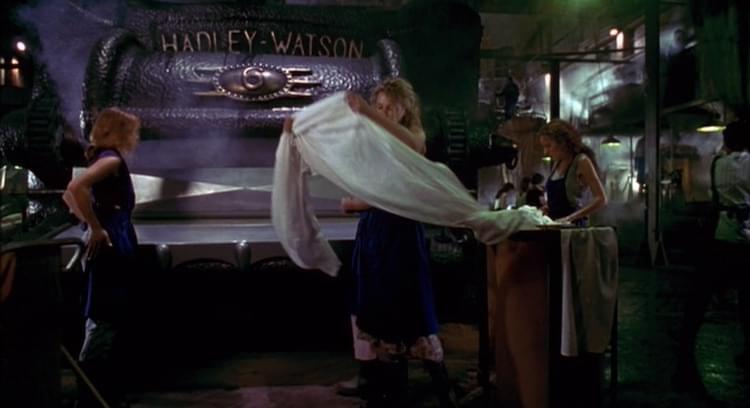
The first problem is that the machine is hard to define. It’s a big contraption that presses and folds sheets and linens and things. The people in the movie call it a “speed iron.” It’s technically known as a “laundry press.” The point is, it’s a device that most people are completely unfamiliar with, and a good movie monster needs to be something we can relate to. A giant rabbit! Now that’s scary. We’ve all seen rabbits, and we can imagine what a giant one would look like. It would look like a rabbit, only bigger. But an industrial laundry press ironing machine device thingee? What is that?

This vagueness has led some people to refer to the film as “the one about a killer washing machine.” But this is incorrect. A killer washing machine? Come on. That would be stupid.

The film is set in a small Maine town that is populated by rednecks, inbreds, and idiots. In other words, it’s set in a small Maine town. (Just kidding, Mainerds! I love ya!) There’s a company called Blue Ribbon Laundry with a factory-like environment that has bedraggled women running around shouting at each other as they, um, do laundry, I guess. It’s not really clear what they do. It looks like a sweatshop. But at the center of the warehouse floor is a behemoth machine that apparently presses and folds things. And when one of the employees cuts her hand on one of its pieces, the machine gets a taste for blood and soon thereafter eats somebody who gets too close to it.

It’s a horrific accident, of course, and everyone is devastated. The local safety board examines the machine and quite reasonably declares the lady-smashing to have been a fluke. There is no reason to suspect foul play or supernatural forces. This does not stop the town’s only cop, Hunton (Ted Levine), from suspecting foul play, nor his friend Mark (Daniel Matmor) from suspecting supernatural forces. What’s funny is that Hunton thinks Mark is crazy for thinking demons are involved, and Mark thinks Hunton is silly for thinking it was murder, when really both of them are morons for thinking it was anything other than an accident.

(Yes, I understand that it was not actually an accident. But Hunton and Mark had no reason to think that, other than the movie needing them to think it. Please don’t make me explain EVERYTHING to you.)

A word on this cop, Hunton. He is the quintessential main character for a bad movie in that he is mean and unlikable. He is even surly to his mailman, who surely has never done him any harm. It does not help that Hunton is played by Ted Levine, who is best known for playing Buffalo Bill, the junk-tucking psycho killer in “Silence of the Lambs.” Levine’s voice sounds strangled and phlegmy, like he just ate a big bowl of ice cream and half of it’s still in his throat. He is not the sort of actor you want as your protagonist if you were hoping for people to enjoy your movie, or even watch it with both eyes.

Anyway, Hunton’s friend Mark is a long-haired hippie type who, get this, worked at an industrial laundry in college! So he knows all about large pressing folding ironing machine gizmos like the one at Blue Ribbon Laundry. He also has a book about the occult, and the book tells him that the machine is probably possessed by a demon, which I guess is the answer you’d expect to find when you look for answers in a book about demons, like when you go to a chiropractor and he tells you that all your problems are attributable to a lack of chiropractic care. Mark’s hands-on experience with industrial machine foldy ironing laundry whatzits, coupled with his perusal of this occult book, convinces him that the machine at Blue Ribbon has a hunger for the blood of virgins. And from the looks of him, if anyone knows virgins, it’s Mark.

The owner of Blue Ribbon is a cantankerous old man named Gartley, played by Robert Englund, best known as Freddy Krueger. Here he wears old-age makeup and clambers around wearing braces on his legs, which is a hint at the marriage between man and machine that will figure heavily into the movie later on, after you’ve stopped paying attention. Gartley owns everyone in town, including the mayor and the city council, and he’s well aware that his fold-sort-iron-press-laundry-machine doodad has the devil in it. In fact, he and the town’s prominent citizens have been sacrificing their 16-year-old virgin daughters to it in exchange for financial prosperity for generations! There, now you don’t have to watch the movie to find out what happens.

“The Mangler” follows the basic template of a regular monster movie, with deaths occurring at regularly timed intervals. The difficulty, of course, is that the monster in this movie cannot pursue its victims; the movie must bring them to it. So even though the machine’s propensity for ensnaring and flattening hapless bystanders has been well established, people continue to hang around it and lean against it, thus enabling themselves to be eaten — and good riddance to anyone dumb enough to be devoured by an immobile object, I say. Serves you right.

OK, at the end of the movie, Hunton and Mark do something to REALLY enrage the machine, and it actually comes to life and chases them around the factory, and I wish I were kidding. It bites Mark in half, which is mildly awesome, but not enough to compensate for the dumbness of the situation. Can I pretend it never happened? I’m fine with that if you are.

P.S.: Somehow an evil refrigerator is also involved. Yes, an evil refrigerator. A pair of bumbling morons were taking it from Blue Ribbon Laundry (does Blue Ribbon Laundry also sell refrigerators?) and delivering it somewhere in town when they bumped against the laundry press. Later, supernatural blue evil lights come out of the refrigerator, which has been left on someone’s lawn, which is evidently what they do with major kitchen appliances in Maine. The reason I didn’t mention any of this earlier is that I was embarrassed to admit I didn’t understand it.

— Film.com

Eric’s Bad Movies: ‘The Mangler’ (1995)

5

Stephen King has had bad luck with the movie adaptations of his horror stories. For every “Carrie” or “The Shining,” there’s something like “The Mangler,” in which a town is terrorized by a demonic laundry machine. (To be fair to the filmmakers, King’s short story can’t have been very good to begin with.) It’s the subject of this week’s edition of Eric’s Bad Movies at Film.com, and it’s approximately as bad as it sounds.

Next week’s movie is from the 1980s, and I hadn’t even heard of it until multiple people suggested it as a candidate for Eric’s Bad Movies. It involves sports, and notice I used the plural.

Children’s Letters to Raven-Symone XVI

20
Children’s Letters to Raven-Symone XVI

(For complete background on this feature, read the introduction here. But here’s the gist: I registered a fake e-mail address for actress/singer Raven-Symone and announced it here, with the disclaimer that it wasn’t real, figuring dumb people would ignore that part and write to it anyway. And I was right.)

It is time once again to open Raven-Symone’s mailbag (if you know what I mean) and make fun of the simple-minded children who write to her. I would have run a new edition of this feature sooner, but the volume of mail received at Raven’s fake e-mail address has slowed to a trickle in recent months. Most of what she gets now is very generic (“Hi Raven, I love you!”) or consists only of her fans inviting her to join them on Facebook or MySpace or Beebo or JimJum or Froofraff or whatever.

But here’s what we do have! Enjoy!

CHILDREN’S LETTERS TO RAVEN-SYMONE

May 15, 2008:

Is this raven -symone?(YES or NO)answer please>This is all I need to know.

* * * * *

June 3, 2008:

Hi Raven

I watched the Oprah Show where it feature the reunion of the Cosby Show and Raven-Symone appeared on the show.

She looked fabulous and I really loved the lipgloss colour she has used on the show.

Could you please please let me know the brand name and the colour of the lipgloss please.

The colour she used was in a pale pinkish shade and it looked great on her skin colour and would like to have that please.

Do let me know.

Thanks
Annie

[Note how the letter begins by addressing Raven directly, then switches to referring to Raven in the third person. This is a literary device pioneered by Joyce and Faulkner, so I’m impressed that Annie was familiar with it.]

New ‘Snide Remarks,’ and a new face!

29

Sure, there’s a new “Snide Remarks” column today, called “Boys Nintendon’t Cry” — but more importantly, the site has had a face-lift! Note how my eyes gaze upon my own name with awe and admiration. Feel free to do likewise!

The main improvement is the front page. It had gotten very cluttered, and it was hard to find things. Now it’s a bit cleaner and simpler. This site has three kinds of content — my weekly “Snide Remarks” column, my movie reviews, and my blog — but some visitors were only aware of one or two of them. On the new front page, whenever I post something new — be it “Snide Remarks,” a movie review, or a blog entry — it will appear at the top of the list, labeled appropriately. Hopefully people who make this site a regular destination will go straight to the front page every time and just see what’s been added most recently.

(Of course, if you use the RSS feeds, you’re not missing anything anyway. But you’d be surprised how many people, according to the survey we did several months ago, didn’t know I had a blog, or didn’t know I wrote a weekly column called “Snide Remarks,” or thought they were the same thing.)

My brother/webmaster Jeff has done all the actual work, as usual. He is to be thanked and lauded! He is also to be e-mailed if you notice anything that has gone amiss in the transition, or any other bugs related to the technical side of the site. There might still be some wrinkles we need to iron out.

Coming soon: the ability to do advanced searches in the movie review archives, an HTML version of my weekly “In the Dark” e-mail, and a button on the site that when you push it a candy bar comes out of your CD drive.

This week’s “Snide Remarks,” including the audio version, is here.
The audio version (i.e., the podcast) is also here.
Subscribe to the podcast’s feed with this URL.

Boys Nintendon’t Cry

0
Boys Nintendon’t Cry

When the video-game-based film “Max Payne” was released last week, a critic named Roger Moore said on Rotten Tomatoes that it “suffers from the heartlessness that makes games emotionally inferior to movies. Nobody ever shed a tear over a video-game character’s death.” Naturally, this led to several dozen people posting angry comments talking about the times that they did, in fact, cry over the death of a video-game character. This reinforces the truism that no matter how ridiculous something is, there will always be someone who has not only done it, but is proud to admit it.

I shouldn’t mock, though. I’ve certainly had my share of emotional experiences with video games. I was a wreck the first time Pac-Man got eaten by that ghost. I cried myself to sleep when a car ran over my Frogger. And I still get a little misty-eyed every time I see an Italian plumber harassed by a turtle.

No, sorry, I was kidding before when I said I shouldn’t mock. Of course I should mock. I’m pretty sure the guys who flooded Rotten Tomatoes with angry repudiations of Moore’s assertion were the same guys — it’s always guys — who had Internet aneurysms back in July when some critics had the nerve not to like the Batman movie. And if you can’t make fun of people like that, then whom can you make fun of? (Besides people who say “whom,” I mean.)

When Moore said that “nobody ever shed a tear over a video-game character’s death,” someone called “powerslayer67” responded, “This man obviously has never played Metal Gear Solid 4.” I suspect that is true. But is powerslayer67 saying that if Moore HAD played Metal Gear Solid 4, he definitely WOULD have cried? Is that the effect Metal Gear Solid 4 typically has on people? Is Metal Gear Solid 4 the “Steel Magnolias” of video games? I was going to read up on Metal Gear Solid 4 to see if I could find an answer, but I noticed that the game’s entry at Wikipedia is longer than the entry on Shakespeare’s “Macbeth,” and I figured that if the game warranted more discussion and analysis than one of the greatest works of theater ever written, then it’s probably every bit as emotionally potent as powerslayer67 says it is.

Other correspondents writing sweatily from their dorm rooms and parents’ basements offered these examples:

“FF7: Crisis Core is another example of a game that really made you feel connected with the characters. Both games in the Chrono series. Someone already mentioned Shadows of the Colossus.”

“I think one of the most emotional parts in any game that I played was towards the end of Final Fantasy X, when you play back Yuna’s message to the group. Half-Life 2, Ep. 2, another great one.”

“At the end of GTA IV when Niko says he feels empty inside….i teared up.”

“FF10 had one of the most emotional endings ever for a game, Bioshock comes to mind, FFVII comes to mind, MGS4 comes to mind, Lost Odyssey, Mass Effect.”

“Ever played Half-Life 2: Episode Two?”

“Play Legend of Zelda: Ocarina of Time or Ico and tell me there’s no emotional heft there.”

Or this one:

“It pains me to see individuals so ignorant as yourself, Mr. Moore.”

That’s probably literally true. I mean, if you can be made to weep bitter tears over the death of a video-game character, you probably feel real pain when a stranger on the Internet disagrees with you, too. At this point I have to wonder, what DOESN’T cause you emotional pain?

And my personal favorite response:

“I have only cried twice over the course of my adult life. Once for real life emotional reasons, the other over the death of a videogame character at the conclusion of Final Fantasy X, never over a film. My personal experiences alone disprove your statement, and consequently your integrity as a film reviewer.”

What is probably hard for the film critic Mr. Moore to understand is that video games have gotten a lot more complex than the ones he played in his youth. This is where I’m blocked, too. I don’t play video games anymore. I’m not intimately familiar with Final Fantasy or Half-Life, and I’m certainly not sophisticated enough to appreciate Metal Gear Solid 4. I mean, I can barely understand “Macbeth”! Is it possible that these games, with their complicated plots and characters, really do offer an emotional connection? Or is it that you’re bound to grow attached to ANYTHING that you spend a hundred hours working on, especially if you do it instead of developing mature relationships with other human beings?

The only way to find out would be to play one of these games myself. And that’s exactly what I decided to do!

* * *

Before changing my mind and deciding it wasn’t worth it, I mean.

Alt text
The author during a recent game of Rock Band.

My relationship with video games began with the Atari 2600 in the early 1980s and more or less ended with Nintendo in the early 1990s. I’ve recently had occasion to play Rock Band, however, and that can be pretty fun. If you’re not familiar, Rock Band is a game which allows you to spend many hours practicing a fake instrument without the burden of developing any actual musical skills. There’s a plastic guitar that has five different colored buttons on it, and whichever color appears on the screen, you press that button on your guitar, and it causes the game to play music. It is an excellent game for teaching people how to recognize different colors and press buttons that correspond to those colors. Don’t think it’s super-easy and that even a mouse in a laboratory can be taught to press a sequence of buttons in order to procure food, though! Sometimes in Rock Band you have to press the buttons really fast.

Alt text

Musicians are often frustrated playing Rock Band because, as it turns out, being able to play a real instrument is of no use in the game. The only thing that helps is having a sense of rhythm and timing, which I do, not to brag or anything. I favor the drums in Rock Band for that reason, and also because the drums are an instrument that you can play sitting down, and also because I don’t get much opportunity in my regular life to hit things with sticks.

Still, Rock Band isn’t a normal video game because no one dies in it, and there’s not a plot or story, which means there’s no reason to cry when it’s over. It’s no Donkey Kong, in other words. The death of Bambi’s mother does nothing for me, but that little man getting smashed with a barrel thrown by a monkey? Forget it.


[ Yes, Roger Moore is also the name of one of the actors who used to play James Bond. I’m sure the movie critic Roger Moore is very tired of hearing jokes about it, which is why I didn’t make any. That, and I couldn’t find a place in the column to do it.
The thing about the “Macbeth” Wikipedia page being shorter than the one for Metal Gear Solid 4 was true at the time but isn’t as of 2018.
For more on the fanboy uprising against Batman-dissing critics, see this and this. Then see it happen again four years later here.
Alternate titles for this column: “Tears of Joystick,” “While My Avatar Gently Weeps,” “The Crying Games.” ]

Friday movie roundup – Oct. 24

5

Three wide releases this weekend, three movies that you’ve seen before.

“Saw V: Still Sawin'” offers nothing that was not already featured in the previous four entries. It is one of Hollywood’s Shameful Secrets®, too, which means I had to pay to see it at a midnight screening last night. The promotional screenings at the Lloyd Center are always full of weirdos and homeless people anyway; you can imagine what it’s like at midnight, especially when it’s a movie that attracts people who like to see movies at midnight and who are willing to pay for them.

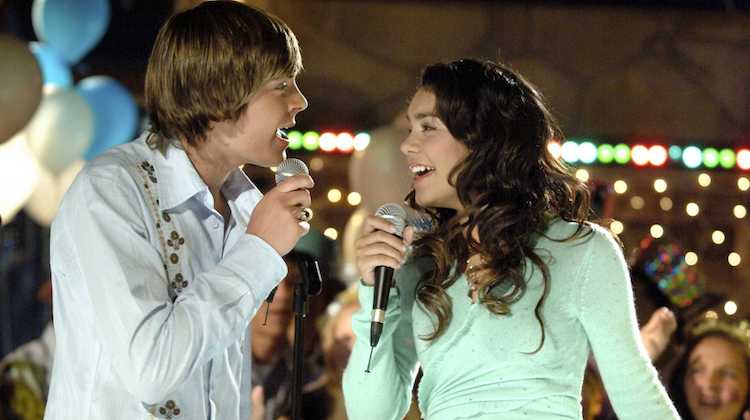
“High School Musical 3: Senior Year” (review at Film.com) is also more of the same, though that might be one of the selling points. It’s fine for what it is, and I’m glad they made some effort to be bigger for the big screen, rather than just filming another Disney Channel movie and plopping it into theaters.

At the “HSM 3” screening the other night, the cast of “High School Musical: The Ice Tour” was in the audience! The show is in Portland this week, and for sure the cast really wanted to watch “HSM 3” on the big screen on their night off. How terrible it must be to actually be owned by the Disney company.

In other news, apparently there is an ice-skating version of “High School Musical,” and apparently it is welcome in Portland.

“Pride and Glory” isn’t a sequel, but it might as well be. It’s a gritty, violent drama about a New York City cop investigating other cops who might be crooked. Sound familiar? Like maybe there have been 10,000 movies like this already? Yeah. I saw it at the Toronto Film Festival and it made me angry, especially the part where a bad guy threatens to burn a baby with a hot iron and almost actually goes through with it. I was appalled by that. Yet afterward, walking back to the hotel with my buddy Eugene, I was making jokes about ironing babies, because in the abstract sense, ironing a baby is very funny. It’s only when you put it in a realistic context that it’s offensive.

Finally, my review of Oliver Stone’s “W.” is online, if you didn’t already notice it. Don’t misunderestimate it.

Sign up for the “In the Dark” e-zine here.
Listen to this week’s podcast version here.
Subscribe to the podcast’s feed with this URL.

Pride and Glory

0

There’s been a lot of talk the last few years about how television has become more cinematic, often outpacing theatrical films for depth and complexity. A prime example is “Pride and Glory,” an ugly and unpleasant cop drama that tries — and fails — to be even a fraction as morally complicated as FX’s “The Shield.” Granted, “The Shield” has had 80 hours to spin its web while “Pride and Glory” only has two. But I bet any random two “Shield” episodes would offer more originality, intelligence, and action than this warmed-over junk.

“Pride and Glory” begins with four New York City police officers being killed in a tenement during a botched drug raid. Ray Tierney (Edward Norton), your standard-issue Grim-Faced Cop Who’s Haunted By The Past, is assigned to head up the task force investigating the massacre, which is made all the more poignant by the fact that Ray’s brother, Francis (Noah Emmerich), was the dead cops’ commanding officer. Francis and Ray’s brother-in-law, Jimmy Egan (Colin Farrell), another cop, was friends with the fallen men, too, and we learn soon enough that the reason for the cops’ visit to that tenement, and Jimmy’s connection to it all, may not be 100 percent above-board.

That’s right, folks: It’s a movie about crooked cops. Yes! Crooked cops! In New York City, even! Thank goodness someone has finally made a movie on this under-explored topic!

As Ray starts to suspect Jimmy of being involved in something dirty, Jimmy and his surviving crew members run around coercing witnesses, beating up perps in exchange for favors, and digging themselves in deeper the way these scoundrels always do. An innocent woman is punched in the mouth. A baby is threatened with a hot iron. Jimmy is HARDCORE, yo! Colin Farrell, who learned a Brooklyn accent for the role but mostly just practiced the F word, is solid, if occasionally overwrought.

Ray is torn between his family — his father, played with amusing drunkenness by Jon Voight, is a cop, too — and his conscience. Edward Norton, who has seldom given a bad performance, strikes the right tone with the weary, embattled Ray, but what can you do with a screenplay this generic? Written by Gavin O’Connor (“Tumbleweeds”) and Joe Carnahan (“Narc,” “Smokin’ Aces”) and directed by O’Connor, the movie recycles old plotlines (last year’s “We Own the Night” is a good comparison) without even trying to put a fresh, original spin on them.

And so we are left to ponder the facts. “Pride and Glory” (an arbitrary title, by the way) is grim, abrasive, and hard to watch, full of swaggering, manly men shouting at each other like high school drama students who have just learned how to be vulgar. Its story and characters are overly familiar. It is shallow and vain, yet thinks it is gritty and meaningful. No thank you. I’ll get my crooked-cop fix on “The Shield,” thank you very much.

Let the Right One In (Swedish)

0

One of the things that some “Twilight” detractors don’t like about the book (and especially the movie) is that despite having vampires in it, it’s not a very good vampire story. Its focus is on the romance between the two main characters, not on the supernatural elements; those expecting a Gothic horror come away disappointed.

As an antidote, I recommend “Let the Right One In,” a spectacularly moody film from Sweden in which two lonely 12-year-olds find solace in one another despite (or maybe because of) one of them being a vampire. How can a movie be so tender, poignant, horrific, and gory all at once? More importantly, how can we savor this masterful film before the American remake (yes, one is in the works) ruins it?

The boy is Oskar (Kare Hedebrant), a pale, light-haired loner who you’d think was a vampire but isn’t. The other boys at school pick on him, apparently out of sheer random cruelty, since there’s nothing obviously mock-worthy about him. It’s as if fate selected him for this destiny through no fault of his own. Alone in his bedroom at night, he pathetically rehearses the revenge that he knows he’ll never actually take.

One night in the snowy courtyard outside the apartment building where he lives with his mother, Oskar meets Eli (Lina Leandersson), a girl with darker features and a big, expressive face. She’s as downcast as he is, though somehow more resigned to it. She has confidence, which he lacks. Yes, she’s a vampire.

That issue is not immediately addressed by Eli and Oskar; their friendship simply avoids it and blossoms anyway. Eli is a tormented soul who genuinely mourns every victim, some of whom are procured for her by Hakan (Per Ragnar), an old man who lives with her in a bare apartment and acts as her — what? Caretaker? Father? Something else? Drinking only the blood of animals, as vampires in other fictions have done, doesn’t seem to be an option for Eli, so her plight — dependent on human blood, yet cursed with a conscience — is heartbreaking. Her youth only makes it more so.

Of course, she’s not actually young. In an exchange of dialogue that must appear, in some form, in all stories about vampires interacting with mortals, Oskar asks how old she is and she responds, “I’m 12. But I’ve been 12 for a long time.” That explains her world-weariness. But I like that Lina Leandersson, the talented young actress who plays her, who has never been in a film before, doesn’t go overboard on the “old soul trapped in a young body” thing. Eli still seems like a child, making it even easier to sympathize with her.

As Oskar, Kare Hedebrant (also a newcomer) earns equal sympathy as a naive, innocent boy. Oskar and Eli’s relationship is too young to be sexual; instead, it is merely sweet and symbiotic. He needs her as a protector and supporter, and she needs him as a connection to the human world she has left behind.

The director, Tomas Alfredson (working from a screenplay adapted by John Ajvide Lindqvist from his own novel), films most of the scenes involving vampire attacks with an eerie matter-of-factness, often shooting the murders from a distance, with little camera movement. That makes the depictions more tasteful, yet somehow creepier, too: If there’s anything ghastlier than witnessing a killing, it’s witnessing it detachedly, as an unemotional observer.

Even in moments where the violence is more graphically shown, Alfredson retains a certain stark subtlety. His style, which I like immensely, is polished and assured, unburdened by flashy tricks or choppy editing. Understatement is often the key to an effective thriller. That’s true even in cases like this, where the thriller elements are only part of a larger picture. It’s a haunting, memorable film that’s liable to stay with you long after you’ve seen it.

Saw V

0

No one expects the fourth sequel to a horror film to be any good, but the “Saw” series has grown particularly redundant. “Saw V” is as rote and mechanical as one of Jigsaw’s traps, though at least Jigsaw’s traps are suspenseful and ingenious. The movie is neither of those things.

It begins immediately after the events of “Saw IV,” which the movie assumes you have watched quite recently. It definitely does not assume that you watched the movie once, a year ago, and forgot everything about it once you had written your review. You may remember (or maybe Wikipedia has reminded you) that a cop named Hoffman (Costas Mandylor) was revealed to be an accomplice to Jigsaw (Tobin Bell), the gravel-voiced trickster whose fiendishly clever devices have killed dozens and entertained millions. Now Hoffman is accepting commendations for solving the case, but FBI Agent Strahm (Scott Patterson) is starting to catch on that he, Hoffman, is actually a bad guy.

Strahm, who was injured in Jigsaw’s final orchestration, follows his hunch and pores over the old Jigsaw case files. As he does this, the film shows us flashbacks to Jigsaw and Hoffman’s prior interactions, thus allowing Jigsaw — the franchise’s central figure — to continue to be a major character even though his death occurred way back in “Saw III.” (Flashbacks are how he managed to be all over “Saw IV,” too.) After we are shown these vignettes, Strahm always deduces something new about Hoffman, something he could only deduce if he had seen the flashbacks along with us. I don’t know how he’s doing that, but it’s a pretty neat skill for a detective to have.

See all the Saws:

“Saw” (2004) B+
“Saw II” (2005) C
“Saw III” (2006) B-
“Saw IV” (2007) C-
“Saw V” (2008) D
“Saw VI” (2009) C
“Saw 3D” (2010) C-
“Jigsaw” (2017) B-

Meanwhile, five strangers are trapped in a series of Jigsaw-style games, forced to work together (or slowly kill one another) in order to survive. Two of them are played by Julie Benz and Meagan Good. IMDB says their characters are named Brit and Luba, but I don’t think the movie ever tells us that. I’m pretty sure I would remember if someone had been called “Luba.”

Anyway, did I mention it’s all pretty routine by now? Whatever wit or cleverness this series had has long since dried up. Even viewers who keep coming back for the blood ‘n’ gore are liable to be disappointed: While there’s plenty of it, it’s rarely the result of anything creative or “fun.” It’s like the movie isn’t even trying to appeal to its most devoted fanbase. I do admire the ability to keep retroactively adding information to the story — oh, it turns out that while THIS was happening, so was this OTHER thing! — but that device works best when there was a master plan in place at the outset, not when you’re making it up as you go.

The first-time director is David Hackl, who worked as assistant director on the last two entries and evidently learned plenty from his bosses. I might as well quote my review of “Saw IV,” since it’s still applicable: “[His] preference is to shoot everything as if he were a film student making a Nine Inch Nails video. You get that metallic swooshing sound effect over everything, jittery jump cuts in the middle of people’s sentences, and eerie, atonal music playing almost constantly. All of these devices are employed even in the non-suspenseful scenes in the hopes of creating a false sense of intensity.”

The film’s promotional tagline is “You won’t believe how it ends.” And it’s true: I was expecting one of those trademark “Saw” surprise twists, and instead I got an anti-climax that made me say “So what?” Is that what they meant? Is the series over now? The faux-intellectual moralizing is beyond absurd, Jigsaw is a joke who’s been dead for two films, and none of the other surviving characters are even slightly interesting. Set the timer and let this thing explode, would you?

Synecdoche, New York

0

As the screenwriter of such loopy, melancholy comedies as “Being John Malkovich” and “Eternal Sunshine of the Spotless Mind,” Charlie Kaufman has been lucky to work with directors like Spike Jonze and Michel Gondry who appreciate — and can translate to the big screen — his singularly bizarre worldview. But he has chosen his sixth screenplay, “Synecdoche, New York,” to direct himself, and as we see him control a project’s vision entirely on his own for the first time, we discover something surprising: He’s even crazier than we thought. Is it possible Jonze and Gondry were actually holding him back?

“Synecdoche, New York” is never explained as a title, apart from being a mispronunciation of Schenectady, N.Y., where much of the story is set. I can tell you that “synecdoche” (sin-ECK-duh-kee) is the name for a figure of speech where something is referred to by one of its parts (calling your car your “wheels,” for example) or vice versa (saying “Use your head!” when you really just mean “Use your brain!”) — but whether that’s relevant, I couldn’t say.

Caden Cotard (Philip Seymour Hoffman) is a theater director in upstate New York with an artist wife, Adele (Catherine Keener), and a precious 4-year-old daughter, Olive (Sadie Goldstein). After Adele takes Olive and moves to Germany, Caden becomes intent on producing a theatrical work that is wholly original and meaningful. “I want to do something important while I’m still here,” he says, echoing the urgent refrain spoken by all artists at one point or another.

His idea is to create a massive, sprawling theater piece in a huge warehouse in New York City, with actors playing him and the people he knows (and, eventually, other actors playing THOSE actors, and so on), all in the interest of conveying the truth and beauty of real life. Theoretically, audiences would meander through the sets he’s constructed, which are scale versions of New York City, and observe the characters in their natural habitats, enacting the dramas and comedies of everyday living.

As usual with Kaufman, the basic story is actually fairly straightforward; it’s the details of the execution that render it whimsical, surreal, and dreamlike. Caden’s box-office manager, a sweet girl named Hazel (Samantha Morton), buys a house that is on fire (“The seller is very motivated”) and that continues to be on fire after she moves in. Characters frequently do not understand each other. (Caden: “I think I have blood in my stool.” Adele: “That stool in your office?”) Young Olive’s diary, left behind when she moved to Germany, has entries in it that she could have only written after the fact, which we hear narrated in Olive’s voice, which now has a German accent. A marriage counselor (Hope Davis) answers questions nanoseconds after you’ve finished asking them, as though she wasn’t listening at all, and has written a book for every possible situation, some of which actually refer to you as you read them.

Weirdness abounds — believe me, what I have mentioned is but a drop in the ocean of the film’s strangeness — but the aspect I find most satisfying is that it passes without comment. Some films have a normal character surrounded by insanity; here, Caden definitely cannot cope with life, but it’s not because weird things are happening. In this universe, life has always been this way. This is just how things are. Caden’s inability to get his bearings and find his happiness is symbolic of what we all go through, regardless of the world we live in, whether it’s the kind of world where people buy burning houses or not.

Kaufman, like Caden, is worried about time, which has little meaning in the film. It’s the first day of autumn in the opening scene; then the radio DJ wishes everyone a happy Halloween, and by the time the scene is over, the morning paper says it’s Nov. 2. Time rushes forward precariously, years at a time, often slipping away from Caden before he realizes it. He has a continuing series of health problems that make him concerned about dying. Life is not a rehearsal, you know — this is it. When we first meet Caden, he is staging a production of “Death of a Salesman.” And who knew about the futility of life and the ever-approaching specter of death better than Willy Loman?

All of this makes it sound like a sad and poignant film, which it ultimately is, all the loony comedy notwithstanding. This will sound strange, but both times I’ve seen the film so far, I’ve come out of it with the sensation I used to have when I was a kid and I would take a nap in the afternoon. I always woke up feeling disoriented and melancholy, mostly because I didn’t like the sensation of having been asleep while the rest of the world was awake. What had happened while I was out? What had I missed? Caden seems to feel like that a lot, unable to get a firm grip on life as it slides past him, and it often gives the film the panicked intensity of a disconcerting dream — not a full-blown nightmare, just a vision that’s slightly “off.” Characters like Claire (Michelle Williams) and Millicent (Dianne Wiest), two of Caden’s actresses, enter and exit his life precipitously. You never know who’s going to be important and who’s going to slip out of the picture without a trace. In that respect, the film feels exactly like real life.

Lots of movies employ a few quirks just so people will call them “quirky.” Kaufman is no quirk hobbyist, however. Quirkiness is so thoroughly entrenched in his writing that one assumes he comes by it naturally, without having to wedge it in. “Quirky,” for Kaufman, would be writing something ordinary and unsurprisingly. “Synecdoche” is uniformly daft, with oddness in every frame, oddness that would take multiple viewings to fully parse and appreciate. Heck, I had to see it twice just to get a handle on which elements are meaningful and which are only there for mirth’s sake. (The pink wooden box labeled “NOSE” that Caden sends to his daughter falls under the latter category, I think.) It’s an utterly brilliant film in that it evokes its intended feelings with apparent effortlessness, not like a staged, contrived snapshot but like a wholly unique piece of art.

High School Musical 3: Senior Year

0

Taking potshots at “High School Musical” is easy, not to mention fun and profitable. The original Disney Channel film was cheap and simple-minded (but harmless), and its sequel was more of the same. Now the geniuses at Disney have figured out that they should be selling these movies, not giving them away on cable TV, so the second sequel, “High School Musical 3: Senior Year,” is playing in theaters. And you know what? It’s not bad. It’s a lump, but it’s a benign lump.

Just to get our timelines straight, and to reveal more detailed knowledge of this series than I ought to have, “HSM” took place in January of the kids’ junior year, “HSM 2” covered the summer, and now “HSM 3” picks things up several months after that, near the end of senior year. Troy Bolton (Zac Efron) has just led the East High Wildcats to another basketball championship, and he and his girlfriend, Gabriella Montez (Vanessa Hudgens), are making their post-graduation plans. Gabriella has been accepted to Stanford. Troy has always assumed he’d go to his hometown University of Albuquerque with his best friend and teammate, Chad (Corbin Bleu).

But thoughts of the future make everyone nervous and angst-y! Stanford is far away from Albuquerque (as are most things, actually) — plus, Troy has been getting scholarship offers from other schools. Then, because this franchise has an obsession with making Troy a perfect model citizen in every possible regard, he is ALSO being considered for an exclusive Juilliard spot, on the basis of his one (1) performance in exactly one (1) high school musical. The movie also tells us that Juilliard is very hard to get into, though this is obviously belied by their interest in Troy.

Apart from the senior-year anxiety (which sometimes gets a bit too serious), very little about the basic plot of this “HSM” is any different from the others. This means, yes, that none of the characters ever actually learn anything. Troy still insists he doesn’t want to perform in the spring musical, then changes his mind. His basketball buddies still think singing and dancing is ridiculous, then do it anyway. Sharpay (Ashley Tisdale) still wants Troy for herself, both on stage and off, and still connives to make that happen, then doesn’t really seem to care when it doesn’t. Ryan (Lucas Grabeel), Taylor (Monique Coleman), Kelsi (Olesya Rulin), and Ms. Darbus (Alyson Reed) are all still around.

In a transparent effort to sow seeds for the next generation of “HSM,” three new characters are introduced — freshmen or sophomores, all, so they can appear in at least three films before they’re forced to graduate. Jimmie “Rocketman” Zara (Matt Prokop), the new Troy, is stalking the current Troy in a rather unsettling manner. His buddy, Dion (Justin Martin), is a tiny black kid and Chad’s heir-apparent. Rocketman’s nemesis will be, I kid you not, Tiara Gold (Jemma McKenzie-Brown), a British girl who is now working as Sharpay’s assistant in a very “All About Eve” kind of way.

Franchise director Kenny Ortega, whose last theatrical films (including “Newsies”) were 15 years ago, justifies “HSM 3’s” big-screen format by staging larger, more visually interesting musical numbers. Where most of the numbers in the previous films were down-to-earth, this time Ortega indulges in the fantasy elements typical of movie musicals — for example, a school quad becomes a ballroom for the duration of a song, then reverts back to reality when it’s over. Sharpay and Ryan’s “I Want It All” number is hugely lavish and entertaining. Troy’s big solo, “Scream,” effectively conveys his indecision (never mind that it’s the same indecision he’s had twice already), and is ambitiously staged and edited.

I still like to make up dirty meanings for the generic pop songs that comprise most of the soundtrack. My favorite this time is in the number about prom, where the guys sing to the girls:

“It’s the night of nights,
You know we’re gonna do it right.”

This is a generic lyric where “it” just means “prom.” But I like to imagine the line being punctuated like this:

“It’s the night of nights:
You know we’re gonna ‘do it,’ right?”

I still can’t say much for Vanessa Hudgens’ bland, personality-free performance, or her grating, nasal singing voice. (Why does she have a mouth when she apparently only needs her nose?) Ryan, once an amusing sidekick to Sharpay, has been relegated to the background. The school musical that closes out the film has one of those audiences that only communicate via standing ovation. The logistics of Gabriella’s visit to Stanford, her returning for the show, and the use of understudies are all baffling and almost certainly impossible. You could spend all day pointing out shots that down match up, characters who are in one place one moment and somewhere else the next, extraneous people who are only in the film because they were in the last two, etc.

But why would you waste a whole day doing that? The film isn’t exactly nourishing, but it’s not unhealthy, either. It’s fine for its target audience, and maybe for the target audience’s parents who will be obligated to drive them to the theater. Those parents will be tired of it after the thousandth DVD viewing, but the same would be true even if it were a brilliant and clever movie. The final lyric of the film says, “I want the rest of my life to feel just like a high school musical,” and if that’s what you want, hey, knock yourself out. I hear you only have to be in one to catch Juilliard’s attention.

High School Musical

0
High School Musical

The Walt Disney Company is unparalleled in its production of inexpensive, medium-quality films that appeal to its two major target audiences: the young, and the easily amused. Many of these films are released in theaters and frequently involve someone like The Rock getting bitten by something like a duck. But Disney also makes dozens of movies for its own cable network, The Disney Channel, where the expectations are even lower. When people pay for a movie ticket, they demand excellence or, at the very least, fart jokes. When it’s coming into their homes basically for free on The Disney Channel, all they expect is that the movie be in color.

Considering how little effort is put into these Disney Channel movies (very little), and how many of them are produced per year (75,000), you can see why it was a surprise when “High School Musical” became a smash hit. Why did fate smile so favorably upon this movie while the rest of the Disney Channel’s offerings faded into obscurity? Why didn’t “Life Is Ruff” (2005), about a boy who enters a mutt in a dog show in the hopes of winning enough money to buy a rare comic book, become a worldwide sensation? Why are there not millions of teenage girls screaming their lungs out in response to “Cow Belles” (2006), in which a pair of rich, spoiled sisters have to work on a dairy farm?

Disney scientists labored for months analyzing “High School Musical,” dissecting it, running laboratory tests on it, trying to determine what made it, as opposed to its siblings, so popular. If they knew what the key factor was, they could reproduce it and create an infinite number of equally successful Disney Channel Movies! But they couldn’t isolate this elusive strand of DNA (known in scientific circles as the OMGene), so instead they gave up and just started making sequels.

(These Disney Channel movies are often filmed in Utah, by the way, a state that is attractive to Disney because it offers low production costs, beautiful scenery, and a vast supply of clean-shaven white people to use as extras. I lived in Utah for many years and know several people who have worked on the Disney films shot there, both in front of and behind the camera. All of them say the same thing about the experience from a creative standpoint: you get paid on time, and the checks don’t bounce.)

“High School Musical” begins at a New Year’s Eve karaoke party at a ski lodge, where two teenagers who don’t know each other are forced to sing a song together. One of the kids has soft, translucent skin and pretty eyes; the other one is a girl. Troy (Zac Efron) has never sung before. Gabriella (Vanessa Anne Hudgens) has sung with her church choir but is terrified of performing solo, possibly because her 5-year-old little-girl speaking voice becomes even whinier and more nasal when she sings. The two of them are urged onstage by the karaoke DJ — compelled, really, in a cruel enforcement of draconian karaoke laws — and listen as the first few bars of a song they’ve never heard before play out. The lyrics appear on the screen, and they belt out the tune as if they’d rehearsed it for months, complete with harmonies, overproduced studio-quality vocals, “oohs” and “yeahs” at appropriate intervals, and that breathy vocal styling that is popular on “American Idol” and top 40 radio and has no connection to actual vocal ability. The viewer settles in for 95 minutes of this.

Vacation ends and school starts up, and it turns out that Gabriella, in a “Grease”-like twist, has just moved to Troy’s school: East High, in Albuquerque, N.M. Troy is the most popular boy on campus and the undisputed star of the champion varsity basketball team. (The fact that their star player is a 5’9″ junior who looks like a cast member of “Gossip Girl” probably says a lot about the competition in the Albuquerque region.) Gabriella asks if he’s going to try out for the school musical, but he says no, the singing on New Year’s Eve was a one-time thing, just experimenting, really, it’s not who he is, not that there’s anything wrong with that, it’s just not for him. Please don’t ever bring it up again. He’s worried about what his teammates will think if they know he sings. What, because they’re all so butch?

During basketball practice, Troy sings a song about his latent musicalism and his attraction to Gabriella. The song has lyrics that are innocuous if they apply to basketball but unspeakably filthy if they do not. For example: “Take the ball to the hole” and “don’t be afraid to shoot the outside J.” (Actually, I don’t know what that second one means in either context.)

The other problem with auditioning for the musical with Gabriella is that it would put them in competition with the couple who usually dominate in this field, the wealthy, snobby drama queen Sharpay (Ashley Tisdale) and her twin brother Ryan (Lucas Grabeel). (The fact that so far no one has questioned the wisdom in the school plays’ romantic leads being performed by a brother and sister probably says a lot about how they do things down there in New Mexico.) Sharpay and Ryan are the villains of the movie, as well as the only characters who are legitimately funny or interesting. “High School Musical” thus suffers from the same ailment as “Masters of the Universe,” and I’m not saying that just so I can be the first person to mention those films in the same sentence.

Troy and Gabriella wind up auditioning anyway, sort of, accidentally, and they happen to perform an intricately produced duet of a song they’ve never heard before, just like on New Year’s Eve. This is evidently a skill of theirs. And once word of the audition gets around, the school is abuzz! A new girl and a jock taking on the fearsome Sharpay/Ryan theatrical incest juggernaut? What further miraculous wonders await us?! In the cafeteria, there is a large-scale production number in which various students, emboldened by Troy’s admission that he likes singing, confess their own secret passions. An athlete loves to bake. A chubby white girl likes hip-hop. A skater dude plays the cello. Naturally, you start making up your own scandalous revelations that would be really funny for the movie to include. “I’m a peeping Tom!” you hope someone will declare. Or: “I had a baby last year!” Why wasn’t I consulted when this film was written?

Troy’s new interests are decried by his best friend and teammate, Chad (Corbin Bleu), whose hair makes him look like Justin Guarini. (Think how sad it must be for Justin Guarini to know that if it weren’t for his hairstyle, no one would ever mention him at all.) There’s an important game coming up, and Chad fears Troy will be distracted by these extra extra-curricular activities. Chad is matched in his immature overreaction by Troy’s father (Bart Johnson), who is also the coach. He, too, is upset to learn that Troy is auditioning for the musical. But who can blame him? No father wants to hear that his son is thinking of forsaking sweaty physical activity with athletic, scantily clad boys in favor of enacting romantic scenes with girls in front of audiences.

Meanwhile, the school’s nerd clique doesn’t want Gabriella distracted from the upcoming academic decathlon (yes, despite all evidence to the contrary, Gabriella is a whiz kid). So the nerds and the jocks conspire to break Troy and Gabriella up. Then, since this is a simple-minded Disney film, they immediately feel guilty and confess to the pair, who happily reconcile, having been split up just long enough for Zac Efron to sing (well, for his vocal double to sing) a fiery I-miss-you song.

Back to the real villains. Sharpay and Ryan get the date of the audition callbacks moved so that it coincides with both the basketball playoff game AND the academic decathlon, which means Troy and Gabriella won’t be able to come to the auditions, which means a counter-scheme is required, and you may rest assured that they DO make it to callbacks, and their performance is incredible, and they get the parts in the play. Consider it an act of great mercy that the movie ends here, with Troy and Gabriella being cast in the show, rather than actually making us watch the show.

This sounds like a happy ending, but wait. What about Sharpay and Ryan? Now they’ll be stuck with supporting roles in the school musical! Sure, they were the villains, and sure, they completely deserve the negative consequences of their actions. But a simple-minded Disney film cannot leave anyone unhappy, no matter how much they deserve it. So in the final scene, Sharpay tells Gabriella that she’s not upset and she’s happy for her. Even though getting the lead in the musical was her No. 1 priority for the entire film, now she suddenly doesn’t care anymore after all. Brilliant! Way to write yourself out of a corner there, “High School Musical”! When you can’t figure out a proper motivation for a character’s change of heart, just give ’em the change of heart anyway!

It’s easy to see why this film and its sequel have been so popular with children and the mentally enfeebled. Its stars are shiny-faced young people with broad smiles who speak in short, uncomplicated sentences. It teaches a positive message about not being embarrassed about your interests, provided those interests fall within certain uncontroversial, socially acceptable parameters. One or two of the songs are tolerable. And, best of all, it’s in color.

— Film.com

’30 Rock’ season premiere online NOW!

7

Rejoice, “30 Rock” fans! The season premiere won’t air on the old-fashioned televisions until next week, but it’s on the Internets NOW! You can watch it! Not next week, but NOW!

Eric’s Bad Movies: ‘High School Musical’ (2006)

22

This week’s edition of Eric’s Bad Movies at Film.com does indeed feature a horror of a different kind: “High School Musical.” As I hinted last week, “HSM” violates one of my rules in that it was a made-for-TV movie rather than a theatrical release. And I’m covering it this week because its second sequel is being released — theatrically this time — tomorrow.

I originally thought I’d cover both “HSM” and “HSM 2” in one column, but I wound up filling the whole space with just the first movie. That means I watched the second film FOR NO REASON. Surely there’s some way of writing that off on my taxes.

Close observers might have noticed that there are varying degrees of badness in Eric’s Bad Movies. “HSM” is bad, no question. It’s corny, simple-minded, and ridiculous. But it’s harmless, and the dance numbers are good. So I didn’t really bring out the heavy ammunition in my write-up the way I did for, say, “Mortal Kombat: Annihilation.” (With “HSM,” the real horror comes in seeing it over and over again, as so many heroic parents of young children have had to do.)

Next week’s movie will definitely be Halloween-appropriate, but I haven’t settled on a specific title yet. I’ve got my eye on one that has one of the most absurd “monsters” I’ve ever heard of in a horror movie, but I need to watch it to make sure it’s as bad as it sounds.

Sad fact: This woman’s vote counts

49

The only thing worse than a stupid person is a stupid person who thinks she’s smart. This woman, a crazy-eyed Virginia voter who is basing her vote on whoever “has the most faith in the Lord” (and that’s just the tip of the iceberg), has a smug, self-righteous look on her piggy face that makes me want to slap her.

[UPDATE: The video has been removed from YouTube. It was from a PBS segment, and you can watch it here. This woman comes on at about 8:30, but start at 6:10 to see her husband discuss his own views much more rationally.]

A transcript:

PBS: What’s the most important issue for you in this election?
TRACY KERLEE: The one that has the most faith in the Lord.
PBS: That’s make-or-break for you.
TRACY KERLEE: That should be make-and-break for everybody.
PBS: And when you hear people saying, “Well, we understand your faith, but what if you’re gonna vote against your husband’s interests as an American worker?”
TRACY KERLEE: The Lord will take care of us. That’s the way I look at things.
…
TRACY KERLEE: I can’t imagine having a president of the United States named “President Obama.” I really have a problem with that. And I am not the only one.
PBS: Because that means what to you?
TRACY KERLEE: His background. A mother that was a atheist. Oh! That really gets to me. A father that was a Muslim. That should get to EVERYONE.
PBS: And when Barack Obama and his wife Michelle say, “But we’re faith-based, we’re Christians”?
TRACY KERLEE: The church they were members of? That’s not the Christianity I know. That’s not the Christianity that’s in the Bible.
PBS: And so for you, you are firmly decided.
TRACY KERLEE: Definitely.
PBS: And what do you say to your husband, who is still on the fence?
TRACY KERLEE: I will pray for him. He knows what the right decision is.

Welcome to Tally Hall!

7

Have you heard of Tally Hall? Well, you have now. I stumbled across this performance on a rerun of Craig Ferguson the other night, and I was instantly a fan. Visually, their gimmick is that each band member wears a specific tie, and they refer to each other by tie color. Musically, they’re catchy, clever, whimsical, and bizarre. (They also have an Internet sketch show that’s hit-or-miss.) This is their introductory song, “Welcome to Tally Hall.” I particularly enjoy the high-pitched screaming at about 3:15, and I’m sad to report that he doesn’t do that on the album version of the song.

[youtube:http://www.youtube.com/watch?v=E2YAYZiBvvw]

Eric’s Time Capsule: ‘Soul Man’ (10/24/86)

0

I hope you have not already forgotten my two-week-old Monday column at Film.com, Eric’s Time Capsule! Especially not now, when the third entry in the series concerns the 1986 comedy “Soul Man”! What could be more relevant in today’s world than a man who pretends to be black in order to get into Harvard Law School? Read and be edified!

‘Snide Remarks’ and politicians being silly

10

There’s some political silliness in this week’s “Snide Remarks.”

And speaking of political silliness, below are Sarah Palin’s two “Saturday Night Live” appearances from this weekend, once in the opening sketch and once in “Weekend Update.” The show didn’t really require her to do much (which is smart, since she’s not an actress or a comedian), but what she did do, she did well. Good for her. (The show earned its highest ratings since 1994, so good for “SNL,” too.)

This week’s “Snide Remarks,” including the audio version, is here.
The audio version (i.e., the podcast) is also here.
Subscribe to the podcast’s feed with this URL.

Fact Checking

0

Here is our analysis of some of the claims made by the presidential candidates in the most recent debate.

Obama’s claim: “I want to thank Hofstra University for hosting us. I’m very happy to be here tonight.”
The facts:Obama was not actually happy to be there. He’d been hoping to watch the baseball playoffs, not sit at a table and argue with John McCain.

McCain’s claim: “As soon as I heard Denny’s had introduced a new breakfast special, I suspended my campaign to fly back to Washington and investigate.”
The facts:Denny’s has not introduced a new breakfast special, and even if it had, there would be no need to fly to Washington to look into it.

Obama’s claim: “Under my tax plan, 95 percent of Americans will see their taxes lowered. Only people making more than $250,000 a year will see an increase.”
The facts:While this is indeed a true summary of the tax plan Obama has revealed, it has nothing to do with the secret tax plan that he will actually implement if he’s elected. That plan will include tax breaks for all terrorists, and impose a heavy tax on Whitey.

McCain’s claim: “I am rubber and Obama is glue, so whatever he says bounces off me and sticks to him.”
The facts:According to both candidates’ medical records, neither man’s body is composed of anything other than the normal biological materials.

Obama’s claim: “I rock a mic like a vandal, light up a stage and wax a chump like a candle.”
The facts:Research indicates this is actually a line from “Ice Ice Baby.” There is no evidence that Obama has ever waxed a chump at all, let alone like a candle.

McCain’s claim: “Joe the plumber doesn’t look anything like Michael Chiklis.”
The facts:Independent research confirms that Joe the plumber actually looks exactly like Michael Chiklis.

Alt text

Joe the plumber (left), and Michael Chiklis.

Obama’s claim: “McCain has voted with George Bush 90 percent of the time.”
The facts:This is only true from a very limited perspective. Taking into account votes on things like what theme the White House Christmas party should have, or whether the Senate should get a puppy, McCain has aligned himself with Bush only 60 percent of time.

McCain’s claim: “As soon as I witnessed the assassination of Archduke Franz Ferdinand in Sarajevo in 1914, I suspended my campaign and rushed back to Washington to deal with the crisis.”
The facts:McCain was nowhere near Sarajevo in 1914, and “rushing back” to Washington in those days would have entailed a weeks-long sea voyage. At the time of the assassination, McCain was in college.

Obama’s claim: “Earmarks only account for 0.5 percent of the budget. Eliminating earmarks won’t make much of a dent.”
The facts:Possibly true, but we still don’t really know what “earmarks” are. Could somebody beef up the Wikipedia entry?

McCain’s claim: “We need to stop spending $450 billion a year on oil imported from countries that don’t like us, such as Venezuela.”
The facts:McCain has grossly exaggerated the amount spent annually on imported oil, which the Department of Energy says is only $448 billion. Furthermore, according to the note that Venezuela passed to Argentina in biology class, Venezuela “sorta likes” America right now.

Obama’s claim: “I like big butts, and I cannot lie.”
The facts:These are two separate assertions combined into one. Obama may indeed like big butts; however, it is not true that he “cannot lie.” Anyone can lie.

McCain’s claim: “Under Obama’s plan, children will have to pay taxes on money received from the Tooth Fairy, and the Tooth Fairy herself will have to register as a small-business owner.”
The facts:While Obama’s tax plan does have a provision for money and goods received from mythical figures, it is a flat 1% tax to be collected after the taxpayer has lost all of his or her baby teeth, or at the age of 12, whichever comes first. The Tooth Fairy remains exempt as a non-profit charitable organization.

Obama’s claim: “I hate America. America needs to be blown up or destroyed with fire.”
The facts:Obama later explained that he was referring to America Ferrera, star of “Ugly Betty.”

McCain’s claim: “Sarah Palin is an intelligent, highly qualified, well-spoken maverick who is absolutely prepared to lead this country effectively should the need arise.”
The facts:We find nothing to dispute in this claim.

McCain and Obama come together to make fun of McCain and Obama

23

I don’t think I’ve mentioned it before, but political humor can be tricky. Comedy is entirely subjective anyway, and introducing politics into it just makes it more likely that one person will laugh while another doesn’t find it funny (or, in some rare and tragic cases, even realize you were trying to be funny).

No one feels the brunt of the rancorous political season worse than the candidates themselves, and that’s why it’s happy-making to watch these clips from last night’s annual Alfred E. Smith Memorial Foundation Dinner in New York City. In election years, the two presidential candidates traditionally are invited to speak at this event, and it’s become a sort of “roast,” where they can crack wise at one another’s expense all in the spirit of good fun.

McCain’s segment is broken into two parts, followed by Obama’s in one. It does my heart good to see them not only making some very good, very clever jokes (they had speechwriters, of course), but to also see them laughing at each other’s jabs. It looks like honest laughter, too, not the fake kind you do because you have to. Like I’ve always said, a good joke is a good joke, regardless of who the target is.

And they’re both funny! They make fun of themselves, of their public images, and each other. Why can’t McCain be this loose and energized in general? His routine here is snappy, animated and smooth. Obama is more deadpan and doesn’t have quite as polished a delivery as McCain. As for the overall quality of the jokes themselves, I’ll call it a draw.

Here are the videos, after the jump.

Friday movie roundup – Oct. 17

3

Friday means one thing and one thing only: new movies! Also, starting at sundown, the Jewish sabbath. So I guess two things. Well, one and a half, since the sabbath thing doesn’t happen until tonight. Friday means mostly one thing, and that one thing is new movies. (Sorry, Jewish people.)

Speaking of Jews, Anne Hathaway — is she Jewish? Her character is, anyway — stars in “Rachel Getting Married,” an exceedingly well-acted drama about a woman who gets out of rehab just in time for her sister’s wedding. Good times!

Then you have “Max Payne,” a video-game-based movie that continues the genre’s perfect record of every single video-game-based movie being bad. (You’re thinking the first “Resident Evil” was an exception, but you’re mistaken.) My review is at Cinematical.

At Film.com, I’ve reviewed “Sex Drive,” a derivative but often very funny raunchy teen comedy.

I wish I had thought of referring to “The Secret Life of Bees” as “Oprah’s Book Club: The Movie,” but someone online beat me to it. Anyway, it’s a pretty generic, albeit well-meaning, drama set in 1964 in South Carolina.

Finally, Oliver Stone’s “W.” opens today having been screened in just about every other major and semi-major market except Portland. We have no idea why. The reason Lionsgate gave us, that it had to do with “market size,” was an obvious falsehood, given that it screened in many markets smaller than us. I’ll have a review this weekend. If nothing else, I’m pretty sure it will wind up being the shortest title of the year.

Sign up for the “In the Dark” e-zine here.
Listen to this week’s podcast version here.
Subscribe to the podcast’s feed with this URL.

Sex Drive

0

“Sex Drive” has a plot that’s similar to the one in “The Sure Thing.” It’s also a road-trip comedy, and it features all the usual types of automotive mayhem and run-ins with strange rural characters and misadventures involving animals. It also begins with a scene that’s identical in format and tone to various scenes in the “American Pie” films, with a protagonist who looks and acts like Jason Biggs, and another character who might as well be Stifler.

“Sex Drive” is not a terribly original movie, in other words, with a plot borrowed from countless 1980s comedies and crude sexual scenarios borrowed from more recent movies. It is, however, often a very funny movie, regardless of where its ideas came from. The cast is fresh-faced and likable, and the movie is able to boast a bizarrely amusing performance by Seth Green as an extraordinarily sarcastic Amish man.

Ian (Josh Zuckerman) is a recent high school graduate and a quintessential Nice Guy, which means he finishes last and remains a virgin. He barely looks old enough to drive, let alone have sex, but the movie assures us he’s 18. (The actor is 23.) He marvels at the confidence displayed by guys who would seem to have even less to offer than he does. His best friend, Lance (Clark Duke), who would normally be the chubby, sexless sidekick, is in fact a total chick magnet. Even Ian’s own 14-year-old brother manages to score.

Ian has been chatting online with a girl called Ms_Tasty, though, and she seems to want him. That is, she wants the guy Ian claims to be — a rugged football player with a 1969 Pontiac GTO. She lives in Knoxville (Ian’s in the Chicago suburbs), and she says that if he’ll drive down to meet her, she’ll do the deed with him.

Would a teenage boy, no matter how horny, really drive eight hours just to lose his virginity to a stranger? If you have to ask then I suspect you have never been, or known, a teenage boy.

Ian really does have access to a ’69 GTO, sort of: It belongs to his older brother, Rex (James Marsden), the aforementioned Stifler knock-off who harasses Ian constantly over his dorkishness and is 95 percent sure Ian is gay and a lost cause. Ian and Lance steal the GTO and head for Tennessee, accompanied by their platonic best friend Felicia (Amanda Crew), whom Ian is secretly in love with and who is secretly in love with Lance. But they lie to her about the reason for the road trip, which lends an unnecessary bit of subterfuge to the plot. Given her one-of-the-guys place in their friendship, would she really object if she knew it was a booty call? And if she did object, so what? Leave her home.

The bulk of the film concerns the road trip and its attendant disasters, with the ever-percolating romantic angst bubbling up now and then as a palate-cleanser. The road-trip hijinks are hit-or-miss, as these things often are; I found that I laughed more at the dialogue than at almost any of the physical humor. As written by Sean Anders (who also directed) and John Morris, adapted from Andy Behrens’ book “All the Way,” the screenplay is rife with R-rated smack-talk and repartee, delivered by Zuckerman, Crew, and (especially) Duke with enough wit and charisma to silence complaints that they are merely a trio of Judd Apatow wannabes.

Also hilarious, and delivered in appropriately small doses, is James Marsden, whose furious anger and malevolence are a far cry from the softies he played in “Hairspray” and “Enchanted.” He doesn’t get to sing here, but he does get to fight one-on-one with a garage door, which is a different skill set altogether.

Oh, yeah, the Amish guy. The GTO breaks down and a helpful but sardonic Amish fellow helps them out. The rock band Fall Out Boy shows up too, for some reason.

There’s really no excuse for a movie with a plot this thin and characters this uncomplicated to last 109 minutes. The out-of-control last act, which ditches every remaining shred of plausibility in favor of crazy physical stunts (the way so many episodes of “The Simpsons” do), could easily be shortened and should probably be reworked entirely. Nonetheless, the age-old battle between being a Nice Guy and being a guy who gets action is almost always good fodder for a teen comedy, and “Sex Drive” earns enough laughs to make it worth the trip.

The Secret Life of Bees

0

The main thing I learned from “The Secret Life of Bees” is that forcing your disobedient daughter to kneel down, barelegged, on a pile of uncooked grits is mean and painful.

But obscure punishments enacted by abusive Southerners are not the main point of “The Secret Life of Bees.” Surely the only reason I would start my review with it is that the film doesn’t really offer much else to talk about.

Directed and adapted by Gina Prince-Bythewood, who made the well-liked “Love and Basketball” several years ago, “Secret Life” falls under the category of Well-Meaning Movies That Were Probably Much Better As Books. In Sue Monk Kidd’s novel, the home-fried, honey-flavored tale of a lonely white girl finding refuge in a black family of beekeepers in South Carolina in 1964 probably seems less precious and more realistic than it does in Prince-Bythewood’s shiny, gauzy version.

Lemme break it down for you one time. Fourteen-year-old Lily (Dakota Fanning) flees her abusive, unloving father (Paul Bettany) and takes the housekeeper, Rosaleen (Jennifer Hudson), a young woman who’s been Lily’s surrogate mom, with her. They head to a town that Lily knows her mother (who died when Lily was 4) once had a connection to, and are struck by a display of locally made honey called Black Madonna. A black Virgin Mary? On a jar of honey? What is up with THAT?

Feeling spiritually drawn, Lily and Rosaleen visit the family that makes the honey. (Well, the bees make it. The family puts it in bottles.) These are the Boatwrights, consisting of three sisters: motherly August (Queen Latifah), no-nonsense June (Alicia Keys), and simple-minded May (Sophie Okonedo).

August, June, and May? Shouldn’t there be an April too?!!

Well, there was an April, and she died. There, don’t you feel like a jerk now?

August welcomes Lily and Rosaleen to stay with them as long as necessary, putting them to work with the beekeeping and honey-jarring. Meanwhile, the Civil Rights Acts has just been passed, and racial tensions in this small, dusty town are running high. Lily’s friendship with August’s godson, Zach (Tristan Wilds), is problematic. Et cetera.

Hey! Did you know that you can learn a lot about life in general simply by observing the rules of beekeeping? Did you also know that beehives can be symbolic of other things, forming the basis of plainly spoken platitudes and folk wisdom? It’s true!

The actors are all earnest and committed, except maybe for Paul Bettany, who quite rightly doesn’t seem to know what he’s doing in this movie. Sophie Okonedo is stuck in a thankless part, i.e., the smiling simpleton, but she does what she can. More notable is Alicia Keys, who adds the right amount of frostiness to balance Queen Latifah’s open, lovable performance as August. In addition, Jennifer Hudson, breaking out of her “Dreamgirls” diva persona, shows more range than I thought she had.

Dakota Fanning, who is the same age as her character, continues to give phenomenal performances even in mediocre films. She has a couple of scenes here, related to Lily’s life of feeling unloved, that show her reach as an actress. That being said, shouldn’t a movie about a young girl who’s never felt loved be more emotionally stirring than this one is? That ought to be a slam-dunk, but the most you get here is a mild sensation of warmth in the general area of your heart.

W.

0

If anyone ever wants to make a serious biopic about George W. Bush, his relationship with his father would be a good focal point. The differences between these two men, plus their pivotal roles in U.S. history, have all the elements of high drama, and the examination of two presidents at once is a tantalizing proposition.

Oliver Stone tinkers with it in “W.,” but “W.” is not a serious biopic. It’s more like a sideshow curiosity. While most biopics assume the viewer already likes the person in question, this one assumes we don’t. The film, written by Stanley Weiser (with whom Stone collaborated on “Wall Street”), reads like a tragedy in which the central figure doesn’t realize how tragic he is — which is what makes it tragic for everyone else.

I have to assume Stone was kidding when he said he was making an evenhanded biography, the way Fox News is kidding when they say “fair and balanced.” Or maybe Stone, like Fox, is so convinced his point of view is correct that he sees no reason for nuance or subtlety. That makes for a fine screed, if screed-making is your thing, but it lessens the film’s value as a legitimate biography.

“W.” stars Josh Brolin as the Yale-educated oilman’s son who graduated from Drunken Frat Boy to Most Powerful Man in the World. Flashbacks take us to the 1960s and ’70s, when Dubya is quitting one job after another and displeasing his hard-to-please father (James Cromwell), who seems to have more faith in Dubya’s brother Jeb (glimpsed only once, played by Jason Ritter). His involvement in politics comes only after he couldn’t find anything else he enjoyed, and even then primarily as a way to make Poppy happy.

Intercut with this are scenes of the run-up to the Iraq invasion and its aftermath, with Colin Powell (Jeffrey Wright) trying to talk sense, Donald Rumsfeld (Scott Glenn) and Dick Cheney (Richard Dreyfuss) urging war, Condoleezza Rice (Thandie Newton) parroting back whatever Bush says, and Karl Rove (Toby Jones) lurking malevolently in the shadows (often literally: again, subtlety, not one of Stone’s strong suits). The earlier-set vignettes give us some insight into why Bush behaved the way he did: his desire to both please and outdo his father, commingled with good old-fashioned arrogance and stubbornness.

What nuance there is in the film comes from Brolin and Cromwell as the Bush presidents. Brolin’s Dubya is a petulant quitter, an uncouth brat who is suddenly expected to work hard after never having had to work for anything in his life. Ironically, his view of the world is as black-and-white as the director’s. He sees things as an over-simplified battle between Good and Evil, and while he means well — this version of George W. Bush is dopey, not conniving — he’s in over his head. Whether this is an accurate representation of Bush, I’ll leave for you to decide. But it makes for a fairly interesting movie character, and Brolin plays him as a real person, not as a caricature (though he does do a fine impersonation of Bush’s speech and mannerisms).

Cromwell gets more screen time than I would have expected. His George H.W. Bush is a calm, principled contrast to his screw-up son, and you can see in Cromwell’s performance the conflicting desires that fathers have for their children, wanting to challenge them but also protect them. Like I said, a serious examination of the dynamic between Bush 41 and Bush 43 could be fascinating.

Jeffrey Wright, Toby Jones, and Richard Dreyfuss are terrific as noble Powell, wormy Rove, and coldhearted Cheney, respectively. As Condoleezza Rice, Thandie Newton seems obsessed with doing a vocal impression that never really works in her favor. As the Bush women, Elizabeth Banks (Laura) and Ellen Burstyn (Barbara) stand by their men with the requisite weariness and occasional bursts of feistiness.

Factually, the film is basically accurate on the major points, in case you were concerned about that. If “W.” is a hatchet job, the target is the man himself, not the specifics of his deeds, which are mostly a matter of public record anyway. What makes him a hero to some and a villain to others is the interpretation of those deeds, and his motivations for doing them. That’s where a serious biopic would be more cautious and equitable. “W.” works well enough as drama (and occasionally as comedy), but it’s a missed opportunity to really explore some great American themes — all the material of a literary classic, squandered on a cheap paperback novel.

Max Payne

0

For a movie based on a video game, there’s a curious dearth of action in “Max Payne.” I know we’ve often complained that these movies were ALL action and NO substance, but this one has gone in the opposite direction. Well, except there’s not really any substance, either. So it went in the opposite direction, but only part of the way. It stopped in the middle and is now a one-dimensional detective noir rather than an exciting shoot-em-up.

By the way, I have never played the Max Payne video game. Does this disqualify me from reviewing the movie? Then stop reading now! Cuz I’m totally about to review the hell out of it anyway.

Mark Wahlberg takes a break from his talking-to-animals duties to play the title character, a New York City police detective whose wife and baby were murdered three years ago by three assailants, one of whom escaped and was never identified. (The other two are dead and thus unhelpful.) Max now works in the cold case bureau of the department, basically pushing papers around all day so he can focus his efforts on his real objective: finding the guy who killed his family.

Following a lead, he winds up in the company of a sultry Russian named, like all sultry Russians, Natasha (Olga Kurylenko), whose sister, Mona (Mila Kunis), is a villain of some kind. (Assassin? Gangster? At one point Mona reminds Max, “You know what I do for a living,” and I thought, “Well, that makes one of us.”) Natasha winds up dead with Max’s wallet nearby, making him a suspect. The subsequent death of a police officer in Max’s apartment makes things look even worse. At this point, rather than cooperating with the Internal Affairs detective (played by Chris “Ludacris” Bridges) and explaining everything he knows, Max becomes surly and combative, acting exactly like a guilty person would even though he genuinely has nothing to hide.

Connected to all this is a new street drug called Valkyr, a serum that comes in little vials, and when you drink it you get terrifying hallucinations that frequently lead to your death. (Yeah, I don’t understand the appeal either.) The drug is affiliated somehow with Aesir Pharmaceuticals, a massive company that Max’s late wife worked for, where the head of security, BB Hensley (Beau Bridges), is an ex-cop and a friend of Max’s.

The conspiracies and secrets run even wider than I have suggested, and perhaps you are wondering where, in all this, is there a place for Max to run around shooting people? And that is a good question! Director John Moore (“Behind Enemy Lines,” the “Omen” remake) stages it like a classic film noir, particularly in the visuals: lots of shadows, slits of light coming through window shades, smoke and steam everywhere — cinematographer Jonathan Sela has photographed everything quite gorgeously. Occasional bursts of red remind us that there was recently a movie called “Sin City,” too. Max, a hard-boiled detective falsely accused of murder who has to find the real doer to clear his own name, is an archetype. There are femmes fatales. You get the idea.

All of this would be a lot more useful if the story surrounding it were better, and if it made more sense. A Valkyr-addicted maniac named Lupino (Amaury Nolasco) is allegedly relevant to the matters at hand, but why, exactly, is he doing what he’s doing? What DOES Mona do for a living — and, for that matter, why is she even in the film? The movie over-explains some things (“The one you’re looking for is Lupino!” someone says, whereupon the movie gives us three brief flashbacks of Lupino, in case we forgot who that was), then leaves a lot of other things piled up like a train wreck.

In the last 10 minutes, after numerous lurching plot twists and unsatisfactory explanations, you finally get the gunfights and vengeance you came for, including some of that super-slow-motion stuff that I understand is quite popular in the video games that the kids play on their iPhones or their Googles or wherever. But until then, it’s merely a lukewarm police procedural, with very little of the adventure that the video game presumably provides.

Howling II: …Your Sister Is a Werewolf

0
Howling II: …Your Sister Is a Werewolf

“Howling II: …Your Sister Is a Werewolf” is such an awful film that I almost feel bad making fun of it. Surely this was not a real movie that was really released in real theaters where real people were really expected to pay real money for it. Surely this was a student film, or a high-school art project, or something the residents at a home for developmentally disabled adults put together in their spare time.

But no. I have checked. It was released theatrically, and what’s more, it was an official sequel to the 1981 cult favorite “The Howling.” It was legit. When they made Part 3, they didn’t call it “Howling II: The Last One Didn’t Count” or “Howling III: Please Disregard ‘Howling II.'” This one is ON THE RECORD.

I’m so delighted with the title that there’s almost no need to talk about the movie itself. “Howling II: …Your Sister Is a Werewolf.” Yes, the ellipsis is there on the screen, as if the “your sister is a werewolf” part is an afterthought. “Hey, everybody, it’s ‘Howling II’! Oh, and also — your sister is a werewolf. But anyway!” The ellipsis is all wrong. “Your Sister Is a Werewolf” is your MAIN POINT here. Listen, fella: YOUR SISTER IS A WEREWOLF! I cannot overstate how important this is! Your sister. Is. A. WEREWOLF!

Actually, since the sister in question is dead when the movie begins, it should really be “Your Sister Was a Werewolf.” But that lacks the emotional punch.

They made about a hundred more sequels to “The Howling” after this one, and it’s too bad they didn’t retain this format in the titling. For example:

“Howling III: Your Son Is a Witch”
“Howling IV: Your Brother Is a Methodist”
“Howling V: Your Father Is Addicted to Pornography”
“Howling VI: It’s None of My Business, But I’m Pretty Sure Your Uncle Steven Is Gay”
“Howling VII: Your Mom Goes to College”

I could go on, but we have to talk about the movie. “The Howling” ended with a TV newscaster proving werewolves existed by turning into one live on the air, which resulted in her being shot dead, also live on the air. Since this all happened in front of everyone, why does her brother need to be told that she was a werewolf? Because “Howling II: …Your Sister Is a Werewolf” pretends that it happened not live on the air but mysteriously and secretly, and that the only videotape of it disappeared immediately afterward. Since this explanation makes no sense whatsoever, it is a perfect introduction to the rest of the film.

We pick things up at the woman’s funeral, where a well-dressed British man named Stefan Crosscoe (Christopher Lee) shows up to deliver a message to the woman’s grieving brother. The brother refuses to listen, but one of the deceased’s coworkers, a reporter named Jenny Templeton (Annie McEnroe), catches up with Stefan.

“What do you know about the death of Karen White?” she asks.

“I know that she is a werewolf,” Stefan replies. Then he walks away. Apparently that was all he had to say on the matter! Fade to black, roll credits.

Jenny persuades Karen’s brother, a meathead named Ben (Reb Brown), to visit Stefan to learn more. Stefan shows them the now-mysterious videotape, which he was able to get his hands on by virtue of being the character in the movie who needed to have his hands on it. He also outlines the plot of the film: Stirba is a werewolf who is about to celebrate her 10,000th birthday, and when she does, all the werewolves on earth will reveal themselves and wreak havoc and destruction. She lives in Transylvania, so they have to go there and kill her. But the regular silver bullets don’t work on mighty werewolves like her. For someone like Stirba, you need TITANIUM!

See?! Doesn’t that make things a lot more exciting? The usual werewolf-killing methods don’t work on these super-werewolves! We’re screwed now! What’ll we do?! Oh — this other thing works. And Stefan has a bunch of weapons made out of it. So … never mind. We’re still OK. Sorry to have brought it up.

Stirba has a new minion here in L.A., a sultry she-wolf named Mariana (Marsha A. Hunt), whom we’re introduced to when she picks up some trashy guys in a punk nightclub, takes them back to a warehouse, and kills them. The band playing at the club, called Babel, performs a song about werewolves, and the movie plays that same song — a generic bit of mid-80s rock — every chance it gets. The same band is even seen playing the same song in Transylvania at Stirba’s castle. If you bought the film’s soundtrack album (why would you do this?), it would probably consist of that one song repeated 12 times.

Anyway, Stefan goes with Ben and Jenny to Transylvania, where they stay at a creepy hotel in a weird little village that has a lot of dwarfs. Seriously, the incidence of dwarfism in this town should probably be investigated by the World Health Organization. Ben and Jenny check into their room, which is Room 666, which doesn’t even register with them, and they immediately have sex. It is not clear whether they were romantically involved prior to this. I tend to think not, since Jenny had earlier referred to Ben living in Montana and coming to L.A. just for his sister’s funeral. Apparently the romance of being in a satanic room surrounded by midgets in a Soviet-bloc village was too much for these two lovebirds to resist. They express their passion for one another the same way they express everything else: in a dry, bored monotone, similar to the flat voice you use when your dad forces you to tell your brother you’re sorry for hitting him.

Meanwhile, unprovoked, the movie keeps showing us scenes of Stirba’s castle. Stirba is an ancient-looking woman at first, but then she performs a sacrifice on a young woman wherein she (Stirba) sucks out the girl’s essence, which is represented by green light that passes between their mouths, as rendered by a Commodore 64 computer. Now Stirba is youthful again, and played by the amply chested B-movie legend Sybil Danning and her often-photographed breasts. Stirba, Stirba’s boobs, and Stirba’s sidekick, Vlad (Judd Omen), welcome their protege, Mariana, and the three (five?) of them turn into werewolves and cavort on a bed. It’s not sex, exactly — they just writhe around, all hairy and gross, and make howling noises. It’s probably the least erotic thing I’ve ever seen, and I’ve seen Bea Arthur’s sex tape.

Back in the weird village, the townsfolk are having a festival of some kind, probably because Eastern European villages are always having festivals in movies. Stefan knows Mariana will be there, and then they can follow her, and she’ll lead them to Stirba. How does Stefan know Mariana’s itinerary when he doesn’t know something as seemingly obvious as the location of Stirba’s giant castle? Stefan knows a lot of things he shouldn’t know, actually. It’s enough to make you suspect that he’s secretly working for the other side — except wait, that’s what would happen in a real movie. In this movie, there’s no explanation. He just happens to know a lot of stuff. Don’t question him, or he will stab you with something made of titanium.

So Mariana, sure enough, shows up at the festival, and she sees Stefan there, and he nods hello to her, which I probably would not do if I were trying to remain stealthy. I’m just sayin’. Then, when Mariana leaves, having had her fill of corn dogs and cotton candy, Stefan doesn’t follow her, even though following her was the whole plan. Instead, Ben and one of the dwarfs follow her, and the dwarf gives Ben special earplugs that he has to wear as they approach Stirba’s domain, and then the dwarf’s own earplugs fall out. “I lost my earplugs!” he cries, in what is surely the most emotionally charged moment in the entire film. At the castle, Stirba starts chanting all crazy-like, and the sound of it carries for miles, and the dwarf can’t find his earplugs, and then his eyes pop out of his skull like squished bugs. Ta-da!

At the film’s 60-minute mark, Jenny gets captured by Stirba’s minions. The rest of the film — a full half-hour — is spent on Ben and Stefan barging into the castle, titanium weapons a-blazin’, to rescue her and kill Stirba. At one point a priest gets attacked by a bat-like creature, though I don’t know how this relates to anything else. Suffice it to say that the Jenny-rescuing process is dragged out for much longer than it ought to be, especially given the incompetent manner in which everything is shot and edited. Any shot involving a werewolf is filmed either in tight close-up or from very far away, preventing us from getting a good look at it. This is obviously because the makeup and costumes are hilarious, and the director, a French guy named Philippe Mora, wants to keep that a secret for as long as possible.

Mora is also fond of inserting random shots of unrelated things into the action. Ben and Jenny will be walking along a cobblestone street in the creepy village when all of a sudden there’s a shot of a gargoyle. Or we’ll see Stirba writhing around nudely in her castle, and boom, there’s a random image of Mariana back at the warehouse in L.A. It’s as if Mora slept through a film class once, woke up long enough to hear someone mention Soviet montage theory, made a note to Google it later, then went back to sleep. The fact that Google did not exist at this time does not detract from the soundness of my theory.

Oh, we find out at the end that Stefan is Stirba’s brother, but I don’t find that interesting. He kills her anyway. Is Stefan a werewolf, too? I don’t think so. The movie doesn’t say. The movie doesn’t say a lot of things, and a lot of the things it does say are idiotic. My sister’s a werewolf? SO IS YOURS, STEFAN! So is yours.

P.S. In the U.K., this film was called Howling II: Stirba — Werewolf Bitch. I think you’ll agree that this is inferior, and unfair to Stirba, who is actually fairly pleasant for a 10,000-year-old woman.

— Film.com

Eric’s Bad Movies: ‘Howling II: …Your Sister Is a Werewolf’ (1985)

19

I know I am occasionally prone to make overstatements in this area, but “Howling II: …Your Sister Is a Werewolf” is one of the worst movies I’ve ever seen. It’s in the bottom 10 for sure. Film students should watch it to analyze how badly it’s shot, composed, and edited — seriously, I mean that. It would be very instructional for people who are learning how to make a film to see such a prime example of how not to do it.

Is is the subject of this week’s edition of Eric’s Bad Movies at Film.com, of course. If you search for “Howling II” at YouTube, you’ll find several edifying clips from the film, including the one where the priest gets attacked by the bat, and the one where Christopher Lee explains the plot.

The male lead in this film is Reb Brown, who would later star in something called “Space Mutiny.” When “Mystery Science Theater 3000” dealt with “Space Mutiny,” they made up a series of amusing names for Brown’s beefy character: Butch Deadlift, Fist Rockbone, Blast Thickneck, Big McLargehuge, etc. Do you want to see the entire list? Of course you do. (For my money, “Reb Brown” is a fairly entertaining name to begin with.)

We’ve been dealing with horror films for October, but next week’s entry will feature a horror of a different kind. It will also violate one of my major rules for Eric’s Bad Movies. Your final clue is that there’s a good reason I’m doing it next week as opposed to some other time. Any guesses?

It comes with fries and an angioplasty

31


Courtesy of Serious Eats, behold: The Fatty Melt. It’s a hamburger where the top bun has been replaced by a grilled cheese sandwich, and the bottom bun has been replaced by another grilled cheese sandwich. In other words, first make you two grilled cheese sandwiches. Then you put a hamburger (and, I’d have to say, bacon, cheese, and condiments) between them. Then you eat the whole thing and die. This might replace the Big Easy as my new favorite deadly sandwich invention.

Choosing Between ‘Saw V’ and ‘High School Musical 3’

0
Choosing Between ‘Saw V’ and ‘High School Musical 3’

It’s a fiendish dilemma worthy of Jigsaw himself. Next week, “Saw V” and “High School Musical 3” will hit theaters on the same day! How can a person with limited time and money possibly choose which one to see?!

Don’t fret, Hector. We’ve got you covered with this handy chart.

‘Saw V’ vs. ‘High School Musical 3’

Here’s what to see…

If you want to watch death:

“Saw V”

If you want to wish for death:

“High School Musical 3”

If you want to hear young people shrieking:

Either

If you like to watch the process of a song getting stuck in someone’s head:

“High School Musical 3”

If you like to watch the process of a screwdriver getting stuck in someone’s head:

“Saw V”

If the sight of gruesome blood and gore would give you nightmares:

“High School Musical 3”

If the sight of Zac Efron’s waxy, inhuman face would give you nightmares:

“Saw V”

If you’d like to see the film that will eventually be described as “the last movie anyone in the cast ever made before their careers all tanked”:

Either

If you’re stuck babysitting your little sister:

“High School Musical 3”

If you’re stuck babysitting your little sister, and your name is Eli Roth:

“Saw V”

If you enjoy watching people forced to carry out horrible acts by the devious madmen who control their every move:

Either (tell me Jigsaw is any worse than The Walt Disney Company)

If you have trouble following a plot that’s any more complicated than, say, Dumbo:

“High School Musical 3”

If it doesn’t matter to you whether a plot makes sense, as long as it’s accompanied by a loud, grinding heavy-metal soundtrack:

“Saw V”

If you want to see another awful, desperate sequel in a franchise that should have quit after the first one:

Either

— Film.com

Report: Down. Palin: Yay! The report says up!

67

Here is what the state of Alaska’s legislative commission found regarding Gov. Sarah Palin’s firing of Alaska Public Safety Commissioner Walt Monegan, whom she allegedly fired because of his reluctance to dismiss a state trooper that Palin wanted gone for personal reasons:

– Palin did not violate any law in firing Monegan. As governor, she had the right to fire a cabinet member for pretty much any reason she wanted.

– Palin DID, however, act unethically, and she abused her power as governor.

That’s two separate findings. Did she break the law? No. Did she abuse her power and act unethically? Yes.

Now here’s Palin’s reaction to the report:

“I’m very very pleased to be cleared of any legal wrongdoing, any hint of any kind of unethical activity there.”

No, dummy. You were cleared of any legal wrongdoing, but NOT of unethical activity. Yes on one, no on the other.

REPORT: Sarah Palin acted unethically.
PALIN: I’m very pleased that the report has cleared me of acting unethically!
REPORT: Did you even read me?
PALIN: I’m so glad the report supports me! I love the report!
REPORT: I don’t support you.
PALIN: See? So much love and support.
REPORT: I don’t even know why I bother with you.
PALIN: Maverick! (winks)

It would be one thing if she said she disagrees with the report. But to say that the report says the OPPOSITE of what the report actually says — who does she think she’s fooling? As Rachel Maddow, MSNBC commentator and part-time K.D. Lang impersonator, says in this clip, that’s not a difference of interpretation. That’s just a lie.

[youtube:http://www.youtube.com/watch?v=4CV6rHnELpY]

In the comments below: people posting examples of other politicians stating the very opposite of what is true, because that makes it OK when Palin does it.

Crucial info hidden from voters!

8

This weekend, as I was skimming through something I’d TiVoed back in April, a commercial caught my eye. Oregon’s three leading Democratic candidates for the U.S. Senator’s seat were having a debate, and the local news was pimping it as the lead story that night. What caught my attention was the fact that the candidate standing at the middle podium was substantially shorter than the other two. That made me pause my fast-forwarding. Then I saw that this shorter candidate ALSO had a hook in place of his left hand.

Why did no one tell me that one of Oregon’s senatorial candidates was a dwarf with a hook for a hand?!

His name is Steve Novick. He narrowly lost the Democratic nomination to Jeff Merkley, who now faces the Republican incumbent Gordon Smith for Oregon’s senate seat. I didn’t follow this primary very closely, and I never watch TV news (or even TV commercials, thanks to TiVo), so while I knew the name Steve Novick, I had NO IDEA he was a hook-handed dwarf.

Why was this not mentioned in every news story about the election? How could I have read (or at least skimmed) so many newspaper articles about the campaign and still never know that Steve Novick is 4’9″ and has a steel hook where his left hand should be? I probably would have voted for him on that basis alone!

Apparently Novick himself has made joking references to his unusual physicality, which is cool. All I’m saying is, he needs to do it more often. Get the word out! Let people know that a vote for Steve Novick is a vote for a tiny man who is partly made of metal!

TV reviews: ‘Kath & Kim,’ ‘Eleventh Hour,’ ‘The Mentalist,’ ‘Life on Mars’

17

“Kath & Kim” (Thursdays, NBC): I lasted seven minutes before declaring this adaptation of a popular Australian comedy a lost cause. Molly Shannon and Selma Blair play the dysfunctional but chummy mother and daughter of the title, a pair of vapid, celebrity-gossip-magazine-reading buffoons. Neither character is likable, believable, or — most important — funny. I’m not even sure anyone told Blair that it’s supposed to be a comedy, because her delivery on the punch lines has the same flat monotone as her delivery of the straight lines.

“Eleventh Hour” (Thursdays, CBS): From producer Jerry Bruckheimer comes this generic remake of a British series about a brilliant scientist (Rufus Sewell) who helps the FBI with cases that involve … science. It’s not clear what this means, exactly. I mean, don’t ALL crimes involve science somehow? The law of gravity, at the very least? I think they’re going for particularly unusual scientific applications, as in the first episode, which involves secret cloning. Still, “science” is a little too broad a category to write a show around, and this one is laughably bland. It’s just another show about a “quirky” lead detective and his unamused partner/babysitter. “In science, a negative result is as important as a positive result!” Dr. Science tells us, to remind us how important science is. Science!

“The Mentalist” (Tuesdays, CBS): This one, I like. Yep, it’s another show about a nutty guy solving crimes. But it’s all in the execution. This guy, Patrick Jane (Simon Baker), used to have a career as a psychic and showman (think John Edward). Now he helps the “California Bureau of Investigation” (which is totally not just the FBI with a different name) solve crimes by using the talents that made him a good fake mentalist: a knack for observation, reading people’s body language and other cues, and sleight-of-hand magic. The first episode’s mystery was very easy to solve, but Simon Baker is fun to watch. I can see this show being good comfort food: not great, but reasonably intelligent and enjoyable.

“Life on Mars” (Thursdays, ABC): Remade from a British series (yep, another one), this is a sharp, unusual cop drama about a New York detective named Sam Tyler (Jason O’Mara) who gets hit by a car and wakes up in 1973. He’s still a cop, and he’s still working in the same precinct, but it’s 35 years ago. He sometimes hears things that make him think he’s really in a coma in 2008 and dreaming all this … but “all this” sure feels realistic to him. He uses his 2008 know-how to help solve crimes, while adjusting to the rather lax attitudes of law enforcement in 1973 (beating up perps for no reason, blatant sexism, etc.). The concept is intriguing, and the 1973ishness is conveyed convincingly in the sets, costumes, and music. With Harvey Keitel and Michael Imperioli (from “The Sopranos”) as co-stars, it seems like a torrent of F-words is always on the verge of breaking out. Good thing the show doesn’t air live. Anyway, I’m hooked after the first episode and eager to see where they go with it.

‘Snide Remarks’: no. Other things: yes.

7

This may be of interest only to those of you who are my mother, but I was sick all weekend. Nothing serious, just a cold, but it was one of those things that sucks all the strength out of you. The only thing I could muster the energy for was lying on the couch and watching “Law & Order: SVU” on TiVo. That show is so ridiculous and hammy nowadays that in a weakened mental state is probably the only way I could watch it. (I watched the one from last season where Olivia goes undercover as an inmate in a women’s prison to find the guard that’s been raping everyone, and then, in a completely unforeseeable turn of events, almost gets raped by him herself!!!!!!!! So tawdry.)

I normally write “Snide Remarks” toward the end of the week, but obviously that was out of the question. Writing “Snide Remarks” requires a great deal more mental energy than watching “Law & Order: SVU” does. (It’s probably harder than writing “SVU,” too. Seriously, how hard could it be?) But I do have a couple other new things for you on this autumn Monday.

I managed to see and review “Quarantine” just as my illness was settling upon me. Maybe the movie gave me the virus. Actually, it wouldn’t surprise me if I caught it from the audience, which was one of the motlier collections of Portland Lloyd Center denizens that I’ve seen. Who will put an end to white trash parents bringing their horrid children to terrifying R-rated movies? Whoever will deal with that important issue, that’s who I’m voting for. Anyway, “Quarantine” is actually quite good, which is rare for a Hollywood’s Shameful Secret®.

At Film.com, the second installment of my new column Eric’s Time Capsule appears today, featuring “Hoop Dreams,” released 14 years ago this week. Even if you are not familiar with that film, perhaps you will find the column interesting! How do you know unless you read it?

Also at Film.com, I wrote a non-partisan article about the 2008 presidential election, and who should star in a movie about it. (Surprise: No Tina Fey!) I compiled the photos, too, thank you very much. Remember that the Film.com overlords love it when people click the “Recommend” button, as it makes them think that people have actually enjoyed the article.

As for my illness, I’m not at 100% capacity yet, but I am feeling better. I plan to drag myself from my cocoon to catch a screening or two today, and gently ease myself back into my workload (which is more rigorous than you think it is, so SHUT UP).

Friday movie roundup – Oct. 10

2

It’s a very C+ kind of week for movies, with nothing terrible but nothing really great, either.

The best of the bunch is “City of Ember,” based on a young-adult novel about an underground city. Lots of fun for the whole family, and Bill Murray plays the idiot mayor!

“Body of Lies” is a body of meh.

“The Express” (reviewed at Film.com) takes the express train to Mehville. It’s about college football legend Ernie Davis, who surely deserves a more interesting and imaginative biopic than this one.

“RocknRolla” (reviewed at Cinematical) is Guy Ritchie’s latest “Snatch” remake.

Finally, there’s “Quarantine,” which is one of Hollywood’s Shameful Secrets©, and it must be quite shameful indeed: A screening was scheduled, and then canceled. Except that they didn’t actually cancel it — they just told the critics they did. It was still held Thursday night, with the public invited. Apparently it was the same scenario in a number of cities. Nice work, Screen Gems! I’ll have a review this weekend.

Sign up for the “In the Dark” e-zine here.
Listen to this week’s podcast version here.
Subscribe to the podcast’s feed with this URL.

Body of Lies

0

Leonardo DiCaprio’s perpetually youthful face means he’s forever doomed to wear beards and goatees in movies where he’s supposed to be taken seriously as an adult. It never looks right, either, even when it’s his own hair that actually grew out of his own face. And it’s a shame, because his acting, which becomes more nuanced and effective with each role, ought to be enough. Let the man play a CIA agent without a goofy beard! We’ll believe him, I promise!

In fairness, the agent he plays in “Body of Lies,” named Roger Ferris, is working in the Middle East, and perhaps the character would grow a beard, no matter how badly, just to fit in better. I guess I can accept that. On the other hand, if wearing a beard were a requirement for a CIA spook working in Iraq, wouldn’t you only assign agents who could grow a good one? You have to think these things through, people.

But anyway. The movie. Oh, I don’t have much to say about the movie. It’s an unfocused, almost pointless spy thriller directed by Ridley Scott and co-starring his BFF Russell Crowe as Ferris’ CIA boss. I thought the film’s message might be summarized by this early statement by Crowe’s character: “We take our foot off the throat of the enemy for one second and our world changes.” By the time the film was over, I didn’t think that was the message anymore, but I’m not sure anything had replaced it. It’s just a movie about some guys hunting terrorists, and occasionally finding them, and occasionally getting blown up. The end.

Ferris is a good spy, albeit more compassionate than the Agency would like him to be. When he promises an Iraqi informant amnesty in the U.S. in exchange for data, he genuinely wants to deliver on it. Back at headquarters, Ed Hoffman (Crowe), couldn’t care less about such things. Adopting a Southern accent (Southern U.S., not Southern Hemisphere), Crowe exhibits a good ol’ boy casualness that belies Hoffman’s unyielding, hard-nosed attitude. You can imagine how infuriating it would be to deal with someone who’s so cheerful yet so unbending.

In pursuit of a terrorist mastermind named Al-Saleem (Alon Aboutboul) — think Osama bin Laden, only fictional — Ferris goes to Amman, Jordan, where the Jordanian equivalent of the CIA is willing to help American operatives bring down terrorists. The head of intelligence, Hani (Mark Strong), is suave and well-dressed, a sparkling character who trades in favors and handshakes, not treaties and contracts. He pledges to support Ferris as long as Ferris is open with him about the details of the operation — which is difficult when Hoffman isn’t being open with Ferris.

The screenplay, adapted by William Monahan (“The Departed”) from David Ignatius’ novel, is cluttered and aimless. It’s not until the film is half-over that Ferris comes up with his plan for drawing Al-Saleem out of hiding, and while that kicks things into high gear, you have to wonder why we didn’t get to it sooner. Was the first hour just for giggles? And it’s always disappointing when a government agent meets a local woman in a movie like this, even when she’s played, as she is here by Golshifteh Farahani, with such natural charm. You know she’s only in the story for one of two reasons: either to betray the hero, or to be kidnapped and used as leverage against him.

I can take or leave Crowe (whose screen time is minimal anyway), but DiCaprio’s performance is winning. Ferris struggles with his compassion for the locals, with the way they’re caught up in the CIA’s web of terrorist-hunting, and with his own tacit endorsement of Hani’s “interrogation” tactics. DiCaprio plays all of this convincingly, coming across as a noble-minded patriot who’s still human, too. He’s easily the film’s strongest asset, and the reason it might be worth watching.

City of Ember

0

Twentieth Century Fox’s partnership with Walden Media, specializing in family-friendly fantasy productions, has yielded mixed results so far, both critically and commercially. “Nim’s Island” scored a hit, while “Mr. Magorium’s Wonder Emporium” failed to catch on, and “The Seeker: The Dark Is Rising” flopped entirely.

Will the tide turn with “City of Ember”? I’d like to think so. It’s a well-made adventure flick that ought to appeal to boys, girls, and their parents … if they notice it exists. Fox-Walden’s promotional department won’t exactly be winning any awards for boosting public awareness of their movies.

Based on Jeanne Duprau’s 2003 young adult novel, the story is set in an underground city where humans have dwelled ever since the surface of the Earth became uninhabitable (for reasons not mentioned). The original plan was for this to be a relatively temporary solution, lasting only 200 years, at which point things would be better and everyone could return topside. But now two centuries have come and gone, and the City of Ember’s leaders have forgotten their history and their purpose. No one remembers what the Builders (as they are called) had in mind when they built the city. No one knows what the plan was, or even that there was a plan.

And now Ember is in crisis. The generator that powers the city, an awe-inspiring piece of machinery that is the city’s heart as well as its sun, is on the fritz. Blackouts are frequent. The city’s pipes are falling apart, too, and the food supply is running out. This is because the Builders only designed everything to last 200 years, but the city’s succession of mayors dropped the ball at some point. The current leader, Mayor Cole (Bill Murray), is friendly but ineffectual, the sort of impotent bureaucrat whose best idea is to create a task force to investigate the blackouts.

It’s the generator — it should probably be capital-G Generator, given the reverence people have for it — that has the citizens most worried. They fear Ember is about to go black and never go back. Some people, like the blindly optimistic Mrs. Murdo (Mary Kay Place), insist that “the Builders will come again and show us the way.” Others, like the doubtful Loris Harrow (Tim Robbins), say that “the Builders abandoned us.”

Loris’ teenage son, Doon (Harry Treadaway), wants to make a difference in Ember, fervently hoping that when the post-graduation job assignments are made, he’ll be put to work on the Generator. His classmate, Lina Mayfleet (Saoirse Ronan, the horrible sister from “Atonement”), a descendant of one of Ember’s mayors, becomes Doon’s compatriot when she discovers an ancient box among her grandmother’s possessions. This box looks like the one that appears in the official mayoral portraits that decorate city hall, except that it’s missing from the most recent ones.

A city having crises both spiritual and practical, a mysterious magic box tucked away in an attic, conspiracies and secrets — those are the makings of a fine young-adult fantasy story. Unlike Walden’s “Chronicles of Narnia” productions, the religious and political metaphors here are not overstated or underlined. Teenager viewers might enjoy discussing their implications, while younger viewers can disregard them entirely and just enjoy the adventurous story.

Directed by Gil Kenan (“Monster House”) from a screenplay adaptation by Caroline Thompson (“The Nightmare Before Christmas,” “Corpse Bride”), the film boasts a stylish art-deco-inspired production design and plenty of engaging twists and turns in the plot. It loses some luster in its last act, when the story becomes rather commonplace and the action starts to resemble a Disneyland ride, but the lively performances by the young leads, Harry Treadaway and Saoirse Ronan, keep things buoyant, as does Bill Murray’s very likable turn as the idiot mayor. The Builders have done a fine job here, if only audiences will show up to appreciate it.

Quarantine

0

Last year, a film called “[REC]” was released in Europe before making the rounds at the world’s horror festivals, thrilling audiences with its you-are-there account of a viral outbreak in an apartment building that turns people into raging maniacs. The film is viewed entirely through the lens of a TV cameraman who accompanied the fire department that responded to an emergency call at the building; “[REC]” is meant to evoke the blinking text that appears at the bottom of a video camera’s viewfinder when it’s in use. It’s the same narrative device used previously in “The Blair Witch Project,” for example, and subsequently in “Cloverfield.”

“[REC]” is a terrific horror movie, and its extremely faithful remake, “Quarantine,” is nearly as good. But why remake the film at all, especially if you’re going to follow the original so closely? Why not just release “[REC]” in the United States?

Because “[REC]” is in a different language, that’s why. Spanish, to be specific. How can America’s scare-happy young people be expected to view a film in which the actors speak in subtitles?

It’s unfortunate, but a foreign-language genre film like “[REC]” would be consigned mostly to art houses and independent theaters, and it would make a couple million dollars, tops, in the U.S. An American remake, though, has unlimited potential, and this particular remake, by up-and-coming fringe director John Erick Dowdle, is fantastically scary and intense. Disregarding its Xeroxed pedigree, it’s easily one of the best American horror films of the year. And why shouldn’t it be? It’s just like its source material, which was one of the best European horror films of last year.

Angela (Jennifer Carpenter) is the host of a TV series called “Night Shift,” in which she and her cameraman, Scott (Steve Harris), hang out with an overnight crew on some job or other; this time it’s a station of the Los Angeles Fire Department. We spend about 10 minutes following Angela as she gets to know the crew members, including the young and handsome Jake (Jay Hernandez) and the slightly older, slightly mustachioed, slightly skeevy Fletcher (Johnathon Schaech). (“I’ll bet a hundred dollars I can bed her before the night’s over,” he tells the other firemen when he doesn’t realize his microphone is on.)

But enough with the niceties. The station responds to a call at an old four-story apartment building where residents heard screams coming from an elderly woman’s flat. The firemen and the police (including one played by Columbus Short) find the woman incoherent, snarling, and dangerous. She makes her point by attacking a policeman and ripping the flesh from his neck with her teeth.

Before the emergency personnel, Angela and Scott, and the building’s residents know what’s happening, the place is locked down by the Centers for Disease Control. No one can enter or leave the apartment building, and those still inside are left to deal with the “28 Days Later”-style virus that makes its victims turn all murder-y.

And that’s basically all there is to it, plot-wise. Oh, there are some details about the cause of the virus, and some plans for escaping from the quarantined building, but you’re not interested in those. What the original directors, Jaume Balagueró and Paco Plaza, did exceedingly well, and what Dowdle expertly recreates, is the sense that the audience is part of the action. The film was shot in a real apartment building, with most of the gruesome special effects done “live,” not with post-production digital trickery. (People who know how movies are made will have a lot of “How did they do that?” moments, followed by smiling admiration for the sleight-of-hand involved.) With just one camera to shoot everything, there can be very little cutting away or editing. It feels like a suspenseful, gory version of one of those murder-mystery dinner-theater shows, where you mingle with the actors and observe the story unfolding all around you.

The screenplay (credited to Dowdle and his brother Drew) seems to allow for some improvisation among the actors, which contributes to the film’s natural, believable tone. But a few scenes are marred by unconvincing histrionics, the sort of shrieking where it sounds like the actor is guessing at what a frightened person would say and can only come up with what he or she has seen other movie characters do.

As for why Scott keeps filming even when his life is in peril — well, that’s always the question in these first-person movies, isn’t it? I guess you just have to accept it as part of the film’s concept. In Scott and Angela’s view, the camera is a weapon — literally, at one point — and the only way to document the egregious offenses committed by the entities that quarantined the building and gave up on its occupants. If Scott hadn’t kept filming, we’d never know what happened to these people! What’s more, we’d be denied the funhouse chills that come from seeing the disaster unfold in a confined space. Bodies dropping from upper-story landings, savages leaping from darkened corridors, a rabid German shepherd in an elevator — this is a recipe for good old-fashioned terror, no matter what language it’s in.

The Express

0

You could go into “The Express” knowing nothing about its subject, late-’50s college football legend Ernie Davis, and still guess what’s going to happen many scenes before it does. It’s pointed out several times that no black athlete has won the Heisman Trophy, so obviously Davis is going to win it. He gets a mysterious nosebleed one night in the locker room, and everyone knows what happens to movie characters whose noses bleed unprovoked. (Hint: It’s the same thing that happens to movie characters who cough for no apparent reason.)

The problem, of course, isn’t that Davis’ life was predictable or boring, it’s that the cinematic retelling of it makes it seem like it was. The fact that Davis won the Heisman is common knowledge and obviously should be part of the story. But why telegraph it so bluntly beforehand? Why belabor the point with such heavy foreshadowing? That’s just bad storytelling.

Most of “The Express” is like that: earnest and well-meaning, but utterly weightless. It shows no nuance between the good guys and the bad guys, and any obstacle that presents itself is quickly overcome. It’s the kind of movie you feel bad criticizing. It hasn’t done anything TERRIBLY wrong, but it hasn’t done anything terribly right, either.

The story starts with Ernie Davis as a child (played by Justin Martin), discovering he’s great at running when a group of racist white kids threatens to beat him up. Racism becomes the film’s recurring theme — and, if it weren’t for Davis’ post-college illness, it would be the film’s only theme.

A high school sensation in Elmira, N.Y., Ernie (now played by Rob Brown) is recruited by many colleges but eventually goes with Syracuse University because it’s the alma mater of his idol, Jim Brown (Darrin Dewitt Henson). The coach at Syracuse is Ben Schwartzwalder (Dennis Quaid), presented here as an amalgam of all tough-but-fair movie coaches. The first few times we see him, his face is hidden from the viewer. It’s not until he watches footage of Ernie Davis on the playing field that we’re allowed to see him head-on, wearing an expression of awe and wonderment. It’s as if Coach Ben Schwartzwalder doesn’t truly exist until he sees Ernie Davis play.

Ernie is one of three black players on the Syracuse team. One of the others, J.B. (Omar Benson Miller), becomes his requisite fat, funny sidekick; the third one is mentioned and shown a couple times but never figures into the story. (It’s just as well, since there are only two black women on campus, and they’re needed for Ernie and J.B.) A couple of the white players resist Ernie’s inclusion, but they get over it when they see how good he is. The 1959 season becomes the team’s best ever, even as Ernie faces racism wherever he goes. In the background, the early stirrings of the Civil Rights movement can be seen.

Directed by Gary Fleder (“Runaway Jury”) and adapted by Charles Leavitt (“Blood Diamond”) from Robert Gallagher’s book, the film is awash in aphorisms and clichés. The coach and Ernie’s wise old grandfather (Charles S. Dutton) say things like “What kind of man are you?,” and Mark Isham’s musical score is perpetually in Inspiring Sports Drama mode, with all those stirring violins and pounding timpani. Everyone is prone to giving impassioned speeches, the likes of which you have previously heard in whichever Inspiring Sports Drama was the last one you saw.

Rob Brown is a reasonably talented actor who has so far been stuck in forgettable, blandly inspiring C+ movies like “Coach Carter,” “Take the Lead,” and “Stop-Loss.” That streak continues here. Whatever fire dwells in his belly is tamped down by a movie that won’t let him be a real person. This is such a gentle, cautious, glossy biography that it borders on idolatry. You don’t need to manufacture dark corners of Davis’ life if there weren’t any, but you don’t need to make him into a noble, unflappable, always-right Boy Scout, either. People can’t relate to a character like that. It’s the complaint many people have had about Superman over the years. If he never does anything wrong, and if nothing can stop him, then what’s interesting about him?

The thing is, I suspect Ernie Davis really was an interesting person. He certainly led an interesting life. That’s all the more reason for being disappointed in “The Express,” as it reduces him and his accomplishments to mere plot points. His powerful devotion to his grandfather is hinted at but barely addressed, just as his struggle to support the Civil Rights movement without rocking the boat on his scholarship is mostly overlooked. The film is based on a true story, but it might just as well have been based on “Remember the Titans” or “Glory Road.”

Happy-Go-Lucky

0

Do you know people in real life who are relentlessly perky and chattery, oblivious to the legitimate dangers in the world, and unable to take anything seriously? Of course you do. And do those people drive you crazy? Of course they do.

What’s remarkable about Mike Leigh’s “Happy-Go-Lucky” is that while the main character is exactly that sort of person, she doesn’t irritate me. She is charming and funny, and her blithe, carefree spirit actually comes across as a legitimate way of dealing with life — or, at the very least, as being better than some of the alternatives.

What’s also remarkable is that Mike Leigh’s last two films were very dreary: “Vera Drake,” about a kindly abortionist, and “All or Nothing,” about a lot of very unhappy British people. Poppy, the ebullient ninny at the center of “Happy-Go-Lucky,” would be unable to watch more than five minutes of those movies. Leigh following “Vera Drake” with “Happy-Go-Lucky” is like Martin Scorsese following “Raging Bull” with a Spongebob cartoon.

Poppy, played to utter perfection by Sally Hawkins, sums up her attitude in the first dialogue of the film, when she enters a bookstore, sees a volume called “The Road to Reality,” and says with a laugh, “Oh, I don’t want to be going there!” When she exits the store, she finds her bicycle has been stolen and laments, “I didn’t even get a chance to say goodbye!” Over and over again you will see things happen that ought to irritate or anger or sadden Poppy, and yet she refuses to be irritated or angered or saddened. She makes Pollyanna look like Sylvia Plath.

She’s a perfect fit for her job — she teaches elementary school — and her best friend and flatmate, Zoe (Alexis Zegerman), a fellow teacher, gets along with her just fine. Not everyone is as tolerant of Poppy’s incessantly chipper demeanor, however, and Poppy is chatty with everyone, including (especially?) those who don’t want to chat.

There isn’t much of a plot in the film, which was written by Leigh and has a lot of improvisational dialogue. It’s simply a character study, an exquisitely detailed snapshot of Poppy’s life. With her bike gone, she finally learns to drive, with a surly instructor named Scott (Eddie Marsan) as her guide. She takes a flamenco-dancing class with a co-worker. She deals with a problematic student. She goes to the chiropractor for back problems, and laughs when she feels pain. We frequently see people whose anger gets the best of them, lending credence to the argument that Poppy’s head-in-the-sand philosophy might be better. It’s better for one’s blood pressure, that’s for sure.

The movie is occasionally laugh-out-loud funny, but it’s generally just whimsical and upbeat. And Hawkins’ performance is nothing short of mesmerizing: How can this woman exist? She is such an exaggeration, yet she seems so believable. Someone tells her, “You can’t make everyone happy,” and she responds, “There’s no harm in trying, though, is there?” Well, except that you annoy people who don’t want to have your sunshine shoved down their throats. But on general principle, yes, there’s no harm in doing your best to spread happiness around.

Is Poppy naive and oblivious? Does she intentionally ignore bad situations, or does she truly not see them? She’s certainly not unintelligent. Her character arc is unusual in that while most movie protagonists are somehow different at the end from what they were in the beginning (they’ve learned something, they’ve endured something, etc.), Poppy doesn’t change — and that’s her arc. The message is that she’s NOT going to change. This is who she is, and she’s happy with herself. Whether that’s good or bad is a topic for a post-movie discussion on Poppy herself and the other Poppys of the world.

On the mechanics of political humor

65

Right to the point: The reason the talk shows and “Saturday Night Live” haven’t made fun of Obama much isn’t that they’re all liberals who can’t stand to make jokes about their guy. It’s that Obama hasn’t given them much to grab on to.

Bill Clinton was a gift to comedians: overweight, Southern, and promiscuous. It didn’t matter that the writers and performers generally supported him politically. A joke is a joke, and Clinton gave them plenty of material. Likewise, you had Al Gore the stiff robot, followed by Al Gore the environmental crusader. There’s always been Ted Kennedy the fat drunk. Meanwhile, plenty of Republican politicians have gone unscathed simply because they weren’t colorful enough to make fun of.

Most of the political humor on these shows isn’t really about politics. It’s about personalities and appearances. Think back to Dana Carvey’s legendary portrayal of George Bush on “SNL.” Did it have anything to do with the president’s policies? Nope. In fact, all there really was to it was a repetition of some of his catchphrases and a vaguely accurate impersonation of his voice. They were lucky they had Carvey, who could latch on to those things and run with them.

Obama is more problematic. As far as his speech goes, he says “uh” a lot, but that’s not much to go on. His voice and delivery are not marked by a particular accent or style. “SNL” has Fred Armisen playing him, but he’s not very good at it yet. He hasn’t found his “wouldn’t be prudent” or “not gonna do it,” to name Carvey’s main Bush-impersonating tools.

Eric’s Bad Movies: ‘I Know What You Did Last Summer’ (1997)

15

The popularity of “I Know What You Did Last Summer,” featured in this week’s edition of Eric’s Bad Movies at Film.com, baffles me. This movie is not scary. It is barely even suspenseful. All four main characters behave stupidly for most of the film, not enough of them die, and one of them who does, does it offscreen. Nonetheless, it is one of the more financially successful films to be featured in Eric’s Bad Movies, so I suspect it will have its defenders, particularly among those who saw it as teenagers and have not seen it since then.

I guess I stumped everyone with my clue last week: “Next week’s movie, also a horror flick, features an actor who would later play a famous real-life outlaw on a TV series.” I was referring to Muse Watson, who plays the hook-wielding killer in this film and went on to play airplane-hijacker D.B. Cooper on “Prison Break.” (My follow-up clue referred to him as a “stealer of money,” which is probably somewhat misleading. The money he made off with was ransom given to him by the government, which technically means it was extorted, not stolen. Sorry about that.)

Next week’s film is a horror sequel from the mid 1980s. Normally I would just do the original film, not the sequel, but the original is actually pretty decent. Besides, the sequel has a title that literally makes me laugh out loud: “[Blank] II: [Hilarious subtitle].” I haven’t watched it yet, so I’m not sure if the subtitle actually appears onscreen, or if it’s just “[Blank] II.” Anyway, it’s listed the hilarious way at IMDB, and it stars a man who also appeared in not one but two hugely successful film franchises. Is that enough to go on?

I Know What You Did Last Summer

I Know What You Did Last Summer

The problem with movies about psychopaths who kill people as an act of revenge against some prior offense is that these psychos almost always wind up going off-message. They’ll be focused on their targets, stalking, lurking, toying with them, and then, randomly, they’ll kill a security guard or a cop — someone who had nothing to do with whatever it is they’re upset about. That’s why I prefer movies about psychos who kill indiscriminately. At least those guys stick to their game plan: They hate humanity, and they want to murder everyone. Simple, elegant, easy-to-follow.

In “I Know What You Did Last Summer,” an inexplicably popular thriller from 1997 with a title that’s far more memorable than its story, we have one of these unfocused revenge killers. For most of the film, the quartet of teenagers he’s pursuing believe he’s after them because they killed him the previous Fourth of July. I think you’ll agree that being murdered by someone is a good reason to be angry with them. The kind of thing will stick in your craw. In fact, it trumps just about every other reason for holding a grudge.

“Why are you so angry at your sister?”

“Because she stole my boyfriend in high school!”

“Oh! I’d be angry too!”

“Yeah. So why are you angry with those four teenagers?”

“Because they murdered me.”

“Oh.” (silence)

But — and here come the SPOILERS — of the five people he manages to kill over the course of the film, only two of them are from that group of teenagers. The other three had nothing to do with it. DON’T TELL US YOU’RE SEEKING REVENGE AGAINST SOMEONE SPECIFIC IF YOU’RE ACTUALLY PLANNING TO KILL RANDOMLY! This is a basic principle of mass-murder that all psychopaths should remember.

But I am getting ahead of myself. “I Know What You Did Last Summer” begins last summer, because that’s when the things that I know you did occurred. It’s the Fourth of July, and two couples are cavorting on a beach in North Carolina, drinking and celebrating their graduation from high school. The characters have names, but it’s easier to refer to them by the actors who play them (or, later in this column, simply by their initials). Ryan Phillippe is a hotheaded jerk, and his girlfriend is Sarah Michelle Gellar. Freddie Prinze Jr. is poor, and his girlfriend is Jennifer Love Hewitt. If you lose track of who’s dating whom, remember that the partners are linked by hair color.

The four are sitting around a campfire talking about the urban legend where a guy with a hook for a hand terrorizes a young couple. They disagree on some of the finer points of the story, and Freddie Prinze Jr. professes a belief that the story is true. So you can write him off as being the smart one.

Later that night, they’re driving on a windy road overlooking the coast when they hit a guy with their car. This leads to a stretch of dialogue establishing that in fact none of them are going to be the smart one.

“He’s dead!” Ryan Phillippe says.

“You’re not a doctor!” Jennifer Love Hewitt replies. “You don’t make that call!” (What, you have to go to medical school to check a guy’s pulse and see if he’s breathing?) DUMB.

“We’ll tell the police the truth!” Sarah Michelle Gellar says. “They’ll believe us!” DUMB.

“If there’s some of him on the car, there’s some of the car on him!” JLH says, misapplying what she has learned on “C.S.I.” DUMB.

There is much debate over what to do with the dead guy. And you know what? If you’re ever in a situation where you have to argue with your friends about what to do with a dead guy, you might need to reevaluate your life. There’s a lot of bumbling as they hide the body so a passing motorist won’t see it, and then more bumbling when they try to dump the body in the ocean and he grabs one of them because whoops, it turns out he’s not actually dead. They throw him in the water anyway, but he snatches SMG’s tiara from off her head (she was named town princess earlier that night), so RP has to dive in and retrieve it from the not-dead-but-quickly-dying man. Now, FINALLY, he’s dead. Except I guess not, because next summer he’s getting revenge on them for killing him. Or for almost killing him. And when I say “revenge,” I mean he’s mad at them but he mostly kills other people. But anyway.

It is JLH, who apparently is our main character (when did that happen?), who first learns of the not-dead man’s interest in getting his non-revenge. She has returned home from her first year of college to find a handwritten note, in all caps, that says, “I KNOW WHAT YOU DID LAST SUMMER!” To me this seems like a happy declaration — it even ends with an exclamation point! — but JLH is terrified. She finds the other three, none of whom are dating or even friends anymore, and tells them about it. RP’s first reaction is to point out that the note is unspecific, and that JLH did a lot of things last summer. Why, perhaps the note-writer is merely referring to the time JLH took a cooking class at the Learning Annex! (DUMB.)

RP’s second reaction is to threaten Max (Johnny Galecki), a local kid who had a crush on JLH and who was the passing motorist that fateful night a year earlier. RP figures Max must have seen something and is now going to blackmail them. RP is wrong, but RP isn’t the type who cares about being wrong as long as he can wear a tank top and punch people. Later that night, the not-dead guy kills Max for no reason whatsoever, other than the movie’s need to show us a death. With only four central characters, you can’t start bumping them off 30 minutes into the film or you’ll run out before the finale.

SMG can’t believe that anyone could have seen what they did last summer. “We were so careful!” she cries, apparently using a different definition of “careful” from the one you and I are familiar with. In an effort to determine who’s harassing them, SMG and JLH visit the woman who they think is the sister of the guy who they think they killed. She’s played by Anne Heche, and she lives in a dumpy rural house, and she wears what looks like a flour-sack dress. The best moment involving her character comes when she gets tired of SMG and JLH and yells, “Get out of my house!,” even though they’re all standing in the front yard at the time.

After some more ominous notes and near-misses, JLH emerges from her ethical cocoon and says she has no problem killing whoever it is that’s bothering them. “I’m not interested in what’s right anymore,” she says. “I’m interested in what’s smart!” Well, it’s about damn time. Unfortunately, this newly expressed interest in not being a bunch of idiots is not implemented. One thing that does change, however, is that while both couples were driven apart by last summer’s trauma (i.e., killing a guy), they have been brought back together again by this summer’s trauma (i.e., being hunted by the guy they killed). In that sense, “I Know What You Did Last Summer” is a romantic drama, showing that the bonds of love are strong enough to withstand even the most heinous manslaughter-cover-up conspiracies and their inevitable horrific aftermath. Love really does conquer all.

— Film.com

Why isn’t ‘W.’ screening in Portland?

14

Here’s a puzzlement. Oliver Stone’s “W.,” a satirical biography of a fellow by the name of George W. Bush (haven’t heard of him), opens next Friday and is being screened for critics in most markets on Tuesday night. Yet it’s not screening in Portland at all.

One’s first instinct is that Lionsgate is trying to save money by only screening it in the largest markets. But that doesn’t wash: It is screening, for example, in Salt Lake City and Charlotte, N.C., both of which have smaller populations and fewer media outlets than Portland. So if they’re trying to save money by screening it in fewer cities, they’re choosing those cities strangely.

Maybe they’re not screening it in cities where they fear it won’t be received very well? Also illogical, given Portland’s famed liberalism and Salt Lake City’s (and possibly Charlotte’s) conservatism.

Whatever the reason, it’s got Portland’s newspaper film critics agitated. Our heaviest hitter, Shawn Levy, who writes for The Oregonian, told Jeff Wells that his paper won’t review the film at all — not an after-the-fact review, not review from the wire services, nothin’. He said our two weeklies, Willamette Week and the Portland Mercury, have issued the same decree.

Maybe Oliver Stone hates Portland because he knows it’s where I live and he remembers my article making fun of the press junket I attended for his last film, “World Trade Center”? Probably not. Paradoxically, the only person who could ever swallow a conspiracy theory that contrived and unlikely would be Oliver Stone himself.

RockNRolla

0

You’d think that being married to Madonna, Guy Ritchie would have picked up on the value of occasionally reinventing oneself. But no, he keeps making the same movie, the same ultra-cool exercises in British gangster violence and stylish criminal shenanigans, and “RockNRolla” is the latest entry. Then again, the one time he did try something different, the result was “Swept Away,” so maybe he’s wise to stay in his comfort zone.

At any rate, “RockNRolla” inspires strong feelings of “meh” in me. It’s not nearly as clever, funny, or stylish as “Snatch” or “Lock, Stock and Two Smoking Barrels,” though the accents are a lot less indecipherable this time around, so that’s nice. It’s also not as good as “Gangster No. 1” or “Sexy Beast” or many of the other gritty British gangster capers that have come around in the last several years. It feels like a rerun — which isn’t necessarily a bad thing, after all. People watch reruns all the time.

Our narrator is Archie (Mark Strong), who works as the calm, suave right-hand man to Lenny (Tom Wilkinson), the most powerful money-lender and underworld boss in London. Half the city’s councilors, judges, and cops are in Lenny’s pocket, and he has leveraged this influence into a massive fortune in real estate.

Lenny is not a figure to be messed with, but the Russians don’t know that. A new mover and shaker named Uri (Karel Roden) has come to town to strike a deal with Lenny — it involves paying Lenny to bribe city officials to get a construction project underway — and he’s a formidable figure himself. Lenny is old school; Uri is dangerously modern.

Tangled in this web is an assortment of unsavory characters (all characters in a Guy Ritchie movie are unsavory): Stella (Thandie Newton), a crooked accountant; a crew of robbers and thieves called the Wild Bunch, which includes One Two (Gerard Butler), Mumbles (Idris Elba), and possibly-gay Handsome Bob (Tom Hardy); and a junkie rock star named Johnny Quid (Toby Kebbell), who recently fell off a yacht and is presumed dead. Oh, and Johnny Quid’s managers, played by Jeremy Piven and Ludacris. Oh, and a priceless painting. Oh, and a guy called Tank who does business out of an SUV and can find out anything you need to know.

It’s amusing enough to see all these low-lifes steal from and double-cross one another, but Ritchie’s usual bag of cinematic tricks (slow-mos, freeze-frames, flashbacks, etc.) isn’t sufficient to breathe new life into this old formula. Most of the characters are just mildly colorful — only Tom Wilkinson’s wily old snake Lenny stands out as a truly memorable creation. It takes a consummate professional like Wilkinson to make Ritchie’s well-worn paths seem fresh again; the rest of the cast, game though they may be, are just along for the ride.

I heard a lot of hatred expressed for this film when it premiered at the Toronto Film Festival last month, and that perplexes me. It doesn’t strike me as the type of film that warrants any passionate feelings one way or the other. It’s kind of fun but kind of repetitive; kind of stylish but kind of derivative. What’s to hate? On the other hand, what’s to love? It’ll be a good movie for HBO, where it can be aired repeatedly and you can amuse yourself by watching 15-minute chunks of it here and there.

UPDATE: Peerflix and LiveUniverse still fraudulent, unresponsive, unreliable

20

I know you’ve been waiting to know whether I resolved my issues with Peerflix, which was bought by LiveUniverse, and which owes me several hundred dollars.

Actually, I know you aren’t really very interested. But I wanted to write about it again to boost the chances that when someone Googles “Live Universe,” they’ll see a blog entry pointing out that Peerflix and LiveUniverse owe me several hundred dollars.

I’d also like to make it known that Peerflix and LiveUniverse are apparently financially insolvent and unwilling to communicate with their clients.

My sole contact at Peerflix, L., finally responded to an e-mail the other day. L. acknowledges my existence about every two weeks, issuing approximately one response for every three e-mails I send her, and simply ignoring the questions she does not wish to answer.

Her latest missive reports that the reason she didn’t reply to my previous queries was that she didn’t have anything new to tell me. Obviously, simply ignoring me is much better than saying, “Sorry, no news!” People who fear that they are being given the runaround by companies owing them several hundred dollars always feel much less anxious after being ignored. So good call, L.!

L. says she still doesn’t know when LiveUniverse will be able to pay me (or the other people they owe — I’ve communicated with several). I’ve asked her twice now whom I should contact directly at LiveUniverse. It doesn’t make any sense to have L. as my only contact when she, by her own admission, has no power to pay me. Who DOES have that power? That’s who I should be talking to. L. has thus far ignored that question each time I’ve asked it.

I sent an e-mail to LiveUniverse headquarters that, predictably, went unanswered.

So that’s the latest. Nothing new, except that Peerflix and LiveUniverse continue to be poorly managed and fraudulent in their business dealings. You should not have anything to do with them or their products.

Piles of words produced by Eric at other sites

0

Two items of possible interest:

At Film.com, I wrote “The Differences Between Nicholas Sparks and Shakespeare,” which was necessitated by Sparks actually comparing himself to the Bard. Seriously. He repeated it again in Entertainment Weekly last week. This guy needs to be punched.

And at Cinematical, Scott Weinberg interviewed me and Will Goss about our respective reviews of “An American Carol,” and the reaction they got. Will reviewed it for Cinematical, totally hated it, and got ripped to shreds. I reviewed it here, expressed milder feelings about it, and, um, also got ripped to shreds. Anyway, the conversation about the whole thing might interest you, if you like reading conversations about things.

Literal interpretation of a music video

16

Remember music videos? And remember how they often had nothing to do with the songs’ lyrics? Here, courtesy of Funny Or Die, someone has taken A-ha’s famous video for “Take on Me” and rewritten the lyrics to match the video.

New column: Eric’s Time Capsule!

2

I am pleased to announce a new weekly column at Film.com: “Eric’s Time Capsule.” The inaugural edition is here. I hope you enjoy it — so much that I’m ending this sentence with an exclamation point!

The Time Capsule works like this: Each Monday, I’ll discuss a movie that was released that same week X number of years ago. I’ll review it, briefly, but focus more on its impact, its legacy, what moviemaking trends it might have been part of, how it fit into the zeitgeist of the time, and so forth (though I think I can promise not to use the word “zeitgeist” too often).

I’ll also talk about what else was going on in the world then: what the hit songs and TV shows were, what other films came out that week, etc.

For my first trip to Eric’s Time Capsule, I’ve chosen “Midnight Express,” released on Oct. 6 (that’s today!), 1978. The fact that this was 30 years ago, a nice, round number, is a coincidence, as I’m not restricting myself to “milestone” anniversaries. Also, 1978 is probably about as far back as we’ll go. The older a movie is, the harder it is to find accurate contemporary information on it, and the less likely it is that our readers will be able to say, “Ah, yes, this brings back memories….”

I’m very excited about this feature. It lets me write about movies in a broader context than just “I liked it/I didn’t like it,” and it gives me a chance to do research, which I enjoy. It also gives me an excuse, in some cases, to watch movies that I’ve never seen before.

Suggestions for the feature aren’t needed, since it’s the release dates that matter, not the films’ quality. I’ll probably focus on good movies, but not necessarily. In general, we’re going to stick to films that are well known, while avoiding those that have been discussed so extensively that anything I had to say would be redundant.

Feedback is always welcome, especially in the form of posting comments at Film.com. (Click that “Recommend” button at the top, too!) Also, note that Eric’s Time Capsule is in the “DVD” section at Film.com, not the “Movies” section, just in case you go looking for it one week and don’t know where to find it.

I hope you enjoy it!

‘Snide Remarks’ is massive and gray this week

0

This week’s “Snide Remarks” is focused on pachyderms, and the babies that sometimes come out of them. It’s entitled “The Elephant in the Womb.” Please to be clicking and then reading.

More news later today. Stay tuned!

This week’s “Snide Remarks,” including the audio version, is here.
The audio version (i.e., the podcast) is also here.
Subscribe to the podcast’s feed with this URL.

The Elephant in the Womb

0

We recently had a blessed event at the Oregon Zoo here in Portland, when an Asian elephant named Rose-Tu gave birth to a healthy baby boy. His name is Samudra, which unfortunately perpetuates the stereotype that young mothers tend to give their children stupid names.

Elephants having babies is a big deal in the zoo world. For one thing, while you lazy human mothers can pop out a baby in nine months, elephants work on it for 22 months. For another thing, breeding elephants in captivity is difficult. Apparently elephants are so big and hideous that even other elephants don’t like to have sex with them.

But the Oregon Zoo has been quite proficient at it, with 28 baby pachyderms (including the new one) born there since 1962. It’s actually the most successful elephant-breeding program in the world. The only thing that comes close to the Oregon Zoo’s knack for getting enormous, baggy-skinned mammals to copulate is when Wal-Mart has a sale on lingerie.

Alt text

So when Rose-Tu got knocked up a couple years ago, the whole elephant-impregnation-enthusiast community watched with bated breath. Rose was only 12 years old at the time, further evidence of the ineffectiveness of abstinence-only sex education, but the miracle of life is always a blessing. The zoo staff said, “Our beautiful elephant Rose came to us with news that as zookeepers we knew would make her grow up faster than we had ever planned. But as she faces the responsibilities of adulthood, she knows she has our unconditional love and support.” Then the zookeepers winked and said, “You betcha!”

The baby’s father, a 36-year-old elephant named Tusko, has been arrested.

Rose’s pregnancy went smoothly. She gained the usual 900 pounds, consuming approximately 300 gallons of ice cream and 30 barrels of pickles a day. Sometimes she’d get really upset over minor things like a zookeeper forgetting to rub her trunk and say “Good girl,” but if you dared suggest her emotional state was because of her pregnancy, she’d flip out. Mostly she just stood in the corner and sobbed about how much she loved Tusko.

The happy day finally arrived on Aug. 23, when Rose — only eight days shy of her own 14th birthday — delivered a healthy 286-pound calf, and by calf I mean baby elephant, not baby cow. That would be freaky if she’d had a baby cow! Man, I would have liked to see that. But no, it was a baby elephant, as expected. There were some unexpected developments, though, and I want to tell you up front that nobody got hurt, because what I’m about to tell you would otherwise be very sad. As soon as the baby was born, Rose wigged out and started kicking and stomping on the poor li’l fella. Zookeepers had to take him away for his own safety for a couple days before the pair could be reunited.

You see, in the wild, a mother elephant would have witnessed other births before and would know what to expect. But the last elephant born at the Oregon Zoo was Rose herself, so she didn’t know what was going on, and she went a little nutty. It makes perfect sense, really. I mean, if no one had ever explained the facts of life to you, and suddenly you were squeezing a 300-pound miniature version of yourself out of one of your most sensitive orifices, you’d probably be alarmed, too. In fact, I heard Jamie Lynn Spears had the exact same reaction when she had her baby.

And now, in case you haven’t wept openly today, here is the scene from “Dumbo” where Dumbo visits his mom in jail.


I do loves me some animals, especially cute baby ones, and I wanted to see Rose and baby Sam. But I couldn’t go to the zoo alone, obviously: stocky guy in his mid 30s, at the zoo by himself, with no children? Definitely a pedophile. So I gathered some friends to go with me: Luscious Malone, Tanny Tantan, and Quartney (names have been changed). Tanny is the father of two little boys, and his wife was out of town, so taking them to the zoo seemed like a fun thing to do anyway, at least in theory. I believe he has since thought better of this, having now experienced the fun of pursuing two energetic boys as they run in opposite directions in the vicinity of wild animals.

Alt text

We waited until Sam had been on display for a few weeks before we went, hoping the line of worshippers bringing their gold and frankincense would have died down, but there was still a 30-minute wait on the beautiful Saturday afternoon when we made our pilgrimage. There’s only so much room in the viewing area at the elephant habitat, so zoo employees have it set up like a carnival attraction: You wait in line, then a small group of you get to stand at the exhibit for about five minutes, and then you’re politely shuffled out of the way for the next group. Otherwise, you’d have people enraptured by the cuteness of baby Sam and his no-longer-infanticidal mother, and they’d stand there all day, preventing other gawkers from gawking.

While you’re waiting, the line snakes past the rest of the elephant habitat, so you can see Sam and Rose’s friends. One of them was a girl elephant, and while we were there she tinkled, which I’ve just realized is not a very accurate euphemism when it’s an elephant doing it. What she did was gush, like a fountain, and I don’t care how old or mature or sophisticated you are, when an elephant pees, it’s HILARIOUS. Because you’re like, “She’s still peeing! Look, it’s still going! She must have a bladder the size of a waterbed!”

Quartney and I had a debate about how big an elephant has to be before you can ride on it. I think, at 300 pounds, Sam is big enough. Quartney says it has more to do with the animal’s age and growth. Poppycock, I say! If something weighs 300 pounds yet is still so small in size, it must be pretty sturdy. Anyway, there’s only one way to find out, and the zoo wouldn’t let us try it.

Alt text

Also: The zoo has lots of vending carts that sell junk food, including “elephant ears.” I realize they’re not actually made of elephants, but still, kind of creepy, isn’t it? “Come see our animals! And while you’re waiting, EAT PART OF ONE!!”

At last it was our turn to see baby Sam. In order to minimize the disruption to Sam and Rose’s baby-and-mommy time, the zoo staff asked everyone to keep their voices down and not to use flash photography. You don’t want people leaning up against the fence shouting, “HEY, BABY ELEPHANT! YOU SO CUTE! HOW YOU DOIN’? COME OVER HERE SO I CAN TOUCH YOU!”

Also, if anyone had any mice with them, they were confiscated.

Rose and Sam were just hangin’ out in the yard when we saw them, with Sam scampering around now and then, always following close behind his momma. So adorable! It made me want to go out and buy a baby elephant to keep as a pet, the way thousands of parents right this minute are being nagged into getting their kids chihuahuas. Good thing elephants aren’t available at the local pet store! Although if the Oregon Zoo can keep getting those beasts to reproduce, maybe someday they will be. Here’s hopin’!

Religion and politics at the movies

13

There’s nothing like religion ‘n’ politics to get people riled up, and nothing like the safe anonymity of the Internet to make them unafraid of expressing their anger.

Two of my movie reviews from this weekend, of Bill Maher’s anti-religion screed “Religulous” and the liberal-bashing spoof “An American Carol,” attracted much fiery discourse. They also attracted quite a few visitors to the site who had not been here before, which is always nice.

My C-grade review of “Religulous” falls among the 35% of negative reviews counted at Rotten Tomatoes, and I guess being in the minority earned it a little extra attention. The comments being posted on it are starting to echo the faith-vs-atheism debate that we had on my review of “Expelled: No Intelligence Allowed,” and I wonder if our time might be more profitably spent re-reading that thread rather than repeating it.

I found that someone quoted from my “Religulous” review, and posted a link to it, at Free Republic. If you’re not familiar with Free Republic, this is where the rightest-wing crazies hang out. This is where people honestly believe Barack Obama is a secret Muslim, as well as the anti-Christ, and where George W. Bush is revered as one of America’s greatest presidents.

Friday movie roundup – Oct. 3

4

If you were a movie critic this week, you’d be as busy as the proverbial one-legged man in the proverbial butt-kicking contest. And when I say “proverbial,” I really mean it’s mentioned in the book of Proverbs. Look it up!

Let’s run through today’s reviews alphabetically:

“An American Carol,” a right-wing spoof about a Michael Moore-ish figure being taught patriotism, is one of Hollywood’s Shameful Secrets®. I intend to review it this weekend.

“Appaloosa” (review at Cinematical) is an entertaining Western starring Ed Harris and Viggo Mortensen that gets just a little soggy near the end. Two-thirds of it is vastly enjoyable, though.

“Beverly Hills Chihuahua” (review at Cinematical) belies its horrific trailer and is actually fairly charming and innocuous. I even laughed a few times!

“Blindness,” in which everyone except Julianne Moore mysteriously goes blind, will have to wait. I was prevented from seeing it not by blindness but by scheduling problems. Look for a review this weekend-ish.

“Flash of Genius”: Meh. True story. A guy invents something, then the Ford Motor Company steals it, then he fights them. Meh.

“How to Lose Friends & Alienate People” (review at Film.com) also gets a “meh,” which is disappointing, because I do love the star, Simon Pegg. He’s miscast, though, as an oblivious jerk.

“Nick & Norah’s Infinite Playlist,” about two teenagers falling in love over the course of one magical night in New York City, is hilarious, sweet, and effortlessly real. It captures the emotions of such an evening very nicely. Michael Cera for the win!

“Religulous” shows Bill Maher interviewing people who believe in God, making fun of them, then insisting everyone should just take his word for it that God is imaginary. Thanks, Bill! Will do!

Finally, if you’re near Portland this evening and have a radio within earshot, tune that radio to 101.1 KUFO at around 7:00 to hear me on the Cort & Fatboy show discussing some of these new releases. I believe listening online is also a possible thing that can be done. Usually my pal Mike Russell does the movie thing for C&F, but he’s out of town or sick or in rehab or something, so I’m filling in. Fun times for everyone! Except possibly Mike!

Sign up for the “In the Dark” e-zine here.
Listen to this week’s podcast version here.
Subscribe to the podcast’s feed with this URL.

Blindness

0

The strange story related in the film “Blindness” is an allegory. It wears its allegoricalness on its sleeve, setting itself in an unnamed city with unnamed characters who experience unexplained oddities that would not occur in the real world. What does the allegory mean? I will leave that for you to determine — partly because I adhere to the Critics’ Code of not giving away the entire movie, and partly because I have no idea.

OK, I have some idea. The film, based on José Saramago’s Portuguese novel “Ensaio Sobre a Cegueira” (“Essay on Blindness”), addresses enough elements of society — government, racism, man’s basic selfishness, the breakdown of civility in a crisis — that it probably has multiple applications. It’s hard not to draw conclusions when, in a film about a blindness epidemic, someone says of the lone sighted person, “How lucky we are to have a leader with vision.”

“How lucky we are to have a leader with vision”! A line like that must be fraught with import.

That borderline-pretentious quasi-depth permeates the film, which was adapted by Canadian filmmaker Don McKellar (“Red Violin,” “Last Night”) and directed by Brazil’s Fernando Meirelles (“City of God,” “The Constant Gardener”). It walks the delicate line between vagueness that inspires thoughtful discussion and vagueness that inspires people to say, “That movie thinks it’s a lot deeper than it really is.”

I had the same reaction to it that I have to a lot of modern art: Huh. Interesting. I don’t know if I “get” it, but I’m glad I saw it.

So, yes: blindness epidemic. It comes on suddenly and completely, and turns everything in the victim’s view white rather than black. (The cinematographer, regular Meirelles collaborator Cesar Charlone, emphasizes this by bleaching most of the color from the picture.) The blindness is apparently contagious, though that is never confirmed medically — nor is anything else about it, actually, since the government’s immediate response is to quarantine the sufferers and ignore them, rather than trying to determine the causes.

A decommissioned sanatorium is the quarantine site, with soldiers stationed outside to prevent anyone from leaving. Apart from the occasional delivery of food, there is no contact between the blind and the rest of the world, and no access to first aid kits or other basic supplies. Since everyone is crammed into small facilities, and blind anyway, issues like privacy and modesty become moot. They have no access to laundry facilities, so they don’t worry about wearing much clothing. Hygiene goes out the window. The place quickly becomes a horrid, festering nightmare of filth and despair.

A doctor (Mark Ruffalo) becomes the de facto leader of one of the wards, trying to keep order in a rapidly deteriorating situation. His wife (Julianne Moore) has for some reason not been stricken with the blindness, but pretended to be so that she wouldn’t be separated from her husband. Her ability to see, which she must keep secret from the others, helps tremendously. How lucky we are to have a leader with vision!

The rest of the group is multi-ethnic, multi-national, and represents all ages: a Japanese man (Yusuke Iseya) and his wife (Yoshino Kimura), a Latina prostitute (Alica Braga), a young boy (Mitchell Nye), an older black man with an eye patch (Danny Glover), a Hispanic bartender (Gael Garcia Bernal), and, what do you know, a guy who’s been blind since birth (Maury Chaykin) and who’s therefore a little better at it than everyone else.

As a “Lord of the Flies”-meets-“Lost” scenario develops, the bartender decides that democratic socialism is no longer viable and institutes a monarchy, declaring himself King of Ward 3. He and his supporters seize control of the food supply and demand payment from everyone in exchange for dinner — first in the form of whatever jewelry they have on them, then in the form of sexual favors. He has acquired a gun, somehow, and everyone knows that whoever wields the weapons wields the power.

It is here that the film, already a visually ugly presentation — you’ve never seen movie stars photographed so unflatteringly — becomes thematically ugly, too. I don’t blame anyone for being turned off by the unpleasantness of it all, but I found the depiction of a total breakdown in society’s niceties compelling, harrowing, and fascinating.

What I wish is that it had gone somewhere in the end. What is the point of it all? What observations is the film making, other than the obvious “people go to pieces when the rules disappear”? The performances, especially Moore’s, are sharp, but they never really rise above the anonymity of the characters or the weirdness of their situation.

Flash of Genius

0

A moment of high drama occurs in “Flash of Genius” when the protagonist, electrical engineer Robert Kearns, sees a new Ford automobile drive past him in the rain with windshield wipers that move … intermittently!!!

This fact-based, well-meaning, allegedly inspiring film is about Kearns’ invention of the intermittent windshield wiper, and his attempts to prove that the Ford Motor Company stole his patents for it. It is approximately as interesting as it sounds, despite its best efforts to be more interesting than that.

Kearns is played by Greg Kinnear, a truly likable actor who imbues Kearns — a devoted husband, a father of six, a curious and capable engineer — with the fire and passion necessary for a man so committed to such a seemingly lost cause. With just a hint of a “you betcha” Midwestern accent, Kearns is dedicated to important principles like truth and justice. “This isn’t about money!” he says more than once. “It’s about right and wrong!” That’s corny, and the film belabors the point, but Kinnear makes it believable.

We begin sometime in the early 1960s (the movie spans two decades but is maddeningly vague on specifics), with Kearns teaching at a university while his wife, Phyllis (Lauren Graham), with whom he is still deeply in love, rears the children. One day on the way home from church Kearns remarks on how annoying it is that windshield wipers operate only on one speed. When it’s a light rain, the wipers start to squeak against the windshield after only a couple passes. But if you turn them off, your vision is quickly obscured.

So with his young sons helping him, Kearns retreats to his basement workshop and basically invents the intermittent wiper. His lawyer friend, Gil (Dermot Mulroney), helps him go to Ford with it, carefully keeping the specifics of how it works a secret, lest Ford coincidentally invent it themselves for free. There’s some double-dealing, some switcheroos, and next thing you know it’s 18 months later and Ford is unveiling its own intermittent wiper, with no acknowledgement whatsoever of Kearns. It’s obvious that Ford stole Kearns’ design; the rest of the film is devoted to Kearns’ attempt to prove that.

This is the directorial debut from Marc Abraham, a film producer with a couple dozen credits to his name. He directs the movie the way a producer would: efficient, straightforward, with little artistry or creative flair. He guides Philip Railsback’s no-frills screenplay through its plot points as if following a template. First the hero needs to get so caught up in what he’s doing that he neglects his family; then he must become obsessed; then there must be impassioned speeches and testimonials from supporters (“If you don’t fight, the rest of us will never stand a chance!” says a character whose name and function, other than delivering that line, I didn’t catch). Eventually there must be courtroom scenes, more speeches, and much inspiring music coming from the string section of the orchestra.

None of it is bad, of course — it’s just overly familiar. The film never rises above its mundane subject matter, and it certainly doesn’t do anything to distinguish itself from any other run-of-the-mill fact-based drama about One Man fighting against The System. And for a movie called “Flash of Genius” — the term for an inventor’s epiphany — it sure doesn’t depict any. We see the moment when Kearns realizes the need for an intermittent wiper. What we don’t see, even though his whole case hinges on it, is how he actually designed one. More insight into the creative mind of the inventor might have helped this ordinary movie stand out from the crowd.

An American Carol

0

“An American Carol” isn’t very funny, which I realize may be a deal-breaker, considering it’s a comedy. But it’s a fascinating artifact, an experiment in something that you don’t see very often: satire from a right-wing point of view, aimed at the left.

The filmmaker is David Zucker, who directed and co-wrote the classic spoofs “Airplane!,” “Top Secret!,” and “The Naked Gun,” among others. He’s co-written “An American Carol” with Myrna Sokoloff (her first film credit) and Lewis Friedman (one of Zucker’s “BASEketball” cohorts), and it’s his first film to really have an agenda. In the past, his targets have been frivolous things — movies, pop culture, and so forth — and often his humor has simply been absurd, with no satiric target at all.

That just-for-laughs brand of silliness is in scarce supply in “An American Carol,” and the issues are much weightier. The film’s theme is that wimpy, effete liberalism, represented by Michael Moore and his ilk, is anti-American and endangers the country. Radical Islam is a serious, imminent threat, and this “let’s negotiate with our enemies” attitude will be the death of us.

Zucker frames his argument in a take-off of “A Christmas Carol”: instead of Scrooge hating Christmas, it’s Michael Malone (Kevin Farley) hating the Fourth of July. Yes, Michael Malone, a corpulent documentarian who makes films with titles like “America Sucks the Big One.” (Kevin Farley, who is the late Chris Farley’s brother, looks more than a little like Michael Moore.) He’s gained great success in the documentary field, but he knows the real fame and fortune is in features. To that end, he’s written a screenplay, “Fascist America,” which he says is “anti-everything-America-stands-for without technically being anti-American.”

A couple of terrorists are willing to bankroll the production — to Michael’s credit, he doesn’t know they’re terrorists — but in the meantime, Michael is visited by the ghost of his idol, John F. Kennedy (Chriss Anglin), who reminds him that his inauguration speech made it pretty clear he wasn’t a namby-pamby pacifist like Michael is. The movie uses JFK’s real words: “We shall pay any price, bear any burden, meet any hardship, support any friend, oppose any foe, in order to assure the survival and the success of liberty.”

Thereafter, Michael is visited by the ghost of George S. Patton (Kelsey Grammer), who takes him through some alternate history. What if the war protesters in 1940 had successfully convinced America not to fight Hitler? What if Lincoln had opted not to fight the South in the Civil War?

Equating those wars with the much more nebulous “war on terror” is a drastic oversimplification, but satire is often based on exaggerations and black-and-white ideologies. There’s often no room for gray areas when you’re making a satiric point. Likewise, the film’s basic premise — that criticizing America’s actions is the same thing as “hating America” — is ludicrously flawed. You can go along with it, though, for the sake of the movie. Or if you can’t, maybe you don’t watch the movie in the first place.

Zucker’s humor is wildly hit-or-miss. Jokes about Michael’s weight and eating habits get old pretty fast. Then again, I like that Zucker isn’t above making jokes about Patton, too, and even about the car accident that killed him. (Wow.) A scene with zombies from the ACLU clogging courtrooms is weirdly amusing, and the ineffectual terrorist-training video (with Goofus-and-Gallant-style do’s and don’ts), plus another one purporting that Christian terrorists are equally dangerous, are broadly funny.

A sequence on a college campus is perhaps the most astute. A student “demonstration” is defined as “when students show what they don’t know by repeating it loudly,” and then there’s a musical number in which the professors harmonize on how they’re the same America-hatin’ liberal hippies they were in 1968, and how useless universities are now (“You’ll get extra credit if you’re poor, black, or gay!” they sing).

Where Zucker goes almost unforgivably off the tracks is when the ghost of George Washington (Jon Voight) takes Michael to the church he used to worship at in Manhattan — St. Paul’s Chapel, which also happens to be next to the World Trade Center. Washington opens the chapel doors and shows Michael the wreckage of Sept. 11, 2001, driving home the point that America is in dire straits and must fight against the enemy.

Using images of an annihilated, still dusty Ground Zero in a comedy would be one thing if the intention were to be as taboo and offensive as possible — if the filmmaker KNEW he was crossing the line and was doing it on purpose, in other words. But Zucker doesn’t seem to have that attitude. He seems to think it’s OK because, underneath the comedy, he has such a Serious Point to make. He’s dead wrong, though, and this scene is uncomfortable (not in the funny way) and appalling (not in the intentional way). Surely this gross misappropriation of 9/11 is as self-serving and inexcusable as any of the “anti-American” behavior he accuses Michael Moore of.

The film is a lackluster effort, with Zucker’s considerable talents having been narrowly focused onto one topic. I’m giving it a just-barely-recommended grade not because it’s terribly funny (which it isn’t), but because I found its point of view so interesting. Consider it a curio representing a philosophy that’s mostly overlooked in Hollywood. Many spoofs these days are completely worthless; at least this one has some ideas in its head, ill-conceived though some of them may be.

Nick & Norah’s Infinite Playlist

0

Fans of the novel “Nick & Norah’s Infinite Playlist” may not approve of the film version, which, from what I understand, alters Nick’s personality somewhat to fit Michael Cera, the actor who plays him. If the changes are indeed egregious, then I sympathize with those readers. However, if you can get past comparisons to its source material, the film is effortlessly funny, sweet, and real in a way that few teen comedies are.

It’s one of those films where everything takes place over the course of one magical night in New York (a city where, if the movies are to be believed, such magical nights are commonplace). Nick, a high school student, is the lovelorn bass player for an electo-punk band whose other members are all gay. He is in no mood to perform at the group’s gig this evening, as he has been dumped by Tris (Alexis Dziena), a horrid Mean Girl who shouldn’t have been dating a sensitive soul like Nick to begin with. The dumping actually took place weeks ago, but Nick is still reeling, particularly in the sense of “reeling” that means “making mix CDs urging Tris to reconsider.”

Those mix CDs, unbeknownst to him, have earned him the admiration of Norah (Kat Dennings), a semi-friend of Tris’ who appreciates Nick’s ultra-hip musical tastes far better than the plastic Tris does. Norah and Nick wind up meeting at Nick’s show (held at the type of sweaty, second-tier venue familiar to indie-rock fans), and though he is still brooding over Tris, he and Norah find plenty of common ground when it comes to music. And best of all: underground sensations Where’s Fluffy? are performing a secret show somewhere in the five boroughs tonight, and Nick and Norah simply MUST find out where.

But first a more pressing concern requires their attention: Norah’s slutty blonde friend Caroline (Ary Graynor, very funny) is drunk beyond her ability to function and needs to be driven home. Nick’s bandmates (Aaron Yoo and Rafi Gavron), eager to see Nick get over the wretched Tris, agree to give Caroline a lift in their van so that Nick and Norah can be alone in Nick’s Yugo. Complications arise: Caroline wanders off; Tris is still lurking in the periphery (now jealous, of course, that her ex is with someone else), and the Where’s Fluffy? show is starting to look like a wild goose chase.

Michael Cera has emerged as the prince of awkwardness, a dorky, non-threatening hero of unrequited teen love. First it was TV’s “Arrested Development” (where his cousin was the object of his affection), then “Superbad,” and then “Juno,” where he played the title character’s baby daddy. The day may come when audiences grow tired of seeing Cera play this type of kid — this wry, worried, deadpan teenager who pines for a girl — but that day has not yet arrived. In “Nick & Norah,” Cera is consistently funny in his usual fashion, and Kat Dennings (Catherine Keener’s daughter in “The 40-Year-Old Virgin”) is a terrific partner, both romantically and comedically.

I’m not surprised that the film captures young love in the big city as well as it does. The director, Peter Sollett, made a film called “Raising Victor Vargas” a few years ago that was just as evocative of New York’s sights, sounds, and romantic possibilities. With a screenplay by Lorene Scafaria (based on Rachel Cohn and David Levithan’s novel), Sollett takes Nick and Norah all over the city, bringing them in contact with a variety of funny supporting characters and situations, while still keeping the focus on them and their burgeoning relationship. As dawn approaches, the movie — which has been energetically witty, even madcap, up to this point — grows quiet and tender, winding down naturally, the way an exciting and exhausting night always does. It’s a nice, smooth finale for a very satisfying lark of a movie.

Beverly Hills Chihuahua

0

To: Scott Weinberg, managing editor, Cinematical
From: Eric D. Snider, blogger/reviewer
Subject: “Beverly Hills Chihuahua”

Hey Scott —

When you assigned me to review “Beverly Hills Chihuahua,” I assumed it was because we both expected it to be terrible, and you knew I would enjoy writing a review ripping it apart. The film’s trailers certainly don’t do it any favors, and the basic premise alone — a spoiled lapdog gets lost in Mexico and has to find her way home — almost makes me reconsider my career path.

So I’m afraid I have to disappoint you by reporting that, as it turns out, “Beverly Hills Chihuahua” isn’t awful. It’s not even really annoying. It’s actually kind of … almost … sort of … OK.

I know! I was as surprised as you are skeptical. And I know what you’re going to say. You’re going to point out that I also kind of liked “Yours, Mine & Ours,” which — heaven help me — was made by the same director, Raja Gosnell. In my defense, let me remind you that I hated “Big Momma’s House” and the “Scooby-Doo” movies, which he also directed. I am by no means a Raja Gosnell apologist. If such a thing as a Raja Gosnell apologist exists, I am not it.

But “Beverly Hills Chihuahua” — or BHC, as the kids are calling it — isn’t the braying, garish nightmare that the trailers make it out to be, or that we’ve come to expect from Disney’s live-action-excrement factory. In fact, once it gets the dumb “Talk to the paw!” jokes out of its system, it’s actually a reasonably charming, mostly benign kids’ movie that adults can watch without their heads exploding. I even laughed a few times. Honest-to-goodness laughter!

The fancy dog, named Chloe, is voiced by Drew Barrymore. Her owner, Viv (Jamie Lee Curtis), is one of those idiots who make their dogs wear clothes and put little booties on their feet. Chloe loves the posh lifestyle and looks down her snout at Papi (voice of George Lopez), a fellow chihuahua who belongs to Viv’s landscaper and is thus of a lower social class.

Then Viv takes off for a few days and leaves her niece, Rachel (Piper Perabo), in charge of her beloved Chloe. Rachel, being a reasonable person, thinks the way Chloe is pampered is ludicrous. But Rachel is also a little irresponsible, which is why she and her girlfriends drive to Tijuana to party all weekend. They take Chloe with them, and Chloe gets lost at the hotel and gets abducted by a shady cabal of dogfight organizers. Why you would want a prissy chihuahua in a dogfight, I don’t know. Is there an audience for that?

Chloe and the other dogs escape, and she partners up with a German shepherd named Delgado (Andy Garcia). Scott, I have to tell you, I love Delgado. He’s a former police dog who had to leave the force after a troubling incident that he doesn’t want to talk about. He calls Chloe “Kid” and uses a gruff exterior to hide his inner goodness. He insists she’s not his responsibility, but he keeps coming back to help her. He’s the canine version of the type of movie character we’ve seen a thousand times before — almost a parody, but not quite.

While Delgado is helping Chloe head north, Rachel and the landscaper (Manolo Cardona) and his Papi are in Mexico searching for her. There’s also a streetwise iguana (Paul Rodriguez) and rat (Cheech Marin) who conspire to steal Chloe’s diamond collar, and an evil doberman, Diablo (Edward James Olmos), who’s been sent by the dogfight guys to retrieve her. Diablo happens to be Delgado’s arch nemesis from his police dog days.

The story gets more and more bizarre as it goes, with Chloe eventually stumbling into her ancestral homeland of Chihuahua, where thousands of her kind dwell among the Mayan ruins and are led by a prophet figure named Montezuma (Placido Domingo). Here the chihuahuas reject the foolishness of Chloe’s lifestyle: “We are not toys or fashion accessories!” they cry. “No mas!”

It’s all ridiculous, but it has an air of self-awareness to it. The dialogue (by TV writer Jeff Bushnell and first-timer Analisa LaBianco) is sprinkled with Spanish, the story teaches kids to embrace their heritage and not make assumptions about people based on their appearance, and Delgado finds happiness in the end. So does Chloe, of course, and Papi, and everybody else, but mostly I was concerned about Delgado. He reminds me of a couple dogs I knew in my childhood, you see. They’re great dogs, German shepherds. Very smart, very loyal. Man, I loved those dogs.

Anyway, I’m sorry I couldn’t write a really funny, scathing review of BHC. I know it seemed like there was no possible way the film could be anything less than horrific … and yet here we are. I might need a few days off. My world is kind of upside-down right now.

Laterz,
Eric

How to Lose Friends & Alienate People

0

Simon Pegg, the British actor who wrote and starred in the fiendishly clever “Shaun of the Dead” and “Hot Fuzz,” should not have been cast as the lead in “How to Lose Friends & Alienate People.” The character, a journalist named Sidney Young who comes to America to break into the magazine business, does abrasive and offensive things with an attitude of narcissistic obliviousness: I don’t know or care whether this will upset anyone, because I’m the only person who matters anyway. That doesn’t jibe with Pegg’s persona as a hapless, unassuming striver who wants to do the right thing but occasionally messes up. You always want to root for Simon Pegg, but Sidney Young deserves whatever he gets.

Sidney is the slightly fictionalized version of Toby Young, who wrote the memoir on which the film is based. In real life, he worked for Vanity Fair under Graydon Carter, whose work with the satirical Spy magazine Young had greatly admired years earlier. I haven’t read the memoir, but comparisons to “The Devil Wears Prada” don’t seem entirely unwarranted. Where that book and movie were about women and fashion, “How to Lose Friends” is about men and celebrities. And in the movie version, the names have been changed to protect the guilty.

In the beginning, Sidney is writing for a rabble-rousing, celebrity-skewering mag in London that runs cover stories such as “Posh Spice? Like F*** She Is!” and is always one step away from a libel suit. Sidney prides himself on sneaking into — and subsequently being thrown out of — fancy parties where celebrities are in attendance. His greatest pride is a photograph of himself being administered a headlock by Clint Eastwood.

The Graydon Carter/Vanity Fair character, now named Clayton Harding and editing something called Sharps magazine in New York City, sees some of his own youthful recklessness in Sidney and hires him to write for Sharps’ “I Spy” section. (“You photograph famous people when they’re drunk” is Sidney’s succinct and astute description of the feature.) Clayton, played by a long-haired Jeff Bridges, is too wealthy and powerful to be as iconoclastic as he once was, but he sees a chance to relive those glory days through Sidney.

Sidney is immediately bothered by the dirty behind-the-scenes machinations involved in producing a celebrities-and-culture magazine. A high-powered publicist named Eleanor Johnson (Gillian Anderson) wants Sidney to do a feature on up-and-coming starlet Sophie Maes (Megan Fox), but she wants complete editorial control over the piece, lest Sidney say anything remotely unflattering in it. Real journalists don’t let their subjects kibitz.

Meanwhile, Sidney is disgusted by the shmooziness of fellow writer Lawrence Maddox (Danny Huston). And since all main characters need a love interest, Sidney has Alison (Kirsten Dunst), a fellow “I Spy” reporter and a dreamy-eyed would-be novelist whose boyfriend doesn’t believe in her talents.

The film begins strongly enough, with Pegg’s quiet, deadpan sarcasm carrying the day, and the opening scenes of Sidney’s foolish attempts to break into star parties are encouraging. But as soon as he gets to New York the character becomes inconsistent and erratic. He’s proud of his paparazzi-level shenanigans (like the Eastwood headlock), but suddenly he’s judgmental about “photograph[ing] famous people when they’re drunk”? Suddenly he’s a real journalist with ethics when it comes to writing a fluffy celebrity profile? He’s oblivious one minute, aggressively pushy the next; shrewd and conniving here, full of integrity there. He can be cocky and arrogant in one scene, self-effacing in another.

Some of what Sidney does feels so outrageously out of line — like wearing a T-shirt with an unquestionably vulgar slogan on his first day of work — that you’d think he must be doing it on purpose. Yet he seems genuinely surprised when people are bothered. A Simon Pegg character would normally be too self-aware (and too self-doubting) for that to happen. This guy, this Sidney Young, I don’t know what his deal is.

“Curb Your Enthusiasm” director Robert Weide, working from a screenplay adaptation by Peter Straughan, finds his best moments in the periphery. Max Minghella has a terrific couple scenes as a pretentious young filmmaker (“I am my own role model”) desperately in need of humbling. (This would be more satisfying if the man to do it, Sidney, didn’t need to be taken down a couple pegs himself.) Gillian Anderson sinks her teeth into the no-nonsense publicist role, and Jeff Bridges brings some of his leftover burnt-out-hippie Lebowski vibe to Clayton Harding.

I continue to admire Pegg’s comic abilities, and he seems to have given it his earnest best here. He’s just not right for the part — and the story fizzles out halfway through anyway, when it becomes too focused on the Sidney/Alison relationship, which is never going to be plausible no matter how much time is spent on it. Like Sidney Young (and the memoirist behind him), Pegg has had trouble finding his niche in America. I just hope he doesn’t lose any more friends or alienate many more people before he does it.

Rachel Getting Married

0

The character at the center of “Rachel Getting Married” is Rachel’s sister, Kym, a barely recovering drug addict and alcoholic who has gotten out of her latest rehab stint just in time for Rachel’s wedding. But why, you ask, if the movie is about Kym, is it named after her sister? As it happens, that is the very question Kym is asking, at least in principle. If Rachel getting married is the important thing happening this weekend, that means Kym is somehow NOT the most important thing. And that’s the hard truth facing Kym in this expertly acted, carefully crafted drama.

Kym, played by Anne Hathaway, is an intelligent young woman from an educated, socially liberal Connecticut family. She has been in trouble for as long as anyone in the film can remember — it is the defining aspect of her personality. She and Rachel (Rosemarie DeWitt) had a little brother who died years ago, which exacerbated Kym’s dysfunction. Now, after nine months in a treatment facility, she’s back at the Buchman family’s large house while chaotic preparations for the lavish, multi-cultural backyard wedding are in full bloom.

The sisters’ reunion when Kym first comes home is touching. While we intuit that there’s going to be friction between them eventually, their initial reaction to each other is warm, tender, and heartfelt. It sets the tone for the film, which wants to assure us of two things: One, that beneath the turmoil there is great love, and two, that love isn’t always enough. Through it all, Hathaway and DeWitt convey the sisterly bond — tears of joy one minute, strangling each other the next, laughing at a shared memory two minutes after that — with more realism and nuance than I’ve seen in a movie in a long time.

Kym and Rachel’s eager-to-please father, Paul (Bill Irwin), is all smiles, glad to have his little girl home, wary of letting her drive the car anywhere. He is remarried to a nice woman, Carol (Anna Deavere Smith); his ex-wife, the girls’ mother, is Abby (Debra Winger), also remarried, a little spacey, frequently detached and absent from things. She seems closest in temperament to Kym. Remember, it was her little boy who died all those years ago. I would be interested in seeing Abby’s story.

Rachel’s fiance, Sidney (Tunde Adebimpe), is a black man. The interracial element of the wedding is never mentioned in the film, though it is mentioned quite a bit in reviews of the film, which mention how not-mentioned it is. I take it as another angle of the movie’s central theme, that the world is larger and more diverse than Kym and her problems — and, what’s more, that everyone except Kym seems to already realize this. Rachel and Sidney plan to live in Hawaii. Kym, who is notorious and recognized everywhere she goes in this small town, would do well to get out of her protective bubble, too.

Two more characters are significant. One is Sidney’s best man, Kieran (Mather Zickel), who has flown in for the wedding and is attending local Narcotics Anonymous meetings. It’s there that he and Kym meet, even before they are introduced back at the Buchman house, and they have a natural kinship and a physical attraction. Kieran is a much more well-adjusted ex-addict than Kym is, and he’s able to help some of the others in her family understand where she’s coming from. This puts him in contrast with the other significant character I need to mention, Rachel’s maid of honor, Emma (Anisa George). As Rachel’s best friend, Emma is protective of her and her feelings, and she’s the first one to tactlessly articulate the “not everything revolves around you” motif to Kym. She’s right, of course, though that doesn’t change the fact that she’s a b-word.

The film was written by Jenny Lumet (daughter of director Sidney Lumet) and directed by Jonathan Demme. It’s the first thing Demme has directed since 1998 that wasn’t a documentary or a remake, and it represents a revitalized, ambitious Demme. With the exception of one contrived scene at a hair salon where crucial information is revealed in a stagy fashion, there is no artifice in the film. It all looks and sounds like real people with real connections to each other. Numerous small touches in their speech patterns — nicknames, code words, family jokes — indicate shared history.

I noted before that I would like to see Abby’s life story. That goes for most of the other characters too, and among the film’s many admirable qualities is that its characters actually seem to HAVE life stories. Shooting with handheld cameras in a real house (rather than a set) provides intimacy, while the acting and dialogue are uniformly authentic, even among the minor roles. Sidney’s younger sister has only a few lines, and then she’s glimpsed in the wedding scenes — yet I feel like I know her as well as if I’d spent the weekend in Connecticut with her and the rest of the huge wedding party.

Demme is sympathetic to all of his characters, including Kym, who is needy, yes — but for heaven’s sake, who wouldn’t be needy, given the circumstances? Since the film is mostly seen through her eyes, we’re inclined to be on her side, and we want Rachel and the others to cut her some slack. But we understand how they all feel, too, and we ultimately come to see Kym the way she sees herself: as an outsider, an observer whose sadness is at odds with the happy event she’s trying to be part of.

Anne Hathaway’s performance might be the best one I’ve seen this year: heartbreaking, fierce, funny, and thoroughly believable. But while the hype, deserved though it may be, surrounds her, one shouldn’t overlook the rest of the ensemble. Rosemarie DeWitt, Bill Irwin, and Debra Winger join her in creating a fractured American family that’s bracingly honest and relatable. The film invites us to immerse ourselves completely in Rachel’s wedding weekend, to witness the family drama and enjoy the simple comedy (yes, there are laughs) that arises from everyday life.

Religulous (documentary)

0

If anyone is more arrogant, condescending and smug than Bill Maher, I don’t want to meet that person. Funny and insightful, yes. Someone I’d want to hang out with, no. This comes into play with “Religulous,” Maher’s smarmy documentary that basically forces us to hang out with him as he travels the world interviewing the dumbest, least eloquent, most extreme religious adherents he can find. His goal? To convince the audience that God is imaginary, that the people who believe in him are delusional, and that organized religion is a blight that must be wiped out if humanity is to progress.

You could disagree, as I do, with Maher’s basic premise while still enjoying (or at least finding interesting) a movie that pursues it. But probably not this movie, which is as intellectually dishonest toward religion as “Expelled: No Intelligence Allowed” was in the other direction. For that matter, it’s not even really anti-religion — it’s anti-Christianity. Judaism and Islam each get a scant few minutes of screen time, and no other faiths are even mentioned. The film can’t make up its mind whether it’s a sincere investigation or just an abrasive satire, and it suffers because of it.

Maher starts by saying he just wants to find out WHY people believe in God. “My big thing is, I DON’T KNOW,” he says. Then he spends the next 100 minutes showing that he was lying when he said that. He’s not looking for answers. He already has the answers — God isn’t real, people of faith are crazy. He keeps saying that people should take an “I don’t know” stance on God, rather than insisting they “know” he’s real — yet Maher is just as insistent on his own “knowledge” that God doesn’t exist.

“Religulous” was directed by Larry Charles, whose work on the “Borat” film was good practice for what Maher had in mind here: conversations between Maher and earnest religious types who, for the most part, don’t realize they’re being made fun of. To support his thesis that 4 billion of the world’s inhabitants are wrong about God, Maher chooses a few dozen of the goofiest ones: redneck Christians, television evangelists, pedophile priests, “ex-gays,” a man who claims to be the Second Coming of Christ, a Holocaust-denying Jew, Scientologists — come on, Bill, Scientologists? Talk about your fish in a barrel. Even religious people think Scientology is nutty. He doesn’t even bother talking to any Mormons, choosing to meet with a couple of ax-grinding ex-Mormons instead.

Some of what happens is funny, even hilarious. Maher is quick-witted and intelligent. Like all good comedians, he has a gift for recognizing and capitalizing on absurdity. The problem here is that he has organized the absurdity himself: He chose his interview subjects specifically because he knew they would provide him with fodder for the jokes he’d already planned to make. Someone who earnestly wanted to learn why religious people believe in God would have talked to some normal religious people, not the fringe-dwellers and nutcases who comprise the bulk of Maher’s interviews.

He insists that Jesus didn’t exist, not even as a regular, non-divine person. He also points out that modern-day Christianity bears little resemblance to what Jesus taught in the Bible. In other words: Jesus never lived, and the things that he didn’t teach (because he didn’t live) aren’t being followed by his adherents. You Christians aren’t very good at following the fictional character you worship!

It should be obvious by now that Maher is preaching to the choir. No one who believes in God is going to see this film and think, “Hey, he’s right. I’m going to become an atheist!” By focusing on religion’s hypocrites and ignoring the overwhelming majority of devout people whose belief in God leads them to be better parents, friends, and citizens, Maher ensures that no one will hear his message beyond those who already agree with it.

All of which would be fine if Maher’s intention was simply to make a comedy. Believe me, I’m very much in favor of making fun of people who disagree with you, and Maher is good at it. But his impassioned diatribe at the end indicates that he wants to make a serious point, which means he’d need to do a better job presenting his case than he has done here.

Appaloosa

0

There’s no question “Appaloosa” is a Western. It’s set in 1882 in the New Mexico Territory, it has tin-star-wearing city marshals getting into gunfights with ornery cusses, it includes some scenes involving problems with Indians — the whole nine yards. But underneath all that, it’s really just a buddy movie, a rough-and-tumble, no-girls-allowed, steak-and-potatoes romp that happens to be set in the Old West. It’s as much Don Quixote and Sancho Panza as it is Butch and Sundance.

The buddies are Virgil Cole (Ed Harris, who also directed) and his sidekick, Everett Hitch (Viggo Mortensen), an inseparable pair of freelance peacekeepers and expert gunmen. At the film’s outset, they are hired by the dusty frontier town of the title to protect it from Randall Bragg (Jeremy Irons), a devious rancher whose band of ne’er-do-wells occasionally murders local citizens, including the previous city marshal. With Cole as the new marshal and Hitch as his deputy, the two set about enforcing law and order.

One of the town’s new ordinances, under Cole’s direction, is that you can’t bring guns inside the city boundaries. He informs a couple of Bragg’s men of this when they show up at the saloon one day.

“That’s the law,” Cole says.

“YOUR law,” replies one of the men, scoffing.

“Same thing,” Cole says. OH SNAP!

Yes, Cole’s word is law, and his actions, while occasionally unorthodox, are effective. His handiness with a gun — and Hitch’s unflinching expertise as his second — means that Bragg’s crew soon gets the message, though a few of them will have to have the message sent to their next of kin. When the city elders complain to Hitch about Cole’s tactics, Hitch reminds them: “You hired him to be Virgil Cole.” And Virgil Cole is exactly what he’s being.

This full-time job of being Virgil Cole is interrupted by the arrival of a comely young widow named Ally French (Renee Zellweger). She rolls into town, immediately takes a liking to Cole, and immediately traps him in domesticity. (Thankfully, the film doesn’t rely on those jokes for very long. A couple references to Cole’s discomfiture over being asked his opinion on curtain patterns, and that’s it.) Ally’s behavior puts the “loose” in “Appaloosa,” though, and Cole’s dealings with her and his dealings with the Bragg gang eventually converge for some of the gunplay and shootouts and showdowns that you pay for in a Western.

The film’s tagline is “Feelings get you killed.” I guess that’s better than the one I thought of: “Girls ruin everything.” The Cole/Hitch dynamic is the story’s central concern, and Harris and Mortensen (who re-teamed after enjoying their experience together in “A History of Violence”) play the taciturn, plain-spoken duo flawlessly. Cole and Hitch have been friends a dozen or so years, and they understand one another without needin’ to use a lot of verbiage. Cole, who enjoys books and wants to be more well-read, sometimes can’t come up with the 10-cent word he’s thinking of, and the ever-faithful Hitch will help him out. Each man is fiercely loyal to the other. You don’t have to worry about anyone breaking up their friendship, least of all Ally French.

“You believe him over me?” she asks Cole when her account of something differs from Hitch’s version.

“That is correct,” Cole replies. And the matter is closed.

Harris, in the director’s chair for the second time (“Pollock” was the first), co-wrote the screenplay with Robert Knott, adapting it from Robert Parker’s novel. Harris has an eye for fun, letting the characters’ dry interactions provide humor without getting too silly, and he’s keen on making the film vastly entertaining in the old-fashioned ways: fun story, fun characters, fun everything. Jeremy Irons’ performance as Randall Bragg recalls two notorious frontiersman of recent vintage, Al Swearengen from HBO’s “Deadwood” and Daniel Plainview from “There Will Be Blood,” but it’s essentially every grizzled bad guy who harassed every small town in every Western.

This high-spirited B-movie aesthetic holds true for about two-thirds of the film, and then things get soggy and listless, with some vague climaxes and lackluster storytelling. The film comes to what seems like its conclusion, only to mosey along for another reel, and you wonder why Harris would fail to uphold the timeless frontier principle of gettin’ while the gettin’ is good. Still, the film made me smile for a solid 90 minutes. Like Hitch, I’d follow Cole just about anywhere.

Funny things!

5

Wondering how Washington Mutual will re-brand itself now that it’s failed as a bank? Our old pal Randy Tayler shows us.

And the lovely and talented David Cornelius has revealed the template for all late-night talk show monologues.

Another Palin video, but more leeway this time

20

Another excerpt from Katie Couric’s interview with Sarah Palin, with Joe Biden thrown in for good measure.

[youtube:http://www.youtube.com/watch?v=jBt0r9Exv2I]

This time, a lot of people aren’t playing fair. The way it’s been talked about on the Interwebs the last few days has been, “Palin can’t even name a single Supreme Court case other than Roe v. Wade!!!” But that’s not what Katie Couric asked her. What she asked was, “What other Supreme Court decisions do you disagree with?” That’s a much tougher question than just, “Can you name any other Supreme Court cases?”

Eric’s Bad Movies: ‘Leprechaun’ (1993)

7

We’re kicking off a month of horror films in Eric’s Bad Movies at Film.com with “Leprechaun,” a completely incompetent effort from 1993 that has spawned several direct-to-video sequels. I haven’t seen the follow-ups, but I get the impression they are more intentionally funny and campy than the original. Maybe the filmmakers realized there was only one way to go with a murderous leprechaun, and it wasn’t straight-up horror.

You guys guessed it right off the bat last week. I’m going to make it a little harder this time (I think). Next week’s movie, also a horror flick, features an actor who would later play a famous real-life outlaw on a TV series. That’s all you get.

And a final note about Film.com: I appreciate you posting comments on my articles over there. Comments are prized by the corporate overlords. But I’ve recently learned that they love something else, too: the “Recommend” count. At the top of each article you can click the word “Recommend” to indicate that you, um, recommend it to people. That’s it. You don’t have to do anything else. You don’t even actually have to like it. Just click “Recommend” and boost my numbers, wouldja? Thanks.

Leprechaun

Leprechaun

Oh, dear. You know I don’t like to criticize movies, but I’m afraid there are a few things about Leprechaun that I simply cannot let pass. First and foremost: The title character, an honest-to-goodness, pot-of-gold, end-of-the-rainbow, wee Irish leprechaun, doesn’t have an Irish accent.

What is this crap? If I’m going to watch a movie about an evil leprechaun who murders people, then that leprechaun had damn well better have an Irish accent. Check my record — you’ll find that this has always been my position. I want to hear “Top o’ the mornin’!” and “Saints be praised!,” the whole nine yards, and I want to hear it with a charming Irish brogue. I understand that the actor playing the leprechaun, world-famous dwarf Warwick Davis, is from England, but that is no excuse. You can’t find an Irish accent for your murderous-leprechaun movie? Then don’t make the movie. It’s as simple as that.

Actually, having seen the movie, I’m convinced not making it would have been the better decision anyway, regardless of how Irish the title character was. Written and directed by Mark Jones, who worked for many years as a writer for TV shows like What’s New, Mr. Magoo? and The A-Team, the film tries to be scary in some scenes (and fails), then tries to be funny in others (and also fails). The only thing the movie is good at is failing. It’s the Washington Mutual of killer-leprechaun movies.

It starts with the leprechaun (who does not have a name) fondling his sack of gold and reciting a rhyme:

Try as they will, try as they might,
Who steals me gold won’t live through the night!

(He even says “me” instead of “my,” like Irish people do — but without the Irish accent! It’s ANNOYING!!)

Having thus established that anyone who steals the leprechaun’s gold won’t live through the night, the film proceeds to show many people stealing his gold and living for months, even years, thereafter. It’s like the movie is TRYING to aggravate me.

The first person to defy the leprechaun’s gold-theft zero-tolerance policy is an Irish man — with an Irish accent and everything! — named Dan O’Grady (Shay Duffin), who lives with his equally Irish wife (Pamela Mant) on a farm in North Dakota. Why an Irish couple would choose to live in North Dakota, I cannot imagine. An overwhelming nostalgia for the bleak despair of the Great Potato Famine, perhaps? At any rate, Dan has just returned from his mother’s funeral in Ireland, and while he was there he caught a leprechaun, which means the leprechaun had to give him his gold. That is the rule, as every Irish person knows. It’s guaranteed by the constitution of Ireland (which was scribbled on a pub napkin and uses the word “begorrah” three times).

But what Dan doesn’t know is that this particular leprechaun has gone rogue, and he murders people who take his gold, even when they acquired it fair and square. As mentioned, the leprechaun always gets his revenge before the night is finished! Or, you know, at some point after that. Whenever he gets to it, really. In this case, he has stowed away in Dan’s luggage, popping out long enough to kill Dan’s wife and then be recaptured by Dan, who repels the leprechaun with a four-leaf clover. In SAT terms, four-leaf clover : leprechaun :: crucifix : vampire. Dan nails the leprechaun up in a crate in the basement, puts the four-leaf clover on top of it to keep him in there, then has a stroke. So much for Dan.

Then it’s 10 years later. A rugged man named J.D. (John Sanderford) has just bought the old O’Grady place and is moving there with his daughter, Tory, who is a spoiled, materialistic Beverly Hills brat. The movie does not tell us why she has to spend the summer with her father, or why they’re moving to North Dakota, or anything else pertinent. But Tory is played by Jennifer Aniston, in her very first movie role! Jennifer Aniston was so ahead of her time that she was fulfilling the obligation of Friends cast members to appear exclusively in terrible movies even before Friends existed!

The O’Grady house is in an alarming state of disrepair, covered in cobwebs and dust and clearly unfit for occupancy. Nonetheless, J.D. plans to move in immediately, this very moment. He’s hired three guys to paint the exterior of the house — because for sure THAT’S what it needs to make it livable — and one of them, Nathan (Ken Olandt), is roughly Tory’s age, vaguely good-looking, semi-mullet-headed, and no stupider than anyone else in the film. That makes him her love interest, I guess.

Tory and Nathan are about to open the old leprechaun crate in the basement when they get interrupted — an obvious measure required by the movie to keep them from knowing the leprechaun exists for as long as possible. Instead, one of the other painters, a hulking, Of Mice and Men-ish oaf named Ozzie (Mark Holton), goes down there, opens the crate, and is harassed by the leprechaun, who demands to know where his gold is. Terrified, Ozzie runs upstairs, reports what he’s seen, and is dismissed as a big dumb idiot by everyone. This includes the third housepainter, Alex (Robert Gorman), who is Nathan’s little brother and the George to Ozzie’s Lenny. (Listen, if you haven’t read Of Mice and Men, I’m not going to explain everything to you.)

Just as everyone’s expressing their non-belief in Ozzie’s leprechaun story and telling him he’s an idiot (which, to be fair, he is), a rainbow appears over the house. No one finds this unusual, even though it hasn’t been raining. Ozzie convinces Alex to go with him to the end of the rainbow to find the leprechaun’s gold, and sure enough, the rainbow actually HAS an end that you can go to, which even a moron knows is not normally the case with rainbows. At the end of the rainbow is a rusty old pickup truck, and in this truck is: the leprechaun’s sack of gold. Somehow, Alex still refuses to believe in leprechauns. NOW who’s the idiot, huh?*

The leprechaun sort of has magical powers, sometimes, and is able to teleport and disguise his voice as a means of tricking people, except when it’s more convenient for the movie for him not to be able to do so. In those cases, he’s just a squirrelly little pest with razor-sharp teeth and a non-Irish accent. He hides under a car and scratches Tory’s leg, then hides in a hollow log and bites J.D.’s hand. The bite is severe enough for J.D. to need overnight hospitalization, which is also very convenient for the movie, as it has no use for J.D. anyway. Having brought Tory to the North Dakota hellhouse and gotten the story rolling, the character’s services are no longer required. See you at the wrap party, J.D.!

The leprechaun wants his gold back. To that end, he pursues pretty much everyone in town except for those who actually have it. Finally, Tory, Nathan, and Alex do encounter him face-to-face, though they still refuse to believe he’s a leprechaun, which is where the Irish accent would really come in handy, you know? I mean, can you blame them for not thinking he’s legit? I’m just sayin’. Nathan keeps shooting the leprechaun with a shotgun, which has no significant impact on his ability to attack them, and then, at last, they find a four-leaf clover and use it to defeat him. Oh, and Ozzie swallowed a gold coin earlier, and the leprechaun was going to cut him open to get it back, but that part is so stupid I’m not even going to mention it.

The problem with having a leprechaun for a villain is that leprechauns are small. It’s one of their most well-known characteristics. If you got into a fight with one, all you’d have to do is pick him up by one leg and throw him over a bridge or something. It’s the same reason I always had trouble with the Child’s Play movies. Something as light as a doll wouldn’t have the leverage to inflict any serious damage on anyone, and it would be easy to outrun him or incapacitate him. Basically, if you get killed by a leprechaun or a doll, you get what you deserve. That is my position, and I will not budge from it.

*Answer: Still Ozzie. But Alex is definitely stubborn.

— Film.com

Peerflix and LiveUniverse owe me money, and I will publicly shame them until they give it to me

19

The companies: Peerflix Media Network and LiveUniverse. The offense: They have not paid me for the last three months of advertising on my site.

Peerflix Media Network contacted me last December about making EricDSnider.com an affiliate site. The terms were good, and I signed up.

The way it works is that I give Peerflix a spot on my site (the vertical ad down the right-hand side of article pages), and they fill it with ads from their clients. I earn based on clicks, but Peerflix guarantees a minimum of XXX dollars a month—beating my old Google AdSense revenue—so switching made perfect sense.

Everything ran smoothly. I got a check in the mail around the 25th of every month, paying me for the previous month. Then, in August, my contact at Peerflix notified me that Peerflix had been bought by LiveUniverse, and that my payment for July might be a bit late because of the transition. No problem. Also, I needed to send in a W-9. Also no problem.

Well, my July payment would have normally arrived around Aug. 25. On Sept. 12, I told my Peerflix contact that I hadn’t gotten it yet, and that my August payment was coming due pretty soon too. She said: “I’m still waiting to hear from the new operators of the network when the payments will be going out. I will send you an email as soon as I have any further information.”

I replied to say that if I hadn’t been paid by the end of September, I would remove the Peerflix ads from my site. She did not respond to that. I e-mailed her again on Monday to remind her that the month was nearly over, and she did not reply to that, either. So I’m still completely in the dark about what’s happening, and they now owe me three months’ worth of payments amounting to several hundred dollars. (Technically, I guess September’s payment won’t be “late” until near the end of October, but still.)

So this, as promised, is the public shaming for Peerflix and LiveUniverse. These companies owe me money according to the terms of my contract. Their representatives have been unresponsive and uncommunicative. I hereby warn any and all parties against doing business with Peerflix and LiveUniverse. As soon as they pay me and explain what’s going on, I will be glad to put the Peerflix ads back on my site (I’ve replaced them with Google AdSense for now) and update this post. Until then, Peerflix and LiveUniverse owe me several hundred dollars, and you should not do business with them.

See? This is why people make fun of Christians

31

You’re not helping, guys. [YouTube]

[youtube:http://www.youtube.com/watch?v=7-NOZU2iPA8]

The Feeling Is Mutual

0

Dear Washington Mutual —

I have been a loyal customer of yours for 10 years, if loyalty is measured only in terms of not abandoning you for another bank. I have often considered doing this, usually when you have treated me with disrespect or apathy, but I’ve always reminded myself that another bank would probably treat me the same way, so why bother changing? So maybe I’m not a “loyal” customer so much as I’m a “resigned” customer, or a customer who has “given up.”

At any rate, I’m writing to you because it seems that you are in desperate straits, and I want to point and laugh at your misfortune the way you have frequently pointed and laughed at mine.

Like many banks, you have been struggling because of the recent problems on Wall Street, which I do not pretend to understand. Well, that’s not entirely accurate. I do pretend to understand them. I nod my head and frown thoughtfully when I read news articles about the crisis, but secretly I’m thinking about Hot Pockets, and how I would like to eat some.

Now comes the news that you, Washington Mutual, have FAILED! In fact, you are the biggest bank failure in HISTORY! Panicked customers withdrew $16.7 billion in just 10 days, making you no longer solvent, and the federal government had to step in and seize you. Then JPMorgan Chase purchased your entire company for a scant $1.9 billion. If no buyer had been found and you’d collapsed entirely, you would have nearly depleted the FDIC’s insurance funds. In short, you are a burden on society and an embarrassment to the banking community. You are the Kevin Federline of banks.

You have no idea how delighted I am by this news. Your shareholders are wiped out, of course, but I’m not a shareholder. I merely have a checking account with you, the scant assets of which are safely insured by the FDIC no matter what JPMorgan Chase decides to do with you. Even if JPMorgan Chase turns every Washington Mutual branch into a homeless shelter for all your former employees, the money in my checking account is still safe.

You’re probably feeling very reflective right about now, Washington Mutual. You’re probably asking yourself, “Where did we go wrong?” A lot of people will blame your failure on the fact that for a few years there, you were giving out home mortgages the way the Special Olympics gives out medals. You were very promiscuous with those mortgages. You were giving them to people who obviously had no ability to repay them, people who didn’t have jobs, or collateral, or last names. Someone would come in and say, “I’d like a mortgage, please,” and you’d say, “Certainly, sir, what’s your name?” And he would say, “Seymour. Seymour Butts.” And you would say, “OK, Mr. Butts, here’s your mortgage! Pay it back anytime you like!” And he’d be down the street before you realized it was a fake name, but you figured, hey, what the heck? Let ol’ whatever-his-name-really-is have a mortgage!

Alt text

So that’s what most people will attribute your collapse to. You were too free with your money, you lent it to people who you knew could not repay it, and then, sure enough, they could not repay it. It’s as obvious as it was completely preventable. But I think your failure is more attributable to something else. I think it’s because of the way you have treated me, Eric D. Snider.

I get credit card offers in the mail all the time, including about three a week from you, Washington Mutual. Like all credit card offers, yours assure me that I am “pre-approved,” a term that, at this point, fools no one. Surely by now everyone realizes that the pre-approval process merely involves learning someone’s address. If you have an address and a mailbox, you are pre-approved.

How do I know that “pre-approved” doesn’t mean anything? Because I have terrible credit. I ruined it in the folly of my youth. Even a cursory glance at my record would show that I should not be pre-approved for so much as a Target gift card, let alone a credit card. I shouldn’t even be allowed to order food at a restaurant without paying for it up front. If I actually applied for one of these credit cards for which I am allegedly “pre-approved,” I would be turned down. This is why I no longer have any credit cards. I don’t want them, and even if I did, no bank would give them to me.

That being said, I’m pretty sure I could have still gotten a mortgage from you.

Anyway, none of this stops you, Washington Mutual, from sending me three credit card offers a week. It also does not stop you from having your tellers try to sell me a credit card every time I go into a branch. This is demeaning to the tellers, and I’m sure they hate it. They are reduced to making the same kind of pitch that fast-food employees are forced to make. (“Welcome to McDonald’s, would you like to try the new McRib sandwich?” “Thanks for making a deposit, Eric, would you be interested in applying for a Washington Mutual MasterCard?”)

Moreover, it seems a little curious to me that a bank — an institution that is supposed to encourage financial prudence, careful investment, and economic wisdom — is pimping credit cards. Credit cards encourage risky, unwise financial behavior. A bank trying to foist them upon its clients is like a doctor trying to sell his patients cigarettes.

The offers you send me in the mail must cost you a total of about a dollar a week in postage, not to mention the paper and printing. We’ll say it’s around two dollars all together. That’s $104 a year that you might just as well have set on fire. Then, when I tear up the offers and mail them back to you in the postage-paid envelopes you provide, that costs you about another dollar a week. So we’re looking at something like $150 a year that you spend in your attempts to give me a credit card — a credit card that I’m NEVER GOING TO ACCEPT and that you WOULD NEVER ACTUALLY GIVE ME ANYWAY!

Washington Mutual, this is very irresponsible of you. Believe me, I’m a Generation-X American — I know what irresponsible financial behavior looks like. In fact, you have frequently punished me for behavior far less reckless than that. Shall we discuss the incident of the Balance Transfer? YES. WE SHALL.

A few months ago, I had $350 in my Washington Mutual checking account, and I transferred $300 of it to my Paypal account. I do this sort of thing regularly, and it always takes about three business days for the transfer to be completed, don’t ask me why. I mean, it’s not like someone has to physically carry a sack of money from Washington Mutual to Paypal. There’s not a stage coach conveying gold bars across the Indian-infested prairie.

Anyway, while the transfer was being processed, a check for $100 that I’d written months earlier and forgotten about finally went through, reducing my Washington Mutual balance from $350 to $250. It was too late to stop the Paypal thing, though, so when it came along the next day to take $300, you went ahead and gave it to them, thus overdrawing my account by $50 and allowing you to charge me a $35 penalty.

Obviously, this was my mistake. I had overlooked the $100 check. But it seems to me that if I try to transfer a balance of money that I don’t actually have, something in your system should say, “Hey, wait a minute! You can’t move $300 to Paypal! You don’t HAVE $300!” If I had walked into a Washington Mutual branch and tried to withdraw $300, the teller would have said, “Actually, you only have $250. Did you know that this check cleared yesterday?” And I’d have said, “Oh, my stars! I did not! Thank you for alerting me!”

I explained all of this when I called your customer support and said I thought the overdraft fee should be reversed. If I had realized I only had $250, I wouldn’t have withdrawn $300. Your people said that the system is set up this way because sometimes people WANT to overdraw their accounts. They know they only have $250, but they need $300, and it’s important enough that they’re willing to pay the $35 overdraft fee.

I said I could see how this would happen occasionally, but shouldn’t there be something in the system that says, “Are you SURE you want to do this?”? Just as a courtesy to your customers, you know. Just to let ’em know that you’re lookin’ out for ’em. Of course, this would result in fewer overdraft fees being charged, which is probably why your people seemed baffled by the idea. It didn’t make sense to them: Provide better customer care AND make less profit? That’s a lose-lose scenario.

And now, guess what? You’re a laughingstock. You had to be rescued, at a tremendous loss, by your former competitors at another bank. You were absurdly reckless with your money, and now nobody has any sympathy for you. How does it feel, jerkfaces? I hope that $35 you got from me helped tide you over!

Sincerely yours,

Eric D. Snider
Proud JPMorgan Chase customer since 2008

TV reviews: ‘Worst Week,’ ‘Gary Unmarried’

5

“Worst Week” (Mondays, CBS): I laughed a lot at the pilot episode of this fast-paced sitcom, and I was impressed by its enthusiastic embracing of farce and slapstick. It’s a single-camera show (i.e., no studio audience) about a hapless man named Sam who meets, and consistently screws up in front of, his fiancee’s parents. Yes, it’s like “Meet the Parents” — except that unlike Greg Focker, Sam is a likable underdog whose eagerness to please is endearing, not annoying. So many sitcoms are ultimately about guys being screw-ups, so it’s nice to see one that admits up front that that’s all it’s about, and then runs with it. The pilot involved many delightful elements of farce (miscommunication, people presumed dead who are not dead, etc.), and while I got squirmy a few times when I realized how bad things were about to get for Sam, I soon started seeing that as one of the show’s virtues: It’s a hilarious story about a perpetual trainwreck, and thank goodness it’s happening to someone else and not me.

“Gary Unmarried” (Wednesdays, CBS): … And now, after that refreshing bit of humor, we’re back to the same old boring thing. “Gary Unmarried” stars Jay Mohr as a newly divorced housepainter sharing custody of his two children with his ex-wife (who’s now dating their marriage counselor, haw haw!). It’s another bumbling-dad/horny-men/sass-mouthed-teenagers/bitter-ex-wife TV show, and it stands apart from the thousand similar shows in no discernible way. I chuckled a couple times during the pilot — not enough to watch the show again.

Friday movie round up – Sept. 26

1

Busy week! Good heavens! So many movies!

“Miracle at St. Anna,”
Spike Lee’s World War II epic about four black soldiers behind enemy lines in Italy, is the one that I think is the best of the new releases, though I note that I am in the distinct minority in liking it at all. I’m curious to read the other critics’ reviews and see what it is they found so disagreeable, because I quite enjoyed it.

“Nights in Rodanthe,” reviewed at Film.com, is based on a book by Nicholas Sparks, and … I’m guessing I can probably stop there.

“Eagle Eye”! Shia LaBeouf! Paranoid techno-thriller! Meh!

“Choke” is based on a novel by Chuck Palahniuk (“Fight Club”), and while it’s not as good as a movie based on a Palahniuk novel ought to be, it’s not bad. Sam Rockwell helps a lot a the main character, a sex-addicted colonial-village re-enactor.

“The Duchess” stars Keira Knightley, and it’s — get this — a period piece! I know! Weird! Also: meh!

“The Lucky Ones” treats Iraq veterans’ problems like sitcom-y jokes, and not very funny jokes anyway. My review is at Cinematical.

“Battle in Seattle,” also at Cinematical, is a fictionalized account of the World Trade Organization riots that took place in Seattle in 1999. It’s an “issue” movie where they never actually explain what the issues are, which is kind of a serious liability.

Sign up for the “In the Dark” e-zine here.
Listen to this week’s podcast version here.
Subscribe to the podcast’s feed with this URL.

Miracle at St. Anna

0

Spike Lee doesn’t do himself any favors by being such a strident, humorless jackass in real life, but he can sure make a good movie when he wants to. “Miracle at St. Anna,” based on a novel by James McBride, is an accomplished, powerful World War II drama with elements of “Saving Private Ryan,” magical realism (is that a ghost talking to that boy?), and a thousand other war-is-hell pictures. It’s unusually ambitious for Lee, and though it has a significant flaw that I’ll get to later, it remains a worthy entry in the canon of battlefield epics.

The primary setting is Tuscany, Italy, in 1944, where four black American soldiers are separated from their unit and stranded behind enemy lines. Holed up in a small village, their leader, Stamps (Derek Luke), manages to make radio contact with his racist captain (Walton Goggins), who tells them to make the best of the situation by capturing a German soldier and interrogating him about a rumored surprised attack. Someone will be there to extract the four soldiers in a couple days.

In the meantime, Stamps and Bishop (Michael Ealy), one of his group, both have eyes on Renata (Valentina Cervi), a beautiful local woman whose family has given the soldiers a place to stay. A third soldier, Hector (Laz Alonso), speaks enough Italian to communicate with the locals, and Renata speaks some English. The fourth soldier is Sam Train (Omar Benson Miller), a hulking, gentle, simple-minded man who rescued an injured Italian boy (Matteo Sciabordi) and has appointed himself as his protector.

There are stereotypes here, both ethnic (Train is the kind of big dummy who yells “Lawdy lawd!” when things go awry) and war-movie (in a quiet moment, someone asks, “Why you think God allows this killing all over the world?”). But over time, three of the four soldiers are established as three-dimensional characters — the exception being Stamps, who remains inscrutably stoic (though likable nonetheless).

What’s more, the story grows impressively deeper and more complex as it unfolds. The Nazis, the Italians, and the Italian resistance movement are all involved. There are mysteries relating to the injured boy’s home village and what happened there. All the characters speak the language they ought to speak (with subtitles, where necessary), adding a layer of authenticity to the well-researched, well-designed production.

Perhaps most significantly, while the focus is sometimes on the American soldiers’ race, Lee’s tone is never preachy or off-putting. The four men’s attitudes on race relations are honest, and they vary from one man to another. The fact is, they’re freer in Italy than they were back in the American South, and if a flashback to an ugly incident at a redneck-owned diner lays it on a little thick, you can overlook it in light of the film’s more elegant sequences.

Consider this: These guys volunteered to fight for, and possibly die for, a country that subjugates them. Wouldn’t that steam you just a little if you were in their shoes? “Miracle at St. Anna” makes it hard not to consider these men’s situation — which, when you think about it, is what all good movies seek to do.

The significant flaw that I alluded to earlier pertains to the scenes at the beginning and end, which are set in 1983 and ’84, with one of the surviving soldiers encountering an old enemy. This framing story is possibly unnecessary (the film is already more than 2 1/2 hours long, you know) and definitely corny. The final scenes are ridiculous enough, bafflingly so, to reduce my estimation of the whole enterprise. Lee took a big gamble, and it failed completely.

But the real film, the 130 minutes or so set in 1944, is exciting, exhausting, and emotionally engaging. This might be the most accessible and skillful work of Lee’s career, and I’m glad to see it.

Nights in Rodanthe

0

The ads say “Nights in Rodanthe” is based on a novel by the man who wrote “The Notebook,” and that might tell you everything you need to know. Will there be schmaltz? Will it be a weepy romance? Will death and mourning play a role? Since it’s based on a Nicholas Sparks book (“A Walk to Remember” is another one), you can bet your hankie on all of the above.

“Rodanthe,” set mostly on an island of that name just off the coast of North Carolina, is a grown-up romantic drama about a suburban mom named Adrienne Willis (Diane Lane) who’s at a crossroads in her life. Her husband (Christopher Meloni) was unfaithful and left her a few months ago, and now he wants to come back. Her teenager daughter (Mae Whitman) hates her, the way all teenage girls hate their mothers.

In the midst of this storm (and a literal one, as a hurricane threatens Rodanthe), Adrienne takes over her friend’s beachside bed-and-breakfast and develops a connection with the only guest, Paul Flanner (Richard Gere), a doctor who’s visiting the island to deal with some unfinished business regarding a former patient. Paul is divorced and has a son (James Franco), also a doctor, with whom he has had a falling out.

Adrienne and Paul have both dealt with loss recently, and each has reached an emotional barricade of some kind. “What are you so afraid of?” she demands to know of him. “What are YOU so afraid of?” he fires back. And yes, it’s the kind of movie where people have complex emotional conversations like that.

It’s the theatrical feature debut for director George C. Wolfe, who was Emmy-nominated for his 2005 TV film “Lackawanna Blues.” With a screenplay adapted by Ann Peacock (“Kit Kittredge: An American Girl”) and John Romano (“The Third Miracle”), Wolfe wades through the crying and the “I’m sorry”-based dialogue — there’s a lot of apologizing in this movie — well enough. The scene in which the hurricane strikes the inn, a major point in the story’s emotional structure, is particularly well shot and edited.

I guess it’s admirable that a movie about two 50-year-olds falling in love managed to get made in Hollywood at all, and the central performances are solid — but they’d have to be, to make something this rote and formulaic come even close to working. It all feels like it came from a template: push this button, establish that emotion, make that character sad, etc. I have nothing against a weepy romance, but this one didn’t do anything for me, largely because everything it tries to do is so obvious and predictable. It’s hard to get into a magic trick when you can see the stuff stashed up the magician’s sleeve.

Eagle Eye

0

“Rachel’s kid plays the trumpet!” That’s one of the very exciting lines of dialogue shouted in “Eagle Eye,” a preposterous but not altogether unamusing techno-thriller about government surveillance and the innocent civilians caught in its web. (Dick Cheney calls it “the feel-good hit of the season!”) The line reminded me of the classic Tom Hanks exclamation in “The Da Vinci Code”: “I have to get to a library, FAST!”

It took four people to write that snazzy dialogue, by the way, and one man, D.J. Caruso, to direct the movie. Caruso is reunited with his “Disturbia” star, Shia LaBeouf, who plays an unambitious Chicago slacker named Jerry Shaw, who comes home one day to find his apartment filled with suspicious things like guns and explosive devices. A mysterious phone call warns him that the FBI is about to show up and arrest him, which proves to be true. Shortly thereafter, the mysterious voice calls him again and helps him escape from FBI custody.

More mysterious phone calls and electronic messages bring Jerry to a rendezvous with Rachel Holloman (Michelle Monaghan), a single mom who’s been getting calls from the same anonymous woman. Whoever’s behind this has blackmailed Jerry into cooperating by way of planting that stuff in his apartment, and they’ve coerced Rachel by threatening to derail the train that her son is on. Yes, the son who plays the trumpet.

The nameless woman who keeps calling Jerry and Rachel is seemingly omniscient and omnipotent. She can always see them because there are surveillance cameras pretty much everywhere nowadays, and she can somehow access all of them, even the ones operated by private citizens rather than the government. Mysterious Voice Lady (MVL) can always hear what Jerry and Rachel are saying, too, by way of their cell phones. Even when the cell phones are turned off, she can activate the microphones. In fact, MVL is so powerful that when Jerry ditches his phone, she simply calls the phone belonging to the man sitting next to him on the train. The man is dozing, and MVL makes his phone light up with the words “PICK UP, JERRY.”

Oh, and she can control the cranes at an auto-wrecking yard hundreds of miles away from where she is.

MVL’s powers stretch the bounds of believability, to say the least, and what starts as a half-decent paranoia thriller about Big Brother soon goes overboard. You have to give up on buying any of it and resign yourself to being entertained by the intensity and the energy (and by Billy Bob Thornton, in the Tommy Lee Jones role as the dogged FBI agent pursuing Jerry and Rachel).

Caruso can slap together a decent action sequence when necessary, with as much reckless collateral damage as you please. You want a thrilling car chase where dozens of innocent bystanders and law-enforcement personnel are injured or killed but from which the main characters escape unscathed? You got it! Meanwhile, back in Washington, government officials (including Michael Chiklis as the Secretary of Defense) are very concerned about American casualties overseas.

It all ties in to the conspiracy at the center of the film, one of those elaborate plans where, once it’s all been revealed, you think, “Was this really the simplest method you could conceive to accomplish this?” Surely there are easier ways. Caruso’s last film, “Disturbia,” was a blatant rip-of of Hitchcock’s “Rear Window”; this time, he’s looking at “North by Northwest” and “The Man Who Knew Too Much,” plus more than a little from a certain non-Hitchcock, late-’60s sci-fi classic. I can think of about 2,001 things wrong with “Eagle Eye,” and Caruso’s skills (and those of his eager and competent cast) would be better used in a less ludicrous, more plausible story. This one’s pure junk, albeit moderately entertaining junk.

The Lucky Ones

0

Many films have sought to portray the terrible damage inflicted by war against a soldier’s mental and physical health, but “The Lucky Ones” takes this concept to new depths by depicting a trio of Army personnel who have been messed up only in amusing, sitcom-y ways. It has three strangers with nothing in common but their uniforms driving cross-country to get everyone home, and if that sounds like an ill-conceived cross between “Stop-Loss” and “Planes, Trains and Automobiles,” you’re right on the money. Especially on the “ill-conceived” part.

Sgt. T.K. Poole (Michael Peña) is a horny young man who’s been rendered impotent — hilarious! — by shrapnel from an IED. He can’t bear to tell his fiancee, though, because without sex, “we got nothing to talk about.” Pvt. Colee Dunn (Rachel McAdams) is taking a guitar that belonged to her boyfriend, who was killed in action, to his family in Las Vegas, deluding herself into thinking they’ll take her into their home, too, as she has no family of her own. T.K. and Colee are on 30-day leaves; Sgt. Fred Cheever (Tim Robbins), a career Army man from St. Louis, is heading home for good, having injured his back in combat. Well, OK, a porta-potty fell on him. But still, he’s retiring.

A blackout at JFK Airport suspends all flights indefinitely, so Cheever opts to rent a car and drive to Missouri. T.K. and Colee tag along, figuring they’ll fly out of St. Louis, but the three wind up sticking together after T.K. and Colee witness Cheever’s home life falling apart the very minute he arrives. Don’t worry if that sounds sad — the film’s jaunty, light musical score, played in nearly every scene, serves to keep you feeling upbeat.

What ensues is a series of contrived, unimaginative comic and serio-comic scenarios. Cheever needs $20,000 to send his son to college — and whaddaya know, that guitar of Colee’s, having once belonged to Elvis, might fetch just that much at auction! The three stumble upon a church service in the Midwest, leaving the devout Colee to have the pastor pray vocally for T.K.’s wounded private parts. They picnic in the Rocky Mountains and happen to encounter a group of hookers in a neighboring campground, one of whom is more than willing to help T.K. overcome his problem.

Some of this is occasionally funny enough to induce a chuckle, mostly because of McAdams’ naive exuberance and Robbins’ general excellence as an actor. An aw-shucks Midwestern Army man might seem like an odd fit for the famously liberal Robbins, but he pulls it off just fine. (Besides, remember him in “The Hudsucker Proxy”?) And while T.K. isn’t as memorable a character as the other two, Peña is a likable, unassuming actor.

But for the most part, the film is astonishingly wrong-headed. Directed by Neil Burger (“The Illusionist”) and written by him and Dirk Wittenborn (“Fierce People”), its light tone is at odds with the characters’ serious problems, and its implausible story conflicts with the vein of realism that lies beneath it. The movie wants us to remember that there really is a war, and that the Army really is having trouble recruiting new soldiers. The thing is, we do remember — and we know those soldiers deserve a better tribute than this trite, phony dreck.

Choke

0

Like all of Chuck Palahniuk’s novels, “Choke” is about several things, all of them perversely brilliant, few of them discussable in polite company. A Palahniuk book (“Fight Club” is his most famous) is like a slap in the face that makes you laugh and cringe, and maybe it arouses you, too. So why does the movie version of “Choke” feel so … well, tame?

‘Tis the story of one Victor Mancini (Sam Rockwell), a sex addict who’s been making a halfhearted effort to curb his appetites by going to a support group, though he often winds up just meeting kinky new partners there. (“These people are the reason emergency rooms have special tools,” he tells us in the narration.)

Victor works as a re-enactor at a colonial village tourist attraction, something else he does halfheartedly, with his Seth Rogen-ish buddy, Denny (Brad William Henke), who’s also a sex addict, albeit one whose particular compulsion doesn’t require a partner, if you know what I mean. Victor has to work long hours to pay the bills at the nursing home his mother lives in (“For loony broads of all ages, but mostly where grannies get dumped”), which is run by extortionist nuns. His mother, Ida (Anjelica Huston), has a number of delusions and doesn’t recognize Victor anymore. Flashbacks to his childhood show them living life on the run, with his con-artist mother frequently “rescuing” him from his foster homes and taking him on adventures.

In his spare time, Victor makes himself choke in restaurants. Why? Because then a good Samaritan has to perform the Heimlich and save his life, which makes the bystander feel like a hero. It also makes him or her feel like a guardian angel to Victor, and they send him birthday cards and money. You save someone’s life, you feel like their protector forever after. Victor has dozens of these heroes corresponding with him, sending the occasional checks when he mentions needing dental work or something.

Victor’s problem, as you might have surmised, is that he cannot deal with true intimacy. The random sexual encounters and the staged interactions with life-saving strangers are the closest he can get to real love. His inability to love (or be loved) becomes a problem when he develops a crush on one of his mother’s doctors, Paige Marshall (Kelly Macdonald). She’s willing to have sex with him (for reasons I won’t spoil for you), but he finds he can’t perform. He actually likes her. The story gets crazier from there, with Ida’s diary (written in Italian) and the identity of Victor’s father coming into play as he looks for answers about who he is and why he’s so messed up.

The film was adapted and directed by Clark Gregg (who also plays Victor’s colonial village boss), and it was clearly a labor of love for him. Though he’s a familiar actor, Gregg has never directed anything before, much less tried to write a screenplay based on a bizarre, outlandish novel. Several of Palahniuk’s books have been declared “unfilmable,” and while “Choke” is one of his more straightforward efforts, it’s still awfully hard to capture its edgy lunacy.

Gregg’s movie version almost overlooks the restaurant-choking scam entirely (a little odd, considering it’s where the title comes from), and the story’s jaw-dropping climax — which involves Victor’s intestinal tract — is drastically underplayed. The film comes off as funny, yes, but it never really gels into the madcap lark that it ought to be. How can a movie about a colonial-reenacting sex addict feel so normal?

My hat’s off to Sam Rockwell for giving another game performance, though. His career is marked by roles like this one: freewheeling yet grounded in reality, and almost always funny. He deserves a starring role in a major box-office hit. “Choke” probably won’t be it, and the movie is not the distillation of Palahniuk’s genius that it should be. But for fans of Rockwell and fans of Palahniuk, it’ll tide us over until that blessed day arrives.

Eric’s Bad Movies: ‘The Wiz’ (1978)

12

Ease on down to Film.com for this week’s edition of Eric’s Bad Movies, featuring “The Wiz,” a terrible screen adaptation of what was apparently a fine Broadway musical. The movie exemplifies Hollywood logic: “This worked really well on stage! So when we make the movie, let’s change everything about it!”

Michael Jackson appears in this film, and I think I am to be commended for writing about it without making a single joke about child molestation. This is especially remarkable when you consider how funny child molestation is.

The clues I gave last week were that the film was the oldest I’d covered so far in Eric’s Bad Movies (i.e., older than 1981), and that “some of its actors were Grammy-winning singers. The film was a remake.” The three major guesses were “The Wiz,” “A Star Is Born,” and “The Jazz Singer.” (Well, someone said “Cannonball Run,” too, but I don’t know what they thought that was a remake of.) “The Jazz Singer” wouldn’t have qualified because only one of its actors (not “some”) was a Grammy winner. “A Star Is Born,” with Barbra Streisand and Kris Kristofferson, was a reasonable guess, though. In “The Wiz,” Diana Ross, Michael Jackson, and Lena Horne are all Grammy winners (and Richard Pryor, too, though for a comedy album, not singing).

There is some uncertainty over what next week’s movie will be, but I believe it will be this one: a horror film from the 1990s starring someone who would go on to star in a popular, long-running TV show.

The Wiz

0
The Wiz

When “The Wiz” debuted to great acclaim on Broadway in 1975, it represented a significant achievement in African American arts and culture. The show was a retelling of “The Wizard of Oz” with a cast, director, producer, and writers who were all black. That in and of itself was noteworthy, but the show’s success made it even more special: It ran for four years and more than 1,600 performances, and won seven Tonys, including Best Musical.

The obvious thing to do, then, would be to make a movie version that was produced, directed, and rewritten by white Jewish men. How better to recreate the Broadway magic for the silver screen than to replace the original innovators with their polar opposites? Coming soon: a Broadway version of “Little Women,” written and directed by giant men!

I can’t say for sure whether the changes are what doomed “The Wiz,” because I never saw the Broadway version. Maybe it was also dull, stilted, and interminable, like the movie. Maybe I would have fast-forwarded through some of the boring parts of the Broadway version, too. Maybe the Broadway version would have caused feelings of ennui and despair in the same way that the movie version does.

But I doubt it. The filmmakers made huge changes in the story. They kept most of the songs but rewrote all the dialogue that surrounds them (and got Joel Schumacher to write it!). They cast Diana Ross, then 34 years old, as Dorothy, and changed the character from a teenage girl on a Kansas farm to a 24-year-old Harlem kindergarten teacher who is sullen, mopey, dour, and expressionless for 98 percent of the film. I didn’t want her to find the wizard. I wanted her to find some Prozac. I also wanted her to find maybe a sandwich and a personal trainer, because Diana Ross in 1978 was built like Gumby in 1955.

The film is off to a boring start with Aunt Em (Theresa Merritt) throwing a dinner party and singing a bland ballad about, er, something while everyone except Dorothy eats and makes merry. Dorothy, for reasons not explained, is somber and morose, leading her to go into the kitchen and sing a bland ballad of her own, this one about, um, something else. Fear, I think. She’s afraid of, you know, stuff. Things. You know how it is.

After dinner, Toto runs out into a snowstorm, which somehow also involves a tornado. It’s a snow-nado, and it’s sweeping through upper Manhattan! It collects Dorothy and Toto and deposits them in the land of Oz, which is also located in Manhattan. I believe the C Train makes local stops there.

That’s the gimmick the film has come up with that was not in the stage version: Oz is a fantasy-tinged version of New York City. The Lion was a statue in front of the Public Library; the Tin Man was a novelty robot on Coney Island; and the Scarecrow was, um, a scarecrow. I guess they couldn’t think of a logical reason for a scarecrow to be in New York, so they went the illogical route and just had him posted in a garbage dump, where he is harassed by four crows who are totally NOT racially offensive like the four crows in “Dumbo” were, I swear.

The Scarecrow is played by Michael Jackson, who at this point still qualified to appear in a film with an all-black cast. It’s a little weird having him play the Scarecrow, though; after the Wicked Witch gets melted, his first instinct is to offer her a $10 million settlement. The Tin Man is played by game show mainstay Nipsey Russell, and the Lion is Ted Ross, who also played the Lion on Broadway. The Tin Man sings a song about his need for oil that includes the line, “If you don’t have STP, Crisco will do just fine,” which coincidentally is also Michael Jackson’s Facebook status.

Your obligatory Michael Jackson jokes, ladies and gentlemen!

The four (plus Toto, who disappears from one shot to the next depending on whether the filmmakers wanted to pay the dog handler that day) follow the yellow brick road through subway tunnels and city streets. You can tell it’s a fantasy version of New York because they make it all the way to the Emerald City without being handed a flier or stabbed. The Emerald City is located on the World Trade Center plaza, and everyone wears green. They even sing a song about it. The song’s central theme: “We wear green.” This is repeated for several minutes, lest you forget. Then the wizard (played by Richard Pryor) makes an announcement: Henceforth, the new color is red. Everything turns red. A new song is sung, this time about the merits of red. And the director, Sidney Lumet, sits back and thinks, “Well! Good thing we spent two weeks and a million dollars filming THAT!”

These large-scale production numbers are unfailingly flat and emotionless. The sets are huge, even cavernous, with dozens of bizarrely costumed dancers executing stiff, joyless choreography. The movie looks like something the Soviets would have done, like an East German version of a Busby Berkeley musical. (“You vill EASE on DOWN ze ROAD!”)

The only real sign of life comes after the Wicked Witch, named Evillene (Mabel King), is killed. Instead of operating out of a castle, she runs a basement sweatshop. A sign tells us they literally manufacture and sell sweat, which is kind of funny, except that we see everyone sewing clothes, too. I guess it’s a sweatshop in both the traditional sense and the jokey sense? Anyway, once Evillene is melted, all her workers cast off their strange costumes and are revealed to be wearing diapers, except for the women, who are wearing diaper-bikini-top combos. They are all lithe, athletic dancers, and they are very excited that their overlord has been murdered by this lanky, Skeletorian 34-year-old and her odd friends. I would be too, I guess. Would I dance around in a diaper? Hard to say.

Having bored us with a stodgy retelling of a once-interesting story, “The Wiz” finally puts itself out of its misery by having Lena Horne show up to sing a five-minute song about, I don’t know, believing in yourself or some crap, whereupon Dorothy is permitted to return home to Harlem without any special effects whatsoever. Was it all just a dream? Who knows! Who cares! They took a good opportunity and squandered it, just whizzed it right down the ol’ pant leg.

–Film.com

PETA would like to gross out Ben & Jerry’s customers

40

About a dozen alert readers sent me links today to this news item from PETA, in which the animal-rights terrorist group encourages Ben & Jerry’s to replace the cow’s milk in their ice cream with human milk.

PETA got the idea from the recent announcement that a Swedish restaurant was going to start using human milk, bought from willing female humans, in some of its recipes.

PETA’s logic, of course, is, “Hey, we here at PETA sure would like some attention!” Secondarily, PETA’s logic is that dairy cows endure a lot of hardship. Thirdly, PETA figures that human milk is probably healthier for humans than cow’s milk is, although let’s be honest, even if human milk were poisonous PETA would still encourage its use as long as it saved the life of an animal.

One of the people who sent me the story said she’d heard a radio crew coming up with names for Ben & Jerry’s flavors using milk from human female ladies. (Ben and Jerry aren’t actually considering doing this, of course.) The new flavors would have to be named after famous women. The favorite was Caramel Electra. I submit the following:

Gov. Sarah Praline
Mocha Winfrey
Cherry Stuart Masterson
Jennifer Love Nougat
Cocoa Chanel
Elizabeth Barrett Brownie
Lemony Dickinson
Jacqueline Bouvier Kennedy Molasses

In Which Clay Aiken Fans Irritate Me

22
In Which Clay Aiken Fans Irritate Me

If you felt the world rocking yesterday afternoon, it’s probably because of this:

(If you’re wondering how he has a son, it was through in vitro fertilization, and the mother is Clay’s friend Jaymes Foster, who is a woman despite being named Jaymes.)

Yes, Clay Aiken has officially come out of the closet, triggering the expected “well, no duh” jokes. Most observers, and plenty of his fans, have strongly suspected it for a long time. What’s newsworthy (relatively speaking) is that he’s finally settled the matter once and for all and ended the speculation. Apparently, within the Claymate community there has been much debate over his sexuality, with one camp insisting he’s straight while the other camp says, “Um, really? Have you seen him?” Now the issue is resolved, and Clay’s fans can move on to more important topics, whatever those might be.

Let’s talk about those fans, shall we? I attended a performance of “Spamalot” on Broadway back in May when Clay was a cast member. Though it was obviously nothing more than a casting stunt designed to sell tickets, Clay acquitted himself rather well. He’s a good singer, of course, and he showed something resembling comic timing, and he was game to do all the goofy stuff the production required of him.

His fans, on the other hand, all behaved like idiots.

The Claymates comprised about one-third of the audience. They showed their devotion to their idol by screaming and cheering every time he did the following:

• Anything.

I mean this literally. Walking onstage always got a reaction. Uttering a line — especially a punchline — drew sustained clapping and yelling. If he did anything physical, especially anything resembling dancing, and especially if it involved turning around to show his backside to the audience, it prompted a tsunami of shrill ululation. In the second act, when he sang a solo number — a good, upbeat song, but nothing out of the ordinary for a Broadway show — he got a STANDING OVATION. In the middle of the show. For a run-of-the-mill song.

Canadian-flavored ‘Snide Remarks’

0

A few random thoughts concerning my experience at the Toronto International Film Festival are cobbled together into this week’s edition of “Snide Remarks,” entitled “Oh, Yeah. Canada.” “Oh, Yeah. Canada” is what I envision the original intent of the national anthem “O Canada” to have been.

This week’s “Snide Remarks,” including the audio version, is here.
The audio version (i.e., the podcast) is also here.
Subscribe to the podcast’s feed with this URL.

Oh, Yeah. Canada.

0

My visit to the Toronto International Film Festival two weeks ago was the first time I’d been to Canada. I started to say that it was the first time I’d traveled that far north, but Toronto is actually south of Portland, where I live. I know it sounds crazy, but it’s true! Toronto is one of Canada’s southernmost cities. You might even say it’s Canada’s “Deep South,” though that is misleading, given the city’s dearth of hillbillies.

The film festival kept me pretty busy, so I didn’t get much chance to sample the local color (which they spell “colour”) or the local cuisine (which they spell “bacon”). Furthermore, Canada is a very large country, at least geographically speaking, and I was only in one neighborhood of one city in it. My experiences might not be typical of Canada, or of Ontario, or even of Toronto. It would be unfair of me to judge Canada based solely on that limited perspective. Obviously, I’m doing it anyway.

Alt text

Canada seems like France and England got together and had a baby, but they couldn’t take care of it, so they sent it off to be raised by American parents, who abused it. Most of the food I encountered was American or American-ish, most signs are in English and French, and the English words are spelt the British way. You go to the city centre, you cash your cheque, you buy some jewellery, and so forth.

And speaking of cash, I had the same reaction to Canadian money that most Americans have, which is to giggle and offer to buy Park Place and Boardwalk with it. Canadian currency is multi-coloured and fanciful. It’s a rainbow of cash! Working in a bank must be like working in Willy Wonka’s candy factory. At the bottom of each bill it says, “Congratulations to Mrs. Jensen’s grade 3 class at Beaver Tail Elementary School in Saskatoon for coming up with the winning design!” On the front are pictures of elderly white people, as expected, while on the back are images of famous Canadian things (geese, hockey players, inferiority complexes, etc.).

Then there is the matter of Canadian television, which I sampled in small bites late at night in my hotel room. Everything about Canadian television looks like it was made in the 1970s. In the 1970s, Canadian television looked like it was made in the 1950s. In the 1950s, Canadian television consisted of a still image of a moose wearing a hat. It was Canada’s most popular programme, with upwards of 10 viewers a week. When the moose died, the Canadian flag flew at half-mast at all government buildings, and the hunter who shot it was charged with treason.

The first show I saw was a political-discussion programme that aired on what must be Toronto’s version of PBS. The topic of conversation was American politics, specifically the selection of Sarah Palin as John McCain’s running mate and jazzercise instructor. (My understanding is that Canada does not have politics of its own, so they must import politics from other countries.) The host was a very soft-spoken man who didn’t seem entirely comfortable being on TV, and he had three guests in the studio and two more joining him via satellite, or via whatever the Canadian equivalent of a satellite is. Two TVs connected by a string, perhaps. Here is my best approximation of what the conversation sounded like:

“I think this is a very interesting choice, and I’m curious to see how the American people respond to it. Karen?”

“Thank you, Dave, you make some excellent points, though my opinions are somewhat different from yours.”

“Fair enough. I believe we agree on the central topic, however.”

“Well, not entirely, no.”

“Whoa, whoa, calm down everyone!”

In other words, it was BORING. Maybe I’m just used to Keith Olbermann calling upon the angry vengeance of God to smite people, or Sean Hannity beheading his guests and bathing in their blood, but if this is what political discussion is like in Canada, NO THANQUE YOU. (Not that I like the angry yelling either. There must be a happy medium somewhere.) (Somewhere in between.) (Which is why it’s called the “medium.”) (I’m retarded.)

I was also amused by the physical appearance of some of the commentators. To put it frankly, people who look like this, with their crossed eyes and their bizarre haircuts, would not normally be permitted on American television.

Alt text

Conservative commentator Ron Christie (who apparently does appear on American TV occasionally) and Toronto Star columnist Linda Diebel.

The film festival itself was very enjoyable, and I saw a lot of good movies. The festival’s slogan this year, emblazoned on everything, was, “For the Love of Film,” as in, “For the love of film, can we please turn down the air-conditioning in here?” or “When is this movie ever going to end, FOR THE LOVE OF FILM?!”

One nice thing about the Toronto Film Festival is that it isn’t too snooty. All film festivals attract some pretentiousness, especially when the French are invited, but this one mostly stayed down-to-earth. One trend I did notice, though, was people referring to films not by their titles but by the last names of their directors. “Have you seen the Arriaga yet?” “No, I just came from the Dardenne!” These people need to be punched, obviously. Movies have titles for a reason. If the filmmaker wanted you to call it by his own name, he would put his own name in the title, the way Tyler Perry does. (“Tyler Perry Presents Tyler Perry’s Diary of a Mad Black Woman, by Tyler Perry.”) Besides, if you’re going to refer to movies by their directors’ last names, you’re going to have conversations like this:

“I really enjoyed the new Zombie!”

“Yes, but how does it compare to the latest McG?”

I also overheard a middle-aged woman, nicely dressed and clearly very upscale, reunite with an old acquaintance. He asked what she was up to these days, and she said, “We’re in production on my fourth book — third novel, fourth book.” In that one sentence, she managed to convey all of the following:

1. I am writing a book, but it is not my first book. Perish the thought! First-time authors are so gauche.

2. Just in case you think I only write imaginary things, you should know that I have also written a nonfiction work of some kind.

3. It’s not enough that I have written four books. The important thing is for you to know that I have written four books.

In general, I found Canadians to be as polite as you’ve heard they are, with the exception of one very aggressive panhandler. He asked my friend and me if we would give him some change, and we said no, and then he followed us and said, “You have change, I can hear it in your pockets,” to which the obvious response is, “We didn’t say we didn’t have any, just that we weren’t going to give it to you.” Finally, he said, “I’ll give you some weed,” which really changes it from panhandling to drug dealing. But at least he was willing to do something for the money, rather than just wanting a handout. I appreciate that in a bum. Unfortunately, my friend and I weren’t really in the market for any weed, so the guy was out of luck. Which is too bad, because I’ve heard good things about Canadian marijuana. I hear it makes you feel really courteous and naive, and you get the urge to listen politely to people.

Friday movie roundup – Sept. 19

0

Here is your weekly shipment of reviewage!

“Ghost Town” is a pretty funny comedy in which Ricky Gervais sees, and is annoyed by, dead people. (My review is at Cinematical.) Of course, if you don’t think Ricky Gervais is funny, you probably won’t care for the film. Then again, if you don’t think Ricky Gervais is funny, then what’s wrong with you?

“Lakeview Terrace” has Samuel L. Jackson, which is always a good thing, but it’s still just a generic thriller about a cop harassing his neighbors. My review is at Film.com.

“Igor” (an animated film about a mad scientist’s hunchbacked assistant) and “My Best Friend’s Girl” (in which Dane Cook summons all his acting skills to play a douchebag) are two of Hollywood’s Shameful Secrets™. (“Igor” was apparently screened in some cities but not in others.) I’ll definitely have a review of “My Best Friend’s Girl” for Cinematical at some point this weekend.

Then there’s “Towelhead,” in limited release, an uncomfortable and controversial — but funny — film about a 13-year-old Arab-American girl living in Texas during the first Gulf War. It was written and directed by Alan Ball, writer of “American Beauty” and “Six Feet Under,” and it has the same kind of suburban-treachery vibe.

We’ve switched to a new feed for the podcast, but I think existing subscribers will be redirected automatically, so it shouldn’t affect your smooth podcast-listening enjoyment. I forgot to double-check with Jeff that everything was all set before it got late and he went offline. I wouldn’t be surprised if he barges into this post and inserts an update, though.

[JEFF’S FORESHADOWED UPDATE: As of this minute, the old feed is now being redirected to http://feeds.ericdsnider.com/InTheDarkPodcast, and the old “Snide Remarks” podcast feed is being redirected to http://feeds.ericdsnider.com/SnideRemarksPodcast. These are both aliases for the same URLs at feedburner.com, but it gives us control to later move to a different service without having to go through this same craziness. So anyway, your pre-existing iTunes subscriptions, etc., should all redirect immediately; if you have any issues, please email me directly at webmaster (at) the domain you’re looking at right now.]

Sign up for the “In the Dark” e-zine here.
Listen to this week’s podcast version here.
Subscribe to the podcast’s feed with this URL.

Ghost Town

0

At first you think “Ghost Town” is about this jerk named Frank, played by supreme jerk-player Greg Kinnear. We meet him as he’s on the phone, chewing out his Realtor for getting his wife mixed up with his girlfriend. (“Does ‘Amber’ sound like the wife of a man my age?!”) Next thing you know, he’s dead, his spirit stuck wandering Manhattan, still wearing the tuxedo he had on at the time of his demise.

But no, “Ghost Town” is actually about a dentist named Bertram Pincus, though I don’t believe anyone in the movie ever calls him by anything other than his last name. He’s played by Ricky Gervais, whom you know from “The Office” and “Extras,” and Pincus is a variation on those brilliant characters: snarky, discourteous, and wholly misanthropic, yet also very funny — not just to the audience but occasionally even to the other characters. It turns out he’s the kind of misanthrope who can really make you laugh once you get to know him.

Pincus dies for a few minutes while undergoing a minor hospital procedure, and when he comes back he has the unique ability to see and hear the hundreds of ghosts, like Frank the jerk, who haunt New York. As usual with these stories, the ghosts have unfinished business for which Pincus’ help is required; the twist is that Pincus has no interest in helping anyone, living or dead, for any reason.

It may sound like “Ghost Town” centers around too many jerk characters, but it’s really only Frank who comes off that way. Pincus is too funny, and we are too much on his side (because really, other people ARE kind of annoying), to dislike him. Besides, he’s balanced out by Gwen (Tea Leoni), Frank’s sweet and kind widow, who works as an Egyptologist and lives in Pincus’ building. She’s about to marry a guy Frank doesn’t like, and Frank wants Pincus to break them up. Pincus, instantly smitten with the lovely Gwen, decides to position himself as the alternative.

It may also sound like there’s too much going on here: fulfilling dead people’s requests, breaking up a romance, and learning to love humanity comprise a busy agenda for one man. That part may be true. David Koepp, who directed the film and wrote it with John Kamps, is a savvy, competent filmmaker whose directorial efforts have usually been more spooky than funny (“Stir of Echoes,” “Secret Window”). His screenplays, meanwhile, have generally been adventure flicks like “Jurassic Park” and “Spider-Man.” “Ghost Town” is one of only a few straight-up comedies he’s written. He brings the funny in impressive doses, but maybe spending so much time in the action genre, which seems to require multiple subplots nowadays, has made him forget that with comedy, simple is usually better.

On a more nitpicking note, it’s hard for me to grasp that there could be someone, like Pincus, who genuinely doesn’t KNOW that it feels good to help others. I can see not wanting to be bothered with it. But to not even be aware that kind deeds generate good feelings in the doer? That seems strange.

Everyone who interacts with Gervais comes out of it looking good, comedy-wise — the man is funny, but he’s a good team player, too. Kristen Wiig is hysterical as a ditzy surgeon, and Kinnear’s scenes with Gervais are so smooth you’d think they were an old vaudeville pair.

Nonetheless, the film owes most of its many laughs to Gervais, who doesn’t try to be a leading man (and even makes jokes about his non-leading-man appearance), and who isn’t afraid to let the emotions of the story get a little sweet where appropriate. Of course, putting the film on Gervais’ shoulders — and more specifically on the shoulders of his comedy stylings — means that if you don’t find his persona funny, you’re not gonna get much out of “Ghost Town.” Personally, I think he’s hilarious, and if the film is little more than his attempt to break out of the “cult following” category and find mainstream American success, more power to him. He deserves it, and “Ghost Town” is an auspicious start.

The Duchess

0

Once “The Duchess,” a sumptuous but empty melodrama, really kicks into high gear, you might expect Lord Jerry of Springer to emerge and start handing out advice to the dysfunctional royals. This mostly true story of Georgiana Spencer Cavendish, Duchess of Devonshire, has all the tawdry behind-closed-doors shenanigans of a daytime talk show, but none of the excitement. It’s as if the characters are as bored as we are.

Keira Knightley drapes another set of historically accurate petticoats and bustles over her praying-mantis frame to play Georgiana, who in 1774, at the age of 17, marries William Cavendish, Duke of Devonshire. Played by Ralph Fiennes, the Duke is older than Georgiana, humorless and passionless, and he has no hobbies aside from his dogs. He is interested in Georgiana only to the extent that she can provide him with male heirs.

Wouldn’t you know it, the one thing he asks of her is the one thing she has trouble with. After a few years the couple has three daughters — two of their own and one fathered by the Duke in an illicit affair before his marriage — but no sons. The Duke’s lack of compassion for Georgiana is conveyed humorously (I assume intentionally) when she goes into labor the first time in the middle of a royal party. She’s screaming in agony offstage while the Duke is raising a glass to toast what he hopes will be the next Duke of Devonshire, oblivious to her pain.

Georgiana becomes known for her fashion sense and her outspokenness on political issues. She befriends Lady Elizabeth (Hayley Atwell), a young widow who shares her free-spiritedness, and invites her to stay at the manor for a while. This makes it convenient for the two ladies to pal around, and also for the Duke to have an affair with Lady Elizabeth. Heck, Elizabeth is so randy, she even tries to engage in some hot duchess-on-duchess action with Georgiana! Spicy!

Georgiana’s own affections, meanwhile, are aimed at Charles Grey (Dominic Cooper), who is younger than the Duke and, unlike the Duke, actually fond of Georgiana. But while her husband is free to commit all the adultery he wants with whomever he wants, Georgiana is unable to study Grey’s anatomy without causing great consternation and fury at home. Life is unfair.

That is the theme, more or less, of “The Duchess”: Georgiana is trapped in a loveless marriage and is unable to explore her real feelings. Women in her day, especially those with titles, were oppressed and isolated. True enough — but “The Duchess” gets carried away with it. The Duke’s treatment of Georgiana is hilariously cold and unfeeling; Fiennes’ performance renders him cartoonish. And as for the Duchess herself, Knightley is merely sleepwalking through yet another period piece, bringing none of the enthusiasm or depth that she provided in “Pride & Prejudice” or “Atonement.”

Directed by British filmmaker Saul Dibb and adapted from Amanda Foreman’s book “Georgiana: Duchess of Devonshire,” the film has pretty costumes and ornate set decorations but not much substance or intrigue. Even the title is generic: This could almost be about any duchess, anywhere. The story is the same every time, and this film barely even tries to distinguish itself.

Lakeview Terrace

0

Everything in “Lakeview Terrace” is in black and white, and I’m not just referring to the film’s racial overtones. The bad guy, Abel Turner (Samuel L. Jackson), is an argumentative bully who drives a heavy-duty pickup truck with a yellow ribbon magnet on the back, doesn’t believe in global warming, and kneels next to his bed in prayer every morning. His new neighbor, Chris Mattson (Patrick Wilson), is non-confrontational, jogs every morning, drives a Prius, and subscribes to the Utne Reader.

But this isn’t a Red State vs. Blue State drama, nor is it even a racial drama (as much as it likes to pretend it is). It’s really just a suburban thriller about a cop who hides behind his badge to harass his neighbors — making it a loose rip-off of the Kurt Russell/Ray Liotta flick “Unlawful Entry,” too.

Chris Mattson, who is white, is married to Lisa (Kerry Washington), who is black. They have just moved to an upper-middle-class Los Angeles cul-de-sac, where their next-door neighbor is Abel Turner, a black man who does not approve of interracial couplings. In fact, Abel is obsessed with race in general, bringing it up at inappropriate and irrelevant times and making those around him uncomfortable. A widower, he has two teenage children who find his strict law-and-order attitude confining. He aggressively corrects their grammar and diction — no Ebonics allowed in the Turner house.

Abel makes life difficult for the Mattsons immediately. He fixes his outdoor motion-sensor lights directly on their bedroom window. He pretends to rob Chris at gunpoint as a “friendly” way of teaching him about safety, then, noting the rap music playing on Chris’ stereo, says, “You can listen to that noise all you want, but when you wake up in the morning, you’ll still be white.” Soon, Abel’s comments are more directly threatening and disapproving, though still not quite to the point where you can call the police. And even then, what good will that do? Abel IS the police.

There are some problems with that theory, especially in Los Angeles, where there are a million different precincts and plenty of higher-ups eager to stamp out any perception of wrongdoing on the part of their men in blue. The movie’s assertion that Abel’s badge means all his fellow cops will automatically stick up for him is probably true only among his closest law-enforcement friends. People in other precincts — and Abel does not live in the same precinct where he works — would have no problem busting an arrogant cop who used his status to harass civilians.

But fine: I’ll buy the premise that the Mattsons have no recourse in dealing with Abel’s aggression, especially since most of what he does, at least at first, is either not technically illegal or else hard to prove. The larger problem is that as a character, Abel Turner isn’t believable. For a while he’s simply an unmotivated psychopath, a man who blindly, rabidly hates interracial marriages. The randomness of that bothered me, right up until the part where the movie explains why he has those strong opinions — and then I was bothered by the too-simple, Psych 101 explanation. It reminded me of one of Jack Handey’s best “Deep Thoughts”: “To me, clowns aren’t funny. In fact, they’re kind of scary. I’ve wondered where this started and I think it goes back to the time I went to the circus, and a clown killed my dad.”

The film was directed by Neil LaBute, his seventh theatrical feature but only the second one (after “Nurse Betty”) that he did not write himself. (It was written by David Loughery and Howard Korder, each with a few prior credits but nothing noteworthy.) It’s apparent that LaBute tried to invest the story with his usual fascinations — lies, awkward relationships, hidden emotional agendas — but nearly every attempt to create subtlety (like having Chris pestered by another black man, his father-in-law) is outweighed by the story’s overall bluntness. No matter how much the film wants to be an examination of race relations, it’s really just a medium-grade potboiler, watchable but unmemorable.

My Best Friend’s Girl

0

You know what I’m tired of? I’m tired of romantic comedies about people who have special, magical relationship “skills” that they use to make money. You had “Hitch,” where Will Smith knew everything about women and could sell you his expertise. Then “Failure to Launch” had Sarah Jessica Parker being hired by exasperated parents to date their loser sons, boost their self-esteem, and get them out of the house. And just last fall there was Dane Cook as “Good Luck Chuck,” whom women would sleep with because they knew it would lead them to their soulmates. These movies aren’t all bad, but their cutesy premises have created a new cliché in a genre that already had plenty of them.

The latest is another Dane Cook offering, “My Best Friend’s Girl,” and it’s a misguided blend of frat-boy raunchiness (which is why they hired Cook) and the usual rom-com tropes (which is why they hired Kate Hudson as his co-star). Yes, chick-flick fans, all your favorite plot points are here — meeting under false pretenses, feeling betrayed when the truth comes out, declaring your love in the rain, and reconciling in a highly public place — but they’re mixed with testicle jokes and vomiting!

Cook plays Tank Turner, a first-class douchebag who, like Cook himself, takes pride in his douchebagginess. When he wants to sleep with a woman, he just treats her like dirt. Of course, this only attracts the type of women who enjoy being treated like dirt, but I guess everyone has a specialty. In his spare time, Tank accepts money from love-struck guys who want him to date their ex-girlfriends, show the women a miserable time, and drive them back into the arms of the guys they dumped. There is a certain logic to it: If you want a girl to think you’re terrific by comparison, set her up with Tank Turner.

Tank’s special skill (i.e., being a jerk) comes into play when his best friend and roommate, Dustin (Jason Biggs), is spurned by Alexis (Kate Hudson), a co-worker he’s been casually dating who has just put him into the Friend Zone. Tank arranges to meet Alexis (without her knowing he’s connected to Dustin, of course), take her out, and be an a-hole; the problem is, they hit it off and fall for each other.

Oh no! He was hired to mistreat a woman, but they wind up sleeping together! The plan is backfiring! Now Tank is dating Dustin’s girl behind his back!

This is a film in which idiots do dumb, manipulative, deceitful things to one another, and then wonder why their lives are so screwed up. Then, outrageously, the movie turns dramatic and wants us to care about these morons and their romantic woes. Written by first-timer Jordan Cahan, the film was directed by Howard Deutch (Douche?), who made “Pretty in Pink” and “Some Kind of Wonderful” and went downhill from there. His efforts to combine the R-rated comedy elements with the Nora Ephron rom-com elements are unsuccessful, to put it mildly.

There are two potentially saving graces. Alec Baldwin has a few scenes as Tank’s father, a women’s studies professor who taught Tank everything he knows about womanizing and lechery, and if there’s a movie that can’t be improved by the presence of Alec Baldwin, I haven’t seen it. The other bright spot is Lizzy Caplan (the alterna-chick from “Mean Girls”), who plays Alexis’ promiscuous, unemployed roommate. That character type (she should be a lush, too) is fast becoming another rom-com cliché, but it still has some usefulness, and Caplan has the right snarky attitude.

Meanwhile, Cook, Biggs, and Hudson all do what they’ve generally done in other films; I guess the novelty here, if there is one, is seeing them do it together. (Who would have thought Dane Cook and Kate Hudson could be a plausible romantic couple? And whoever did think that, how does it feel to be so wrong?) But the movie is mirthlessly vulgar, with only a few scattered laughs escaping from the miasma of desperation.