Home Blog Page 33

Mad Money

0

“Mad Money” plays like the chick-flick version of “Ocean’s Eleven,” with the emotional stakes played up and the logistics of the heist played down. It’s men who are most interested in gadgets and technicalities, after all; women prefer films about relationships. I’m generalizing, but hey, so is the movie. It’s one of the most general movies I’ve seen in a while: generally entertaining, generally watchable, generally unremarkable.

Directed by “Thelma & Louise” writer Callie Khouri, it’s the fluffy, shallow story of three women who work at a federal reserve bank and plot to steal decommissioned currency before it’s shredded. But they are not criminals, these women. The only reason they even entertain the notion is that the money is going to be destroyed anyway. No one will miss it, and there are no victims.

Of course, the bank managers (led by Stephen Root as a particularly eagle-eyed administrator) are aware that their employees might be tempted to take a little to-be-shredded cash home with them, so security is tight. To pull it off, you need the cooperation of three levels of employees: someone who shreds the money, someone who pushes the carts full of money from one floor to the next, and a janitor.

The janitor and ringleader is Bridget (Diane Keaton), a flighty, middle-aged, upper-middle-class WASP — a stretch for Diane Keaton, I know — who must take the custodial job after her husband (Ted Danson) is downsized. They’re in the process of selling their expensive home and are steeling themselves to live a much more frugal lifestyle. Evidently this is unacceptable to Bridget — they’re in financial straits yet she still has a housekeeper and drives a Range Rover — and so the theft seems reasonable to her.

Her partners are Nina (Queen Latifah), a single mom living in the ‘hood who just wants a better life for her kids, and Jackie (Katie Holmes), a perky young lady who lives in a trailer with her husband. Apart from that and the fact that she’s diabetic, we know nothing about her.

In fact, we don’t really know much about anyone beyond their basic character traits. Keaton is shrilly goofy, as always, more endearingly so than the last time we saw her (“Because I Said So” — shudder), and that’s OK as far as it goes. But considering she’s the protagonist of the film, it’s strange that no effort is made to explain her thought process. There’s a point where the trio has stolen enough cash to pay off their debts and be comfortable — and that’s when Bridget insists they keep going. This puts everyone in considerable danger; it’s greed, pure and simple. Why does Bridget succumb so easily to it? And why does the film (by “Fracture” screenwriter Glenn Gers) play it off like it’s all just harmless and cute?

Nothing in the movie suggests that we should ponder the consequences of the ladies’ actions. Goodness knows the ladies themselves don’t. They get their loot, we get a few laughs out of it, and all is well. I guess you’re just not supposed to think about it, so I’ll stop.

Cassandra’s Dream

0

Woody Allen is 72 years old, and “Cassandra’s Dream” is his 38th theatrical feature, yet it’s alive with energy and ideas, not to mention good old-fashioned suspense and tragedy. It plays like a milder version of “Before the Devil Knows You’re Dead” (by 83-year-old Sidney Lumet), as both films deal with brothers who get into more trouble than they can handle. The question is, how come our nation’s elderly filmmakers are so interested in these intensely morbid subjects?

Set once again in London, Allen’s newfound source of inspiration, “Cassandra’s Dream” begins with brothers Ian (Ewan McGregor) and Terry (Colin Farrell) buying a sailboat they cannot afford. They name it Cassandra’s Dream after the dog Terry bet on to win enough for the down payment, but the name is really Allen’s sly way of invoking the mythological Cassandra, whose premonitions of doom always went unheeded.

Ian works at their father’s struggling restaurant but yearns to become a real estate investor. Terry works at a garage and has a weakness for gambling, as well as for alcohol and codeine (not a wise combination). The brothers are fiercely loyal to one another, freely lending money or other help whenever they can. As their dear old mother (Clare Higgins) puts it, “In the end, all you have in this life that you can count on is family.” Remember that for later.

Mom has a brother, Uncle Howard (Tom Wilkinson), a plastic surgeon whose several clinics worldwide have made him a millionaire. The boys know they can count on him for a loan if things get tight, and their mother makes reference to her brother’s generosity frequently, usually in the context of complaining that her husband (John Benfield) hasn’t been nearly as successful in life.

Howard comes for a visit, and just in time, too. Terry has racked up a sizable gambling debt, threatening his hopes of buying a house with his long-term girlfriend Kate (Sally Hawkins). Ian needs capital for an investment in some Los Angeles hotels, which is part of a larger plan of moving to L.A. with his new girlfriend, a coyly seductive actress named Angela (Hayley Atwell).

Howard can lend the boys the cash, but this time he needs them to do something for him in return. I think you’ll have more fun with the movie if I don’t tell you what it is. Suffice it to say that it’s not legal, moral, or easy.

Colin Farrell and Ewan McGregor make a convincing pair of brothers who have grown up to be best friends, and their fraternal affection for one another is endearing. Tom Wilkinson, surely one of the best character actors in the business, grabs the film by the throat in his few (but crucial) scenes. I love that Allen tends to shoot in long, unbroken takes, and will let the actors stumble over their words here and there without re-doing it — not because he’s sloppy, but because the lack of eloquence makes the dialogue feel natural. Wilkinson has a few of those moments that dramatically increase the feeling that these are real people who are getting into some scary business.

Allen laces the story with many references to dreams, both the kind you have when you’re asleep (Terry is plagued by nightmares) and the kind you speak of wistfully when you’re awake. Ian has his dream of moving to L.A.; Terry wants to open a sporting goods store; their father has poured his whole life into his restaurant. All of these ambitions are fanciful, perhaps inaccessible altogether. This isn’t the story of criminals or bad guys, but of regular people who let themselves get caught up in wanting what they can’t have. That’s been the stuff of tragedy since the days of the ancient Greeks, and Woody Allen has made dramatic use of it.

Falling

0

The Bible asks, “What shall it profit a man if he shall gain the whole world and lose his own soul?” Eric Boyle, the protagonist in Richard Dutcher’s profoundly unsettling new film “Falling,” has gotten the short end of the stick: He’s lost his soul and hasn’t gained the world, either.

Dutcher, the writer and director of Mormon cinema’s “God’s Army,” “Brigham City,” and “States of Grace,” plays Eric, a lapsed Mormon who moved to L.A. to become a filmmaker but is now stuck in a life he doesn’t want. Unable to break in to the business without making something shocking or titillating, Eric pays the bills by working as a freelance videographer. He drives around L.A. all day, looking for fires, crime scenes, and other juicy events to shoot, then sells the footage to news stations. He directly profits from others’ misfortunes, and he hates it.

He has a wife, an aspiring actress named Davey (Virginia Reece) who also came to L.A. to make it big but who has also learned firsthand of the city’s soul-crushing powers. Their relationship is loving, albeit strained by their ambitions and separate internal struggles. Both have been striving for so long that they wonder if there is any limit to what they will do to succeed.

Eric may have reached his limit, or at least he recognized the limit when he sailed past it. “Falling” covers a four-day span of his life in which he: attends the funeral of a fellow videographer who was caught in gang crossfire, earns a huge paycheck by surreptitiously filming another gangland murder, and berates himself for not intervening to help the victim. That’s not even mentioning the tragic event that, as a flash-forward, is the first scene in the film.

These are times that would try any man’s soul. What compounds it for Eric is knowing that things could have been different for him if he had stayed on the path of his youth: “I’m not supposed to be like this,” he says simply. He was once a faithful religious man. Now, for reasons we don’t know (or perhaps for no single reason at all), he has slipped away from his faith. Did he find his religion incompatible with his bottom-feeding livelihood and abandon it to make the job more tolerable? Even as he wistfully considers his former life and rues his current situation, he doesn’t seem eager to return to God, even though the unspoken truth is that it would probably help him. He has assembled all the puzzle pieces, yet remains unwilling to put that last key component in place.

It’s impossible not to think of Dutcher’s own story, widely discussed last year when a Utah newspaper published an editorial by him in which he said he had left the Mormon Church — not bitterly, or because he believes it to be false, but for personal spiritual reasons. He has said that the idea for “Falling” actually predates his other films, conceived back when he was in L.A. trying to become a filmmaker. But surely recent events have added some shades to the story; all of his films have been personal to some extent.

“Falling” is relentlessly bleak, a tragic, cautionary story in which a number of ugly things happen, and Jim Orr’s stark cinematography even makes L.A.’s sunny skies look desolate. The two lead performances are consistently good, even in uncomfortable moments; in Eric and Davey’s climactic argument, it’s some of the writing I don’t quite believe, not the acting. (No spoilers here, but the timing of some of the revelations feels suspect, as does Davey’s initial cheerfulness, given where she’s just been.)

The finale, brutally violent and almost just as brutally emotional, marks another milestone in Dutcher’s growth as a proficient filmmaker and film editor. Relying solely on images, with no words or music, Dutcher conveys this major point in Eric’s spiritual journey vividly, graphically, viscerally — you feel it as much as you see it. But is it the end of Eric’s journey, or a turning point leading him in a new direction? He’s losing the world; can he still gain his soul?

Beaufort (Hebrew)

0

Beaufort Castle is an ancient fortress in southern Lebanon that came under Israeli control at the start of the 1982 Lebanon War, and stayed that way until Israel abandoned it in 2000. The film “Beaufort,” an Oscar nominee in the foreign-language category, depicts the last few days of the occupation, entirely from the point of view of the final group of Israeli Defense Forces soldiers to be stationed there.

Any film about Israel is bound to be fraught with political powder kegs, more so if the Israeli military is the subject. On IMDb I see message board threads with titles like “A very dangerous propaganda movie” and “Is this pro or anti Israel?,” and I realize the film is (to quote Stephen Sondheim) fraughter than I thought.

Evidently the matter of occupying Beaufort and southern Lebanon is a sore subject in Israel — why, it reminds me of a certain other country where the citizens are divided on whether their military’s presence in a foreign land is necessary. “Beaufort” is a fine war picture, one that spotlights war’s wastefulness and futility, and humanizes its soldier characters. It doesn’t make a statement on the rightness or wrongness of the Beaufort occupation, though it does comment on the absurdly drawn-out process of leaving it. And even if it did say the whole thing was a mistake to begin with, would that make it “anti-Israel”? No more so than being against the U.S. occupation of Iraq makes one “anti-American.”

The commander at Beaufort is Liraz (Oshri Cohen), a young and uncertain leader, enigmatic to the men he supervises. When a bomb expert, Ziv (Ohad Knoller), arrives to inspect a suspicious object on the dirt road outside the base, then declares the mission too dangerous, Liraz is angry. He thinks Ziv is just trying to get out of doing some work. They have to determine whether the bomb is armed in order to clear the road — “a road that only we use,” notes another soldier, Koris (Itay Tiran), with the cynicism and weariness of an enlisted man who’s seen it all and has become disillusioned.

Koris makes a good point about the relative value of this particular dirt road, and Liraz starts to grow frustrated with his own commanders. The Lebanese, aware that Israel is about to leave Beaufort, have started shelling the base to make it look like they’re chasing them out. Liraz pragmatically insists that they should either leave immediately, or stay and fight. This endless dithering and delaying is stupid and costly — costly because the longer they stay put, the greater the chance of their men being killed while standing watch at Beaufort’s command posts. As casualties mount, Liraz becomes more anxious to leave Beaufort.

Directed by Joseph Cedar and based on Ron Leshem’s novel, “Beaufort” is a war movie with no warfare, apart from mortar shells being fired by an unseen enemy. (Note that the Beaufort group’s military commanders are never seen, either.) The tension in several scenes comes from wondering when or if an explosion will occur, and Cedar directs these sequences with great restraint. Certain elements of the story are predictable, drawn from the template of the old-style war movies (if you share a candid, quiet moment with the platoon leader, you’re gonna die), but it generally feels fresh and insightful, not to mention timely. Why spend all that time, and sacrifice all those lives, just to guard a hill that you’ll eventually abandon anyway? I guess that’s war for you.

American Son

0

You’d be excused for feeling skeptical about Nick Cannon appearing in a serious drama about a Marine about to be shipped off to Iraq. And if knowing it’s from Neil Abramson — director of the Jerry Springer trainwreck “Ringmaster” – turns you off altogether, well, no one will blame you.

But “American Son” is blessed with a powerful, honest screenplay by first-timer Eric Schmid, and Cannon — who has always been charismatic, if nothing else — displays a remarkable talent for drama. Abramson has done some documentary work since “Ringmaster” (a film that I assume he’s embarrassed about, too), and that eye for real human drama helps make “American Son” a compelling picture.

Cannon plays Mike Holland, a Bakersfield, Calif., kid who has a 96-hour leave from Camp Pendleton before being deployed to Iraq – except he’s not telling anyone that Iraq is where he’s going. He’s not ready to face that truth himself yet, much less confess it to his family and friends back in “Bako,” as they call it.

The film periodically reminds us how many of Mike’s 96 hours are left, a sort of doomsday clock that helps us share in Mike’s slow-burning panic. He has only four days in which to have Thanksgiving dinner with his family, reconnect with his high school buddies, and find some solace and relaxation with Cristina (Melonie Diaz), a Latina he met on the bus ride home. Since she’s new to his life, she doesn’t have any expectations of how he’s supposed to act, which is a major relief to a guy in his situation.

Bakersfield is portrayed (accurately, in my limited experience) as a barren, desolate city, perfectly befitting the bleakness of Mike’s frame of mind. What’s more, the situation should feel familiar to anyone who’s ever gone home only to find that nothing has changed. Mike hangs out with his regular buddies, none of whom are going anywhere or doing anything, still drinking beer and smoking weed every night. His best friend, a white gangsta named Jake (Matt O’Leary), even resents him a little for doing something with his life. When it comes out that doing something with his life might mean getting killed in battle, the pain gets even deeper.

Cannon’s performance is noteworthy for being loose and informal – he never seems to be “acting” – while clearly being the work of careful rehearsal. He strikes the right tone in every scene, cavalier in one, terrified in the next. A sequence with an injured Marine (Jay Hernandez) living in Cristina’s neighborhood is surprisingly emotional, and a near-perfect representation of the macho but sensitive bonds forged by military service.

There are nice realistic touches everywhere, from Chi McBride’s performance as Mike’s deadbeat father to Tom Sizemore as his unsure stepfather. Most of all, you sense Mike’s despair over not being able to make these 96 hours a perfect send-off for him. The film is 100 percent apolitical, with no mention of the rightness or wrongness of the specific war that Mike is being sent to fight. The point is that he’s somebody’s son, brother, and friend, and he’s going to war.

The Recruiter (documentary)

0

How’s this for a job: Your assignment is to persuade people to join an organization that is definitely going to send them into a war zone, where there is every chance they will be killed. And you thought being a telemarketer was tough!

“An American Soldier” (now being called “The Recruiter”), an intriguing and complex documentary from Oscar-nominated director Edet Belzberg (“Children Underground”), follows the efforts of Sgt. Clay Usie, one of the Army’s top recruiters, as he does his job in the small town of Houma, La. This happens to be where Usie grew up, and that probably helps him connect with the local youth. Still, he’s good enough at what he does that he could probably be from the moon and still get kids to join the Army.

He seems to be sincere in his love for the armed forces and the United States. “I don’t have a ‘pitch,’” he says of his recruiting tactics. “I go out and look for patriots.” That kind of black-and-white thinking – all patriots would serve in the military; all who would serve in the military are patriots – may not hold up to scrutiny, but it does appeal to a lot of people, particularly those whose options are limited.

We meet four such individuals in “An American Soldier,” all 18 years old and just finishing high school. Matt idolizes Usie (who’s only a few years older) as a father figure, his own father having abandoned the family ages ago. Chris is a chubby kid who wants to join the Army seemingly for the health benefits. Lauren, a chain-smoking tomboy, hopes the Army can help her with college. Only Bobby, an all-American-looking football player with an attorney for a father, seems to be signing up out of something other than necessity. And sure enough, when they get to basic training, he’s the only who excels the most at it.

The film isn’t interested in statistics about the education or income level of Army volunteers. Belzberg wisely focuses on the human stories, and the multi-faceted issue is very compelling. Bobby’s father (a veteran himself) doesn’t want his son to join the Army during wartime for the very understandable reason that he could be killed. On the other hand, Lauren’s mother is practical, knows her daughter may not have a chance to go to college otherwise, and can see that the Army can provide a good life. Both points of view are valid, and Belzberg is sympathetic to everyone, letting them be themselves for good or bad.

The second half of the film follows the four new recruits in basic training … or three of them, anyway. We’re told that Chris went to training two weeks early, and we never see him again. The assumption is that it wasn’t feasible for Belzberg to send a camera crew with him, but if that’s the case, she should tell us. As it is, it’s very strange for him to simply disappear from the film.

When Lauren hates basic training and wants to leave, her mother encourages her to stick with it. “This is part of growin’ up,” she says. “It’s s***, but it’s life.” Joining the Army is, for many people, a way to grow up and learn self-discipline. Usie would recommend it for those reasons – heck, he’d recommend it for any reason. As he tells one potential recruit, “Tell us what your goals are, and we’ll tell you how the Army can help you reach them.” Overstating things a bit? Sure. But the Army needs soldiers, and a lot of soldiers need the Army.

Slingshot Hip Hop (documentary; Arabic)

0

When you hear that “Slingshot Hip Hop” is a documentary about Palestinian rap groups, you probably have the same thought I had: What, that old subject again? Why can’t filmmakers come up with something original?

Just kidding. One of the joys of a film festival is seeing documentaries on unusual topics that you had never considered before, and I’m sure I’m not the only one who didn’t know Palestine had even one rap group, let alone a major hip hop movement. First-time feature filmmaker Jackie Reem Salloum (an American with Palestinian and Syrian roots) knows that our curiosity will be piqued simply by hearing the subject matter; I’m afraid she coasts a little too far on that, actually. The movie’s lack of focus suggests she was hoping the mere novelty of it all would carry it for 85 minutes.

It does carry it for a while, though. When Public Enemy rapped about a “fear of a black planet,” they probably had no idea they would one day be a source of inspiration to Arab kids living in Israel and the West Bank who saw their own struggle against the oppressive Israeli government as paralleling that of the urban black kids against American racism. DAM, the first Palestinian rap group (they started in 1999), believed that just as Americans had a “fear of a black planet,” Israelis have a “fear of an Arab nation.”

It’s that bad blood between the groups that has led to centuries of untold misery and suffering on both sides, but DAM’s three members – two brothers and a friend, all now in their mid-20s — wanted to find a positive outlet for their feelings. They work with children in their community, the Israeli city of Lyd, and are bona fide heroes among the younger generation. They emulate the American style of “gangsta” rap, but actual violence is not part of their agenda.

“Slingshot Hip Hop” is narrated by Suhell, whose older brother Tamer is DAM’s front man. After examining the roots of that group, we meet several of the groups they inspired, including PR (Palestinian Rapperz), whose members live in the prison-like Gaza, unable to leave to meet their fellow hip-hoppers in person. It’s when the focus is on those injustices and hardships that the film is at its most powerful. There’s a particularly sad vignette about kids living in a refugee camp who put on an illegal rap show and wind up in prison on trumped-up charges.

What the film lacks, though, is a cohesive theme or story line. An introduction to the Arab rap movement is all well and good, but it’s not enough – an introduction is only the first part of a story, after all. What should have been the emotional climax of the movie, when the Arab rap groups finally get through checkpoints and walls and bureaucracy and are able to meet each other, is tacked on over the closing credits like an afterthought. Salloum has some excellent rough material here; she just doesn’t make it flow the way her rappers do.

Traces of the Trade: A Story from the Deep North (documentary)

0

YouTube’s popularity notwithstanding, it is not true that just because you have filmed something means that other people will want to see it. The documentary “Traces of the Trade: A Story from the Deep North” is a prime example of someone making a film with her heart in the right place, but with very little actual purpose. It might as well be a home movie that you show only to relatives.

The filmmaker, Katrina Browne, is descended from the De Wolf family, which at one time was the most prolific slave-trading family in America. The town of Bristol, R.I., today worships one of the early De Wolfs as a demigod, the locals conveniently disregarding the fact that their town was the hub of the slave trade in the North, and that all of De Wolf’s fortune came from the suffering and degradation of enslaved Africans.

As Browne became aware of her ancestors’ misdeeds, she did what any privileged white Yankee Protestant would do: She felt guilty and wanted to, in her words, “repair the enormous harm that our ancestors had caused.” She invited 200 De Wolf family members to join her on a trip retracing their forefathers’ steps, including visits to Ghana (where slaves were acquired) and Cuba (where they worked on sugar plantations). Only nine agreed. Some others ignored her outright; some wrote back to express concern about what she was doing, a point of view that Browne dismisses.

The film is a document of their journey, both psychological and geographical, and while it raises some thought-provoking and controversial questions about reparation and white guilt, it also makes Browne and her fellow travelers look like oblivious blowhards. The subtext that screams throughout the film is this: “Excuse me, black people? Can we drag up a painful and bitter subject as a means of making us feel better about ourselves? Thanks.” Browne and her nine relatives try to join in on a spiritual healing ceremony in Ghana, only to be rebuffed by locals who find their attempts condescending and invasive. Tension like that follows them everywhere — and yet they persist in their quest.

Late in the film one of Browne’s cousins says he wonders if what they’re doing is self-indulgent. Gee, ya think? The fact that Browne left that scene in the film suggests she has her doubts, too, but acknowledging your project’s self-indulgence doesn’t excuse it.

From an artistic standpoint, the movie suffers from Browne’s voice-over narration, which is flat and bland. Even declarations that ought to be packed with emotion sound completely hollow. I don’t know if she was considering it, but I do not see a career in voice work in Browne’s future.

Like I said, Browne’s efforts seem sincere. I gather that she and her relatives legitimately want to do what they can to reverse institutional racism, and more power to ’em for that. But as a film, “Traces of the Trade” has nothing to offer anyone other than the De Wolfs themselves.

Secrecy (documentary)

0

Government secrecy: good or bad? Whatever your gut answer is, the issue is a thorny one. “Secrecy,” a sharply produced, thought-provoking documentary by Peter Galison and Robb Moss, presents talking heads who make compelling arguments on both sides.

You say the government goes overboard with the secrecy? Consider this: In 1983, after word leaked that our guys were eavesdropping on terrorists via certain communications channels, the chatter stopped. Eight months later, Hezbollah bombed the Marine barracks in Beirut. If our tricks had remained secret, we might have known about the attack before it happened.

You say the government must often operate in secret in order to protect us? Consider this: We had information on some of the 9/11 perpetrators before the attacks — but the intel was so highly classified that the people who could have done something with it didn’t have access to it.

Then again, at one point we were monitoring Osama Bin Laden’s satellite phone … until that fact leaked to the press, at which point Bin Laden quite understandably stopped using his satellite phone.

Then again, the government has been known to use the “It’s a secret! We can’t tell you!” excuse as a cover when it botches something and doesn’t want to admit it. Case in point: an Air Force plane crash in Waycross, Ga., in 1948 that killed three civilians. The Air Force avoided a lawsuit by claiming it couldn’t release the flight records because they contained “state secrets.” The eventual unsealing of the records, decades later, showed that they contained nothing of the kind, and that the crash was the result of Air Force negligence — which was the real secret the military was trying to keep hidden.

See? Thorny.

A fiery documentary could be made promoting either point of view, and while some may take “Secrecy” to task for not being forceful enough, I like that it remains, if not quite neutral, certainly evenhanded. Inevitably, the focus turns to the George W. Bush administration’s obsession with secrecy, and there too many of the facts are too damning to permit fence-sitting. As one interviewee puts it, “The idea that the president and the president alone can decide what we’re allowed to know is profoundly un-American.”

Galison and Moss interview quite a few notable figures, including former CIA executive director James Bruce, NSA official Mike Levin, and former CIA Jerusalem bureau head Melissa Boyle Mahle. The latter expresses the most interesting point of view, and the one that probably reflects most viewers’ thoughts: She believes secrecy and openness are both important, depending on the situation. She freely admits that secrecy allows the government to do certain necessary things that the public would find distasteful if it knew about them. On the other hand, if an organization operates in darkness too much of the time, it can become a creature of darkness itself. Abu Ghraib and Guantanamo are filled with evidence of that.

The directors go a little off track here and there, notably with Mahle’s comments about how working for a secretive organization like the CIA can mess up your personal life, which is undoubtedly true but also undoubtedly irrelevant to the matter at hand. But most of what’s included in “Secrecy” is intelligent and eye-opening, with enough historical facts and well-formed opinions to fuel hours of post-movie conversation.

My 2008 Sundance Film Festival Diary

0
My 2008 Sundance Film Festival Diary

Day 1 (Thursday, January 17):

Have 12 months really elapsed since the last time we cavorted in Park City, Utah, for the Sundance Film Festival? A look at the calendar confirms it. And here we are again, movie critics, journalists, filmmakers, showbiz honchos, and regular ol’ movie lovers, all crammed into an affluent mountain town that is currently colder than the frozen tundras of hell.

Why do we do it? Because we love movies. Also, at least in my case, because someone is paying us. This year I’ve endeavored to spread myself as thin as possible by offering coverage to both of the major outlets I write for, Film.com and Cinematical. Officially I’m here on Film.com’s dime — that’s what it says on my press badge — so I guess it’s like I’m married to Film.com but openly cheating with Cinematical. Luckily, my spouse and mistress are both very understanding, and neither is particularly concerned about the quality of my performance. I’m sorry, I believe this metaphor has gotten away from me.

The first day of the festival consists only of a premiere screening in the evening, and so usually I ignore “Day 1” altogether. But this year they offered a press screening of the opening-night film to be held at the same time that the flick was unspooling at the public gala event across town. (Actually, I’m told they’ve been doing this opening-night press screening for several years and I just haven’t ever gone to it. WHATEVER.)

And so I arrived in Park City at around 5 p.m., with time enough to collect my press pass from festival headquarters, drop my stuff off at the Film.com condo, and complain bitterly that it is colder than usual. I think I make this observation every year, but I really do think the temperature is lower than it has been in years past. Are you a weather historian with access to hard data that can prove me wrong? Then shut up.

The Yarrow Hotel’s conference rooms constitute two of the three press-screening venues (and the third is just across the parking lot), so members of the press spend a lot of time there. To achieve maximum efficiency (read: laziness), several people I know are actually lodging in Yarrow hotel rooms. These include the Cinematical gang (of which my old pal Scott “The Angry Jew” Weinberg is one) and WGN Radio’s Erik Childress, with whom I also go way back. Staying at the Yarrow means almost never having the leave the hotel for any reason other than to acquire food.

[My Cinematical entry on how the Yarrow Hotel is becoming more useful.]

The opening film was “In Bruges,” a dark, violent comedy from Irish playwright Martin McDonagh, whose work I love. This was probably the reason I took note of the previously ignored opening-night press screening; usually the opening-night film is something I’m at best marginally interested in. “In Bruges” stars Colin Farrell and Brendan Gleeson as hitmen who’ve been sent to the titular Belgian city to hide out after a whacking goes awry (and I think we’ve all been there); audacious, vulgar, un-P.C. hijinks ensue.

Afterward Erik, Scott, and I walked across the parking lot to the Albertsons supermarket, where the aisles were filled with festival-goers buying supplies for their hotel rooms like Floridians stocking up before a hurricane. They were dazed, disoriented (no one’s ever shopped in this particular store before), and confused by the local customs. “They don’t sell liquor here?” I heard one woman ask her companion, as if the idea of a grocery store not selling vodka was the very height of provincialism, and the idea of enduring a liquor-free film festival the height of absurdity.

I eventually made it back to the Film.com condo, just up the street from the Yarrow. It’s a pleasant three-bedroom rental being shared by me, fellow Film.com writer Amanda, and Film.com overlord Laremy and his wife. Having arrived last, I naturally was assigned the room containing not one sizable bed, but three very narrow beds. The others tried to make it sound like this was a positive thing, like maybe I could have slumber parties or something. I’ve slept in twin beds before, but these were smaller than twins. Were they triplets? Is there such a thing? Maybe they were European. Everything is smaller in Europe.

At any rate, after much jovial and good-natured conversation with my housemates, I retired for the night. I chose a bed at random but found it very uncomfortable. I wound up trying them all, Goldilocks-style: One was too lumpy, one was too lopsided, and one was juuuuust tolerable.

Day 2 (Friday, January 18):

I arose at 8 a.m., an early hour that readers of previous years’ diaries will recall is typical of the first day of the festival and much less typical of subsequent days. But this year we are being very diligent and professional and will arise by 8 a.m. every day! We are even referring to ourself in the plural, that is how professional we are.

First on the docket was a documentary I was very eager to see. It’s called “Stranded,” and it is the story of the Uruguayan rugby team whose plane crashed in the Andes Mountains in 1972. You probably remember this story because it involves cannibalism. I know that’s why I remember it. My whole life I thought it was a Chilean soccer team, not a Uruguayan rugby team, but you can bet I got the cannibalism part right.

The story has been told numerous times, including several fictionalized versions, but this is the first time the survivors have been interviewed themselves for a documentary. They tell the story in remarkable detail, and the filmmakers even take a few of them on a trip back to the site where it all happened. No doubt this was hilariously fun for everyone involved.

[My Cinematical entry about about “Stranded,” particularly its running time.]

We got out of “Stranded” at around 11:10 a.m., by which time a long line was already forming for the 11:30 screening, which I had been planning to attend. But I was really hungry — so hungry I could eat a Uruguayan rugby player, as the old saying goes — and knew I could not obtain food and still get into the soon-to-be-packed 11:30 screening. So I skipped the movie and got lunch at Burger King, which is practically adjacent to the Yarrow and is the only fast food place within easy walking distance. It might as well be an official Sundance venue.

After lunch I used the Yarrow’s newly accessible wifi to do some work while sitting in the lobby. I recently retired the ancient laptop I’d been using at Sundance since 2001, a dilapidated steam-powered iBook that was so old it had been manufactured before the advent of the letter “J.” Now I have a newish iBook whose battery lasts longer than 10 minutes, so I no longer spend all my Sundance down time in search of an electrical outlet. This is a great luxury, and it will reduce the number of tedious outlet-searching anecdotes that used to fill these reports.

The next flick was at 2 p.m., a documentary called “Traces of the Trade,” in which descendants of what was once America’s most prolific slave-trading family retrace their forefathers’ misdeeds and find ways to assuage their guilt without actually, you know, doing anything. (I am oversimplifying the film’s content.) At one point very late in the film one of the family members worries that what they’re doing is self-indulgent, and many of us in the audience chuckled ruefully. White people are so lame.

Next I grabbed a snack at the concessions stand, which in previous years has had a sign that said “CONCESSION’S,” requiring me to stealthily remove the offending apostrophe. This year there is no sign at all, leading me to believe that they have given up on ever getting it right. I applaud their admission of failure.

There was a short recess before the next film, “Slingshot Hip Hop,” a documentary about Palestinian rap groups. Apparently there are a lot of them, all inspired by American hip hop artists like Tupac and Public Enemy. The struggle of Palestinian youths living in Israeli-occupied zones parallels the lives of black kids in American ghettoes in some ways, so you can see how the Arab rap trend would emerge. On the plus side, Palestinian rappers seldom talk about bling, nor do they advocate the sipping of Bacardi as if it were one’s birthday.

I had some time for dinner next; strangely, none of my usual Sundance pals were around, as they had chosen different screenings from me, maybe even intentionally so as to avoid spending time in darkened rooms with me. There is a Quizno’s up near the Burger King, and I think it’s brand-new this year, although you may recall that I also thought the long-standing opening-night press screening was brand-new, too. I am what they call an unreliable narrator. Anyway, I ate at Quizno’s, did some writing, then headed to the Holiday Village for another screening.

Holiday Village is an actual movie theater that Sundance invades and occupies each year. (I imagine the theater owners being tied up and locked in a closet for 10 days.) Three of the auditoriums are for public screenings, and the fourth is a press venue. It’s the only press venue with actual theater seats instead of uncomfortable hotel-conference-room chairs, so that’s nice.

The film was my fourth documentary of the day, “The Recruiter” (formerly known as “An American Soldier”). It follows the efforts of one of the U.S. Army’s top recruiters in a small Louisiana town; in the second half, it follows four of his proteges through basic training. The film raises some interesting questions about how our military finds soldiers, and the reasons people have for signing up, and the qualifications necessary. (Hint: It’s OK if you talk like a hillbilly. It’s also OK — perhaps even mandatory — to fight in Iraq while mispronouncing it “eye-rack,” a mistake even President Bush doesn’t make.)

Six National Guardsmen from this little town died in one attack in Iraq. At the memorial service, the recruiter expresses his condolences to the family of one of the soldiers — then tries to recruit the dead soldier’s little brother. I couldn’t decide whether this was patriotic and inspiring or tacky and appalling.

There’s also a lesbian white trash girl named Lauren who wants to join the Army as a means of going to college. She is disappointed when basic training isn’t what she expected. “I wanna learn about art,” she says. “I wanna learn histories, I wanna learn Englishes — I wanna get smart!” Yeah, good luck with that.

The first Friday of the festival is always a big night for parties, and Scott had made sure we were all invited to one in particular. It was sponsored by Magnolia Pictures in conjunction with a movie called “Timecrimes” that’s playing in the fest’s midnight series, and somehow Austin’s legendary Alamo Drafthouse theater was involved, too. The party was being held at a condo up in the hills. A taxi would be needed to get there. Even if you had a car in town, you wouldn’t know where the place was.

What I had temporarily forgotten was that Park City cab drivers don’t know where anything is either. A lot of them swarm in from other cities just for the festival, and they don’t know any more about Park City streets than the festival-goers do. Scott and Erik and I, plus a couple other Cinematical folks, piled into a taxi-van armed with Mapquest directions, then had to convince the driver that he had missed the turn onto the street where the condo was. The drive was 2.1 miles from the Yarrow; for this we paid $13, with no discount for having to provide our own navigation.

The party was a rager, packed with dozens and dozens of attractive young people, a lot of fantastic food courtesy of the Alamo’s chef, and free-flowing booze and karaoke (which enjoy a symbiotic relationship). Comedian David Wain and “Super Size Me” director Morgan Spurlock were there, but the presence of celebrities didn’t matter. Someone accidentally fell into the hot tub on the patio. The smell of marijuana hung heavily in the air. When the karaoke started, someone turned on a fog machine to add to the ambience. The fog quickly filled the huge, three-story condo and then, in a completely unforeseeable turn of events, set off the smoke alarm. The fire department responded by sending a truck and three firemen, who went from room to room making sure there was no actual fire, followed closely by a handful of trashy and flirtatious drunk girls who evidently believed they were living out a scene from a porno.

I am not built for heavy-duty partying, and I really wanted to catch tomorrow’s 9 a.m. press screening — of “Timecrimes,” actually, the very film we were celebrating. So at about 1:30 a.m. Erik and Cinematical’s Kim and I shared a taxi-van with two other party-goers (well, party-leavers, I guess) back down to our lodgings. This time I was so tired it didn’t matter which of my three beds I slept on.

Day 3 (Saturday, January 19):

Remember how I was up at 8 yesterday, and how you snidely predicted that would be the end of my early rising? Well, guess who didn’t get to bed until after 2 and still got up at 8 this morning! That’s right. Suck it, haters!

The reason for my ambitiousness was partly out of how professional and diligent I am, and partly because I wanted to see the movie about time travel and killing. It’s “Timecrimes,” a Spanish film written and directed by Nacho Vigalondo, who was at the party last night in his film’s honor, singing karaoke like a madman. I was particularly fond of his rendition of the Rolling Stones’ “Sympathy for the Devil,” in which he changed the lyric “nature of my game” to “nacho of my game.” The food at the party was nacho-based, too. This kind of thing probably happens a lot when your name is Nacho.

Speaking of the party, conversations about it were overheard on the shuttle bus today. It was the talk of the town! Apparently after we left, a squadron of tow trucks showed up to haul away the cars that people had parked in the neighboring condos’ driveways. Any party involving both the fire department and tow trucks is a success in my book.

Oh, and something else: While we were making our way to the party, there was a blackout on Main Street, plunging several parties and other events into darkness for a half hour or so. One of our pals today said that when the lights went out in the middle of their party, one of his colleagues said, “You guys, this is how ‘Cloverfield’ starts. I’m going back to the hotel.” And he fled, seemingly legitimately creeped out by the similarities. No monsters were reported on Main Street, however, unless you count Paris Hilton’s herpes sores, which are the size of buffalo.

But anyway. “Timecrimes.” Solid genre flick about a man who sees odd things in the woods near his house, goes to investigate, is terrorized by a spooky man in a bandaged face, and eventually travels through time. There are far too many hurt-your-brain paradoxes to be dealing with them at 9 in the morning, I’ll tell you that, but of course that’s not the movie’s fault.

Our next screening, over at the Holiday Village venue, was “Savage Grace,” a faux-arty, faux-sophisticated, faux-edgy piece of trash about a guy whose relationship with his mother is inappropriate. The movie is Oedipal, but it’s far from complex. I sat with Erik Childress and Cinematical Kim, and we all loathed it. Kim and I could scarcely speak of anything else immediately afterward, when we ate at the Chinese buffet that Kim likes but nobody else does. The food is OK, but drinks aren’t included, and by the time you’ve paid for the buffet and a drink and sales tax, you’re spending almost $11, which is way too much for a mediocre Chinese lunch. If this is how they do things in China, then it’s no wonder they’re in so much trouble. Killing all the non-male babies probably isn’t helping either.

Screening next was a film called “The Wackness,” starring Ben Kingsley and featuring one of the Olsen twins, either Mary Kate or Ashley, whichever one is anorexic and looks like a fish, but I needed some time to write. I repaired to Childress and Weinberg’s room at the Yarrow to work in peace and quiet while they were at the screening. They came back when it was over, ranting and raving about how much they hated it. Imagine their shock and horror later, standing in line for something else, when they heard other people speaking favorably of it! This became the source of much consternation for several minutes, and then we forgot about it.

Those two had already seen the next film on my schedule: “Diary of the Dead,” the latest zombie flick from acclaimed zombie master George Romero. As always, Romero has a great sense of humor, some cool ideas, and plenty of hammy, obvious dialogue. The concept in this one is that it’s the usual zombie outbreak, but from the perspective of college kids who document everything with video cameras. It’s almost the exact some format as “Cloverfield,” except that “Cloverfield” makes more realistic use of the gimmick. “Diary of the Dead” cheats a lot. Content-wise, though, it’s a fun zombie movie.

What was particularly fun for me was that I sat next to Jeff Vice, the film critic at Salt Lake City’s Deseret Morning News. I first started doing movie reviews in 1999 at a small paper in Utah, and Jeff was the one who helped me get the publicists’ contact info and generally showed me the ropes. I would guess I’ve watched at least 500 movies sitting right next to Jeff, and since he’s such a horror geek, “Diary of the Dead” made him as giddy as a zombie in a brain store.

A few minutes of downtime and then it was back into the screening room for “The Great Buck Howard,” starring Colin Hanks (Tom’s son) as a guy who becomes the road manager for a has-been magician/mentalist played by John Malkovich. Emily Blunt plays a publicist. Everyone seemed to enjoy the film, as the screening room was filled with sounds of laughter and merriment and Childress and Weinberg whispering about how hot Emily Blunt is pretty much every time she was on the screen. Is she lovely? Certainly. Is this a fact that needs to be restated constantly? I dare say not.

In a jovial mood after the lighthearted film, several of us headed over to Burger King next for some nourishment (if that is the right word) and conversation. The main topic: This particular Burger King’s inability to get people’s orders right. You ask for crispy chicken, you get grilled chicken. You say hold the tomatoes, tomatoes show up anyway, like slimy, unwelcome dinner guests. You expect some level of incompetence from fast food joints, but it’s disappointing when it’s the place that prides itself on letting you have it your way. And the church says amen.

We were all meeting up again at 10:30 for the last screening of the day, but in the meantime we had work to do. I knew I would be distracted if I tried to write in someone’s hotel room, so I chose the Yarrow lobby instead, with its fireplace and ample wifi. Unfortunately, seated next to me on the couch was a very friendly and chatty woman who said, “Oh, you’re a journalist writing your story?,” which means she knew what I was trying to do, yet she insisted on talking to me anyway. Under different circumstances, I’m sure I would have found her delightful and refreshing. Under these circumstances, I wanted to push her in the fireplace.

Kim said she saw Kirsten Dunst checking in to the Yarrow as we entered the lobby, but I was skeptical. Why would Kirsten Dunst stay at a dump like this? But as I was leaving again at 10:15, I saw Ms. Dunst with two of her people as they were getting into a cab. What surprised me is that while I don’t think she is good-looking at all in movies anymore (it didn’t help that she was so whiny in the last “Spider-Man”), she was very cute in person. Just adorable! And tiny, of course. All celebs are tiny.

The 10:30 screening was at Holiday Village (hooray for real theater seats!), and it was “The Merry Gentleman,” a title that bears no relation to the content of the film whatsoever. There are men in it, but no one that I’d call a “gentleman,” and no one is merry. Michael Keaton directed it and also stars as a taciturn, suicidal hitman who befriends a shy but optimistic Scottish girl played by Kelly Macdonald. There are some lovely things about the movie, but the story is slow-paced and doesn’t quite come together in the end.

As I exited the theater afterward, I found I had a text message from Laremy, my Film.com overlord. Remember how my bedroom at the condo had three beds in it even though there was only one of me? Well, Laremy had arranged a slumber party for me by allowing two guys to sleep in those other beds, and he was wondering which one (of the beds) I preferred for myself. By the time I called him back to find out who these strangers were and why he thought I wanted to share a bedroom with strangers, the strangers had already gone to bed — and sure enough, they had guessed wrong about my bed preference and had put one of the strangers in the comfortable one. Laremy said, “But I can wake him up and have him move if you want.” Did I take him up on this offer? Yes. Yes I did.

I got home to find a pair of refugees on the living room’s fold-out couch, and then the two aforementioned strangers occupying the two least comfortable beds in my room. Apparently Laremy had been busy making friends all day. He said he had warned the two I was rooming with about my legendary snoring and that they were fine with it. That’s what everyone always says. But do I still get woken up at 4 a.m. by someone walking over and punching my leg so I’ll roll over? Yes. Yes I do. Why they gotta be hatin’?

Day 4 (Sunday, January 20):

Three days in a row, people. This is unprecedented. I arose at 8 a.m. AGAIN today. I was the last one in bed last night and the first one up this morning. I am the most industrious person in the condo. I have never been in a group of people before in which I was the most industrious. What is going on here?

As I was getting ready to leave this morning, I chatted with the strangers who had slept in my bedroom. (The refugees on the fold-out couch were gone by the time I got out of the shower.) They’re documentary filmmakers who made a film called “10 mph” about a guy who rode a Segway across America. They were very nice. They gave me a DVD copy of the movie, proving once again that if you speak to an independent filmmaker in Park City for longer than five minutes, you will walk away owning a copy of his or her movie.

Perhaps as karma’s way of balancing out my awesomeness, today I started having chest pains whenever I exerted myself, e.g., by walking kind of fast or going up a slight incline. I thought it might be the high altitude, except that it’s never been a problem before. Is this nature’s way of telling me not to walk anywhere, ever, for anything? Or is it nature’s way of telling me not to eat at Burger King every day? Either way, I plan to continue ignoring nature, which has rarely been useful to me anyway.

My 9 a.m. film was “American Son,” starring Nick Cannon as a Marine with a 96-hour leave before being deployed to Iraq. You might not take Nick Cannon very seriously, and you’d be justified in feeling that way, but he has oodles of charisma. He’s actually very good in this role, with more depth than you’d expect. Also, “Nick Cannon” is a pretty cool name. It sounds like a private detective.

Speaking of cool names, the coolest name of any journalist covering the festival is this: Valentine Ding. I saw it on his press badge a couple years ago, and I saw him again today. I don’t know Mr. Ding, but if he ever Googles himself to see if people are commenting on how great his name is (I know I would), here’s another testimonial for him.

I took a shuttle bus over to Sundance headquarters at the Park City Marriott, the first time I’d had to make use of the system this year, what with the press-screening venues all in one place. I kind of miss taking the shuttles, actually. It’s time-consuming and inconvenient, and the bus drivers seem to choose their routes and schedules by some complicated calculus known only to them, but it’s fun to be out among the festival-goers, overhearing conversations and picking up tips on which movies to see or avoid. Also, people very frequently say things that are bizarre or hilarious, and that’s always a treat.

The reason for my visit to headquarters was to pick up some press kits for the movies I’d seen, and thereafter to walk to the nearby Grub Steak Restaurant, site of the Outfest Queer Brunch. This is an event held every year, sponsored by one of the gay cable channels — Logo, or Here, or Bravo, I don’t know — for the purpose of … um … having brunch, I guess. I don’t know. The gays invented brunch, so that part makes sense. I’d never had any interest in going before, and continued not to have interest this year, except that Kim had said it would be super-fun if I went with her, and I thought it might be an amusing experience. Then Kim bailed out and sent someone in her place, and also told us we had to “cover it,” i.e., do work instead of just eat brunch. It was a total bait-and-switch.

In her place was Erik Davis, Cinematical overlord and native of Queens, New York, a fact which produced fodder for several puns that never made it out of my mouth. We met up at the restaurant and were admitted into the queer brunch. The brunch itself wasn’t particularly gay — your basic scrambled eggs, bacon, fried potatoes, and so forth — but they did make sure to have an open bar and dance music playing at an unreasonable volume. There was an actual DJ spinning the tunes. Only the gays would hire a DJ to play breakfast.

The place was packed, with everyone sitting at long banquet tables with very little room between them. The music was so loud, and the space so crowded, that conversation or mingling wasn’t really feasible. It was like going to a dance club, with the added awkwardness of trying to navigate with a plate of food in your hands.

The funny part was that we’d gotten an e-mail reminder the day before, and the e-mail included a list of celebrities who were “confirmed” to be attending. These included Paris Hilton, Winona Ryder, Quentin Tarantino, Kirsten Dunst, Sharon Stone, Sean Combs, Dennis Quaid, Ellen Page, Hugh Dancy, Wes Bentley, Nick Cannon, Ray Romano, Nick Stahl, John Foster, Saffron Burrows, and Reichen Lehmkuhl. In actual fact, the only one who showed up was Reichen, who I guess was on “The Amazing Race” and was subsequently famous for being Lance Bass’ first post-coming-out boyfriend. I don’t consider reality show contestants to be celebrities any more than I consider people who get arrested on “Cops” to be celebrities, so it turns out there were zero celebrities there.

If you cover Sundance, you get a lot of e-mails like that, where various famous people are “confirmed” to be attending, which of course is a ploy to get YOU to attend. But think about it: Celebrities do whatever they want, whenever they want. You think Paris Hilton was like, “Yes! I definitely want to attend the crowded queer brunch and be wedged into a restaurant with hundreds of strangers!”? Please. The only thing “confirmed” about Paris Hilton is that they’re naming a new venereal disease after her (“Hepatitis P”). All “confirmed” means is that the stars’ publicists RSVP’d to every invitation they got, and the stars could show up to all or none of them.

I will say this for the queer brunch, though: The food was good, free, and did not come from Burger King.

Next I headed back to the Yarrow for a screening of “Just Another Love Story,” which the catalog suggested was a Danish film noir. Danish film noir! That is something you don’t see every day. Unless you get the obscure Danish Film Noir satellite TV channel, I mean. It’s a visually interesting movie about a married man who stumbles into a situation where he’s pretending to be the boyfriend of a blind amnesiac car-accident victim. I enjoyed it up until the last 20 minutes or so, where it went over-the-top with strange twists and revelations. But hey, Danish film noir.

An irksome element was that the catalog declared the film to be 90 minutes long when in fact it’s around 105. I’m starting to realize that if the book says “90 minutes,” that means they don’t know and they’re guessing. Or maybe “90 minutes” is the default value in the template they use when they prepare the film listings, and if the filmmaker doesn’t provide them with the actual time they just leave it. You can trust odd times like 88 minutes or 97 minutes, but if it says 90 minutes, forget it. It could be anything.

Also irksome: the jackholes sitting behind me who kept talking during the movie. They were speaking either Spanish or Italian, I couldn’t make out which. These guys were not press; they were “industry,” meaning they work in the movie business in some capacity that does not require them to exercise common courtesy or professionalism. (In other words: They work in the movie business.)

We had a big problem last year with people using their BlackBerrys during screenings, but that epidemic has died down considerably this year. Oh sure, there’s still the occasional industry type (it’s rarely a critic or journalist) who has to check his BlackBerry every two minutes, lighting up the theater as he does so. But for the most part, the novelty of the BlackBerry has worn off and people are behaving themselves.

Next up was “Sleep Dealer,” a futuristic sci-fi film from Mexico. Of course, coming from Mexico, “futuristic” could just mean they have running water. (ZING!) But I kid Mexico. I sure wanted to like the film, which has some very clever sci-fi ideas, but it’s slow and not very well executed.

[My Cinematical entry about the “Sleep Dealer” press screening, and how it was packed to the rafters.]

In the 7:30 p.m. slot, Weinberg, Kim, and I joined up for “The Broken,” a horror movie where a lady sees her Doppelganger and then scary stuff happens. Scary stuff beyond seeing her Doppelganger, I mean. I think I liked it, but I was kind of dozy and I’m not sure I caught the full effect of it. It sure made Kim jump and squeal like a schoolgirl, though.

The best part was that while the book said it was 110 minutes, the actual running time was 88. They announced this beforehand, and the screening room burst into applause. See? I’m not the only one.

Speaking of Kim and Weinberg, there were more developments today concerning movies they saw on previous days. First of all, Kim said the more she thinks about “Savage Grace,” the more it grows on her. (I had the opposite reaction: The more I think about it, the more I want to push it in the fireplace.) And Weinberg’s negative review of “The Wackness” continued to draw incredulous responses from people who loved it. I decided I need to get in to a public screening of it sometime this week so I can see where I stand on this hot-button issue.

“The Broken” was it for me. Though it was barely 9 p.m., I had plenty of writing to do, and none of the late screenings particularly interested me anyway. I picked up my daily supply of Burger King and walked back up to the condo, munching on fries and wondering what it would sound like if my heart literally exploded. I think my ribcage would muffle the sound, and that’s a shame.

Day 5 (Monday, January 21):

My Ripken-like streak of arising at 8 a.m. continued today, and get this: I didn’t have to be at a movie until 11:30. I used the time to write and to visit headquarters to request a ticket to a public screening tomorrow night.

We got our first really bad weather today. It snowed all night and continued to snow off and on throughout the day, making everything slushy and wet. This almost led to an unpleasant incident on my walk to the Yarrow when a couple was on the sidewalk in front of me was walking really slowly and arm-in-arm, preventing me from getting around them. It is unwise to raise my ire first thing in the morning.

While waiting for the shuttle bus to take me to headquarters, whom should I run into but Patrick Hubley, the world’s friendliest Canadian. Patrick used to be the head press officer for Sundance, so I used to see him frequently before and during the festival, always unfailing nice, helpful, and energetic, no matter how stupid my questions were. This year he’s here just as an audience member, which means he’s able to actually watch and enjoy the films instead of dealing with minor crises 24 hours a day. It was very good to see him.

On our shuttle bus was Rachel Dratch, formerly of “Saturday Night Live.” She was sitting across from me with a friend. I didn’t want to make a big public scene, so I waited until I was getting off and then tapped her on the shoulder and said, “You, I love. You’re so funny.” She said, “Oh, thank you!” and that was the end of our correspondence. She seemed nice. I don’t know why I said “You, I love” instead of “I love you.” Maybe it seemed less intimate.

I took care of my business at headquarters and hustled back to the Holiday Village for an 11:30 screening of “Sunshine Cleaning.” The thing about the Holiday Village venue is that they always choose the least efficient way of doing things. Maybe it’s a game between them and the other venues. At the Yarrow screening rooms, they’ll have a volunteer at the door writing down your name and who you work for. (The films’ publicists want this information, and the festival also likes to keep track of which press and industry people go to which screenings.) Sometimes they have two volunteers working simultaneously, to make the line move twice as fast.

But at the Holiday Village, they have you sign in yourself. The volunteer just sits there at a table and says, “Write your name and your outlet here on the paper.” The line moves slowly — and if the line is longer than about four people, it no longer fits in the little lobby area and you have to stand outside. There’s a word for this kind of scenario, and it starts with “cluster.”

That’s how it was today. The line was about 30 people deep, and we were out in the snow, hardly moving at all. Finally, at 11:20, I was about 10th in line when a Sundance worker came out of the theater and announced there were no seats left, sorry. They didn’t even go outside to tell the rest of the line. I guess they assumed those of us who had been within earshot would pass the word along.

Over at the Yarrow, there was something else starting at 11:30, and I decided this could fill my “I don’t know what this movie is, but I have nothing else to do right now so I might as well watch it” slot. I get at least one of those every year. I got to the screening room (the smaller of the two Yarrow venues) just as they stopped letting people in so they could count the number of empty seats. I was first in what quickly became a line of about 15 people.

While we were standing there waiting, someone from a major entertainment news publication came hurrying up, also seeking admittance. He saw there was a line and that space was tight. He found the film’s publicist, gave his name and the publication he worked for, and said — right there in front of those of us waiting our turn — “Can you facilitate?” Meaning: “Can you help me get in regardless of whether anyone else does?” The publicist, much to his credit, said it was up to the fest volunteers who run the screenings. They certainly weren’t going to play favorites.

The guy went to the back of the line. I don’t know if he got in to the screening, but I hope he didn’t. I mean, if he had taken the publicist aside and privately asked him to work his mojo, that would be one thing. But to do it right in front of everyone, like his needs were more important than everyone else’s, that’s just crass. Some Hollywood reporter he is.

The movie was “M?°ncora,” a Peruvian drama about a young man trying to figure out what to do with his life. In the end he discovers that you can’t run away from your problems, which is a pretty original and innovative thing for a movie to be about.

[My Cinematical entry about the film, and how its subtitles were messed up.]

Next up, in the other Yarrow theater, was a film called “Phoebe in Wonderland.” I was near the end of the line when a woman hurried to join it and said, “Is this the line for ‘Phoebe’?” Only she pronounced it “Foe-bee.” “Is this the line for ‘Foe-bee’?” I said to whoever was next to me, “Ten season of ‘Friends’ and someone is still unfamiliar with the name Phoebe?”

“Foe-bee in Wonderland” is an excellent dramatic comedy about a peculiar little girl who’s rather obsessive-compulsive except when she’s rehearsing for her school play, “Alice in Wonderland,” where she behaves pretty normally. It’s a very lovely and warmhearted story about the power of words and labels, about parenting, and about over-zealous school systems that try to stifle all the childishness out of children. Phoebe is played by Elle Fanning, sister of Dakota Fanning, who was at Sundance last year getting raped in “Hounddog,” a movie that has not been heard from since. I suspect “Phoebe” is going to go a lot further.

I had a break next, so Weinberg, Kim, and I walked across the parking lot to Used To Be A Burrito Place. I don’t remember the real name of it. I only know it used to be a burrito place and that, as of last year, it’s now a really good pizza, pasta, and sandwich place.

They had a sign posted above the counter indicating that they make their food “with love,” that it’s not “fast food,” and that if you’re in a big hurry you’re in the wrong place. We loved the sentiment. The funny part is that they didn’t put the sign up especially for Sundance — the woman at the counter said it went up weeks ago, for the locals. I was hoping the pushy guy who tried to butt in line at the “M?°ncora” screening would show up and demand some pizza really, really fast, but alas.

Our next film was one I’d been looking forward to, “The Mysteries of Pittsburgh,” based on Michael Chabon’s first novel. Chabon is one of my very favorite writers, and while “Mysteries” isn’t his best book, it’s certainly worthwhile. This screening was packed, too, and Weinberg and I wound up in the very front row. Luckily, they set these screening rooms up so that the front row isn’t ridiculously close to the screen, and viewing the film wasn’t uncomfortable.

Well, except for the fact that it wasn’t any good. Weinberg started a new game during it, where we write notes to each other rather than whisper snide remarks¬©. At a point where the main character was about to be injured, only to be saved when his friend Cleveland — who had been absent for weeks — suddenly appeared, I wrote to Weinberg: “DEUS EX CLEVELAND.” When you hang out with me, you get to experience awesome jokes like that all the time.

[My Cinematical entry on the “Mysteries of Pittsburgh” disappointment.]

We had only moments to get from “Mysteries” to our final film of the day, “Downloading Nancy.” I was anticipating it because someone had said it was awful, while someone else said it was difficult to watch but nonetheless praiseworthy. Finally, something that would spark strong feelings one way or the other!

The movie is about an effed-up woman who was sexually abused by her uncle when she was young and now wants to be abused by her sexual partners as an adult. She goes to meet a guy she met on the Internet expressly for that purpose, while her cold-fish husband waits at home and worries (sort of).

I am pleased to report that “Downloading Nancy” is the Worst Film of the Festival (so far). It is singularly ugly, loathsome, vile, and unpleasant. There are no characters in the film for us to like, relate to, sympathize with, or root for — or even anyone who seems like he or she is SUPPOSED to inspire such a reaction. While enduring the film, I imagined what a public screening must be like, particularly the Q-and-A afterward. I imagined asking the director this question: Considering how much time, energy, and money it takes to make a film, why would you go to all that trouble just to make something so ugly?

[My Cinematical entry: Why does “Downloading Nancy” have product placement, of all things?]

We stood around and ranted about it for a while, then got hungry and wandered over to Albertsons to look for food before finally ordering pizza from Dominos. With our Cinematical pals Erik Davis and James Rocchi offering their Yarrow hotel room as headquarters, Weinberg, Kim, and I joined them in eating and reveling until it was late at night and I had to get back to the condo before I fell asleep. The other Film.com folks had left, and the strangers were gone, so I had the place to myself, to sleep in whichever bed I chose! I was very excited to take advantage of this.

Day 6 (Tuesday, January 22):

I know a lot of readers are dying to know whether I got up early again today, bringing my streak of professionalism and efficiency to six days. The answer is that I got up at 9 a.m. I grant you that some people don’t consider 9 a.m. to be “early,” but in my defense, those people can eat me.

First on my agenda, naturally, was to hop on the ol’ Interwebs to see the Oscar nominations. The Academy changed its schedule a few years ago, moving the nominations up so that now they’re always announced during Sundance. It’s a way of making entertainment journalists’ heads explode from trying to cover two major stories at once. Before the day was over, many of those heads would explode a second time.

My first screening of the day was “Towelhead,” the directorial debut of Alan Ball, who wrote “American Beauty” and created HBO’s “Six Feet Under.” I was surprised to learn that “Towelhead” was based on someone else’s novel, as the subject matter seems very Alan Ball-ish, dealing once again with suburban hypocrisy and treachery.

It’s about a 13-year-old Lebanese-American girl who starts to experience her sexual awakening in the midst of the Gulf War (hence the title, a slur she has thrown at her several times). Most of the adults in her life are immature and petty, and her strict father won’t talk to her about private matters. He won’t even let her wear tampons, which he says “are for married women.” That seems crazy to me, but hey, I’m not Lebanese.

I really liked the film. It has some troubling and potentially controversial elements, yet at no point did I feel like Ball was doing it solely for the sake of being shocking. It’s not exploitative in the least, putting it in direct contrast to “Downloading Nancy,” which IS shocking just for the sake of being shocking.

We exited that screening at the Yarrow and immediately found ourselves in line for the next one, a documentary called “Where in the World Is Osama Bin Laden?” This was a hot-ticket item, not just because of the subject, but because it’s from Morgan Spurlock, whose “Super Size Me” was a sensation when it premiered at Sundance in 2004. Everyone was dying to know if Spurlock had managed to do what the U.S. government clearly stopped trying to do long ago: find the world’s most wanted criminal.

As it turns out, that’s not really the point. The title and the first several minutes of the movie are kind of a bait-and-switch. Instead, the movie — which is mightily entertaining as well as informative — is a crash course in Middle East politics and religious conflicts. Spurlock goes from place to place, talking to regular people and trying to determine the roots of extremism. He hears frequently that Middle Easterners love Americans but hate America’s foreign policies. They also hate Bin Laden and everything he stands for. They hate that he gives real Muslims a bad name.

I was sitting next to Childress. About five minutes before it ended, he nudged me and showed me a text message he’d gotten on his phone. He was naughty for looking at his text messages during a screening, of course, but he told me later he’d gotten a series of calls and texts in quick succession, and he was worried that there was a family emergency or something.

The text message he showed me said this: “Heath Ledger is dead.”

When the film ended a few minutes later and everyone spilled out into the halls of the Yarrow, the news was already spreading like wildfire. Other people had gotten similar text messages. Journalists were whipping out their laptops to go online and see what details were available. It was all anyone talked about for the rest of the day.

I was heading to press headquarters to do some business and get some writing done. People on the shuttle bus were starting to hear the news, and false details were spreading at the usual astonishing pace. Kim from Cinematical called me to see if I wanted to contribute a few lines to the “in memoriam” post they were assembling. The TV in the press lounge, usually tuned to the Sundance Channel, was on CNN instead, where the mainstream news media once again demonstrated that being accurate isn’t nearly as important as being first.

Of course, things at Sundance continued as scheduled. In this case, that meant hustling back to the Yarrow for another in-demand screening, “Choke,” about a sex addict who works at a cheesy “colonial village” tourist trap and in his spare time pretends to choke on food at restaurants so that someone can save his life and feel like a hero. One minute you’re mourning the death of Heath Ledger, the next minute you’re watching a movie in which Sam Rockwell believes he might literally be the offspring of Jesus. Film festivals can be very surreal like that.

“Choke” is based on a book by Chuck Palahniuk, one of my favorite authors. I was glad that the previous night’s disappointment over a poor adaptation (of Michael Chabon’s “The Mysteries of Pittsburgh”) was not repeated. “Choke” captures much of the lunacy of Palahniuk’s book, and Palahniuk has been in town to support the film. I would love to meet him. Of course, we both live in Portland, so it would be weird if I had to go to Utah to run into him. But I don’t know where he lives in Portland. Maybe I should find out and just show up at his house one day. Surely the man who wrote “Fight Club” would appreciate the inappropriateness of such an action.

I had a ticket for a public screening of “Be Kind Rewind” next, but everyone who has seen it has said it’s “good, not great,” often in those exact words. I’d have gone anyway if it hadn’t been for the fact that it conflicted with a press screening of “Sugar,” the new film from the people who made “Half Nelson” a couple years ago. I’d heard very good things about this, and “Half Nelson” was an excellent film, so I skipped “Be Kind Rewind” and did “Sugar” instead.

I’m glad I made the switch. It’s not a brilliant movie, but it is a very nice one, about a kid from the Dominican Republic who comes to America to play professional baseball. The story definitely does not follow the trajectory you’d expect. Also, even though it is about baseball, it is not slow or boring, nor are there commercials every three minutes.

It was about 11:30 p.m. when the screening ended, but more merriment was yet in store. Weinberg had procured DVD screeners of several films playing at Slamdance, Sundance’s goofier, weed-smoking cousin, so a few of us gathered in someone’s hotel room to watch “Paranormal Activity.” It’s about a couple who set up cameras to try to capture the weird stuff that’s been happening at night in their house; bad things happen; terror occurs.

The movie’s pretty scary, actually, or at least the parts I was awake for seemed to be. When it was over I was semi-conscious and was permitted to sleep on the extra bed in whoever’s room it was. It was not the first time I’d fallen into a coma in a strange hotel room, nor will it probably be the last.

Day 7 (Wednesday, January 23):

You’ll be glad to know that the chest pains I was having a couple days ago have subsided. Now if I exert myself slightly I just get a little light-headed, like maybe I’m going to pass out, except I don’t pass out. This is definitely an improvement, as chest pains are painful (duh) while light-headedness is kind of fun. It’s how Paris Hilton feels all the time, only without the lesions.

I got up at 8:45 this morning (DAY SEVEN OF EARLY ARISING!) and headed straight for the Yarrow lobby, where I made with the clickety-clack on the laptop for a while. This was necessary because apparently my various employers actually want me to write things for them.

My first screening was at 11:30 a.m., the premiere of the new version of “Funny Games.” The 1997 original is a love-it-or-hate-it German terror flick about a home invasion. The new one is almost a shot-for-shot remake, made by the same writer/director, Michael Haneke. The only conceivable reason for it is simply to have it in English, which is more marketable than German.

Not that it’s very marketable anyway. This is an intense, uncomfortable film with some disturbing violence (though most of it happens off-camera). Personally, I love it. Haneke’s a very, very talented filmmaker. The discomfort, for me, is the fun kind. Maybe it’s because the movie has a slightly playful tone to it — creepily playful, but playful nonetheless.

It was about 1:20 when we got out, and I needed to get to the Racquet Club for a 2:30 public screening of “The Wackness.” You’ll recall that this film has been the source of much discussion this week due to the fact that many people love it and a few vocal others dislike it immensely. Thus far the world had been deprived of MY opinion, and it was time I remedied that. Untold millions were wandering in darkness!!

This was to be my first public screening of the festival. They prefer to keep members of the press quarantined in press screenings, but it is possible to get public tickets on a case-by-case basis. I like to do a few public screenings here and there, just to be out among regular people and eavesdrop on their phone conversations. I was not disappointed. While in line waiting to get in, the woman next to me was on the phone describing a movie playing at the fest called “Donkey Punch,” and she found it necessary to explain what a “donkey punch” is. It’s a mythical sex act, and if you aren’t already acquainted with the term, I urge you not to Google it.

For some reason they’re persnickety about food and beverage in the Racquet Club screening venue. They’ll sell it at a booth in the waiting area, at prices that have literally made me laugh out loud in the past, but when you actually get into the building there are volunteers telling you that you can’t bring it in. Savvy Sundance veterans such as myself have thus learned to smuggle food and beverage in our backpacks and eat it surreptitiously when the volunteers aren’t looking. And that is how I was able to eat a Whopper while waiting for “The Wackness” to start.

(Side anecdote: At public screenings they give you little ballots so you can score the movie afterward, and that’s how the audience awards are determined. So right before the movie starts, there’s a card on the screen that says, “Don’t forget to vote!” When it appeared, someone yelled, “Obama!,” and there was much laughter and applause. If he had yelled “Huckabee!,” I suspect there would also have been laughter, but a different kind.)

So. “The Wackness.” It’s about a young man who has just graduated and doesn’t know what to do with his life. I know! The innovation is astounding. The element that makes the film ever-so-slightly different from the 13,827,356 other indie films with that premise is that it’s set in New York in 1994, and the main character is a white, rap-loving marijuana dealer who trades weed for therapy sessions with a psychiatrist played by Ben Kingsley. The kid himself is played by Josh Peck, of Nickelodeon’s “Drake & Josh” show, doing his part to break into more “adult” roles, i.e., roles that involve doing drugs and showing his butt.

It’s a C or C+ movie. I don’t understand loving it and I don’t understand hating it. A few laughs, a memorable character or two, and a lot of padding. The book says 110 minutes; it’s really more like 100; even that is too long. My feeling is that if your movie doesn’t really have a point, you should get to it as quickly as possible.

I managed to catch a shuttle just seconds after exiting the venue and headed back to Holiday Village for a press screening of a comedy called “Adventures of Power.” Much of the usual gang was there: Childress, Weinberg, friends from Film Threat and Slash Film, and others. We chatted and laughed and had a good time, up until the movie started. Then the laughter died.

I endured about 20 minutes before I decided there was no point in continuing and I left. It’s a transparent “Napoleon Dynamite” wannabe, complete with nerdy main character who doesn’t realize he’s a joke, who wears a headband and a fanny pack to convey to us how hilariously out-of-touch he is. The guy’s claim to fame is that he’s great at playing air drums along with cheesy ’80s rock songs. That is the movie’s joke. Its one joke. Childress and Weinberg walked out on it later than I did, reporting that it never got any better. A pox on it.

‘Twas dinnertime next. Weinberg, Kim, and I headed across the parking lot to Used To Be A Burrito Place, where chicken parmesan and chicken marsala (which smelled a lot like dog butt, no joke, but Kim said it was delicious) were consumed. And then Weinberg and I had to go watch a movie about biker gangs.

“Hell Ride” was executive produced by Quentin Tarantino. He didn’t write or direct it, but it’s clear that Larry Bishop, who did, has memorized everything Tarantino has ever done. It fits with the grindhouse cinema du crap experience that Tarantino and his pals are so fond of, being about two rival biker gangs who, like, track each other down and shoot each other a lot. Its dialogue is hyper-aware and over-written. It’s either a commentary on bad biker movies or possibly just a bad biker movie. Weinberg wrote me this note during it: “Bad on purpose is still bad.” He hated hated HATED the movie; I found elements of it kind of fun, particularly its visual style. But yeah, not a very enjoyable movie.

It was preceded by a short. Shorts are Sundance’s way of saying, “Here’s your last chance to go to the bathroom before the movie starts.” This one, “The Rambler,” looked like a ’70s low-budget hitchhiker flick. I missed a few minutes of it while I was in the bathroom, but I got back in time to see the hitchhiker in the basement of someone’s house, having sex with a woman who then proceeded to vomit all over him. It was colorful vomit, not realistic at all, and it just kept coming. Buckets of it, over and over again. It was supposed to be funny, and it was, and on a whole the short was one of the strangest things I’ve ever seen in my life. And as a nine-year Sundance veteran, that’s saying a lot.

The night ended with me and the Cinematical crew and Childress all hanging out in Kim’s hotel room, eating and talking and yelling about movies. It was fun, a simple pleasure that people like me look forward to at film festivals. Festivals are like a support group for movie addicts, except that we enable each other instead of trying to quit. This group meeting last until 3 a.m., and ended then only because someone looked at the clock and emitted an expression of great shock and horror, which is probably how a lot of support groups end.

Day 8 (Thursday, January 24):

I’m not even going to brag anymore. I was up at 8:45 a.m. I’ve successfully gotten up at a reasonable hour every day of the festival. I have not overslept and missed anything I was supposed to see. It is a major victory for me in the ongoing battle between me and myself. I will win this war yet! I will not allow myself to triumph!

The weather continued to be lousy today. In years past we’ve generally lucked out and had maybe one day of snow during Sundance, while the remaining days were clear (though still cold). But this year it’s snowed at least a little bit almost every day. IT IS ANNOYING. I intend to register a complaint with Robert Redford, if I can find the hollow tree he lives in.

It was a light day, movie-wise. Several of the press screenings were for films I simply had no interest in seeing — documentaries about lint, or angsty German dramas about bored housewives, that sort of thing. I also needed a good, long chunk of time to write. It’s hard to get anything done when you’re doing it in half-hour spurts. By the time you find a place to sit down, get out your laptop, connect to the wifi, check your e-mail, get up to go to the bathroom, grab a snack from the concessions stand, chat with whichever pal you run into, and complain about the weather, it’s almost time to pack it up and go to the next screening. So I needed some real time to do some real work.

But first was a screening of “Donkey Punch,” mentioned in a previous entry. The title is an attention-getter; the movie itself is only so-so. It’s a thriller about three English chicks who hook up with four guys while on vacation, and the seven of them go out on a yacht to party, and someone accidentally gets killed, and then panic and paranoia set in. I’d say the major selling point is that the mythical “donkey punch” actually figures in to the plot. The lesson of the film is that you should not do Ecstasy and meth while at sea with guys you just met, which is one of those lessons that really shouldn’t have to be spelled out.

For me, the most enjoyable thing about “Donkey Punch” was telling people I was seeing it. “Sorry, I can’t join you — I have an 11 o’clock donkey punch.” “Is this the line for the donkey punch?” “Hi, I’m here for my donkey punch.” Also playing the fest is a film called “Good Dick,” which inspires similarly hilarious double-entrendre. Don’t pretend you’re not amused.

After our “Donkey Punch,” Renshaw and I headed over to Burger King for lunch. One of the things we discussed was how we hadn’t looooved anything at the festival yet. Liked a lot? Sure. But we hadn’t been blown away. Is it too much to ask, after “Donkey Punch,” to also be blown away?!

Now it was time for me to set up shop in the Yarrow lobby and get some work done. I sat at the table, which is much more conducive to writing than sitting on the couch with my laptop balanced on my lap. (I don’t care what it’s called, my laptop belongs on a table.) I got down to business, hammering out reviews and stuff, pausing only occasionally to chat with other members of the press as they passed by, and also to eat half a box of Cheez-Its that I had fetched from my car. (Cheez-Its are very helpful in the writing process, and somewhat healthier than what a colleague of mine uses: a thermos of coffee and bourbon, which he calls “genius juice.”)

Tom Arnold walked by a couple times while I was writing, but I couldn’t muster much enthusiasm for that. I might not even mention it in this diary.

Somewhat more interesting was that one of the kids from “The Recruiter” — the doc about an Army recruiter in a small Louisiana town — was hanging around the lobby, evidently waiting for a ride. He was the one in the movie who had displayed the most proficiency in basic training. The film’s “where are they now?” cards at the end said he was doing well with the Army and working in an “undisclosed location.” Apparently that location is the Yarrow Hotel. Don’t tell anyone!

It had been snowing lightly most of the day, but at around 4 p.m. it started to come down like the proverbial mofo, the wind blowing so hard that the snow was falling sideways. The Yarrow lobby is generally cold anyway because the doors are always opening and closing, but it was extra-cold today because the fireplace wasn’t lit. Someone asked why and was told that it was “broken.” How can a fireplace be “broken”? It’s a hole in the wall. You put wood in it, and then you light the wood on fire. Calling a fireplace “broken” is like saying your carpet doesn’t work.

Then we found out it’s a gas fireplace. There was something wrong with the gas line. That made more sense, and I deleted all that stuff I just said.

Cinematical Kim wanted some of us to go to dinner at Squatters, a brew-pub down the street. She and I and Cinematical boss Erik Davis met up with James Rocchi there, along with a friend of Kim’s who was in town for a visit. It was nice to sit down in an actual restaurant and have someone bring food to us, rather than telling the lady at Burger King what I wanted and waiting for some teenagers in the back to make it for me.

Just before leaving the Yarrow we saw something astonishing: The new issue of Entertainment Weekly was sitting on a table, and it had Heath Ledger’s face on the cover. He died Tuesday afternoon. This was Thursday evening. How in the world did they throw a tribute together so fast? From a purely logistical standpoint it was amazing. They must have called staffers back into the office Tuesday evening and worked feverishly into the night. Surely the magazine must go to press Wednesday afternoon at the latest, to be in people’s mailboxes and on the newsstands Friday. (EW is a sponsor of Sundance, so we get the new issues hot off the presses Thursday night.) I was very impressed.

I also felt bad for Brad Renfro, who died a few days earlier and was relegated to a little paragraph inside the magazine. You were no Heath Ledger, Brad Renfro.

The snow had stopped falling by the time we were done with dinner, and we trudged back to the Yarrow. I had a 7:30 screening of “Baghead,” from the guys who made “Puffy Chair” a couple years ago. They call this genre of movie “mumblecore”: hipsters in their 20s, semi-improvised dialogue, hand-held cameras and cheap lighting, wry humor, slacker characters, and so forth. “Baghead” sort of spoofs the mumblecore thing, as well as independent film in general. It’s fun and sweet.

My last film of the day was to be a 10 p.m. screening of “American Teen.” It’s a documentary that follows the lives of a few high school students in their senior year. I’d heard it was great, and I knew Paramount Vantage had already bought it, but the description sounded too much like those shallow TV “reality” shows that follow teens around. I hate those snotty kids and those awful shows, and so “American Teen” didn’t really appeal to me. Still, everyone kept saying it was great. I might as well give it a try.

And guess what? I found a film to love. “American Teen” is nothing like “Laguna Beach” or “The Hills” or any of those other stupid TV series. Its characters are normal Indiana high school kids — a jock, a queen bee, a band geek, a misfit, and so on — and the film captures all the drama and passion of adolescence. This is often said of really good documentaries, but it’s true: “American Teen” is more compelling and enjoyable than most fictional films. I laughed and cried and was completely swept away by these kids’ everyday stories.

Still on the high of finding a new gem of a movie, I met Kim in the Yarrow lobby. Weinberg, Childress, and Davis had all departed for home at various points during the day. Kim and I found Rocchi in the Yarrow bar and hung out there for a while. It was crowded and noisy. Over in the corner I recognized former New York Times film critic Elvis Mitchell sitting at a table having a lively discussion with someone. That someone? Quentin Tarantino.

Now, I’m not a fanboy. I haven’t loved everything Tarantino has made, and I do blame him for reviving John Travolta’s career, a deed that now seems like an act of terrorism. But come on: It’s Quentin Tarantino. He inspired a whole generation of filmmakers, and while many of their efforts have been derivative and uninspired, at least they were inspired to make movies. Plenty of good movies have come from the post-Tarantino mindset, too.

Unfortunately, there was no way for me to talk to him. He and Elvis Mitchell were having an animated conversation (the only kind QT knows how to have, I think), and I would be interrupting — interrupting just to say, “Hi! Me fan, me like movies, you make good things!” I opted to spare him the indignity and instead tried to overhear what they were talking about. I was unsuccessful. The bar was too loud. And when you’re loud enough to drown out Quentin Tarantino, well, pat yourself on the back.

Day 9 (Friday, January 25):

The guys from Film Threat were kind enough to let me stay at their condo last night, as most of their crew had gone home. I felt safe despite their publication’s ominous title. Film Threat? What about Film Promise? That would be so much more pleasant.

After getting up at 8:30, showering, stumbling around half-asleep, going outside, going back inside, putting clothes on, and going outside again, I gave the Film Threat guys a lift down to the Yarrow. One of my favorite secrets about Sundance used to be that the Yarrow Hotel didn’t care if you parked there. This was in stark contrast to every other business in Park City, which will tow your sorry butt within seconds if you’re not actually a customer. Everyone assumed the Yarrow had the same policy, so no one parked there, so there was always plenty of space for me.

Anyway, last year the Yarrow jumped on the bandwagon and started blocking off their parking lot — unless you paid $20 to park there. I thought it was the end of an era. But this year it’s open again, and I’ve been parking there the last few days, even overnight. Please do not tell anyone, though, as I want this to remain my little secret.

I actually didn’t have a screening until 1:30, so I spent a few hours in the Yarrow lobby (the fireplace was fixed now) writing and such. At about 11 a.m., a young man of about 22, apparently a guest of the hotel, emerged from his room and began shouting to everyone within earshot — which included a lot of people, since he was shouting — that he was drunk. He was drunk and happy and very, very friendly. His friends tried to keep him under control, but they soon gave up and let him wander the lobby, being drunk. I asked him, “Are you drunk already today, or still drunk from last night?” Either way, it is quite impressive to be drunk at 11 a.m. He said it was left over from last night. He also said he had vomited in the fireplace, but I don’t think that was true. On the other hand, why would you make up something like that?

My first film of the day was “Hamlet 2,” in which Steve Coogan plays a washed-up-actor-turned-high-school-drama-teacher who stages a sequel to the famous tragedy as a means of addressing his own issues with his father. It’s a very funny movie, albeit a little uneven, with a tone that reminds me of “Waiting for Guffman,” “South Park,” and even “The Office” (the Coogan character is frequently as awkward as Michael Scott).

The movie is a Sundance curiosity. It was added to the schedule so late that it doesn’t even appear in the printed film guide, something I don’t remember ever happening before. And then it was the first film bought — by Focus Features, for $10 million, an almost unheard of amount. (The last Sundance movie to fetch a price that high was “Napoleon Dynamite.”) Because of all that, the screening room was packed, despite it being the last day of press screenings and much of the press corps having gone home already. For some reason Tom Arnold and Illeana Douglas (you’d recognize her if you saw her) were at the press screening, too. We don’t usually get celebrities sitting among us, so that was weird.

Next up was a film I’d heard good things about, “Good Dick,” about a reclusive young woman who fends off attempts by a nice guy to bring her out of her shell. What’s interesting about this movie is that its title is not double-entendre. You figure there will be a guy named Dick, or someone will be a private detective, or whatever. But no: It really is about a woman who hates and fears men and their man-parts until she meets a good one. The title is single-entendre. Good luck marketing that one.

Since I’d had lunch at Burger King, that meant I needed to have dinner elsewhere. So Used To Be A Burrito Place it was! (Turns out it’s called Atlantic Pizza & Deli. Who knew?) Had me a hearty chicken parmesan sandwich, then walked next door to the Holiday Village venue for a screening of “Red.” I hadn’t heard much about this film either way; accordingly, the press screening was nearly empty. Still, this did not prevent a man from sitting directly behind me and wheezing and sniffing a lot. I moved farther back to get away from him. He knows that’s why I moved, too, and I don’t care.

“Red” is a lot like “Death Wish,” only instead of a man’s wife being killed as the inciting incident, it’s a man’s dog being killed. DON’T MESS WITH A GUY’S DOG! The man is played by Brian Cox, who is a terrific actor, and his performance makes the film a B- when otherwise it probably would have been a C.

Turns out I had a Brian Cox double feature in store, as the next film — my last of the festival — also starred him. It was “The Escapist,” a good old-fashioned manly prison-break movie from England. I sat with Cinematical’s James Rocchi, and we both got a kick out of it. We also got a kick out of spending the rest of the night making naughty Brian Cox puns on the order of “If you want to make your movie better, just put Cox in it” and “I love seeing Cox on the big screen.” See, “Good Dick”? That’s how you do childish double-entendre.

Day 10 (Saturday, January 26):

As usual, this 10th day of the fest was a cheat, as I didn’t do anything Sundance-related. There are no press screenings on the final Saturday, and there weren’t any public screenings that I felt compelled to wedge myself into. They did announce the awards, though, so here they are:

JURY AWARDS:
U.S. Documentary: “Trouble the Water,” about an aspiring rapper and her husband trying to survive during Hurricane Katrina.
U.S. Documentary Director: Nanette Burstein for “American Teen,” which was my favorite film of the fest.
U.S. Documentary Editing: Joe Bini for “Roman Polanski: Wanted and Desired,” about the noted rapist and occasional filmmaker.
U.S. Documentary Cinematography: Phillip Hunt and Steven Sebring for “Patti Smith: Dream of Life,” about the rocker. If I cared one iota about Patti Smith, I would have seen the movie.
U.S. Documentary Special Jury Prize: Lisa F. Jackson, director of “Greatest Silence: Rape in the Congo,” for her “piercing, intimate look into the struggle of the lives of rape survivors.”

U.S. Dramatic: “Frozen River,” which I never heard anyone mention the entire festival. The press screening was the first day. It got bought by someone, so it will turn up in theaters eventually.
U.S. Dramatic Director: Lance Hammer for “Ballast.”
U.S. Dramatic Screenwriting (the Waldo Salt Award): Alex Rivera and David Riker for “Sleep Dealer.” I smell a rat. Could the fact that the not-very-good screenplay was workshopped in the Sundance Institute’s writing program have anything to do with it?
U.S. Dramatic Cinematography: Lol Crawley for “Ballast.”
U.S. Dramatic Special Jury Prize: “Anywhere, USA,” for having “the spirit of independence.” I heard nothing but bad things about this movie, but apparently it has the spirit of independence, whatever that means.
U.S. Dramatic Special Jury Prize: “Choke,” for the work of its ensemble cast.

World Documentary: “Man on Wire,” about a guy who did a tightrope walk between the Twin Towers back in the ’70s. Heard from several people that it was pretty good.
World Documentary Director: Nino Kirtadze for “Durakovo: Village of Fools,” about a castle near Moscow where initiates for a right-wing movement are trained.
World Documentary Editing: Irena Dol for “The Art Star and the Sudanese Twins,” about an artist’s attempt to adopt some twins.
World Documentary Cinematography: Al Massad for “Recycle.”

World Dramatic: “King of Ping Pong.” No buzz on this one.
World Dramatic Director: Anna Melikyan for “Mermaid.” From Russia. That’s all I know.
World Dramatic Screenwriting: Samuel Benchetrit for “I Always Wanted to Be a Gangster,” an existential comedy from France.
World Dramatic Cinematography: “King of Ping Pong.”
World Dramatic Special Jury Prize: Ernesto Contereras, director of “Blue Eyelids.”

AUDIENCE AWARDS:
U.S. Documentary: “Fields of Fuel,” about America’s addiction to oil.
U.S. Dramatic: “The Wackness.” I predicted this.
World Documentary: “Man on Wire,” a fairly rare instance of the jury and audience awards going to the same film.
World Dramatic: “Captain Abu Raed,” the first feature film to come out of Jordan in about 50 years.

* * * * *

And so another year at the Sundance Film Festival draws to a close. The movies were so-so, with just a few standouts, but the atmosphere was livelier than last year. That’s pretty subjective, of course; it could just be that I happened to have more fun with my Sundance friends than I did last year. The point is, I had a great time, I saw some very good movies, and I’ll be back next year. Let’s just try to do something about all the snowfall, OK?

Links to funny things that I did not write

7

Everyone thinks their friends are funny. That’s usually part of why you’re friends, because your senses of humor match. But some of my friends’ blogs make me think, “I bet other people would laugh at this, too.” So here are some posts that I believe you will enjoy, as penance for not having a “Snide Remarks” column this week (or next week, or the week after).

Chris Clark is very funny. He will pretend not to care that I said that, but secretly he is delighted and wants more people to tell him he is funny. You might enjoy his recommendations for making church Christmas parties more fun, and his feelings about his wife about to have a baby (key line: “WE ARE NOT VIETNAMESE”), and his not-at-all-bitter thoughts on some negative reviews he recently received. Oh, and DO NOT MISS “Eventide Masquerade,” which is his answer to the vampire novel “Twilight.” Actually, you will not go amiss if you just start at the beginning of his archives and work your way forward.

His wife is Lisa Valentine Clark, who has been one of my best friends since we were in the Garrens Comedy Troupe together way back in ’96. Lisa and I are very close. While she was pregnant this last time, I helped her by gaining as much sympathy weight as I could. We joke about me being the father of at least one of their children, but secretly we all wish it were true. I liked her story about seeing Maroon 5 in Las Vegas (her brother is the guitarist), and her charming thoughts on parent-teacher conferences, and an amusing story involving their daughter Phoebe. (Please note: Despite having been an actual English teacher at one point, Lisa doesn’t always spell words the right way. This, and the fact that she doesn’t give a rat’s arse, is part of her charm.)

I’ve known Craig Bates since high school. I believe I am partially responsible for getting him into acting, so if his wife is reading this, I apologize. Craig can rant and rave like nobody’s business, and he is not afraid to use a swear word here and there if necessary. Enjoy “What’s Wrong with Corporate America” and “Life Takes Visa.”

Then there is Emmie. Ah, Emmie. A “graceful beauty,” I once called her in a review of a stage production she was in. So true, so true. She is married to a guy named Steve that none of us have ever met, but we’ve seen pictures so we know he exists. Anyway, just as with Chris Clark’s blog, you would do well to just peruse Emmie’s archives (if you know what I mean). Among recent posts, I laughed at this one and this one and this one.

Ken Craig is another friend from the Garrens Comedy Troupe days. He lives with his wife and innumerable children in Las Vegas, where it is too hot to go outside eight months out of the year. He doesn’t blog very often, but when he does it’s because he has a topic that needs addressing. See “Dr. Schulze, I Presume” and “A Very Merry Christmas Movie.”

Batman in the Operating Room: Why Some Comedy Isn’t Funny

16
Batman in the Operating Room: Why Some Comedy Isn’t Funny

Robert Reed was a classically trained actor whose most famous role was that of the dad on “The Brady Bunch.” He was evidently a prickly fellow and constantly harassed the show’s producers about its lousy scripts. I get the feeling that for him, working on the show was like a gourmet chef having to take a job at McDonald’s.

I’ve just stumbled across an amazing memo that he wrote to the producers in response to a particular episode. It is amazing for two reasons. One, analyzing “The Brady Bunch” with high-minded theatrical philosophies is funny, and the seriousness with which Reed treated it is hilarious.

But two, in the process of explaining why “The Brady Bunch” sucks, Reed actually does a really good job of explaining the principles behind comedy, and why violating those principles usually results in failure.

Here is the memo. It is long and academic-sounding, but I truly do find it fascinating.

No ‘Snide Remarks’ today, but we do have old men fighting

5

There is no “Snide Remarks” today, nor will there be one next Monday or the Monday after that, because I’ll be covering the Sundance Film Festival.

However! Please do not despair. I will do my best to entertain you in other ways. I’ll be doing my usual daily reports from Sundance, with the first one appearing Saturday. Also, I’m going to post some other amusing reading material for you here shortly.

In the meantime, why not watch a video of two old French-speaking men fighting on a TV news broadcast?

[youtube:http://www.youtube.com/watch?v=n-hAPvv-D5Q]

Friday movie roundup – Jan. 11

22

The biggest new release this weekend isn’t new, technically. It’s “The Bucket List,” which opened in New York and L.A. on Christmas so that it could eligible for the Oscars … Oscars that it probably won’t be nominated for, since it blows. I guess they were thinking that if it starred Jack Nicholson and Morgan Freeman and was directed by Rob Reiner (“A Few Good Men”), then of course it would get some Academy Award attention! My review of it is at Film.com.

The other new wide release is “First Sunday,” an African American comedy that is clearly a rip-off of the Tyler Perry genre of comedy/melodrama/religion mishmashes. It’s the worst movie of the year! So far!

It’s interesting that “The Bucket List” and “First Sunday” both have the same major thing wrong with them: They are ill-equipped to handle the abrupt shifts in tone from buffoonish comedy to serious drama. I even used some version of the word “buffoon” in both reviews. It is very hard to switch from cartoonish, unrealistic comedy to down-to-earth melodrama, and these movies do not pull it off.

Still in limited release but expanding to more theaters today is “The Diving Bell and the Butterfly,” a true story about a man who suffered a stroke that left him unable to move anything other than his left eye — and with that left eye he established a means of communication and dictated a book. It’s very inspiring. If nothing else, it will give me a kick in the butt the next time I’m complaining to myself about writer’s block. This guy couldn’t even move and he still wrote a book.

Finally, we have two of HOLLYWOOD’S SHAMEFUL SECRETS© (movies that are not screened for critics, which almost always means they’re lousy):

“In the Name of the King: A Dungeon Siege Tale” is from notorious German director Uwe Boll, widely considered the worst filmmaker currently working. His previous films have been either video game adaptations (“The House of the Dead,” “Alone in the Dark”) or fantasy-and-swords crap (“BloodRayne”); this one appears to be both!

“The Pirates Who Don’t Do Anything: A Veggie Tales Movie” is a Veggie Tales movie. I have no idea why anyone over the age of 4 would be interested in seeing it. Perhaps that is why they did not screen it, as most critics are over the age of 4.

(Actually, I’m told that it was screened in some cities. But if it was screened in Portland, the publicist neglected to tell us, so I’m callin’ it a Shameful Secret©.)

Sign up for the “In the Dark” e-zine here.
Listen to this week’s podcast version here.
Subscribe to the podcast’s feed here.

First Sunday

0

Tyler Perry’s success with church-going black audiences may not have earned him much credit in mainstream Hollywood yet, but it has gotten him something else: imitators. As if Perry’s own films weren’t bad enough, now we have to contend with ill-begotten rip-offs of them? Heaven help us.

“First Sunday” is like Perry’s “Diary of a Mad Black Woman” or “Madea’s Family Reunion” in that it awkwardly tries to combine broad, clownish humor with emotional sentiment and religious fervor. The concoction is unpleasant, to say the least. The comedy isn’t funny, the emotion is contrived, and the spirituality feels forced.

It’s the first theatrical film by David E. Talbert, who, like Perry, is a prolific playwright and a director of straight-to-video comedies. This one concerns a couple of petty Baltimore criminals named Durell (Ice Cube) and LeeJohn (Tracy Morgan), who have serious money problems. LeeJohn owes some bad Jamaicans cash due to a scheme that I didn’t quite follow that pertained to a van full of wheelchairs (?), while Durell’s ex-girlfriend Omunique (Regina Hall) is going to move — with his young son — to Atlanta unless she can come up with $17,000 for the lease on her hair salon. She isn’t asking Durell to come up with the money, but he knows it’s the only way to keep his son nearby.

After a half-hour of sidetracks and shenanigans (the guys go to a massage parlor, and LeeJohn’s masseuse turns out to be a dude, if you can imagine anything so hilarious), LeeJohn and Durell wander into a church one Sunday just in time to learn that the congregants have raised quite a bit of money for building renovations. Why not sneak back in later tonight and steal the cash from the church’s safe?

It is LeeJohn’s idea; LeeJohn is simple-minded and a little crazy. Durell, slightly more practical, is appalled by the notion of robbing a church. Nonetheless, he realizes it is the ONLY WAY to keep his son from being taken away. THE ONLY WAY, PEOPLE!!! What do you expect him to do?!

Strangely, Durell goes from being reluctant to being fully committed, to the point that he brings not one but two guns for the job. When it turns out the church board is meeting late that night and the thugs are caught in the act of breaking into the safe, Durell takes everybody hostage. The problem now is that the cash that was supposed to be in the safe is already missing: Someone has stolen the money that Durell and LeeJohn were planning to steal.

The bulk of the film is set in the chapel, where Durell keeps everyone while trying to determine who has the money. There has been a lot of strife at the church. The deacon (Michael Beach) wants to use the funds to move the church out of the ghetto, while Pastor Mitchell (Chi McBride) and his daughter Tianna (Malinda Williams) want to stay in the community. The spazzy gay choir director, Rickey (Katt Williams), offers nothing except lame one-liners based on misunderstandings, e.g., when someone says some funds have been put into an escrow account, he says, “Who’s Escrow? He don’t even go to this church”; when someone calls LeeJohn and Durell “miscreants,” he says, “‘Miscreants’?! We are African American!”

Rickey is a prime example of Tyler Perry’s influence: the character who doesn’t fit in the movie. (Perry’s Madea always sticks out like a sore thumb, too.) Most of the other characters, while comedic, at least resemble real people. Rickey is simply a cartoon, a sketch-comedy figure — which is fine, but not when he’s the only (or almost the only) character like that. It’s hard to take anything about the film seriously when it’s being pulled down to his level of buffoonery.

(See also: the old woman in the church-board meeting who is played by a young man in drag. I’m trying to remember the last African American comedy I saw that did not include a man dressed as a woman, but my memory comes up short. And how come the character disappears in the middle of the hostage situation? Was the actor only contracted for one day of filming?)

The story alternates between being dull and being ludicrous, culminating in a courtroom scene that’s so inept and implausible as to be surreal. All of the film’s attempts at sentiment fail, partly because Ice Cube is no better at conveying emotion than an actual ice cube would be, and partly because Talbert isn’t competent enough as a writer or director to pull off the sudden shifts in tone. The film is an embarrassment from start to finish.

What the heck, one more stupid joke from Rickey:

DEACON: The community is affecting us!
RICKEY: I’m not infected, I have papers to prove I’m not infected.

What is this, a minstrel show?

News Flash! The MPAA Rating System Is Complete Crap!

0
News Flash! The MPAA Rating System Is Complete Crap!

The MPAA rating system is totally screwed up, as everyone other than the MPAA itself knows. Savvy moviegoers have figured out the bizarre system of morality employed by the MPAA and have learned to disregard it as irrelevant at best, misleading at worst.

For example, the MPAA will allow all manner of violence and explosions in a PG-13 movie as long as it’s mostly non-graphic, i.e., bloodless. In other words, it’s OK for kids to see loads of violence; we just don’t want them seeing the actual consequences of violence. For that you get an R rating.

Sex and nudity, on the other hand, are totally taboo. “The Cooler,” infamously, was given an NC-17 rating simply because Maria Bello’s pubic hair was slightly visible during a sex scene. (That’s the actual reason the MPAA gave the filmmaker.) Yet again, the standard is applied erratically. Nudity and sexual activity are liable to get you an R, but you can stay within the PG-13 range as long as your characters only talk about sex and make raunchy jokes and behave crudely.

That’s as long as they avoid using the F word, of course. You can get away with two or three of those in a PG-13 movie, unless you use it in its literal, verb sense. If you do that, you get an R rating, even if you only use it once — unless your movie is called “Anchorman” or “The Jane Austen Book Club” or “My Best Friend’s Wedding” or “Notting Hill,” in which case you can use it in the literal, verb sense and still be PG-13.

The problem is that the MPAA claims to have parents in mind, yet they prove time and time again that they have no clue how parents think. “Once,” the charming Irish musical from last year, was rated R for a few dozens uses of the F word, as was the marvelous “Billy Elliot” back in 2000. Aside from that, both are perfectly lovely, uplifting, joyous films, with no sex, nudity, or violence. Yet “Anchorman” and the Austin Powers movies, with their rampant innuendo, vulgarity, and randiness, are rated PG-13. Can the MPAA seriously believe that parents would rather let their kids watch “The Spy Who Shagged Me” than “Billy Elliot”? Does someone honestly think that the former is more suitable than the latter simply because it doesn’t happen to use one particular swear word?

The MPAA insists that everyone is treated equally and fairly, and that (for example) independent films aren’t judged any more harshly than big-studio films. They state it boldly on their website: “There has never been even the slightest jot of evidence that the rating system has deliberately fudged a decision or bowed to pressure.” I guess they’re pretending not to have seen Kirby Dick’s “This Film Is Not Yet Rated,” a slam-dunk dossier of MPAA double standards, inconsistency, and general hypocrisy, a film that is crammed with evidence that the rating system has deliberately fudged a decision or bowed to pressure — routinely and habitually, in fact.

How else to explain the PG-13 rating for the violence-and-nudity-heavy “Beowulf,” or the persistently violent “Pirates of the Caribbean: At World’s End”? Dave Chen posted a great dissection of some recent MPAA missteps on his blog, More Than Fine, and he cites “Pirates” as an example. The film begins with a scene of mass hangings, including one of a child, and is rife with death and murder thereafter, some of it rather gross. Chen includes a YouTube compilation of all the film’s deaths so you can see for yourself.

So how did it get a PG-13 rating? Because it was Disney! I earnestly believe that if this had been an independent film with a bunch of no-name actors, the MPAA would have given it the much more sensible rating of R. But because it was a huge, influential studio — a studio that happens to be an official member of the MPAA (along with Sony, Paramount, Fox, Universal, and Warner Bros.) — they went along with what the studio wanted.

Unfortunately, all the complaining about the MPAA won’t have any impact, because the group operates autonomously and secretly, and no one has any authority over them. They don’t have to change a damn thing if they don’t feel like it, and believe me, they don’t feel like it. Watch “This Film Is Not Yet Rated” and see if you don’t come out of it a little more outraged than you were before. I’m still awaiting the MPAA’s response to the film’s charges. I’m not holding my breath, though.

— Film.com

The 2007 Online Film Critics Society awards

0

The Online Film Critics Society, of which I’m a member, has finished its voting and announced its awards for 2007. It turns out most of the things I voted for wound up winning, which is always nice; where I voted for something else, I’ve noted it.

Here are the winners. If you’re curious to see who the nominees were, you’ll find the list here.

Best Picture: “No Country for Old Men”
Best Director: Joel & Ethan Coen, “No Country for Old Men”
Best Actor: Daniel Day-Lewis, “There Will Be Blood”
Best Actress: Julie Christie, “Away From Her” (My vote: Marion Cotillard, “La Vie En Rose”)*

More ‘No Country for Old Men’ questions and answers

37

I cannot tell you how glad I am that Miramax sent out screeners of “No Country for Old Men” to the various critics’ groups. If I’d had to wait until it actually came out on DVD to resolve these questions, it surely would have driven me crazy.

Some astute readers have posted follow-up questions and observations on my previous two posts about this movie (here and here), and since I have the resources, here are some answers!

Q Tip: “When [Bell] pulls up to the motel there are two doors that are roped off in the crime scene and both room doors seem to have their locks blown out by the pressurized cow-killer.”

Marie: “There were two hotel rooms with locks blown out. I supposed that he was in the room next door, after it was confirmed that he was not in the room Bell entered. And I assumed that Sheriff Bell sensed that as well, but backed away and didn’t attempt anymore exploration, because he knew that he was just an old man, not up for the fight.”

Bonus podcast: Dawn Taylor and Eric talk about movies

3

My friend Dawn Taylor had access to a studio at a local hippie-run radio station, so we recorded a 45-minute podcast discussing the best and worst movies of 2007, as well as several other subjects that popped up that you might call “tangents” or “sidetracks.” You can listen to it here; if you subscribe to my weekly “In the Dark” podcast, your podcast-subscribing device has probably already downloaded it for you. Enjoy!

Why Must Michael Bay Focus So Much on the Robots?

0
Why Must Michael Bay Focus So Much on the Robots?

You probably visit Michael Bay’s website a lot. I know I do. How else will I know what Michael Bay is thinking? But I have to say I was disappointed in his New Year’s Eve entry. He wrote:

“For the millions of viewers that logged on this year I want to thank you for the support. ‘Transformers 2’ will be coming soon. The new robots are really really unique and there are a lot of them this time.”

So there will be a lot of robots “this time.” (Unlike last time?) That’s great, but what about the humans? Mr. Bay seems to be focusing solely on the robot characters, and while I agree that they’re a crucial part of the story, they’re certainly not the most important. If Mr. Bay thinks I go to a Transformers movie solely to see giant space robots that turn into cars, he is sadly mistaken!

Will the sequel continue to explore the budding romance between Sam Witwicky and Mikaela Barnes, played so memorably in the original by Shia LaBeouf and Megan Fox? These are two refreshingly original characters, and their relationship stirs the soul on so many levels. It would be a shame if the sequel pushed those elements aside in favor of more action. I am also curious to know whether Mikaela will ever be successful in finding a shirt that fits her.

I was moved by the story of Capt. William Lennox (Josh Duhamel), the military officer who has a wife and new baby at home waiting for him. I bit my nails down to the nubs during the film, hoping he would make it out OK and return to his family! The sequel would be terribly remiss if it didn’t address the issues the Lennoxes must surely face now. How is William adjusting to civilian life? Does he suffer from any post-traumatic stress? How does he fill his days?

And let me go on the record now as saying that a Transformers movie without Jon Voight as Defense Secretary John Keller is no Transformers movie at all!

Was I the only one who sensed sparks flying between the smart-aleck computer hacker Glen Whitmann (Anthony Anderson) and the beautiful Australian computer genius Maggie Madsen (Rachael Taylor)? I know it’s not typical for the overweight African American comic relief character to wind up with the gorgeous blonde — and that’s exactly why I’d like to see the Transformers sequel break those boundaries! Show us the hidden depths of emotion in these characters! Prove to us that there really is “more than meets the eye.”

What about Mrs. Witwicky’s flower garden? After the first movie’s suspenseful 45-minute sequence in which the Autobots trampled everything and tore up the lawn, I’m fearful that Sam’s mother will blame him for it. Will it harm their mother-son bond? Will the sequel show the garden replanted and thriving once again? Or will it still be wrecked, a sad monument to the shenanigans of the first film? I’m eager to see which direction Mr. Bay goes with this.

I’m grateful that Paramount is taking the dangerous financial risk of even making a sequel, and I’m overjoyed that Michael Bay is again on board as the film’s director, mastermind, and creative guru. To Mr. Bay I say this: I know the temptation to cram the sequel full of robots will be great. But please do not forsake the rich, memorable human characters that made the first film such an artistic marvel. I’m sure I’m not alone when I say you could do away with the robots altogether and still have a fascinating, deeply moving story!

— Film.com

‘No Country for Old Men’: Bell and Chigurh and the motel room

63

In a previous post, we talked about an element of “No Country for Old Men” that had led to misunderstandings. Now we address something where there truly are several possible explanations: Sheriff Bell and Anton Chigurh in the motel room. Were they there at the same time? What is the deal with that scene?

First, the events leading up to it. Bell arrives at the hotel just as the Mexicans are fleeing the scene. (They learned where Moss was by talking to his mother-in-law at the bus station, you’ll recall.) Bell sees numerous spent bullet shells next to the wall outside the swimming pool, where Moss was standing the last time we saw him; floating in the pool is, presumably, the woman he’d been talking to. Bell hurries to Moss’ hotel room, where a wounded Mexican is crawling away and where Moss lies dead just inside the door.

It would appear the Mexicans arrived while Moss was still talking to the pool girl. Moss was carrying his rifle (in a case), so he was able to return fire on the Mexicans before fleeing to his room. With one of their own having been hit, and with the money not sitting in plain sight, and with Moss fighting back, the Mexicans aborted their mission and took off.

Bell informs Moss’ wife of her husband’s death, then goes to the morgue, then has coffee with the local sheriff, who tells him the money was not in the hotel room. He guesses the Mexicans must have taken it, but Bell points out that they were speeding away pretty quickly.

During this time is when Anton Chigurh visits the hotel room. When Bell returns after having coffee, the lock has been blown off the door. He stops outside the door. We can see the reflection of something off the shininess of the blown-off lock, but it’s impossible to tell exactly what we’re seeing, whether it’s Bell’s own reflection or the reflection of someone inside the room.

The first ‘Snide Remarks’ of 2008!

1

The main reason I make sure to go home for Christmas every year is that I almost always get a “Snide Remarks” column out of it. (Also, I love my family. But that’s not relevant here.) This year’s edition, “Male Pattern Badness,” includes mention of a fun new game we came up with, one that all families everywhere can enjoy.

This week’s “Snide Remarks,” including the audio version, is here.
The audio version (i.e., the podcast) is also here.
Subscribe to the podcast’s feed here.

Male Pattern Badness

0

I am not particularly manly, as you know from reading my work or talking to me or seeing my picture or knowing what my name is. Cars? Sports? Camping? Hunting? No thank you. The overwhelming majority of my tentative forays into all those elements of ruggedness have ended badly.

But a few distinctly masculine traits do surface in my behavior now and then. For example, there is no artwork hanging in my apartment. There never has been, except for a period of time when I had a portrait hanging up that I’d bought at a thrift store for 50 cents solely because the man in it looked like (but wasn’t) Walt Disney. I’ve just never seen the need to decorate. People are amazed and appalled at this, and they think my apartment feels like a prison, with its bare white walls and the constant threat of being stabbed. And while I like the idea of having some lovely artwork or decor brightening up the place, every time I’m about to buy some, I think: Shouldn’t I spend this money on food? Decor just isn’t practical.

So that’s pretty manly, not caring what my environment looks like. Another example is the amount of time I wasted recently when they were tearing up the sidewalk and part of the street outside my apartment. They’re trying to make this section of town more pedestrian-friendly and neighborhood-like by putting in nicer sidewalks and old-fashioned street lamps, in the apparent hope that this will, by itself, result in fewer murders. It was going on right outside my window, and I was endlessly fascinated by all the tractors and machines and implements, and that made me feel manly — or, rather, like a little boy, which is pretty much the same thing. I had no interest in performing any of the labor myself, of course, but I loved watching the equipment and wondering where it comes from and who makes it. “What do you do for a living?” “Oh, I work at a factory that makes the long metal poles that construction guys use to draw the straight lines in freshly poured sidewalks.”

The most fascinating piece of equipment to me was the curb machine. I’d never seen anyone make a curb before. I guess I’d never thought much about it. It turns out they put the curb in before the sidewalk, which surprised me — real men right now are saying, “Well, duh” — and they do it with this vehicle that drives very slowly down the street while smoothly and steadily excreting cement in the shape of a curb. It looks like the Play-Doh Fun Factory, or like the time I had food poisoning.

And then I went to my parents’ house for Christmas, where my dad and my brothers are always engaging in manly behavior. My dad got an air compressor for Christmas, and he was very happy about it. I don’t even know what an air compressor does. I mean, I assume it compresses air, but for what purpose? Apparently it’s used for inflating tires, and other projects where a sustained, powerful blast of air is needed — which makes it redundant, because my dad can do that himself. (BOING!)

I have told you before about crotchball, a manly (i.e., imbecilic) game that my dad and my brother Chris play. This year a new pastime was devised, and it’s called: Shooting Each Other with a BB Gun.

My dad has had this BB gun for decades — I remember it from my childhood — and it’s recently been returned to active duty as a way of keeping rabbits off the lawn in the backyard. It sits next to the sliding glass door in the kitchen, where it’s handy if Dad sees unwelcome critters eating and pooping on his grass.

Somehow the handiness of the BB gun led to Chris wanting my other brother Lane to shoot him with it, just to see how bad it hurt. Now, already you will have identified this as a male trait, this desire to know how painful something is. Women are OK with not knowing. If you tell a woman something hurts, she’ll take your word for it. She does not need to quantify it.

So Chris stood at the edge of the backyard, about 30 feet away, and Lane shot him in the back. Chris’ response was to leap around hollering while the rest of us fell into fits of hilarity. Then this conversation ensued:

CHRIS: Can I shoot you now?
LANE: No.
CHRIS: Then do you want to shoot me again?

With those being his options, Lane chose to shoot Chris again, this time hitting him in the buttocks. Well, probably just one buttock, I guess. More leaping around and hilarity followed. And as stupid as the whole thing was, I was overwhelmed by a primal male urge to find out for myself: How much does it hurt to get shot with a BB gun?

Chris was more than happy to help me find out. The rule of this new game was that the subject got to choose where on his body he wanted to be shot, and I figured my butt would offer the most padding and protection. Chris aimed and fired and a fraction of a second later I had my answer: It stings, but it’s not terribly painful. I think Chris was overreacting with his jumping around. Or maybe I’m just more of a tough guy than he is. Or maybe I just have a fatter butt.

In the final round of this bit of family merriment, Chris ran back and forth against the retaining wall at the edge of the backyard, like a duck in a carnival shooting gallery, while my dad fired shot after shot at him as fast as he could. He hit him three times, which was enough to win the stuffed bear. My mom watched the whole thing, no doubt feeling especially grateful that she has daughters, too.

Friday movie roundup – Jan. 4

2

To celebrate the first weekend of the new year, the major Hollywood studios have decided to just roll over and take a nap. “Go see ‘National Treasure’ a second time and catch the subtle nuances you missed the first time!” they seem to say.

The only wide release today is “One Missed Call,” which is one of Hollywood Shameful Secrets©, i.e., a movie that was not screened for critics, which is almost always a bad sign. In this case, it technically was screened — at 10 p.m. last night, at a theater 15 miles outside of town (though they probably didn’t arrange it that way in every market; just Portland). I went, but I ain’t writin’ a review at midnight just to tell you what you can probably already guess about a movie in which teenagers receive voice mails foretelling their own deaths.

My review will be posted at Film.com sometime today or tomorrow. [UPDATE: Here it is.] For now I’ll just say that it’s not as bad as it could have been. (If anyone from Warner Brothers is reading this, you may feel free to use that quote in your advertising.)

In limited release is a very good scary movie called “The Orphanage” that I heartily recommend to you. It is Spain’s entry for the foreign-language category at the Oscars, and while it’s slightly unusual to submit something as un-prestigious as a horror film, this one has an added layer of poignancy to it that makes it rise above being “just a scary movie.” Oh, and it’s also actually scary, which “One Missed Call” mostly isn’t.

Sign up for the “In the Dark” e-zine here.
Listen to this week’s podcast version here.
Subscribe to the podcast’s feed here.

One Missed Call

0

Remember that period a few years ago where it seemed like every movie at the multiplex was a PG-13 remake of a Japanese horror flick? Well, if you thought that trend was over, you were wrong. DEAD WRONG.

“One Missed Call” is the latest, based on a 2003 thriller called “Chakushin ari” that was directed by Japan’s most twisted and brutal filmmaker, Takashi Miike (“Audition,” “Ichi the Killer”). I haven’t seen it, but one can only assume that the new version, by French director Eric Valette and American novelist Andrew Klavan (“Don’t Say a Word”), has been watered down in the usual ways: less blood, more beautiful people, a greater focus on appealing to the 16-year-old target audience.

All of which is fine, as long as the scariness remains. Alas, for the most part, it does not.

The setting is an unnamed college in an unnamed city, where psychology student Beth Raymond (Shannyn Sossamon) suddenly finds herself surrounded by death. Friends and acquaintances are getting voice mails sent from dead friends’ phones, date-and-time-stamped two days in the future, and in these messages they hear themselves dying. Sure enough, when the time indicated in the voice mail arrives, some dreadful accident befalls them and death ensues.

Beth sees a connection in all these apparently “accidental” deaths, and she finds a police detective named Jack Andrews (Edward Burns) who believes her — largely because his own sister died the same way, one of the early links in this deadly game of phone tag. Jack and Beth set out to discover what supernatural force is responsible for it all, eager to do so before they start getting calls from their future selves, too. Perhaps they’re also hurrying to stave off copyright lawsuits from the makers of “The Ring.”

In the middle of all this is a strange, semi-comic diversion in which Beth’s marked-for-death friend Taylor (Ana Claudia Talancón) is approached by a TV producer (Ray Wise) who believes his show, “American Miracles,” can help her. Beth learns by way of a TV promo that Taylor has decided to go through with it and is now downtown at a Catholic church having her cell phone exorcised; luckily the episode is airing live (which is always the case in movies but seldom in real life), giving Beth and Jack time to show up and witness what happens next.

A few scenes in the film achieve actual creepiness, notably one set in a burned-out hospital, where Beth’s panic and edginess are palpable — or, I should say, where the panic and edginess of the situation are palpable; Shannyn Sossamon’s flat performance does not contribute. But while most films of this genre feature a false climax followed by calm, followed by the real climax, this one allows way too much time to pass in between those two high points. You think, OK, that was the false climax, so it should be ending for real pretty soon, wrapping things up, any minute now, let’s get to the final scare, we’re waitin’ for it … and, OK, finally, there it is, thank you, wow, that took forever, let’s go home.

The film is just 87 minutes, yet it feels padded, first with Taylor’s subplot, then with Beth’s flashbacks to her irrelevant childhood, where some trauma evidently made her deathly afraid of peepholes. (I’m serious.) Other details are unintentionally funny, including the hallucinations people have when they’re about to die (evil dead baby holding a cell phone, anyone?) and Taylor’s inexplicable Spanish accent that causes her to say, in response to something eerie, “Now I’m really cripped out.”

There will surely be worse horror films released in 2008, possibly even in the month of January. “One Missed Call” is more useless than bad, the type of thing that will divert your attention for an hour and a half but will probably not leave you feeling very cripped out.

Speaking of horrifying ads…

14

I stumbled across this picture in conjunction with a show these clowns are doing in Boston. I was instantly terrified.

We can all agree, I’m sure, that clowns are evil creatures in league with the devil. This “Bucky” fellow looks particularly malevolent. The slogan “You will laugh until it hurts!” sounds like a vicious threat.

Then there’s this description of the show, which moves me from finding them creepy to being actively hateful toward them:

Chris & Gina Allison a.k.a. Bucky & GiGi aren’t just any clowns. These two comedians combine circus skills, physical comedy, mime, and comedy magic to create a memorable show that will leave children from 3 to 103 laughing out loud. Bucky & GiGi’s travels have taken them around the world, most recently to Liuzhou, China for their International Clown Festival.

Bucky’s goofy and lovable character is a bit of Jerry Lewis and Jim Carey mixed together, while GiGi’s school marm persona is just what Bucky needs to keep him in line…or at least try.

These two funsters will amaze and amuse both young and old with their comedic antics combined with magic and juggling.

I have never seen a 103-year-old child, and I do not wish to! I also do not wish to see the antics of anyone who can be accurately described as a “funster”! Why do we as a society continue to tolerate this?

Only 165 People Paid to See Jessica Simpson’s New Movie

0
Only 165 People Paid to See Jessica Simpson’s New Movie

Think how sad you would be if you were Jessica Simpson. You’d have the failed marriage, the jacked-up teeth, and the fact that you’re kind of dumb all staring you in the face every day. And now you’d have something else to add to your list of woes: a movie that was probably the worst failure of 2007.

If you don’t remember Jessica Simpson even having a movie in 2007, you’re not alone. Approximately 299,999,835 of your 300,000,000 fellow Americans were also unaware that “Blonde Ambition” existed. The other 165 paid to see it the weekend of Dec. 21, when it opened in eight Texas theaters.

That 165 figure is an estimate. We know it played on eight screens and earned (according to Box Office Mojo) a total of $1,322. We figure the average ticket price is about $8, which works out to 165 tickets sold. Then we figure each of the theaters showed it four times a day, or 12 times for the weekend, for a total of 96 screenings across all eight locations. That breaks down to 1.7 tickets per showing. If you saw “Blonde Ambition,” odds are you were alone in the theater except for 7/10ths of another person.

The most embarrassing part is that the movie was supposed to go straight to DVD, where it belongs, without ever sullying a cinema with its presence. Had it done that, it would have been simply one of a million other straight-to-video projects that all celebrities do at some point, and no one would have thought twice (or even once) about it.

But someone figured they should plop it into theaters for a cursory big screen run before the Jan. 22 DVD date. Goodness knows why. And why choose Dec. 21, a date that already had five major wide releases opening? Why not, say, Nov. 30, which had one? Or Dec. 28, which had zero? Alas, it is futile to try to determine why film distributors do what they do. Their ways are mysterious.

The reasoning behind opening it exclusively at eight Texas theaters was that Jessica Simpson is a Texas girl, and surely the locals would come out to support their native daughter’s success. Unfortunately, she’s a bit of a pariah in the Lone Star State right now due to her relationship with Cowboys quarterback Tony Romo. She was in the stands the day Romo had his career-worst game, and some fans believe she was contributing to the team’s Super Bowl hopes being dashed. She’s the Yoko Ono of the Dallas Cowboys.

Taking for granted that Texas sports fans are superstitious and crazy, you’re still left with the fact that Simpson wasn’t exactly everyone’s favorite girl when “Blonde Ambition” was excreted into those eight Texas cinemas on Dec. 21. The film also wasn’t publicized very well, and there were no advance screenings for critics. Word of mouth probably wasn’t very good, either; the one review I can find of it on the Internet calls it one of the worst movies ever made.

So, despite her boobfull performances in “The Dukes of Hazzard” and “Employee of the Month,” it would appear Jessica Simpson is not destined for Hollywood stardom. She may have to go back to doing what she really has a talent for. And as soon as we figure out what that is, we’ll let you know.

— Film.com

A message from Rudy Giuliani

17
[youtube:http://www.youtube.com/watch?v=y2iFhGtKO-Q]

Remember, people: If you don’t vote for Rudy Giuliani, EVERYONE WILL DIE!

What’s funny is that at first I thought this was a parody of over-the-top fear-mongering political ads. But nope! It really is such an ad. Stay classy, Rudy!

‘No Country for Old Men’: The status of Moss

23

By far the most thoughtful discussion I’ve ever seen on this website has been the one about “No Country for Old Men” (the best film of 2007, in my opinion). If you read the comments people have posted, you’ll see a variety of interpretations of the film’s themes and messages, and even some alternate theories about the plot. (Spoilers ahead.)
Many of these interpretations are perfectly valid insofar as they are not contradicted by anything within the film itself. But there is one theory — a persistent one, surprisingly — that is flat-out wrong. It is the theory that Llewelyn Moss (Josh Brolin), the man who steals the bag of money and tries to outrun the evil Anton Chigurh (Javier Bardem), is not killed when the movie says he is killed and in fact is still alive, hiding out, perhaps in preparation for a sequel.

Miramax has been kind enough to send screener DVDs of the film (along with other “prestige” pictures) to members of various critics groups. Now that I have the film in hand and am not relying solely on memory, I hope I can end this speculation once and for all.

The Hobbit Movies Are Coming, But Will They Be Any Good?

0
The Hobbit Movies Are Coming, But Will They Be Any Good?

Like most sentient beings, I loved the “Lord of the Rings” films. I didn’t convert my parents’ basement into the Shire or shave hair off the dog and glue it to my feet or write my diary in an elfin language or anything like that — but upon leaving the screening for “Fellowship of the Ring” I did call a friend and say, “I want to drive my car off a bridge so that I can die with Lord of the Rings having been the last movie I saw.” Which, OK, might have been overstating it slightly. But still.

Remember those three glorious years when we got a new LOTR every Christmas? It was so sad when 2004 rolled around and all we got was “Lemony Snicket” and “National Treasure.”

But then we remembered: There’s another “Lord of the Rings” book that Peter Jackson could adapt! It’s “The Hobbit,” and it’s a prequel! Ian Holm couldn’t play Bilbo (he’s young in the book), but Ian McKellen could still play Gandalf! As long as Peter Jackson was directing and someone named Ian was in the cast, it would be just like getting another LOTR movie!

Unfortunately, as everyone now knows, the issue was very complicated. Jackson wanted to make a Hobbit movie, but there got to be bad blood between him and New Line over LOTR royalties, and then there were questions about which studio owned the rights to the “The Hobbit” anyway. The latter problem could be solved easily — studios tend to work out their differences quickly when they stand to make hundreds of millions of dollars — but Jackson’s beef with New Line had stubborn people on both sides.

Then we got another Christmas gift in 2007 in the form of “The Golden Compass” crashing and burning at the box office. It was the latest in a string of disappointments for New Line, and next thing you know they’re announcing they’ve worked out their differences with Peter Jackson and the “Hobbit” movie is back on track! It could be coincidental, of course, but I prefer to think that New Line head Bob Shaye was pooping his pants over the failure of “Golden Compass” and finally broke the glass on the “In Case of Emergency, Kiss and Make Up with Peter Jackson” fire extinguisher.

I am excited. All LOTR fans are excited. But I am also nervous, for the following reasons:

Jackson will executive-produce but does not plan to direct.

Much of what we loved about the LOTR adaptations was Jackson’s touch. If he gets Sam Raimi to do it (as has been widely reported), we might be OK; they have similar styles. But if it’s not Raimi? Heaven help us. [Jackson wound up directing after all.]

They’re making two movies.

“The Hobbit” is one book. It’s not even a particularly long book. You could do it in two hours. How will it be spread into two movies, each of them at Jackson’s typical length of three hours? Apparently the second film will fill in the gaps between “The Hobbit” and “Fellowship of the Ring,” but that’s very dicey territory there. It reeks of double dipping. Let’s not be greedy here. [They made three movies.]

It’s hard to recapture the magic.

The LOTR films were shot consecutively over 18 months in New Zealand. The cast members became like family, even getting tattoos to commemorate their remarkable experience. Jackson was like a big furry hobbit father to them all. The three LOTR films feel like one huge story, all cut from the same cloth. Don’t we all know from personal experience that it’s hard — often impossible — to recreate something magnificent? [I got this one right.]

These Hobbit movies may turn out to be great. I hope they are! But we’re kidding ourselves if we think they’re going to repeat the once-in-a-lifetime achievement of the LOTR series. Now if you’ll excuse me, the life-size Arwen doll that I married in a private ceremony last summer has dinner waiting for me.

— Film.com


Some of these jokes were cannibalized from a song I wrote, “Is It Weird? (The Lord of the Rings Song).” I make no apologies for stealing from myself.


Not all commenters are smart (shocking evidence within)

9

Let’s start the new year with a fresh batch of unwitting hilarity, shall we? It’s always nice when people post comments on the columns and reviews here at EricDSnider.com; when those comments are flawed, it is only slightly less nice. We collect them here for you to enjoy, with our favorite parts cast in bold type.

DUMB COMMENTS POSTED ON ERICDSNIDER.COM

“Underdog”:
I think I was an excellent movie. [I think you were an excellent movie, too!] My son loved it and that was all that matters. He won’t stop talking about it. He is 3 yrs of age and There couldn’t of had been a better movie for him.

The dog in the movie I thought was cute and a perfect fit. I really didn’t sit and analyze the movie as others have done, but rather watched my son as he stared into the movie screen theater with and anxiety that was overwelming. [“Anxiety”: I do not think this word means what you think it means.]

I think Disney has done a great job entertaining our kids and will continue doing so.

Think about what kind of entertainment there is for a child these days. Praise God

* * * * *

“Picasso at the Lapin Agile” (theater production):
You are a moron. Lapin Agile is the name of an actual bar in Montemarte in Paris. Steve Martin did not make it up, therefore it is not “a very Steve Martinian name for a bar”.

[It is true that I was not aware that Lapin Agile is a real place. Whether my lack of familiarity with the bars of Paris makes me a moron is debatable. However, the fact that Steve Martin did not invent it does not preclude it from being “a very Steve Martinian name for a bar.” On the contrary, the name’s Steve Martinianness is no doubt why he was attracted to it.]

* * * * *

“Just My Luck”:
when i was this movie i feel im a lindsay lohan and my partner is chrise pine.thank you

[Parents of America, please take a moment to reflect on this question: Why are your children so stupid? Thank you.]

Here’s that end-of-the-year stuff you ordered

1

With mere hours to go before 2007 is naught but a memory, let’s enjoy this cornucopia of end-of-the-year features, won’t we?
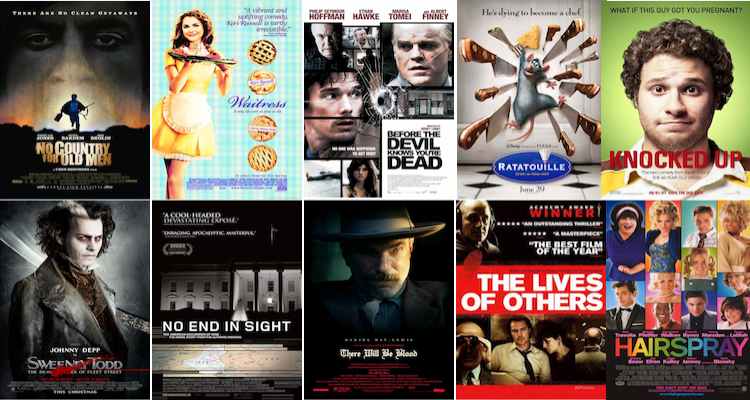

“The Best and Worst Movies of 2007” is exactly what it sounds like. It also includes some miscellaneous data and a list of Hollywood’s Shameful Secrets© for 2007.

“Eric’s Media Inventory: What I Watched and Read in 2007” is, curiously, also exactly what it sounds like. This is the one that maybe is only interesting to me, so you’re allowed to skip it if you want to.

Finally, this week’s “Snide Remarks” is, naturally, “The Best of ‘Snide Remarks’: 2007,” a collection of my favorite chunks from this year’s columns.

Have a safe and enjoyable New Year’s Eve, and I’ll see you in 2008!

This week’s “Snide Remarks,” including the audio version, is here.
The audio version (i.e., the podcast) is also here.
Subscribe to the podcast’s feed here.

The Best and Worst Movies of 2007

0
The Best and Worst Movies of 2007

When 2007 began, some feared it would be a terrible year for movies, mostly because of the slew of “threequels” that threatened to dominate the summer. But as it turns out, 2007 was a fantastic movie year, one of the best in recent memory. For the most part, even those threequels were OK.

I reviewed 254 movies this year and watched another 44 new releases (mostly at film festivals) that I didn’t review. I took January off, but I still wound up seeing most of those films on DVD. The only wide releases (1,000+ screens) that I missed altogether were: “The Abandoned,” “Aliens vs. Predator: Requiem,” “Code Name: The Cleaner,” “Daddy’s Little Girls,” “Dragon Wars,” “Epic Movie,” “Feel the Noise,” “Freedom Writers,” “The Nanny Diaries,” “The Perfect Holiday,” “Sarah Landon and the Paranormal Hour,” and “This Christmas.” I don’t see any serious contenders for the Top 10 list there, though I do see a couple that might have made the Bottom 10.

“Chicago” revived Hollywood’s taste for musicals in 2002, and while it took a few years and some mistakes to get it going, the genre is now in full bloom again. I count six full-blown musicals released in 2007: “Hairspray,” “Sweeney Todd,” “Once,” “Across the Universe,” “Enchanted,” and “Romance & Cigarettes.” “Southland Tales” has a musical number. “I’m Not There,” “La Vie En Rose,” and “Walk Hard: The Dewey Cox Story” are musical biopics (one satirical) in which the characters perform frequently.

The “Bratz” girls do a song. “Alvin and the Chipmunks” “sing,” if you can call it that. “High School Musical 2” was a huge made-for-TV hit. Michael Cera sings “These Eyes” in one of “Superbad’s” more memorable scenes. And who could forget the simple, sweet song that Keri Russell sings in “Waitress”? “Baby don’t you cry, gonna make a pie, gonna make a pie with a heart in the middle….”

But all was not sweetness and light and toe-tapping melodies in 2007! Revenge, murder, and greed were major themes, too, as found in “No Country for Old Men,” “Before the Devil Knows You’re Dead,” “Sweeney Todd,” and “There Will Be Blood,” to name a few of the best ones.

Here are what I believe to be the best films of 2007. It’s a pretty eclectic mix: musicals, R-rated comedies, G-rated cartoons, documentaries, foreign films, war movies, and revenge thrillers. I can find no overarching theme among the top 10 except that they’re all really, really good movies. Here’s hoping 2008 is filled with more of them.

The Best Movies of 2007:

1. “No Country for Old Men” Sometimes I’m ambivalent about the order of my top four or five movies. Not this year. “No Country for Old Men” made the list as soon as I saw it, and it hit the #1 spot when I saw it a second time. It’s the closest thing to a perfect movie that I saw all year, richly detailed, beautifully constructed — and it doesn’t forget to be entertaining, either.

The film does not end the way you want or expect it to. But further reflection on it — or, as in my case, a second viewing — confirms that it’s the “right” ending. Once you understand the story’s themes and ideas, the ending is perfectly satisfying and sensible. It’s only when you are stuck in the mindset that this is a Straightforward Crime Thriller, and thus that the bad guy must be caught and the good guys must succeed, that the finale seems wrong.

Look at the lengthy list of comments posted on my review of it. Viewers have offered some analyses that are astonishingly insightful and intelligent. You can reasonably discuss several different “messages” or “points” of the film without being completely off-base. How many movies lend themselves to that kind of conversation?

And yet it is not an “artsy” or incoherent movie, either. It’s not like “Donnie Darko,” where nothing makes sense and you have to sit around and try to figure out what’s going on. The narrative itself is straightforward. Except for one scene where it’s uncertain whether two particular characters are actually in the same room at the same time, there are no elements of the story — that is, the actual events of the plot — that are ambiguous. This happens; that happens; this person dies; so does that one; etc. Some elements of the plot are more clear than others, but it’s all there.

2. “Waitress” A film that’s genuinely, lastingly uplifting to one’s spirits is rare. I saw “Waitress” at the Sundance Film Festival in January and was blown away by its tartly funny dialogue, its elegant solution to its story’s thorny dilemma (what do you do when you the husband you hate gets you pregnant and you fall in love with your married gynecologist?), and its sunny — but not naive or blindly optimistic — outlook. The performances by Keri Russell, Nathan Fillion, Adrienne Shelly, Cheryl Hines, and Andy Griffith are sweet and endearing. “No Country for Old Men” is a “better” film in that it’s deeper, weightier, and more generally accomplished. But “Waitress” is the film from 2007 that I love the most.

3. “Before the Devil Knows You’re Dead” I warned earlier against assuming “No Country for Old Men” is a Straightforward Crime Thriller. “Before the Devil Knows You’re Dead,” on the other hand, is exactly that. In fact, it’s so straightforward that you can guess pretty early on who will live and who will die. That knowledge comes in the form of a sinking feeling, the sense that just as in the Greek tragedies the film resembles, greed and hubris will be punished. The thrills come from two sources: suspense over how, exactly, things will shake out, and the fierce performances by Philip Seymour Hoffman, Ethan Hawke, Marisa Tomei, and Albert Finney.

4. “Ratatouille” This may have been Pixar’s toughest sell yet. Who wants to see a movie with an unfamiliar foreign word for its title and a rat for its main character? As yet “Ratatouille” is an ingenious mix of old-fashioned cartoon humor, thoughtful ideas on art and talent, and breathtakingly beautiful animation. This is what digital projection was made for: an animated film where every frame is a work of art.

5. “Knocked Up” and “Superbad” The nice thing about making your own list is that you can cheat. Separately, these films would be among the Honorable Mentions: great films, but slightly flawed, and surpassed in excellence by at least 10 others this year. But taken together — and why not take them together, with their release dates bookending the summer, their similarly raunchy-but-sweet stories, and their overlapping producers, directors, and cast members? — they comprise an unbelievably funny four hours of smart, modern comedy.

6. “Sweeney Todd: The Demon Barber of Fleet Street” I make no apologies for admiring the intricate work of Stephen Sondheim, and for loving his macabre musical about a murderous barber. With such excellent source material to draw from, director Tim Burton did something amazing: he made the material even better. “Sweeney Todd” emerges as a dark, morbidly entertaining and horrific film. The tunes might not make you tap your toes, but the images will make you cover your eyes.

7. “No End in Sight” With calm, rational facts and interviews with key players, political scientist Charles Ferguson examines what the United States did wrong in Iraq in those crucial first few months after the fall of Baghdad. The story is scathing, eye-opening, and infuriating — and yet Ferguson’s tone never becomes strident. This is a movie that doesn’t have to raise its voice to make its points.

8. “There Will Be Blood” The story of a vile oilman in early-20th-century California is vast in every way, with a performance by Daniel Day-Lewis that’s one for the ages. You hate the character, but you sure love watching him scheme.

9. “The Lives of Others” It already won the foreign-language award at the Oscars back in February, but let’s not forget this German gem (which was released stateside in 2007), a marvelously touching look at an East German secret police agent’s transformation from automaton to human being. Ulrich Mühe gives a brilliant performance, made even more poignant by the knowledge that Mühe died of cancer just as the film as achieving its success.

10. “Hairspray” There are moments in “Hairspray” that are almost embarrassingly earnest. What’s remarkable is that it doesn’t matter. For as subversive as the basic story is — it’s based on a John Waters film, for crying out loud — this is as sincere and honest a movie as you can imagine, and fabulously high-spirted to boot. Like “Waitress,” it just plain makes you feel happy, with infectious tunes, energetic dance numbers, and a simple message that’s impossible not to like: be yourself, love yourself, and don’t try to stop the beat.

Honorable Mentions:

11. “In the Valley of Elah”
12. “Juno”
13. “Michael Clayton”
14. “Across the Universe”
15. “Eastern Promises”
16. “Lars and the Real Girl”
17. “The Host”
18. “3:10 to Yuma”
19. “The Lookout”
20. “Crazy Love”

The Worst Movies of 2007:

1. “Bratz” In the category of Movies That Are Based on a Line of Toy Dolls and That Feature Jon Voight, this one easily beats out “Transformers” for sheer awfulness. In fact, it beats out everything. It’s a flat-out terrible abortive trainwreck of a disastrous pile of worthless stupid garbage of an utter mess of a movie, and if you thought it was funny, then I have to assume you are either a 12-year-old girl, or mentally handicapped.

2. “Daddy Day Camp” Cuba Gooding Jr. answers the age-old question, “How bad does a sequel have to be for even Eddie Murphy to turn it down?” As for Cuba, no living actor is better at taking a bad film and making it completely unbearable.

3. “License to Wed” You know your movie is bad when Robin Williams is in it and he’s not even the most annoying thing about it.

4. “Delta Farce” Because “farce” sounds like “force,” you see, and Delta Force is a part of the U.S. Army. It’s a pun. Get it? Hello? Is this thing on?

5. “Wild Hogs” Tim Allen, John Travolta, and Martin Lawrence all in one movie? Did the casting director somehow have access to my nightmares?

6. “Are We Done Yet?” Because there were a lot of unanswered questions at the end of the annoying kiddie comedy “Are We There Yet?” For example, “Could Ice Cube make a movie that was worse?” And the answer is yes!

7. “Captivity” I’m sorry, but if I’m going to watch Jack Bauer’s daughter being tortured, I really need to see her caught in a bear trap and stalked by a cougar at some point.

8. “Halloween” Rob Zombie is a black-hearted monster without an ounce of talent, and no amount of threatening, hateful e-mails from his fans can convince me otherwise.

9. “Redline” Ninety-five minutes of cars driving around really fast. It was conceived, produced, and bankrolled by a millionaire real estate mogul as a vanity project for his girlfriend, and it’s approximately as good as you would expect a movie to be when it was conceived, produced, and bankrolled by a millionaire real estate mogul as a vanity project for his girlfriend.

10. “Who’s Your Caddy?” This movie makes some very good points. It turns out black people are fun and sexy while white people are racist and uptight. Now I know!

Hollywood’s Shameful Secrets

As has become trendy within the last couple years, a huge number of films were not screened for critics before they opened — almost always a sign that the studios know they’re bad and want to avoid negative opening-day reviews. Here are Hollywood’s Shameful Secrets for 2007.

“Abandoned”
“Aliens vs. Predator: Requiem”
“Awake”
“Bug” (screened in some markets, not in others)
“Captivity”
“The Comebacks”
“Daddy’s Little Girls”
“Dead Silence”
“Delta Farce”
“Feel the Noise”
“Firehouse Dog” (screened in some markets, not in others)
“Hostel II”
“Illegal Tender”
“The Invisible”
“Kickin’ It Old Skool”
“The Last Legion”
“Redline”
“Sarah Landon and the Paranormal Hour”
“Skinwalkers”
“Slow Burn”
“Stomp the Yard” (screened in some markets, not in others)
“This Christmas”
“War”
“Who’s Your Caddy?”
“Why Did I Get Married?”

These secrets are only slightly less shameful: The films were screened, but not until the night before they opened. In some cases, those screenings were at 9 or 10 p.m., and in some cases the press weren’t even invited.

“Blood and Chocolate”
“Ghost Rider”
“Halloween”
“The Hitcher”
“I Know Who Killed Me”
“The Messengers”
“Primeval”
“Reno 911!: Miami”
“Resident Evil: Extinction”
“Underdog”
“Vacancy”

Finally, these films were screened segregation-style: Critics working for newspapers were invited to a press-only screening several days in advance; online critics had to wait for a night-before-opening public screening. All of these are from the same Seattle-based publicist (who handles Fox, Sony, and Universal), making me wonder if it’s the publicist’s rule, not the studios’.

“Fantastic Four: Rise of the Silver Surfer” (Fox)
“Live Free or Die Hard” (Fox)
“The Simpsons Movie” (Fox)
“Death Sentence” (Fox)
“Hitman” (Fox)
“Across the Universe” (Sony/Revolution)
“We Own the Night” (Columbia)

Miscellaneous data:

Longest movie: (Tie) “Lady Chatterley” and “Pirates of the Caribbean: At World’s End,” both 168 min.

Shortest movie: “Them,” 77 min.

Longest title: “The Assassination of Jesse James by the Coward Robert Ford”

Shortest title: “P2”

Most enjoyable bad movies: “Skinwalkers,” “The Last Legion”

Least enjoyable good movie: “Away From Her”

Bad motorcycle-related movies in which Peter Fonda appears: “Ghost Rider,” “Wild Hogs”

Movies in which hapless persons accidentally access Internet porn and then become bumbling idiots who can’t seem to make it go away: “Because I Said So,” “Wild Hogs”

Movies with scenes in which gunshot victims use an at-home, do-it-yourself method to remove the bullet: “Seraphim Falls,” “Shooter,” “Black Book,” “No Country for Old Men”

Please stick to TV’s “Scrubs,” John C. McGinley: “Wild Hogs,” “Are We Done Yet?”

We’re tired of you too, Cuba Gooding Jr.: “Norbit,” “Daddy Day Camp”

Don’t think we’ve forgotten about you, either, Robin Williams: “License to Wed,” “August Rush”

We don’t even know why we bother with you, Jon Voight: “Bratz,” “Transformers,” “National Treasure: Book of Secrets,” “September Dawn”

Movies set mostly in or around Las Vegas: “Smokin’ Aces,” “Next,” “Ocean’s Thirteen,” “Resident Evil: Extinction,” “Lucky You”

Movies featuring frogs singing and/or playing band instruments: “Meet the Robinsons,” “Paprika,” “Shrek the Third”

Movies about unwanted pregnancies: “Knocked Up,” “Waitress,” “Stephanie Daley,” “Juno,” “August Rush”

Movies set almost entirely in hotel rooms: “Vacancy,” “Room 314,” “1408,” “Bug”

Movies set almost entirely in besieged houses or other small locations: “Them,” “Right at Your Door,” “The Mist,” “Vacancy”

Movies in which two central characters have a rushed, impromptu wedding at the end: “Pirates of the Caribbean: At World’s End,” “Fantastic Four: Rise of the Silver Surfer”

Movies in which Barry Bostwick appears and in which Nancy Drew is mentioned: “Nancy Drew,” “Evening”

Movies released on July 3 in which robots “pee” on people: A mechanical baby in “License to Wed,” and an Autobot in “Transformers.”

Movies in which the main character is a stunt driver or motorcyclist whose father was supposedly killed in the line of duty: “Ghost Rider,” “Hot Rod,” “Redline”

Movies centered around restaurants: “Waitress,” “Ratatouille,” “No Reservations”

Biopics whose titles are songs closely associated with the subjects, who are foreign-born singers who died young: “La Vie en Rose,” “El Cantante”

Non-French productions set entirely or with significant portions in France: “Rush Hour 3,” “Ratatouille,” “Broken English,” “Mr Bean’s Holiday”

Fairy tales in which a dying king must choose his heir, and a prince played by Rupert Everett wants it to be him: “Shrek the Third,” “Stardust”

Movies with childbirth scenes: “The Brothers Solomon,” “Waitress,” “Knocked Up,” “Shoot ‘Em Up,” “Eastern Promises,” “Juno,” “The Ex”

Movies whose titles have no obvious connection to the movies’ content: “Slow Burn,” “Fracture,” “Disturbia,” “Evening,” “Live Free or Die Hard,” “Superbad,” “The Last Time,” “Resident Evil: Extinction,” “Persepolis,” “Before the Devil Knows You’re Dead”

Time keeps on tickin’: “3:10 to Yuma,” “2 Days in Paris,” “The 11th Hour,” “28 Weeks Later,” “30 Days of Night”

Movies whose titles are complete sentences: “I Know Who Killed Me,” “You Kill Me,” “Why Did I Get Married?,” “I Think I Love My Wife,” “Shoot ‘Em Up,” “Are We Done Yet?,” “We Own the Night,” “There Will Be Blood,” “Who’s Your Caddy?,” “Reign Over Me,” “I’m Not There,” “I Am Legend,” “P.S. I Love You,” “Meet the Robinsons,” “Live Free or Die Hard”

One-word, nine-letter movies: “Rendition,” “Atonement,” “Delirious,” “Interview,” “Enchanted,” “Halloween,” “Hairspray,” “Captivity,” “Disturbia”

Movie movies: “Epic Movie,” “Bee Movie,” “The Simpsons Movie”

Why so formal?: “Mr Bean’s Holiday,” “Mr. Brooks,” “Mr. Woodcock,” “Mr. Magorium’s Wonder Emporium”

Movies titled by 13-year-old boys: “Mr. Woodcock,” “Walk Hard: The Dewey Cox Story,” “Balls of Fury”

Movies that saved a wretch like me: “Amazing Grace,” “Gracie,” “Grace Is Gone”

So much killing!: “Death Sentence,” “Death Proof,” “Death at a Funeral,” “Dead Silence,” “You Kill Me,” “I Know Who Killed Me,” “Before the Devil Knows You’re Dead,” “Live Free or Die Hard”

Movies in which many crows or ravens gathering is a bad omen: “The Messengers,” “Resident Evil: Extinction,” “The Seeker: The Dark Is Rising”

Movies with narrators who are not characters in the film: “Rocket Science,” “The Assassination of Jesse James by the Coward Robert Ford,” “Fred Claus,” “Enchanted,” “Stardust”

Movies with mariachi bands: “Bratz,” “The Heartbreak Kid,” “No Country for Old Men”

in which Josh Brolin shoots a dog: “No Country for Old Men,” “American Gangster”

Movies in which a human is surprised to discover that an animal can communicate with him or her: “Ratatouille,” “Underdog,” “Bee Movie,” “Alvin and the Chipmunks,” “Enchanted”

Movies featuring Cat Stevens’ “Don’t Be Shy”: “Sicko,” “Martian Child,” “Mr. Magorium’s Wonder Emporium”

Movies in which wacky things happen in bowling alleys: “Martian Child,” “Dan in Real Life,” “Across the Universe,” “Lars and the Real Girl”

Movies dealing with Middle East politics of the 1980s: “Persepolis,” “The Kite Runner,” “Charlie Wilson’s War”

* * * * *

Past “Best/Worst” lists:
2006
2005
2004
2003
2002
2001
2000
1999

Media Inventory: What I Watched and Read in 2007

0
Media Inventory: What I Watched and Read in 2007

Whoever thought of measuring time in “years” is awesome! If time just continued endlessly, without starting over every 12 months or so, we’d be deprived of end-of-the-year features like this one. And then where would we be?

This is simply my recounting of the movies and TV shows I watched, and the books I read, in 2007. I used to talk about the theater productions I saw, too, but there were only a couple this year, and it’s not like you could go watch them now anyway.

As always, this feature might be of interest to no one except me, and you are welcome to skip it if you like. None of this will be on the midterm.

MOVIES

I started the year by taking a hiatus from reviewing new releases throughout January, my first such break since I started in 1999. I used the time to catch up on old films I’d never seen before. It was my goal throughout the year to watch as many classics as I could, and there were some real gems that I was glad to have finally experienced. None of those January movies were too important, and I wound up seeing a lot of them when I reviewed their DVD releases for DVD Talk anyway. So everybody wins!

As for those classics, I used Turner Classic Movies, TiVo, and Netflix to accomplish my goals there. TCM are TiVo are especially useful when watching extraordinarily long films such as “Ben-Hur,” “Gone with the Wind,” and “Lawrence of Arabia.” I think I watched each of them in three chunks (and yes, I’d never seen any of them before).

I’ve generally not been one to watch films over and over again, even ones I really like, simply because I’m curious about the undiscovered treasures still awaiting me. But for some reason in 2007 I grew more fond of taking a second look at movies, particularly ones that I wasn’t sure about.

Nowhere was this more important than with “No Country for Old Men.” I loved it immediately, and when the ending didn’t sit right, I could tell it was because I was missing something, not because the filmmakers or the author they were adapting had screwed up. I don’t think that’s the case with every film, of course — plenty of movies really are just badly made — but in this instance, I sensed there was something there that I just wasn’t “getting.”

So I watched it again. This time everything clicked into place. The thematic elements that I’d missed the first time came through loud and clear. And this wasn’t a case of the filmmakers being obscure, forcing you to see their movie twice just to make sense of it. It’s perfectly “gettable” in one pass; it just took two for it to work on me.

On the other hand, there’s “Eagle vs Shark.” I saw it in conjunction with the Portland International Film Festival in February and disliked it, then was surprised to find that several people whose comedic tastes generally run parallel to mine loved it. That wouldn’t be such a big deal, except that in this case I remembered my screening had been marred by an early-morning start time and a lousy seat in an uncomfortable theater. Perhaps my professionalism was slipping and I had allowed external factors to influence my opinion?

So I watched it again, under better circumstances, fully open to the possibility of loving it. And guess what? Still didn’t like it. Sorry, “Eagle vs Shark.” I gave you two chances.

Same goes for “Diary of a Mad Black Woman,” which I re-watched while reviewing a new DVD edition of it, genuinely curious to see if I could discover why so many people loved it. Nope: It’s still a terrible movie, and the DVD extras made me dislike the falsely humble but actually egomaniacal Tyler Perry even more.

When the new “Blade Runner” final cut was released, it was my first exposure to the film. I found it slow and not exactly laden with content. (The story itself is pretty simple.) But I knew it was revered by many, and when a friend of mine wanted to see it on the big screen I went with him to give it another look. I still don’t love it, but I can appreciate the level of expertise in the special effects (which were particularly good for 1982) and the overall uniqueness of Ridley Scott’s vision.

Consider also “Killer of Sheep,” a film that won the critics’ award at the Berlin Film Festival in 1977 and then circulated underground for years, but didn’t get an actual theatrical release until 2007. It seems the filmmaker, Charles Burnett, was never able to afford the rights to some of the music used in it, and it wasn’t until Steven Soderbergh and some others stepped in and helped out that the film finally got its due.

The press screening of this much-loved-in-certain-circles underground classic left me underwhelmed. I understood it for what it was — a neo-realist look at how it was to be poor and black in Los Angeles in the 1970s — but I didn’t quite get what all the fuss was about. Yet once again, the film continued to be raved about by many film writers, so when the distributor offered copies of the DVD in late November, I took advantage of the opportunity to see it again. It had a greater impact the second time (particularly the natural, unaffected performances), and as with “Blade Runner,” I can appreciate certain qualities about it without actually loving it.

I especially tried to re-watch the movies I was considering for my top 10 list, which was necessary because so many films were competing for a spot. (It was a good year for movies.) I discovered that while “300” is an amazing spectacle on the big screen with an overpowering sound system, it loses quite a bit on DVD with an average TV and generic speakers. I found that “Hairspray” and “Waitress” made me just as happy the second time as they did the first time. I learned that my theory about “Before the Devil Knows You’re Dead” was true: Even though you know what’s going to happen when you watch it again, you can still be enthralled by the outstanding performances.

In all, I watched 371 movies in 2007 (including 17 duplicates). Here’s the list of everything.

2007 releases that I saw and reviewed:
The list is here if you want to see every single film I actually reviewed this year.

2007 releases that I saw but did not review (you can read my Sundance and SXSW diaries for brief notes on some of them):
“638 Ways to Kill Castro” (SXSW)
“After the Wedding”
“All the Boys Love Mandy Lane” (SXSW)
“American Fork” (Slamdance)
“Away from Her”
“Blood and Chocolate”
“Borderland” (SXSW)
“Brand Upon the Brain!”
“Cashback” (SXSW)
“Chapter 27”* (Sundance)
“Cherry Valley” (SXSW)
“Confessions of a Superhero” (SXSW)
“Everything’s Gone Green” (SXSW)
“Exiled” (SXSW)
“Fall From Grace” (SXSW)
“Fay Grim” (Sundance)
“Frownland” (SXSW)
“The Go-Getter” (Sundance)
“Grimm Love” (SXSW)
“Hear and Now” (Portland Film Festival)
“Helvetica” (SXSW)
“He Was a Quiet Man” (SXSW)
“Hounddog” (Sundance)
“Joe Strummer: The Future Is Unwritten”
“Killer of Sheep” (twice)
“The King of Kong”
“A Lawyer Walks into a Bar…” (SXSW)
“Life of Reilly”
“Lost in Woonsocket” (SXSW)
“Manufacturing Dissent” (SXSW)
“Moving McAllister”
“Mulberry Street” (SXSW)
“The Nines” (Sundance)
“Orphans” (SXSW)
“The Prisoner, or How I Planned to Kill Tony Blair” (SXSW)
“Severance” (SXSW)
“Smiley Face” (Sundance)
“Snow Angels”* (Sundance)
“Skills Like This” (SXSW)
“Steal a Pencil for Me” (SXSW)
“This Is England”
“When a Man Falls in the Forest” (SXSW)
“The Wind That Shakes the Barley”

(*I eventually did review these movies.)

2007 releases that I watched twice:
“300”
“Before the Devil Knows You’re Dead”
“Eagle vs Shark”
“Eastern Promises”
“Hairspray”
“Hot Fuzz”
“Knocked Up”
“The Lookout”
“No Country for Old Men”
“Paprika”
“Ratatouille”
“Shrek the Third”
“The Simpsons Movie”
“Stalking Santa”
“Superbad”
“Persepolis”
“Waitress”

Pre-2007 releases that I had seen before, and reviewed, that I re-watched this year:
“Diary of a Mad Black Woman”
“Elf”
“Fight Club”
“O Brother, Where Art Thou?”
“Singles Ward”
“Toy Story 2”
“The Triplets of Belleville”
“Wild Tigers I Have Known”

Pre-2007 releases that I had seen before but did not review, that I re-watched this year:
“Ace in the Hole”
“Annie Hall”
“Babes in Toyland”
“Being John Malkovich”
“Gremlins”
“Jungle Book”
“Lady and the Tramp”
“The Little Mermaid”
“North By Northwest”
“Poltergeist”
“Raging Bull”
“Sleeping Beauty”
“Twilight Zone: The Movie”
“Wake Up, Ron Burgundy”

Movies from various years that I saw for the first time and reviewed for DVD Talk:
“Family Law”
“The Last Time”
“Re-Animated” (made-for-TV movie)
“Screen Door Jesus”

Pre-2007 releases that I saw for the first time this year:
“12 Angry Men”
“The Age of Innocence”
“Beauty and the Beast” (1946)
“Ben-Hur”
“The Big Heat”
“Blacula”
“Blade Runner” (twice)
“Blowup”
“Breathless”
“Elizabeth”
“Five Easy Pieces”
“George Washington”
“Glengarry Glen Ross”
“Gone with the Wind” (I know!)
“Harold and Maude”
“Heat”
“His Girl Friday”
“Idiocracy”
“Lawrence of Arabia”
“The Man Who Shot Liberty Valance”
“MASH”
“Metropolis”
“Rambo: First Blood Part II”
“Rashomon”
“Reds”
“Rio Grande”
“Robocop”
“Shane”
“The Shootist”
“Sleuth” (1972)
“Sling Blade”
“Spartacus”
“Sunset Blvd.”
“The Third Man”

TELEVISION

I have watched less and less TV every year since I started keeping track in 2004. That year I watched 767 hours; in 2005 it was 539, then 457 in 2006. In 2007 I watched just 343 hours, less than half of what I watched in 2004. That’s not even an hour a day. And considering I TiVo everything and skip the commercials, I watched those 343 hours of programming in about 260 hours — or a scant 42 minutes per day in front of the TV set. Clearly I have failed as an American.

The amazing part (to me, anyway) is that I love TV! Believe me, it has not been a conscious decision to watch less television. I’ve just been busier with movie-watching and other activities (writing, most notably), and I’ve cut loose a lot of shows that are good enough but that I simply don’t have time for. In 2008 I pledge to watch more TV.

Shows I watched regularly (more than six episodes):

“24”
“30 Rock”
“Aliens in America”
“Campus Ladies”
“Curb Your Enthusiasm”
“Family Guy”
“Friday Night Lights”
“Heroes”
“It’s Always Sunny in Philadelphia”
“Law & Order”
“Law & Order: SVU”
“Lost”
“The Office”
“Pushing Daisies”
“Rescue Me”
“Saturday Night Live”
“Scrubs”
“The Shield”
“The Simpsons”
“The Sopranos”
“South Park”
“Veronica Mars”

My favorite shows in 2007:

1. “30 Rock” (NBC): This show was funny when it premiered in the fall of 2006. Since then it has only gotten better, each episode a dizzying cavalcade of punchy humor, bizarre tangents, and pure Alec Baldwin-y goodness.

2. “Friday Night Lights” (NBC): The second season has suffered just a little from a plot line that nobody believes, but the rest of the show is as good-hearted, decent, and engrossing as anything on television.

3. “The Sopranos” (HBO): Everyone talked about the ending (which I liked) so much that it overshadowed what came before it: a crackerjack final season full of surprises, inevitabilities, and whackings. So many whackings.

4. “Pushing Daisies” (ABC): The best new show of the strike-abbreviated fall season! I love every whimsical, imaginative, cutesy second of it.

5. “The Shield” (FX): This show is a marvel. The sixth season aired this year, and it was every bit as good as the five seasons before it. How many shows maintain that level of quality year after year?

BOOKS

I read 21 books this year, including 18 novels and three non-fiction titles. I started but did not finish a few others due to a longstanding policy that if a book isn’t doin’ it for me within 50 pages, I give up. I’ll stick with a bad movie to the end, but books take longer to read than movies take to watch, so I have to draw a line.

One of the books I attempted was “Pride and Prejudice,” by Jane Austen. With the barrage of Austen-related movies being released, I figured I should finally read one of her novels. It began well enough for me, and I found it cute and funny and charming, and then after about 50 pages the charm wore off and I quit. Sorry. Just not my cup of tea.

Here’s what I read in 2007. The fact that I finished them suggests I enjoyed them to some degree; titles I particularly recommend are asterisked.

“1776,” by David McCullough. Somewhat stiff but overall enlightening account of the American Revolution. McCullough’s insights on the character and personality traits of George Washington are especially interesting.

“Apathy and Other Small Victories,” by Paul Neilan. A slim, sardonic novel about a shiftless man in his late 20s who, like so many of his generation, views the world with laziness, irony, scorn, and apathy. When he is halfheartedly accused of the murder of his dentist’s deaf receptionist, can he muster the energy to defend himself? The tone throughout is laugh-out-loud funny in a caustic, who-gives-a-crap way. The protagonist, Shane, is like Holden Caulfield for the early-21st-century hipster generation.

“The Boy Detective Fails,” by Joe Meno. Funny and strangely touching is this breezy novel about a former boy detective (think Encyclopedia Brown) who spent some time in a mental institution and is now trying to come to grips with his sister’s death. Death is the ultimate mystery, of course, and our hero’s realization (and acceptance of the fact) that not all mysteries are solvable is sublime.

“Bridget Jones’s Diary,” by Helen Fielding. Listened to it on CD. Found it v. enjoyable, actually.

“End of Story,” by Peter Abrahams. Half-decent thriller about a would-be writer who teaches a creative writing class at a prison, where she is strangely attracted to one of the inmates. She comes to believe he’s innocent of his supposed crimes and gets way too involved. I found the ending rather disappointing.

** “Fablehaven: Rise of the Evening Star,” by Brandon Mull. If there was any question before that Mull deserves to inherit the Harry Potter audience, this should settle it. This sequel — about a young boy and girl whose grandparents are caretakers of a magical preserve — is even more inventive, more whimsically outrageous, and more fun than the first book.

** “Finn,” by Jon Clinch. It is the story of Huck Finn’s father, a minor but sinister character in Twain’s novel, his story here fleshed out by a very imaginative and accomplished author. He’s a tragic, mean figure, and Clinch writes exquisitely.

“For Whom the Bell Tolls,” by Ernest Hemingway. Turns out the only Hemingway I’d ever read was “The Old Man and the Sea,” in junior high school. “For Whom the Bell Tolls” is set during the Spanish Civil War, with an American soldier helping a guerrilla group fight against the fascists. Hemingway writes the story as if it had been translated directly from Spanish (so people say “What passes? instead of “What’s going on?,” for example), which gives it an air of formality that can be off-putting at times but extremely beautiful in other cases.

“Harry Potter and the Deathly Hallows,” by J.K. Rowling. A little-known work in the children’s fantasy genre.

** “Heart-Shaped Box,” by Joe Hill. I don’t read a lot of scary novels, so maybe it doesn’t count for much when I say this is the scariest thing I’ve ever read. It’s about an aging heavy-metal rockstar who buys a ghost on the Internet on a whim — and the ghost turns out to be real, and angry, and scary.

** “Lies My Teacher Told Me,” by Joe Loewen. The title is more inflammatory than it needs to be, but the book is excellent. Loewen, a historian, examines the dozen or so most popular high school history textbooks — and rips them apart for their inaccuracies, their dullness, and their whitewashing of American history. Many Americans grow up with false or incomplete ideas about their nation’s past, and Loewen’s lively and well-sourced book seeks to correct that.

“My Holocaust,” by Tova Reich. A relentlessly savage satire about the modern-day religion of Victimism, where everybody wants in on the martyr action in order to feel special about themselves. Reich mocks her fellow Jews who worship at the altar of the Holocaust, using it to define themselves and their religion above everything else. She also has stinging barbs for other religions and groups who try make their persecutions and trials match up with those of the Jews, everyone eager to wrench a piece of the sympathy market away from them. Funny stuff.

“Nineteen Minutes,” by Jodi Picoult. A very good novel about the aftermath of a high-school shooting, following the lives of several key figures: the picked-on shooter, the survivors, the judge who must hear the case, the lawyers who must try it, and the killer’s mother. The relationships between all these people are explored with no easy summations or black-and-white answers. Everybody is somebody’s child. Everybody has a story.

** “The Road,” by Cormac McCarthy. The post-apocalyptic story of a man walking the roads of ruined America with his little boy is one of the most beautiful, emotionally devastating books I’ve ever read.

“A Spot of Bother,” by Mark Haddon. From the author of the excellent “Curious Incident of the Dog in the Nighttime” comes this amusing story about a family: aged father is slowly losing his mind, mother is having a guilty affair, brother is gay, sister is about to get married to a dunderhead. Haddon has a very impressive ability to make us see the world through each person’s eyes so well that we empathize with everyone.

“Stranger Than Fiction: True Stories,” by Chuck Palahniuk. Not as enjoyable as his fiction, but there are some good tales in here.

“The Terror,” by Dan Simmons. There really was a British ship that got lost in the Arctic in the 1840s while searching for the Northwest Passage. This suspense novel fictionalizes the trip and speculates on what happened: there might have been a terrifying ice monster. Pretty gripping at times, though I’m not entirely satisfied with the turn things take in the end.

“The Time Traveler’s Wife,” by Audrey Niffenegger. I finally got around to reading the book everyone was talking about a few years ago. I like the mix of romance and science-fiction, and I like Niffenegger’s spare, descriptive style.

“Water for Elephants,” by Sara Gruen. Wanna know what life was like for circus workers during the Depression? This novel, which spins a fine yarn about love triangles among performers and animal trainers, is just the thing.

** “World War Z,” by Max Brooks. What if there were a huge zombie outbreak? How would it affect the world’s economies, societies, and governments? Brooks’ hugely entertaining novel answers those questions ingeniously. Lots of fun.

** “The Yiddish Policeman’s Union,” by Michael Chabon. My favorite author imagines a world where, instead of the nation of Israel being formed after World War II, the Jews were given their own spot in Alaska. This novel is a mixture of Jewish mysticism and hard-boiled detective fiction that only someone as clever and imaginative as Chabon could come up with.

* * * * *

Past media inventories:
2006
2005
2004

The Best of ‘Snide Remarks’: 2007

0

Some call it momentous. Some call it groundbreaking. Some call it lazy. Whatever it is, it’s my favorite chunks from this year’s “Snide Remarks” columns, cobbled together into one easy-to-digest serving….

My fat brother Jeff and his wife, non-fat Beth, are teaching my 2-year-old niece sign language. I think this shows remarkable foresight on their part, because you never know when you’re going to be deaf. You think Helen Keller saw it coming? I doubt it. — “Uncle What’s-His-Name”

A world where everyone caters endlessly to the whim of 2-year-olds is a world where nothing is accomplished and where the Wiggles are the president of the United States. We can’t have that, people. We must eventually put a stop to the nonsense and get back to work. We must also see to it that the Wiggles are dealt with appropriately, not elected to the presidency but executed in the town square, their heads displayed on pikes outside the city walls as a warning to others. — “Uncle What’s-His-Name”

Not many celebrities are indigenous to Utah. The air is too thin, the liquor too inaccessible. They prefer to live in the more fertile climes of California. The few celebrities that are native to the Beehive State tend to be lesser sub-species, like Wilford Brimley. And the types rarely mix: If Wilford Brimley were to try to join a pack of Hollywood celebrities, they would tear his ample, walrusy flesh from his bones. — “The Audubon Society’s Guide to Celebrity Watching”

I don’t know if you’ve taken a gander at the ol’ U.S. map lately, but Ohio is not where you think it is. You’re thinking it’s in the Midwest somewhere, maybe next to Nebraska or something. BUT NO SIR! It is way the hell east, past the Mississippi River, into the Eastern Time Zone, nowhere NEAR the Midwest. It’s practically in Europe. Anyone who is from Ohio who claims to be from the Midwest is a liar. You should punch that person right in his corn-fed pie-hole. — “Not Very Progressive”

The car had recently had engine work done, so everything was in top shape in that regard. Its only defect was that its four tires were showing the same signs of age that humans do: they’d become bald, wobbly, and prone to expelling their air. — “Prizm Break”

The only time clowns are ever funny is when they don’t intend to be — when a car full of them overturns on the highway, for example, and 30 sad-faced harlequins come crawling out, bleeding and wounded, their red noses honking as they collapse face-down on the pavement. — “Send in the Clowns … TO HELL!”

Utah is overwhelmingly Mormon, and Mormons are overwhelmingly conservative and Republican. The Republican Party could put up a jar of angry bees as its presidential candidate and Utahns would still vote for it. If the Lord Himself came down from heaven and ran as a Democrat, He would not win in Utah. “What’s with all this ‘love thy neighbor’ business?” Utahns would say. “How are we going to win the War on Terror with that attitude?!” — “Cheney Roast”

Limbo is for people who led good lives but who died before Jesus’ time, and for infants and children who died without being baptized. It’s a nice place, full of perpetual happiness and lollipops and bunnies and so forth, but God isn’t there, so it doesn’t have quite the full awesomeness of heaven. Also, it’s near the interstate, so you get a lot of traffic noise. — “Out on a Limbo”

[Queen Elizabeth II:] It is our first visit to the colonies in 16 years, and not much seems to have changed. Still the same 13 colonies plus goodness knows how many extra, sub-colonies. (That gaudy American flag is littered with stars!) People still drive their automobiles on the right — which is to say the wrong — side of the road. The subjects continue to be v. casual and informal in their behaviour, even to the point of stubbornness. For example, the colony of Massachusetts has not paid me its Tea Tax in over 200 years! To me that sounds like good cause for a beheading. — “Windsor? I Hardly Knew Her”

We don’t really do forced sterilization in the United States anymore. It’s had a negative connotation ever since the Nazis tried it. They ruined it for everyone, just like the square mustache and the goose-step. — “Two to a Womb”

Now, I don’t know who invented the catheter, but I’m pretty sure it was someone who was completely unfamiliar with male anatomy. A nun, perhaps, or Jodie Foster. The urethra is a very narrow tube, while the catheter is a very wide tube. I saw the catheter, and I saw what the nurses planned to do with it, and I thought, “What? Are you kidding me? You think that’s going to fit? I’m flattered that you think I have such a roomy urethra, but seriously, ladies.” It was going to be like shoving a hot dog into a drinking straw. — “Urine Trouble”

Pamplona’s Running of the Bulls is a great example of how screwed-up men’s thinking can be. “How can we demonstrate to ourselves and the world that we are courageous and brave? I know! By putting ourselves in danger … and then running away from it!” Yes, there’s no better way to establish your manliness than by fleeing in terror from something. — “Inexcusabull Behavior”

Just because it was summertime, however, don’t think there weren’t any serious and thought-provoking films. The documentary “Sicko” made many people contemplate a very important issue, i.e., whether or not Michael Moore is a fat fat fatty. “I Now Pronounce You Chuck & Larry” addressed the topic of gay marriage and confused many Adam Sandler fans by coming out against gay-bashing. And “Harry Potter and the Order of the Phoenix” warned against the dangers of letting women be in charge of schools. — “Smells Like Summer”

The latest statistics indicate that if you were to take all the excess fat from every American and put it into a big, giant pot and boil it, the Americans would dip Snickers bars into it and eat them. How fat are we? In the late 1950s, it was faddish for college students to see how many people they could cram into a phone booth. The record was 25. When a group of average Americans tried to duplicate that feat last year, the most they could fit was zero, because phone booths don’t exist anymore. Some researchers believe that this is because we have eaten them. — “Ahead of the Curves”

Some conservatives were very angry when Gore got the Nobel Peace Prize. This is because some conservatives are very angry whenever anything good happens to Al Gore. If his daughter gave him a “World’s Best Dad” coffee mug for Fathers Day, Rush Limbaugh would scream about it for weeks, in between fistfuls of narcotics and pie. — “A Nobel Gesture”

The saggy pants trend began in hip-hop culture and has spread among white and Latino youth, but it’s still mostly urban black kids who embrace the style. The look is part of the “gangsta” image. Somehow, wearing your pants so you look like a confused old man on “America’s Funniest Home Videos” is meant to make you seem tougher. Maybe the idea is that you’re so tough, you don’t have to worry about running away from anything, and to prove it you incapacitate yourself by belting your trousers around your knees. — “The Saggy-Bottom Boys”

A Liberal’s Guide to the Perfect Thanksgiving: Before you eat, allow everyone at the table a moment to silently pray to, or otherwise thank, God, Mother Earth, or whichever higher power they worship, if they worship one — unless it’s the Christian God, in which case they really ought to stop cramming that down everyone’s throats and try to have a little respect for other people’s beliefs. At the end of the meal, offer a toast to the blessing everyone at the table appreciates most: the fact that Canada is so close by, making their empty threats of moving there seem almost believable. — “The Perfect Thanksgiving”

Door-to-door salesmen have been a part of American life for decades. The death of a salesman was even the subject of a famous play (“The Crucible”). — “You Panhandle the Truth”

The December issue of Details magazine has a story entitled “Are you turning your kid into a douchebag?,” which is like Sports Illustrated running an article called “Are you turning your kid into a sports fan?” — “Unresolved Issues”

What can you talk about when you’re wearing $800 pants? If it were me, all I’d be able to talk about would be the fact that my pants cost $800, and how I was terrified of spilling food on them. Or farting! You can’t fart in $800 pants, especially considering that if you’re wearing $800 pants, you’re probably also wearing $75 underwear! — “Unresolved Issues”

Where are the end-of-the-year features?

0

Astute readers may have noticed that this is the last Friday of the year, and thus the time when I should be posting my “Best and Worst Movies of 2007” article and related features. They will be posted by Monday.

There are two reasons for the delay. One is that I didn’t accomplish as much during my week-long visit to the ancestral Snider homeland as I thought I would, waylaid as I was by family merriment and some under-the-weatherness.

The greater reason is that the studios made us wait a little longer than usual this year to see some of the key potential-top-ten-list films. It’s impossible to see everything in a year, of course, but this year there were a few titles I noticed appearing on other critics’ lists that I hadn’t seen yet. Then there were a few others that I had seen but wanted to revisit before finalizing my list. I’m trying to avoid the trap of “Well, this A- movie I saw in November is fresher in my mind than the A- movie I saw in March, so I’ll put it on the list and bump the March one.”

So I’m giving myself the weekend to get everything together. I might sneak in and post stuff early, but for sure it will be there by Monday. It’s probably best to just crawl into bed and sleep the weekend away to make the time go faster.

Friday movie roundup – Dec. 28

2

With the heaping helping we got last Friday and on Christmas Day, we certainly don’t need any new movies today — and Hollywood was glad to oblige! Nothing opens wide today. Next week, only one thing opens wide (“One Missed Call”), and it’s barely being screened. So you have some time to catch up on what you’ve missed without falling behind.

“In the Dark” this week focuses on three limited-release pictures, all of which are worth seeking out (or waiting for, as the case may be).

Sure to be an Oscar contender is “There Will Be Blood,” starring Daniel Day-Lewis as a devious early 20th century oilman. It’s from Paul Thomas Anderson, director of “Magnolia” and “Punch-Drunk Love,” and it’s even better than both of those films.

Also generating buzz is “Persepolis,” an animated film about a young girl growing up during the Iranian Revolution of the late 1970s. It’s France’s submission for the foreign-language category at the Oscars, and it’s sure to be nominated in the animation category, too. It’s a marvelous little movie.

Finally, there’s “The Savages,” about two grown-up siblings figuring out what to do with their aging father. Philip Seymour Hoffman and Laura Linney star. It’s funny and poignant and stuff.

Sign up for the “In the Dark” e-zine here.
Listen to this week’s podcast version here.
Subscribe to the podcast’s feed here.

The Orphanage (Spanish)

0

If you ever find yourself in Spain, do not visit any orphanages, for they are all haunted. Guillermo del Toro has taught us this, first by directing the chilling “Devil’s Backbone” and now by producing something simply called “The Orphanage,” which is as tingly and creepy a ghost story as you could wish for, recalling classics like “Poltergeist,” “The Sixth Sense,” and “The Others.”

Our story unfolds thanks to the actions of someone who apparently never learned that lesson about orphanages. Her name is Laura (Belén Rueda), and she has recently bought the orphanage she grew up in, intending to fix it up and use it as a home for special-needs children. She and her husband, Carlos (Fernando Cayo), are making the necessary repairs while their adopted little boy, Simón (Roger Príncep), plays with his imaginary friends. Laura and Carlos figure he’ll grow out of that once some real children move in.

As you have no doubt surmised, Simón’s friends soon prove to be slightly more than imaginary, and strange occurrences ensue. Finally, on the day of the open house, Simón disappears. He cannot be found. Laura and Carlos are heartbroken, Laura in particular. The cherubic lad is sick and needs medication regularly. Where could he be?

Days pass. Laura starts to hear things. Objects within the house inexplicably appear in places she didn’t put them. She hires a psychic (Geraldine Chaplin) and her crew to investigate the house for signs of paranormal activity, while Carlos scoffs.

The lean and thoughtful screenplay (by first-timer Sergio G. Sánchez) includes all the ingredients needed for a shivery ghost movie, first in the huge, dark house itself, and then in the nearby lighthouse, caves, and rocky seashore. There’s a kid running around in an extraordinarily unsettling scarecrow-face mask. A bug-eyed old social worker named Benigna (Montserrat Carulla) shows up to inquire as to Simón’s health; that night Laura catches the old bat lurking in the tool shed with a shovel! Later Benigna is involved in something surprising and horrible and fantastic. I could list delightfully creepy details like this all day.

There is imagination in the “games” played by the ghosts, which Simón explains to Laura, and director J.A. Bayona — making his first feature film — creates urgency and panic in them, too. A few of the film’s scares are cheap tricks like things popping out suddenly, but an impressive majority are better than that. The story creates situations that are genuinely suspenseful and nerve-racking, scary without being gross — well, except for one part — and liable to make you jump and laugh and cover your eyes and grab your armrest and maybe look behind a few doors before you turn off the lights tonight.

The unexpected element is that it’s not just a ghost story. It’s also a fable about motherly love and devotion, and a remarkably tender one at that. Belén Rueda’s performance as the frantic Laura is poignant, sure to earn the sympathy of every parent in the audience. A movie can be great solely on the basis of being scary, of course, but an added dimension like this one really helps it hit home.

More Film.com articles for your perusal

3

A roundup of what I’ve written at Film.com since the last time I did one of these updates. If you want to keep track of me over there, you can bookmark this page. Or you can just wait until I summarize everything in one of these blog entries.

Five Film-Related Things I’m Thankful For | Just in time for Thanksgiving!

20th Century Fox Hates the Internet | I think they’re assuming this whole “Internet” thing won’t catch on.

Money: Or, Why You Can’t Blame Jason Lee for Making The Chipmunks | You’d do it, too, for that kind of money.

Films I’d Hate to Market: The Kite Runner and Persepolis | “The rape scene isn’t too graphic!”

Will Newspaper Film Critics Become Extinct? | Not to toot my own horn, but the Alabama joke is one of my all-time favorites.

Thoughts on a Keira-Free Pirates of the Caribbean 4 | Will people watch another “Pirates” movie without Keira Knightley? Um, yeah.

Quantity and Quality: The Top 5 Performers of the Year | Giving one great performance in a year is noteworthy. Giving two (or three!) deserves serious praise.

And here’s one from Cinematical, where most of what I write is more newsy than funny, so I don’t always tell you about it. But for the 12 Days of Cinematicalmas, I did a Retro Cinema piece on “Gremlins.” Enjoy!

If January 2008 movies are lousy, you’ll hear about it from me

8

You may recall that last year (well, technically still “this year”) I took January off from reviewing new movies. I thought at the time that it might become a tradition, but this year (well, technically still “next year”) I don’t feel compelled to put myself on hiatus. Maybe I’ve seen enough great movies lately that I’m not feeling burnt out.

There’s also the fact that, for the first time maybe ever, there are January releases on the docket that look intriguing and that might actually be good! “Cloverfield,” the annoyingly hyped but admittedly cool-looking monster movie from producer J.J. Abrams, opens Jan. 18. The next week we get the fourth Rambo movie, apparently just called “Rambo,” which may not be good but which at least warrants some attention. Most January movies are altogether ignorable.

(Sidetrack: How can they just call it “Rambo”? Wasn’t the first one called “Rambo”? No sir. The first one was called “First Blood” and featured the character of Rambo. The sequel was called “Rambo: First Blood Part II,” and then came “Rambo III” and now what should be called “Rambo IV” is being called just “Rambo.” For a while they were calling it “John Rambo,” which would have provided a nice symmetry with Stallone’s recent “Rocky Balboa.” Then for a few minutes it was being called “Rambo: To Hell and Back” — really — and I’m glad they changed their minds about that.)

So it will be business as usual this January! Already I am looking forward to (links go to trailers) “27 Dresses,” “One Missed Call,” “Untraceable,” “First Sunday,” “Mad Money,” and wow, maybe I should rethink this.

There Will Be Blood

0

We get to know early-20th-century oilman Daniel Plainview pretty well over the course of “There Will Be Blood’s” 2 1/2 hour running time, and there’s no question that blood is important to him, in both its literal and metaphorical senses. He’s willing to shed it when necessary (i.e., when it suits him), and he puts a lot of stock in the blood shared between family members. “If it’s in me, it’s in you,” he says to his brother of a character trait he has, one that there’s no reason to assume would be genetic. Plainview’s son is adopted — which to Plainview means he might as well be some stranger off the street.

But in Paul Thomas Anderson’s sprawling, engrossing, multi-layered adaptation of Upton Sinclair’s “Oil!,” Daniel Plainview (played with characteristic intricacy by Daniel Day-Lewis) is most obsessed with a different kind of blood, the black, viscous kind that runs through the veins of the Earth and gives life to civilization. When you control that blood, you control the world.

Plainview seems to know this instinctively. In the film’s dialogue-free first 15 minutes, we see him as a grizzled miner in 1898, then building his first well in 1902, and ultimately in 1911, where he’s a successful businessman. He goes from one California town to another and leases property where he believes oil can be found. True to his name, he speaks plainly and openly to those he does business with. What most of them don’t know, unfortunately, is that he’s a snake. He lies with breathtaking ease, as if it’s just as easy to formulate a complicated falsehood as it is to simply tell the truth. For him, it probably is.

Tipped off by a wayward son of the Sunday family, Plainview and his little boy, H.W. (Dillon Freasier), descend on the small town of Little Boston. The Sundays have a large, barren ranch with oil underneath it, and Plainview promises that as he mines it and builds a pipeline, he’ll also build schools and churches and bring roads and water wells to the town. It’s in everyone’s best interest that he essentially buy up every piece of property in sight. Sure, they could drill for the oil themselves, now that they know it’s there — if they had the equipment and the know-how and the men to do it. Plainview has all that. They need him.

Plainview is not a religious man (except when it benefits him to pretend to be), which puts him at odds with most of the town, particularly Eli Sunday (Paul Dano), a spiritual teenager who makes his father promise not to lease their land until Plainview pledges to give $5,000 toward the construction of a church for Eli to preach in.

Eli is widely viewed as a healer and a prophet, earnestly plying his spiritual gifts. He is a natural enemy to Plainview, who believes everyone is as big a charlatan as he is himself, and who furthermore doesn’t want anyone else in town to wield power or influence. “I want no one else to succeed,” he says with a laugh to one of his associates. “I hate most people.”

An accident at one of the wells leaves young H.W. nearly deaf, which makes him even less useful to Plainview. (Did Plainview ever even give the poor kid a name, or just initials?) Plainview has generally been compassionate to his adopted son, if not what you’d call “loving,” but he’s too busy to be burdened with a deaf kid — especially one who’s not even his real son, for crying out loud. He is furious when Mr. Sunday (David Willis) dares to suggest how he should raise his family, though it’s worth noting that he did the exact same thing to Sunday when he first came to town.

Comparisons to “Citizen Kane” are inevitable, for reasons on the screen and behind it. On the screen, we have a story of a flawed, wealthy man who rises to great power and lets it destroy him. Behind it, Paul Thomas Anderson, like Orson Welles, is a wunderkind, revered by peers twice his age. He understands the technical elements of filmmaking as well as the storytelling elements. He was Robert Altman’s right-hand man, and widely believed to have been at least a co-director on his final film, “A Prairie Home Companion.” Anderson may well become one of the greatest filmmakers of the 21st century — if he doesn’t follow Welles’ path and flame out early, that is.

Paul Dano, who barely spoke as the Nietzsche-emulating teen in “Little Miss Sunshine,” more than makes up for it as the verbose, fire-and-brimstone Eli Sunday. Eli’s sincerity and godliness are apparent — I take him at face value, though I note that other viewers find him duplicitous and egotistical — but they don’t prevent him from standing up to Plainview … and that means Dano is standing up to Day-Lewis. It’s a testament to Dano’s strength that the battle isn’t as one-sided as you’d expect. (The two also appeared together in the little-seen “Ballad of Jack and Rose.”)

Day-Lewis is well known for his selectivity when it comes to making films, and for his deep commitment to the few roles he does choose. He is not often known for being a lot of fun to watch, though. His characters tend to be nearly as serious as he is. So it’s a refreshing change to see him get wild and woolly as Plainview, whose fearsomeness and villainy are electrifying. It doesn’t matter that the film is 158 minutes long. I could watch Daniel Plainview rant, scheme, lie, and connive for hours.

The Water Horse

0

“The Water Horse” is set on the banks of Loch Ness, and it’s about a reptilian creature that lives in the lake and becomes famous, and someone stages a photo that turns out looking exactly like the iconic picture of the Loch Ness Monster — yet the movie never refers to it as “the Loch Ness Monster.” Everyone calls it a water horse, after a beast from some old Scottish legend. Does the real Loch Ness Monster own the rights to that name? Is “water horse” the generic version? Is this like when a movie wants to have a character who’s in the Boy Scouts, but the real Boy Scouts won’t give their permission, so they call him a “Junior Camper” instead?

Am I obsessing over tangential matters because the movie itself is forgettable and kind of dumb and I don’t feel like talking about it? Yes. You know me so well.

Oh, it’s harmless enough, as family movies go. It’s not substantially different from “Free Willy” or “E.T.” or any of the other boy-and-his-pet flicks. It’s directed by Jay Russell, whose “My Dog Skip” is one of the more delightful such films of recent years, though this one is a major step downward, quality-wise.

“The Water Horse” is set during World War II in a small village near Loch Ness. I would point out that the Loch Ness Monster legend was already well established by this time in real life, but that would be obnoxious of me. Our protagonist is Angus MacMorrow (Alex Etel, from the fantastic “Millions”), a lonely little boy who counts the days until his daddy is due home from the war. He is afraid of the water and of most other things. His sister hears he spent a day at the lakeshore and asks their mother if he had fun. Mum says, “Fun? Angus?”

Maybe it wasn’t “fun,” per se, but he did find a giant egg buried in the sand and bring it home. It hatches; out pops a cute little computer-generated baby dinosaur with an insatiable appetite. He hides it in the shed and feeds it secretly, but it is soon too large to be hidden. It needs the bathtub, which means Angus must let his sister Kirstie (Priyanka Xi) in on the secret. The family’s new handyman, a somewhat mysterious fellow named Mowbray (Ben Chaplin), also finds out. The kids’ mother (Emily Watson) is kept in the dark. You know how moms get when they find out a prehistoric creature is living in the bathroom.

Meanwhile, the army has billeted a batch of soldiers at the MacMorrow estate (which actually belongs to a wealthy gentleman; the MacMorrows are merely tenants). Captain Hamilton (David Morrissey) has been sent here to make sure the Germans don’t try to use Loch Ness as an entry point into Scotland. There’s not actually much danger of this; we gather someone really just wanted to get Capt. Hamilton out of the way for a while. For his part, Hamilton takes his duty very seriously, though not so seriously that he can’t develop a crush on Mrs. MacMorrow. When she starts to favor the freewheeling Mowbray, Hamilton is jealous.

Based on a novel by Dick King-Smith and adapted by Robert Nelson Jacobs (“Chocolat”), the movie is equal parts childish whimsy and bad-guys-want-to-kill-whatever-they-don’t-understand adventure drama. In the former category, there’s a scene where a still-small water horse gets chased by a bulldog through a fancy dinner party, resulting in spilled gravy and people saying, “Well, I never!,” and so forth. In the latter category, well, there are all those military guys hanging around, and you know how they like to shoot things. “They are trained killers, after all,” Capt. Hamilton tells Mrs. MacMorrow.

All of it is framed by scenes set in a Scottish pub in the present, where an old man played by Brian Cox tells young travelers the story. All my affection for Brian Cox as an actor could not stop me from giggling every time he appeared on the screen, overdoing a Scottish accent and being all mysterious with his story. Be prepared for a huge shock when it’s revealed at the end that HE is Angus!!!!!!!!!! (Sorry. Spoiler warning!)

The Loch Ness Monster — whoops, water horse — special effects are pretty good, particularly when the creature is still young and cute and of a manageable size. It’s a movie for kids, and I suppose they will like it well enough, its pedestrian story notwithstanding.

The Great Debaters

0

“The Great Debaters” is Oprah-produced, Oprah-approved, and Oprah-endorsed. Oprah, people! If you think I’m going to criticize an Oprah movie, you’re crazy. She’s all-powerful. She will cut you.

It’s a perfectly respectable drama, made from the Inspiring Sports Movie template but centered around a college debate team instead of a sports team. All the tropes are there: the plucky underdogs, the unlikely victories, the defeats that come as the result of intra-team squabbling, the triumphant finale, and so on.

And you know how Inspiring Sports Movies always have a lot of rousing speeches? “The Great Debaters” is about making speeches! It’s not annoying or manipulative that every other scene has someone giving an impassioned discourse on a weighty social issue — it’s what they’re supposed to do! Speechifying is inherent in the subject matter. That’s very handy.

This is only the second time Denzel Washington has directed a film (after “Antwone Fisher”), and it clearly means a lot to him. Based on a true story, it stars Washington as Mel Tolson, a professor at all-black Wiley College in Marshall, Texas, in 1935. The evenings find him dressed like a farmhand and secretly meeting with sharecroppers to encourage them to unionize, an activity which the local authorities don’t cotton to and which gets Tolson branded as a communist. But by day he is the upstanding speech professor, intent on forming the finest debate team possible.

He selects as his two main debaters Hamilton Burgess (Jermaine Williams), a hefty, self-deprecating scholar, and Henry Lowe (Nate Parker), a rascally ladies’ man who says he came to college because “school’s the only place you can read all day — except prison.” The alternates are 14-year-old whiz kid James Farmer Jr. (Denzel Whitaker) and Samantha Booke (Jurnee Smollett), the first female in the team’s history.

James Farmer Jr. is the son of a Wiley theology professor (played by Forest Whitaker), a soft-spoken and well-educated man who finds it hard to retain his dignity in this era of whites-only bus stop benches and baldly racist police departments. Refreshingly, Farmer Sr. supports his son’s endeavors and doesn’t worry unreasonably about Tolson’s influence on him. You expect a movie like this to have a character whose parents don’t want him on the team, and I’m glad that particular cliche was discarded, even if many of its cliche brethren are here in full force.

The team does well from the outset, defeating teams at other black colleges and eventually being invited to compete at white universities. Mixed with these rousing exploits are mini-dramas about Henry and Samantha’s budding romance (despite his reckless ways and fondness for alcohol) and the danger of being black in the South in the 1930s. Lynchings are still common at this point, and each of the main characters has a different way of confronting terrible reality.

I liked the movie, and I’m not just saying that because I fear Oprah’s wrath (though I do). Its structure and content are not original, no, but Robert Eisele’s screenplay is just sophisticated enough to be above average (the debate scenes are brimming with thoughtful speeches), and Washington’s direction is smooth. The film is a little more elegant than the usual by-the-numbers Inspiring Sports Movie.

It is bolstered by some fine performances, too. Jurnee Smollett overcomes the cruelty of the misspelled non-name her parents saddled her with to light up the screen as Samantha, a woman of fiery temperament and extraordinary debate skills. When Sam is on her game, you’ll agree with every word she says, no matter what the topic. (The film does stack the deck in her favor by letting the Wiley team always take the most reasonable and popular side of each debate issue.) Nate Parker and Denzel Whitaker (no relation to Forest, though he plays his son) flesh out the team’s personality; Jermaine Williams, the fourth team member, falls by the wayside halfway through.

Denzel Washington and Forest Whitaker, both in the elite group of black Oscar-winners, have only a few scenes together, and that’s a shame. But individually, they do what they’re best known for: charismatic, engrossing performances that feel honest and uncontrived. They make it look easy. If “The Great Debaters” isn’t the best in its class, as least it has some of the classiest people behind it.

The Bucket List

0

“The Bucket List” is a cheery cancer comedy with a drippy tearjerker ending, which might not sound like fun to you, but I bet your parents will love it. It’s the kind of movie that people’s parents love. It has just enough vulgarity to make undiscerning audiences think they’re watching something “sophisticated,” along with the sort of “Grumpy Old Men”/”Odd Couple” humor that has been a surefire laugh-getter for decades. In fact, some of the specific jokes have been getting laughs for at least as long as I’ve been alive.

It’s the first time that Morgan Freeman and Jack Nicholson, both 70-year-old Oscar winners, have appeared in a film together. Maybe it’s fitting, for such a momentous occasion, that they each play exactly the same type of character they’re famous for. After all, a milestone like this is no time to be trying something new.

Nicholson plays Edward Cole, a surly, rascally millionaire who’s been married four times and still loves the ladies. Freeman plays Carter Chambers, a wise, calm grandfather who’s been married to the same woman for 45 years. He narrates the film, too, of course; Morgan Freeman cannot be in a movie without also narrating it.

Edward and Carter are terminal cancer patients who decide, after being given less than a year to live, to make a bucket list, i.e., an itemization of all the things they want to do before they kick the bucket. The list has most of the activities you’d expect (skydiving, seeing the pyramids, etc.), and Edward’s unlimited financial resources enable them to travel in style all over the world, accompanied by Edward’s unflappable assistant, Thomas (Sean Hayes).

There isn’t much conflict inherent in the story — Edward and Carter like each other; why else would they take a world tour together? — so screenwriter Justin Zackham must invent some. First he makes Edward generally cantankerous and dismissive of Carter when the two are roomed together at the hospital; that attitude gives way soon enough. Once they’re on their trip, Carter tries to make Edward reconcile with his long-estranged daughter, while Edward tries to get Carter to return home to his wife.

Which brings us to one of the film’s major deficiencies: Carter’s relationship with his wife, Virginia (Beverly Todd). Everything we see between them suggests love, affection, and complete devotion. Yet when he learns he has just months left to live, he embarks on a world tour with a man he just met. Virginia is understandably upset. She tries to get him to come home and he refuses. When he finally does return, he acknowledges the trip’s benefit to his character: “I left a stranger and came back a husband.”

Really? Was his relationship with Virginia on the rocks before? Was he failing as a husband? If so, that would be a good thing for you to tell us, movie. It doesn’t do any good to announce that your character has improved if you don’t first tell us that he’s lacking.

Nicholson and Freeman are fine, naturally, giving the type of just-good-enough performances that they can do in their sleep and still charm audiences. You can almost overlook the inconsistencies in their characters: Edward’s sudden enthusiasm for the bucket list and Carter’s sudden timidity both feel contrived, but the actors’ zeal nearly compensates for it.

Rob Reiner, whose last really good film was in 1995 (“The American President”), does not improve his directorial losing streak with “The Bucket List.” A few bits of dialogue produce chuckles, but the bulk of the humor is obvious and pedestrian. Reiner also cannot reconcile the wildly different tones of the movie: buffoonish comedy one minute, treacly life-and-death melodrama the next. The whole thing is shallow and brainless. If two no-name actors were playing the leads, the film would rightfully be ignored altogether, if it even got made to begin with.

Persepolis (French)

0

“Persepolis” is essentially a coming-of-age story, though that description feels a little reductive for a movie as special as this one. It is the memoir of Marjane Strapi, an Iranian woman who was born in 1969 and underwent the travails of adolescence at the same time that her country was struggling through an astonishing revolution. Her perspective is not unique — obviously there were plenty of little girls in Iran in the late ’70s — but she is the only one so far to write a graphic novel based on her experiences and subsequently turn it into an animated film.

That’s right, “Persepolis” is a cartoon, mostly in black-and-white, almost entirely in French (Satrapi lives in France now), and framed around the Iranian Revolution. It is named for the ancient ceremonial capital of Persia, a detail that is not mentioned in the film itself. I don’t think a cartoon has been this hard to market since “Fritz the Cat.”

We begin in Tehran in 1978, where young Marji (voice of Gabrielle Lopes) lives with her parents. She’s a precocious, adventurous tyke, fond of Bruce Lee and Adidas and looking forward to shaving her legs one day. The stories that surround her of political prisoners and government torture are filtered humorously through her naive young eyes.

We learn that her parents are part of the rising tide of people who oppose the Shah, a cruel dictator who (like his father before him) has modernized Iran but callously quashed all dissent. The Shah is forced out, but the system chosen in his place isn’t much better: it’s an Islamic Republic. Suddenly Western culture is “evil” and women must wear head scarves in public.

Marji is entering adolescence now. She has to buy rock ‘n’ roll cassettes from men on the street who sell them as if they were drugs. Her parents (Simon Abkarian and Catherine Deneuve) admire her independence and tenacity. Her saucy, wise old grandmother (Danielle Darrieux) remembers the old days, when she and her sweetheart could walk down the street hand in hand. Now women are vilified and oppressed, while men can do more or less as they please.

Since Marji’s outspokenness keeps getting her into trouble, her parents send her to Vienna, where Mom has a friend. Now a teenager (and voiced by Chiara Mastroianni), Marji bounces from home to home, at one point living with Catholic nuns and hanging out with the disaffected youth of the city. They call themselves anarchists, but of course they’re the high school version, i.e., they just like to wear Goth makeup and throw around words like “nihilism.” She eventually comes back to Iran and goes to an Iranian art school, where the models are covered in robes and Botticelli’s “Birth of Venus” has the naughty bits scribbled out.

It’s Marji’s grandmother who teaches her the most important life lessons. Be yourself, she tells her. Be independent. And remember this: “You’ll meet a lot of jerks in life. If they hurt you, remember, it’s because they’re stupid. Forgive them.” That’s good advice.

Narrating the film, Marji calls adolescence “a time of constantly renewed ugliness” — and the same description applies to her beloved homeland. Strapi’s story (which she has adapted and co-directed with Vincent Parannaud) is a bittersweet one, recounting the epic changes Iran has undergone during her lifetime. In 2007, it’s clear the country is still experiencing growing pains.

But because it’s a coming-of-age story, too, “Persepolis” is also full of girl’s-eye-view anecdotes of growing up: ridiculous boyfriends, failed romances, and wanton teenage rebellion. Marji’s story is set at a specific time in a specific place, but the basic elements are the same as they’ve been for girls everywhere throughout history.

Friday movie roundup – Dec. 21

10

Not that it’s a busy time of year or anything, but if you can spare a few hours, Hollywood has 829 movies it would like you to watch.

Opening today are:

• “Sweeney Todd,” a fantastic adaptation of the Sondheim musical starring Johnny Depp as the vengeful barber who slits his customers’ throats, and Helena Bonham Carter as the insane woman who bakes them into pies. The list of R-rated musicals is surely very short, but this is one of ’em.

• “Charlie Wilson’s War,” based on the outrageous true story of a Texas congressman (Tom Hanks) who organized the CIA’s funding of the Afghans during their war with the Soviets in the 1980s. Humor and satire abound. Read the review at Film.com.

• “P.S. I Love You,” a romantic dramedy in which a young widow (Hilary Swank) is comforted by letters written by her dead husband pre-mortem. As I approached the theater for the screening I thought, “I cannot imagine anyone wanting to watch Hilary Swank read love letters from her dead husband for two hours.” Inside I ran into a friend who works for one of the ad agencies that arranges these screenings. She wasn’t working at this one; she had come because she just wanted to see the movie. And yet again I demonstrate that I know nothing about women.

• “Walk Hard: The Dewey Cox Story,” co-written and produced by Judd Apatow, and while it isn’t up to the level of his “Knocked Up” and “Superbad,” it’s certainly a worthy companion. It’s a parody of musical biopics (especially “Walk the Line”), and it’s got some great scenes. “I’m cut in half pretty bad!” is a line that makes me chuckle every time I think of it.

• “National Treasure: Book of Secrets,” which didn’t screen until Wednesday night, at which point I was already out of town for Christmas. One assumes it is more of the same monkey business that made the first “National Treasure” such an unexpected, “Da Vinci Code”-ripping-off hit. I’ll have a review posted over the weekend. Why, here’s that review now!

But that’s not all! On Christmas Day three more films open in wide release:

• “The Great Debaters,” an Oprah-produced true story about a debate team from a black college in the 1930s, made from the template of Inspiring Sports Dramas. Do you think they ever considered calling it “The Master Debaters”? Well, they should have.

• “The Water Horse,” based on a novel about a little boy who finds an egg that hatches and becomes the Loch Ness Monster. Presumably not based on a true story.

• “Aliens vs. Predator: Requiem,” in which more aliens battle more predators. Not screened for critics, who historically have had very strong anti-alien and anti-predator leanings.

There you go! That should keep you busy for a while, or not quite as long if you only see the good ones.

And that’s it for me and the blog until at least the 26th. I’m in Southern California with my family for Christmas, the way nature intended. (White Christmas? Bah!) I hope yours is as merry as I know mine will be!

Sign up for the “In the Dark” e-zine here.
Listen to this week’s podcast version here.
Subscribe to the podcast’s feed here.

The Kite Runner

0

“The Kite Runner” might be the year’s best example of a well-meaning movie that doesn’t have anything significantly wrong with it — it just doesn’t have anything significantly right with it, either. I feel just as bad criticizing it as I would recommending it.

Anemically adapted by “Troy” screenwriter David Benioff from Khaled Hosseini’s bestselling novel, “The Kite Runner” was directed by Marc Forster. In tone, it falls somewhere between the two films he’s best known for: It has alarming plot elements like “Monster’s Ball,” but it’s toned down and glossed up like “Finding Neverland.” Consequently, those traumatic events barely register, either with the characters or with the viewer.

It’s an American production that was shot partially in China with dialogue mostly in Dari, a Persian dialect spoken in Afghanistan. It is in Kabul in 1978 that we meet Amir (Zekeria Ebrahimi) and Hassan (Ahmad Khan Mahmidzada), two young boys and best friends. Amir’s father, called Baba (Homayoun Ershadi), is a wealthy politician, and Hassan is the son of their housekeeper. They are an expert kite-flying team (a popular sport among the children in their neighborhood), and Hassan — an intensely calm boy — is more than happy to be the one who fetches the kite when it falls.

Baba thinks Amir is weak and spineless; meanwhile, he dotes on the less-fortunate Hassan and his father, treating the lad like a second son. When bullies pick on Amir for having a “flat-nosed Hazara” for a friend (referring to Hassan’s ethnicity), Amir’s resentment grows. He later fails to act to prevent harm from befalling Hassan, then compounds his guilt by sabotaging his friendship with him. For all of this he cannot forgive himself.

We jump ahead 10 years. Everyone fled Kabul when the Soviets invaded in 1979; Amir (now played by Khalid Abdalla) now lives with his ailing old father in California, maintaining a booth at an open-air market while trying to become a professional writer. His ambitions aren’t taken seriously, not by his dad, and not by Taheri (Qadir Farookh), a once-powerful Afghan general that Baba wants to impress. But Taheri’s beautiful daughter Soraya (Atossa Leoni) takes Amir seriously, and they fall in love.

Eventually Amir must return to his homeland, now firmly under Taliban rule, to make amends with Hassan’s family. It is meant to be his act of redemption, but the film’s muted tone hasn’t succeeded at conveying the enormity of his guilt, so the redemption doesn’t feel as sweet as it ought to.

The children who play young Amir and Hassan are non-actors, and they give natural, unforced performances. It’s hard to say whether two boys with more acting experience could have done more to bring the characters’ complex emotions and motivations to light. I’m inclined to think yes — though there’s something to be said for the authenticity Forster got with these two.

Khalid Abdalla and Homayoun Ershadi are fine as the adult Amir and his father, with Shaun Toub giving a nice anchor performance as Rahim Kahn, a family friend who comes in and out of Amir’s life. The movie’s flaws are not large enough to make it unwatchable, or even “bad.” It’s the kind of film whose major accomplishment is to make you think, “Wow, the book is probably really good. I should have stayed home and read it.”

National Treasure: Book of Secrets

0

If you walked out of “National Treasure” three years ago thinking, “OK, that was kind of fun but it sure was ridiculous,” then I’m here to tell you, you ain’t seen nothin’ yet. The sequel, “National Treasure: Book of Secrets,” is twice as ridiculous and half as fun. It’s based on a flimsy premise, and then that flimsy premise is abused and twisted to the point that you wonder how anyone involved could possibly have thought what they were doing was coherent.

It goes like this. Noted treasure hunter and historian Ben Gates (Nicolas Cage) and his father Patrick (Jon Voight) are very proud of Patrick’s great-grandfather, Thomas Gates, who helped foil a Confederate plot just after the Civil War. Imagine their horror, then, when a mysterious fellow named Mitch Wilkinson (Ed Harris) shows up with one of the famous missing pages from John Wilkes Booth’s diary, and that page seems to implicate old Grandpa Gates in the conspiracy to kill Abraham Lincoln!

Patrick is despondent. Ben is furious and disbelieving. He must clear his great-great-grandfather’s name. He must! Why, if schoolchildren grew up thinking Thomas Gates was a conspirator in the Lincoln assassination, that would be … well, it would be taking place in a parallel universe. No one in this universe knows any name other than Booth’s when it comes to the Lincoln assassination.

The film tries to make us forget that. There’s one funny (but ridiculous) moment where a little boy, having heard the news about ol’ Thomas Gates, confronts Ben about it on the White House lawn. (“See?!” the movie seems to say. “Ben’s life is being ruined already!!”) In another scene, Ben mentions how Samuel Mudd, the doctor who provided assistance to the injured Booth, still lives in infamy in the expression “his name is mud.” Surely we do not want such a fate to befall the Gates family! Fine, except that five seconds of Googling yields the fact that “his name is mud” pre-dates the Lincoln assassination by at least 45 years and has no connection whatsoever to Samuel Mudd.

So already I am not terribly invested in Ben Gates’ insane quest to clear his forefather’s name. Maybe he was a Booth conspirator. Maybe he wasn’t. Who cares? I promise you, the answer is no one.

But the movie takes it even further. Ben’s method of proving Thomas Gates’ innocence is to prove why his name was really on that diary page: He was helping the Union find a hidden treasure before the Confederacy did, to prevent it from falling into Rebel hands. If Ben can follow the clues to this treasure, it will prove his great-great-grandfather was innocent!

Did you catch that? Do you see the connection between finding the treasure and proving Thomas Gates was not a Booth cohort? Neither do I. But the movie is convinced that it’s a simple “if/then” statement, that all Ben has to do is get a picture on the front page of the paper of him standing next to a pile of gold and everything will be settled.

Ben makes a lot of crazy assumptions. He and his assistant Riley (Justin Bartha), the one who has the funny one-liners, find a clue suggesting the Statue of Liberty replica in Paris. They go all the way to Paris and use a remote-control helicopter with a camera attached to it to fly up and read the statue’s inscription — rather than, say, looking it up on the Internet. From there Ben leaps to the conclusion that since “twin” and “resolute” both appear in the inscription, that must mean that additional clues are hidden inside the so-called “resolute desks” that sit in the queen’s office at Buckingham Palace and the Oval Office at the White House. I mean, what else could a veiled, cryptic message — in French, which Ben does not speak — possibly mean?

When Ben needs to take a photo of something but his cell phone’s camera won’t work, he simply holds the item up while running a red light in London, then has Riley hack into London’s computer system to retrieve the picture that the traffic camera took.

Foreseeing the audience’s complaints that Ben behaves recklessly and implausibly, the film has his estranged girlfriend Abigail (Diane Kruger) cite it as one of her beefs with him. She doesn’t like how he always assumes things that, yes, turn out to be true, but that he had no logical reason to assume. It’s a fair complaint.

But you know what, movie? Acknowledging the outrageous flaws in your main character does not make them OK. In a way it’s worse. You’re basically saying, “Yes, we realize none of this makes any sense. But fixing it would have been too hard, and we’re really not that concerned.”

The screenplay is by husband-and-wife team Cormac and Marianne Wibberley (credited, too cutely, as just “The Wibberleys”), who previously had a hand in such unfortunate endeavors as “I Spy,” “Charlie’s Angels: Full Throttle,” “Bad Boys II,” “The Shaggy Dog,” and the first “National Treasure” — which, looking at that list, appears to be the best thing they’ve ever done. They are reunited here with director Jon Turteltaub, still an enthusiastic proponent of daffy action sequences and cheerful nonsense.

Helen Mirren is in the film as Ben’s mother, Patrick’s ex-wife. She is an expert in pre-Columbian American languages. Bruce Greenwood is in the film as the current U.S. president, his name never given. He is a fan of American history and is gullible enough to be led into a tunnel under Mount Vernon by Ben. I could sit here all day and tell you the goofy things that happen in this movie, but I suspect you’ll enjoy it more (or not) if you see for yourself.

P.S. I Love You

0

Hilary Swank doesn’t usually play girlie roles, and the unabashed chick flick “P.S. I Love You” demonstrates why: She’s not very girlie. Her Oscar-winning performances in “Million Dollar Baby” and “Boys Don’t Cry” are proof enough that she’s at her best playing boxers or dudes, not “Sex and the City” types who wear designer clothes and worry about whether their shoes know how much they love them. “P.S. I Love You” even casts Kathy Bates as her mom. I kept expecting them to put on some denim jackets and head down to Home Depot.

Swank plays what obviously should have been the Sandra Bullock part, an uptight, pragmatic woman named Holly with a happy-go-lucky Irish husband named Gerry (Gerard Butler). They are very happy despite their differences, for they are soul mates.

Then, wouldn’t you know it, Gerry dies of a brain tumor. She is inconsolable for several weeks, despite the best efforts of her mother, her married friend Sharon (Gina Gershon), and her single-but-looking friend Denise (Lisa Kudrow). On her 30th birthday, she gets a letter from Gerry, the first of many that he wrote to her before he died and arranged to have delivered regularly after he was gone. This first one urges her to go out and celebrate her birthday with her friends. The next one tells her to splurge on a nice new outfit. Soon enough she and the girls are in Ireland on a trip he paid for, meeting a handsome singer named William (Jeffrey Dean Morgan) in a pub, and sleeping with him. (Well, just Holly does.)

It’s supposed to be sweet that Gerry is reaching out from beyond the grave to help Holly get her groove back, and I can see how it would look that way on paper. (The film is based on a Cecelia Ahern novel.) But then you have creepy moments like the one where Holly and William are lying in bed, post-coital, and they start sharing fond memories of Gerry. I don’t care how many letters your dead husband sent you, don’t talk about him when you’re naked in bed with someone else. That’s a pretty basic rule.

Back in New York, Holly starts a tentative friendship with a bartender named Daniel (Harry Connick Jr.) who has no filter on his brain and consequently often says outrageous things. (Just like Sophia on “The Golden Girls”!) Connick is good for a few laughs, and so are Gershon and Kudrow, the latter in particular with her character’s shamelessly methodical way of finding new boyfriends. Even Swank, if not exactly a delicate, feminine heroine, exhibits some charming lightheartedness here and there.

But director Richard LaGravenese (who adapted the novel with Steven Rogers) seems content to let the film be nothing more than a generically competent, mildly diverting girls’ night out, with only its slightly unusual premise to separate it from every other chick flick ever made. It’s fitfully amusing, sure, but also overwhelmingly saccharine and manipulative. It aims low and meets its aims. Being a C student is fine if that’s all you can do, but shouldn’t you at least try to do better?

Sweeney Todd: The Demon Barber of Fleet Street

0

I devoutly believe Stephen Sondheim is the greatest songwriter in the history of musical theater (note I do not say “most hummable”), and “Sweeney Todd: The Demon Barber of Fleet Street” is one of his best works, a darkly comic and truly horrifying tale. Yet though I’ve seen some great live productions of it, I’ve never seen the show’s rich themes brought to life as vividly as in Tim Burton’s new film version.

Burton nails it, starting with the casting (Johnny Depp as Sweeney? Helena Bonham Carter as Mrs. Lovett? Perfect!) and continuing with the cold, desaturated colors of Dariusz Wolski’s cinematography and the fantasy-nightmare version of 19th-century London as reconstructed by production designer Dante Ferretti and set decorator Francesca Lo Schiavo. Heck, let’s mention Colleen Atwood’s deliciously grimy costumes and the hair and makeup staff, too! When Mrs. Lovett has a sunny daydream about her and Sweeney relaxing on the seashore, their pale, powdery faces make them look more ghoulish than usual — a subtle reminder that they do not belong in a place so cheerful. They belong in hell.

But look at me, talking about sets and costumes as though I were writing a theater review! Burton’s version is not theatrical; it is cinematic through and through, with swooping cameras and color schemes that would be impossible to create in a live setting. And while a live production is limited by logistics and good taste in how much fake blood it can use when the demon barber slits his customers’ throats, Burton goes all out. You think “Sweeney Todd” is a bloody story? You have no idea. At least a dozen people meet their maker in that fashion, and Burton shows us every single one of them, never bothering to cut away discreetly or merely hint at the gore involved. His goal is to horrify us not just with the idea of Sweeney’s deeds but with the actual sight of them.

John Logan’s screen adaptation is very faithful to the stage version (songs by Sondheim, dialogue by regular collaborator Hugh Wheeler), with no changes to the plot and only a few musical numbers trimmed or omitted. Sweeney Todd is the name assumed by Benjamin Barker, once a happy London barber with a wife and baby daughter but now a hardened, bitter man. It seems the evil Judge Turpin (Alan Rickman) coveted Barker’s wife and trumped up some false charges to get Barker shipped off to prison. Now, 15 years later, Barker’s wife is dead and his little girl Johanna (Jayne Wisener) is a ward of the judge, who keeps her locked away and plans to marry her himself.

Sweeney wants revenge on the judge and on the Beadle Bamford (Timothy Spall), the slobbering lackey who does Turpin’s bidding, and if he can get them into a barber’s chair, he can use his razors to do the job. He finds his old barbershop has a new downstairs neighbor in the filthy Mrs. Lovett, who sells meat pies that are, by her own admission, the worst in London. Meat is hard to come by, and while her competition is rumored to use the neighborhood pussycats, Mrs. Lovett would never stoop to such — well, OK, the cats are just too fast for her to catch.

She recognizes Sweeney for who he really is and fills him in on what happened to his beloved wife and daughter, barely hiding her own budding affection for him. Sweeney is too focused on revenge to notice. He soon realizes that once you decide you’re capable of murder, you find there are a lot of people who deserve it. He has to bide his time until the judge visits his barbershop, so hey, maybe every man in stinking, rotten London deserves to have his throat slit in the meantime. Or every man in London who won’t be missed, anyway. (You can’t go killing a guy whose wife knows where he went and expects him home soon.) Lucky for Sweeney, Mrs. Lovett has a swell idea for disposing of the bodies that pile up. Soon her meat pies are the most popular in town!

There is devilish humor in all this, of course. Burton knows better than anyone how to dance merrily on the line between the macabre and the disgusting, and Depp and Carter are truly inspired choices to play the leads. What two actors are better at playing funny, bizarre lunatics?

It should not escape the viewer’s notice that Sweeney is ultimately no better than the evil judge he so reasonably wants to destroy. Both are consumed by their own selfish desires — Sweeney for revenge, Turpin for Johanna — and both demonstrate a cold indifference to human life. In a throwaway joke new for the movie, we see Turpin sentence a little boy to death at the gallows. It’s a bit of morbid humor, but it also parallels something we saw earlier, when Sweeney was willing to kill Toby (Ed Sanders), the young boy who works for Mrs. Lovett.

The story is ultimately about unfulfilled desires. Sweeney wants to avenge his wife and daughter, which he can never truly do. Mrs. Lovett wants Sweeney for a husband. Toby wants Mrs. Lovett to be his mother. Judge Turpin wants Johanna, and so does Anthony (Jamie Campbell Bower), a young sailor who sees her singing in her upstairs window. Tim Burton swirls all of this into a fantastically haunting tale, a nightmare musical of cannibalism and revenge that’s gripping from the first minor chord on the organ to the bloody, inevitable resolution.

Walk Hard: The Dewey Cox Story

0

It takes a smart team to make a good spoof. This is evident in the many not-good spoofs that have polluted cineplexes in recent months, simple-minded exercises like “The Comebacks” and “Date Movie” that think referencing something is the same thing as spoofing it.

“Walk Hard” gets it. Written by Jake Kasdan and Judd Apatow and directed by Kasdan, it’s a parody of musical biopics, particularly “Walk the Line” and “Ray,” and it merrily deconstructs the conventions of the genre with subtlety and (where required) blatant outright mockery. When the legendary rock singer Dewey Cox (John C. Reilly) stands contemplatively in the shadows backstage before a performance and a crew member urges him to get ready, a band member explains: “Dewey Cox needs to think about his entire life before he plays.”

The rest of the film is a flashback, of course, starting with Dewey’s childhood in Arkansas in the 1940s. His brother Nate is a talented pianist and the favored son; as you know from seeing other biopics, Dewey is bound to be responsible, at least indirectly, for Nate’s death. In this case, it’s horseplay in the barn that leads to Dewey accidentally cutting Nate in half with a machete.

At age 14, Dewey — already being played by the very obviously 40-something John C. Reilly — performs rock ‘n’ roll at a school talent show, resulting in mayhem. A few years later he’s married to, and has an impossible number of children with, Edith (Kristen Wiig), who doesn’t support his dreams of being a musician. “I do believe in you!” she insists. “I just know you’re gonna fail.” He sweeps floors at a black nightclub where everyone dances erotically, and gets his big break when the regular singer/guitarist is injured.

His trajectory mostly follows Johnny Cash’s, notably in his falling in love with a backup singer named Darlene (Jenna Fischer) and eventually leaving his wife for her. He becomes a drug user, too, after being introduced to it by his drummer, Sam (Tim Meadows), who warns him against using marijuana … not very convincingly, since he also mentions that it has no side effects, isn’t addictive, and is the cheapest drug there is.

There are a lot of laughs in seeing Dewey go through the phases of a rock star whose career spans several decades. In the ’60s alone he has a Dylan-esque incomprehensible period and an LSD-fueled romp with the Beatles, who are played by Jack Black, Paul Rudd, Jason Schwartzman, and Justin Long in a scene that will either slay you with its ad-libbed silliness or leave you absolutely cold. Me, I cracked up, particularly at the constant declarations of “We’re the Beatles,” a jab at the tendency in fact-based movies to include self-conscious cameos by actors playing real people. Either way, there’s no denying Rudd’s John Lennon impersonation is simultaneously accurate and absurd.

That sums up the movie’s general attitude, actually: accurate and absurd. The record execs who guide Dewey’s career are Jewish, which is to be expected; to bring the point home, they’re dressed in ringlets, beards, and yarmulkes and have names like L’Chaim and Mazeltov.

Not every joke is a hit, and not every plot point strikes the right balance between being useful to progress the story and being funny. The songs are great, though, all robustly sung by Reilly and written so they sound like legitimate rock and country hits. Kasdan and Apatow were wise not to make the songs goofy, and Reilly and company are wise to play them with a straight face. That makes the double-entendre, when it appears, that much funnier.

Reilly has emerged in recent years as a surprisingly versatile performer, and much funnier than I’d have expected from his early appearances in films like “Boogie Nights” and “The Perfect Storm.” His performance here is clearly inspired by his association with Will Ferrell, right down to the obligatory moment where an unshaven and unkempt Dewey Cox runs around a city street in his underwear, but Reilly makes Dewey his own creation. Like Ferrell’s best characters, Dewey is two-dimensional and exists purely to make us laugh — but any fellow played by Reilly is bound to be kind of sweet, too, even in a film as staunchly anti-sentiment as this one.

Charlie Wilson’s War

0

“Charlie Wilson’s War” is about a liberal congressman who fervently believed America should get involved in a foreign war, and how that decision proved to be the right one. It was written by Hollywood liberal Aaron Sorkin and directed by Hollywood liberal Mike Nichols. WHAT IS THIS, BIZARRO WORLD?!

Now, before I get too far I should mention the sobering (i.e., buzz-killing) finale, where America botches the aftermath and possibly makes things worse. But the point is, the initial involvement was morally and politically appropriate, and 80 percent of “Charlie Wilson’s War” is a dizzyingly satiric and outrageous — and true — story.

Charlie Wilson was a good ol’ boy, a representative of Texas’ 2nd congressional district who loved his whiskey, his women, and numerous other vices. When a stripper he’s just met says she loves him, he replies, “It helps not to know me.” He is played here by Tom Hanks — a smart move, given that Charlie might otherwise come off as too flawed to be likable, and everyone knows it’s impossible not to like Tom Hanks. (Go ahead and try! You won’t get far!)

The film begins in 1980, just after the Soviet invasion of Afghanistan, a poor nation that is woefully unequipped to fight back. Charlie, on the congressional committee that oversees secret CIA funding, increases the budget so the U.S. can help the Afghans fight their war. He’s doing it for bleeding-heart reasons: He and his assistant, Bonnie (Amy Adams), have traveled to an Afghan refugee camp in Pakistan and seen firsthand the devastation the Soviets have caused.

Back in Texas, Charlie has a friend in Joanne Herring (Julia Roberts), a conservative born-again Christian millionaire who also wants the U.S. to help the Afghans, but for entirely different reasons. She sees it as a matter of national security. If the Soviets take over Afghanistan and gain a stronghold in the Middle East, then next thing you know the Commies will be invading the United States. An Afghan victory over the Soviets is good for America.

Between the two of them — Charlie calling in political favors, Joanne cozying up to her fellow Christian millionaires who have political clout — they succeed in getting the budget needed to get weapons to Afghanistan. The problem is that it cannot be done overtly. If the U.S. openly aids the Afghans in a war against Russia, it’ll turn the Cold War into a regular war. Any U.S. aid must be on the down low.

Their CIA contact is Gust Avrakotos (Philip Seymour Hoffman), a boozy, embittered agent whose temper has put him in the doghouse but whose skills at covert operations are unparalleled. Charlie and Gust somehow get cooperation from Israel, Pakistan, and Egypt to divert some captured Russian weapons into Afghan hands — Russian so that the Afghans could plausibly have captured them from their enemies rather than gotten them gift-wrapped from Uncle Sam. And if you’re marveling wide-eyed at Charlie’s ability to get Israel, Pakistan, and Egypt to work together on something, then you’re starting to see how unlikely a figure Charlie Wilson is, and how entertaining a film about his adventures can be.

Mike Nichols is no stranger to larger-than-life political stories (“Primary Colors”), and certainly Aaron Sorkin (TV’s “West Wing” and “Studio 60”) knows his way around smart dialogue, rapid-fire delivery, and heart-on-your-sleeve political sentiment. (Charlie’s liberal bona fides are established in a scene where he urges a constituent to solve a public nativity scene debacle by simply moving it 100 feet, off public property and onto a church’s lawn.) They’re a good fit for this story, which brings up political and religious divides in passing but doesn’t get into the nuts and bolts of those very fractious issues.

Hanks’ performance is lightweight and funny, less than his usual Oscar-caliber simply because there isn’t much depth to it until the very end, when Hanks’ patented glassy-eyed sorrow kicks in for a moment or two before the credits roll. The luminous Amy Adams is underused as Charlie’s girl Friday, while Julia Roberts saunters through her five or six scenes (she is a supporting character, not a lead) with the usual flair. It’s Philip Seymour Hoffman who’s the real treat as Gust, a spy so shameless that when he offers his services to Charlie in a sincere desire to help, he can’t resist the urge to bug his office at the same time. No actor currently working is better than Hoffman at playing weaselly, disheveled louts.

It’s a wild and crazy romp through the ’80s until the end, when the Afghans finally defeat the Soviets and the CIA decides it has no further responsibility to help the country rebuild. The film fizzles out then, and the hand-wringing about what we ought to have done post-war feels tacked on. Either explore it in depth or leave it out. Don’t drop it in our laps and scamper away. Cut-and-run is not the American way, not in foreign policy and not in movie-making.

My new pick for Worst Christmas Recording Ever

46

The other day I was driving to pick up my friend Lady Dawn so we could go to lunch when I heard my new choice for Worst Christmas Recording Ever. It was a version of “Silent Night,” sung by a vaguely country-ish female artist whose voice was just flat-out ugly. It wasn’t that she was off-key or anything; she simply had an unpleasant voice.

To make it worse, she added some words. Between “Silent night” and the next line (“holy night”), she added, “It was a …,” which made me laugh out loud, which I do not believe was the intended effect. It reminded me too much of a blues singer who will ad-lib “I tell you!” or “Lemme tell you ’bout!” or “I’m singin’!” between lines.

When I picked up Dawn, I described the song to her and did an impression of what the singer’s voice sounded like to me as reproduced here:

[Sample]

Dawn said, “Are you sure it wasn’t Stevie Nicks?” I said, “No, no, I’m pretty sure it was a country singer. She had backup singers that I assume were her sisters or something.”

When I got home, I checked the radio station’s website and discovered that IT WAS STEVIE NICKS!! My impersonation of her was so adept that Dawn recognized it instantly.

Here is the song. I encourage you to listen to the whole thing. Does her voice strike anyone else as grating and unlistenable? Does she sound to you, as she does to my mom, like a slowed-down chipmunk? Do the random fills (“Well, it was a!”) make anyone else laugh?

[“Silent Night,” by Stevie Nicks; vocals by fingernails on a chalkboard]

Angry Letter: I’m not interested in (i.e., don’t agree with) your politics

13

A now-former “Snide Remarks” reader named Andy sent this in response to this week’s column, “War Is Hell (at the Box Office)”:

Sorry Eric,

Not intrested in your politics. One too many ‘I’ve got serious things to say’ pieces. I just can’t take geo-politics from a guy who piles on teenage girls who like hor-sees.

Also, IT’S NOT WHY I COME TO A HUMOR-MOVE REVIEW WEB SITE.

Peace out, Craker

I assume he’s referring to the incident of Amber the Horse Girl.

I don’t know if he’s calling me a cracker (or “craker”), or if he’s signing his own name there. If it were the latter, “Craker” would probably be on the next line, not the same line as the “Peace out.” Then again, maybe all bets are off when dealing with someone who calls you (or himself) “Craker.”

As always in these cases, “I don’t come here to read your politics” probably means “I don’t agree with your politics.” Which is totally fine. Can we agree on Amber the Horse Girl, though? That was some funny shiz.

’10 Things Christians and Atheists Can (And Must) Agree On’

14

Here is a very level-headed, insightful article by David Wong called “10 Things Christians and Atheists Can (And Must) Agree On.” (It contains some PG-13 language and images.) At a time when there is increasing animosity between those groups, I find this attitude of “Can’t we all get along?” very refreshing.

Naturally, since the article is about finding common ground and respecting one another, most of the comments that people have posted in response to it are full of hostility and anger — merely proving one of Wong’s points, which is that there are a-holes in both camps who simply don’t want to understand how other people think.

Angry Letter: ‘Alvin and the Chipmunks’

22

Someone named Katrina (not the hurricane) did not appreciate my negative review of “Alvin and the Chipmunks.” Her e-mail reads more or less the way you would expect an e-mail from someone who loved “Alvin and the Chipmunks” to read.
Dear Eric Snider,
I just read your review of the Alvin and the Chipmunks and you have made me extremely mad because you ,yourself, have no idea what you are talking about. Before you try to critizes a movie you need to watch it first. Theodore DID NOT eat Simon’s pop. That is impossable, seeing as how Theordore is the green chipmunk and Simon is the blue. Simon didn’t even eat Theordore’s poop after saying it was a “raisen.” He spit the the poop out and said ” You owe big time.”

I just saw the movie last night and it was written so that it would fit with the cartoon. You know the one called Alvin and the Chipmunks. If you read the dedication at the end of the movie you would of seen that Alvin, Theodore, and Simon were created 50 years ago. You must of not grown up watching the cartoon because if you did you would of seen all the jokes that came from the cartoon that were in the movie. And any one who agrees with you has never seen the cartoons either and has no education. So how about you spend your money and go watch the movie and then write your review.

Big Fan of the Chipmunks,
Katrina

She is correct that I accidentally reversed the roles of pooper and poop-eater in my review. I sincerely regret the error and have fixed it now. As if Theodore would ever eat Simon’s poop! That is totally something Simon would do, as any faithful viewer of the old cartoons would of known.

Excel Entertainment suddenly really proud of the movie it dumped onto DVD

9

Just got a press release from Excel Entertainment regarding the film “Stalking Santa.” It says:

BREAKING NEWS 12/17

Stalking Santa trailer was posted on YouTube just two days ago …. We were at 300,000 viewers this morning and now a few hours later we are almost at half a million viewers(475,104) and going up.

Alot of Hollywood movie trailers on YouTube have only hit that mark and we believe we will pass half a million soon. “The Golden Compose” trailer with all its hype only hit just over 500,000. So move over Hollywood and make room for Independent filmmakers

News Updates 12/18 As of Today we at 750,00 viewers

Current YouTube viewing polls:
#1 – Most Viewed (Today)
#1 – Most Viewed (Today) -Comedy
#1 – Most Viewed (This Week) – Comedy
#12 – Most Viewed (This Week)

“So move over, Hollywood, and make room for independent filmmakers — independent filmmakers who will sell their films to Excel Entertainment after receiving promises of a solid theatrical campaign, only to have Excel chicken out and send the film straight to DVD after all!”

As for the “Stalking Santa” trailer getting over 750,000 (or 750,00) views on YouTube, that’s fantastic. I hope it helps sell DVDs. As for that being more impressive than “The Golden Compass” (or, possibly, “Compose”) getting 500,000 views, that’s a bit unfair. The trailer for “Compass” may have only gotten half a million hits on YouTube, but it was also readily available on dozens of other movie websites, where it presumably got thousands more hits; plus it was shown in theaters, which meant a lot of people didn’t need to look for it online at all. The “Stalking Santa” trailer, on the other hand, is pretty much only on YouTube. So yeah, 750,000 is phenomenal, especially for an under-the-radar indie film like this, but let’s not exaggerate things.

[YouTube link]

[youtube:http://www.youtube.com/watch?v=tEV-OGRFsXg]

A merry Neil Diamond Christmas

8

Here’s a video that some friends of mine made last year. It’s a familiar song given a new Christmas setting, and darned if it isn’t just about the cheeriest, merriest little video you ever did see. I don’t even know what it all means! But it sure is nice.

The people whose house is visited at the end are my old friends the Clarks (stars of “Stalking Santa”), including their children Miles and Owen, the latter of whom you may recall once had bees in his head.

[YouTube link]

[youtube:http://www.youtube.com/watch?v=co95UshXloU]

Angry Letter: Leave UVSC alone!

37

When I wrote for a paper in Utah whose name escapes me now, one of my favorite things to make fun of was Utah Valley State College, the goofy little cousin to Provo’s more prestigious and selective Brigham Young University. I don’t know which of my UVSC columns a reader named Megan stumbled upon — it could have been this one, this one, this one, or this one (I think it was the second one) — but whichever it was, it roused her enough to send this e-mail:

Honestly I don’t see what you have against UVSC, it’s a really good school and it’s a heck of a lot cheaper than BYU. It must all come down to you being jealous. [She’s a graduate of UVSC’s fine Logic & Reasoning Department, apparently.] You were probably the one that go shot down to even enter into UVSC, so then you had to go to BYU, Big whoop. [This is like saying, “You couldn’t get a job at McDonald’s, so you had to take a job as a brain surgeon instead.”] You’re an egotistical, presumptuous, and uncultivated man. (I forgive you if your uneducated mind had to look up all of those words but IÂ’ll sum it up for you. I just called you a really big jerk.) Yes, you won you offended me but I can still give you my input (it seems like you’re wanting it or you wouldn’t have written this article). UVSC is a great school and so many talented students have achieved great knowledge there. Though you hear on the TV about BYU and how students are being raped and robbing bars (yes, check the news sometime.) [Thank goodness no UVSC student has ever committed a crime! That would render her argument useless!] But you have no reason to trash UVSC. It’s not like it’s the best college, but neither is BYU. In the real world it doesn’t matter what college you go to just as long as you have a degree in something you’ll get hired for the job. So shut up and grow up. You may be old but you’re really immature and sophomoric.
I’ll be waiting for your reply.

Since she requested a reply, I gave her one. I didn’t say much, but I ended with this:

Thanks for writing. I do hope you enjoy your stay at UVSC, and that you work hard and earn your diploma. Well, not a diploma, of course; what they actually give you is a Chili’s gift certificate and a balloon. But still! Work hard!

Alas, that joke is recycled from one of the above-mentioned columns, but what can you do?

‘Snide Remarks’; Christmas shopping; coffee cake

0

What’s with all the war movies this year? And what’s with all of them tanking at the box office? These issues are explored in this week’s “Snide Remarks,” entitled “War Is Hell (at the Box Office).”

Speaking of Christmas shopping (well, I was thinking about it), today is the last day to order something from Amazon.com, get free shipping, AND have it guaranteed to arrive before Christmas. You can still buy stuff this week and get it in time, but you’ll have to pay for two-day shipping. Either way, if you’re doing any Amazon buying, I’d be much obliged if you’d use this link to access the site, or the link at the top of this page under the “Buy Stuff” tab. I get a small commission that way, and that small commission helps me buy slice after delicious slice of coffee cake at the cafe that just opened across the street from my apartment.

Also, rent. But mostly it goes toward coffee cake.

P.S. To the people who thought I had made a “mistake” by posting a picture of Chip and Dale in Friday’s blog that mentioned “Alvin and the Chipmunks”: If you have to explain your jokes, or even explain that something is a joke, then life isn’t worth living.

This week’s “Snide Remarks,” including the audio version, is here.
The audio version (i.e., the podcast) is also here.
Subscribe to the podcast’s feed here.

War Is Hell (at the Box Office)

0

A huge number of war-related films have come out in 2007, and the public’s response has been resounding: We do not wish to see war-related films.

Actually, I should be more specific. It is only films about Iraq and the War on Terror that the public does not want to see. The public is more than happy to see films about wars involving giant space robots that turn into cars. “In fact, we’d like more of those movies!” is an exact quote from the public.

But when it comes to movies about Iraq, Afghanistan, and terrorism, the bombs have been bursting in theaters. “In the Valley of Elah,” “Lions for Lambs,” “A Mighty Heart,” “No End in Sight,” and “Rendition” all tanked, none of them grossing more than $14 million. “The Kingdom” did better ($48 million), but it was oriented more toward solving crimes and blowing things up than ruminating on the war. It even had tanks, which meant there was a slight chance one of them could turn into a giant space robot.

The conservative commentators who dominate talk radio and the cable news networks have offered a very simple explanation for all these war movies flopping: The American public is tired of liberal Hollywood pushing its anti-war, anti-Bush agenda. But there are two problems with that explanation. One, not all of the movies are actually anti-war and anti-Bush; two, even if they were, at this point so are most Americans. You’d think they’d be flocking to see movies that express opinions they agree with.

It’s all very frustrating for filmmakers, and so I started thinking. I’m very interested in becoming a Hollywood tycoon. How can I make a movie about the war in Iraq that millions of moviegoers would pay to see? Here’s what I decided my movie will need.

1. A happy ending. The problem with all the Iraq movies is that they’re such downers. “It’s going so poorly!” “It’s destroying our young men and women!” “It’s a never-ending quagmire that has diminished America’s standing in the eyes of the world and will ultimately cost us trillions of dollars while essential programs here at home remain underfunded!” Blah blah blah. My Iraq movie will have troops restoring law and order to the streets of Baghdad, and it will end with Osama bin Laden exploding after a live grenade is shoved down his throat by a soldier wearing an Uncle Sam costume. The soldier will be played by Jack Bauer.

2. No politics. Holy crap, nothing bores an audience faster than longwinded conversations about politics. In my Iraq movie, there will be no scenes set in Washington, D.C. A couple of politicians will show up in Baghdad to see what’s going on, but they will immediately be taken out by snipers. It doesn’t even matter whose side the snipers are on. The important thing is that there will be no discussion of exit strategies, moral imperatives, or hearts and minds.

3. Giant space robots that turn into cars. This is easy. I’ll have our military’s tanks turn into giant robots, and the insurgents’ guns will also turn into robots, and then the robots will punch each other and deliver a lot of clever one-liners on the order of “I’ve got you between Iraq and a hard place!” It is conceivable that one of the robots will be a lady robot with enormous breasts and the voice of Angelina Jolie, but only if we can integrate it seamlessly into the story without seeming forced.

4. Oh, and pirates.

5. A simplified version of the issues. Another problem with the Iraq situation is that it’s kind of hard to follow. For one thing, did you know that there are two kinds of Muslims? There totally are! After all these years of hearing on talk radio that we’re just supposed to hate and/or fear “Muslims” in general, now it turns out there are different kinds! And who are these “insurgents” we keep hearing about, and what made them hate us so much? Ugh, so many questions, and the answers are complicated, often involving foreign words. So in my movie, it will be simplified: Our guys will shoot anyone who speaks Arabic.

I anticipate this film grossing $300 million domestic, more if I succeed in getting Michael Bay to “direct” it (Directors Guild of America bylaws stipulate the quotation marks when referring to Michael Bay’s work). I’m pretty sure Nickelback is already on board for the soundtrack, and I’ve got Ian McKellen to provide the voice of one of the giant robots. Watch for it in summer 2009 — unless the war is over by then, but I’m not too concerned about that.

Friday movie roundup – Dec. 14

6

December is one dickens of a busy month, if you’ll pardon the weak semi-pun. There are six films going into wide release next Friday the 21st, plus another three on Christmas Day — and that’s not even counting the five or six limited-release pictures that will open. So between watching movies, re-watching potential top-10-list movies, and doing Christmas shopping, I’ve barely had time to watch TV.

Anyway, the big onslaught is next week. Today, Hollywood has just a couple films that it’s hoping will distract you from more important things.

“I Am Legend” is worthy of your time, with Will Smith as the lone survivor (OR IS HE?????) of a virus that wipes out humanity.

“Alvin and the Chipmunks,” on the other hand, is not even worthy of the electrons it takes to write this — though I note it’s not nearly as horrifically bad as I feared it would be.

“Juno,” which we reviewed in limited release last week, expands a bit today. Peter Sciretta at Slashfilm was good enough to post a list of which cities get it and when, so you can check that to see when your metro area will be blessed.

“The Kite Runner” opens in a handful of markets today and goes wide next week. I’m reviewing it now because I wanted to get it out of the way of the aforementioned Dec. 21 onslaught. Anyway, it’s not particularly good.

“Romance & Cigarettes” is a daft musical starring James Gandolfini and written and directed by John Turturro. It’s in limited release, as is the documentary “For the Bible Told Me So,” an inspiring presentation on the conflict between religion and homosexuality.

Sign up for the “In the Dark” e-zine here.
Listen to this week’s podcast version here.
Subscribe to the podcast’s feed here
.

Alvin and the Chipmunks

0

Considering we’re talking about a live-action version of “Alvin and the Chipmunks,” and that there’s a scene (already immortalized in the trailer) where Simon eats a piece of Theodore’s poop, I guess we should count it a Christmas miracle that the film is merely bad, rather than apocalyptically bad.

Such are the low standards with which we brace ourselves when it comes to cheap, uninspired movie versions of familiar children’s characters. Did the movie cause us to pray for the sweet release of death? No? Then it is a success! Huzzah!

Alvin, Simon, and Theodore are three average chipmunks who, for reasons not explained, can talk. They speak in the helium voices you remember, courtesy of Justin Long, Matthew Gray Gubler, and Jesse McCartney. (Why they needed three different actors, I don’t know, since the chipmunking process makes them sound unrecognizable and identical to one another anyway.) By happenstance, they find themselves in the home of Dave Seville (Jason Lee), an unsuccessful songwriter whose cheerful-sounding demo tape definitely included the phrase “abyss of death.” After getting over the initial shock of sentient woodland creatures living in his house, he writes a Christmas song for them in the hopes of hitting the big-time.

His contact in the music industry is a sleazy record exec named Ian (David Cross). The chipmunks go over to Ian’s house late one night, sing him the song, and literally 12 hours later it is playing on the radio at the supermarket. Ian works fast! And soon enough the chipmunks are superstars.

The conflict in the story has to do with Ian’s desire to exploit the li’l guys and turn them into overworked, overpaid, pampered rock stars. Dave, meanwhile, understands that the chipmunks need structure and safety — though he strongly resists their attempts to call their relationship with him a “family.”

The film was conceived by “Simpsons” writer Jon Vitti and written by him and a couple kiddie-TV guys. There are moments where you can see Vitti trying to break free of the restraints placed upon him by a film whose studio backers no doubt insisted the product remain bland and mediocre. When Dave falls unconscious on the floor, the chipmunks fear they have killed him, leading Alvin to quickly say, “Wipe everything down. I’ll need three garbage bags, a shovel, latex gloves….” This is even funnier coming from that damn cute chipmunk voice.

Yet for the most part, mediocrity is the rule. The story barely makes sense, of course, and most of the jokes are easy and careless. Dave’s job is to yell “Allll-viiinnnn!” as often as possible, that being the one thing the Dave figure is famous for in the chipmunk mythology. He’s given a romantic interest in Claire (Cameron Richardson), a photographer who lives in his apartment complex, yet she’s possibly the single least interesting romantic interest in the history of film.

The chipmunks, by the way, are computer-animated creatures the size of real chipmunks. This goes against the Saturday-morning cartoon version of the ’80s, but I guess it never really made sense that the chipmunks would be the size of human children anyway. I’m glad that wrong has finally been righted by director Tim Hill, who, having previously directed the second “Garfield” movie, is now the go-to guy for bad children’s movies about humans interacting with computer-generated animals. If my nightmare comes true and they do make a “Calvin & Hobbes” movie, I hope he directs it.

I Am Legend

0

The most startling thing about “I Am Legend” is how quiet it is. That’s logical, since it’s about a man who for most of the film is the only human being in New York; but given Hollywood’s propensity for loudness at all costs — and especially given director Francis Lawrence’s pedigree of music videos and the chaotic “Constantine” — it’s a pleasant, eerie surprise to be overwhelmed by all that silence.

Based on Richard Matheson’s novel (previously filmed as “The Last Man on Earth” and “The Omega Man”), the movie is set in 2012, when a virus has killed the vast majority of the world’s population. Of the few million people left alive, most have turned into cannibalistic zombie vampire-y things, preying on whatever animals or people they can find.

Then there’s Dr. Robert Neville (Will Smith), a military scientist. He and a tiny percentage of other people were strangely immune to the virus. He was tasked with helping prevent the outbreak; that having failed, he now works feverishly to devise a vaccine. The cannibal zombie vampires are still human beings and can theoretically be made well again.

Accompanied by his trusty German shepherd Sam, Robert hunts the deer that now live in Manhattan (but look out for lions!) and makes daily trips to the video store. He has gasoline and water and electricity at his heavily barricaded home/laboratory. He always makes sure to be home well before dark, to prevent any of the infected from following him and discovering where he lives.

Will Smith has the same kind of everyman likability that has made Tom Hanks the world’s biggest movie star, and he has the same obligation here that Hanks had in “Cast Away”: to keep the audience’s interest despite being alone on the screen. Smith manages that exceedingly well, with one particular sequence of events reinforcing his loneliness and grief so vividly that it actually brought tears to my eyes. He is a fine actor, let us not forget, in addition to being a butt-kicking action hero.

He gets to flex both sets of muscles in “I Am Legend,” as Robert inevitably encounters nests of infected folks and must kill, evade, or capture them. Lawrence creates spooky tension with all that silence, piling on more creepiness as we realize the zombies are starting to get smarter.

That brings me to one of the problems I have with the screenplay, which was adapted (not very faithfully) by Mark Protosevich (“Poseidon”) and Akiva Goldsman (“Batman & Robin,” “Practical Magic,” “I, Robot,” several other bad movies) from Matheson’s novel. Robert is obsessed with curing the monsters, suggesting he realizes they are not beyond hope. Yet he also insists they have no shred of humanity left, despite several very obvious signs that they do. If he’s so pessimistic about them that he’s willfully ignoring evidence of their humanity, then why is he also determined to cure them? Those two mindsets are at odds with each other.

Robert is a tragic, bleak figure. You might wonder why a movie like this is coming out in December instead of during the summer blockbuster season; you won’t wonder after you see it. In flashbacks, we see him hustling his wife (Salli Richardson) and daughter (Willow Smith) out of New York just before a quarantine is imposed. “I can still fix this,” he says, even though things are already bad enough that such a declaration is ludicrous. He says it again later in the film. By that time, it’s downright pathetic. You feel for the guy.

The decision to create the zombies with computers instead of good old-fashioned actors in makeup does not pay off; they never look any better than video game characters. That and some sogginess in the film’s last act (when he plays the Bob Marley CD for someone — oy vey) prevent me from loving it. Nonetheless, the silence, the suspense, and Smith’s accessible performance draw you in for some post-apocalyptic fun. The end of the world is almost always a hoot.

Great moments in movie promotions: ‘The Kite Runner’

7

Paramount Vantage sent out a press release today hyping a new type of banner ad that will allow people to buy their movie tickets right there in the banner, without having to leave whatever website they’re on. It is kind of cool, and it is kind of convenient. But the movie they’re launching it with is “The Kite Runner,” and here’s what they say about it:
“… transactional banners to promote and sell tickets for their up coming blockbuster movie The Kite Runner…”

We are going to overlook the miscasting of “upcoming” as two words and instead obsess over the word “blockbuster.” There are two amusing reasons why this is the wrong word.

– Most elementally, how can a film be a “blockbuster” (defined as “major box office hit”) when it hasn’t opened yet? With a cumulative domestic gross of $0, it’s actually more of a flop.

– Even after “The Kite Runner” is released, it stands absolutely no chance of being a “blockbuster.” It is a quiet film, mostly in Dari (a variant of Persian spoken in Afghanistan), and it’s about little boys who fly kites until one of them gets raped. I promise you, there is not a single person at Paramount Vantage delusional enough to think it will be a huge financial hit. It’s a prestige picture, the kind that’s released in the hopes of getting awards and maybe making $50 million if it’s lucky. It might be a “sleeper,” it might be a “sensation,” it might be a “critical darling.” (Actually, no, it won’t be that.) But it will not be a “blockbuster.” Sorry!

My thoughts on the Golden Globe nominations

3

I do not care about the Golden Globe nominations.

Eric does the weather on KBYU News: April 1999

16

Here’s another blast from the past. On the last broadcast of the semester in April 1999, for some reason I was the guest weatherman on the KBYU News. I don’t remember whose idea it was or how it came about. I was the editor in chief of The Daily Universe by then, and we worked closely with the TV people, so I guess it was synergy in action.

It wasn’t scripted; instead, you’d just watch the monitor in the camera and read the numbers off the screen, making you no more a meteorologist than the people at home doing the same thing. At the 1:32 mark, the numbers leave the screen and I realize I was warned about this and that I failed to glance at the last couple stats I would need before they disappeared, like I was supposed to. So instead I make something up.

Note: I don’t know what the anchorwoman’s name is (Joanna something) or what the deal is with my sweater.

Also note: They told me to take off my glasses so they wouldn’t get a glare off the lights.

Final note: I found this on the same tape as “Venus Envy.” What additional wonders will this old VHS tape hold??

[YouTube link]

[youtube:http://www.youtube.com/watch?v=giGkYhTB-8g]

The latest in incoherence

24

Someone has posted a comment on my review of “The Golden Compass” at Film.com that is so incoherent, you’d think it had been written by Tim Nasson. Here’s what “WALLYONE” had to say:
Golden Compass is rather well put together, like one might expect a refreshing new candy. Be mindful the picture is aimed at the 13-15 year age group (which might explain why Mr Snider’s review has a bi-polaric bearish overview which concludes with best paragraph (of which I heartily and bi-polaric concur)) The picture would appear to be enjoyed by a mature audience through that 13-15 wonderment/confirming age, where at least you could argue/disagree with authority (in at least on your alternate growth world stage). Overviews should also take note the repeated efforts to sell the (untitled (at least to this reviewer) follow-on well wrapped candy for which the production costs will much less because at least half of the story is already in the can. The Dakota Richards heroine character (Lyra) has been well set, while the Kidman (Mrs. Coulter) is likely to suprise in development(s) based on the slapping of her soul and unsaid/unheard lines to unbuilt bridges. One of the most confirming scenes was Lyra’s use of Mrs. Coulter’s fly to strike back at the adult with their own toy (13-15 behavior). thankyou

Translation? Anyone?

Will Newspaper Film Critics Become Extinct?

0
Will Newspaper Film Critics Become Extinct?

All across America, daily newspapers are feeling the pinch as more and more readers turn to the Internet for their news, weather, and dangerously uninformed opinions. Circulation is down. Staff members are being laid off. And one of the most expendable positions — at least to bottom-line-minded publishers — is the film critic.

The reasoning is that since the same movies are released in every city, there’s no reason to pay a local guy to review them. It’s much cheaper to just buy them from the wire services, which syndicate reviews by Roger Ebert, the Associated Press, the New York Times, and others.

In 2007 alone film critics at papers in Chicago, Denver, Dallas, Atlanta, Akron, Ft. Lauderdale, and Tampa have been either reassigned or fired altogether. Those papers are tightening their belts. If you gotta fire somebody, it makes more sense to get rid of the movie critic than, say, someone covering local sports or local politics.

The problem with this line of thinking is that if everyone follows it, eventually we’ll be left with only a few different critics whose reviews will be reprinted in the nation’s 1,400-plus daily papers. Do you want to pick up the paper and see Roger Ebert’s cavalcade of four-star reviews no matter which city you’re in? Fewer voices means the conversation becomes less interesting.

It’s a pretty lousy situation all around. The only people who faithfully read newspapers anymore are old people — and old people don’t go to movies or care what movie critics write. In fact, the only reason old people subscribe to newspapers at all is so they’ll have something to complain about. I remember it well from my days at a small daily paper in Utah. They always start by telling you how long they’ve been a subscriber, as if that gives them editorial privileges. “I’ve subscribed to your paper for 35 years,” they’ll say, “and I’ve never seen anything as offensive as the word ‘crap’ that appeared in today’s Metro section!” The next day, they’ll call to report what the new most offensive thing they’ve ever seen is.

They always end the call by threatening to cancel their subscription — a threat they will never, ever carry out. How would they read Family Circus every day if they didn’t get the paper? On the Internet? Please. You could run a front-page photo of the mayor desecrating the corpse of the caller’s husband, and she still wouldn’t cancel her subscription.

But I have gotten away from my point, which is this: I hate old people.

My secondary point is that as newspapers struggle to redefine themselves in the 21st century, their film critics will have to work extra-hard to make their services seem indispensable. How can they do this? By writing directly to their local audiences.

Think about it. Sure, movies are the same regardless of where you see them. But a critic in Des Moines is writing for a much different audience from a critic in Tucson. Critics should play up the differences as much as possible, to make even reviews of nationally released films seem like local stories. Do I have absurd examples? Of course I do.

Iowa film critic: “‘I Am Legend’ is flawed because it shows Will Smith growing corn in New York City, something we Hawkeyes know the region’s climate and soil content would never allow!”

Utah film critic: “‘Enchanted’ is a mixed bag. It has scenes of women doing housework, but it also depicts women as having jobs outside the home. For mature audiences only.”

Alabama film critic: “If you want to see a great fantasy film, one that depicts a civilization far more advanced than our own, go see ‘Beowulf.’”

Good luck, my ink-and-newsprint colleagues! May your bosses only threaten to cancel your employment and never actually follow through.

— Film.com

Eric’s student film debut: ‘Venus Envy,’ 1997

11

Want to see a student film I appeared in 10 years ago? Of course you do!

It’s called “Venus Envy,” and it’s a spoof of cheesy 1950s sci-fi flicks, the kind that are obsessed with “radar” and “atoms” and “lasers” and “invaders from other planets.” It was directed by Brandon Sawyer and written by him and Randy Tayler. Both were buddies of mine, which explains Brandon’s interest in casting me, given my limited acting range.

I play a Venusian named Zankar. You can tell he’s from Venus because he wears tinfoil and speaks in a funny voice. The hero is played by Brian Judd, who for some reason went by the nickname Phontaine in those days. The beautiful lady scientist is played by Charisse Loew, who was from South Africa or something. I have no idea where she and Brian are now.

We shot the film on Dec. 11 and 13, 1997 (10 years ago this week!), and it played as part of the BYU film department’s annual “Final Cut” program the next April. Jared Hess, who would go on to direct “Napoleon Dynamite,” was a cinematographer on another film that year; Jon Heder wasn’t around yet, but his brother Doug was.

The film shoot was fun, except that I couldn’t really move between takes or else the tinfoil would rip. The experience, though obviously much smaller in scale than a feature film, was enlightening. I got a distinct sense of how much setup and preparation is necessary to make a movie, the amount of work that happens out of the camera’s field of vision, and the behind-the-scenes tricks that you do when you don’t have a CGI budget.

The sound isn’t great on this old VHS copy I found, so I subtitled a few lines that I thought might be indecipherable otherwise. All things considered, I think it’s a pretty funny little spoof.

(Warning: Features one use of the expletive “Gadzooks!” and an over-fondness of the verb “to thwart.”)

[YouTube link]

[youtube:http://www.youtube.com/watch?v=5KSlW3bTgOE]

New ‘Snide Remarks’ and so forth

0

Unwanted magazines are the subject of this week’s “Snide Remarks,” entitled “Unresolved Issues.” As always, I try to cover the most important topics.

And keep an eye on the blog, because we have a delightful item to share with you later this morning. It involves me and tinfoil. That’s all I’m sayin’.

This week’s “Snide Remarks,” including the audio version, is here.
The audio version (i.e., the podcast) is also here.
Subscribe to the podcast’s feed here.

Unresolved Issues

0

For some reason I’ve started getting the magazines Ebony and Jet delivered to my house. This is a mistake, of course. Though the magazines are addressed to me, I did not subscribe to them. They are targeted at a black audience, and as you may know, I am not black. It is one of my deficiencies.

I believe the errant periodicals are the result of a mix-up at Delta Airlines. A few months ago, they sent me a notice saying I had unused frequent flier miles that were about to expire, and I could trade them in for magazine subscriptions. I do not know why frequent flier miles would expire. Do they go bad after a while? Was there a risk of my spoiled miles contaminating the other, fresher miles stored with them?

Anyway, they gave me a list of about 45 magazines to choose from, each worth a certain number of points based on whether it’s a weekly or a monthly publication, and how popular it is. I had 1,200 points to work with; a typical magazine cost about 400. It was like the old “Wheel of Fortune,” where you went shopping after every round and spent the money you’d accumulated on gaudy junk, when what you really wanted was for them to just give you cash.

Now, already something was strange. I went through this process with Delta a few years ago, trading in my unused points for a year of Premiere and Spin magazines — and I have not flown on Delta Airlines since then. How did I rack up 1,200 new points? Someone suggested it was probably a batch of points that was still fresh a few years ago but has expired now; I prefer my theory, which is that the 10 or 20 points I had left over from last time were left unattended and somehow reproduced.

However it happened, I now had another 1,200 points with which to purchase magazines, and while I don’t remember all the titles I chose, I know that Ebony and Jet were not among them. I probably chose magazines geared toward white culture — Golf Digest, The CBS Network Newsletter, Bad Dancer Weekly, etc.

The one title I do remember requesting is the other one that has started coming to my house, and it’s Details. Many of the available titles were flat-out unappealing to me — Socks Weekly, Clam Enthusiast, George Bush’s Highlights for Children, Mexican Soap Opera Digest, etc. — so I eliminated those. That left me with a few, like Details, that I wasn’t particularly interested in but that I figured I wouldn’t mind leafing through during my idle toilet-based moments. I knew Details was very popular among men, and I knew I was a man, and I knew it was free, and so what the heck.

So I’ve read the last few issues of Details, and it turns out that if Ebony and Jet are for African Americans, then Details is for posers and tools. I used to wonder what my mailman thought delivering Ebony and Jet to me, but now I’m more concerned about how the Details subscription reflects on me. The December issue has a story entitled “Are you turning your kid into a douchebag?,” which is like Sports Illustrated running an article called “Are you turning your kid into a sports fan?”

Like many men’s magazines, Details is 90 percent ads with a few shallow articles sprinkled in between. These articles are generally on topics like “You should learn how to tie a bow tie” and “All the cool people are drinking flavored tequilas this year.” This month there’s a hard-hitting one-page exposé on the subject of “why we’re tired of fake breasts.” Sometimes there’s something about current events in which the writer paraphrases whatever Jon Stewart said last week.

There are also a lot of articles that are really just ads in disguise. Usually these are multi-page features displaying the latest fashion trends among thin, high-cheekboned men with unlimited disposable income. Helpfully, the pictures are accompanied by lists of the clothing articles featured, along with where you can buy them and, often, how much they cost. This is the most eye-opening. I’m sure I don’t have any friends who would spend $800 on a pair of pants. I’m reasonably confident that even if one of my friends became a millionaire, he wouldn’t spend $800 on a pair of pants. How could I be friends with someone like that? I don’t think we’d have anything in common. What can you talk about when you’re wearing $800 pants? If it were me, all I’d be able to talk about would be the fact that my pants cost $800, and how I was terrified of spilling food on them. Or farting! You can’t fart in $800 pants, especially considering that if you’re wearing $800 pants, you’re probably also wearing $75 underwear!

(If you are currently my friend and you would, in fact, spend $800 on a pair of pants, please consider this our final correspondence.)

The bottom line is that in my effort to help deplete the world’s natural resources, I now have three magazines coming to my apartment regularly that I have no interest in reading and that are merely occupying space on the back of my toilet. I would recycle them, but I refuse to use the recycling bin outside my building until the landlady replaces it with one made by Dolce & Gabbana. I mean, honestly. What are we, savages?

Friday movie roundup – Dec. 7

1

Hey, did you realize that Dec. 1 was the anniversary of the first “In the Dark” podcast? Neither did I! But it was! Not to toot my own horn, but the podcasts sure don’t suck as much now as they did a year ago.
This week’s only wide release is “The Golden Compass,” which I’ve reviewed for Film.com and previously blogged about here. Children are unlikely to be driven to atheism by it, as they will be spending most of their time trying to figure out what’s going on.

In limited release but widely hailed as a likely Oscar candidate is “Atonement,” starring Keira Knightley and James McAvoy. It is very good. It’s based on a novel that does not have the promotion of atheism as its goal, so that’s a selling point.

Finally, there’s “Juno,” a quirky, snarky, and very funny film about a pregnant teenager. It’s in L.A. and New York now but will go wide soon. It’s well worth looking for, and is a dark-horse candidate for the Oscars (particularly in the screenplay category).

Sign up for the “In the Dark” e-zine here.
Listen to this week’s podcast version here.
Subscribe to the podcast’s feed here.

The Golden Compass

0

Even without having read the fantasy novel on which “The Golden Compass” is based, I can tell that the movie has drastically eliminated a lot of its material. The book presumably makes sense, whereas the movie is rushed and slapdash. I frequently had to ask myself, “What are the heroes trying to accomplish?” And I am a grown-up who watches movies for a living! I can only imagine how befuddled kids will be.

My but the special effects sure are fantastic, though! There are armored alcoholic polar bears galloping across the tundra, none of it real but all of it pretty darn convincing. There are smaller animals everywhere, all computer-generated and realistic (except, strangely, for a puppy — for which they could have just used, you know, a real puppy). You can often be caught up in the magic of the movie and swept along with its story — until you remember that, oh yeah, you don’t really know what’s going on.

Basically, it’s like this. Lyra (Dakota Blue Richards) is a young orphan girl who lives in a parallel world where people’s souls dwell not inside of them but in the form of animals that accompany them. They’re called daemons (which is the archaic spelling of “demons”). Your daemon might be a dog, or a monkey, or a bird, or whatever. I guess you wouldn’t have a fish for a daemon, because then you’d have to carry your soul around in a bowl. If you get hurt, your daemon feels it too, and vice versa.

Anyway, the rulers of this world have outlawed certain kinds of knowledge, including all talk of “dust,” i.e., the magical kind that was once a way for humans to commune with other worlds. The Magisterium (as the ruling party is known) also got rid of all the golden compasses, which were also used to … um … learn … stuff.

But there is still one golden compass, and Lyra is (probably) the long-prophesied girl who can read it! She gets whisked away by the tall, icily beautiful Mrs. Coulter (Nicole Kidman), who says she needs an apprentice on an expedition, but who’s really in with the Magisterium. Lyra escapes her clutches and gets help from an American-style cowboy named Scoresby (Sam Elliott — love him!) and an exiled polar bear named Iorek Byrnison (voice of Ian McKellen).

Help with what, you ask? Well, Lyra’s uncle, Lord Asriel (Daniel Craig), has gone into the north country to try to make contact with another world, and Lyra wanted to go after him. I think. No, wait! Boogeymen called gobblers have been abducting children, and Lyra wants to find them because a couple of her friends were among those taken.

Also, there are witches.

The film was adapted and directed by Chris Weitz, who previously adapted and directed “About a Boy.” You might think a task like this would be overwhelming, given his background, and I’d say you were right. Weitz has the narrative leaping around frantically, managing to set up some interesting sequences — the polar bear fight is pretty thrilling — but not much ongoing momentum.

Even with no prior knowledge of the story, you can tell where material has been removed or oversimplified. When Lyra first goes off with Mrs. Coulter to her fine house, about 10 seconds pass before Lyra is talking about how she’s been there for “weeks,” and there are all of these “rooms we’re not allowed in.” But that’s the first we’ve heard of it. The film gives no indication that any time has passed — and that’s a movie-making mistake, not a story-structure one.

Contrary to the e-mail that was forwarded to you by the ladies at church, the film is not blatantly anti-religion or anti-God. There are certainly parallels that can be drawn between the iron-fisted Magisterium and, say, the Catholic Church — especially since “magisterium” is a real word that means “the teachings of the Roman Catholic Church.” But who knows that? The paranoid, free-will-crushing Magisterium reminded me more of the many fascist governments I’ve seen in other movies, and our heroes’ attempts to fight against it are no more fraught with anti-religion symbolism than any other kids film about young people fighting authority (i.e., most kids films). It’s certainly not going to make impressionable young viewers question their religious faith. They’ll be too busy trying to figure out what’s going on.

Atonement

0

Childish misunderstandings produce dire consequences in “Atonement,” an achingly poignant melodrama whose title’s significance doesn’t hit home until the final minutes. Based on Ian McEwan’s novel, the story is awash in tragic romance, the kind where lovers are at the mercy of cruel fate as minor events change the course of their lives.

It begins on a hot summer day in 1935 at the Tallis estate in England. Thirteen-year-old Briony Tallis (Saoirse Ronan), a bossy and precocious writer, is trying to corral her cousins into performing a play she’s written for the evening’s entertainment, as her older brother and a friend are visiting from London. But the kids are more interested in swimming. Everyone is listless and deflated, the way lazy summer afternoons often make us.

From her bedroom window, Briony sees her older sister, Cecilia (Keira Knightley), out on the lawn, talking to Robbie Turner (James McAvoy), the housekeeper’s son. Is there a flirtation there? Later Robbie asks Briony to deliver a note to Cecilia, which Briony reads and misconstrues. Briony subsequently finds Cecilia and Robbie in the library together, engaged in some rather compromising behavior. When a truly nefarious deed is committed later that evening, Briony tells the police it was Robbie. She saw him do it — or, at least, she put two and two together and determined the answer must be four.

Joe Wright (2005’s “Pride & Prejudice”) directs these early scenes with great tension and energy, and just a dash of humor. Robbie does something silly while composing his note to Cecilia, and yet that small, careless act has far-reaching consequences. I marvel at the way Wright conveys both sides of it: it’s a dumb thing, and it’s also a hugely important thing. It’s both. Life is like that, isn’t it?

The story jumps ahead a few years to World War II, with Robbie fighting in northern France and going a bit nutty from the war. Cecilia, a nurse, has never forgiven Briony for her false accusations all those years earlier. Briony (now played by Romola Garai) is in training to be a nurse herself, and she longs to undo the terrible wrongs she committed. But is it too late? And whom does she really want to placate anyway — those she harmed, or her own conscience?

With gorgeous photography by Seamus McGarvey (“The Hours”) and a beautifully emotive musical score by Dario Marianelli (“Pride & Prejudice”) — not to mention the lovely period costumes and all the other accoutrements of tragic romances — “Atonement” strikes almost all of the right chords. Furthermore, an astounding 5 1/2-minute scene on the beach of Dunkirk, all captured in one shot, cements Wright’s status as a director with marvelous technical proficiency.

It is a very good movie, if not a great one. James McAvoy, overshadowed in “The Last King of Scotland” by Forest Whitaker’s more noticeable performance, should get more attention here, as his Robbie is the real protagonist of the film, and an expressive and sensitive character to boot. On the other hand, Keira Knightley, though no slouch in the acting department, is curiously unremarkable as Cecilia. The character is consigned to a fate worse than death for movie heroines: waiting and pining for the man she loves.

Romance & Cigarettes

0

Who’d have thought that in the year of “Across the Universe” there would come a musical that was even stranger? Yet here is “Romance & Cigarettes,” a potty-mouthed Brooklyn love story about a man named Nick Murder and his lovers and friends, all of whom sometimes burst into song — not original songs, but familiar recordings by artists as diverse as Engelbert Humperdinck, Tom Jones, and Elvis Presley.

This is technically a 2005 picture that got stuck in the wheels of a studio merger, with neither party entirely sure who actually had the rights to it. At last the film’s writer and director, John Turturro, stepped in and said, “The heck with both of you, I’ll distribute it myself.” This seemed to satisfy everyone, and now “Romance & Cigarettes” is finally in theaters, delighting, offending, and bemusing audiences wherever it goes.

It’s set in a blue-collar neighborhood in an undetermined time period, sort of the present but sort of the ’50s, too. Nick Murder (James Gandolfini) is a construction worker whose wife, Kitty (Susan Sarandon), has just discovered his affair with Tula (Kate Winslet). Kitty is faithful and fiery, the sort of wife any man would be glad to have — but Tula is a little younger, a redhead, and a randy British vixen to boot.

Nick and Kitty have three daughters, and it’s a sign of the movie’s preference for fantasy over realism that they are played by Mandy Moore, Mary-Louise Parker, and Aida Turturro, the last two being just three years and one year younger than James Gandolfini (who is 15 years younger than Susan Sarandon). The girls take their mother’s side in the matter of the adultery, of course. The one played by Moore, called Baby, is meanwhile in love with a neighbor kid, Fryburg (Bobby Cannavale), a pompadoured preener who wants to be a rock star if he can only break free from his mother’s control.

Also involved: Nick’s construction-worker buddy Angelo (Steve Buscemi), who offers wise-beyond-his-station advice, and Kitty’s Cousin Bo (Christopher Walken), who wears hats and sings Tom Jones’ “Delilah.”

The film has the feel of a production assembled by a theater troupe, where an established set of actors take on whatever roles they need to for that particular show. The age differences (or lack of them) don’t matter, just as it didn’t matter when Phil Hartman played Dana Carvey’s dad in a “Saturday Night Live” sketch. There are theatrical moments like the one where a former lover of Kitty’s is mentioned — and he suddenly appears in the kitchen to talk to Kitty, without everyone freezing, without a magical sound effect, without anything “cinematic” at all. We understand it as a theatrical device, just as we would if we were watching a play.

Now, about the singing. Turturro uses the original recordings on the soundtrack and has his performers sing over them. It would have been more fun to record entirely new versions, sung only by the actors, but I’m guessing that would have done damage to the film’s shoestring production budget.

It doesn’t matter too much, because the musical numbers are stylish and giddy, with enough dancing and general merriment to make you overlook the almost-karaoke nature of the songs. In fact, I found myself smiling with bafflement for most of the film — laughing out loud at Kate Winslet’s delightfully filthy performance, feeling pleasantly puzzled by Turturro’s unusual storytelling choices, and mostly enjoying the unorthodoxy of the whole thing.

The Band’s Visit (Hebrew/Arabic)

0

To fully appreciate the deeply warm and optimistic nature of “The Band’s Visit,” you might have to be personally connected to the conflict between Israel and Egypt. Watching the film as an outsider, I’m definitely moved — but I can tell that for the characters in the story (and by extension the everyday Israelis and Egyptians they represent), it means even more.

On the surface, it’s a light and simple fish-out-of-water comedy. An Egyptian police band has flown to Israel to perform at the opening of a new Arab cultural center. Led by the no-nonsense Lt. Col. Tawfiq Zacharya (Sasson Gabai), the band members, in their crisp, powder-blue suits and expressions of nervous confusion, wind up in the wrong tiny town, with no buses heading back to civilization until the next day.

They stop at a small cafe, seemingly the only business in this tiny place, run by Dina (Ronit Elkabetz), a beautiful extrovert with a throaty voice and an open smile. She is more than happy to let the eight musicians stay with her and her friends for the night (her friends are somewhat more reluctant). Tawfiq is apprehensive at first, not wishing to impose, and perhaps not wanting to admit vulnerability to these strangers. But eventually they go home with the kind foreigners and experience an evening of small-town Israeli hospitality.

What follows is a pleasant collection of low-key adventures. Tawfiq, an austere man but not an ogre, lets his defenses down as he spends time with Dina, his casual and friendly hostess. Dina’s other houseguest, Haled (Saleh Bakri), a ladies’ man and troublemaker (that’s why Tawfiq insisted he stay nearby), spends the evening on the town with Papi (Shlomi Avraham), a local guy who needs some tips on how to score with the ladies. Other band members stay with the unemployed Itzik (Rubi Moskovitz) and his family.

Writer/director Eran Kolirin, who has mainly worked in Israeli television, finds plenty of sublime humor in the band’s out-of-placeness, but avoids getting too cute or formulaic. The film’s greatest treasures are in the most surprising places: Dina and Tawfiq finding common ground in one scene, the band’s clarinetist playing the charming tune he composed in another.

We learn, not surprisingly, that two languages are universal: music and love. The Israelis don’t speak much Arabic and the Egyptians don’t speak much Hebrew, but they all know enough English to get by. (That’s why the film was ineligible for Oscar’s foreign-language category: too much English.) They communicate well enough to express their basic humanity, enough to learn the timeless lesson that we’re all brothers and sisters on this big crazy planet of ours.

The film’s sweetness, simplicity, and sincerity are hard to overstate, and probably impossible not to like. The programmers at the Cairo Film Festival refused to show the film solely because it was an Israeli product, and I have to assume they didn’t even bother to watch it. If they had, surely they’d see the irony in being so closed-minded about it — and more to the point, surely they’d have been charmed by its abundant humor and inarguable message.

On informed opinions on ‘The Golden Compass’

0

Every time there is a controversy about a movie, this topic arises again: Can you have a valid opinion about a movie you haven’t seen? The answer is mostly no — which should be obvious, but I guess it isn’t.


The only way you can form an intelligent opinion on a film without seeing it is if you’re basing your opinion on elements of the movie that are factual and not subject to interpretation — who the actors and filmmakers are, how many F-words it has, things like that.

For example, maybe you don’t like movies set in the Old West. If a movie is set in the Old West, that is a matter of fact, not opinion, and you can easily find it out from watching the ads or reading the reviews. Armed with that knowledge, you can determine whether you would consider it a “good” movie or a “bad” movie (with the goodness or badness here determined by that specific criterion).

Or maybe it’s the objectionable content that helps you decide. Several websites count and list the instances of profanity, nudity, sexual activity, and violence in movies, and you can use that information — all of it more or less quantifiable and not subject to much dispute — to form an opinion on whether the movie is right for you.

But when we get to a movie’s theme, or its message, or its point, now we’re talking about interpretations, and those can vary from person to person. If you and I watch a movie and count the F-words, we’re going to come up with the same number (assuming we don’t miss any). But we could watch the same movie and come out with entirely different interpretations of what its message was.

The only way to form a valid opinion on a movie’s point, message, or theme is to watch it. Period.

Juno

0

“It’s probably just a food baby,” says 16-year-old Juno’s best friend Leah when Juno says she’s pregnant. “Did you have a big lunch?”

No, there was no big lunch. Juno is pregnant for realsies, and “Juno” is one of the year’s snappiest, snarkiest, most quotable comedies. Diablo Cody, a former stripper who’s now a writer, penned the screenplay, and she populated it with hip characters who speak not in the manner of real people but in the manner of self-aware movie characters. And yet, just as Joss Whedon accomplished with his TV series (notably “Buffy the Vampire Slayer” and “Firefly”), “Juno’s” people can pepper their language with stylized slang and still come off as believable, human characters.

Juno MacGuff (Ellen Page) is the kind of Middle American high schooler who’s too interesting to be popular and too savvy to care. She listens to cool ’70s bands and watches obscure foreign horror films, palling around with her best friend Leah (Olivia Thirlby) in her off hours. She also has a platonic guy friend, Paulie Bleeker (Michael Cera). They became slightly more than platonic on a recent night — boredom was a factor — and now Juno’s oven has a bun in it. Bleeker’s bun.

Her first instinct is to “take care of it” (“I’m just calling to procure a hasty abortion,” she says when she phones the clinic), but she thinks better of it and chooses the adoption route instead. She tells Leah they should give the baby to “a woman with a bum ovary, or a couple of nice lesbos.”

Instead, they find the Lorings, a generically nice couple who live in a generically nice home in a generically nice subdivision. Vanessa (Jennifer Garner) badly wants a baby; her husband Mark (Jason Bateman) seems to be going along with it, though it’s clear to us he has reservations. They meet with Juno and her father (J.K. Simmons) and offer to pay all her medical expenses. The arrangements are made. Everyone is happy.

Vanessa, a little nervous and uptight, reacts to the outspoken, seemingly carefree Juno the way a normal person would: Is this girl for real? Mark, on the other hand, “gets” Juno. Though he’s in his mid to late 30s, Mark in a state of arrested development, playing his guitar, collecting comic books, and watching cheesy movies — in other words, behaving just like Juno. Who is 16. The brilliant irony of the film is that Mark is trying too hard to be cool … which is exactly what some people will accuse the film itself of doing.

The talent involved in “Juno” is enviable. It’s director Jason Reitman’s second film, after the dark satire “Thank You for Smoking,” and he’s only improving with age. He favors understatement and deadpan wit, but he’s not afraid to let a little emotion come through when it’s needed. Furthermore, while I’d never heard of Diablo Cody before — I’m not up on my strippers-turned-writers — her exceedingly well-written screenplay here should secure her a place in Hollywood for as long as she can crank out funny characters and literate dialogue.

J.K. Simmons and Allison Janney are more than just parental buffoons as Juno’s folks, while Bateman and Garner have the plastic smiles of bland suburban affluence down pat. Michael Cera’s gift for stammery teenage awkwardness has been documented numerous times already, most recently in “Superbad,” and it’s nice to see that it’s not getting old yet. The kid can still wring more laughs out of not knowing what to say than almost anyone.

The outstanding writing and direction aside, “Juno” might have failed if it didn’t have a capable actress in the lead role. Ellen Page is most recognizable for playing Kitty Pryde (the one who can walk through walls) in “X-Men: The Last Stand,” though certain audiences will remember her performance in the disturbing thriller “Hard Candy,” where she played a girl who turns the tables on a would-be pedophile. Barely out of her teens, Page has shown remarkable common sense and discernment in choosing her projects. “Juno” lets her show off her comedic chops and razor-sharp timing, all in the service of a character whose effortless charm is her most endearing trait.

There’s a delicate line between “likably quirky” and “trying too hard to be quirky.” I think “Juno” steps on the wrong side a couple times (the pop-culture reference Juno makes when her water breaks is a bit of a reach), but not enough to diminish the pleasure I take in the film overall. It’s an absolute delight.

And now for some beautiful women

33

When I listed some celebrities that I do not find beautiful despite Hollywood’s attempts to convince me otherwise, I didn’t expect to see such fervent responses! Many of you very strongly agreed or disagreed with my choices.

I also didn’t mean to imply I consider these women ugly, necessarily, only that they are not the gorgeous sex symbols that they seem to think they are (judging by their film roles). Women like Kathy Bates and Brenda Blethyn aren’t beautiful, either — but no one’s casting them as romantic leads or putting them on the covers of glamour magazines, either.

In other words, I don’t care if you’re not stunningly beautiful. Just don’t try to convince me you are if you’re not. Accept your averageness. I know I have.

Now then. To be fair, here are some actresses I do think are very beautiful. I wonder if my fondness for them correlates to the fact that many of them often play strong, powerful characters instead of dummies?


Uma Thurman
(Some of you had her on the ugly list, and I was shocked. I really do think she’s quite pretty.)


Natalie Portman

Piping hot Monday goodness

0

As the autumnal glow of November gives way to the hellish winter nightmare of December, what better way to warm up than with a delicious batch of snark? This week’s “Snide Remarks,” another edition of “Ask Eric Stuff,” is brimming with it.

And if you’re curious about Hollywood’s Shameful Secret© “Awake,” which opened Friday without any advance screenings, my review of it is here. (Spoiler: It blows.)

This week’s “Snide Remarks,” including the audio version, is here.
The audio version (i.e., the podcast) is also here.
Subscribe to the podcast here.

Ask Eric Stuff 29

0

The “Ask Eric Stuff” feature is so popular that every time we do one, we are deluged with letters, postcards, and telegrams from fans who threaten suicide if we do not publish another installment immediately. It’s been over three months since the last one, though, so we hope those fans were only kidding.

“Ask Eric Stuff” works like this. People ask Eric stuff, and Eric answers them. You can submit questions here. It’s extremely simple. If we made it any simpler, we’d start getting questions from Mississippi, and nobody wants that.

Dear Eric: Why is it that every time a group of women gather, the conversation turns to swapping baby stories? — Muddled in Montana
Dear Muddy: Think about it. If you shoved a nine-pound human out of one of your personal orifices, don’t you think you’d talk about it a lot too?

Dear Eric: I tend to eat an entire half gallon of ice cream whenever I sit down for a single bowl. How can I break this unhealthy habit? — I Scream for Ice Cream
Dear Fatty: Quit buying ice cream, stupid.

Dear Eric: I like wearing vintage clothes but all the kids at school make fun of me. Why do they do that? — Social Reject
Dear Reject: By “vintage clothes,” do you mean clothes from the 1700s? Because that would totally explain it.

Dear Eric: My mom wants me to move out, and I haven’t even hit 25 yet! What can I tell her or do for her so that she’ll let me stay? — Little Boy at Heart
Dear Boy: All you can do is tell her the truth: that you’re a scared loser who doesn’t want to move out of mommy’s house yet. Some whimpering and pants-wetting should really drive the point home.

Dear Eric: How come my sister’s toenails are so shiny and smooth, and mine are mangled claws? — Hooves Need Trimming
Dear Trim: Is there any chance you were adopted? Maybe your biological parents were falcons? Do you have any other falcon-like tendencies? For example, do you have thin, tapered wings, and do you hover while hunting for small rodents? If not, then I got nothin’.

Dear Eric: Why haven’t I been fired yet for spending 95% of my work hours doing nothing but reading random stuff on the Internet? — Lazy
Dear Lazy: Because most of your co-workers spend 100% of their time doing that.

Dear Eric: How long until my Diet Coke addiction kills me? — Addicted in Alabama
Dear Addict: Diet Coke isn’t too bad. The real killer is Diet Heroin.

Dear Eric: My back hurts from bending down all day to pick up my kids’ toys. And my feet are in agony from stepping on numerous small hard toys. Any ideas? — Tired Mom
Dear Tired: Well, a lot of people have started protecting their feet with something that scientists are referring to as “shoes.” Others have tried this thing where they teach their kids to pick up their own toys. I know it sounds crazy! But many parents swear by it.

Dear Eric: My daughter has no interest in potty training whatsoever. What can I do to encourage her to use the potty? — Tired of Diapers
Dear Diapers: Show her how much fun it is to use the potty. Set up a toilet in the living room and invite all the family members to take turns using it, laughing and cavorting as they do. Your daughter will see the fun they’re having and want to join in.

Dear Eric: If you suddenly won the lottery, what would be the first thing you did? — Rachel
Dear “Rachel”: Double-check to see how I could have won without ever playing. Then cash the check before anyone notices.

Dear Eric: How do I break up with my less-than-confident boyfriend without making him feel worse about himself? — Overwhelmed in Oklahoma City
Dear Okie: Just explain that it’s not him, it’s you. Guys always understand when you tell them that!

Dear Eric: My geography teacher won’t stop pronouncing places wrong! How can I get her to stop? — Eager in Nevada
Dear Eager: Wait until the principal is visiting the class, then ask her a question about Niger.

Friday movie roundup – Nov. 30

0

This is the weekend that Hollywood forgot. Only one new film is opening in wide release today, and it’s a totally off-the-radar thing that wasn’t even screened for critics. It’s called “Awake.” It’s about a guy who becomes alert and aware during surgery. How this gets stretched into a movie, I don’t know.

I have a review of “Margot at the Wedding,” which is playing in limited release.

And that’s it! It’s a slow weekend. Next week we have “Atonement” and “The Golden Compass,” so that should liven things up a bit.

Sign up for the “In the Dark” e-zine here.
Listen to this week’s podcast version here.
Subscribe to the podcast’s feed here.

Awake

0

“Awake” begins with ominous titles telling us that about one in 700 people who are anesthetized for surgery fail to go completely under. They remain conscious and aware for the entire ordeal, unable to alert the doctors that something is wrong. This is a nightmarish scenario. Too bad it has almost nothing to do with the movie!

Oh, sure, it happens to a guy in the film. His name is Clayton Beresford (Hayden Christensen), and you’ve probably guessed from his WASPy name that he’s the scion of a billionaire Manhattan family. He’s a young man, but he needs a heart transplant. It’s during that procedure that he realizes, to his horror, that while he can’t move a muscle or make a sound, he can still hear his surgeon, Dr. Harper (Terrence Howard), and his assistants. He can feel their scalpels and bone saws. Yowch!

This proves to be a minor plot point — which is a positive in the sense that it would be hard to base an entire film around that one scenario, but a negative in the sense that we’ve been misled by the film’s opening moments. It’s a bait and switch. Everything else that happens in the movie could have happened just as easily if Clayton were entirely knocked out for the surgery.

The movie is actually about something else connected to the surgery, something I won’t spoil for you even though the movie’s trailer does. Suffice it to say that not everyone involved has Clayton’s best interests at heart.

Meanwhile, there are domestic troubles in Clayton’s life. He’s been secretly dating a woman named Sam (Jessica Alba) for over a year and wants to marry her; however, he’s convinced his mother, Lilith (Lena Olin), won’t allow it. He turns out to be right, but it’s not clear what Mom’s objections are. Is it that Sam doesn’t come from a wealthy family? Or is it just that Lilith is unhealthily attached to her son and doesn’t want ANY woman to take him away?

Never mind and who cares. While Clayton is enduring his painful surgery, he has an out-of-body experience, and this is where first-time writer/director Joby Harold shows a bit of skill. As Clayton focuses his thoughts on his beloved Sam, interspersed with imagined scenes of running through the hospital corridors trying to save himself, we almost start to feel some of the panic and terror of the situation. The movie is very nearly effective in those moments.

Don’t worry, it passes. Soon enough we’re back to our regularly scheduled plot, which grows increasingly ludicrous as additional details are revealed. The sinister persons in Clayton’s life have hatched one of those schemes that can only exist in movies because they are so complicated, and rely so much on coincidence, good luck, and happenstance, that they would never work in real life. You see the whole thing laid out and you think, “Wouldn’t it have been much easier to just [fill in the blank]?” And you can think of a dozen alternate plans to go in that blank.

The film plays fast and loose with the laws of medicine and hospital procedure, getting sillier and sillier as it does so. For a supposed psychological thriller, it’s neither psychological nor thrilling — but it’s not unbearable, either. It moves fast and doesn’t waste a lot of time. It may be an unnecessary and absurd movie, but at least it’s an efficient one.

The Diving Bell and the Butterfly (French)

0

While “The Diving Bell and the Butterfly” boasts some marvelous performances, I think I’m most impressed by the work of the cinematographer, Janusz Kaminski. He does things that are relatively common, but he does them at a higher level and with greater accuracy than most directors of photography would bother with.

The first 14 minutes are entirely from the perspective of a stroke victim in a hospital bed. To duplicate what the man’s eyes see, Kaminski moves things in and out of focus, leaves parts of the frame obscured altogether, and produces light flares, often all at once and at random intervals. The man is groggy; his eyesight is unreliable. For a solid 14 minutes we are trapped in his body with him, seeing exactly what he sees, the way he sees it. The effect is so well done that it’s easy to overlook just how difficult it must have been to achieve it.

With that introduction we are hooked into the story, the extraordinary but true account of Elle magazine editor Jean-Dominique Bauby, who suffered a stroke that left him in a rare condition called “locked-in syndrome”: His mind was intact, but the only part of his body that still worked was his left eye. With that eye he established a means of communication and dictated a book.

Let that be a lesson to all you procrastinating would-be writers. A guy who was paralyzed except for one eye managed to write a book. What’s your excuse?

Jean-Dominique Bauby is played here by Mathieu Amalric, bug-eyed and frog-like in his diminished capacity. After that opening sequence, the film alternates between Bauby’s perspective and more traditional cinematic angles; when we see him objectively it’s always a little startling to note how helpless he appears, considering how eloquent and dignified his thoughts (narrated to us in voice-over) have sounded. His deep intelligence and thoughtful soul don’t match his crippled body. It isn’t fair.

He is aided by Henriette (Marie-Josee Croze), a speech therapist who devises a way for him to communicate. One blink for “yes,” two for “no” is simple enough. Beyond that she recites the letters of the alphabet in order of how frequently they are used, and he blinks when she gets to the one he wants. The process repeats for the next letter in the word, and so forth. They get pretty good at it after a while, and once she has the first couple letters she can usually guess what the word is supposed to be, the way some cell phones do when you send text messages.

His friends call him Jean-Do (John Doe?). A few of them come to call on him in the hospital, though communicating with him is a frustrating, exhausting endeavor. His former lover, Celine (Emmanuelle Seigner), with whom he has three children, returns stoically to his bedside, at one point even helping him communicate with another former lover. Most touching is Jean-Do’s telephone conversation with his homebound father (Max von Sydow), who can ask questions and then must listen as Henriette painstakingly translates Jean-Do’s answers. “I miss you,” his dad says, simply and tenderly. What more can he say? Jean-Do’s medical condition is most devastating to Jean-Do himself, of course, but those who love him are not exactly spared.

The director is Julian Schnabel, whose two previous films “Basquiat” and “Before Night Falls” were also biographies of artists working under restrictive conditions. The screenwriter, Ronald Harwood, won an Oscar for “The Pianist,” which yet again featured a sensitive soul trapped by forces beyond his control.

All of these films celebrated, to use a movie critic’s cliche, the triumph of the human spirit. “The Diving Bell and the Butterfly” does it, too, but in a different way. We know that Jean-Do is not going to recover from his condition. That offer is never on the table. What we hope for instead, then, is that he will not let himself be beaten by his body’s betrayal. We root for the small victories and the eventual coming to terms with his new life. It is amazing that a story as sad as this one inherently is could be so uplifting, but that’s exactly what it is.

Money: Or, Why You Can’t Blame Jason Lee for Making ‘The Chipmunks’

0
Money: Or, Why You Can’t Blame Jason Lee for Making ‘The Chipmunks’

Jason Lee is a funny guy. He makes millions of people laugh every Thursday night on “My Name Is Earl.” He has talent. So why did he provide the voice of the title character in this summer’s awful “Underdog” movie? And why is he the main human character in this Christmas’ “Alvin and the Chipmunks,” which looks to be almost unimaginably bad?

That’s an easy question to answer. Money. And I don’t blame him!

I don’t know what he’s getting for the Chipmunks movie. IMDb.com says he got three million dollars for “A Guy Thing.” Whatever it is for “Chipmunks,” it’s safe to say that it’s more than the average person makes in 20 years, maybe more than the average person makes in a lifetime.

If you offered me three million dollars to be in the worst film ever made, working under excruciating conditions with the most egotistical and demanding director in the business, I would have signed my name on the contract before you’d finished saying the word “dollars.”

This is because I’m an average person with an average income, and I’m fascinated by the idea of large amounts of money. It’s funny how when you’re a kid, if you get some unexpected cash you think, “Cool! I can spend this on candy and gum!” And then when you’re an adult and you come into bonus money you think, “Cool! I can pay my electric bill!” And you’re genuinely excited about it! It’s sad, really. Did I say funny? I meant sad.

So it’s hard to blame Jason Lee or any other actor for taking on projects that they know are going to be terrible. Several million dollars is a lot of money, even to a movie star. Michael Caine supposedly once told an interviewer that he’d never actually seen “Jaws: The Revenge,” in which he starred, “but I have seen the house it built, and it’s terrific.”

Besides, there’s something to be said for an actor who just wants to work, who isn’t worried about making masterpieces as much as he simply likes to act get paid. That’s an attitude the average person can relate to: I may not love every minute of this job, but I sure like that paycheck every Friday. Christopher Walken has been in an astonishing number of bad movies, including “Joe Dirt,” “The Country Bears,” “Kangaroo Jack,” “Gigli,” “Envy,” “The Stepford Wives,” and “Domino.” Why? He likes acting. It’s fun. It pays well. Who cares if the finished product is any good?

Sure, there are some actors who care. Daniel Day-Lewis shows up every five years or so, makes a movie, then scampers back into his hermit hole again. He’s very selective. Good for him. What does he want, a medal? Talk to me when you’ve starred in “Bratz II: The Reckoning,” Mr. D-L. Then I’ll know you’re a real person.

— Film.com

I’m sorry, Hollywood, but no matter how hard you try to convince me these women are beautiful, I’m just not buying it

71

It’s perfectly OK to be a movie star without being gorgeous! You don’t have to pretend that everyone who’s famous is also good-looking!

Anne Hathaway

Penelope Cruz

The Savages

0

John and Wendy were the names of two of the children in “Peter Pan,” but this John and Wendy aren’t Darlings. They’re Savages.

Subtle name-based symbolism aside, “The Savages” is a sharply funny story about growing up, growing old, and getting over yourself. Written and directed by Tamara Jenkins (“Slums of Beverly Hills”), it presents a dilemma not often addressed in movies: How can you have a midlife crisis when you don’t have a life to begin with?

Wendy Savage (Laura Linney) and her brother John (Philip Seymour Hoffman) are both single, both close to 40 years old, and both playwrights. The difference is that John is a theater professor at a Buffalo, N.Y., college, while Wendy works temp jobs in Manhattan and applies for one playwright fellowship after another. John has a longtime girlfriend (Cara Seymour) whom he has avoided marrying; Wendy sleeps with a married man (Peter Friedman) who lives in her building. The Savage siblings, as you can see, are going nowhere.

Their lives are jump-started when their father (Philip Bosco) starts to lose his mind. He’s been living with a widow in Sun City, Ariz., for years and has had very little contact with his children, but when he starts writing on the walls with his own poop, the home-health nurse figures it’s time to involve the family. Dad needs to move into a nursing home, or something, and Wendy and John must figure out what to do.

Linney and Hoffman both excel at playing rumpled, dowdy, unfortunate adults, and their chemistry as sister and brother is completely believable. Both well-educated (maybe overmuch so), John and Wendy can reference literature in their arguments, yet can be petty and stubborn, too. They can also express hilarious exasperation with one another with just a glance, exactly the way real siblings can.

Jenkins achieves some real poignance, too, as her characters face the imminent death of their father. (Their mother has never been in the picture.) It’s trite to say that their father’s decline is a wake-up call about their own mortality, but that’s what it is. Dad’s life is almost over; what have we done with ours?

The dismal New York winter during which the film is set and the story’s heady themes of aging and death give the film a melancholy undertone. I think you’ll remember the laughs most, though — smartly written, perfectly delivered dialogue, accompanied by a sunny, hopeful ending. Forty-year-old slackers dealing with their parents are common in independent films, but Linney and Hoffman (and Jenkins’ sharp screenplay) make this one memorable.

More of commenters saying the darnedest things

17

Here at EricDSnider.com, we love it when our readers post comments! The fact that some of the comments our readers post are stupid does not diminish our enthusiasm! If nothing else, it provides us with fodder for this occasional feature:

DUMB COMMENTS POSTED ON ERICDSNIDER.COM

“Step Up”:

hi im sherry sieler from caldeon on i ove tyler gag he is sexey her is a kiss for u tyler gage

[Tyler Gage is the fictional main character’s name. Comments like this one are sadly typical in their illiteracy. I’ve actually started deleting some of them when they appear, just because I’m tired of the collective I.Q. of the site dropping every time there’s a movie with a cute boy in it.]

* * * * *

“Harry Potter and the Order of the Phoenix”:

I HATED IT! IT SUCKED! If People Even READ The Book They Would Agree It Sucked. They Left Out Like 99% Of The Whole Story. I’d Like To See How They Try To Shove Everything They Needed Out Of This Part For The Rest Of The Series Into The Movies They Aren’t Supposed To Be In. Stupid Directors.

[Yeah, that’s the problem. The only reason so many people liked the movie version of “Harry Potter and the Order of the Phoenix” is that no one ever read the obscure book it was based on.

By the way, this person’s strange system of Capitalizing Every Single Word was mentioned by another poster, causing this one to explain: “I’m Just Used To Typing Like This.” But that begs the question. WHY are you used to typing like that?]

Roger Ebert explains why some movies ‘only’ get an A-

10

A sentiment expressed frequently by commenters here at EricDSnider.com is this one: “Why did this movie ‘only’ get an A-? Your review doesn’t mention anything wrong with it!”

Two recent examples. On “The Bourne Ultimatum,” someone writes, “I thought this movie deserved much better [than] a B+.” (Considering the scale only goes up two more notches, to A- and A, I’m not sure that “much” better than B+ was really an option. That’s like saying you wish something cost “much” less than a nickel.) And on “Lars and the Real Girl,” a reader says, “Now, I’ll go back and read your [review], and may learn why you thought the film deserved only an A-.” (“Only” an A-? You people are tough!)

In both of those cases, the reviews are entirely positive. There’s nothing in the text to indicate that I thought the movie was lacking in any way. So why not a perfect score?

As is often the case, Roger Ebert has expressed the answer to this question much better than I would have. In a recent “Answer Man” column, he received this question:

I often find some of my very favorite films are ones you give 3 1/2 star ratings. I’ve never read a review where you explain what costs these movies the last half star…. How do you decide on those?

And Ebert explains it thus:

I wish that I didn’t give star ratings at all and every review had to speak for itself. But 3 1/2 is a very good rating, meaning all a movie lacked was an ineffable tingle at the base of my spine.

Exactly. An A- or B+ movie, if there’s nothing specifically wrong with it, simply lacks a certain something — something you can’t necessarily put into words, but something nonetheless.

I used to be much more liberal with my A’s. If you look in the archives, you’ll find I gave them out more frequently when I first started reviewing (mid-1999), and less often starting in about 2004. It used to be that if I couldn’t think of anything particularly wrong with a film, I gave it an A. Now my attitude is different. It’s not enough that a film doesn’t have anything noticeably wrong with it. It needs to have something strongly right about it, too.

‘Snide Remarks’ deals with giving

2

Welcome back! I hope you were able to turn Thanksgiving into a five-day weekend, the way the Pilgrims intended. I don’t know why Thursday was originally chosen for Turkey Day, but it was a genius move. It leads naturally to taking Friday off, too, and heck, you need Wednesday for a travel day, so you’re pretty much down to a two-day work week. If you worked last Wednesday and/or Friday, you’re a chump. Do you hear me? A chump!

Anyway, this week’s “Snide Remarks” is rather embarrassingly entitled “You Panhandle the Truth!” (audio version is there too, and also here), and it’s about donations and charities and things such as. Enjoy, won’t we?

You Panhandle the Truth!

0

It is the season of giving! We gave thanks last week, and now, for the next month, we must give money. People become very charitable during the holidays. United Way, Goodwill, The Salvation Army, all of these organizations are practically overwhelmed by donations in December. Why, poor people eat like kings this time of year! Then in January they go back to starving.

Here in Portland, the season of giving never stops, because we have more panhandlers per capita than any other city in the nation, according to the Department of Statistics I Just Made Up. The panhandling situation has reached such epidemic proportions that the panhandlers are now going door-to-door.

I’m not referring to the people who want money in exchange for a product or service. Door-to-door salesmen have been a part of American life for decades. The death of a salesman was even the subject of a famous play (“The Crucible”).

Nowadays, most salesmen are more like salesboys. When I was at my parents’ house in California for Thanksgiving, I personally turned away two such teenagers, one selling Christmas trees, the other magazine subscriptions. To the former I explained that my dear sainted crazy mother puts up about 10 Christmas trees every year, all over the house, and that we don’t need any more, thank you. To the latter I just said no. I didn’t really have an anecdote to share with him.

So these are not panhandlers. I don’t even know why I brought them up. What I’m really talking about is how a few weeks ago, an actual panhandler came to my door, wanting money in exchange for nothing.

He was a grizzled man of about 45, and he explained that he’d been bitten by a dangerous spider, necessitating a trip to the emergency room. Whatever Oregon’s healthcare-plan-for-poor-people is had covered the hospital costs, but it had not provided for the medication he now needed. He was wondering if I could spare 10 dollars to help him get it.

He must have anticipated my skepticism, because before he’d even finished telling his story he was taking off his shirt to show me the bandage on his upper arm. Sure enough, there was a wound underneath it, seeping spectacularly through the gauze. Had this wound actually come from a spider bite? I guess I believed that. I’m certainly aware of the threat posed by spiders in this neighborhood. Plus, it seemed far too odd to be fictional. Hard-luck stories are usually much less interesting than that. Of course, maybe he got the wound in a knife fight and wanted 10 dollars to buy a bigger knife. I don’t know.

The part of the story that really seemed to have holes in it was the part where the hospital patched him up but failed to give him the medication he needed. Moreover, it is not my custom to give 10 dollars to strangers. I might give a panhandler a quarter or 50 cents if he catches me on a good day (note: my good days are rare), but 10 dollars? Yikes.

I also thought about this: If I give 10 dollars to this thin, grungy spider victim, he’ll think I’m an easy mark and start coming around regularly. It’s like feeding a stray cat.

So I told him no, I’m sorry, but I can’t spare 10 dollars. He asked if I could maybe spare five dollars. I told him that was not possible either.

“What about two?”

“I don’t think I even have any cash on me.” (By pure coincidence, this was actually true.)

“Can you spare some change, then, for bus fare?”

“I don’t have any change, I’m sorry.”

“Not even a dollar-fifty, for the bus?”

“Sorry.”

He seemed very put out by my failure to provide any help for the unmedicated spider-bitten man who had shown up on my doorstep, and he left. A few moments later, through the open window on the other side of the apartment, I heard him talking to someone on the sidewalk. He was saying this: “So then I asked for five dollars, and he said no, and then TWO, and he said no, and then a DOLLAR-FIFTY, and STILL NO!” His tone was that of a man who cannot believe the utter bull**** he has just been handed. I don’t know who he was talking to. Maybe he had a partner who was working the opposite side of the street. Maybe he was talking to the spider.

The personal visit from a panhandler was unprecedented, but in downtown Portland, you can’t walk half a block without someone hitting you up for money. In addition, most of the freeway exits have homeless people stationed at them with cardboard signs requesting donations. Everywhere you turn, someone wants money.

Beyond the panhandlers, you also have the do-gooders. These are people volunteering for charitable organizations that help starving children and the environment and whatnot. They are infinitely more annoying than panhandlers because most panhandlers are pretty lazy about it. They’ll sit there and ask for change as you pass, but they don’t really care if you just keep walking. The do-gooders, on the other hand, won’t take no for an answer, and they’ll chase you down if you ignore them.

I first encountered one of them within a few days of my moving to Portland in 2005. A smiling young lady stopped me on the street and asked if I had a minute. I thought maybe she was taking a survey or something, and I DID have a minute, so hey, why not? Turns out she was hoping I would set up a monthly donation to whatever her charity was, with the money going to starving children in other lands. She even had photos of these starving children, presumably to verify their existence. I told her I certainly sympathized with the starving children — why, I was feeling a bit hungry myself at the moment — but that given my then-precarious financial situation, it would be highly irresponsible of me to establish a system where money was automatically withdrawn from my bank account every month. I could barely take care of myself, I told her. How could I take care of a starving child?

It was only with great effort that I was able to extricate myself from her. She kept phrasing her solicitations in terms of what I “wanted” to do. Her reasoning was that if I truly WANTED to help the starving children, surely I could find a way to do so, no matter how poor I was. If I was telling her no, then it must be because I just didn’t WANT to help the starving children.

This tactic was not effective on me. I doubt it is effective on anyone. I’m sure I’m not alone in not liking it when strangers on the street try to tell me how I “truly” feel. What I truly wanted was for her to shut up and leave me alone.

And it’s not that I’m opposed to generosity! I’m a bleeding heart. I feel sorry for everyone. I’m a sucker for a sob story. I give to legitimate charities when I can. But I ain’t exactly Rockefeller. And even a millionaire would run out of money pretty fast if he signed up with every charity represented by these eager young people standing on the corners of downtown Portland.

Savvy Portlanders have learned how to avoid them. First and foremost, you don’t make eye contact with them. They thrive on eye contact. If you make eye contact, you’re dead. They’ll thrust out a hand to shake yours, they’ll say, “Hey, my name is Jake! How are you today?,” and they’ll act like your pal, hoping to guilt you into hearing their spiel and signing up to donate money every month.

They post themselves at intersections, so you have to be careful not to get stuck standing next to one while you’re waiting for the crosswalk light. If you do, you’re trapped. Your only recourse then is to pretend to be talking on your cell phone.

Usually the do-gooders are nicely groomed and fresh-faced, but since this is Portland, sometimes you see one with an “alternative” look, too. Because for sure I’m going to give my financial information to the guy with pierced everything whose hair is arranged into foot-long spikes. They say you shouldn’t judge a book by its cover, but let’s be honest, most books’ covers are pretty accurate.

• • • • •

If you have extra money lying around, you might consider donating some to Toys for Tots or the Children’s Hunger Fund. Both organizations earn four stars from Charity Navigator, a watchdog site that ranks charities according to how efficiently they use their donations.

Everything’s Cool (documentary)

0

In “An Inconvenient Truth,” Al Gore explained that global warming is real. In “Everything’s Cool,” documentarians Daniel B. Gold and Judith Helfand explain why it needs to be explained that global warming is real. If the scientific community in general is convinced of it, why are the American people so far behind?

According to “Everything’s Cool,” a modestly entertaining and occasionally eye-opening documentary, this gap between what scientists know and the general public knows is the result of a misinformation campaign. The oil and coal lobbyists, we’re told, want to position global warming as a debatable theory rather than an understood fact, because the more people are alarmed by climate change and seek to stop it, the less oil and coal they’ll use.

The evidence is damning, particular with regard to George W. Bush’s environmental policies and the right wing’s general dismissal of global warming. Here’s Philip Cooney, who headed the White House’s Council on Environmental Quality for four years despite having previously been a lobbyist for the oil industry. In 2005, the New York Times showed that Cooney had repeatedly changed scientists’ reports on climate change — replacing definite words like “is” and “will” with ambiguous words like “may be” and “could” — in order to make the scientists’ findings on global warming sound less certain than they were. (Cooney has no scientific background himself.) He resigned two days after the Times story “to spend more time with his family,” and was immediately hired by ExxonMobil. This was the man in charge of keeping the president informed on environmental matters, ladies and gentlemen.

Then there’s the Competitive Enterprise Institute, which unilaterally opposes ALL government regulation of industry and commerce. Their current campaign is against global warming science, since if people accept it and seek to do something about it, that will inevitably lead to more regulations placed upon the energy industries. Before adopting anti-global-warming as its pet project, the Competitive Enterprise Institute lobbied for the tobacco industry. Who funds the CEI now? Why, such fine organizations as ExxonMobil, Texaco, Amoco, and the Ford Motor Company, of course! What a happy coincidence for the oil companies and car manufacturers that all the science the CEI finds refutes global warming!

The film has a significant flaw, though, and that’s its lack of focus. There’s a thread about Utah ski-resort workers trying to convert to biodiesel. There are scenes with Heidi Cullen, The Weather Channel’s climate expert, showing how global warming has begun to get more airtime on that network. There’s some nonsense about people’s response to the movie “The Day After Tomorrow.”

A lot of this is fun, but the film rambles on too long and indulges in too many tangents. A tighter focus would serve the film’s educational agenda much better. And hey, a cameo from Al Gore wouldn’t have hurt. That guy really knows how to sell the global warming thing.

Starting Out in the Evening

0

The actor Frank Langella is 70 years old and has had a long, illustrious career, mostly in theater. Yet watching him in “Starting Out in the Evening” is like seeing a brilliant new actor give his breakthrough performance. Every small gesture and minute detail adds to the realness of the character, at every turn defying one’s expectations of how a character like this “ought” to be. It is not a flashy performance. The only unusual thing about it is how good it is.

Perhaps fittingly, Langella is playing an elderly novelist in search of his second wind. His name is Leonard Schiller, one of the New York elite writers on the order of John Cheever or Philip Roth, the author of four widely admired but now out-of-print books. He has not published anything in years, and now he’s working on what he figures will be his swan song. The trouble is, he’s been out of the game so long, and the business has changed so much, that he might have trouble finding a publisher.

That is where Heather Wolfe (Lauren Ambrose) comes in. She’s a grad student seeking to write her thesis on Leonard’s life and work, and while at first he very graciously declines her offer on the grounds that he is too busy, he soon realizes her thesis might be the added boost of notoriety he needs to get his new novel on the shelves.

And so a relationship commences. The two are separated in age by about 50 years, and Leonard is initially unsettled by her casualness, her coyness, her sometimes brazen flirtations. He usually calls her “Miss Wolfe” despite her insistence that he use her first name, and despite her unwavering use of his. Leonard is not a prude, nor is he prickly or reclusive — defying your expectations of an elderly, no-longer-published author, right? He is simply old and well-mannered.

He’s also highly principled, maybe too much so to function in the modern cutthroat world of publishing. He believes art and commerce are at war, that to write for a popular magazine — full of ads and fluff — is equivalent to selling out. These attitudes in a young writer are usually dismissed as overly idealistic and naive, and you figure the kid will grow out of it. Not so with Leonard, who quietly believes his principles with his whole heart. He may be old-fashioned, but he is not misguided or irrelevant.

Heather finds all of this fascinating (as do I), and her affection for Leonard is revealed to extend beyond mere admiration of his work. She credits him with giving her the courage, as a teenager, to find her freedom and pursue her dreams. His first two novels had strong, determined female characters. His second two, which Heather does not hold in nearly such high esteem, lack such a character. She guesses, correctly, that the shift coincides with the death of Leonard’s wife, whom he deeply loved.

Leonard Schiller has a daughter, Ariel (Lili Taylor), who is approaching 40 and wants to have a baby. Leonard pressures her in the manner of all fathers who want grandchildren: gently and teasingly, but also relentlessly. He sees her reunion with a former flame, Casey (Adrian Lester), as a waste of time, as Casey has already firmly declared that he does not want children. Why must Ariel constantly bend her will to match what her boyfriends want? Why can’t she stand up for herself? In other words, why can’t she be like the bold heroines of Leonard’s first two novels?

I think the title of the film (which is based on a novel by Brian Morton) is perfect, more so because no one in the movie ever actually says the words. We understand their meaning, though. Leonard seeks to find new vigor in the twilight of his life, and Ariel is learning she can still change and refine herself even as she approaches middle age. It is never too late to improve yourself and your circumstances.

As directed by Andrew Wagner and adapted by him and Fred Parnes, the movie slips into conventional behavior in the third act, where Leonard and Ariel’s conflicts with one another come off as melodramatic. (Note to screenwriters: The line “What’s that supposed to mean?!,” shouted in an argument between family members or other intimates, always sounds like it belongs in a TV movie-of-the-week.) The way Heather disappears from the film is unnerving, too, though perhaps necessary to shift the focus back to the Schillers.

There are so many small things about Langella’s performance that I love. Leonard is eloquent without being pretentious; when asked if last year’s heart surgery was scary he says, “It did tend to concentrate the mind.” He is clearly a man who has a way with words, and Langella’s soft voice and crisp enunciation remind me of a beloved college professor: intimidatingly brilliant, yet friendly and accessible. He is a man at whose feet anyone would love to study.

In fact, Langella is so believable as a novelist, in the way he speaks, the way he carries himself, the way he discusses his creative process with Heather, that watching him filled me with a desire to write a novel myself. I have no idea what it would be about, and I’m not sure I actually have the skills to do it, and I know for a fact that there are more than enough bad novels already out there — but Leonard Schiller made me WANT to. How many movies truly make you want to do anything?

Two more Thanksgiving movies

1

I managed to find a movie theater in Lake Elsinore, Calif., on Wednesday, and it managed to show me two films: the delightful “Enchanted” and the non-delightful “Hitman.”

When I was growing up here, we had no movie theater in town. They built this one in the mid-’90s … and then it promptly went bankrupt when someone built a bigger, better one a few miles down the freeway. So this one was retrofitted with stadium seating and reopened about a year ago — and still no one goes to it. Maybe everyone’s used to the one down the freeway (which is still better)? “Enchanted” is going to be the #1 film of the long weekend, and I was one of around 15 people in the theater. Lake Elsinore is seriously the land that time forgot.

Wednesday movie roundup – incomplete Thanksgiving edition

0

There are five wide releases hitting theaters today, plus “No Country for Old Men” expanding to 800+ screens, plus “I’m Not There” opening on 130 screens. That makes it one of the most crowded Thanksgiving weekends ever, at least in terms of movies. I guess if you don’t go to the movies, your Thanksgiving won’t be affected at all.

I’ve got reviews of “The Mist” (scary-fun monster movie!), “I’m Not There” (artsy-crazy Bob Dylan biopic!), and “August Rush” (dumb!). The latter is this week’s Film.com review, but ‘cept it’s not showing up there yet, so I don’t know what the deal is. Perhaps the virulent stream of profanity I used to describe Robin Williams’ soul patch got caught up in copy editing. (UPDATE: All is well! Here is the “August Rush” review.)

Unfortunately, I don’t have a review of the week’s biggest film, Disney’s “Enchanted,” because the screening conflicted with something that had to take priority. I also don’t have one for “Hitman,” because Twentieth Century Fox didn’t screen it until last night (never a good sign), and I’m in SoCal visiting the family and not in Portland going to screenings. (Was there a screening in SoCal that I could have gone to? Meh, probably.)

I plan to see “Enchanted” and “Hitman” today and get reviews posted ASAP. And as soon as I do, this week’s edition of “In the Dark” will be e-mailed out. No podcast this week. No podcast, only turkey.

P.S. I forgot to mention “This Christmas,” which is about a black family’s first holiday together in four years. It wasn’t screened for critics at all. That’s probably why I forgot to mention it.

Hitman

0

I was worried the streak might be broken. “Hitman” stars Timothy Olyphant, who’s a good actor, and it’s about a squad of assassins who are raised up from childhood to be perfect killers — kind of a cool idea. Would this be the first time in history that a movie based on a video game turned out to be good?

Never fear! The streak continues. “Hitman” ought to be all about the fighting and killing, yet the fight scenes aren’t terribly good. They’re not even abundant, which is the sort of thing you can usually count on in a movie like this. I haven’t played “Hitman,” but I’m guessing the movie has chosen, for some reason, to re-create the story scenes that play between levels. The ones that players skip.

Olyphant plays Agent 47, an orphan who was trained in the art of killing with other orphans and castoffs by a secret organization. This organization shaves their heads clean and tattoos barcodes on the backs of their skulls — you know, to help them totally blend into a crowd and not stand out in any way.

The story is convoluted and chaotic, but it mostly involves Agent 47 pursuing Russian president Belicoff (Ulrich Thomsen), whom he was supposed to kill but who wound up alive instead. It could be that Agent 47’s own people are turning against him. He doesn’t really know who his “people” are. He only communicates with them via instant messenger on his laptop. His handler’s remarks are read aloud by the computer software, I guess so the audience doesn’t get bored reading them. He even communicates this way in a crowded train station, where anybody walking past could overhear. Again, stealth, not really this secret organization’s strong suit.

Agent 47 winds up protecting/kidnapping Nika (Olga Kurylenko), a semi-Russian babe who’s been sleeping with Belicoff. The agent was supposed to kill her but changed his mind. He makes her ride in the trunk of his car most of the time. He’s also being pursued by Mike Whittier (Dougray Scott), an Interpol agent.

“Hitman” serves as a reminder that Russian accents are nearly always funny. This is especially true when one of them is coming from Robert Knepper (as a coldblooded Russian mobster), who plays the sinister T-Bag on TV’s “Prison Break.”

The director is a French fellow named Xavier Gens. His first feature, a horror flick called “Frontiere(s),” is set to be released by Lionsgate at some point in 2008. I’ve heard good things about it, as far as French horror flicks go. No doubt it’s better than “Hitman,” which was written by Skip Woods, who wrote the John Travolta/Halle Berry disaster “Swordfish,” which I probably could have mentioned at the beginning of this review to save you the trouble of reading any further.

Enchanted

0

“Enchanted” isn’t a perfect Disney film, but it’s the closest thing to a live-action classic that the studio has produced in a very long time. Most of the Mouse House’s recent films have been minor trifles like “The Pacifier” or “Underdog,” comparable to the fondly remembered but not particularly good ’60s and ’70s goofs like “The Computer Wore Tennis Shoes” and “The Barefoot Executive.” “Enchanted” is more on the order of “Mary Poppins”: magical, endearing, funny to both kids and adults, and featuring a star-making performance.

That would be Amy Adams, already an Oscar nominee and winner of many critic groups’ awards for “Junebug,” which not enough people saw. “Enchanted” should be her mainstream breakout. She plays Giselle, a cartoon fairy-tale girl cut from the same cloth as old-school heroines like Cinderella and Sleeping Beauty. She’s interested primarily in meeting a handsome prince who will sweep her off her feet and marry her immediately. She meets the guy, Prince Edward (James Marsden), but before they can wed his wicked stepmother, Queen Narissa (Susan Sarandon), pushes her into a wishing well that sends her into another dimension — the third.

The movie has been animated up to this point; now it is live-action, with Giselle in flesh and blood in New York City, completely baffled and frightened by the real world. Where is the castle? Where are the handsome princes to catch her when she falls? Why does the midget she runs into not answer to the name Grumpy?

She is rescued from the rain by a Good Samaritan named Robert (Patrick Dempsey). He’s a divorce lawyer who views romance from a practical standpoint. He and his girlfriend, Nancy (Idina Menzel), have been dating for five years, and he’s just now thinking of proposing. He has a 6-year-old daughter, Morgan (Rachel Covey), who loves fairy-tale princesses. Dad bought her a book of biographies of historical women instead.

They let Giselle sleep on their couch, stymied by her naive behavior and concerned for her safety if she’s allowed to wander the streets. (She was planning to sleep “in a nearby meadow, or a hollow tree.”) She’s waiting for Prince Edward to come rescue her — which, in fact, he’s trying to do, having cast himself into the same wishing well, popping up out of the same New York manhole. Joining him are Giselle’s chipmunk friend Pip (who cannot talk in the real world like he can in cartoonland) and a royal adviser named Nathaniel (Timothy Spall), who secretly works for the evil Queen and is trying to kill Giselle.

Many delights follow. The screenplay, by Bill Kelly (“Premonition”), is rife with references to classic Disney cartoons, some subtle and some not. I absolutely adore the scene where Giselle summons her animal friends to help her clean up Robert’s apartment — which, since it’s New York, turn out to be rats, pigeons, and cockroaches. (“Well, it’s always nice to make new friends!”) What’s more, she sings a song while she does it, with clever lyrics mentioning the words “toilet,” “hairball,” and “vermin.” (I heartily recommend watching the clip of this scene at the film’s MySpace page. It’s called “Happy Working Song.”)

As Robert guides Giselle around the city, looking for Edward, they teach each other a thing or two. He learns to be a little more romantic and spontaneous, while she learns about this thing called “dating,” where the prince and princess actually get to know one another before getting married. In her world, of course, all the prince has to do is wake someone up or put someone’s shoe on, and bam! They’re married the next day.

Essentially, Giselle evolves from an old-school character like Cinderella (who really didn’t have a lot of depth) to a modern heroine like Belle (who did). And while this isn’t the kind of movie that gets nominated for acting Oscars, Amy Adams’ performance is one of the most completely convincing of any movie this year. She has the walk, the voice, and the gestures of a cartoon heroine — and then somehow, on top of all that, makes her believable as a person, too. “Enchanted” is a rather generic title for this movie, but you can see why it stuck. Adams is absolutely enchanting.

Prince Edward is also a lot of fun as he jaunts around Manhattan in search of his bride-to-be, calling out to her in song when he spots her, just in time to be run over by a bicyclist. The character gently satirizes the blandness and vanity of fairy-tale princes. When Pip does charades to try to get Edward to understand Narissa’s evil plan, Edward’s guesses are along the lines of “You can’t believe how handsome I am?” and “You’re honored to be in my presence?”

Susan Sarandon only gets a few minutes of live-action evil, but she appears to be having a blast camping it up. Unfortunately, her subplot with Nathaniel isn’t developed very well, nor is her motivation for wanting Giselle dead exactly clear. (If Edward marries, somehow that means his bride becomes queen and Narissa is dethroned?) I’m also disappointed by the short shrift given to some of the secondary characters, whose happily-ever-after endings don’t quite add up. The presence of a cheap fart joke and a cheap poop joke doesn’t exactly thrill me, either. I guess no matter how otherwise smart and respectable a kids movie is, if it’s Disney, it’s gotta have flatulence.

But overall, director Kevin Lima (“Tarzan,” “102 Dalmatians”) does a fantastic job with the film’s many-layered story and subtle homages, never letting the references become strained or obvious. He focuses on the story, like he ought to, and generally avoids pandering to the young audience. Classic Disney actresses Julie Andrews (Mary Poppins), Paige O’Hara (Belle), Judy Kuhn (Pocahontas’ singing voice), and Jodi Benson (Ariel) have cameos. The songs — some clever, some cheesy and pop-ish — are by Oscar winners Alan Menken (“The Little Mermaid,” “Beauty and the Beast”) and Stephen Schwartz (“Pocahontas,” “The Hunchback of Notre Dame”).

This is a film Walt himself would have been proud of, a family flick that’s marvelously gratifying no matter what your age.

August Rush

0

Very little of what happens in “August Rush” is plausible. Heck, Robin Williams plays a Bono-like street musician who lives in a condemned theater with a brigade of homeless kids who are also street musicians, whom he governs like Fagin in “Oliver Twist” — and that’s not even the least believable part of the movie.

What is the least believable part? Hard to say. Maybe it’s the protagonist, an 11-year-old musical prodigy named Evan (Freddie Highmore), going to Juilliard despite having no parents, no guardian, no birth certificate, and entering under a fake name. Maybe its his Dickens-esque attempt to find his long-lost parents. Considering Evan has no legitimate reason to believe his parents are even alive, much less that they are interested in seeing him, you have to admire his … well, let’s be charitable and call it “optimism.”

But I truly think the movie’s least believable element is the fact that Evan’s mother, a concert cellist named Lyla (Keri Russell), doesn’t even realize she has a son. Yes, you read that right. How does a woman become a mother and not know it? Well, she loses consciousness as she’s giving birth, you see, and when she wakes up her controlling father (William Sadler) tells her the child was stillborn, when secretly he gave the baby to an orphanage. Apparently no doctors or nurses ever spoke to Lyla during her hospital stay (for surely the subject would have come up one way or another), and apparently you can give someone else’s baby away just by forging her signature.

When Lyla finds out, 11 years later, that her dad lied to her about her baby, BOY IS SHE STEAMED!!!

So there’s the geometry of the movie: Evan is looking for his parents, Lyla is looking for her son, and Louis (Jonathan Rhys Meyers), a rock-singer whose one-night stand with Lyla produced Evan, is looking for Lyla again. Lyla and Louis only spent a few hours together 12 years ago, but they still pine for one another now. I suspect Louis is in for a nasty surprise when he finds out he’s a dad, but I guess we’ll leave that for the sequel.

The screenplay, rife with uninspired and melodramatic dialogue, is by Nick Castle and James V. Hart, co-writers of “Hook,” which also had Robin Williams cavorting with Lost Boys. (I like to point out unusual coincidences.) I’m curious to know if the story was always intended to be set in modern-day New York, or if it was originally meant for an earlier time period. If it were set in the 1800s, many of the film’s least-believable elements — secretly giving away babies, getting into schools without parents or identification, living undetected in an abandoned theater with two dozen kids — would be much more plausible.

It’s directed by Kirsten Sheridan, whose father is the Irish filmmaker Jim Sheridan (“My Left Foot,” “In the Name of the Father”). She tries mightily to make the material inspiring and sentimental, and it does have a certain generic wholesomeness to it. Unfortunately, its exertions are too obvious, its story too contrived for us to swallow it.

And did I mention Robin Williams? And that he has a soul patch? OK.

(Note: Maybe I’m obsessive, but when a movie mentions dates, I pay attention. This movie screws them all up. We’re told Evan was born Dec. 17, 1995. He tells a social worker he’s been at the orphanage for “11 years and 16 days.” Assuming he arrived there within a day or two of his birth, that means the present date is about Jan. 2, 2007. He runs away to New York City shortly after that — but the posters the orphanage plasters everywhere say he’s been missing since Feb. 9, 2006, a full year off. They also say he’s 12 years old now, which is obviously wrong. When Lyla starts looking for Evan, she says he was born “11 years, 2 months, 15 days” ago, making the current date March 4, 2007. Evan then goes to Juilliard for “six months,” making it September or thereabouts, at which point there’s a Juilliard concert in Central Park, which someone says they do “every spring.” Dumb.)

The Mist

0

Stephen King’s entertaining stories have probably been ruined by movies more than any other author’s, so it is a rare pleasure that 2007 should see not one but two successful adaptations: “1408” and now “The Mist,” a scary-fun horror flick that doesn’t skimp on the thrills or the mayhem but doesn’t completely wallow in violence, either.

Another nice surprise is that it was adapted and directed by Frank Darabont, whose previous King films were the syrupy kind — “Shawshank Redemption” and “The Green Mile” — and who hasn’t made a film at all since 2001’s “The Majestic.”

“The Mist” begins with a terrible storm in rural Maine (is there any other kind of Maine?) that downs trees and knocks out the electricity. The next day, a strange mist is seen coming in off the lake, and while a few dozen locals are buying supplies at the grocery store, a bloody-faced old man comes running in screaming, “Something is in the mist!”

He ain’t whistlin’ Dixie, either. In a very satisfying turn of events, several of the people in the besieged grocery store actually see what’s in the mist firsthand (one of them, predictably, does not live to tell the tale) and can accurately warn the others. The de facto leader, an artist and family man named David Drayton (Thomas Jane), insists they need to board up the store’s front windows before the whatever-it-is tries to break through. But he faces opposition from Brent Norton (Andre Braugher), his prickly next-door neighbor and a lawyer who won’t believe there’s any creature in the mist until he sees it with his own two eyes.

There is also Mrs. Carmody (Marcia Gay Harden), a religious fanatic who takes all these signs and wonders as irrefutable evidence of the impending apocalypse. As time passes in the supermarket (like “1408,” this story is set almost entirely in one location), her ravings start to gain traction among people who have now seen the mist-dwelling things for themselves and are terrified of what they mean. People get crazier and crazier and start to embrace escape plans that are foolhardy or suicidal. “You scare people badly enough, you can get them to do anything,” says the bloody-faced old man, Dan (Jeffrey DeMunn), voicing what could be seen as some of the film’s commentary on modern politics.

Watching the film — caught up in it, enjoying nearly every minute — I thought often of the classic “Twilight Zone” episode called “The Monsters Are Due on Maple Street,” where friendly suburbanites are whipped into a panic by the fear that one of them may be an alien. In “The Mist,” no one in the grocery store is thought to be in league with whatever’s out there. But the idea that we have more to fear from each other than from monsters is an underlying theme.

These people actually have quite a bit to fear from the monsters, too, and that fact is horrifically made manifest by frequent scary attacks from the outside. Darabont isn’t afraid to show us what everyone’s so afraid of, yet he manages to save some surprises for later as well. The explanation for the creatures’ existence is officially summed up in about two lines of almost-thrown-away dialogue — perfunctory at best, and that’s all the film needs. What do you want, a biology class?

There are inevitably some slower moments as the film pauses to regroup and explore some lesser relationships such as that between a young soldier (Sam Witwer) stationed nearby and the store’s cashier (Alexa Davalos). There are far more people trapped in the store than the story actually needs, so a lot of them remain anonymous and voiceless, with colorful performers like Frances Sternhagen (as an old lady) and Toby Jones (as a store manager with sharpshooter skills) adding flavor. But maybe “flavor” is an unfortunate choice of words, considering the fate some of the characters meet.