Home Blog Page 32

Superhero Movie

0

The best that can be said for “Superhero Movie” is that, despite a lazy title that puts you in the mind of wretched parodies like “Date Movie” and “Epic Movie,” it’s not nearly as bad as those. It’s rather benign, actually — never very funny, and never amusing for more than a few moments at a time, but not grating or clownish, either. It has no reason to exist; on the other hand, its existence will not harm anyone.

These are the best praises I can muster for a spoof as slight as this one. At 71 minutes (plus 10 minutes of outtakes and three minutes of credits), it’s short and underdone. It’s also, perhaps, too narrowly focused: Rather than lampoon the entire ripe-for-parody genre of superhero movies, writer/director Craig Mazin (a writer on “Scary Movie 3” and “4”) chooses to do a line-by-line parody of the first “Spider-Man” film specifically. (A couple brief sequences do address the “Batman” and “X-Men” mythologies, too.) And so already the film is dated, since the object of its satire came out six years ago. If it had expanded to mock superhero flicks in general, it might have seemed fresher.

But it’s a lot easier to parody a specific movie than an entire genre. To spoof a genre, you must identify its most common tropes and conventions and then exaggerate them. To spoof a particular film, all you have to do is copy it and twist it slightly. “Spider-Man” had its upside-down kiss scene; “Superhero Movie” replicates it but has the fire-escape ladder that the hero is hanging from slide down at the last second. “Spider-Man” had Peter Parker test his powers by crawling up a brick wall; “Superhero Movie” copies it and then has the kid start breakdancing while vertical.

Ha ha! Get it? It’s just like that movie from 2002, except somewhat different! It’s just like “MAD TV,” except longer, and I had to pay $9 to watch it!

The hero in question is Rick Riker (Drake Bell), a nerdy kid whose story follows the same path as Peter Parker’s, only it’s a dragonfly and not a spider that bites him. Equipped with all the powers of a dragonfly except flight, he fights crime while pining for Jill (Sara Paxton), the pretty girl next door with a douchey boyfriend (Ryan Hansen). Meanwhile, the boyfriend’s uncle, billionaire Lou Landers, (Christopher McDonald), becomes a deadly supervillain.

Mazin gets help from old pals Leslie Nielsen, who plays Rick’s kindly uncle Albert, and David Zucker, who directed the last two “Scary Movies,” along with “Airplane!,” “Top Secret!,” and “The Naked Gun.” Zucker is credited as a producer on “Superhero Movie,” and his rapid-fire absurdist style can occasionally be seen. For example, there is this exchange at Thanksgiving dinner:

LOU LANDERS: I never married.
JILL: (offering him dessert) Fruitcake?
LOU LANDERS: No, I just never found the right woman.

That’s a classic joke structure, typical of Zucker’s work. If “Superhero Movie” had more of that kind of energy, it might have succeeded rather than simply falling flat.

Part of the problem is that the superhero genre has already been spoofed. “Mystery Men” did it; so did Mazin’s own little-seen “The Specials.” For that matter, the superhero films themselves often subvert our expectations or make winking references to the silliness of it all, and they’re often very funny. (Remember Peter Parker’s disastrous first costume?) Mocking a genre that already doesn’t take itself too seriously isn’t much fun.

Like I said, this one’s harmless. The cast (which also includes Marion Ross, Brent Spiner, Jeffrey Tambor, Tracy Morgan, and “Airplane!’s” Robert Hays) is game, and no one overacts — a rare treat in these spoof movies. You might get a few chuckles out of it when you’re flipping channels and see it on TNT next year.

Stop-Loss

0

It’s been almost nine years since Kimberly Peirce’s breakout film “Boys Don’t Cry,” so expectations for her new project were bound to run high. Alas, she doesn’t do herself any favors with the self-serious, emotionally hollow “Stop-Loss.” Why would someone who’s so selective about the films she makes choose something so uninspired?

The title refers to the U.S. Army’s policy of renewing soldiers’ enlistments against their wishes, a necessary step when new recruits are in short supply and there’s a war going on. Technically, the war in Iraq ended years ago, but this hasn’t stopped the military from hanging on to thousands of soldiers who were supposed to have gone home when their time was up.

“Stop-Loss” is a fictional story about a real crisis, written by Peirce and Mark Richard and starring Ryan Phillippe as the soldier who gets stop-lossed. His name is Brandon King, and he has just returned to his hometown of Brazos, Texas, after a firefight in Tikrit that left some of his men dead or wounded. Brandon is a model soldier and staff sergeant, even to the point that his saintliness strains credulity, but he snaps when he learns he’s being sent back. He tells his commanding officer (Timothy Olyphant) that he refuses to go, then flees the Army base.

Brandon believes his one chance of overturning the Army’s decision is to enlist the help of a Texas senator he once met. To that end, he heads for Washington D.C. with Michelle (Abbie Cornish), the fiancee of his best friend and fellow soldier Steve Shriver (Channing Tatum). Meanwhile, back in Brazos, Steve is having some serious post-traumatic stress disorder, and a third Army buddy, Tommy Burgess (Joseph Gordon-Levitt), is still reeling from the death of a friend back in Tikrit.

Like the post-Vietnam dramas of 30 years ago (particularly “The Deer Hunter”), “Stop-Loss” seeks to show the horrors of war not by depicting battles but by peering into the minds of the soldiers who survived them. Yet Peirce’s attempts to show Steve’s PTSD hallucinations and Tommy’s internal struggles fail to hit home, and the characters — though well played by Tatum and Gordon-Levitt — come off as tertiary rather than as part of the ensemble. They’re not quite the focus, but not quite minor figures, either.

Phillippe fares better as Brandon, with a convincing Texas accent and more opportunities to show the character’s depth of emotion. Brandon feels guilty about how he led his men in Tikrit and betrayed by the Army for pulling the rug out from under him, and he earns the audience’s sympathy whether we agree with his going AWOL or not. Phillippe has yet to persuade the American public that he has the charisma, talent, and gravitas necessary to successfully carry a serious drama … and I’m not sure this will persuade them, either. But it’s a step in the right direction. He’s certainly come a long way since “Cruel Intentions.” (Then again, haven’t we all?)

It’s Peirce’s handling of the material that falls short. The tacked-on title cards at the end announcing statistics on the stop-loss program bring heavy-handedness to a film that otherwise mostly avoids the soapbox. But on the other hand, considering how mealy-mouthed the movie is, maybe a little indignant preaching would have improved it (or at least made it more love-it-or-hate-it). As it is, Peirce crams the story full of content — events, plotlines, and characters — but not much actual meaning. Rather than provoking discussion of important issues, the film provokes almost no response at all.

Flawless

0

Like so many good heist movies, “Flawless” presents us with a seemingly unsolvable puzzle, lets us stew over it for a while, then solves it for us. The puzzle is of the “How did Person X manage to accomplish Task Y?” variety, and it is indeed a head-scratcher. I wish the film came up with an answer that was anywhere near as ingenious as the question, but it’s a generally satisfying story anyway.

The setting is a diamond company in London in 1960, where Laura Quinn (Demi Moore) is a senior negotiator with bruises on her head from constantly bumping into the glass ceiling. An American girl, she has lived in England since attending Oxford (and seems to have halfheartedly picked up a mild British accent along the way), she’s essentially married to her job, and she’s frustrated at being passed over for promotions.

She’s friendly with the night janitor, Mr. Hobbs (Michael Caine), a cheeky old widower. I don’t recall whether he ever calls anyone “guv’nor,” but he seems like the type. The fact that executives ignore him when he’s around makes him privy to a lot of delicate information, and he warns Laura after overhearing that the bosses plan to use her as a scapegoat. All her loyalty and hard work, and now she’s going to be hung out to dry.

But Hobbs has a plan. He wants to steal a small portion of diamonds from the company’s vault deep within the building. Not a lot — not even enough to be noticed, probably — but enough to make them both rich. Of course Laura is appalled at the idea, and of course Hobbs is persuasive, and of course she eventually agrees, reluctantly, to participate in the scheme. And a heist movie is born!

Up until the actual robbery, there isn’t much to distinguish the film from its numerous genre-mates, apart from its jazzy setting (London in the ’60s always feels so swingin’ to me). After the robbery, though, when that unsolvable puzzle emerges, we’re treated to about 30 minutes of highly entertaining mystery and intrigue as the missing diamonds ARE noticed and a massive investigation ensues. The diamond company’s head honcho (Joss Ackland) is apoplectic, while an insurance investigator, Finch (Lambert Wilson), maintains an Eliot Ness level of calm, steely dedication to rooting out the thieves — who continue to work right under his nose, of course.

Director Michael Radford (“Il Postino”) stages the robbery itself with great suspense, and his re-creation of the bygone era in which the film is set is nicely detailed. (Get a load of those giant, clunky surveillance cameras!) Unfortunately, he can’t overcome the weaknesses in Edward Anderson’s screenplay, which is hampered by an unnecessary framing story set in the present (complete with Demi Moore in old-age makeup) and a pedestrian climax. It’s very disappointing to watch an otherwise smart, engaging movie end with a scene where Person A says to the bad guy, “I’m going to tell everyone what you’ve done!,” and then Person B pulls out a gun and says, “I’m afraid I can’t let you do that.”

Really? “I’m afraid I can’t let you do that”? Isn’t that what people say in PARODIES of movies like this?

The film also takes a weak stab at a political message, with the unrest in South Africa — where all the company’s diamond mines are — serving as backdrop to the proceedings. That aspect ought to have been fleshed out more or abandoned altogether, not wedged in awkwardly at the beginning and end.

But it’s not a bad movie, and most of it is solid enough, despite resting on the not-strong-enough-to-have-things-resting-on-them shoulders of Demi Moore. Michael Caine and the rest of the mostly British cast are serious enough to pull the job off, and they make the flick eminently watchable.

Chapter 27

0

John Lennon’s murder in 1980 traumatized a generation of Beatles lovers, and the infuriating senselessness of it all resulted in a disproportionate amount of rage being directed at the killer, Mark David Chapman. With the other major assassinations of the Baby Boomer generation you could at least see why someone would disagree with the man enough to want him dead. But why would anyone want to kill John Lennon? Why? Yoko, sure. But why John???

An intense exploration into Chapman’s mind might bring some closure to those still in mourning by helping them understand what he was thinking. But “Chapter 27” manages to be entirely about Mark David Chapman without saying a single insightful thing about him. It fails to pass the “Why are we watching this?” test. What’s the point, that there is no explanation for Chapman’s actions? That no matter how much you dissect it, it will always be a pointless act? The point of the movie is that there’s no point? Well, that’s awesome, but no thank you.

Written and directed by first-time filmmaker J.P. Schaefer (adapting Jack Jones’ book “Let Me Take You Down”), “Chapter 27” takes its title from Chapman’s obsession with “Catcher in the Rye,” which has 26 chapters. Chapman, played here by a fattened-up Jared Leto, wants to be Holden Caulfield and write an extra chapter to Holden’s story — a chapter where, I guess, Holden is a greasy fat loser who thinks John Lennon is a phony.

The film takes us on a wearying, tedious journey through the last few days before Chapman shoots Lennon, telling us nothing about anything in the process. Here is the entire plot: Chapman goes to New York, hangs around, kills a Beatle. The end. Sorry for the spoilers.

Chapman quotes “Catcher in the Rye” a lot and adopts Holden Caulfield’s hatred of “phonies.” Chapman himself lies quite a bit, though, which makes him a contradiction, albeit not an interesting one. He also idolizes Lennon while simultaneously hating him — again, a potentially intriguing facet, wholly unexploited here.

I’ve never heard Mark David Chapman speak, so for all I know Leto’s impersonation of him is accurate. But here’s what Leto sounds like to me: Imagine a combination of Winnie-the-Pooh, the old pedophile on “Family Guy,” Towelie on “South Park,” and Truman Capote. His voice is whispery and effeminate, deeply Southern, and 100 percent hilarious. The fact that he says nothing of value (despite talking constantly) only adds to the absurdity.

Chapman spends much of his time in the film hanging around outside Lennon’s building with the other fans and stalkers, and his interactions with a photographer (Judah Friedlander) and a Beatles lover named Jude (GET IT??????), played by a pre-meltdown Lindsay Lohan, are mildly diverting for a minute or two; mostly they serve to break up the monotony of an otherwise listless film.

I made a note of something Jude says in discussing “Rosemary’s Baby” with Chapman: “It’s slow-moving, and nothing happens until the end.” I find it hard to believe that Schaefer included that line without recognizing the irony. No one could be that clueless.

Children’s Letters to Raven-Symone XV

26
Children’s Letters to Raven-Symone XV

(For complete background on this feature, read the introduction here. But here’s the gist: I registered a fake e-mail address for actress/singer Raven-Symone and announced it here, with the disclaimer that it wasn’t real, figuring dumb people would ignore that part and write to it anyway. And I was right.)

I thought we’d have a lot of e-mails regarding Raven’s new film “College Road Trip,” but there was only one that mentioned it, and it was an otherwise unremarkable e-mail, so I didn’t include it. Instead, it’s the usual mix of butchered English, logical puzzles, and references to Raven’s weight. Enjoy!

CHILDREN’S LETTERS TO RAVEN-SYMONE

Jan. 12, 2008:

THE FIRST THING IM GONNA SAY IS………..OMG!!!!!!!!!!!!!!!!!!!!!!!!!!!
I CANNOT BELIEVE THAT IM ACCTUALLY TALKING TO RAVEN SYMONE HERSELF!!!! [You’re not!]
LET ME JUST INTRODUCE MYSELF,MY NAME IS TASNEEM AND IM FROM UAE [United Arab Emirates]
IM UR NUMBER ONE FAN IN UAE [possibly true],AND EVEN IN THE WORLD!!!!!!! [probably not true]
I WAS SOOOOOOOOOOOOOO HAPPPY WHEN I SAW UR SITE!!
EVERYDAY, AT NIGHT WHATEVER DAY IT IS,I WATCH UR SHOW AND I CANT MISS AN EPISODE!!!
UR RLLLY MY FAVE AND WHAT I LIKE BEST IN U IS UR GD NOT LIKE THOSE OTHER CELEBS,U DONT WEAR CLOTHES THAT R OPEN AND SHORT CUZ FOR US THAT IS BAD, AND U DONT DO BAD THINGS,FOR PPL WHO R ARABS ITS BAD AND U R THE MOST ONE THAT DOZNT DO THAT
I RLLLLLY LOVE WATCHING UR SHOW CUZ ITS SOOOO FUNNY!!AND ITS SOO NICE IN EVERY WAY,I WILL BE SO HAPPY IF U ACCEPT ME ON MSN AND ACCTUALLY TALK 2 ME BY URSELF NOT SOMEONE ELSE
I RLLLLLY WANT TO TELL U THAT IF UR SHOW STOPS I WILL DIE CUZ I LUV IT SO PLZZ KEEP ON DOING NEW SHOWS FOREVER!! [Gulp. For heaven’s sake, don’t tell her that the show was canceled last year and the final episodes aired in November!]
U R MY FAVE CELEB PLZ STAY LIKE THIS AND DONT CHANGE AND BECOME BAD LIKE THE OTHERS LOOOL [“Laughing out out out loud”?]
PLZ COME TO THE UAE SO I CAN MEET U AND HOPEFULLY TAKE A PIC WITH U AND GET UR AUTOGRAPH!
PLZ PLZ ACCEPT ME ON MSN AND TALK WITH ME
AND PLZZZZ REPLY TO THIS EMAIL BY URSELF CUZ THAT WILL MEAN A LOTT TO ME PLZ DONT TLL SOMEONE WHO WORKS FOR U TO ANSER IT!!
LOVE,
UR NUMBER ONE FAN
TASNEEM

[You are the most one that doesn’t do that!]

* * * * *

Hilarious new YouTube video

27

Remember the “Star Wars” movies, and how they were very popular and featured a weapon known as a “light saber”? You had to be very agile and quick to use it properly — but it turns out a chubby Canadian kid can wield one pretty well, too, as seen in this hilarious new video.

HA!

[youtube:http://www.youtube.com/watch?v=HPPj6viIBmU]

Hillary’s ‘3 a.m.’ girl isn’t voting for Hillary

10

Remember Hillary Clinton’s TV ad that tried to scare people into voting for her by suggesting that she, and not Obama, would be best prepared if the White House phone rang at 3 a.m.? The commercial used stock footage of a little girl sleeping peacefully in bed — but it turns out the little girl, now a teenager, is an Obama supporter, and in fact was actively campaigning for him before Hillary’s commercial appeared.

HA!

[youtube:http://www.youtube.com/watch?v=oXmYVRIpu2w]

Shocked and appalled by a straw

21

WSAZ in West Virginia has this amusing news story about a woman who bought a package of crazy straws at Wal-Mart for her 3-year-old daughter, only to find that two of the straws’ crazy shapes strongly resemble a penis.

[youtube:http://www.youtube.com/watch?v=LMLdb5VdzNs]

No question, the straws’ shapes do look rather phallic. Was it intentional? Hard to say. I have no idea what the design and manufacturing process for novelty straws is like. Are the shapes random? Was this particular one intended to look like something else?

The woman who bought the straws was shocked and appalled, devastated that her 3-year-old daughter would be exposed to such a vulgar item, even though of course a 3-year-old has no idea there’s anything unusual about the straw.

What made me laugh, though, was the fact that in her conversation with the reporter, the woman can’t even bring herself to say the word “penis.” I think that speaks volumes about her puritanical attitude toward sex and anatomy, when she thinks the medical, biological word for the male member is taboo.

Two important SXSW photos

1

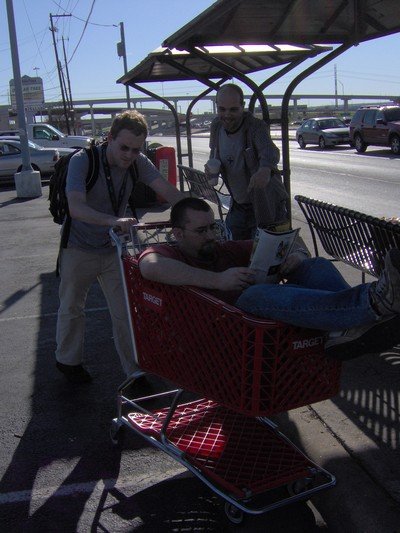
Will Goss posted these photos on Facebook, and I have stolen them to show to you. They are from my last day at SXSW, the one where we got stuck a few miles from downtown and had to wait for a bus and I sat in a shopping cart.

Here’s one with Eugene and Weinberg. Why Eugene is pushing the cart, I don’t know. I don’t remember this part specifically. I must have been very engaged in my reading.

Artificially Swedened

0

If there’s a name for the style in which my apartment is decorated, it’s Homeless Person Squatting in an Abandoned Tenement. This is fine with me. Sure, I could spend thousands of dollars on nice furniture and decor. But on the other hand, no I couldn’t, because I don’t have thousands of dollars. I have the essential items — bed, chair, table, piano, life-size plastic dog, Ron Burgundy bobblehead doll, flashlight, etc. — and I’m happy with that.

Or at least I thought I was happy. Then an Ikea store opened in Portland and I realized how truly miserable I was.

It is a major event whenever the Swedish furniture juggernaut deigns to opens a new store somewhere, and Portland was no exception. Everyone caught Ikeamania! People lined up to be among the first shoppers. Local news agencies covered the story from the angle of “Boy, there sure are a lot of people excited about this!,” and of course that coverage gave Ikea free advertising, which resulted in more people getting excited about it, which made the news agencies cover the story even more fervently, and the circle of life continued.

I did not visit the new Ikea right away, preferring to wait until the crowds of zealots had finished their pilgrimages before I braved it. In the meantime, I began to notice things about my apartment that I should probably improve. For example, there was no place to sit. I mean, I had chairs at the kitchen table, but when it came to relaxing and having guests over for conversation, all I had was my ugly yellow chair and the LoveSac. The LoveSac will comfortably hold two occupants, but they must be occupants who are very familiar with each other and like to cuddle. That minimizes the potential guest list.

So I decided it was time to buy a couch to replace the one I’d given away when I moved here from my last apartment. Unfortunately, given the size of my current space, and the size of the LoveSac (i.e., gigantic), I knew I could not have both. Getting a couch would mean getting rid of the LoveSac.

Alt text

A LoveSac (not mine).

O LoveSac! I purchased you six years ago, almost to the day, because you were new and innovative and comfortable! And also because Luscious Malone and Tanny Tantan talked me into it, even though I couldn’t afford you! Your dear price remained on my credit card balance for months, maybe years!

O LoveSac! How many hours did Luscious or Tanny or I or some combination of us sit upon you? How many guests at Oscar parties and other gatherings rushed to re-shape you with their own buttocks before you were claimed and re-shapen by another?

O LoveSac! When my other friend Lisa was pregnant, which was usually, she preferred to fling her bloated self onto you more than any other piece of furniture, because only you, LoveSac, adjusted to fit the contours of her massive body, cradling her like a womb — like the very womb which inside her then was heavy-laden!

O LoveSac! I am sorry to have gotten rid of you so unceremoniously via Craigslist, where less than two hours after posting my ad I was shoving you into the back of some soccer mom’s SUV. Surely you deserved a better fate than to wind up in a suburban teenage boy’s bedroom, where heaven only knows what indignities will befall you.

I salute your memory, LoveSac. You were indeed a sac of love.

* * *

Before Luscious Malone and I made our trip to Ikea, I went online and determined exactly what I wanted to buy. I didn’t want to make any impulse purchases. My impulses are not to be trusted.

In addition to the most inexpensive love seat Ikea sells, I had my eye on a new desk and bookcase. My current desk was massive and cheap, having been purchased at Wal-Mart in 2001 and already starting to disintegrate, while my bookcase, though slightly newer and from Pier 1, had always been flimsy and precarious. I didn’t exactly need a new one — it’s not like the books were actively falling off the shelves — but hey, Ikea has a bookcase for $19.99. At those prices, I couldn’t afford not to buy one!

Luscious and I test-drove all these items in the Ikea showroom and found them acceptable. Of course, one of the fun things about Ikea is that they give their products made-up Swedish-sounding names. So my love seat was actually called a klobo, my desk was a johan, and my bookcase was a flärke. The klobo, johan, and flärke are sturdy, well-designed pieces of furniture, and like all of your finest furniture, they come in a box and you have to put them together. That’s how it’s possible to make impulse buys at Ikea. You’re about to check out and you think, “Hey, you know, I should grab a box of bed before I go.”

But I was strong and did not buy anything not on my list. Klobo, johan, flärke, that’s it. OK, and a footstool, because it was only 20 bucks, and I’d been putting my feet up on a stereo speaker. So klobo, johan, flärke, and solsta pällbo, that was it. Sure, I was tempted by the pflüng, and the poorg, and the velm, and the jarkolg, and the glaven — who doesn’t need a glaven? — but I remained steadfast. It takes more than just a handsome and stylish klarng to make me go off my budget!

With some wrangling, we got all the stuff into Luscious Malone’s Jeep and from there into my apartment, where I spent the rest of the day assembling it like the brawny man I am. I had to get rid of my old desk and bookcase, too. The bookcase wasn’t worth trying to sell, so I just set it outside on the curb, where it disappeared within an hour, probably because someone thought they were stealing it. The desk was even more worthless, so I took it apart and put the individual pieces in the garbage can. That I was able to do this at all was proof of the desk’s shoddiness. As a rule, you should not be able to dismantle a major piece of furniture with your bare hands.

And now, suddenly, my apartment is more homey and inviting! It has been Ikeacized, at least partially, and already I feel more like having guests over for a book club or a fondue party. Or both! Why not! The sky’s the limit, now that there’s an Ikea in town! Am I going to take full advantage of it? You bet your klärb I am.

‘Snide Remarks’! Movie reviews!! Etc.!!!

0

All that business with South By Southwest is over now, so we’re back to our regular programming here at EricDSnider.com. That means we have a new “Snide Remarks” today, entitled “Artificially Swedened” and addressing the pivotal issue of the furniture in my apartment. Surely you have been concerned.

And hey! Look over here! Reviews of “10,000 BC” and “Horton Hears a Who!”! I sort of apologize for not reviewing and warning you against “10,000 BC” sooner, but at the same time, it is not needful that you should be commanded in all things. I mean, seriously.

More bloggy stuff later today.

This week’s “Snide Remarks,” including the audio version, is here.
The audio version (i.e., the podcast) is also here.
Subscribe to the podcast’s feed here.

Friday movie roundup – March 21

14

Happy spring! And happy Easter! And hey, what about Passover? Happy that too! I hope you weren’t planning to celebrate any of these things by going to the movies!

“Drillbit Taylor” is lousy, and “Shutter” (review is at Film.com) is even worse. The third wide release, Tyler Perry’s “Meet the Browns,” wasn’t screened for critics, and you know what that means. (You probably also know what Tyler Perry’s name in front of it means.)

In other news, I promise to have the final installment of my SXSW diary posted today, a mere seven days after the day it covers. If you knew how busy I’ve been this week, you’d stop hassling me (RANDY TAYLER!!) to get it done. I wish I had more time during the festivals to work on these reports, because I really enjoy writing them. Each one is like a mini-“Snide Remarks,” with the hard part done by having the topic assigned to me.

Sign up for the “In the Dark” e-zine here.
Listen to this week’s podcast version here.
Subscribe to the podcast’s feed here.

Drillbit Taylor

0

Here it is, the first major sign of weakness in the Judd Apatow comedy juggernaut: “Drillbit Taylor,” a cluttered and clueless effort produced by Apatow, co-written by Seth Rogen (“Superbad”), and featuring barely a whiff of the raucous-but-intelligent humor of previous J.A. productions.

It reads a lot like a junior version of “Superbad,” with two nerds — a fat vulgar one and a thin pensive one — who are best friends and who are joined by a third, even nerdier nerd. Wade (Nate Hartley, the skinny one) and Ryan (Troy Gentile, the fat one) are instant bully-targets when they start high school, and the metal-mouth squeaky-voiced Emmit (David Dorfman, the McLovin of the group) only makes it worse by hanging around them.

Their chief tormenters are Filkins (Alex Frost), a garden-variety high school psychopath, and Ronnie (Josh Peck), his grinning accomplice. I thought they were co-bullies and equals, but when Wade and Ryan go to the principal (Stephen Root), they only mention Filkins. So I guess Ronnie is just a sidekick. He should get a better agent.

Anyway, the principal offers no help because he’s convinced Filkins is a good kid. (See, idiots? You should have told him about Ronnie.) This leaves the boys with no choice but to post an ad online seeking a bodyguard. This ad somehow comes to the attention of Drillbit Taylor (Owen Wilson), a homeless Army veteran who evidently has ready access to the Internet. (Sorry, movie, but one glimpse of him sneaking a look at a coffee shop patron’s laptop doesn’t count as an explanation.) Drillbit, an easy-going, laid-back kind of homeless guy who doesn’t seem the least bit put out by being homeless, says he’ll use his Army training to protect the boys. But his real plan is to cozy up to them so he can sneak into their houses and steal their stuff.

This tangent is drastically unnecessary. It’s a foregone conclusion that he’ll have a change of heart and commit himself fully to helping the boys after all, so why not start there? Must we endure the standard discovery of betrayal and the subsequent hurt feelings and the inevitable reconciliation? Is it not enough that we must watch the same formula in all romantic comedies? Oy.

To effect his plan, Drillbit infiltrates the boys’ school, posing as a substitute teacher. Somehow he actually winds up subbing for some actual classes (this makes no sense whatsoever), and from that vantage point he can harass the bullies from the inside. He also commences a romance with an English teacher (Leslie Mann).

And that’s where we arrive at our focus problem. Who is the star of this movie, Drillbit or the boys? The movie is named after Drillbit, but the story is really about Wade and Ryan. The screenplay passed through several writers’ hands — John Hughes wrote the original treatment — and I think it got muddied up in all the rewrites. The direction by Steven Brill (“Little Nicky,” “Without a Paddle”) certainly does not bring any clarity to the project.

The worst part is, it starts out OK. There are a few laughs in the beginning, and I like the kids playing the lead roles. The premise has potential. But it very quickly loses whatever steam it had, to the point that the last half hour feels unbearably drawn out. In a good comedy, it doesn’t matter if the plot is overly familiar or if the story has foregone conclusions. When you’re looking at your watch and mumbling, “Get on with it already,” that’s a bad sign.

Meet the Browns

0

Well, it took five tries, but Tyler Perry has finally made a good movie. Not a great movie, and not a movie without its flaws, but a good one nonetheless. This is something that, like a colony on the moon, many scientists believed we would not see in our lifetimes.

The film is “Meet the Browns,” which Perry has adapted from one of his his seemingly endless supply of stage plays, and it shows remarkable growth. The awkward mix of farcical comedy and Lifetime Network melodrama that sunk his previous films (“Diary of a Mad Black Woman,” “Why Did I Get Married?,” etc.) has been diluted considerably, so that now only a few moments stand out as cringingly slaphappy.

For the most part, it’s a satisfying, respectable drama starring Angela Bassett — it’s no coincidence that Perry’s best movie has the best actress he’s been able to get — as Brenda, a Chicago single mother struggling to make ends meet. She’s a good mother, savvy and shrewd and protective, but she can only do so much. The kids’ fathers are not in the picture. And as the film begins, the factory where she and her pothead Latina best friend Cheryl (Sofia Vergara) are employed closes down.

On the same day, Brenda gets word that her father (whom she never met) has died in Georgia, and that one of her half-siblings has provided bus tickets for her and the kids to come to the funeral. She travels to the rural, unnamed town to meet her extended family for the first time, and for a few minutes you think it’s going to be a retread of “Welcome Home Roscoe Jenkins,” with a never-ending parade of buffoonish characters and outré backwater situations. Certainly Brenda’s introduction to her half-brother Leroy Brown (David Mann), who wears garish outfits and behaves in a like manner, is not encouraging.

Fortunately, things quickly settle down again; the rest of the Browns are, if not completely normal, at least wacky in an agreeable, comfortable way. (I do like Jenifer Lewis as Vera, Brenda’s heavy-drinking, outspoken half-sister.) The film is about Brenda’s attempts to find stability for herself and her three children, and it plays out like a modern-day fairy tale. There are villains like Michael (Phillip Edward Van Lear), one of her snaky, deadbeat baby daddies. There is also a gallant prince in the form of Harry (Rick Fox), a basketball recruiter with his eye on Brenda’s talented son, Michael Jr. (Lance Gross), and on Brenda herself. The finale is deliriously, improbably happy — which is the point of the whole thing, of course.

Bassett is outstanding as Brenda, strong and dignified in the face of hardship (and, occasionally, in the face of other actors being less strong and dignified). There’s a crucial scene in the first act between Bassett and Irma P. Hall as Mildred, an elderly neighbor who runs an informal daycare. Mildred, a no-nonsense old gal, dares to bring up a subject that may have already been on the viewer’s mind: “You young girls today, having more babies than you can take care of.” Brenda acknowledges her mistakes but dismisses them as beside the point: She gave birth to the kids, and now they’re her responsibility. Bassett’s distinguished performance makes it easy to go from judging Brenda for getting knocked up by three different guys to admiring her for striving to do the right thing now.

Perry’s writing is still clumsy at times. “Meet the Browns” uses an extraordinary coincidence (Harry the basketball recruiter happens to be from the same tiny Georgia town as Brenda’s relatives!) and some phony crises to manufacture instant drama. Brenda makes a major decision about the future of her family at one point, and the movie doesn’t even show the decision-making process. From a storytelling standpoint, that’s flat-out wrong. Perry’s signature character, the rascally old Madea, makes a cameo late in the game that literally could be removed from the film without affecting the story in any way.

Yet despite those mistakes, “Meet the Browns” feels like an honest, warm drama with relatable characters. The humor is mostly funny and unforced. If Perry can maintain this balance between fulfilling the audience’s wishes and shamelessly pandering to them, he might prove to be a gifted filmmaker after all.

Shutter

0

I don’t feel like talking about “Shutter,” which is this week’s bad remake of an Asian horror film, so instead I’m going to tell you why critics won’t like it but regular audiences will.

The primary reason for the frequent disconnect between critics and moviegoers is simply that critics see a lot more movies. That’s it. It’s not that critics are snotty (though some are), or that general consumers are uncultured morons (though some are). It’s just that the more movies you watch, the more likely it is that what you’re seeing will resemble something you’ve seen before and will thus fail to impress you.

In this case, every single element of “Shutter” feels ripped off from “The Ring,” “The Grudge,” “Dark Water,” “Pulse,” “The Eye,” and “One Missed Call” (to name the first six that come to mind). It’s about an American couple (Joshua Jackson and Rachael Taylor) living in Tokyo, where they notice weird light flares in their photographs and soon start seeing the ghost of a pasty-faced, stringy-haired Japanese waif everywhere. The spirit is vengeful. There are lots of jump-scares, where you’re startled by something happening suddenly and accompanied by a loud sting on the soundtrack. There are weird, unexplained phenomena that are “creepy” but illogical.

To me, “Shutter” is the epitome of gutless, derivative hack work. But then again, I’ve seen all those movies I mentioned, plus some of their original Asian versions. If you haven’t seen them — or any of the other recent lukewarm PG-13 thrillers like “The Ring Two,” “The Grudge 2,” “The Messengers,” “Stay Alive,” “Darkness Falls,” “The Fog,” or “An American Haunting” — then all of this will seem new to you, and you may well find “Shutter” to be tense and scary like it’s supposed to be.

If you’ve seen even one of them, though, this is all gonna seem like reheated leftovers. The time I’ve spent watching it and writing these 332 words about it far exceeds the attention it deserves.

My 2008 SXSW Film Festival Diary

0
My 2008 SXSW Film Festival Diary

Day 1 (Friday, March 7):

Yee-haw, dude! I am once again in Austin, capital city of Texas and hipster capital of the South, for the South By Southwest Film Festival. This is only my third time at SXSW, but it’s already one of my favorite annual events: fun movies, fun friends, and fun parties. And I don’t care what you’ve heard on the street, I like fun things.

I arrived last night without incident, but some of my friends weren’t so lucky. Scott Weinberg, Eugene Novikov, and Jason Whyte (all acquaintances from eFilmCritic.com and elsewhere) had connecting flights in Dallas that were canceled due to weather. Who knew they had weather in Dallas? Weinberg and Eugene rented a car to drive from there to Austin, while Jason hitched a ride with someone, and all of their luggage remained behind (as did Eugene’s driver’s license, which he left on the counter at the rental agency).

The only incident of note in my travels was when I landed in Austin and saw the usual line of hired drivers holding cards bearing the names of the passengers they were collecting, and one of the cards said “Brown Mary.” Not Mary Brown; not even Brown comma Mary; just Brown Mary. Naturally, my first thought was, “Big wheel keep on turnin’; Brown Mary keep on burnin’.” Whoever or whatever you are, Brown Mary, I salute you.

This alleged “weather” in Dallas had far-reaching effects, as we discovered today. We’d been invited to a special press screening of “Harold & Kumar Escape from Guantanamo Bay,” which is premiering in the festival tomorrow night, but learned upon reaching the theater today that the print had not arrived. The screening was pushed back to 5 and then to 6, which threw everything out of whack because some of us were planning to see other films at 5 or 6. And when you skip a movie, it sets off a domino effect, because you want to see it at a later showing, but then that later showing conflicts with something else, and so you have to look for another showing of THAT movie, and before you know it you’re sitting in the corner with a highlighter pen and a screening schedule, sobbing.

Nonetheless, most of us decided to go to the rescheduled “Harold & Kumar” press showing. We had a few afternoon hours to kill in the meantime, and as it happens, my Fat Brother Jeff was here! His company has sent him for SXSW’s Interactive Festival, which includes panels and workshops and a trade show related to tech-geek-computer-Internet-nerd things. (The “Interactive” label is odd, considering it is aimed at people who sit at their computers all day and never interact with anyone.) This was the first-ever juxtaposition of my family world and my movie world. Jeff and I ate lunch at Jack in the Box (mm-mmm, local flavor!) then went to the Austin Convention Center to get our festival badges. This massively chaotic and time-consuming process seems to have gotten slightly less chaotic and time-consuming than in previous years, so hooray for progress.

Jeff went about his computer-nerd business and I headed to the hotel room being shared by Weinberg and Erik Childress, which for some reason always winds being the base of operations for all of our associates. Sure enough, the room was already littered with movie critics: Weinberg, Childress, Eugene, Jason, Will Goss, and Erik Davis, who is Weinberg’s and my boss at Cinematical. A DVD screener of some festival film was playing, but whatever interest the group had had in it to begin with had waned by the time I arrived, and now there was mostly chatter and schedule-making and the sort of merriment you’d expect to find in hotel room crammed full of snarky, opinionated movie geeks. It was just like heaven, only smellier.

Weinberg and Eugene returned their rental car and came back with Liz, a friend of Weinberg’s who was going to give us a ride to the Alamo Drafthouse on South Lamar for “Harold & Kumar.” We love this venue, but we do not love its location, two miles south of almost all the other SXSW venues. Six of us crammed into Liz’s small sedan, a car that comfortably seats four, uncomfortably seats five, and impossibly seats six. The laws of both traffic and physics were broken in the process, but we made it to the Drafthouse.

The screening did not start at 6, nor even at 6:30. As the time approached 7:00, we calculated the very latest the film could start before we’d have to abandon it altogether in the interest of not missing our 9:30 film (which was taking place back in the downtown area and would require us to be in line by 8:45 at the very, very latest). Cabs were called and put on notice to collect us at 8:30, whether “Harold & Kumar” was over or not. If we had to miss what would surely be a mind-bending, super-secret surprise in the final few minutes, so be it.

Meanwhile, we took advantage of the Alamo Drafthouse’s cuisine. As you may know from reading previous SXSW reports or from simply being a cool, happening person, the Alamo is one of the best movie houses in the country. The programming at their several locations is a mix of new releases and goofy special showings, and they offer full food and beverage service delivered right to your seat. It’s good food, too, and an absolutely treasure for festival-goers like us who often don’t have time to eat between screenings. It was the first Alamo experience for Davis and for a couple of our other associates who we ran into there, and Weinberg took particular pleasure in sharing this Austin landmark with them, like an acolyte sharing the gospel with a new convert.

The film finally started at about 7 (we’d already finished eating by then), and it was … meh. I didn’t find it as funny as its predecessor, but it did have some very solid laughs. Worth the wait and the hassle and the agita and the tsuris and the other Yiddish words? Probably not.

We did indeed miss the last two or three minutes in order to catch our cab. It deposited us at the Paramount Theatre, an old movie palace within sight of the capitol building on Congress Avenue that is where all the big SXSW premieres are held. Eugene was already in line, and we were joined by Greg the Volunteer and his girlfriend. Weinberg and I met Greg here at SXSW two years ago and got to be friends with him. Greg was kind enough to let me stay at his place last year and again this year. He even picked me up at the airport last night. He was standing there with a sign that said “White Eric.”

The movie we were all seeing was “21,” about some card-counting math nerds from M.I.T. who go to Vegas on the weekends to make a killing at the blackjack tables. Some of the cast members were allegedly there, but I didn’t see them. Who I did see was Scott Porter, whose role as becrippled quarterback Jason Street on “Friday Night Lights,” filmed ’round these parts, has made him one of Austin’s local celebrities. He was wearing a fedora for no good reason, although I guess I’m not sure what a good reason would have been.

As the theater filled up and people milled around, Davis got out his camera and snapped some pictures of the crowd, causing an usher-slash-security-guard to come over and politely tell him photography is not allowed and they would have to take away his camera if he persisted. When Davis pointed out, also politely (despite being from New York City), that there were at least a dozen other people taking pictures right at that moment, that the theater was practically aglow in the light of camera flashes, the guy just said, “We can’t catch everybody.” I took this to mean, “We’re not even trying to catch anybody, but you happened to be sitting near the back and on the aisle.”

You know what might have helped reduce the amount of photography? A sign somewhere saying, “No photography.” I made this observation aloud, and Weinberg and Davis joked that maybe the rule is only that Jews can’t have cameras. Eugene said there was a sign that said, “No Jews with cameras,” and the reason I hadn’t noticed it was that it was in Hebrew.

SXSW festival director and suave personage Matt Dentler introduced the film, as always; we believe he is a “jumper,” like Hayden Christensen, able to introduce a film in one venue and then introduce another one on the other side of town five minutes later. He is everywhere at once. He presented us with the film’s director, Robert Luketic, who also made “Legally Blonde” and “Monster-in-Law,” and who seemed duly humbled and overwhelmed to have his movie kicking off the SXSW Film Festival.

Too bad it ain’t that good a movie. The card-counting hook is interesting, but the rest of it is generic and ordinary: a nobody becomes a somebody, forsakes his friends, then learns What’s Really Important. YAWN!!

Kim Voynar, another Cinematical editor, had gotten into town just in time for the film, and she’s sharing a hotel room with Melanie, whom Kim and I met in Oxford, Miss., last month. Post-film, the whole lot of us traipsed over to Buffalo Billiards, a 6th Street bar where the official opening night party was being held, but we didn’t stay very long. Kim, Melanie, and I wound up driving off in Kim’s rental car in search of food, and we ended up at the delightful Taco Cabana. As always, eating Mexican food at 1:30 in the morning proved to be a poor decision, but poor decisions are part of the fun of a film festival.

Day 2 (Saturday, March 8):

Though the accommodations at Casa de Greg were hospitable, there was no denying one fact: My Fat Brother Jeff was staying in a nice hotel in the heart of the SXSW district. So last night I had Kim drive me to Greg’s so I could get my stuff, then drop me off at the Marriott Residence Inn, where I slept on the pull-out bed in Jeff’s room. I’m pretty sure this was the first time Jeff and I had shared a bedroom in at least 20 years. Passersby would have heard a symphony of snoring.

Today’s activities commenced with me taking a cab down to the Alamo Lamar for a documentary called “Secrecy,” about the CIA’s obsession with keeping things on the D.L. There are two points of view on this issue. On the one hand, some things need to be kept secret as a matter of national security. On the other hand, the public must be informed in order for democracy to work, and sometimes “national security” is just code for “we don’t want you to know about this because it’s illegal and/or we really screwed it up.”

I like that the film doesn’t take a strident tone one way or the other, and people on both sides — former CIA executives, Washington Post journalists, etc. — make good points. I think we can all agree that on certain matters, secrecy is a must. For example, if Congress were planning a surprise party for the president.

Eugene was at the screening, as was Laremy, my Film.com overlord. Afterward we three attempted to get a cab back to downtown but were intercepted by a stylish-looking older woman asking us if we needed a ride there. You’re not supposed to get into cars with strangers, I know, but there were three of us, and she was old. Plus, she was going the same place we were, which I believe is the exception to the “don’t get into cars with strangers” rule. (Pay attention, kids!)

She was obviously well-monied, well-educated, and well-coiffed, with one of those short haircuts that upscale ladies of a certain age often get. She pointed out important Austin landmarks are we drove (“That’s where the hippies live”), and when Laremy noticed the Obama bumper sticker sitting on her dashboard, politics became the subject of conversation. She loves Obama! She hasn’t actively campaigned for a candidate since George McGovern in 1972, she said, and some of her Hillary-supporting lady friends currently aren’t speaking to her. I say if you have any Hillary-supporting friends who aren’t speaking to you, count yourself lucky.

(In the interest of equal time, I should also point out that John McCain is a creepy old warmonger.)

Our new best friend dropped us off downtown and we all went separate ways. I was headed to the Alamo Ritz, the new downtown location of the legendary movie house. Apparently the original location, a few blocks east, lost its lease last year and this old theater/concert venue became the Alamo’s snazzy new home.

And whom should I see in line but Obama Lady again! She must have followed me over after parking her car. She waved to me and said to save the seat next to me when I got inside. I didn’t like where this was going. When we got inside, she sat by me, and she started discussing her movie schedule for the rest of the day. Evidently we were destined to be seatmates forevermore.

As she talked and I didn’t listen, something dawned on me. There was an incident last year where I was watching a documentary about the appalling conditions in Darfur, and a woman sitting near me kept vocalizing her horror with audible gasps and tut-tuts, and when the frustrated Marine in the film said all he could do was write reports about what he was witnessing, this lady said, aloud, “To who?!” It wasn’t enough that she should be appalled about Darfur; she wanted to make sure everyone knew how appalled she was. Well, I’m 95 percent sure Obama Lady is that woman.

When I realized this, I casually asked if she’d seen SXSW films last year, and if she’d seen “The Devil Came on Horseback” specifically, and she said she had. I wanted to follow that up with, “Did you constantly express your horror with vocal reactions in order to let everyone around you know how socially conscious you were?,” but I thought that might be pushing it.

The movie we were seeing now was called “Wellness,” a documentary-style sad comedy about a hapless middle-aged guy who has poured all his money into a multi-level marketing program. Like 99 percent of all people who get involved with MLMs, he’s getting a sucker’s deal, and the film follows his fruitless attempts to recruit other investors even as he starts to see the handwriting on the wall.

The director introduced the film by saying it wasn’t produced the normal way, that the story grew “organically,” i.e., there was no script when they started. As he described the intentionally haphazard filmmaking process, Obama Lady said what I was thinking, which was, “This doesn’t sound like a very good movie.” She wound up leaving it halfway through, perhaps to do some canvassing.

While I admire the natural, realistic central performance, I had trouble enjoying the film because it’s just so bleak. I love awkward, uncomfortable comedy; this just isn’t funny very often, and the poor fellow never catches a break.

I had only a few minutes turnaround before the next movie, also at the Alamo, a moody dramedy called “The Lost Coast.” I believe it qualifies as mumblecore: listless twentysomethings spend Halloween night wandering around San Francisco and being angsty. In particular, there are two friends, a gay guy and a straight guy, and the straight guy is engaged to be married but is grappling with the fact that back in high school he and the gay guy (who was “straight” then, too) engaged in some shenanigans, if you know what I mean. (I mean gay sex.) Apparently this is unacceptable. I mean, it would be one thing if they’d been in a college fraternity together, as the straight guys there fool around with each other all the time. But not high school, dude. That’s not cool.

During this film I was seated next to two quintessential fat movie geek Kevin Smith-looking types. They shared a giant plate of nachos and saw nothing wrong with speaking to one another during the film. Usually that annoys me, but I didn’t mind too much with these guys because the things they were saying were really insightful. Like when a character in the movie dressed as a Frenchman for Halloween and carried around a baguette as a prop, the guy right next to me laughed and said, “He’s got a baguette!” That sort of remark quelled my anger, because I was getting more out of the film than I would have on my own. It was like watching a DVD with a director’s commentary, only instead of the director it was two chubby social retards who COULDN’T SHUT THEIR FAT STUPID MOUTHS. I gave them a few warning glares and finally resorted to saying, “Could you not talk, please?,” and then they actually shut up for about 45 minutes. I don’t know what the lesson of that story is, except maybe that you should get the nachos at the Alamo because they’re awesome.

It was dinnertime now, and I’d been invited by Laremy from Film.com to join him, a Film.com corporate boss, and our Austin correspondent C. Robert Cargill for dinner somewhere. Cargill drove us up to a place called Ruby’s, reputed to have some of the best barbecue in town. We ordered giant piles of meat and feasted like carnivores while having animated (and, if I may say, intellectually stimulating) conversations about movies. It was interesting to meet Cargill in particular, simply because he was a co-worker I’d never actually met before. And it was nice to meet Mike the corporate guy, too, in particular because he paid.

Cargill got me back to the Alamo Ritz in time to hop in line with my regular posse for a world premiere called “Explicit Ills.” We were within 10 spots of the front of the line, so we had a great vantage point when no fewer than 120 people associated with the film entered ahead of us and almost filled the theater. I’m not exaggerating. The theater seats 165, and I’m certain no more than 35 actual festival-goers got in.

We noticed that at “21” last night, a few rows were reserved for people associated with the film, only instead of taping or roping them off or putting up signs, they just had a squad of the Paramount’s austere old-lady theater staff — all of whom look like former Texas Gov. Ann Richards — stand guard and not let people sit there. Seems like rope or tape or signs would have been easier, but who am I to criticize local custom? Anyway, maybe the “Explicit Ills” people solved that problem by just reserving the entire theater. Our group found seats only in the very front row, and I had to leave after a half hour because I was getting a headache.

[My Cinematical entry about the large “Explicit Ills” entourage.]

I rejoined the gang for the midnight movie, back at the Alamo Ritz again but this time not quite as overly populated with film folk. It was a horror flick, “Shuttle,” in which an airport shuttle van taking people downtown late at night turns into a NIGHTMARE RIDE FROM HELL!!!! While I was willing to give that weak-sounding premise a fair shake, the film proved to be laughably stupid. You accept that the characters in movies like this will occasionally make poor choices that prevent them from escaping, but these people were complete idiots. There would be a thousand possible ways they could escape or at least turn the tables, and many of these ways had very strong chances of success, and they would choose to throw a bag of ice at the guy’s head. It reminded me of that joke in the first “Scary Movie” where the victim passes up a gun and knife and chooses to fight with a banana.

But oh well! You can’t win ’em all. Something I’ve said about SXSW all along is that it doesn’t particularly matter whether the films are any good, because the experience is a blast either way. I drank a milkshake during the movie and managed to limit myself to one “There Will Be Blood” reference, so it was a good night.

Day 3 (Sunday, March 9):

It is cruel irony that Daylight Saving Time should begin — and that we should thus lose an hour of sleep one night — during a film festival that prides itself on keeping people out late. I got back to the hotel room a little after 2 a.m., which was now 3 a.m., and found it quite difficult to arise at 9 this morning. I got up at 10, made an executive decision to blow off the 11 a.m. movie, and took my time getting ready, stumbling around, bumping into things, and doing some writing (some of my best, no doubt).

It is funny to walk around Austin at almost noon on a Sunday and see people shuffling and yawning like it’s 6 a.m. on a Monday.

My first screening, at 1:30 p.m., was “Up With Me,” a verite-style drama about a kid from Spanish Harlem who gets a scholarship to a fancy prep school and is torn between his old world and his new one. Sounds awfully generic, but the naturalistic acting and photography give it an engaging sense of realism. It also practically reeks with the aroma of Spanish Harlem, and you can well imagine how great that is.

I next trudged to the Convention Center for a screening of “Super High Me,” a documentary in which a man smokes marijuana pretty much constantly for 30 days to see what effect it has on him. Of course, he already smokes a lot anyway, so first he has to spend a month NOT getting high, for comparison’s sake.

The subject of this experiment is a stand-up comedian named Doug Benson, who was there to introduce the film to a capacity crowd. It was, shall we say, a receptive audience. I don’t think I’d seen that many stoners assembled in one place since … well, since I’d stood outside earlier and glanced around downtown Austin.

Anyway, Benson pointed out that he blatantly stole his film’s premise and title from Morgan Spurlock’s “Super Size Me.” Since Spurlock has a new documentary called “Where in the World Is Osama Bin Laden?,” Benson said his own next film is going to be “Where Is Osama Bin Laden with My Weed?”

The movie is funny, if not particularly revelatory — except, maybe, for the fact that a month of being high 18 hours a day has virtually no impact on Benson’s health, lung capacity, sperm count, or overall mental acuity (his SAT scores actually go up a little). I was somewhat hindered by Benson’s self-professed status as a “pot comic.” I don’t usually care much for comedians whose acts consist almost entirely of jokes about one subject: black comics who only talk about the differences between black people and white people, fat comics who only talk about being fat, etc. Weed is funny, I get that, but come on.

Most of my SXSW pals were at that film, and the entire gang was at the next movie, scant moments later: “The Promotion.” I had no idea this film existed until I saw it on the SXSW schedule, but my interest was piqued by seeing it was a comedy starring John C. Reilly and featuring Jenna Fischer, Seann William Scott, and Fred Armisen. If I’d known up front that it had a cameo by Jason Bateman, I’d have been even more excited.

The Paramount Theatre was packed. This is usually the case for big-name premieres whether anyone knows anything about the movie or not, and Reilly has established a lot of comedy street cred in recent years with “Talladega Nights” and the little-seen but much-admired “Walk Hard: The Dewey Cox Story.”

I sat with my Austin pal Greg and his girlfriend in the center section, where I quickly realized there was going to be a problem: The man sitting directly in front of me had a giant head that blocked much of the screen. My other friends were toward the back and off to the side, where the sight lines are better, and while I hated to abandon Greg — whom I’d seen very little of since moving to my brother’s hotel after the first night — I also hated to only see the top half of the movie. So I moved, and Greg pretended to be horribly offended, and the circle of life continued.

My move proved to be fortuitous in more ways than one, as two seats down from me was Mary Jo Pehl, known to nerds the world over as Mrs. Pearl Forrester on the latter few seasons of “Mystery Science Theater 3000.” (Of course, the REAL nerds know she had once appeared as that character prior to her full-time run, too, in episode #607, “Bloodlust.”) I said hello and told her I was a huge fan of the show, and that I actually interviewed her on the phone for my college paper back in 1997, not that she would remember, and indeed she did not. She was very nice and friendly, though.

And then “The Promotion”: the funniest film I’ve seen so far this year. Granted, the year is only 2 1/2 months old and hasn’t really had any good comedies, but still. It has Seann William Scott as a normal guy with a supermarket managerial job who vies for a promotion against John C. Reilly’s character, an impossibly nice Canadian. The film consistently goes against expectations for a movie like this — you actually root for both guys — and the script is loaded with running jokes and visual gags.

It proved to be one of the rare instances where all of us in the group loved a film. Usually there’s one guy who’s gonna be an orndorf about it (orndorf: n., from Brian Orndorf, eFilmCritic reviewer whose opinions are consistently the opposite of everyone else’s). But there were no orndorfs among us this time, and we skipped merrily into the night chattering about the film’s hilarity.

Most of us planned to reconvene for a midnight movie, but in the meantime we split up to go find places to sit down and write. Eugene and I walked over to Halcyon, which appears to be both a coffeehouse and a bar, and possibly also a nightclub. And why not, really?

There was a long line for the midnight film, attributable to its being a horror flick and also to the director having arranged with the Alamo Drafthouse to give everyone in the audience a free beer. That kind of news travels fast around here.

The movie was “Dance of the Dead,” a horror comedy in which zombies arise on the night of the high school prom and a group of hapless teens must save the town. We had a terrific time with this movie. Some of the dialogue is corny and not all of the acting is good, but the zombie scenes: WOW. So much energy and excitement, so many creative kills, so many very impressive tricks and special effects (especially given the small budget). There’s a cemetery scene where the zombies are literally launching themselves out of the graves, and it’s one of the flat-out coolest things I’ve seen in a while. And at the film’s climax, which involves an explosion, they fired a cannon of confetti from the back of the theater to make us all part of the action. There are no confetti cannons at Sundance, I’ll tell you that.

[My Cinematical entry about the “Dance of the Dead” premiere.]

Day 4 (Monday, March 10):

Today was chilly and rainy — wholly unacceptable weather for Austin. Something called Zappos.com was promoting itself by handing out free plastic rain ponchos, so we saw a lot of people walking around in them all day, their hoods up and their bodies covered with a white plastic sheet. These ponchos have the unfortunate (and presumably unintentional) effect of making the wearer look like a Klansman. Evidently Zappos.com did not think its cunning plan all the way through.

My first movie of the day, at 11 a.m., was at the Paramount Theatre, a large venue anyway and one that’s particularly difficult to fill when you’re showing a documentary at 11 a.m. on a rainy Monday. A publicist for the film I was seeing was out on the sidewalk handing out fliers, inviting one and all to attend. It was downright evangelical!

The movie was “Crawford,” about the tiny Texas town that became famous when George W. Bush chose it at his adopted hometown right before he ran for president in 2000 — just in time to show voters how folksy and rugged and ranchy the Connecticut-bred, Yale-educated man-of-the-people is. It’s an interesting look at how intense scrutiny — every time Bush is in Crawford, it’s on TV — can affect a small, rural town.

Eugene and I were at that film, and we joined Goss and Melanie at the Alamo Ritz next for “‘Bama Girl,” a documentary about a black girl running for homecoming queen at the University of Alabama. She wouldn’t be the first black queen in the school’s history (she’d be the fifth), but she would be the first one to be elected without being endorsed by “the Machine,” a secret cabal of fraternity and sorority higher-ups who control all the school’s elections.

The young woman who introduced the film referred to the Alamo as “a movie house and a house of restaurant,” a construction that amused us to no end. She also inadvertently referred to the servers as “servants” before quickly correcting herself. I don’t know which I prefer, the unpolished introduction by an enthusiastic festival staffer, or Matt Dentler’s smooth intro that always begins, “The minute I saw this film, I knew we had to get it for South By Southwest.” (We love you, Matt! In fact, the minute we saw you, we knew we had to get you for South By Southwest!)

It stopped raining at some point in the afternoon, and after I’d spent some time writing and walking around, I figured I might as well get in line for the evening’s big premiere of “Forgetting Sarah Marshall.” This is the new film from uber-producer Judd Apatow, written by Jason Segal (who was one of the friends in “Knocked Up”) and starring him and Kristen Bell (aka Veronica Mars). It was at the Paramount at 7:00; experience suggested that someone from our group should be in line by 5:45 or so if we wanted to get good seats. Usually we make Jason or Goss or even Eugene be the line-waiter, but I thought I’d take one for the team. Surely I would not have done this if it had still been raining, Klan poncho or no.

Melanie joined me soon, and then Eugene shortly thereafter. He had just seen “Explicit Ills,” the movie whose premiere audience had consisted almost entirely of people who worked on it. Eugene reported that the director, Mark Webber, referenced the Cinematical piece I’d written about that incident and apologized to the Cinematical crew for not getting in. Of course, we DID get in; it was all the people after us who got screwed. But hey, it’s cool that Webber read my article and gave Cinematical a shout-out, even if it was sarcastic (which I think it was).

We also got news that The Hollywood Reporter and Variety had published their reviews of “The Promotion” from last night — and they both hated it. Mind you, neither publication actually sent a critic to SXSW. Since “The Promotion” is a studio film being released theatrically soon anyway, they’d had a press screening back in L.A. to coincide with the SXSW premiere, and that’s where the HR and Variety critics saw it. HR’s Kirk Honeycutt said it “must be one of the unfunniest comedies ever.”

We were all flabbergasted. As I mentioned in yesterday’s entry, it’s rare that EVERYONE in our group loves a film equally. I can understand someone not liking it — comedy is subjective, after all — but “one of the unfunniest comedies ever”? Come on. Weinberg was particularly outraged (his job is to be more outraged than anyone else), and he immediately began compiling a list of 101 terrible comedies that Kirk Honeycutt apparently hasn’t seen if he’s calling “The Promotion” one of the worst ever made.

Speaking of Weinberg, he and Jason and Greg and many others were just coming from the “Forgetting Sarah Marshall” pre-show party. Some of the cast had been there, and so had, apparently, a lot of bartenders and liquor bottles. Attending the party (which I hadn’t heard about) entitled you to sit in the special roped-off section of the Paramount, so that was pretty awesome for those guys.

And the movie? Funny! There has been some concern that the Judd Apatow comedy juggernaut will run out of steam, and it probably will eventually, but it doesn’t happen with “Forgetting Sarah Marshall.” It’s about a guy who takes a vacation to Hawaii after his TV-actress girlfriend dumps him, only to find that she and her new boyfriend are staying at the same hotel — an absurdly contrived situation, now that I spell it out for myself, but that thought didn’t occur to me while I was watching it. The movie deftly combines show business insider jokes, meta-references, situational comedy, and relationship humor. I think I laughed more frequently at “The Promotion,” but I laughed harder at “Forgetting Sarah Marshall.” And of course some of the funniest lines are ones I can’t repeat here, not when my mother might be reading.

“Knocked Up” played in this same slot last year, and was immediately followed by the Austin Chronicle/SXSW party where Loudon Wainwright and Voxtrot performed and several “Knocked Up” cast members hung out. We still talk about the coolness of that party. Sometimes at night we dream about it. So naturally we wanted to attend it again this year, in the desperate hope that lightning would strike twice, but that it would be the good kind of lightning, the kind that makes you have fun at a party, not the kind that kills you.

But first Eugene and I needed to see “Battle in Seattle,” which was playing at the Paramount immediately after “Sarah Marshall.” I’m not sure why we “needed” to see it, but we did, or we thought we did. It’s about the riots that occurred at the World Trade Organization meeting in Seattle in 1999, with fictional characters — cops and protesters alike — drawing us in to the drama and tragedy and tear gas.

The funny thing about this real-life incident is that I was alive and well and conscious and even working at a newspaper in 1999, and yet I have no memory of it whatsoever. I’m guessing I read the news stories, saw “World Trade Organization,” had no idea what that was or why people were protesting it, and stopped reading before I got to the good part, i.e., the part where cops were busting hippie skulls.

The film is kind of terrible. It makes almost no effort to explain the protesters’ grievances against the WTO, instead assuming that we will be on their side regardless. One of the characters even makes a joke about how the general public doesn’t know what the WTO is; all they know is that it’s bad. So, OK, ha ha, interesting comment, but it kinda undermines the WHOLE POINT OF YOUR MOVIE.

Also undermining the movie: the terrible, terrible dialogue. I quote some of the more generic examples:

“The press would have a field day!”

HE: “You know nothing about me!”
SHE: “I’ve been around men like you all my life.”

(Spoken to a pregnant woman.) “You want adventure? You just signed up for the greatest adventure of all!”

“You’re gonna turn downtown into a war zone!”

“How do you stop those who stop at nothing?”

So … yeah. “Battle in Seattle.” The minute I saw this film, I knew it was poo.

Eugene (who shared my sentiments) and I got out of there around 11:30 and headed over to the Austin Chronicle party to see if it was still swingin’. Security guards were checking bags outside to prevent people from bringing in any beverages, because if you bring in your own drinks, it decreases the likelihood that you’ll buy them inside.

I had a bottle of water, as always, so I drank what was left of it, and the guard gestured to a garbage can so I could dispose of the container. I asked if I could keep the empty bottle, as I don’t actually BUY bottled water; I get a new one every few weeks and just refill it. (People who drink bottled water exclusively are suckers who might as well be throwing their money into a fire.) The guard said no, I can’t bring a bottle into the venue, even an empty one. Why? Because I might fill it with booze and smuggle that booze out with me when I leave, and they don’t check bags when people exit, only when they enter. I pointed out, in a well-reasoned and rational argument, that this was a stupid rule. He said it’s a Texas state law — which is good to know, because it means every single other venue I’d been to in the last four days was violating this law, since no one had ever checked our bags before.

So I tossed the empty bottle into the garbage can, which was just inside the venue gate. Then, once we entered, I took the bottle back out of the garbage can (it was just lying on top of a bunch of other empty water bottles) and put it back in my bag, which I knew it was safe to do because the guard had just told us they don’t check bags when you exit. I considered my act of civil disobedience to be an excellent way of messing with Texas, which I’ve wanted to do ever since I saw a bumper sticker telling me not to.

The party was still packed with people, but all the food was gone and the band was not one we were interested in watching. We saw only one person we knew, a mildly (read: extraordinarily) inebriated Childress, who was getting around the rules about smuggling alcohol out of the venue by hiding it in his stomach and bloodstream. Stick it to the man, Childress! Then fall down!

With the party failing to dazzle us sufficiently, Eugene and I left and soon ran into Weinberg, Davis, and Goss, who were wandering the streets of Austin in search of food. The five of us wound up at Jimmy John’s, a sandwich shop that’s open late, where we ranted about the Hollywood Reporter review some more, concluding that if you think “The Promotion” is one of the unfunniest comedies ever made, you must not have seen anything with Larry The Cable Guy or Martin Lawrence. I mean, honestly.

Day 5 (Tuesday, March 11):

Jeff and I had to check out of his hotel this morning, and I’d already made arrangements to head back to Casa de Greg for the duration of my stay. There would prove to be complications in this, but as they are not the kind of complications that would amuse you, I omit them.

I left my bag with the front desk and walked across the street to the Convention Center, where I wrote for a while and then caught a screening of a documentary called “Frontrunners.” It’s a very amusing story about the student body election at Stuyvesant, the most competitive public high school in New York (it’s for gifted students), where some of the kids take their politics VERY seriously. Sometimes these docs have universal themes that can be extrapolated; this one is pretty much only about these kids at this school, but that’s fine. We got a kick out of it anyway.

“We” consisted of me, Eugene, and Melanie, and while Eugene then wandered off to meet some alleged other friends who were allegedly in town for the alleged SXSW Music Festival, Melanie and I went to the Alamo Ritz to meet Kim for another movie. (We eschew the kids and their rock ‘n’ roll.) This movie was called “Yeast,” and I was very eager to see it for the simple fact that it was written and directed by the wife of the guy who made one of my least favorite movies from last year, “Frownland.” I was genuinely eager to see what her style would be.

“Yeast” is yet another mumbly thing about twentysomethings who can neither communicate nor shut up, this time starring the filmmaker herself, Mary Bronstein, as a woman whose roommate and friend are maddeningly immature, irresponsible, and idiotic. I note that Kim described the movie from the opposite point of view: “a mumblecore chick-flick about Rachel, a maddeningly annoying control-freak dealing with her fractured relationships with two friends.” Yeah, the main character becomes annoying in the second half, but her two friends are complete morons the entire time. By the end of the movie, I hated all three characters. Hated, hated, hated them. I note that this is the exact same reaction I had to the main character of “Frownland,” so if the Bronsteins seek to be in the business of creating fictional characters that make the audience want to strangle them (the characters), then they are off to a good start.

Next I met up with Jeff, who gave me a ride in his rental car over to Greg’s apartment so I could drop off my bag. This is where the aforementioned unamusing complications occurred.

Soon thereafter I found several others of our group lounging in Childress and Weinberg’s hotel room. Weinberg and Erik Davis were live-blogging the SXSW film awards ceremony. (The awards and “closing night” party are on Tuesday, even though the festival continues through Saturday. It has never been adequately explained to me why this is.) How could they live-blog the ceremony from the hotel room? By sending Goss as an unpaid Cinematical intern to the ceremony and having him text-message the results as they were announced. At one point Davis and Weinberg went outside for a cigarette and delegated me to monitor the text messages in their absence, thereby removing themselves from the process entirely. I admire their managerial skills.

The awards were not especially noteworthy except for one point: “Explicit Ills” won the audience award. The way the audience voting works is they hand out ballots at each screening, and you indicate your score for the film on a scale of 1 to 5. The film with the highest average vote wins. (They take the average rather than the cumulative because different films play to different sizes of audiences.)

Well, you may recall that at the first screening of “Explicit Ills,” people connected to the film comprised literally 80 percent of the audience, and I’m guessing every single one of them gave it a 5. Neil Miller at Film School Rejects points out something I didn’t know: that by the time they’d handed out ballots to everyone in the film’s entourage, there were none left for the 30 or so regular people who made it in to the theater. So not only was the theater packed with ringers, but those ringers were the only ones voting. I’m not saying this was all part of some evil master plan to win the audience award, but it’s definitely an unfortunate outcome. Between this and Hillary Clinton’s inexplicable primary wins, I’ve pretty much lost all faith in democracy.

Most of the gang went to see a documentary about World of Warcraft next, while Childress and I returned to the Alamo Ritz for “Nights and Weekends,” the latest from mumblecore godfather Joe Swanberg and his regular muse, Greta Gerwig. Gerwig was in “Yeast,” too, as one of the annoying friends, and it’s a testament to her skill as an actress that I was able to hate her SO MUCH in that film while loving her a lot in “Nights and Weekends.” These mumblecore things are typically light on plot, so one’s enjoyment of them depends on one’s interest in the characters and their situations. I was quite taken by this film’s emotional depth and its honest, funny characters. I don’t think all viewers will consider it their cup of tea, but those who do will find the tea has a rich aroma and a pleasant, bittersweet taste, with the tea bag of acting steeped for just the right length of time in the hot water of directing, and a nice dollop of the honey of cinematography added for flavor.

“Nights and Weekends” let out at around 10:30, and Childress and I walked over to the film festival closing night party, which was scheduled to blend into the music festival opening night party at around 11. I was once again stopped at the entry point by a security guard who made me drink the rest of my water, after which he gestured to a garbage can for me to throw the bottle away. But then he failed to continue watching me, and I put the empty bottle back in my bag like I intended to. Snider 2, Texas 0.

This party always involves live music, and we arrived just as Moby was finishing his set. If you have never seen Moby perform, what he does is he plays records. He is very good at it. I mean, I can play CDs OK, but records are trickier because you have to choose 33 or 45 rpm, and then you have to put the needle in just the right place and make sure it doesn’t skip. So it’s really cool to see a professional record player.

Weinberg, Davis, Kim, Melanie, and all the gang were already at the party, which was in the backyard of a bar called Stubbs. This is the only joint event of the film and music festivals, so people from both worlds were there, intermingling and trying to understand one another’s languages.

Promptly at 11, they stopped letting people into the backyard party. I knew this because Eugene texted me and said he was being denied entry. I told him it was because the “film” party was over and the “music” party was going to start inside the bar, and that if he went to the bar’s actual indoor entrance, they’d let him in. Seems like the people telling him he couldn’t get into the backyard could have told him this, but whatever. Their primary concern was looking for water bottles.

Eugene successfully entered Stubbs, then went out the back door into the backyard, which you’ll recall is where he wanted to go in the first place. We were all still out there, though a feeble attempt was being made by party officials to funnel us inside. For some reason most of us decided that rather than stay at the party, we should go watch “Dance of the Dead” again at midnight.

I believe this was a first for me, seeing the same film twice in the same festival. It wasn’t that it was the best movie we’d ever seen, though we certainly did like it a lot. It was more that it was the only thing playing that we had any interest in, and we wanted to eat at the Alamo Ritz, and we’d become friendly with some of the cast and crew, and heck, why not? You run your life, we’ll run ours.

A reported 175 people were turned away from the packed screening; we should probably feel bad for whoever the first six of them were, since we essentially took their seats. No free beer for the audience this time, but they did repeat the trick of firing the confetti at the film’s climax. Really, more theaters should do this with more movies. It doesn’t even have to be an explosive climax. Just fire the confetti.

It was 1:30 a.m. when the film ended, and it seemed like a good idea for us all to go back to the hotel room and hang out for a few hours. Again, why not? Apart from needing sleep, I mean. Kim and Melanie hung out with us for a while before saying their farewells — they were leaving the next morning — and departing. Then a few guys associated with “Dance of the Dead” showed up and the merriment continued while Childress — whose ride to the airport was picking him up at 6 a.m. — slept in bed, seemingly oblivious to the chaos around him. I don’t know if Childress has always had this skill or if he learned it when he started sharing hotel rooms with Weinberg at film festivals, but it’s definitely a handy talent to have.

It was around 4 when I crashed on Weinberg’s bed while Weinberg stayed up writing and doing whatever it is Weinberg does (I don’t ask, and neither should you). At 6, when Childress left, I moved over to his bed and slept for real. It was probably a quintessential SXSW day: some good movies, some raucous adventure, a party, and not nearly enough sleep.

Day 6 (Wednesday, March 12):

Today was unusual, and I have very little to report. Finding myself grotesquely behind in my writing assignments, I had no choice but to forsake most of the films I’d planned to see today and devote myself fully to writing. It may sound odd to hear a writer complain that he has been forced to write, but the truth is that most writers spend about 90 percent of their time looking for excuses not to. That is probably why so many of them are driven to drink.

As it happens, today was going to be a light day anyway, as most of the films on the schedule either didn’t interest me or were movies I’d already seen. I did catch “At the Death House Door,” an impressively well made documentary about a man who was the chaplain at a Texas penitentiary for many years and as such ministered to 95 inmates on their final days before being executed. It invokes important questions not about the rightness or wrongness of capital punishment, but about the haphazard way it is administered in the United States.

This screening was at the Convention Center, and as I walked across the main pavilion afterward I saw people gathered around the Dell Lounge, a glass-encased room built by the people at Dell Computers. I do not know what the general purpose of the Dell Lounge is; one assumes it was built cheaply and flimsily, and that we won’t be able to get tech support when it collapses. But at this particular moment, everyone was gawking at the event occurring within the Lounge, which turned out to be Billy Bob Thornton being interviewed. So you can add that to your list of celebrity sightings.

I headed over to Weinberg’s hotel room now. Childress went home early this morning; Weinberg was in there working. He and I were in the same boat of needing to pile up stacks of words sufficient enough to appease our editors. We vowed to stay in the room and write write write write until 11 p.m., when we’d be allowed to go to a movie.

What this actually meant, of course, was that we would spend the next seven hours distracting one another. We would chit-chat for a few minutes, then say, “OK, back to work,” then get very studious for a few minutes, then talk again. Weinberg was particularly good at interrupting me, engaging me in conversation for a while, then saying, “Quit interrupting me!” And since he was coordinating Cinematical’s SXSW coverage, and since I was writing reviews for them, he had to frequently interrupt me to say, “Have you finished that review yet?,” when he knew full well that I had not, and that the reason I had not was that he kept interrupting me. Then he would ask again, this time in the Staten Island accent of our Cinematical boss Erik Davis, and I would respond with an impression of Weinberg’s Philadelphia voice. Both of our impressions are very good, though Weinberg refuses to admit how well I do him.

At 11 p.m., I went to the Alamo Ritz to catch at least the first part of “R.S.O.: Registered Sex Offender,” a mockumentary about a skeezy guy just released from prison. I was only partially interested in the feature; mainly I wanted to see the short that was preceding it, entitled “I Slammed My D*** in the Drawer.” The program said it was based on a true story, and the title and concept made me laugh. As it turns out, I could have watched it on Funny or Die, but eh, whatever. (Warning: It contains some salty language.)

Weinberg, Goss, and Jason were seeing a horror film called “Otis” at midnight in the Alamo Ritz’s other auditorium, and I left “R.S.O.” early to join them for that. (“R.S.O.” was fine, but I didn’t feel compelled to stick with it.) “Otis” seems like a bland semi-parody of “Captivity” or “Hostel,” and the first hour of it is just awful — over-acted, under-written, and half-baked. I don’t know what the last 30 minutes are like, because I left. I was really tired, and the movie was sucking. I’m told it gets into some very obvious Iraq War parody stuff later on. Oy vey.

Day 7 (Thursday, March 13):

I made up for seeing only one full movie (and parts of two others) yesterday by seeing six of ’em today. Yes, SIX! And three of them had to do with Iraq! Wheeeee!

I began my day with a heaping helping of nerdery, thanks to “Second Skin,” the aforementioned documentary about World of Warcraft players. It is very interesting to me that there are 50 million WOW players, and I don’t know a single one of them. Or at least if I do, they have kept their WOW involvement secret from me. The film does a nice job of showing us the lives of several players without making fun of them or treating them like jokes. Of course, I still think they’re all losers worthy of ridicule, but I think that about a lot of people. You can’t blame the movie for that.

After “Second Skin” is when my Iraq marathon began. Initially my plan was to see one film and be done with it, in and out, easy-peasy. But I realized after the first one that I should probably stick around for the second one, and then that led to the third one, and even though my resources were drained and I really wanted to do something else, I was stuck and had no choice but wait until it was all over, no matter how lengthy or costly it became. When it was all over, I questioned whether I should have ever started in the first place. I’m sure you know the feeling.

First up was “Body of War,” a documentary directed by Phil Donahue and somebody who isn’t Phil Donahue (don’t feel like looking it up), about an U.S. soldier who came home from the war paralyzed from the chest down and is now involved with the Iraq Veterans Against the War organization. I think the film has some fundamental flaws, not least of which is the fact that its subject, Tomas Young, joined the Army on Sept. 13, 2001, specifically because he wanted to do something in the aftermath of 9/11. If he’d already been in the military and THEN was sent into a dubious, ill-conceived, disastrous war, then I think the film’s point would be stronger. As it is, well, you did sign up with the intention of fighting a war, and that’s what you got. Would you be any less paralyzed now if the Iraq invasion had turned out to be a really great idea? I just think the film’s point would have been better made if Donahue and not-Donahue (seriously, too lazy) had chosen a different poster boy.

One thing the film does well is to intercut Tomas’ story with C-SPAN footage from October 2002 in which one senator after another parrots back President Bush’s message about the dangers of Iraq in the run-up to the war. Much of what these men and women, Republicans and Democrats both, said at the time now sounds hilariously naive and inaccurate, which of course was the point of including it. The film seems to ask: How could so many people have been so wrong?

What amused and annoyed me — annused me? — was the audience’s reaction. When a particularly vile senator such as DeLay or Frist would appear on screen, many of those in attendance at the Paramount Theatre would boo and hiss. Yes, actual hissing, as if they were watching a silent melodrama in which a mustache-twirling villain had tied a woman to a train track. When someone spoke out against the war (such as Sen. Robert Byrd, who emerges as something of an ignored prophet), they would applaud him.

Mind you, I agree with the sentiments here with regard to the Iraq war. But it’s silly to applaud a movie. It’s filmed images being projected against a screen: The performers aren’t actually there to soak in and respond to your admiration. And in this case, not only are the performers not there, but the footage of what they’re saying is 5 1/2 years old. You’re applauding or hissing something that happened half a decade ago. Laughing, gasping, crying — those are natural, spontaneous responses to a movie, done almost unconsciously. Clapping, booing, and hissing are conscious decisions, and the only reason you do it in a situation like this is to let everyone around you know what you think. “Look how civic-minded and outraged I am!” is the subtext. And guess what? No one cares what you think. Shut up and watch the movie.

Next in my Iraq marathon was “Bulletproof Salesman,” a documentary about a man who sells armored vehicles in Iraq. Is he a war profiteer? Um, probably. He says he’s no more a profiteer than the people who sell toilet paper and other necessary supplies to war zones, and maybe he’s right. Maybe I’d agree with him more if he didn’t come off as such a b-hole in the movie.

In truth, it’s not a very good documentary anyway. It’s very short (70 minutes), and it lacks any kind of story or arc. It’s basically, “Well, here’s this guy, and here’s what he does, and the end.” It was disappointing because I’d had several people tell me the film was great. Turns out my intel was faulty. It was the best I had at the time, and I took the appropriate action by seeing the movie, but now I knew differently. To make up for it, the only option I had was to keep seeing more Iraq movies.

Luckily, there was another one showing! It was “Stop-Loss,” a fictional film in which an Army staff sergeant with pouty lips is angered to learn his tour of duty has been extended beyond its original expiration date. It will be released in theaters in a couple weeks, and it has some big names in the cast (Ryan Phillippe, Channing Tatum), but I cannot imagine it will break the trend of Iraq-themed movies failing at the box office. Nor do I think it should, as it’s emotionally flat and unengaging. If you want to see a great movie about the effects of war on young soldiers, rent “In the Valley of Elah.” If you want to watch a shallow treatment of the subject — co-produced by MTV, for heaven’s sake — watch “Stop-Loss.”

Having finally found my way out of the Iraq movies (well, OK, there weren’t any more), I hit a midnight screening next with several of the regular gang. The film was “Southern Gothic,” a horror flick in which a preacher becomes a vampire and views it as a blessing rather than a curse — the fulfillment of God’s promise of “eternal life.” I think that’s a fantastic idea for a movie, but this one squanders it with terrible, terrible acting and dialogue. It was no “I Slammed My D*** in the Drawer,” I’ll tell you that much.

It was now 1:30 a.m. You’re thinking that surely this was the end of my day. But no! Weinberg had a DVD player back in his hotel room, and he and Goss and I elected to watch more movies. Our selection was “[Rec],” a very, very frightening Spanish film about a virus outbreak that turns people all killy. That’s nothing new, of course (“28 Days Later,” etc.), but man alive does this thing ever sizzle. It’s filmed by the characters themselves (like “Blair Witch Project” and “Cloverfield”), and that device continues to be a scarily effective way of drawing the audience in to the action. The film has not been released in the United States and is already being remade as “Quarantine,” to be released in October. I can only assume that the remake, in keeping with the trend of American remakes of foreign horror films, will suck. In the meantime, here’s what Weinberg had to say about “[Rec]” at Cinematical.

Goss and Weinberg and I collapsed into the loving arms of sleep shortly after the film concluded, with Goss on the floor between the hotel room’s two beds. Visions of zombies and soldiers and World of Warcraft nerds danced in our heads.

Day 8 (Friday, March 14):

We figured that a good way to spend our last day at the festival would be to go watch “Doomsday” at a multiplex somewhere. It opened in wide release today without having been screened for critics, and it had to do with a deadly virus and a post-apocalyptic wasteland, and what the heck, why not? It’s not like we were already at a film festival or anything.

I suggested last night that we catch today’s noon showing, as this would enable me to be back downtown in time for a 3:30 SXSW film I wanted to see. But Weinberg insisted noon would be far too early, considering we were about to stay up too late watching movies, so we planned on the 2:30 showing instead. Indeed, noon came quite early after our 4 a.m. bedtime. Honestly, even 2:30 was pushing it. Also honestly, why were we in such a hurry to see “Doomsday”? We make no sense.

Weinberg, Eugene, Goss, and I took a cab to a multiplex a few miles south of downtown. We did indeed watch “Doomsday.” This happened without incident.

Afterward we sauntered over to the nearby Barnes & Noble to do some browsing, the other three in the sci-fi/fantasy/nerd section, me in the magazine aisle. (Long-time readers may recall that I get kind of obsessive about finding the current Entertainment Weekly when I am away from home.) Then we walked to Arby’s for lunch — not because any of us particularly like Arby’s, but because it was the only reasonable choice within our immediate field of vision. I would guess this is how Arby’s gets a lot of its business.

It was after our meal that we began to discover the pickle we were in. You can’t hail a cab anywhere in Austin except right downtown, and even then your prospects are dicey. Your best bet is to call the cab company and have them dispatch one to you — but when we called, one company told us it would be at least an hour, and the other company didn’t even answer their phone.

We started walking up South Lamar Boulevard, figuring we might see a taxi that way. At the very least, we knew we’d come to a bus stop eventually and could get downtown by means of public transportation (as if we were common poor people!). We found a stop, and a woman waiting there said a bus should be along in about 15 minutes. Goss called Austin Cab Company again and was met with great annoyance when he could not provide the exact street address of our location. Giving the dispatcher five obvious, unique, unmistakable landmarks and an approximate address was insufficient for Austin Cab Company, an outfit that, despite its name, apparently has no knowledge whatsoever of the streets of Austin. Maybe “Austin” is just the name of the guy who started the company. At any rate, Austin Cab Company refused to do business with us and has thus forever earned our scorn and condemnation. Their competition, Lone Star Cab Co., shall be our sole taxi service in Austin henceforward. SUCK IT, AUSTIN CAB COMPANY. We hate you, and we hate your ass face.

The four of us were grumpy and sweaty by now. I sat in an abandoned shopping cart and read Entertainment Weekly while we waited for a bus to show up. When it did, we learned that it would only take us up South Lamar, leaving us to walk another mile or so east to the SXSW venues. We accepted this as the best offer we were going to get, exited the bus at 6th Street, and trudged toward our final destinations. Weinberg’s fury at the bus’s failure to stop at 3rd Street (where he wanted to get off), and then at his inability to hail a cab, grew to Incredible Hulk proportions. We feared he would lay waste to the city of Austin with his wrath.

Eventually we made it to Congress Avenue, where Eugene went to secure a place in line for the 7:00 movie while Goss, Weinberg, and I headed to the hotel near the Convention Center. Goss and I had left our festival badges there, thinking we’d be back from “Doomsday” with two hours to spare rather than 30 minutes. We retrieved our badges and trudged back to Congress Avenue. Weinberg stayed in the room to write and pout.

SXSW’s music festival was in full swing by now, with 6th Street closed to automobile traffic so that the hundreds of skinny identical-looking hipsters could wander aimlessly and drunkenly from one music venue (read: bar) to the next. 6th Street takes on a carnival-like atmosphere during the music fest, with bands competing with each other for the eardrums of passersby and the streets clogged with revelers. It strongly resembles Mardi Gras, only with less boob-showing and bead-acquiring.

Goss and I were weary and cranky and in no mood to be jostled by indie-rock fans. Someone representing Dentyne Ice was handing out free samples of the gum to anyone who passed him. We took some. Then the guy wanted to take our picture holding the gum. This seemed like a strange thing to want to do. Had there been some question back at Dentyne headquarters about whether people would accept offers of free gum? Did this intern need proof? “See, guys?” I imagined him saying when he got back to the office. “I told you people would take free gum if you offered it to them!” Goss and I dutifully stood still long enough to have our photo taken, but we did not smile or in any other way indicate that the free gum had brought us any amount of pleasure. I do not think these photos will appear in any Dentyne promotional materials.

At this point in the film festival, it is easy to get a seat, even for big premieres. Many of the festival-goers have gone home already. We joined Eugene in the Paramount Theatre and watched “Assassination of a High School President,” a film-noir-detective-comedy-drama about a school newspaper reporter investigating the theft of some SATs. Childress saw it at Sundance and HATED it, but it turns out he was orndorfing us: We all found it quite suitably funny and entertaining — not a classic, perhaps, but certainly not bad.

(By the way, the new Rolling Stones concert film “Shine a Light,” directed by Martin Scorsese, was allegedly screening at SXSW tonight at 7:30. However, all the SXSW website and printed film guide had to say about its location was that it was on an IMAX screen. There was no indication where this alleged IMAX screen was. Was it like a treasure hunt? Did anybody find it? Were the raisiny, emaciated corpses of the Rolling Stones in attendance? I have no idea.)

I went back to Weinberg’s hotel room after “Assassination” to write my “Doomsday” review and hang around until our midnight movie. It was a documentary called “Not Your Typical Bigfoot Movie,” about a couple of very devoted Bigfoot researchers who live (of course) in the Southern backwoods somewhere. They have lots of “pictures” of Bigfoot that are actually pictures of various wooded areas in which there are shadows that sort of look like the shape of something that could be Bigfoot, if they weren’t just shadows and if Bigfoot existed. I never tire of watching documentaries about idiots. Never.

This was a very short documentary (62 minutes!), which is nice for a midnight film. Afterward a whole bunch of us wound up at party headquarters, aka Weinberg’s hotel room, with some of the people from “Dance of the Dead,” which had its third and final screening tonight. The screening went well, and the filmmakers have been in talks with some people about getting it distributed theatrically. They couldn’t tell us anything definite, but it seems promising. It’s definitely a film that could do good business with the horror crowd.

At around 2:30, I was pretty tired and wanted to head over to Casa de Greg to get some sleep. I made my farewells with everyone and headed downstairs to catch a cab. None were to be found. The woman at the hotel’s front desk said that with the music festival in full swing, getting a taxi would take at least an hour. I gave up and went back to Weinberg’s room to doze for a while. Finally, at about 4, I went down to the street to try again and was glad to find a Lone Star Cab rather than the hated Austin Cab Company. At this point, I probably would have forsaken my principles and taken whichever one showed up first, so I’m glad it was Lone Star.

* * *

And thus ended my 2008 South By Southwest experience. I can’t overstate how much I love almost every aspect of this festival. I love the programming, which includes some serious movies but mostly focuses on fun, non-stuffy titles like “Forgetting Sarah Marshall.” (Sundance would program something like that only over Robert Redford’s dead, leathery body.) I love the Alamo Drafthouse. I love seeing my friends. I love the SXSW audiences, which are generally good-natured, well-behaved, and fun to interact with. I love SXSW’s tireless producer Matt Dentler, even if he does introduce every film by saying, “The minute I saw this film, I knew we had to get it for South By Southwest.” His vision of the festival — of its identity and its place among other film festivals — is perfect.

Long live Matt Dentler and SXSW! Long live the Alamo Drafthouse! And long live me, Eric D. Snider! I’ll see you in 2009.


Friday movie roundup – March 14

5

They’ve made a cartoon based on “Horton Hears a Who,” and it was duly screened for critics, but I did not see it. The screening was last Saturday morning, and I was in Austin. I actually considered going to the one here, but meh. I’d have had to get up early on a Saturday.

But I do have a review of “Never Back Down”! And it’s a delight. The review, I mean. The movie is stupid.

Also note, in limited release, “Funny Games” and “Chicago 10.”

And finally, “Doomsday” is one of Hollywood’s Shameful Secrets and was not screened at all. Review to come.

I’m almost done catching up on my SXSW diaries. Keep an eye on this blog over the next couple days.

Sign up for the “In the Dark” e-zine here.
Listen to this week’s podcast version here.
Subscribe to the podcast’s feed here.

Funny Games

0

The purpose of “Funny Games” is to provoke and disturb the audience. It does this so well that you may not be able to watch it — a curious thing for a filmmaker to shoot for, but hey, that’s the Austrians for you.

Michael Haneke already made this film in 1997 before going on to make other challenging films like “The Piano Teacher” and “Cache.” Now he has remade it, almost shot-for-shot (see my note at the end), in English. His reason is apparently just that he’d like the film to be seen by a wider audience.

The hilarious part there is that no matter what language it’s in, this film is not very marketable. It’s not only a violent movie but a movie ABOUT violence. It toys with the audience’s expectations about how movies are supposed to work. It allows brutal things to happen, then indicts us for wanting to see brutal things happen.

It’s set in a lovely vacation home on a lake somewhere, the refuge of an affluent, upper-crust family whose members amuse themselves on long car trips by playing “Name That Tune” with opera CDs. We know little else about them other than their names: George (Tim Roth) the father, Anna (Naomi Watts) the mother, and Georgie (Devon Gearhart) the young son.

Just after they arrive for an extended stay, a young man in a tennis outfit stops by. He says his name is Peter (Brady Corbet). He’s staying with the neighbors for a couple days, and the wife of that family asked him to come over and borrow four eggs from Anna. Anna gladly hands them over. Peter drops them on his way out, apologizes profusely in his soft, whimpery voice, and Anna gets some new eggs for him.

While this is going on, Peter’s buddy Paul (Michael Pitt) shows up. Like Peter, he’s dressed in tennis whites and is unfailingly polite. Also like Peter, he is slightly odd in his behavior. The boys’ language is grammatically correct and unprovocative, yet at the same time slightly “off.” Some of their answers are non sequiturs. They ask questions that don’t seem to mean anything. They refer to each other by names other than Peter and Paul.

Haneke presents this sequence in a way that’s almost unbearably tense. No one is doing anything blatantly wrong from a moral standpoint; even from a purely social standpoint the boys are more awkward than anything else, only gradually growing intrusive and presumptuous over time. Part of the reason the scene is so unsettling is that you can’t quite put your finger on what’s unsettling about it.

Finally the dam breaks and the incident turns into a full-blown home invasion. George is incapacitated — unmanned, really, as he is forced to see his family suffer, powerless to help. Peter and Paul play mind games with the family and with the audience. Peter is the younger and less confident of the two, while Paul — played with chilling menace by the soft-spoken Michael Pitt — runs the show.

Haneke’s goal is to unnerve us by subverting our expectations. He sets it up as a violent film, and yet almost every act of violence takes place off-camera. Instead of the frantic editing one normally sees in movies about killers and victims, Haneke shoots in long, unbroken takes. He keeps us distanced from the action by minimizing close-ups and by frequently composing shots that avoid the actors’ faces, or that focus on someone other than the person speaking. And then, once we feel safely distanced from the horror, Haneke yanks us into it by having one of the characters look right into the camera and address us.

The film is not fun in the usual way that movies are fun. It deliberately avoids giving the payoffs we expect. Yet I don’t find it frustrating or aggressive. Some provocative filmmakers seem intent on irritating or turning off the audience. With Haneke, I get the feeling that once you understand what he’s up to, he’s glad to have you in on the joke. He certainly goes about executing it in a masterful way.

(Finally, a note on how the film was remade. Only a few minor things prevent it from being literally a shot-for-shot remake. The dialogue, apart from being in English instead of German, is likewise almost identical. The sets are virtual twins of those in the original. Haneke has basically made it so that native English speakers have their own version of his film. He has not watered it down or altered it in the translation.)

Doomsday

0

British filmmaker Neil Marshall earned a legion of new fans with 2005’s “The Descent,” a genuinely scary flick that put me, for one, off spelunking forever. And for his next act? An energetic but derivative apocalyptic adventure that Rogue Pictures has unceremoniously dumped into theaters without press screenings or even much promotion.

Being one of Hollywood’s Shameful Secrets™ (movies not screened for critics before they open) gives a film a certain stench, and it’s too bad that “Doomsday” is stuck with it. It’s not great — I’m not even sure I’d call it “good” — but the studios have certainly screened films that were worse. Heck, the studios have screened films that were worse this week (including one whose name rhymes with “Mever Mack Mown”). “Doomsday” is perfectly acceptable as a C+ movie, the kind that you don’t see on purpose but that will certainly amuse you if you happen to stumble into the theater accidentally.

It begins with florid narration by Malcolm McDowell, who tells us that a horrific virus — subtly called the Reaper Virus — wiped out much of England. Then a wall was built to divide the infected northern half of Britain from the clean southern half, and all the sick people up north were left to die in chaos. “Social order decayed along with the corpses,” McDowell says.

Now it’s 2035 and the virus has resurfaced in London. What’s more, the British government — led by a weaselly Scotsman named Canaris (David O’Hara) — spotted signs of life in the quarantine zone a few years ago, decades after the last remaining virus victims should have died. If there are survivors, that means they must have discovered a cure. And if they have a cure, we can break into the quarantine zone, take their cure, and bring it back to London.

It’s a huge leap in logic to say that if there are survivors up north then those people MUST have found a cure, but on such leaps are government policies determined. Canaris and his non-evil associate, Nelson (Bob Hoskins), decide to send a team in to bring back this alleged cure. (The government has a prime minister, too, but he doesn’t do anything.) The team is led by Eden Sinclair (Rhona Mitra), a cop/doctor/scientist (I was never really clear on what her job was) who lost her mom to the quarantine zone when Eden was a little girl and who now has a magical glass eye that can record video. That’s how you know it’s The Future!

Eden assembles a group of anonymous fellow cop/doctor/scientists, and off they go. The quarantine zone proves to have some society after all, but it’s the savage kind you see in “Road Warrior” and movies like it, the kind where people are cannibals and put on wild gladiator-style shows and wear bones in their hair. A character played by McDowell is there, and so is a crazy demigod leader named Sol (Craig Conway). Eden and her crew do battle with the locals; people are shot, stabbed, run over, and exploded; caches of weapons, vehicles, and cell phones are discovered (what luck!); and so it goes.

Marshall tends to film the fight scenes more confusingly than necessary, but his refusal to skimp on the blood and gore should make genre fans happy. He also stages a fantastic car chase sequence near the end (yes, even in wasteland of the future they can still have car chases), and he puts forth Rhona Mitra as a legitimately tough action heroine. Its occasional tense moments notwithstanding, it’s an action flick more than a horror movie. And as far as that goes, it’s not bad. Rogue Pictures might be ashamed of it, but there’s no need to be.

Horton Hears a Who!

0

Yes! At last! This is how you make a good Jim Carrey comedy — by leaving his forced physical mania behind and including only his voice! “Horton Hears a Who!” succeeds where previous Dr. Seuss adaptations have fallen short, most notably by using animation — fluid, elastic, genuinely Seussian animation — to tell the story. Carrey’s shtick has always felt cartoonish anyway; now that he’s playing a cartoon, it actually fits.

How the idea of reinventing Seuss’ delightful drawings as cartoons failed to escape the makers of “How the Grinch Stole Christmas” and “The Cat in the Hat,” I don’t know. Carrey’s performance as the Grinch was very good — I guess hiding him under a ton of makeup and costumery works as well as removing his physical presence altogether — but the movie itself was uninspired. And the less said about Mike Myers’ live-action desecration of the Cat in the Hat, the better.

No, Dr. Seuss’ stories should be cartoons, and they should be as pleasantly energetic and funny as this one, directed by Pixar veteran Jimmy Hayward and newcomer Steve Martino, from a script by Ken Daurio and Cinco Paul (a duo whose previous efforts, “Bubble Boy” and “College Road Trip,” would not have inspired much confidence). Here the good doctor’s gently whimsical, subtly insane vision is preserved, as is the story. Only the Whoville scenes have been beefed up (there was almost no backstory in the original) — and even there, the rhyming narration, read by newsman Charles Osgood, is written in such a convincingly imitative style that I had to double-check that it wasn’t actually from the book.

Carrey is the voice of Horton, the childlike elephant who hears a tiny cry for help come from a speck of dust floating by one day in the jungle. Horton is imaginative and playful, and not a little naive (Carrey’s tapping into his inner Canadian, I think) as he tries to convince everyone else in the jungle that he’s not imagining things. There really are tiny people on this speck, and it really does need protecting!

On the speck itself, Steve Carell provides the voice of the Mayor, a befuddled family man rendered useless by a powerful city council that is staunchly opposed to bad news. When the Mayor tries to warn his people that their world is spinning out of control and may soon be destroyed, he is ignored or derided. When he tries to convince them that a giant invisible elephant that he’s been talking to is trying to save them, he is laughed off as a false prophet.

Seuss’ original didn’t indicate that the Mayor had any trouble convincing his fellow Whos of Horton’s existence, but the revision fits Seuss’ style. The story already lends itself to numerous interpretations — the “a person’s a person no matter how small” theme has already been co-opted by the anti-abortion crowd — so why not add another dimension? Part of what makes “Horton” timeless is that it can be read either as a parable with a variety of possible messages, or as nothing more than a fun story.

Back in Horton’s world, his chief opponent is the Kangaroo, a judgmental snob who “pouch-schools” her son and single-handedly enforces the jungle community’s anti-imagination standards. (“If you can’t see, hear, or feel something, it doesn’t exist!” she says, the exact opposite of what you’d expect a right-wing home-schooler to believe.) Voiced by Carol Burnett — Carol Burnett, ladies and gentlemen! — the Kangaroo is a marvelously imperious antagonist, and she’s joined in the story’s unforced merriment by a mean Russian buzzard (Will Arnett), a bunch of banana-crazed monkeys, and several other bizarre creatures.

The addition of Horton’s mouse pal, Morton (Seth Rogen), is unnecessary, and the inclusion of an REO Speedwagon musical number, while funny, is strangely out-of-place. Yet other changes, like the Mayor’s devoted wife (Amy Poehler) and 96 daughters, blend as seamlessly with the Seussian worldview as if they’d been there from the start. Surely Dr. Seuss himself would approve of this lightheartedly wacky interpretation of his work. Let’s hope other filmmakers use this as an example and get future adaptations right, too.

Never Back Down

0

If you combined “The Karate Kid” with “Fight Club,” then threw in a dash of “The O.C.” and “You Got Served,” then beat it with a stick until it was really stupid, you’d have something twice as smart as “Never Back Down.” The very height of teen-oriented idiocy, this wrong-headed ode to violence is aimed at two particular niches: vapid girls who want to watch sweaty, shirtless young men fight each other; and meathead guys who believe macho douchebaggery is the answer to all life’s problems (and who also, incidentally, want to watch sweaty, shirtless young men fight each other).

Our Daniel-san is the brooding, hotheaded Jake Tyler (Sean Faris), a young-Tom-Cruise-looking high schooler who has just moved with his beleaguered mother (Leslie Hope) and idolizing little brother (Wyatt Smith) from Iowa to Florida. A couple half-hearted references are made to the local kids’ wealth versus the Tyler family’s poverty, I guess to remind us that Jake is supposed to be an “outsider” despite being bright, athletic, and startlingly handsome.

His new school has an underground fight club, and the number one rule of this fight club is to tell everyone about it. Led by top fighter Ryan McCarthy (Cam Gigandet), whose prowess makes him even more important on campus than the football or basketball players, the fighters call it “brawling.” It’s more than just throwing punches: It’s full-on, no-holds-barred, Ultimate Fighting Championship stuff, known officially as “mixed martial arts.”

Ryan sees a YouTube video of Jake getting into a fight after a football game at his old school, and for some reason this means Ryan must force Jake to fight him. To that end, Ryan has his girlfriend, Baja (Amber Heard), flirt with Jake and invite him to a house party. Thus lured in to the dragon’s lair, Jake initially resists brawling with Ryan, even though Ryan is friendly about it. “I saw the clip, and you can bang, dude!” he says, with as much vague homoeroticism as everything else in the movie (i.e., a lot of it). Unmoved, Jake won’t fight until finally Ryan taunts him into it, whereupon he totally kicks Jake’s butt.

After that humiliation, Jake’s new sidekick, Max (Evan Peters) — kind of dorky and much less handsome, as mandated by Movie Sidekick bylaws — tells Jake about a mixed-martial-arts training facility run by Mr. Miyagi, who is strangely using the pseudonym Jean Roqua and being played by Djimon Hounsou. Jake goes there to learn how to brawl better so he can get revenge on Ryan. Despite being a novice at the mixed combat style, he demands to be put in the advanced class, and for some reason Roqua agrees to his demands.

I find myself using the phrase “for some reason” a lot as I try to explain what happens in this movie. For some reason Jake’s mother gets angry when she learns Jake is training with Roqua, even though this is healthy, disciplined fighting, not the fisticuffs he used to get into regularly in Iowa. For some reason Baja — now actually growing fond of Jake — is really mad that Jake won’t accept her apology for setting him up at the party, like somehow HE’S the jerk here. For some reason the finale has a nightclub willing to host a major brawl tournament, even though such an event would be a huge insurance liability (and probably illegal besides).

Oh, yeah. The finale. The big brawl tournament is called The Beatdown, and it’s super-secret and no one knows when or where it’s taking place until they get a text message 24 hours in advance … and then it turns out to be at this very popular club where hundreds of people are dancing anyway. So I guess stealth wasn’t really a key component after all.

By this time, Jake has realized that he doesn’t need to fight Ryan to feel good about himself, and that it wouldn’t solve anything anyway. Thank goodness that feeling passes! Instead, he lets Ryan goad him into fighting again, even indicating he’s aware he’s being manipulated but dismissing it when Baja calls him on it. “Walking away and giving up are not the same thing,” she says. “Good,” he replies. “Because I’m not doing either one.” But if he’s not doing either one, then why is it “good” that they’re not the same thing? Their differentness is irrelevant in that case. He should have said, “That’s fine, but I’m not doing either one anyway.” Proper syntax is important, Jake.

The screenplay (by Chris Hauty, whose only other IMDb credit was 12 years ago) is written in such a way as to maximize its impact on horny, volatile 18-year-old boys. The characters call each other “bro” and “dude” almost exclusively and taunt each other with sexual euphemisms like “faggot,” “bitch,” and the multiple-entendre “let’s get it on.” Director Jeff Wadlow (“Cry_Wolf”) fills the party scenes with boobful girls, at one point showing a couple of them making out in a hot tub pretty much just so guys in the audience will hoot.

I guess we’re into spoiler territory here, but I want to tell you what the film’s message is. The film’s message is that sometimes — heck, MOST of the time — fighting is the answer. You might think it would be unwise for Jake to fight Ryan again. You might think it will only lead to more escalation, that if Jake beats Ryan it will make Ryan want to come back and beat Jake, and back and forth like that forever. But that is WRONG, amigos. The fact is, if you respond to your notoriously unstable arch-rival’s tauntings by beating the crap out of him in front of the whole town, AND you steal his girlfriend — well, after that he’ll never try to fight you again. The next day at school he’ll nod and smile at you, because now he RESPECTS you.

See? Aren’t you glad you fought him? You settled it once and for all! Good thing you ignored Mr. Miyagi and your mother and your girlfriend and everything else you ever learned. Never back down, bro!

The Lost Coast

0

As Jasper, the narrator and protagonist of “The Lost Coast,” begins to describe the events of Halloween night, he says, “We found a dead body — but more on that later.” You know it’s an eventful night when discovering a corpse isn’t even the lead story.

In this moody, occasionally dreamlike drama, it’s not what happens to Jasper and his friends that’s important so much as what happens within Jasper’s soul. Yes, most of the drama here is internal, and while writer/director Gabriel Fleming falls prey to some of the missteps typical of new filmmakers, he gets a lot right, too, with a lot of emotional insight.

The film is constructed around an e-mail that twentysomething Jasper (Ian Scott McGregor) is writing to his fiancee overseas in which he explains what happened the previous night. We gather from his tone that the events were of some importance, and the fact that it was Halloween in San Francisco — one of the most raucous nights in a raucous city — suggests there may have been shenanigans (if you know what I mean).

Jasper spends the evening with Mark (Lucas Alifano) and Lily (Lindsay Benner), his friends since high school. Mark and Lily dated back then, back when Mark was still “straight”; now he’s outgoing, frivolous, and gay, the kind of guy who will go to a costume party dressed as a flasher and confidently hit on the host.

Jasper is not as confident as his best friend, nor is he as certain of his own identity. The two boys did some fooling around back in high school, presaging Mark’s open homosexuality and Jasper’s muddled confusion. He’s straight, and he loves his fiancee … but what about Mark? What did it mean, if anything? How does it reflect on the dynamics of their friendship now?

All of this is brought to a head by Caleb (Chris Yule), Mark’s troublemaker friend who learns of Mark and Jasper’s scandalous past and then makes the mistake of mentioning it to Jasper. As the four trudge through San Francisco in search of Ecstasy (which Jasper has tried to arrange by calling a flighty guy he met once at a party), their feelings for one another come to light.

Jasper and Mark both have interesting stories — the straight guy who might have some gay leanings; the gay guy who might have feelings for his straight best friend — and you could make a good film from either point of view. Fleming tries to cover both of them, even cheating at one point by including a scene with just Mark and Lily even though the story is supposed to be told solely through Jasper’s eyes. Both characters ought to be fleshed out a little to give them the right dramatic weight. The film’s only 74 minutes long, for crying out loud! Go ahead and take the time to explore their psyches a bit more.

I do like the understated performances by McGregor and Alifano, though. Neither actor resorts to the simple stereotypes that lesser actors might have used, and their dedication to presenting real, relatable characters is a boon to the film. “The Lost Coast” has elements of the “mumblecore” movement and of the overplayed gay-coming-of-age genre; thankfully, it’s not as derivative as those labels would suggest.

Wellness

0

I get the feeling “Wellness” is supposed to be an awkward, sad comedy about a hapless fellow who just can’t catch a break. The problem, then, is that it’s rarely actually funny, and the story of the poor guy who can’t catch a break is bleak and depressing. There’s never any payoff, no relief, no redemption. What did this tragic character do to deserve such treatment?

His name is Thomas Lindsey, and the film’s best attribute is the outstanding performance by unknown actor Jeff Clark in the lead. Thomas is middle-aged with a wife and kids back home, and he’s currently driving around Pennsylvania trying to find investors for Wellness, a revolutionary new health product. Or at least it’s supposed to be. Thomas, not a great salesman to begin with, isn’t exactly clear on the particulars about Wellness. All he knows is that he’ll never make his own investment back if he doesn’t recruit others to sell it.

Yes, it’s a multi-level marketing scheme, and like 99 percent of all people who get involved with MLMs, Thomas is in the process of getting royally screwed. His hard-nosed supervisor, Paul (Paul Mahaffy), has joined him briefly to see how he’s doing and give him tips on salesmanship — and, it should be noted, to pick up Thomas’ own last bit of buy-in money.

We see the handwriting on the wall long before Thomas does, and Clark’s disheveled, naturalistic performance lets us see Thomas’ painful realization process. He’s a good, honest man who’s now trapped in a business where good, honest men cannot succeed. It’s no world for a guy like him.

There is a little comedy in Thomas’ hopeless attempts to explain a product he’s never seen, and we can laugh sorrowfully at the unprofessional-looking fliers he slaps together for a seminar (“PARADIGM SHIFT!!!!” one declares, as if that means anything).

Writer/director Jake Mahaffy (son of the actor who plays Paul) uses realistic dialogue and a verite shooting style to give the film something close to a documentary feel. This is marvelously effective at drawing us in to Thomas’ miserable life, which is made all the more depressing by the slushy, wintry towns in which the film was shot.

The question is why. Why are we watching this? What is the point of it all? What lesson are we meant to learn? Thomas has little in the way of a character arc apart from slowly accepting his sad fate, and though there is some small poignance in Thomas’ symbolic hobby of collecting empty hornets’ nests — like Wellness, the nests have no intrinsic value and have been abandoned by their creators — that’s hardly enough to supply the film’s theme all on its own. In the end, “Wellness” is all tragedy and no catharsis.

Super High Me (documentary)

0

Ah, marijuana. Is there anything funnier? If your answer is either “no” or “What was the question?,” then Doug Benson is the comedian for you. His pot documentary “Super High Me” follows his efforts to abstain from ganja for a month, followed by 30 days of nonstop highness, all in the interest of seeing what impact weed has on him. It’s science!

This isn’t a groundbreaking doc like its namesake, Morgan Spurlock’s “Super Size Me,” was. Perhaps it’s fitting, given the subject matter, that “Super High Me” is low-key, light on statistics, and heavy on comedy. It does flirt briefly with California’s pot-friendly “medical marijuana” laws’ conflict with federal drug laws, and the 10th Amendment to the Constitution is even cited at one point. But don’t worry! You won’t have to think about anything too heavy.

Since Benson is a working comedian with a lot of gigs, and since he talks freely about the “Super High Me” project while it’s in progress, director Michael Blieden can chronicle a lot of Benson’s journey simply by showing us clips of his act. His jokes about going without weed for a month, and then about being stoned 24 hours a day, are often funny and always easy-going. Benson is not a particularly inventive or clever comedian, but he is consistently amusing and amiable. I note that he always looks stoned whether he is or not. No doubt that contributes to his target audience’s affection for him.

Meanwhile, the film has him undergo a few tests to gauge the effects of the marijuana. During his sober month (during which he doesn’t drink alcohol, either) he takes an SAT and various physical exams, including a check on his sperm count and lung capacity. He chats casually with his doctor, who says that as a private citizen he thinks marijuana should be legalized because it’s mostly harmless, but that as a doctor he’s concerned about people smoking a plant they didn’t grow, whose provenance and purity are always questionable. Good points on both sides, I suppose.

The film’s comedy, both in Benson’s act and in his daily life, relies heavily on one’s appreciation for (or tolerance of) pot humor. Personally, I get tired of comedians whose acts are almost exclusively on one subject: black comics who talk mainly about the differences between black people and white people; fat comics who talk about being fat; pot comics who only make jokes relating to the stoner lifestyle. They may be very funny performers, but a little of that goes a long way, I think.

All of which is a roundabout way of saying that “Super High Me” is a niche documentary. It avoids any universal or thought-provoking issues, which limits whatever general appeal it might have had. And that’s fine, of course. Just don’t smoke this particular joint unless you’re already familiar with the buzz.

At the Death House Door (documentary)

0

On the subject of the death penalty, there are reasonable arguments to be made on both sides. But even those who support capital punishment in theory must concede that it’s perilously difficult to administer it in practice. It’s only defensible if there isn’t the slightest doubt whatsoever that the person is unequivocally guilty — and how many cases are that clear?

The documentary “At the Death House Door” doesn’t take a firm stance against the death penalty altogether, but it sure makes a strong case for exercising caution. It does this through the poignant, heart-rending story of Rev. Carroll Pickett, a soft-spoken Texas man who served for 13 years as chaplain at the notoriously execution-happy Huntsville Prison. Here he counseled with 95 prisoners during their final hours, and the experience changed his life.

Pickett was a local preacher in 1974 when he was asked to minister to the families of the people taken hostage during a deadly prison siege. Some years later, he became the prison chaplain officially, moving with his wife and children from a large, comfortable home to a depressing brick house on the prison campus. Counseling soon-to-be-executed inmates was not specifically in his job description, but it came to be his duty and eventually his personal mission.

“The system is broke,” he says, now retired and reflecting upon his profound career. “But no man should die without a friend. I think that’s what I was.”

The job was stressful and emotionally painful, and Pickett’s marriage suffered because of it. To cope, he made tape recordings of his thoughts and feelings, an audio diary so personal that his children didn’t even know it existed until the documentary was being produced. His second wife, Jane, says she has never seen him cry. “Those tapes must be his tears,” she says.

Interwoven with Pickett’s general story is the specific case of Carlos De Luna, who was executed in 1989 for a murder he almost certainly did not commit. Pickett doubted the man’s guilt at the time, and subsequent investigations (including one by the Chicago Tribune chronicled in the film) have cast enough doubt to show that De Luna never should have been convicted, let alone executed.

Steve James, whose “Hoop Dreams” is one of the most highly praised documentaries ever made, co-directed “At the Death House Door” with producer Peter Gilbert. Their touch is artistic but not pretentious, utilizing music (a haunting score by Leo Sidran) and other cinematic effects sparingly — just enough to elevate the film from public-television special to high art.

We see, through extensive interviews with Pickett and his family, how he changed over the years from an unequivocal death penalty advocate — his own grandfather was a murder victim, and his father taught him, “Hang ‘em high, hang ‘em fast” — to a man whose feelings are now a great deal more nuanced. He treated the prisoners humanely, gently, even the ones he knew were guilty. He recoils at the memory of an inmate whose botched execution lasted 11 excruciating minutes before he finally died. “That’s not, to me, either Christian or American or Texan,” he says.

You can make a strong case for the position that if the state is certain of a murderer’s guilt, it should be able to execute him. But “At the Death House Door” reminds us that we are very, very rarely 100 percent certain — and that even if we are, the killers are still human beings. Carroll Pickett’s compassion and sympathy, so expertly captured by James and Gilbert, should be a humbling lesson for us all.

Yeast

0

It’s risky to make a film with only three characters. If the audience dislikes even one of them, that’s 33 percent of the ensemble gone. In the case of “Yeast,” a three-person mumblecore debacle by Mary Bronstein, I hate all three of them. How am I supposed to enjoy a film when I dislike 100 percent of the characters?

Something tells me Bronstein would be pleased by this reaction, and part of me admires the chutzpah required to make a film so blatantly cringe-inducing. The wife of Ronald Bronstein, whose similarly aggravating “Frownland” is currently making the rounds, Mary Bronstein has achieved something notable with “Yeast.” It’s a sort of litmus test: Whichever character you hate the most says something about you.

Bronstein herself plays Rachel, a rather bossy, frequently exasperated young woman who has for some reason surrounded herself with friends who do nothing but annoy her. She and her best friend and roommate Alice (Amy Judd) are supposed to go camping with a third friend, Gen (Greta Gerwig), but Alice decides at the last minute not to join them. She refuses to say why, or to even get out of bed. Rachel gets fed up and leaves without her.

The camping trip is a nightmare of awkwardness and irritation. Gen is flighty, silly, immature, and irresponsible. Her cloying behavior is cute, but come on — it gets old after a few minutes, let alone after an entire weekend. How could anyone be expected to endure her on a regular basis if this is how she always is?

For the first hour of the film, I was on Rachel’s side. I pitied her for being stuck in a world that she’s not loose enough to enjoy. This society of hipsters and slackers and devil-may-care attitudes is no place for a serious, mature woman like her. She needs to get away from her “artist” (i.e., unemployed) friends and find some bankers or stockbrokers or something.

It seems to me that her behavior shifts in the last 20 minutes, though. She becomes outrageously bitchy and controlling, far more than is justified by her friends’ maddening inertia. I went from sympathizing with her and hating the other two to hating all three of them. They all infuriate me beyond measure.

Yet I see that other viewers have had sort of the opposite reaction: Gen and Alice are fine; it’s Rachel who’s awful. Cinematical’s Kim Voynar wrote that Rachel is “a maddeningly annoying control-freak dealing with her fractured relationships with two friends.” Spout’s Karina Longworth calls Rachel “a torturously needy, bullying, self-obsessed adult-age girl who comes to learn the hard way that she is not the center of the universe.” At Salon, Andrew O’Hehir says she’s “a monstrous and manipulative young woman, simultaneously cruel and needy, who abuses and berates her roommate and her supposed best friend without mercy and then can’t understand why they’ll do anything to get away from her.” This is Rachel we’re talking about — the one I sympathized with for two-thirds of the movie.

Hmm. I don’t like to contemplate what this says about me. But truly, I couldn’t stand Gen — and I adore Greta Gerwig, who plays her! That’s a testament to Gerwig’s skill, I suppose, that she could create a character so slap-worthy despite her own charming cuteness. And Alice is just sluggish and lethargic and slovenly and useless. Ugh.

So the film has value as a divisive conversation-starter and character study, perhaps, and maybe it was Bronstein’s intention to make it so grating and tiresome as to be virtually unwatchable. But I’m not sure doing it on purpose makes it OK. If you want to make a movie to help you work through your own issues, fine — make the movie and show it to your therapist. Don’t expect us to congratulate you for doing a great job of making something unbearable.

Up With Me

0

“Up With Me” is proof that you can make a good film out of old ideas. All it takes is a different approach, some reinvention to give the familiar themes a new twist. In fact, the only real shortcomings in “Up With Me” occur when the film tries too hard to be creative. As backward as it may sound, the film is at its best when it sticks to the situation that we’ve seen a thousand times before, for the simple reason that its technique gives it new life.

The film was created by the East Harlem Tutorial Program, with non-actors filling the roles and a do-it-yourself mentality governing every aspect of it. Written by Maeve McQuillan and Greg Takoudes (with help from some of the kids) and directed by Takoudes, it’s about a kid from Spanish Harlem named Francisco (Francisco Vicioso) whose academic excellence has earned him a scholarship to a fancy upstate prep school. His girlfriend, Erika (Erika Rivera), misses him, knows it will be good for him, and frets that they will be divided by his new education. His best friend, Brandon (Brandon Thorpe), on the other hand, is openly bitter about Francisco’s departure, seeing it as a betrayal in the immature way that teenagers see everything as a betrayal.

At the prep school (which we don’t see until the film is half over), Francisco is a novelty and a curiosity who isn’t expected to do well. On his visits home, his time is split between Erika and Brandon, with each party convinced he’s neglecting them in favor of the other. Francisco is a young man torn in at least three different directions, and at no point does anyone consider what’s best for him, personally.

The scenario is familiar. We have seen movies about street kids seeking to improve their lives before. We know from experience that Brandon will be a troublemaker and that Francisco will try too hard to please everyone. Nothing about the basic story of “Up With Me” is groundbreaking.

What’s innovative is the way the story is told. With hand-held cameras, natural lighting, and honest, unforced performances, the film has a level of intimacy and realism that could not have been achieved with famous actors and shiny production values. Even if you didn’t know that these were non-professional actors who really do live in Harlem, you’d sense it when you watched them. An early scene of Erika and her two girlfriends gabbing about their love lives is so charmingly unaffected and funny that it could pass for a documentary. Even the best actors can’t fake that kind of genuine teenage exuberance and delivery.

Takoudes and McQuillan’s concession to traditional cinematic form is to have Erika narrate the film in eloquent, poetic language. Her description of her life and her love for Francisco has a dreamy quality that injects artfulness into a film that otherwise tends to avoid anything lofty — and the combination works beautifully. Her daily life might be ordinary and earthy, but her thoughts are sublime.

Unfortunately, the film takes some turns in its second half that damage its carefully laid foundation. Francisco, Erika, and Brandon become entangled with dangerous thugs over a $500 debt one of them owes, and the way that storyline plays out is conventional, as if this were just another urban street drama. I almost think the film would be better without any particular “storyline” at all. It’s most effective when it focuses on the three characters and their relationships and struggles, not when it’s hammering away at a convoluted plot.

College Road Trip

0

“College Road Trip” stars Martin Lawrence, Raven-Symone, Donny Osmond, and a pig. Want to guess which one gives the most convincing performance? I’ll give you a hint: it’s the one who’s chubby, fuzzy, and has a cute pink tail. That’s right, Raven-Symone.

I hated every minute of this train wreck. While its ostensible purpose is to warm your heart and tickle your funny bone, the production is actually much more cynical and calculated than that. The real point of this movie is to separate the easily amused and the desperate-for-entertainment from their money, under the guise of “wholesome family programming.” Sure, it’s clean and family-friendly. But you know what else is? Lots of GOOD movies!

These people don’t care. These people — these untalented studio hacks who crank out putrid family comedies like sausages in a factory — don’t care that there are plenty of wholesome entertainment options that also happen to be clever, funny, and artistic. And why should they? They know people will pay to see this crap, too. Why bother making something good when the audience doesn’t care either way?

Sigh. Anyway. The plot. Bright, headstrong Melanie Porter (Raven-Symone) wants to go to Georgetown University in the fall, but her overprotective buffoon of a father (Lawrence) wants her to stay close to home and go to a place he calls “Norfwestern,” which I guess is also sometimes known as Northwestern. Still, he takes a road trip with her to Georgetown, and en route they have all manner of shenanigans and hijinks and what-have-you. Also, for some reason Melanie’s science-nerd little brother Trey (Eshaya Draper) tags along and brings his pet pig with him.

Dad is a cop and has commandeered a police vehicle for the trip; obviously, the car must be destroyed at the movie’s earliest convenience. This leaves the Porters walking to a motel that doesn’t take pets, which requires them to wrap the pig in swaddling clothes and pretend it’s a baby. Then the pig has no choice but to escape, run down the hall, and ruin a wedding. These are all mandatory actions when you are trying to make your movie as stupid as possible.

They hitch a ride for a while with a super-perky dad and daughter who are also on a college road trip. The dad is played by Donny Osmond, and the movie wants us to think he’s annoying, irritating, and insufferable. And make no mistake, he is. I wanted to punch him every minute he was on the screen. But what’s curious is that his behavior is no more outlandish, over-the-top, or tiresome than Martin Lawrence’s — and HIS character is just supposed to be funny.

The Porters eventually make it to Pittsburgh, where Grandma Porter lives, and where a couple of Melanie’s friends are also staying for the night during their own college road trip. The friends are not necessary to the story, except that they’re spending the night at a sorority house where one of their sisters lives, and Melanie sleeps there instead of at Grandma’s, and that gives Dad a reason to sneak into the sorority house to spy and be overprotective and get caught and go to jail and hop around frantically and just generally make an ass of himself, and sweet gravy do I ever hate Martin Lawrence. I find him absolutely intolerable. I know this is a personal thing with me and that not everyone shares my opinion, but even taking him out of the equation, this is still an awful movie.

So the next morning Melanie and Dad have to fly the rest of the way to Washington D.C. If you know that D.C. is only 190 miles from Pittsburgh, you might think, “Why don’t they just rent a car and drive? They’ll be there in three hours, tops. Surely that would be cheaper and easier than flying.” But that shows how little you know. The reason they have to fly is so that they can miss their flight, panic, and hitch a ride with a team of skydivers who are heading that way. Naturally, they will be unaware that the people they’re riding with are skydivers, and that the plane will not actually land in Washington; it’s just going to fly overhead and let everyone jump out. This means, of course, that the Porters have NO CHOICE but to parachute out of the plane, despite having no training and having signed no insurance waivers. And you have probably already guessed that they will land on a golf course just as the man whose wedding they previously ruined is making an easy putt on which a $20,000 bet lies, and they will cause him to miss the putt AND fall into a pond, whereupon they will flee for their lives and run to the Georgetown admissions office just in time for Melanie’s interview — because, wouldn’t you know it, the golf course over which the plane dropped them is ON CAMPUS. Thank goodness for that lucky break!

I hated this movie.

It was written by the halfwits who wrote “Bubble Boy,” along with a pair of newcomers. I’m going to mention their names only so they’ll see how much I disliked their movie when they Google themselves. Emi Mochizuki, Carrie Evans, Cinco Paul, and Ken Daurio, if “College Road Trip” represents the zenith of your writing skills, then I urge you to seek other occupations.

I hated this movie. Not only is it a platform for the grotesquely unfunny Martin Lawrence to do his bug-eyed shtick yet again, it’s also an infuriatingly lazy picture. You can tell they weren’t even TRYING to be original or smart or creative. They took an astonishingly bad script — one with so many contrivances, contradictions, and unmotivated actions that you’d assume it was a first draft and that its author was 7 years old — and rushed to produce it as cheaply and easily as possible.

Defenders of the film will say, “Come on, lighten up! It’s a family movie! It’s for kids!” And you know what? That’s a flimsy excuse. Like I said, plenty of artists make things for kids and actually work hard at it. If you want to reward half-hearted, soulless, mass-produced dreck, be my guest. But don’t expect me to give it a pass just because it’s G-rated.

10,000 BC

0

If you watch “10,000 BC” and are disappointed or surprised by how bad it is, then I have to say, with all due respect, that you’re a moron. It was written and directed by Roland Emmerich, the man who made “Independence Day,” “Godzilla,” “The Patriot,” and “The Day After Tomorrow.” What did you expect? Say what you will about the man, at least he’s consistent.

The film’s title is useful insofar as it identifies a time period in which the story definitely could not have taken place. But I’m not even going to dwell on the historical inaccuracies! It would be faster to dwell on the historical accuracies: There were indeed humans living in 10,000 B.C., and some of them probably occasionally got eaten by wild animals. The end.

But you have not bought a ticket to “10,000 BC” in order to learn about history. Why you did buy a ticket, I cannot imagine, but it certainly wasn’t for that. Probably you were hoping for an exciting and well-told adventure story, in which case I suspect you will walk away disgruntled, and possibly also laughing.

It is the story of D’Leh (Steven Strait), a chiseled, dreadlocked young caveman with excellent teeth who is in love with Evolet (Camilla Belle), a beautiful, blue-eyed young woman, also with excellent teeth, who appeared one day out of nowhere. Old Mother (Mona Hammond), the mystical crone who serves as the tribe’s spiritual adviser, prophecies that Evolet is a harbinger of doom, and that four-legged demons are going to come.

The four-legged demons turn out to be another tribe on horseback, and these guys — all vaguely Arabic-looking — abduct Evolet and other tribespeople and haul them back to their territory across the “sea of sand” (i.e., desert). It thus befalls D’Leh and his hunter friend Tic’Tic (Cliff Curtis) and some others who maybe don’t have names to chase after the Egyptians (sorry! spoiler!) and rescue Evolet and the others.

Also, D’Leh might be the Chosen One because he killed a mastodon single-handedly. Also, Evolet has scars on her hand in the shape of a constellation, and that apparently means something. Also, the bad guys are led by the Almighty, a tall, veil-enshrouded mystic who’s not as almighty as he claims to be. Also, there are beasts that look like a cross between an ostrich and a velociraptor, and also D’Leh befriends a saber-tooth tiger, and also Old Mother sits around in a coma having prophecies a lot of the time, and also at one point the narrator (Omar Sharif!) says, “Like an icy rain, sadness fell over D’Leh’s heart.” Like an icy rain, sadness fell over D’Leh’s heart! How do you write that and expect people not to laugh at you?

But “10,000 BC” is a very serious film. In fact, it’s too serious. Yet when it tries to be light, that somehow feels wrong, too. It’s just a wrong movie altogether, an elaborately nonsensical stew of crazy costumes, bizarre accessories, and funny voices. Its dramatic action is unconvincing, and its characters are zeroes. It will be a good DVD for renting, watching on a big screen, and openly mocking with friends. Apart from that it has very little use whatsoever.

The Bank Job

0

“The Bank Job” is one of the most generic film titles I’ve ever heard, and for a while it looks like the movie is going to live up to that standard of ordinariness with a well-worn story about a crew of London bank thieves. But then a trove of unforeseen details bursts open, and suddenly the story is filled with new dimensions that separate it from a run-of-the-mill heist flick.

Tweaking a genre as familiar as this one is not easy, and venerable Brit screenwriters Dick Clement and Ian La Frenais got a helping hand from history: allegedly, the basic details of this story are true (though they were “classified” by the British government for so long that you can’t find much substantiation for them). It is 1971, and a militant criminal named Michael X (Peter De Jersey), named after his idol Malcolm, has thus far avoided prosecution because he possesses photos of a member of the royal family in an extremely compromising situation. The obvious solution? Get a hold of those photos and remove Michael X’s leverage.

That’s where the heist comes in. Terry Leather (Jason Statham), a semi-reformed criminal who’s now a car dealer and family man but who still never looks like he’s more than a few minutes away from kicking your arse, is contacted by Martine Love (Saffron Burrows), an old associate who in turn has been contacted by a government operative named Everett (Richard Lintern). Everett’s people want Martine to rob the bank where Michael X’s safety deposit box is stored, hand the photos over, and keep whatever else they steal. The government has no official involvement, and presumably the criminals will happily fend for themselves with their newfound riches.

Terry rounds up a crew of the usual suspects (all dodgy, colorful blokes), and they go to work in the normal fashion: renting the empty storefront two doors down, digging a tunnel underneath it leading to the bank, etc. You know the routine. You’ve seen these movies before. You could do it in your sleep.

The fun part comes when you realize the robbery is well underway and the movie is only half over. Things then become wonderfully chaotic, complicated by factors that no one involved — not Everett, not Martine, and certainly not Terry — anticipated. The director, Roger Donaldson (“Dante’s Peak,” “Thirteen Days”), presents London as a city consisting entirely of underworld, and several key players become involved, including a sleazy porn king (David Suchet), a brothel madame (Sharon Maughan), a lot of crooked cops, and even some members of Parliament. Terry and his gang might be a little unsavory, but at least they don’t spend taxpayer dollars on their vices.

The film is gritty in that invigorating, 1970s kind of way (with plenty of vivid British slang from the period), and it has the messiness and extraneous details of a true story. Terry’s female car-lot employee (do we ever even learn her name?), a government agent who infiltrates Michael X’s inner circle, and at least one of Terry’s crew members are all ultimately unnecessary characters, and an entirely fictional screenplay wouldn’t bother to fabricate them. Their presence here, whether they actually existed or not, adds to the film’s tangly sense of realism. It’s more than enough to help the film overcome its inauspicious beginning, not to mention that boring title.

Miss Pettigrew Lives for a Day

0

As light and pleasant as a summer breeze and almost as weightless, “Miss Pettigrew Lives for a Day” is a screwball comedy set in London during the Great Depression. England is on the brink of war with Germany, breadlines stretch around the block — and everyone’s doing their best to live it up as though they haven’t a care in the world.

Of course, this is more or less the way movies of the 1930s portrayed life; no one wanted to go to the cinema just to be reminded how poor everyone was. Based on Winifred Watson’s 1938 novel and guided by British TV director Bharat Nalluri, “Miss Pettigrew” re-creates the swing-era merriment with cheerful abandon, only occasionally pausing to remind us of the peril that England was about to face.

Miss Pettigrew (Frances McDormand) is a not-very-good governess, frequently unemployed and (as far as we can tell) homeless, too. Frumpy and dowdy, with frizzled hair and a sackcloth dress, she looks every bit like the sheltered clergyman’s daughter she is. But she’s as resourceful as Mary Poppins, and when she swipes a lead from the employment office and finds herself acting as “social secretary” to a flighty nightclub singer, she adapts to the new duties without a moment’s hesitation.

The singer is Delysia Lafosse (Amy Adams), an American girl with a baby-doll voice who’s currently stringing along three, count ’em three, men. Nick (Mark Strong) is the wealthy nightclub owner whose apartment she’s inhabiting; Phil (Tom Payne) is the callow 19-year-old producer’s son who she hopes can get her the lead role in a new West End musical; and Michael (Lee Pace) is her pianist at the club, a decent fellow, and clearly the one she’s meant to be with. In the tradition of romantic comedies, that means it is he whom she neglects the most.

Delysia does not mean to be trampy or duplicitous in her affairs with these three fellows. She seems as alarmed by the circumstances as Miss Pettigrew is, as if she has no idea how she got into the mess but now finds it all rather exciting. For her part, Miss Pettigrew dutifully helps Delysia tell the right fibs to get one man out of the house before another one shows up, all the while gently guiding her toward the right decisions. A good governess does more than merely follow orders, after all; she seeks to truly help her employer.

Delysia can’t abide Miss Pettigrew’s ghastly outfit, so the two go shopping and make the middle-aged spinster over into a handsome, matronly woman of society. It is in this guise that Miss Pettigrew meets Joe (Ciaran Hinds), a fashion designer with a snobby, social-climbing fiancee, Edythe (Shirley Henderson). The latter recognizes Miss Pettigrew from seeing her on the breadline the night before and holds that information over her. No one thought Miss Pettigrew was a duchess or anything, but surely they would be appalled to learn she was penniless and starving.

The story reassuringly stacks the deck in just the right way so that everyone who must be dumped before the final scene has it coming. A more substantial film would make Delysia’s choice between her three suitors a more difficult one, or have it so Miss Pettigrew’s burgeoning flirtation with Joe was inappropriate given his relationship with Edythe. But “Miss Pettigrew Lives for a Day” is about a nobody being somebody for 24 hours, and as such has no interest in deep, weighty matters. We are on board to see daft Brits run around in a flurry, slam doors, coo to their beloveds, and eventually wind up happily ever after.

Frances McDormand — with her wise, pragmatic face and joyful (if not classically “beautiful”) smile — is perfectly cast as Miss Pettigrew, a woman who is kind but not to be trifled with. Amy Adams, meanwhile, coming off her delightful appearance in “Enchanted,” continues to be … well, enchanting as Delysia. She has the perfect flibbertigibbet charm to balance out Miss Pettigrew’s more sensible behavior, so much so that it compels me to use the word “flibbertigibbet” for the first time in my career.

Underneath it all, tucked away in the corners, are the occasional reminders that Miss Pettigrew really IS poor and starving, and that England really IS about to go to war. The young people ignore the omens and continue partying; as Miss Pettigrew quietly says to Joe at one point, “They don’t remember the last one, do they?” She remembers, though, and she has had her share of sadness. How nice that she gets to truly live for a day … and maybe even for a little while longer, too.

Snow Angels

0

No one ever talks about the weather in “Snow Angels.” The film is set in a quaint, ordinary Pennsylvania town, the kind of place where frozen ponds and high snow banks seem like a permanent part of the landscape. The locals are used to it. The cold makes everything quieter, softer, more brittle. Very little of the story relies on these atmospheric conditions — most of the plot could happen just as easily in Miami — but the hushed chilliness adds immeasurably to the film’s impact. The weather is a silent but crucial supporting character.

You have probably already got a good idea of what “Snow Angels” is like, and telling you that it was directed and written by David Gordon Green (adapting Stewart O’Nan’s 1994 novel) might make the picture clearer. With the contemplative and emotionally fraught “George Washington,” “All the Real Girls,” and “Undertow” under his belt, Green comes to “Snow Angels” having already mastered the art of intimate portraits of small-town rural life. Here he expands on his previous themes: the yearning for bigger things, the fragility of relationships, the subtle sensation of being trapped both geographically and spirituality.

We meet a multitude of folks, their connections to one another gradually becoming apparent over the course of the film. The film’s flash-forward prologue has already revealed that there will be gunshots fired before the story is over, and that unsettling fact hangs like a fog as the story unfolds.

There’s Arthur Parkinson (Michael Angarano), a somewhat shy but mostly normal high school kid with a crush on the geek-chic new girl, Lila (Olivia Thirlby) Arthur’s parents (Jeanetta Arnette and Griffin Dunne) are splitting up, a common theme in this town. Arthur works at a Chinese restaurant with Annie (Kate Beckinsale), the town beauty, only a few years older than Arthur and his former babysitter. She married her high school sweetheart and has since split up with him. His name is Glenn (Sam Rockwell), and he once attempted suicide. Now he is superficially a born-again Christian, unemployed, unreliable, living with his parents, and desperately trying to reconcile with Annie.

Annie has already moved on, though — to a married man named Nate (Nicky Katt). His wife is a friend of Annie’s. He’s a dog for cheating on her, and Annie’s a dog for enabling him. But that’s the problem with insular small-town life: Everyone has a history with everyone.

Then there is a tragic event, unrelated to the gunshots — we still have those to look forward to! — that dramatically impacts the community in general and a few people specifically, bringing many of the underlying themes to the surface. Glenn has wrecked his marriage and his life. Arthur’s parents are messed up, and Arthur is still young enough to hope he can prevent such disasters from happening to him. The wreckage of broken relationships is scattered all over the film. Everyone is sorry all the time. People say “I love you” a lot, but we never hear anyone say “I love you, too.” (The most awkward example: Annie’s mom saying “I love you” over the phone, just as Annie is hanging up on her.)

All the performances are natural and un-showy, with Sam Rockwell — normally a more comic actor — the standout as Glenn the trainwreck. Despite the film’s general tone of poignant melancholy, there are light moments here and there — glimmers of sunshine that break up the ice now and then. And though much of what happens in it is sad, it’s not a “depressing” movie. There’s a certain beauty in the bleakness, in the stark, snowy landscapes, and in the characters whose lives are just as barren.

Friday movie roundup – March 7

7

Everything I’ve heard about “10,000 B.C.” makes me really wish I’d been able to see it. There are reports of audiences hooting derisively at it and critics openly mocking it during the screenings. But the Portland screening was last night (i.e., at the very last possible minute while still avoiding the stigma of not screening it at all), and I was on my way to Austin. So, alas, I have no review of it for you, and I doubt I’ll be able to get to it until after South By Southwest.

But I do have reviews of two good movies, one with a terrible title and one with a great title. The terrible title is “The Bank Job,” surely the most generic name I’ve ever heard but a pretty solid heist flick. The great title is “Miss Pettigrew Lives for a Day,” which sounds even better if you say it with a snooty British accent.

And then there’s “College Road Trip,” a film so bad it made me wish I could watch a Larry The Cable Guy movie instead. Even laying aside my increasingly virulent hatred of Martin Lawrence, it’s still pretty awful. Someone asked if I do A+ ratings, and the answer is no, the scale stops at A. I don’t give F- grades either — but if I did, “College Road Trip” would get one. That and “The Bank Job” are my Film.com reviews this week.

As I mentioned, I’m in Austin now for the South By Southwest Film Festival. I plan to do the daily diary thing as usual, though I’ve noticed I seem to have even less downtime here than I do at Sundance, so don’t be alarmed if I fall behind in my reports. It just means I’m out having adventures for you to read about later.

Sign up for the “In the Dark” e-zine here.
Listen to this week’s podcast version here.
Subscribe to the podcast’s feed here.

Reader response wrap-up

24

Though I promise I wasn’t fishing for compliments when I asked for examples of movies you’d seen (and loved) solely on my recommendation, it was nice to read some of the lovely testimonials that some of you posted.

You’ve convinced me! I’m not going to give up reviewing movies after all!

Just kidding. I wasn’t considering it anyway. I was contemplating suicide, though, and you’ve talked me out of that.

Just kidding! You haven’t talked me out of it.

(Just kidding.)

I was somewhat taken aback to see how many of you claimed not to make a move, film-wise, without first consulting me. That’s simultaneously the nicest compliment and worst curse that a film critic can get. “I always check with you first! So you’d better not let me down….”

Have you ever cursed my name?

77

Yesterday I asked you to share instances where you saw a movie solely on my recommendation — a movie you wouldn’t have seen otherwise — and loved it. Many of you gave delightful testimonials. I was especially glad to note films that were overlooked generally — “Mr. Magorium’s Wonder Emporium,” “Waitress,” and “Stranger Than Fiction,” for example — that some of you discovered because of my reviews. It makes it all worthwhile, you know? That and the money.

Now it’s time for the opposite. Now I want to hear about times when you saw a movie based on solely on my recommendation — a movie you wouldn’t have seen otherwise — and hated it. Note that I’m not talking about simply disliking a movie I liked, as that happens frequently. I’m talking about a time where you weren’t even considering a movie until I recommended it, and you trusted me against your own gut instinct … and came out of it wishing you hadn’t listened to me.

Go ahead, lay it on me.

Have you ever been glad you listened to me?

62

A reader named Dan posted a comment on my review of “The Lookout” over the weekend that said, in part:

I watched this film last night, purely on Eric’s recommendation during a podcast. A wonderful film, beautifully acted and shot…. Thanks Eric for the tip.

Friends, that’s the kind of comment that does a movie critic’s heart good. The point of film reviewing (at least from my perspective) is to help people enjoy movies more. That means steering them away from the ones that aren’t worthwhile, and reminding them of the ones that are. Obviously a review can only reflect my personal opinion, but ideally you can use my comments to determine whether or not you would enjoy the movie yourself.

So when I hear that someone saw a movie solely on my recommendation, and that they loved it — well, it makes me go all warm and fuzzy inside. It’s nice to hear feedback of any kind (just so I know I’m not just talking to myself), but that kind is especially nice.

And now I hope it won’t be TOO self-indulgent (I know it is at least a little bit) to solicit more testimonials. Have you ever seen a film specifically because I recommended it — one that you probably wouldn’t have seen otherwise — and wound up loving it? Post a comment and tell us about it!

(If the opposite has happened — you saw a film on my advice and HATED it — hang on to that. We’ll talk about those later.)

Film.com articles for your viewing pleasure

5

In the absence of a new “Snide Remarks” this week, here are some of my recent Film.com pieces, which I’m hoping a) you haven’t already read and b) you’ll find suitable as substitutes.


The Size of ‘Meet the Spartans’ Doesn’t Matter – Sure, it’s too short. You say that like it’s a bad thing.

I Never Thought the Vanity Fair Party Was All That Great Anyhow… – This required a lot more research than I usually like to devote to absurd concept pieces.

Every Oscar Speech Ever Given – Yes, every single one.

What REALLY Happened on the Set of ‘The Other Boleyn Girl’ – Pure, unadulterated lies. Please note that where I mention someone getting punched in the face, the version I submitted had “boobs” instead of “face.” My version was funnier.

Maybe ‘10,000 B.C.’ Will Be Good – But probably not.

Friday movie roundup – Feb. 29

4

Today is the fifth Friday of February — something that can only happen in leap years, and only when Feb. 1 is a Friday, too. February gets five Fridays only once every 28 years, so enjoy it while it lasts!

Our leap day movies (also rare, since movies usually come out on Fridays) are “Semi-Pro” (OK, but not Will Ferrell’s best work), “Penelope” (a delightful modern fairy tale), and “The Other Boleyn Girl” (aka skit night at the Renaissance Faire).

In limited release you’ll find the wonderful “Band’s Visit” from Israel and the slightly less wonderful (but still good) “Caramel” from Lebanon.

Today is also the birthday of Howard Tayler, whose web comic “Schlock Mercenary” is a consistently amusing sci-fi treat. Since his birthday is Feb. 29, that means 1) his friends and family only have to celebrate it once every four years, and 2) I’ll never forget when his birthday is. It’s a built-in mnemonic device! I’m actually much better friends with his brother Randy, yet I have no idea when Randy’s birthday is. (December? Maybe around the 10th?)

So happy 40th (i.e, 10th) birthday, Howard!

Sign up for the “In the Dark” e-zine here.
Listen to this week’s podcast version here.
Subscribe to the podcast’s feed here.

Penelope

0

“Penelope” stars Christina Ricci as a woman cursed by a witch to be born with a giant forehead. No! I kid. She’s cursed with a pig-like snout. The forehead is all Ricci.

Now that the unfair cheap shots are out of the way, I’ll tell you that “Penelope” is a rather delightful family-friendly fairy tale with a nice message and a fey, whimsical attitude. It is set in an unnamed city, possible European (by the license plates) but possibly American (by most of the characters’ accents), possibly in the present (they have surveillance technology) but possibly in the past (reporters use typewriters and large, bulky cameras). With that timeless, placeless tone, it reminds me of TV’s “Pushing Daisies,” with a lot of that show’s merry demeanor, too.

Poor pig-nosed Penelope Wilhern is the victim of a curse put upon her father’s ancestor as punishment for the family’s snobbery. Penelope’s blue-blood parents (Richard E. Grant and the indispensable Catherine O’Hara) are ashamed of her ghastly appearance and, having faked her death as a baby, now keep her hidden in their midtown mansion. It has been this way for 25 years, and for the last several, the Wilherns have been using a matchmaker to try to find Penelope a husband. Why? Because if Penelope can find someone to love her for who she is, the curse will be broken and the pig nose will (presumably) morph into a more human shape.

The curse-breaker must be one of the family’s “own kind,” however, and the Wilherns are frustrated to find that their fellow aristocrats are as unforgiving of Penelope’s schnoz as they are. They remain optimistic, though, while Penelope, convinced she is ugly and will never be loved, sulks and complains of her embarrassment over being rejected by one suitor after another. (Once they see her, they are forced to sign non-disclosure agreements, thus keeping Penelope’s existence a secret.)

Penelope’s best hope turns out to be a blue-blood who’s squandered away the family fortune in gambling halls and now seems not very blue-blooded at all. His name is Max (James McAvoy), and he is initially sent to see Penelope as a spy for a paparazzo (Peter Dinklage) who wants photos of the mythical “pig woman.” Colluding with the photographer is Edward (Simon Woods), a suitor who told everyone he’d seen a pig girl and now wants to prove it.

That fact becomes moot when Penelope finally leaves the mansion and goes out in public herself, first with her face half-covered (“Bad nose job?” a new friend guesses), and eventually in all her porcine glory. It’s here that the film becomes even more spirited and jaunty, first as Penelope experiences the world for the first time (she thinks joggers in the park are running after her), and then as she gains fame — and even popularity! — for her appearance.

Directed by first-timer Mark Palansky and written by TV scribe Leslie Caveny, the film has been on the shelf for years but seems to have survived more or less intact. Some parts of Penelope’s character arc as she makes friends out in the world are underdeveloped, and Reese Witherspoon’s presence as a newfound pal feels like the remnants of a long-excised subplot, but those are small complaints.

It’s a cute story, with just enough bite to make it more than just a kids-only flick. Ricci is game, and it’s fun to see her in the most light-hearted role she’s played since … well, almost ever. Peter Dinklage’s wryness and James McAvoy’s swoony sensitivity are well used, as is Catherine O’Hara’s considerable gift for playing self-delusional buffoons. Mocking the idle rich and those overly concerned with social standing is an agreeable pastime, and the movie’s love-yourself message is always nice to hear. Pity about that giant forehead, though.

The Other Boleyn Girl

0

“The Other Boleyn Girl” pretends to be a serious historical romance, but it’s really just a bodice-ripper, a cheap Harlequin paperback dressed up in frilly clothes. Imagine skit night at the Renaissance Faire and you’ll have a pretty good idea of what’s going on here.

Based on Philippa Gregory’s historical-accuracy-be-damned novel, the story presents the Boleyn sisters, Anne (Natalie Portman) and Mary (Scarlett Johansson). Anne is the older one (though she was younger in real life), still unwed when Mary ties the knot with good-hearted William Carey (Benedict Cumberbatch), and pleased to be a saucy single gal. Her conniving father (Mark Rylance) and uncle (David Morrissey) have a plan, however, to increase the family’s social standing: They’ll invite King Henry (Eric Bana) for a visit, and then throw Anne at him as a potential mistress!

The reason they assume King Henry will go for this is that he really, really wants a male heir, and so far his wife, Catherine of Aragon (Ana Torrent), has shamefully failed to provide him one. Also, Henry apparently has no decency or scruples and will gladly sire a bastard with any attractive woman who offers her womb to him. That is (or was, anyway) one of the perks of being the king of England.

Anne objects at first to being the family whore, then gets over it (pretty quickly, actually) and flirts brazenly with the king when he arrives. When the king injures himself in a riding accident, for some reason the family sends Mary in to treat his wounds, even though it would have made a lot more sense, plotting-and-scheming-wise, to send Anne. The result, predictably, is that the king gets a crush on Mary, who wasn’t even trying to seduce him.

And so now the sisters, who used to be all giggly and gossipy and hip, are totally mad at each other. Mary’s husband doesn’t seem to mind the idea of his wife being the king’s mistress, though Mary and Anne’s mother (Kristin Scott Thomas) — who once had a title and property herself and gave it up to marry the man she loved — finds the whole thing distasteful.

Then a lot more stuff happens. Say what you will about this movie, there’s no denying a lot of stuff happens in it. Anne secretly marries Henry Percy (Oliver Coleman), which angers the king and gets her exiled to France for a while. Then she returns and acts more charming and seduces Henry after all. Then there’s some weird stuff with the Boleyns’ brother, George (Jim Sturgess), and then there’s a declaration that the queen — you know, the one Henry’s actually married to — can’t possibly produce a son at this point. How do we know? Because, as someone loudly announces, “The queen no longer bleeds!” This made me laugh more than it should have.

Though the screenplay adaptation was written by super-scribe Peter Morgan (“The Queen,” “The Last King of Scotland”), there’s only so much he could do with the soapy, melodramatic material, and British TV director Justin Chadwick can’t iron out the kinks, either, despite his august cast. Anne is appalled one minute, then willing, then remorseful, then calculating, then jealous — it’s a soup of random, unmotivated attitude changes, and while Portman runs through them dutifully, she never makes sense of them. Johansson is just bland as Mary, and Eric Bana makes Henry VIII one of the dullest kings in recent memory.

The only one I liked was Spanish actress Ana Torrent as Catherine of Aragon. As the beleaguered queen who knows her days are numbered, she exudes great dignity and authority, an understated and affecting performance in a movie full of garish histrionics. King Henry ought to have stayed home and left those ditzy Boleyn girls alone.

Semi-Pro

0

Will Ferrell doesn’t bring much to “Semi-Pro” that he hasn’t brought to his other starring vehicles. His character, Jackie Moon — the owner/coach/starting forward of the 1976 Flint (Michigan) Tropics basketball team — is a cocky, self-important man-child who isn’t nearly as talented as he thinks he is. In other words, he’s just like Ron Burgundy and Ricky Bobby and all the others.

But count me among the people who don’t mind the repetition. Ferrell is funny, and while there might not be much variance in the basic descriptions of his characters, he always demonstrates plenty of comedic inventiveness in the specifics.

In this case, the R rating — a first for a Ferrell-headlined comedy* — gives him the freedom to indulge in the kind of creative swearing that we all enjoyed so much in “Superbad” and “Knocked Up” (though not nearly as much of it). Given Ferrell’s wide-eyed-little-boy persona, it’s especially funny, for example, to hear him utter the things he says to an obstinate referee. (The printable part is “I’ll murder your family.”)

Then again, it’s classic Ferrell — absurd, silly, and almost innocent — when we learn that the worst thing you could possibly call another person in 1976 was “jive turkey.”

Yes, with Ferrell’s fascination with the 1970s, “Semi-Pro” is like “Anchorman” all over again. The script was written by Scot Armstrong (“Old School,” “Starsky & Hutch”), but clearly Ferrell and his co-stars, most of them natural-born improvisers, had plenty to add. If nothing else, they take to the surreal comic situations called for in the script (wrestling with a bear; Jackie’s inability to vomit) like pros.

The story has Jackie struggling to get his unpopular, untalented team up to at least fourth place by the end of the season so it can be one of the minor-league teams folded in to the NBA. This means filling the stands with fans, which a natural promoter like Jackie should have no problem with, as well as improving the team’s on-court performance, which Jackie is loath to admit he has no prowess for whatsoever.

Just in time, he acquires a one-time pro named Monix (Woody Harrelson), a good player and a hothead who was glad to come to Flint because he has an old girlfriend here. Lynn (Maura Tierney) isn’t interested in rekindling the romance; on the other hand, her new boyfriend (Rob Corddry — at least I think it’s her boyfriend; could be a brother) has a total man-crush on Monix, his favorite player.

The director is Kent Alterman, a studio honcho taking his first stab at directing, and he’s got his work cut out for him. The huge cast of characters makes the film unwieldy at times; editing it down to a breezy 90 minutes must have been difficult. The team’s color commentators, straitlaced Dick Pepperfield (Andrew Daly) and heavy-drinking Lou Redwood (Will Arnett), could have done 90 minutes of material by themselves. Andy Richter’s role as a Tropics staffer with undefined duties probably once had more meat to it, too.

In fact, the film struggles whenever it must deal with the mechanics of the plot. Monix and Lynn’s subplot feels out of place, particularly since Monix is a secondary character. (If anyone gets a love interest, it ought to be Jackie, who sometimes seems like he’s being passed off as the comic relief rather than the star.) The efforts of Tropics stand-out Clarence Black (André Benjamin) to get into the NBA likewise register high on my “I don’t care” meter.

The film is not up to par with some of Ferrell’s previous efforts, and I think his recent comments about laying off the sports comedies for a while are sensible. There are many very funny moments and scenes here, though. It’s an agreeable flick — not great, perhaps, but suitably mischievous and goofy.

*Though he was the most memorable person in “Old School,” he was not the headliner. Luke Wilson was.

Chicago 10

0

It was 40 years ago that the Democratic National Convention in Chicago became the site of riots, demonstrations, and protests, almost none of it related to the candidates or the presidency. It makes the current battle for the Democratic nomination look far less interesting in comparison.

Eight men were arrested and eventually prosecuted for inciting the riots; one of them, Jerry Rubin, said you had to count their two lawyers among the persecuted, too — hence the total arrived at in “Chicago 10,” a refreshing and innovative semi-documentary from Brett Morgen (whose last doc, “The Kid Stays in the Picture,” about venerable movie producer Robert Evans, was just as entertaining and illuminating).

Morgen uses real footage to tell the story of the convention, the riots, and the events preceding them. Intercut with this material are re-creations of the trial a year later, with the script based on the actual court transcripts and the action provided by … animation. Yes, rather than find actors who look and sound like the participants, Morgen simply got famous voices (Nick Nolte, Mark Ruffalo, Roy Scheider, Hank Azaria, Dylan Baker, and more) to do the heavy lifting and hired artists to simulate the court proceedings in a realistic, non-cartoony way.

The result is a heady history lesson (or a trip down memory lane, if you’re old enough), the glitz of the animated-but-still-highly-accurate re-creations complementing the more documentary-ish archival footage. The trial offers a bounty of almost Kafka-esque absurdity, the kind of stuff you could never make up because no one would believe it. The doddering judge, Julius Hoffman (no relation to defendant Abbie Hoffman), well into his 70s at the time of the trial and voiced here by Roy Scheider, plainly views the defendants with contempt while granting favors to the prosecution. And despite the trial’s hugely important legal ramifications, the judge seems most concerned about the use of profanity in his courtroom.

Mind you, the defendants aren’t exactly squeaky-clean pillars of society, either, and their antics before and during the trial do them no favors. Still, it’s the overzealous police whose actions ultimately caused the riots. When Morgen shows a female cop testifying that she never saw a police officer beat up a demonstrator, he can do what the real trial couldn’t: cut to actual footage of police officers beating up demonstrators, one clip after another, a parade of them refuting the cop’s implication, if not making her an outright liar. (Maybe it’s true that she, personally, never saw it happen….)

If there are great lessons or messages to be gleaned from it all, Morgen doesn’t seem too interested in driving them home. This isn’t a polemic. Though there’s no question whose side Morgen is on, his purpose is simply to tell the story, and to do it in an electric and entertaining fashion. He’s an invigorating filmmaker, not content to go the well-traveled route when there’s a new path to try. “Chicago 10” benefits from that sense of adventure.

Eric Recommends: ‘Hartsburg, USA’

2

“Hartsburg, USA,” by David Mizner. One of the skills I most envy in good writers is the ability to get inside the heads of their characters and show the readers what they believe and why. Mizner does that exceptionally well in this comic, lightly satiric novel about a small-town school board election that comes to represent the Red vs. Blue divide in America.

The candidates are a born-again Christian busybody housewife and a failed-screenwriter liberal journalist. They’re polar opposites, yet Mizner makes them both seem real and empathetic — no small feat, considering the emotionally charged issues that come up in their heated campaign, and their very different opinions on them.

Mizner doesn’t stack the deck against either side. Both candidates have their strengths and flaws, and while I assume Mizner himself is probably more like the liberal character, he represents the conservative character’s thought process as well as if it were his own.

The writing is often funny and always affectionate toward its characters (though the characters themselves are not always nice to each other). It’s also very insightful with regard to the political process and the way it divides people who, differences aside, all have a lot in common, too.

The 2008 Oscar roundup

9

The Oscars were reasonably short (3:17), reasonably entertaining, and not terribly surprising. Jon Stewart was very funny (Gaydolf Titler!), Helen Mirren was elegant even while saying the word “cojones,” and a whole lot of foreigners won awards. Several of the acceptance speeches were actually quite touching and sweet, which is rare.

I correctly predicted 13 out of 24, same as last year. I note that while I intentionally avoided matching Entertainment Weekly’s predictions in the short categories because of their poor track record, this year we split: EW got the documentary short right, I got the animated short, and we both missed the narrative short.

The big winner of the night was “No Country for Old Men.” That’s only the second time since I started doing top 10 lists in 1999 that my pick for the year’s best film actually won the Oscar for Best Picture. (The other time was “Lord of the Rings: Return of the King.”) Am I starting to have the same tastes as the Academy? Am I turning into an old white liberal rich man? I hope so!

“No Country” won four prizes. The second biggest haul was three awards for … “The Bourne Ultimatum”? It won all three of its categories (editing, sound editing, and sound mixing) — not bad, considering the first two “Bourne” films didn’t even get nominated for anything.

After the jump, the complete list of winners, in case you didn’t watch the show and haven’t been anywhere else on the Internet yet today.

Monday stuff: ‘Snide Remarks,’ a late review

1

Matters of race, politics, abortion, and homosexuality appear in this week’s “Snide Remarks,” and my Utah readers probably already know what that means: It’s about Sen. Chris Buttars (R-West Jordan). If you’re not familiar with Buttars, you’re in for a treat. Please feast on this week’s column, entitled “A Crock of Buttars.”
And speaking of loathsome, vile things, my review of Larry The Cable Guy’s “Witless Protection” is up at Film.com. The final paragraph reads: “If you find any of this funny, please rush out and see ‘Witless Protection.’ And please don’t ever do anything that would make me aware of your existence. I prefer not to know.” This was toned down (at the request of my editor) from my original conclusion, which was: “If you find any of this funny, please rush out and see ‘Witless Protection,’ and then please take your own life. It is the only honorable course of action.” I accept the need for the alteration, though I stand by my original position.

This week’s “Snide Remarks,” including the audio version, is here.
The audio version (i.e., the podcast) is also here.
Subscribe to the podcast’s feed here
.

A Crock of Buttars

0
A Crock of Buttars

I occasionally miss living in Utah. One of those times is when a state senator refers to an unpleasant bill as a “black baby — a dark, ugly thing,” apologizes to blacks for his remarks but makes a reference to lynch mobs in the apology, and then exasperatedly refers to African-Americans as “those people.”

As a satirist, I have occasionally tried to make up characters as befuddled and clueless as Sen. Chris Buttars (R-West Jordan), but I’ve never come up with anything this funny. Here’s what happened: On Feb. 12, while debating a school-funding bill, one state senator called it “the ugly baby bill,” i.e., a thing nobody wants. Playing off that little joke, Buttars said, “This baby is black, I’ll tell you. This is a dark, ugly thing.”

In Buttars’ defense, both “black” and “baby” have multiple meanings. “Baby” can be a slang term to mean any object — as in, “Man, this baby is ugly!” or “Let’s set that baby on fire!” Also in Buttars’ defense, he’s 65 years old and has lived in Utah his entire life. It’s quite possible he’s never even seen a black baby.

The problem is, the other senator called it “the ugly baby bill,” obviously using “baby” in the sense of “a human infant.” The debate had also included references to the biblical story of King Solomon offering to split a baby in half. So when Buttars called this “baby” black, dark, and ugly — well, he didn’t leave a lot of wiggle room there for alternate meanings.

Buttars said later that day that he didn’t intend for his remark to have racist overtones, but that he could see how people could take it that way, and he apologized. But the damage was already done. It didn’t help that in 2006, he told a radio interviewer that Brown v. Board of Education — the landmark Supreme Court case that did away with segregation in schools — was “wrong to begin with.” With that already on his record, Utah’s civil rights and minority groups were quick to condemn him over the black baby incident. Many people all over the state called for his resignation. I don’t know if Jesse Jackson and Al Sharpton made official statements, but I assume they at least knew about it, since an alarm goes off in their bunker any time the word “black” is used in public.

After a week of lying low, Buttars granted The Salt Lake Tribune an interview on Feb. 18. During this interview, he expressed disbelief at how vitriolic the attacks against him had gotten. “I thought … the first couple days, ‘Well you’re getting beat up but you deserve it, you made a mistake.’ But then they started getting meaner and meaner and meaner to the point it is just a hate lynch mob.”

Oh, Buttars. Buttars, Buttars, Buttars. You’re in the middle of a highly emotional controversy about a perceived racial slur you made — and then you use the term “lynch mob”? What is the matter with you? Again, I grant you, the word “lynch” does not automatically refer to mobs of Klansmen who killed hundreds of blacks in the United States in the 19th and 20th centuries. But surely you are aware that the term is frequently, perhaps even predominantly, associated with such infamy, and that it has recently been discussed in highly public forums. Surely you know that the term “lynch mob” has very specific connotations for African-Americans. (Remember? The people you were trying to apologize to?)

Then again, maybe he doesn’t know that. After that remark fanned the flames even higher, he told the Tribune, “Lynch mob is a Western term. You wouldn’t find one person in 10,000 in Utah that thinks that’s a racist term…. That’s not a racial term in my opinion.” And then the clincher:

“How do I know what words I’m supposed to use in front of those people?”

At this point everyone stopped being angry and just sort of shook their heads and sighed. The prospect of explaining to a 65-year-old man why the term “those people” might be problematic in this context was wearying at best.

What Buttars has amply proven throughout all this is that he simply doesn’t think before he speaks, and possibly not even after. That’s not a crime, and he’s certainly not the first politician to suffer from foot-in-mouth syndrome. So why did this become such a big deal? Because a lot of Utahns already thought he was a jerk, and now they had something solid to hold against him. It was like arresting Al Capone for tax evasion: not his worst offense, but we’ll take what we can get.

Buttars, first elected in 2000, takes all his marching orders from Gayle Ruzicka, president of the Utah chapter of the ultra-conservative Eagle Forum. Buttars is a Ruzickatista, one of her flying monkeys that do her bidding to make sure the Utah legislature passes plenty of laws governing “morality” and “decency,” defined here as “things Gayle Ruzicka agrees with.”

He’s in favor of outlawing abortion. He would make exceptions for cases where the mother’s life is threatened — but only if it’s her life at stake, not merely her health. He said in 2007, “If you just consider the health of the mother, is it ‘Will she just be tired more often?’ or is it something much more serious in the ladder of health deterioration?” Because as you know, the main reason the liberal media is always encouraging women to have abortions is that they hate listening to pregnant women whine about how tired they are. No more of those hasty, tiredness-alleviating abortions under Chris Buttars’ watch!

He’s against the teaching of evolution in schools and has frequently mentioned how evolution teaches that we descended from monkeys … which means, after all, that he actually has no idea what evolution teaches. He wants only abstinence to be taught in sex-ed classes, and is furiously opposed to Planned Parenthood being involved in any way, lest the students learn how to avoid catching STDs. I assume he figures that if students aren’t going to be abstinent, it’s only fair that they get gonorrhea as punishment. (I assume.)

It’s the gays that Buttars has targeted most often. He’s got a real problem with them. A few weeks ago he led the charge when the Salt Lake City council unanimously approved a new system that would allow unmarried couples (gay or straight) to prove they live together and depend on one another financially. This registry would serve as a resource for businesses when determining whether to issue insurance benefits. It’s a way to go “on the record” about living together and being financially intertwined without actually getting married. Buttars opposes the registry on the grounds that if we’re going to start collecting the names and addresses of gay people, it should be to exterminate them, not give them insurance benefits.

No, I have exaggerated. Buttars opposes it because in his mind it’s too close to a “civil union” or a “gay marriage” — never mind that about 75 percent of those who would benefit from the registry are straight unmarried couples. Buttars went so far as to call the registry “repugnant,” though he stopped short of calling it a “gay, ugly baby.” Why, if people who depend on one another financially are allowed to share one another’s insurance benefits, then the next thing you know heterosexual marriage will be outlawed and only gays will be allowed to vote.

You might think that Buttars is overreacting, and that people sharing each other’s insurance benefits has no impact whatsoever on him or anyone else. But that’s just what the gays WANT you to think. The fact is, insurance benefits are one of the major reasons that people choose to be gay. They see all those perks waiting for them, and they figure that while it’s going to be tough to retrain themselves to be attracted to members of the same gender, it will be worth it to get those insurance bennies. But by taking a clear stand against such perks, Utah sends a message to its citizens, and that message is: Don’t be gay! It will avail you nothing. And the result is that over time, fewer and fewer Utahns will choose to be gay, and eventually the state will have an entirely straight population, and all the community theaters will close, and there won’t be any more “American Idol” contestants from Utah, but I think you’ll agree that’s a small price to pay.

Anyway, the state legislature had hearings about this registry thing, and local lesbian Christie Gleave testified about how she was unable to visit her partner in the hospital because she wasn’t on her insurance. On Feb. 12 — the same day that Buttars would make his fateful “black baby” statement — The Salt Lake Tribune ran a photo of Gleave speaking as Buttars looked on, and the expression on Buttars’ face would appear to speak volumes.

Alt text
Photo by Scott Sommerdorf, The Salt Lake Tribune

Now, I don’t know exactly what was happening when this photo was taken. Maybe Buttars was in the middle of a belch. Maybe Gleave was saying something particularly vile, like “I want all of you to imagine Chris Buttars naked,” or “I stand outside of preschools and recruit young girls to become lesbians,” or “I vote for Democrats.” Maybe in context the look on Buttars’ face is entirely appropriate, the same reaction you or I would have had. I don’t know. All I know is that out of context, it looks like an expression of pure, unfiltered hatred. He would appear to have so much contempt for this woman that he can’t even hide it. If looks could kill, the flags at Home Depot would now be flying at half-mast.

So these are hard times for Chris Buttars, who is viewed by many of his constituents as a cranky old bigot. (Of course, to some voters, that’s a selling point.) He says he’s running for re-election in November. We’ll see whether he gets to stay, or whether people use this debacle to finally get rid of him. Personally, I think his career as a state senator has been dark, ugly, and black, just like a Filipino baby.


Alt text

[ In case my fellow “South Park” fans were wondering, yes, it’s impossible to talk about Buttars without thinking of the character by that name.
If you want to hear the actual audio of the “black baby” incident, someone has posted it on YouTube.
In keeping with his policy of saying something stupid first and then apologizing later, Buttars eventually clarified his remarks on Brown v. Board of Education. Basically: The long-term effects of the decision were great, but it may have hurt minority students in the short-term.
Buttars’ quote about abortion was from an April 19, 2007, article in The Salt Lake Tribune, originally found here but now filed away in the Trib’s for-pay archives. The relevant part is quoted here, however.
Technically, the flags at Home Depot would be flying at half-staff, not half-mast. “Half-mast” is properly used only to refer to flags flying on ships or at naval stations. But “half-mast” is by far the more common term in regular people’s lives, and you don’t want to confuse readers with an unfamiliar-but-technically-correct term when you’re trying to make a joke.
Buttars won his re-election, by the way. He wasn’t seriously opposed during the primaries, leaving him to face only a Democrat in the November election — and in his district, a Democrat can’t win no matter how evil the Republican incumbent is. He retired in 2011.]

Funny articles at Cinematical (not written by me)

5

A couple of my Cinematical pals posted articles this week that made me laugh. They might make you laugh, too, if you are a fairly hardcore movie buff.

First is Scott Weinberg’s response to the news that Hasbro and Universal are teaming up to make movies based on board games (including Candy Land). Weinberg (whose dental agony facilitated my recent trip to Mississippi, you may recall) provides seven other possible game-to-movie adaptations, including who would direct them. It’s the latter element that is most clever, in my opinion.

Then we have James Rocchi, the world’s politest Canadian, offering his Oscar predictions based on what he thinks Ernest Borgnine will vote for. Why Borgnine? Because Rocchi figures most of the Academy is like him: old, white, liberal, rich, and male. So when in doubt, ask yourself: What would Ernest Borgnine do? Rocchi writes in Borgnine’s voice, too, which makes it extra-funny.

Friday movie roundup – Feb. 22

2

It’s rather perverse to open a Larry the Cable Guy movie on Oscar weekend, isn’t it? I guess that’s what they call counter-programming, like releasing a chick flick on Super Bowl weekend.

Larry’s movie, “Witless Protection” (what’s with this guy and pun titles?), was of course one of Hollywood’s Shameful Secrets®, not screened for critics before opening today. Curiously, the film “Be Kind Rewind” — which premiered at Sundance last month — was also not screened for critics in most cities. Some of us skipped it in Park City because we figured we’d get a press screening when it opened locally. Shows what we know.

As for movies whose distributors are not embarrassed by them, “Charlie Bartlett” and “Vantage Point” are the two big releases today, and both of them are pretty good. “Charlie Bartlett” was actually supposed to open last July, and I saw it way back then, wrote my review — and then had to sit on it for seven months when they pushed the film back on the schedule. It was very annoying to have that review sitting there on my desktop, waiting to be posted, for all that time. The organizer in me kept wanting to do something with it, and kept being frustrated by the knowledge that I couldn’t. So I’m glad to have it gone.

Finally, two good horror movies are in limited release. George Romero’s “Diary of the Dead” is pretty decent, while “The Signal” — in which a signal goes out over all the TVs, radios, and cell phones and causes people to become violent — is fantastic. It’s scary and funny, very much in the spirit of the “Evil Dead” movies.

Sign up for the “In the Dark” e-zine here.
Listen to this week’s podcast version here.
Subscribe to the podcast’s feed here.

The Signal

0

You don’t often see horror movies as scary, nor comedies as funny, as “The Signal.” Bearing an unfortunate (and apparently coincidental) resemblance to Stephen King’s novel “The Cell,” it might be dismissed as a clone, but make no mistake: The execution of the premise is wholly fresh and original.

It is New Year’s Eve and the city of Terminus is disrupted by a mysterious signal that’s being transmitted on all TVs, radios, and cell phones. This signal seems to burrow into people’s minds, filling them with fearful hallucinations and prompting them to lash out violently. In other words, the signal turns people into killers.

With the city in chaos, the streets filled with death and mayhem, a young man named Ben (Justin Welborn) wants to find his girlfriend, Mya (Anessa Ramsey), and flee to safety. Only trouble: She lives on the other side of town. With her husband. Who probably won’t want his wife running off with her lover while civilization is collapsing around them.

Mya, meanwhile, is contending with Lewis (A.J. Bowen), her loutish exterminator husband. He’s become infected by the signal, evidenced by what he did to his buddy’s skull with a baseball bat, and now Mya starts thinking leaving town with Ben is probably a good idea.

Ingeniously, the film is broken into three segments, each by a different director (David Bruckner, Dan Bush, and Jacob Gentry; that trio wrote the screenplay, too), and each with a different tone, style, and visual appearance. They all tell parts of the same story, covering events from other points of view and fleshing out the ensemble of characters.

Part 1 emphasizes terror, with scenes set in Mya’s apartment building that are as pants-wettingly frightening as anything you’ll see this year. Part 2 turns to dark comedy (though still with creepy chills and some explosive violence), as a New Year’s Eve party to have been hosted by a bland married couple is postponed when the hostess must kill the host, who had become infected and was trying to kill her. Now the wife, Anna (Cheri Christian), and Ken (Christopher Thomas), the lone guest to have arrived so far, have to deal with other survivors and refugees coming to call. Among them is the amusingly inept landlord (Scott Poythress) and even Lewis, who saw Mya’s car crashed outside the building and wants to know if she’s hiding in here.

Part 3 leads to some resolution for most of the characters, particularly Ben and Mya. It’s not as tense or funny as the other chapters; this is the gray, moody segment, and maybe it’s a little anti-climactic given how extraordinarily enjoyable the first two parts were.

Bruckner, Bush, and Gentry have devised a remarkably scary premise that works on two levels. First, for sheer visceral terror, you can’t beat ordinary humans going insane and beating the hell out of one another. They’re not mindless zombies or other attack creatures. They’re regular people who seem perfectly normal until they start acting out. The signal doesn’t make them behave irrationally. It scrambles their brains so that what they’re doing — which they’re perfectly conscious of — SEEMS rational to them. “It’s telling me what I should do, what I should want,” is how Lewis summarizes it during one of his more lucid moments.

Yet on a deeper level, the film is also a satire of our technology-based society, a comment on how (as cliché as this may be) our electronic devices have enormous influence over us. Think about how everyone jumps to see if a ringing cell phone is theirs, or how people arrange their schedules around certain TV shows, or how talk-radio listeners can be worked up into foamy rages by Rush Limbaugh and Sean Hannity. The signal in “The Signal” is simply an exaggeration of the hold on our lives that technology already has.

With its expert mix of comedy, horror, and violence, “The Signal” might be the heir to the “Evil Dead” legacy, complete with a hero who fashions a truly awesome homemade weapon, the details of which I won’t spoil for you. The film is graphic without being torturous or distasteful, and funny without becoming so silly you can’t take it seriously anymore. It’s the best film of its kind to come out in ages, one that true horror fans can get behind.

Vantage Point

0

I’ll tell you up front that I love movies that show multiple perspectives of the same event, and I love movies that mess around with timelines. When a film shows something, then jumps back in time to show it again from a different point of view, I am as delighted as a child. “Vantage Point” does that with a terrorist bombing, and every time the bomb goes off and the clock resets itself, I smile. If that is the wrong reaction to have to a terrorist bombing, then I don’t want to be right.

What you get from “Vantage Point” is a lot of vigorous actors — Dennis Quaid, William Hurt, Forest Whitaker, et al. — doing vigorous work in the service of a crafty, fast-moving, well-told story. Directed by Pete Travis and written by Barry L. Levy (the first feature credit for both), it feels like an episode of “24” (or, for that matter, like Jack Bauer himself): energetic, lean, and efficient, with no excess fat.

We begin in Salamanca, Spain, where a historic anti-terrorism summit is about to be capped off by a speech from U.S. President Ashton (William Hurt). First our perspective is from the news control van, where the director (Sigourney Weaver) and her crew fill us in on whatever backstory we need — including that one of the Secret Service agents guarding Ashton is Thomas Barnes (Dennis Quaid), who took a bullet for the president last year and has been a little skittish ever since.

So it must be deja vu for Barnes when Ashton’s speech is interrupted, rudely, by someone firing two shots into him. Panic fills the crowded plaza as Barnes and his fellow agent Taylor (Matthew Fox) scramble to get the president to an ambulance and to find the shooter. Moments later, a bomb goes off — and the movie pauses, rewinds, and says “23 minutes earlier….”

The story begins anew, this time from Barnes’ perspective specifically, and ending once again with the bomb. Then we go back again and follow a Spanish cop named Enrique (Eduardo Noriega), then an American tourist (Forest Whitaker), the president himself, a mysterious local (Saïd Taghmaoui), and so forth. Each retelling reveals new facts. Dialogue we heard in the background in one segment is given new context in the next. Little things make you go “hmm…” at first (why can’t Barnes reach his command center on the radio?), then make sense later.

As is nearly always the case with these things, the conspiracy as it’s eventually explained is outrageously elaborate, the type of scheme that requires the evildoers to have some pretty serious foreknowledge and to do an awful lot of lucky guessing. The dialogue is often pedestrian, too, with lines that are either old clichés (a betrayed man crying out, “You used me!”) or laughably expository (“Your brother spoke very highly of your special forces training”).

The effects of those deficiencies are offset, however, by the thrilling pace and by the strength of the cast. Hammier actors might have ruined it; these old pros take things seriously — a crucial element in getting the audience to suspend its disbelief, given how implausible the whole story would be in the real world. The movie’s all about how you can see something with your own eyes and still not know what really happened, and I’m happy to let it mess with my mind.

Charlie Bartlett

0

An acquaintance of mine loves the movie “Rushmore” so much that he was mortally offended by “Charlie Bartlett,” which borrows most of its plot and a lot of its tone. While I can see his point, and while I would caution any hardcore “Rushmore” devotees against seeing it, I do think “Charlie Bartlett” is smarter, deeper, and funnier than most teen-oriented comedies. It’s praiseworthy for those reasons, never mind where it got its ideas from.

The title character, played by Anton Yelchin (“Alpha Dog,” TV’s “Huff”), is a rich kid who’s been expelled from one private school after another for various white-collar crimes, including selling fake IDs. His father is “gone”; his mother, Marilyn (Hope Davis), is permissive and insecure, a boozy, pill-popping wreck who seems more interested in being Charlie’s friend than in being his mother. When she finally does decide to discipline him, she has to ask his advice on how long he should be grounded. She’s never done it before, and she doesn’t know what the norm is. (“About 36 hours,” he tells her.)

With the list of prep schools exhausted, Marilyn sends Charlie to public school for the first time, where his native intelligence, baby face, and unfamiliarity with the uncouth ways of public school make him an easy target for bullying. It doesn’t help that he keeps dressing like a private-school student, sport coat and all.

His mother makes him see a shrink — the family has one on call — who prescribes him Ritalin, which Charlie decides to sell rather than ingest. (His brief personal experience with the drug convinces him it should be for recreational use only.) Like Ferris Bueller before him, Charlie is a natural leader and a person who makes lemonade from lemons. He enlists the bully who pummeled him, Murphey Bivens (Tyler Hilton), as his business partner and cashier, and sets up shop in the boys’ bathroom. There he sees “patients,” hears their troubles, and determines what kind of prescription drugs could help them. Then he goes back to his own shrinks, claims the symptoms for himself, and gets the pharmaceuticals.

It’s an ambitious enterprise, but it does some good, too. There in the bathroom confessional, with doctor and patient in separate stalls, the students can reveal things they could never tell their parents or family physicians. Charlie is one of them — somehow better than them, they believe, and ridiculously smart, but still just another high school student. They know they can trust him.

Meanwhile, Charlie begins a cute romance with Susan Gardner (Kat Dennings), a nice girl whose father (Robert Downey Jr.) is the school principal. Her relationship with her dad is less adversarial then you’d think; she shows a kindness to him, particularly in their home life, as she’s aware he’s battled drugs and alcohol in the past. (Kudos to Robert Downey Jr. for playing a role like that without overplaying the art-imitates-life angle.) The principal, aware of Charlie’s status as a troublemaker, cautions his daughter away from him, but the two males ultimately find common ground.

Director Jon Poll and writer Gustin Nash, both previously uncredited in feature films, examine teen life in a way that’s edgy without being self-conscious and hilarious without being dumb. Yelchin’s performance is key, and the kid is likable and interesting, with a youthful appearance (he was 17 when the film was shot) that belies the machinations that are constantly tumbling around in his head. Yelchin and Charlie Bartlett and the movie itself have a certain exuberance about them, looking for ways to be cheerful in spite of all the horrors that adolescence has to offer.

Witless Protection

0

The low point of Larry The Cable Guy’s “Witless Protection” comes when Larry tries to check into a small motel. The proprietor is a Middle Eastern man who speaks in backward Yoda language. “Pay with card credit you must!” he says. (Really, Larry The Cable Guy movie? You’re going to make fun of how other people talk?) Larry is trying to stay off the radar by not using any plastic, so he’s offering to pay with a wad of crumpled-up dollar bills. The clerk says no, it’s company policy, he must have a credit card. He is not mean or snippy about it; he’s just stating the policy. Lots of hotels require a credit card, if only to cover incidental expenses.

That’s when Larry starts abusing him. He unwads a bill and reads aloud how cash is “legal tender for all debts public and private.” Then he says, “Can you read English, Pamper-head?!” Then he calls him Mohammed, and makes fun of the guy’s real name when he corrects him. Then he pulls out his badge and flat-out threatens him. “You’ll be in Club Gitmo faster than you can say ‘Eye-slamic jihad,’ using your holy book here [referencing a Koran on the desk] for toilet paper!”

Larry The Cable Guy, ladies and gentlemen. Larry The Cable Guy.

Now, politically incorrect humor is one thing. You can get away with it if you lace it with irony so that the audience knows you don’t REALLY feel that away about whichever minority group you’re targeting. It also helps if it’s funny, as “South Park” and Sarah Silverman generally are.

But there’s no irony in Mr. The Cable Guy’s rant. The poor desk clerk is completely undeserving of the attack, and it’s not even a cleverly worded one. The intent of the scene isn’t to make the audience think, “Ha ha, the movie is mocking racism by pretending to be racist!” No, the intent of the scene is make the audience think, “Yeah, Larry! Stick it to those damn terrorist camel jockeys! These colors don’t run! WOOOOOO!!”

I hated this movie for a lot of reasons, most of them typical: because it’s excruciating, nonsensical, idiotic, unfunny, badly conceived, badly written, badly acted, and badly directed. It was the above-described scene that put it into a category all its own for me, where I began hating it not just for its utter lack of quality as art or entertainment, but for the blackness of its very soul.

For the record, Larry plays a small-town cop named Larry who “rescues” a beautiful blonde named Madeleine (Ivana Milicevic) from “kidnappers” — who, it turns out, are actually FBI agents protecting her as they transport her to Chicago to testify in a criminal trial. But Larry won’t let her go even after the truth is explained, because he believes the feds are crooked. He takes it upon himself to get her to Chicago safely.

There’s an extended sequence in an airport in which Larry runs afoul of the security personnel and winds up being strip-searched. The absurd, illogical rules of airport travel are certainly fodder for satire, but the way it’s done here is as pestilential as the rest of the movie: loud, one-note TSA agents tromping past “subtlety” and “wit” and going right for the obvious gags, i.e., the ones about Larry’s questionable hygiene. It’s an imbecile’s idea of what “satire” is.

Within the first 10 minutes of the film I noted these subjects being referenced: penis size, masturbation, poop, and pornographic magazines. Over the course of the rest of the movie there’s an abundance of sexual references and dirty jokes, plus the obligatory moment where the stuffy British rich person (Peter Stormare, doing the worst British accent I’ve ever heard) falls face-first into a pile of horse manure.

See? It’s the kind of down-home family entertainment that liberal Hollyweird just doesn’t make anymore.

The writer and director is a man named Charles Robert Carner, whose prior credits are mostly in TV. I don’t want to speak ill of the man on a personal level, since he might be a kind, generous, intelligent fellow in real life, but I will say that as the movie progressed, I fantasized more and more about it failing at the box office, ruining his career, and forcing him to live on the streets. When Larry took off all his clothes for the body-cavity search at the airport, I retreated deeper into my imagination, and the fantasy grew more elaborate. Now I pictured the homeless Charles Robert Carner for some reason moving to Portland (we’re very homeless-friendly here), where one day I happen to pass him on the street. He asks for spare change, and I tell him I don’t have any, but as I walk past him something about his demeanor catches my eye. I pause. “Do I know you?” I ask. He says, “I don’t think so. I just moved here from L.A.” I ask why he left L.A., and he says, “I was a filmmaker, but my career got ruined by a horrible movie I made.” I say, “Oh, wow. Which movie?” And he says, “‘Witless Protection,’ starring Larry The–” and before he can finish I punch him in the face.

In closing, allow me to quote several of Larry’s jokes from “Witless Protection,” just to give you an idea of the type of humor we’re dealing with here.

“You’re quicker than a mule gettin’ nut-kicked.”

“The last female I was with that was as warm and cuddly as you was a porcupine.”

“That’s heavier than Michael Moore after a Las Vegas buffet.”

“You’re faster than Angelina Jolie adopting jungle pygmies.”

“I’m madder than a two-fingered cripple trying to return a text message.”

SOMEONE ELSE: It could be a catastrophe!
LARRY: It could be real bad, too.

If you find any of this funny, please rush out and see “Witless Protection,” and then please take your own life. It is the only honorable course of action.

The Counterfeiters (German)

0

It’s a foregone conclusion that a film about the Holocaust can usually pick up an Oscar or two, but it would be unfair to dismiss this year’s foreign-language winner as having benefited solely from that bit of Academy-voter shorthand. While “The Counterfeiters” certainly was not the best foreign-language film of 2007, it does peer deeper into the complicated moral quandaries experienced by Hitler’s victims than most films on this topic do. It even manages to find a relatively fresh angle: What about the Jews who were not just imprisoned by the Nazis, but forced to help the Third Reich, too?

Based on a true story and adapted and directed by Austria’s Stefan Ruzowitzky, “The Counterfeiters” centers on a wily character named Salomon “Sally” Sorowitsch (Karl Markovics). Pre-war, he’s a con man, a forger, and an all-around rascal. “You know why the Jews are always persecuted?” he says. “Because they refuse to adapt!” That’s not a problem for a chameleon and like him, and while everyone around him in Berlin in 1936 starts to see the handwriting on the wall, he’s still living footloose and fancy-free.

He is finally arrested by an undercover agent, Herzog (Devid Striesow), and sent to a concentration camp. True to his motto, he finds a way to adapt by making his artistic skills known. Soon he’s in demand as a portraitist for vain Nazi officers and their families, and relatively well treated for his efforts.

Finally he’s transferred to a new camp where all the most talented prisoners have been put to work on a special project: The Nazis want them to create perfect counterfeits of British pounds and American dollars. Once they’ve developed convincing fakes, the Germans will introduce millions of them into England and America and destroy those countries’ economies. It is a dastardly plan, one that actually might work … and Sorowitsch is good enough to do it.

And so that is his dilemma. If he helps the Nazis make counterfeit money, he stays alive, yet he helps them win the war. (It’s chilling when Herzog tells him, almost chummily, “We’re on the same side now.”) Yet if he refuses, he dies, and the Nazis probably find someone to replace him anyway. Fellow prisoner and counterfeiter Adolf Burger (August Diehl), who would go on to write the memoir that the film is based on, is Sorowitsch’s conscience, and the two men argue about their plight constantly. Meanwhile, the counterfeiting operation is aided by a nervous doctor (August Zirner), a naive Russian art student named Kolya (Sebastian Urzendowsky), and other men with expertise in printing, paper-making, and so forth. One inexperienced man lied to the Nazis about his skills so they’d put him to work here instead of killing him, and Sorowitsch’s knack for fast-talking and fabricating keeps him alive. Adapt or die, right?

It’s impossible to say what’s right or wrong in a situation like this; one of the consequences of war is that it renders all the usual rules of civilized conduct null and void. Ruzowitzky’s straightforward style of filmmaking is best when he sticks to that aspect of the story. He tends to lay it on a little thick when he gets into the life-or-death dramatic moments like Kolya’s efforts to hide his tuberculosis from the Germans. That stuff is the territory of any generic war thriller, not nearly as fascinating as the counterfeiting operation and its related quandaries.

Quit putting apostrophes in last names. I MEAN IT.

34

With brothers Joel and Ethan Coen up for multiple Oscars this weekend, I’ve had the unfortunate experience of seeing them referred to as “the Coen’s” many times on the Internet. (Why not in print? Because print writers have copy editors.) And so this is as good a time as any to remind you of a very important punctuation fact:

“COENS” DOESN’T NEED AN APOSTROPHE, AND NEITHER DO PLURALS OF ANY OTHER LAST NAMES*.

This is a distressingly common mistake. Even sensible people who would never dream of writing “I have two cat’s” or “My neighbor’s are really loud” still buy signs to hang outside their houses that say “The Johnson’s” (or whatever their last name is; sometimes it isn’t Johnson).

One Smith, two Smiths. Keeping up with the Joneses. I don’t care how “weird” it looks to pluralize “Jones” as “Joneses,” that’s how you do it. Does it look weird to pluralize “boss” as “bosses”? Well, it shouldn’t.

Now, if you want to indicate that this is the house belonging to the Johnsons, you can use an apostrophe — but it goes after the “S.” The Johnsons’ house. The sign on your mailbox or front porch could say The Johnsons’, if you like. But it could also just say The Johnsons, as in The Johnsons live here. Best to leave the apostrophe out altogether if you can’t remember where it’s supposed to go.

The only reason you would use The Johnson’s is if there’s one dude called The Johnson, and this is his house. But honestly, how often does that come up?

So the directors are not the Coen’s. They are the Coens. “No Country for Old Men” is the Coens’ movie. I hope it win’s many award’s on Sunday.

(*Yes, obviously a name like D’Angelo or O’Malley has an apostrophe. Don’t be a smart-aleck.)

Every Oscar Speech Ever Given

0
Every Oscar Speech Ever Given

Thank you. Oh wow. I am continuing to express my disbelief as the applause dies down.

Now that the applause has ceased, I begin my speech outright. First, let me make a transparently false claim of utter surprise at having won! I would also like to express hollow praise for the other nominees in this category. All of them are deserving of some adjective such as “amazing” or “inspiring.”

Here is where I marvel at the sheer number of people I ought to thank. It is a large number! Allow me to offer a listing of them, each name accompanied by a few words. For example, when I mention my co-stars, I will use the words “amazing” and “inspiring.” My spouse or partner has always believed in me. My deceased parent never gave up on me, and indeed, this award is for him or her. I cast my gaze upward as I say this, to emphasize the point that my deceased parent now resides in heaven above me.

If the film for which I have been awarded is a “message” film, I must also get serious for a moment and say a few words about that message, and how much I believe in it, and how important the film has been to me personally. Working on this film was an extraordinary journey for me, regardless of what kind of movie it was or whether it was any good.

Oh no! Now I am becoming flustered by the music that has begun to play, indicating my time is up! My voice grows a little louder and more panicked as I rush to conclude my remarks. Let me end by paying lip service to some important charitable cause and/or political concern! And now I hold my Oscar aloft as I say “thank you” once again and exit the stage, first in the wrong direction, and then in the right direction.

Good night!

— Film.com

Eric’s 2008 Oscar predictions

11

I correctly predicted 13 out of 24 awards last year, and I was very proud of that, as a lot of categories last year had no obvious frontrunner. So I think I’m on a hot streak right now. I’m feelin’ good about these picks. Bet on ’em. I’m goin’ 24 for 24 this year, baby!


Best Picture
Nominees: Atonement, Juno, Michael Clayton, No Country for Old Men, There Will Be Blood.
Should win: I believe No Country was the best film of 2007 — and lookee here, it was nominated for Best Picture, too! (It doesn’t always turn out that way.)
Will win: It’s gonna win, too. Atonement doesn’t have a chance (a film rarely wins Best Picture without having a director nomination), Juno is the “it’s cute, but let’s be serious here” entry, Michael Clayton just doesn’t have the momentum, and too many people think There Will Be Blood is weird.

Best Director
Nominees:
Paul Thomas Anderson, There Will Be Blood; Joel Coen and Ethan Coen, No Country for Old Men; Tony Gilroy, Michael Clayton; Jason Reitman, Juno; Julian Schnabel, The Diving Bell and the Butterfly.
Should & will win: The Coens. They’ve got the momentum to win it, having already taken awards from quite a few other guilds and critics groups.

Best Actor
Nominees:
George Clooney, Michael Clayton; Daniel Day-Lewis, There Will Be Blood; Johnny Depp, Sweeney Todd: The Demon Barber of Fleet Street; Tommy Lee Jones, In the Valley of Elah; Viggo Mortensen, Eastern Promises.
Should win: I saw no better performance all year than Jones’ in Valley of Elah. That man is a marvel.
Will win: … but nobody saw that movie, and besides — they’d rather vote for Jones in No Country for Old Men. Mortensen is out, considering his is the film’s only nomination. Depp and Clooney are both Hollywood favorites, but they can’t pass Day-Lewis, who’s been lauded for this role since before the movie was released.

I Never Thought the Vanity Fair Party Was All That Great Anyhow…

0
I Never Thought the Vanity Fair Party Was All That Great Anyhow…

By now you’ve heard the news, the dreadful news, that Vanity Fair has canceled its traditional Oscar-night party due to fears that the writers’ strike would ruin the Academy Awards ceremony. Many Hollywood types are positively despondent over the news, as the Vanity Fair party is usually THE cultural event of the season. But you know what? When I’ve been to the Vanity Fair party, it hasn’t even been that great.

A lot of my friends in Hollywood — Jack, Denzel, Cate, and so forth — simply LIVE for the Vanity Fair soirée each year. I don’t understand their enthusiasm. There’s always some kind of snafu to ruin an otherwise serviceable gala. Why, one year I was casually enjoying a bit of sturgeon roe caviar when a waiter bumped into me, causing me to spill my glass of Clos du Mesnil champagne all over my $8,000 tuxedo. You can bet Vanity Fair got the bill for the dry cleaning!

Then there was the time I was chatting with Oprah and Tom (who was still married to Nicole at that time), and the subject of tax shelters came up. Tom was insistent that a Roth IRA and a system of flow-through shares and limited partnerships was the best method, while Oprah and I felt a more diversified approach would yield better long-term results. The disagreement became heated and soured much of the evening, with Tom eventually storming away and insisting his squadron of chauffeurs drive him home at once.

Or what about the year Dame Judi and Sir Ian got into a tussle over whose vacation home — hers in Majorca or his on the French Riviera — was nicer? Many of us had been to both and could easily compare their relative merits (the one in Majorca has a much nicer swimming pool), but it seemed Judi and Ian only wanted to bicker amongst themselves. It was most unpleasant, dahling, I can tell you that.

I recall another horrid instance in which the Chateaubriand served at dinner was notably drier than it ought to be, and the marbling was not as exquisitely flavorful as we’d been accustomed to eating. The chef was Wolfgang Puck, but for weeks after that embarrassing mistake he was known as Wolfgang Suck. Why, if I wanted to eat dry Chateaubriand, I could go to Chez Michel on Rue de Rivoli in Paris! Am I right? You’ve been there. You know what I’m talking about. (Michel is a dear friend of mine, but he can’t cook a proper Chateaubriand to save his life!)

So I confess I truly don’t see what the big deal is about the Vanity Fair party. The cocktails are no better than they are at Tavern on the Green (I try to luncheon there whenever I take a meeting in Manhattan), and as for the string quartets they usually get to provide the music — well, let’s just say I’ve heard better Bach concertos in basement taverns in Vienna! Good riddance to the Vanity Fair party, that’s what I say. A few hundred of my closest friends and I are going to rent a villa in Spain to celebrate the Oscars privately, and I’ll bet our gala goes off better than Vanity Fair’s ever did.

— Film.com

What’s a ‘spoiler’? And why are some people so easily spoiled?

19

Peter Sciretta at SlashFilm posted something the other day that summarizes a thought I’ve been having a lot lately: People have changed the definition of what a “spoiler” is.

Peter writes:

Originally a spoiler meant something from a film that gave away a twist or turning point in the story. Basically, anything that would ruin your experience watching the story on the big screen. I don’t know exactly when, but sometime in the last year the tide began to change online, and [even] studio-released production photos began to be considered “spoilers” even when they didn’t reveal something major about the story.

Nowadays we have people freaking out if they see or read ANYTHING about a movie, no matter how minor. Peter’s article was prompted by some fans getting upset when he posted photos of the new Hasbro toy version of the “Cloverfield” monster. To them, seeing what the monster looked like constituted a “spoiler,” and he should have warned them before posting the picture.

‘Snide Remarks’ Presidents Day special: Part 2 of the Mississippi story

1

Hello, and welcome to Presidents Day. Many furniture stores and car dealerships are having special sales in honor of Washington and Lincoln, so I hope you will take advantage of that, in their memory.


Meanwhile, “Snide Remarks” brings us the eagerly awaited second half of the Oxford Film Festival story, ingeniously titled “A Visit to Mississippi, Part 2.” It, too, contains a reference to Lincoln, also in honor of Presidents Day.

This week’s “Snide Remarks,” including the audio version, is here.
The audio version (i.e., the podcast) is also here.
Subscribe to the podcast’s feed here.

A Visit to Mississippi, Part 2

0
A Visit to Mississippi, Part 2

(Part 1)

Kim and Jen went to Wal-Mart again Friday morning, goodness knows why, and then we drove into the heart of Oxford for lunch. At the center of town is a place called The Square, a charming, old-style town square populated by shops and restaurants. It had been recommended that we have lunch at a place called the Ajax Diner. This proved to be the best advice any of us had ever been given, by anyone, at any time, in our entire lives.

The Ajax Diner is locally famous, and the fare is hearty, traditional Southern grub like your momma used to make, assuming your momma was a buttery short-order cook in a diner. I got something called The Big Easy. It’s chicken-fried steak on an oversize bun, with mashed potatoes and gravy — not on the side, but on the sandwich. Pickle chips and butter beans are on it, too. It comes with fries and a defibrillator. Kim and Jen had similar comfort food, reportedly just as delicious as my Big Easy. I used to look down on Mississippi for having the highest obesity rates in the country, but not anymore. Now I nod understandingly and salivate at the thought of shoving another plateful of Ajax Diner food down my gullet.

Alt text
The Big Easy is more appetizing in person than it is in this photo.

You may recall that the actual reason I was in Oxford was not to gain 30 pounds (that was a side benefit), but to be on a panel, the title of which was “Film and the New Media: Writing About Film in Print and for the Blogosphere.” I was honored to participate in the panel, and that honor was only slightly diminished by the knowledge that they had actually wanted someone else. I felt a lot of pressure to say something insightful and intelligent, considering how much money had been spent on my plane ticket and hotel room. Some of that money was Donna Ruth’s. I didn’t want to let her down!

The panels were being held in a lecture room on the Ole Miss campus. In addition to me, Kim, and Jen, the panel included: Godfrey Cheshire, a film critic and filmmaker, and a North Carolina native, which possibly explains his being named “Godfrey Cheshire”; and Gary Myers, an Ole Miss law professor with a specialty in media law. Paul Cullum, a writer for Variety, was supposed to be there but couldn’t make it. In a way this was a good thing, as it meant we could make fun of Variety all we wanted.

Our panel went pretty well, I think. It was a good, lively discussion, punctuated by someone asking a “question” that turned out to be nothing more than an excuse to mention that his film was playing in the festival and to hurry to the front of the room to give us each a DVD copy of it. I admired his tenacity but found his behavior tacky. This is also how I feel about panhandlers, and George Bush.

Alt text
The panel: Kim, me, Jen, Godfrey, and Gary.

After the panel we headed over to the theater to see a documentary called “America Unchained.” It was made by a British guy named Dave Gorman, who I knew from a show he did once where he told the story of trying to meet 52 other Dave Gormans. This time, his plan was to drive from California to New York without ever giving any money to The Man: no chain restaurants, chain hotels, or chain gas stations, only Mom-and-Pop businesses. In so doing, he discovered small-town America, with its decent, hard-working people and their questionable fashion choices. I hate it when foreigners criticize America; in contrast, I love it when they find things to praise about it. It makes me feel patriotic to remember how awesome we are.

But who cares about movies? We were here for the parties. Tonight’s was at an art gallery on The Square, with food no less spectacular than the previous night’s had been. There was a variety of fancy meats and cheeses and crackers, with grilled chicken on a stick and a heavenly sauce to dip it in. At the center of it all was an unusual spread for crackers. Like the scent of flowers in Donna Ruth’s house, this spread was the subject of much conversation. We eventually learned that its primary ingredients were goat cheese and rosemary, with figs involved somehow, and the amazing thing is that even though I don’t like any of those things, I LOVED THIS SPREAD. It was sweet and tangy and tart and pleasant. I wanted to strip naked, cover myself in it, then use crackers to eat my way clean again, and had it not been for the room’s chilliness, I’d have done just that.

Donna Ruth was at this party, of course, greeting all her new friends from the previous night, wineglass in hand. She cemented her status as my New Favorite Person when she told me that she’d spent the day filming a campaign commercial for some local Republican politician whom she supported. The director had painstakingly arranged Donna Ruth and other supporters so they surrounded the candidate in a fake-looking tableau, but then had been dissatisfied with the result, exclaiming, “It looks staged!” Donna Ruth said, “Well, s*** yeah, it looks staged. You just staged it!” Whether she actually said that at the time or was simply telling me now what her thoughts had been didn’t matter. Either way, she’s a pistol.

Also at the party, and helping out with the arrangements, were some of Oxford’s elite. Oxford’s elite women all have perfect noses and feathered, dirty-blond hair; they look like the players’ wives you see in the stands at football games. Oxford’s elite men, meanwhile, look like good ol’ boys, former athletes stuffed into suits. Every one of them could be a lawyer, and in fact we noticed a disproportionate number of law offices on The Square. You could picture any one of these guys in court, his thumbs under his suspenders, maybe pulling out a handkerchief to wipe the sweat off his forehead, doing that folksy thing with the jury: “Friends, I don’t know about no ‘probable cause’ or ‘reasonable doubt.’ I’m just a simple Mississippi boy. But I do know that my client is as inn-oh-cent as a newborn baby calf.”

While we cavorted in the art gallery, we realized why we had seen so few Ole Miss students on campus earlier in the afteroon: they were all taking naps to prepare for the heavy-duty partying they were now doing at the bars all around The Square. Surely this level of debauchery cannot be accomplished without preparing oneself beforehand. The only thing they were celebrating was the fact that it was Friday, but they celebrated with the fervor and drunkenness of Mardi Gras, Spring Break, and the assassination of Lincoln, all rolled into one. Frat boys leaned out of car windows and shouted incoherently at passersby. Sluttily dressed sorority girls went “Wooooo!” while stumbling around on stiletto heels. The Square became an impassable cluster of tipsy, perfumed bodies — and the film festival had nothing to do with it. This was all Oxford.

Ole Miss is known as a party school, and it was living up to its name. There’s a place in town called the Rebel Barn, which is an old barn with two drive-through lanes so that you can buy beer without getting out of your car, which is such a ridiculously bad idea that it’s no wonder someone tried it. It is right next to Ole Miss, and of course the “Rebel” is the university mascot, so there’s no ambiguity about who the Rebel Barn is targeting. Now those college students were doing what they apparently do every Friday night, and it was a sight to behold. One of our friends stumbled into our party having just come from one of the local bars, and he looked shell-shocked, like he’d teleported from an ancient Roman bacchanal.

Having stuffed myself with as much food as I possibly could, it made little sense to go to another party and eat some more, but hey, as the old saying goes, “When in Rome, eat like a damn pig.” We trundled a few blocks over to some dude’s house, a rustic old place with a lot of charm and not much standing room, where the front door leads into the bedroom (where there is also a piano), and from there into a living room and kitchen. As the house filled up with festival people coming over from the art gallery, we spilled out into the yard, where a bonfire was built. The host’s wife had made something called chess squares, whose main ingredients were cream cheese, powdered sugar, yellow cake mix, and, I believe, crack cocaine. It was incredibly delicious, and I ate 1,000 pieces of it. The festival supplied plenty more food, including whatever was left from the art gallery, with the new addition of chicken fingers and fried pickles. I never thought I would like fried pickles. Now I realized that my counter-instinct was right: Anything tastes good if it’s deep-fried.

* * *

Saturday was more of the same: another trip to Wal-Mart and another lunch at the Ajax Diner. The Square looked no worse for the wear from the previous night’s collegiate revelry, with the exception of an SUV on which someone had used soap to write a message on the back window. In an ingenious parody of the “How’s my driving?” stickers you often see on commercial vehicles, this prankster had written “How’s my penis?” Accompanying it was a drawing of a penis and a local phone number that you could call to register your complaint or compliment. Ah, college.

At 4:00 we went to a showing of “Quiet City,” a movie that had played at a few other festivals but that none of us had seen. We’d met the filmmakers at one of the parties and promised we’d try to see their movie; somewhat coincidentally, we then actually saw their movie. (You always tell the filmmakers you’ll try to see their movie, even if you have no intention of doing so. What else are you gonna say? “No, sorry, your movie sounds awful” isn’t really polite party conversation.)

“Quiet City” is an example of a new movement in filmmaking called “mumblecore,” in which directionless hipster twentysomethings have trivial conversations while meandering around town, always filmed with handheld cameras, natural lighting, and semi-improvised dialogue. In the Q-and-A afterward, the filmmakers tried to distance themselves from the “mumblecore” label, I guess because no one likes being pigeonholed — but it was kind of a funny protest to make, since “Quiet City” has every single characteristic of a mumblecore film. It was like someone making a movie in which the characters frequently burst into song, then saying, “I wouldn’t call it a ‘musical’…” Too bad, because that’s what it is.

We all really liked “Quiet City,” whatever genre it belongs to, but the old people sitting in front of us did not. I wouldn’t expect them to. This type of movie speaks directly to a particular age group, and people born in the 1890s do not qualify. I can’t even fault them for speaking out loud during the movie, in conversational tones, making no attempt whatsoever to whisper or keep their comments quiet; after all, when they were young, movies did not exist. They probably just were never taught the proper etiquette for moving-picture shows. Frankly, I’m glad they didn’t declare talking pictures a tool of the devil, rally a mob, and set the theater on fire. Ah, old people.

Crazy coincidence: Aaron Katz, the writer and director of “Quiet City,” is from Portland, where I live now, and so is Scott Prendergast, writer and director of “Kabluey.” It was fun to chat with them at the parties about Portland-related things — you know, where to buy weed, how to organize a flag-burning, stuff like that.

Saturday night was the film festival’s award ceremony and party, to be held at a community arts center on University Avenue. We arrived to find people already nibbling at the buffet table (well, at the food on the table) and availing themselves of some pre-ceremony drinks courtesy of the open bar. Soon everyone was corralled into the theater area and the show began. Blessedly, it was not terribly long (you know how award shows can be), and it was enlivened by some fun video clips and a performance by the Jones Sisters, a local a cappella gospel group.

“Kabluey” won the jury award for best narrative feature; I’d probably have rated it juuuust below “Quiet City,” but it would have been close. Who knows, maybe those old people were on the jury. Scott Prendergast seemed delighted to have won, and if I were more of a gossip-monger I would point out how completely hammered he was at the award ceremony. But I am not that kind of writer, and his drunken, slovenly ways will not be fodder for this column.

The party was another lively one, with the centerpiece being the huge buffet table loaded with food from several local restaurants and caterers. And not to be redundant, but sweet Bubba’s moonshine, do they know how to cook down here! I’m considering moving to Mississippi just so I can fulfill my lifelong dream of being the world’s fattest man … the world’s fattest, happiest man.

A local DJ was playing music in the theater, and soon the stage was crowded with people dancing. At Kim and Jen’s behest, even I spent a few minutes up there shaking my moneymaker (a term that is inapt in my case, as I do not derive any income from it. In fact, considering the expense of maintenance and upkeep, I believe my so-called “moneymaker” actually costs me money).

The midnight party was at some dude’s house again, a different dude this time. The houses on his street weren’t numbered, and the only way we could tell we were at the right place was that a couple dozen people were already congregating on the porch and front lawn — but then we realized we weren’t entirely sure that those people knew they were at the right place, either, because no one had actually gone inside, nor had the house’s occupants come outside. For all we knew, the film festival party-goers had simply squatted at some random house and the homeowners were inside, cowering in terror. But it turned out to be the right place, and the reason the dude whose house it was hadn’t come outside or let anyone in yet was just that … well, I never did learn the answer to that question. His was yet another house where you have to go through the bedroom to get to the kitchen, so obviously they have their own way of doing things down here.

Kim and Jen and I were all very tired, and this party was quickly becoming crowded. We were leaving the next morning, though, so we wanted to stick around long enough to say farewell to our new Oxford friends. As we were mingling outside, a festival volunteer pulled up in her pickup truck, which was loaded with all the food for the party. She barged up to the group of us and started bossing people around. “I need some big strong men to help me carry all this food inside,” she said. Nobody moved very fast, so she said it again and started singling people out. Jen refused to help, on the grounds that the woman had asked for men specifically. I used the same excuse. What, a woman can’t carry food? Why you gotta be sexist, y’all?

We left a few minutes later, only instead of going back to the hotel, which is where we should have gone given that it was 1 in the morning, we went to get something to eat at the Huddle House. The Huddle House is one of the few places in Oxford open late. It’s a chain restaurant, an imitation of Waffle House, which itself is an imitation of Denny’s (which itself is an imitation of picking scraps out of a dumpster). The Huddle House proved to be the only place in Oxford where we’d seen any sizable gathering of black people, not counting Donna Ruth’s art collection. Considering one-fifth of the city’s population is African-American, you’d think there would be more sightings. I guess we just didn’t go to the right parts of town — but then again, how many “parts” can a town of 17,000 really have?

* * *

Our stay in Oxford was over the next morning. We drove back up to Memphis, had lunch at Jim Neely’s Interstate Barbecue (considered to be one of the best barbecue places in the country), returned the rental car, and went our separate ways to our separate flights.

The more I find out about Oxford, the more I wish I’d had more time to explore it. I’d like to visit William Faulkner’s grave, for example, or go to Square Books, consistently ranked among the best independent bookstores in the country. (We walked past it a few times on The Square, but I didn’t realize its significance.) I also want to go to Graceland Too, about 30 miles from Oxford, where a crazy Elvis fan has turned his home into a shrine and grants tours at all hours of the day or night. (The real Graceland, in Memphis, I have little interest in.)

I want to stop in at the business we drove past several times that appears to be both a bail bondsman’s office and a barbershop. Does this combination fill a particular need in Oxford? Does local custom prescribe a fresh haircut before getting your buddy out of jail? Do the same employees handle both sides of the business? Can you walk in and say, “I need a thousand dollars, and a little off the top”?

I said at the beginning that they may not be entirely at peace with the less savory aspects of their heritage here in Mississippi — but then again, who is? Nobody anywhere belongs to a culture that doesn’t have some uncomfortable and embarrassing incidents in its past. How you behave now is a lot more important than how your ancestors behaved 150 years ago. And while mocking the benighted yokels who populate our Southern states is easy, not to mention fun, the fact is I enjoyed every minute I spent in Oxford — not in an ironic, condescending, “look at the hicks” kind of way, but honestly and truly. The town is charming and friendly and colorful, and I believe I may have mentioned the quality of the food.

Michelle at the film festival said they’d love to have us back as panelists again next year, and I know she’ll remember. Because if there’s one thing I learned in Dixie, it’s that old times there are not, in fact, forgotten.


[ For Kim’s version of the weekend’s events, you can read her account here.
I should mention that we didn’t just love Oxford; we loved the Oxford Film Festival, too. It was very well organized, and the three movies we saw were excellent. I really think that with enough exposure, the fest could develop over time to be a notable player in the festival circuit. I’m so glad Weinberg had excruciating dental problems, thus giving me the chance to go. ]

In Bruges

0

I have long admired the Irish playwright Martin McDonagh for his bleak, darkly comic works, in no small part because almost every one of them features, in full view of the audience, at least one act of unspeakable violence. There is something visceral and real about seeing blood packets hidden in an actor’s wig spatter into the front row when his stage brother hits him in the head with a bat. That’s good theater, friends.

McDonagh’s first feature film as a director (he won an Oscar for a short several years ago), called “In Bruges,” takes the action out of the miserable villages of Ireland where his most famous plays are set but retains the violent action and caustic dialogue that make them so memorable.

His knack for creating horrible yet endearing characters is in full force, too, and “In Bruges” is essentially a character-driven crime story. The title city (pronounced “broozh”) is a beautiful medieval relic in Belgium where two professional killers are sent after a job in London goes slightly awry. Ken (Brendan Gleeson) is the more experienced of the two; Ray (Colin Farrell) is the newbie whose miscalculation brought them here at the behest of their boss, Harry (Ralph Fiennes), who has told them to sit tight and await further instructions.

Harry has booked them in a quaint bed-and-breakfast, quaintness being the city’s most abundant resource. Ken, a circumspect and peaceful middle-aged man, is charmed by the city’s gorgeous old buildings and canals; McDonagh, shooting on location, makes sure we see just how beguiling the old city is. Ray, on the other hand, is squirrelly after his London mistake, and given to excitability anyway. He hates Bruges immediately: “If I grew up on a farm and was retarded, Bruges might impress me.” His sour attitude changes only when he and Ken stumble upon a film crew shooting a scene involving a midget. Ray is fascinated by midgets.

After meeting the dwarf (Jordan Prentice) and a lovely crew member named Chloe (Clemence Poesy), Ray’s spirits improve dramatically. Still he is haunted by his conscience, though, and by apprehension about what Harry’s further instructions might be. Are they in Bruges just to hide out? Or will there be a job for them here?

The people in McDonagh’s skewed world tend to be racist, petty, and easily distracted by minutiae. Two men about to engage in a gunfight with one another can calmly discuss the terms of it so as not to harm the pregnant bystander. Mortal enemies can share a laugh over another person’s obsession with the word “alcoves.”

Yet none of this feels contrived, as it might in the hands of someone less fluent in this language, or someone who merely sought to emulate the bombast of a Tarantino script. (McDonagh, it should be said, has been writing Tarantino-esque dialogue almost as long as Tarantino.) The film is galling and vulgar and unrepentantly un-P.C., but avoids being merely an exercise in excess by giving its characters real emotions to deal with. Ray’s boy-like enthusiasm and limited attention span are believably funny, while Ken’s protective, fatherly sympathy for him is just as honest.

The breeziness and eventual dramatic weight of the story, along with the hilarious, snappy dialogue, help the film rise above its basic ordinariness: It is, after all, just another crime-based black comedy. Except that McDonagh and his seasoned actors imbue it with a little extra something. How pleasing that the dwarf thing, seemingly just a gimmicky quirk of screenwriting, turns out to be a crucial story element. That’s good filmmaking, friends.

Diary of the Dead

0

George Romero’s obsession with zombies has made him the undisputed godfather of undead cinema. His “Night of the Living Dead” defined the genre 40 years ago and spawned countless imitators, and while some of those pretenders have done well, you can always tell who they’re copying. There’s nothing quite like a George Romero zombie flick: audacious, funny, horrific, and full of embarrassingly bad writing.

“Diary of the Dead,” Romero’s fifth entry in the catalog, offers a modern twist, and you can feel the 68-year-old perpetual outsider struggling to keep up with a genre that has in many ways hurried past him. This time the action is viewed entirely through the video cameras of the characters, film students documenting the zombie apocalypse and subsequently uploading it to the Internet.

The director is Jason (Joshua Close), a strident, serious kid who’s shooting a cheesy student film at University of Pittsburgh when the dead begin to rise. The first incident occurs live on a cable news channel, caught in the background as a reporter stands in front of a murder scene. (When a dog bites a man, that’s not news. When a murder victim rises from the stretcher and bites a paramedic’s neck, that’s news.) Jason and his compatriots hop in an RV and head for home, figuring there will be safety with their families, and Jason obtrusively puts his camera in his friends’ faces along the way, wanting to capture their thoughts and emotions.

Jason’s girlfriend, Debra (Michelle Morgan), quickly gets tired of his screwed-up priorities, and their pal Tony (Shawn Roberts) must fulfill most of the regular boyfriend duties (comforting, protecting, etc.), as Jason’s always got that camera glued to his face. (That is a hint at the movie’s Major Important Message.) Their fellow travelers aren’t worth mentioning, except for the boozy old professor named Maxwell (Scott Wentworth), whose alcoholic apathy and penchant for pithy, cynical remarks are so over-the-top it’s hard to tell whether Romero intended for the character to be as funny as he is. I think some of his ramblings were supposed to be insightful.

The usual zombie predicaments arise, and here Romero proves he has not lost any of his scary-making skills. I’m impressed by the fact that, five movies in, he can still come up with interesting and entertaining ways of inflicting violence, both on the living and the dead. The way the deaf Amish guy dispatches a flesh-eater is ingenious (yeah, there’s a deaf Amish guy in the movie), and I seem to recall another zombie’s eyes exploding out of his head.

But having committed to the gimmick of telling the entire story through footage shot by the characters (the same formula used in “Cloverfield”), Romero almost immediately starts cheating and finding ways around it. The group finds a second video camera, for example, and it’s obvious the only reason is so that Romero can shoot conversations the normal, cinematic way, cutting back and forth between angles. The students have extraordinary access to surveillance cameras and the like, too, and incorporate it into their own project with amazing speed and dexterity. Jason is able to do an editing project in a few seconds that should have taken all afternoon — all so that Romero can stay within the limitations he imposed on himself.

Romero’s satirical target this time is the media. TV news distorts the truth about the zombie outbreak, so it befalls the YouTubers and the bloggers to set the record straight. But is this infatuation with do-it-yourself filmmaking healthy? Romero makes his point — ham-fistedly, as usual — by having a character hand over a gun to someone, saying, “You take this. It’s too easy to use” — and then repeating the same dialogue later, this time referring to a video camera. Ooh, heavy.

Yes, as always, Romero is great with the horror stuff, he has a lot of terrific ideas … and then he louses it up with hammy, unsophisticated writing and significant plot holes. If he ever made use of a good script doctor, he’d have a combination of satire, scares, and gore that would be hard to beat. As it is, we have to settle for an imperfect, rough-around-the-edges B movie — which, after all, might be part of the charm. Maybe a smooth and accomplished Romero movie wouldn’t be as much fun.

Friday movie roundup – Feb. 14 (which isn’t even Friday)

7

For some reason all of this week’s movies are coming out today rather than Friday. I get the connection for “Definitely, Maybe,” which is a romantic comedy and thus appropriate for Valentine’s Day. But why did the others all follow suit? Will people be taking their sweethearts to see “Step Up 2 the Streets”? You could go crazy trying to figure out how movie marketers’ minds work.

Anyway, “Definitely, Maybe” is decent; “Step Up 2 the Streets” is a typical street-dancing movie with fantastic dance scenes and nothing else; and “Jumper” has a nifty premise squandered by hasty, careless execution.

Then there’s “The Spiderwick Chronicles,” which is the best young adult fantasy movie of the last several months. My review of it will be at Film.com shortly, if it is not there by the time you read this is at Film.com. This week’s podcast and “In the Dark” mailing are also forthcoming have at last arrived.

Happy Valentine’s Day (I guess), and if you happen to be my mother, happy birthday! I love you, and I’m glad nobody forced you to watch “Welcome Home Roscoe Jenkins” last week the way they forced me.

Sign up for the “In the Dark” e-zine here.
Listen to this week’s podcast version here.
Subscribe to the podcast’s feed here.

Step Up 2 the Streets

0

Most sequels are unnecessary, but “Step Up 2 the Streets” takes it to a new level. It is a follow-up to the 2006 hit “Step Up,” and that film’s star, Channing Tatum, does appear in one scene to pass the torch. But other than that, it’s no more connected to “Step Up” than it is to “Save the Last Dance” or “Honey” or “Stomp the Yard” or “How She Move” or “You Got Served” or “Take the Lead” or “Feel the Noise” or any of the other teenage street-dancing movies that have proliferated in recent years.

It’s no better than any of those movies, either, which is to say it’s laughably simple and underwritten, with stock characters and a by-the-numbers storyline. But I don’t really mind this sub-genre anymore, now that I’ve gotten used to it. All the scenes where people aren’t dancing tend to be forgettable, but the dance sequences are energetically choreographed and performed.

This time our heroine is Andie (Briana Evigan), a rowdy Baltimore high-schooler who spends all her time with The 410, a street-dancing squad specializing in impromptu public performances designed to surprise and unnerve onlookers. (They spray a little graffiti now and then, too.) Faced with the choice of either straightening up her act or being sent to Texas to live with her aunt, she chooses the former and enrolls in the Maryland School of the Arts, a “Fame”-style performance academy.

You may well imagine that Andie’s freestyle dance moves raise eyebrows at MSA, particularly the eyebrows of Blake Collins (Will Kemp), the school’s traditionalist director with the strangled American accent. (If the British actor can’t sound American, maybe you should just let him be British. I’m just sayin’.) But Collins’ younger brother, Chase (Robert Hoffman), who’s either a student or fellow administrator, I’m not sure which, likes Andie’s style.

For a while Andie is caught between two worlds: the staid, stuffy realm of MSA and her rehearsals with The 410, run by a thuggish taskmaster named Tuck (Black Thomas). Eventually she is banished from the street troupe for having “turned her back” on them (going to a good school and making something of yourself = turning your back on your friends), so Chase helps her start her own street-dancing team composed of fellow MSA students. Turns out she’s not the only one there with freestyle skills that have been suppressed by the academy’s rigidity. The new squad, populated by hastily introduced misfits and weirdos, must practice in secret lest Collins find out. They’re like Dumbledore’s Army!

The MSA crew posts a viral video online in which they taunt Tuck and The 410; it’s pretty funny, actually. I also got a laugh out of this exchange between Andie and Chase:

CHASE: There’s a lot you don’t know about me.
ANDIE: Which is surprising, considering how much you talk about yourself.

And then I thought: Wait, no he doesn’t. His character is as ill-defined as everyone else’s. Apparently he was intended to be a conceited ladies’ man. The only indication we have of that, though, is when the dorky-quirky MSA kid named Moose (Adam G. Sevani) shows Andie around the school and he lists Chase as a ladies’ man. Thank goodness for expository characters like Moose, or we wouldn’t know who anyone was.

But first-time feature director Jon Chu and choreographer Hi-Hat (see also: “How She Move”) execute some gnarly dance scenes, culminating in a rain-soaked finale that sizzles with teen-friendly sexual energy. The performers were not chosen for their acting abilities, nor are they called upon to do anything more than address the usual Afterschool Special dilemmas and dramas. It’s all about the dancing, and there’s no denying the skill involved there.

The Spiderwick Chronicles

0

After the overcooked bombast of “The Golden Compass” and the slapdash carelessness of “The Seeker: The Dark Is Rising,” “The Spiderwick Chronicles” is a pleasant, lightweight treat. Like those other films, it’s a young adult fantasy story based on a series of novels; unlike them, it is coherent and occasionally thrilling. It’s a movie I can imagine kids actually liking, as opposed to one that clueless studio executives merely want them to like.

The setting is a decrepit old house in New England, where young Jared Grace (Freddie Highmore) has just moved with his family: twin brother Simon (also Highmore), jerky older sister Mallory (Sarah Bolger), and their mother (Mary-Louise Parker). Dad is in the process of taking himself out of the picture, and for reasons not explained the family has moved into the house, which belonged to a great-great-uncle.

That ancestor, Arthur Spiderwick (David Strathairn), had dealings with magical creatures — fairies, goblins, and the like — and compiled all the knowledge he gleaned into a book, which he has sealed up and hidden in the attic. Jared, however, surly about the move and eager to rebel, finds the book, ignores its warnings, and reads it. Unsealing it awakens an ogre called Mulgarath (voice of Nick Nolte), who wants to use the secrets contained in the book to destroy all life on earth, magical and non-magical alike.

Jared is informed of the basics of the magical world by Thimbletack (voice of Martin Short), a brownie who lives in the walls of the house. Magical creatures are invisible to humans unless they desire to be seen, or unless the humans look through a special lens that Spiderwick designed, or unless a magical creature does you the favor of spitting into your face. (Magic saliva has certain properties.) The house is protected by a spell that repels Mulgarath’s legion of squatty, nasty goblins, but if anyone treads outside the charm’s boundaries, they are fair game.

I can find a few things to complain about. It’s never explained what type of information the book has that would be useful to the ogre; you’d think that, being a magical creature himself, he would already know whatever Spiderwick learned in his observations. Also, it’s funny how the kids’ crazy old aunt Lucinda (Joan Plowright) had an American accent when she was a child but evidently became British as she got older. The grand climax in the battle with Mulgarath is outrageously abrupt and maybe anti-climactic — though it did make me laugh, and I think it was supposed to.

But these quibbles are amusing, not annoying; I enjoyed most of the film. Freddie Highmore, already deservedly praised for his performances in “Finding Neverland” and “Charlie and the Chocolate Factory,” continues to impress in his dual roles here. Director Mark Waters (“Mean Girls,” “Freaky Friday”) and screenwriters Karey Kirkpatrick (“Charlotte’s Web”) and David Berenbaum (“Elf”) get mired in family-drama stuff here and there (notably Jared’s anger over his parents’ separation), but for the most part the focus is sharp and the story is swiftly told. The film is short without feeling rushed, and the special effects are convincing without drawing undue attention to themselves. It’s a fun, likable, and straightforward movie. Take the kids and enjoy yourselves.

Jumper

0

Add “Jumper” to the list of movies with nifty premises that are squandered by a sloppy, rushed execution. Based apparently rather loosely on Steven Gould’s 1992 novel, it’s about a young man who can teleport himself anywhere in the world, who is pursued by a mysterious organization that wants him dead. That’s a fine idea for a sci-fi film, and Doug Liman is a competent director (“The Bourne Identity,” “Mr. & Mrs. Smith”). So why is the finished product so hasty and vague and unrewarding?

Hayden Christensen plays David, a “jumper” since age 15. His clunky narration explains that “mom left when I was 5; as for Dad, well, let’s just say he wasn’t much of one.” Now 23, he lives a carefree life in New York City, existing on money he’s stolen from various banks by popping into their vaults, and constantly visiting all the corners of the earth just for fun. It is a good life, that of a jumper.

Until he meets Roland. Played by Samuel L. Jackson in an inexplicable white wig, Roland is a jumper hunter. “You are an abomination,” he tells an unlucky teleporter who has fallen into his grasp. “Only God should have the power to be in all places at all times.” Technically, jumpers are only in one place at a time, but you can’t argue with zealots who want to exterminate your kind.

David escapes from Roland and, perhaps inspired by his brush with death and perhaps just because the movie thought it was time, he returns to Michigan to look for his high school crush. Her name is Millie (Rachel Bilson), and she now tends bar at an Ann Arbor tavern. She and everyone else in Ann Arbor thought David was dead. Why has he waited eight years to return? And why isn’t the whole “we thought you were dead” thing addressed? You’d think Millie’s surprise at seeing him again would be a little deeper than a simple “Hey, I haven’t seen you in ages!” Michiganders evidently roll with the punches pretty smoothly. A dead man can show up to order a drink and be greeted with a hug.

Eventually David meets another jumper, Griffin (Jamie Bell), who knows a lot more about Roland’s group than David does, and the two reluctantly decide to work together to fight Roland and save themselves. Yet even with Griffin’s hurried explanations, you get the feeling that a lot of backstory and mythology have been cut out. Certain dialogue here and there suggests much greater complexity — the history of Roland’s group, the technology they use to find and trap jumpers, the physical laws governing teleportation, Griffin’s motives — that has obviously been excised in favor of a dopey CW Network romance and small-scale action scenes.

The screenplay is credited to three writers: David S. Goyer (“Blade,” “Batman Begins”), Jim Uhls (“Fight Club”), and Simon Kinberg (“XXX: State of the Union,” “Mr. & Mrs. Smith”). I suspect that too many cooks — and too much studio interference — have spoiled the broth. There’s a very cool sequence late in the film that involves David and Griffin jumping all over the world while fighting, and it briefly energizes what is otherwise a lackluster movie. It also hints at what a good movie this could have been if it were tighter and smarter. The book has a sequel, and the movie transparently leaves the door open for one, but I doubt things’ll get that far. I suspect this is both hello and goodbye for “Jumper.”

Definitely, Maybe

0

As regular readers may have noticed, my chief complaint about romantic comedies is that they tend to follow the same template, with no variation from the usual plotline. This puts me at odds with many members of the target audience, who view the genre’s sameness as a virtue. They find comfort in the way every rom-com uses the same plot devices and character types. I suppose it’s akin to re-watching a beloved film when you need an emotional boost, only instead of watching the same movie repeatedly you watch a different one that happens to be essentially the same as the others.

Anyway, when I respond positively to a romantic comedy, it’s usually because it follows the regular formula with more wit or charisma than usual, or because it actually deviates from the prescribed path. “Definitely, Maybe” has a little of both elements. It’s slightly sophisticated, rather smart, and not too manipulative. Moreover, it’s just unconventional enough in its structure to pique my interest, while still hewing close to the basic elements that rom-com fans expect.

The gimmick is that Will Hayes (Ryan Reynolds), a soon-to-be-divorced ad man, is telling his daughter Maya (Abigail Breslin) the story of how he met her mother. He had three women in his life back in those days, and he changes their names as he tells the tale so that Maya won’t know until the end which one turned out to be Mom.

Cute idea, right? The execution is a little implausible, as the way Maya eventually figures it out is by recognizing a visual detail that Will surely didn’t mention in his narrative; she’d have to have SEEN the story, like we do. But that is the logician in me talking, and the logician in me needs to shut up sometimes.

Will’s story starts in 1992, when he moves to New York for two months to work on Bill Clinton’s presidential campaign. He has a girlfriend, Emily (Elizabeth Banks), back in Wisconsin, whom he plans to marry. But in the meantime he meets two other women: Summer (Rachel Weisz), a writer who’s dating her too-old-for-her college professor (Kevin Kline); and April (Isla Fisher), a free-spirited fellow campaign worker who’s apathetic about politics and digs this new Kurt Cobain fellow everyone’s been talking about.

His story, occasionally interrupted by Maya’s interjections (she can’t believe her daddy used to smoke cigarettes!), spans much of the ’90s, with Emily, Summer, and April all coming in and out of his life at various times. I give credit to writer/director Adam Brooks (who wrote “Wimbledon” and “Bridget Jones: The Edge of Reason”): He kept me guessing which of the women would turn out to be Maya’s mother right up to the end. It’s a welcome feeling, considering most rom-coms’ “dilemmas” boil down to “Should I choose the woman who’s nice to me, or the one who’s a total b-word?” These women are all reasonable choices for Will, with no obvious frontrunner, and the three actresses each have their own brand of chemistry with Reynolds (who has always been much better than the movies he’s in).

Where I think the film goes a little wrong is in the end, after Maya learns which of the three pseudonymous women in Will’s story turns out to be her mother. There’s a bittersweet element to the way things stand at that point, with a touching note of daddy-daughter affection. And then Brooks chickens out, hedges his bets, and tacks on an extra 10 minutes to ensure everything turns out rosier than it would have. I think he should have quit while he was ahead — but I bet the real rom-com fans will disagree with me there.

Children’s Letters to Raven-Symone XIV

30
Children’s Letters to Raven-Symone XIV

(For complete background on this feature, read the introduction here. But here’s the gist: I registered a fake e-mail address for actress/singer Raven-Symone and announced it here, with the disclaimer that it wasn’t real, figuring dumb people would ignore that part and write to it anyway. And I was right.)

How have I allowed four months to pass since our last installment? It is shameful of me. That is why, even in the midst of all the more pressing tasks (i.e., the ones that pay $$$$) that I have before me, I have taken the time to compile another batch of hilarious e-mails. As always, my favorite parts are in bold type. Enjoy!

CHILDREN’S LETTERS TO RAVEN-SYMONE

Oct. 14, 2007:

HEY RAVEN MY NAME IS GORET AM 13 YEARS OLD AND U ARE MI ROLE MODEL.
I LOVE YOUR WORK AND I JUST THINK U ARE AMAZING.
AND AM NOT LIKE THE OTHER FANS THAT GO OVER THE
BOARD TO TRY AND GET YOUR INFORMATION.

I WILL REALLY LOVE TO MEET U ONE DAY IN
PERSON.AM COMING TO GEORGIA NEXT SUMMER TO VISIT MY COUSINS AND I HOPE TO HEAR MORE FROM YOU.
PLEASE CAN U ADD ME AT BEBO…THNX.U CAN REACH ME AT [e-mail address].pleaseee add me.

and remmember biggest fannnnnnnnnnnnnnnnnnnnnnnnnnnnnnnnnnn.

[That last part, with the elongated “fan,” is creepy.]

* * * * *

Here’s that Southern-fried ‘Snide Remarks’ you ordered

0

It’s a two-parter! But only one part has been published! You have to wait until next week for the second part! It’s not as exciting as my choice of punctuation would indicate!

This week’s “Snide Remarks,” including the audio version, is here.
The audio version (i.e., the podcast) is also here.
Subscribe to the podcast’s feed here.

Mississippi survived; ‘Snide Remarks’ delayed

0

I’m not gonna lie to you: Mississippi was a blast. I LOVED the Oxford Film Festival and the town of Oxford itself. I had a great time. I will tell you all about it in this week’s “Snide Remarks”…

… which is aaaalmost done but not quite. The sudden Mississippi trip threw my schedule (such as it was) out of whack, so now I have to whack it back in, or however that figure of speech works out. Stay tuned.

A Visit to Mississippi, Part 1

0
A Visit to Mississippi, Part 1

Sure, the Sundance Film Festival boasts swanky premieres and tons of celebrities, and the Cannes Film Festival is where the elite of the film world gather to hobnob and make deals. But only at the Oxford Film Festival in Oxford, Mississippi, would the opening-night party be held in a private home where over the kitchen sink hangs a small painting of slaves picking cotton.

They are not entirely at peace with the less savory aspects of their heritage here in Oxford, though that’s not to say they’re exactly at war with them, either. Things just sort of … are. The University of Mississippi campus — that’s Ole Miss to you college sports fans — has a road called Confederate Drive, and a riot ensued when the first black student tried to enroll there in 1962. But then again, the city (population 17,000, with Ole Miss students doubling it) was home to William Faulkner and is also home to this film festival, which celebrates independent movies and forward-thinking artistic expression.

I had never been to Mississippi before, of course, because why would you go to Mississippi? And most of what I knew about the state wasn’t positive: high obesity rates, low student test scores, home of John Grisham, awfully close to Alabama. But my friend Scott Weinberg had been asked to be a panelist and juror for the film festival, and then he had a major dental emergency that prevented his attendance, and so when he asked if I’d like to go in his place, I only had one question: Is someone else paying for it?

Turns out someone else was, and so I was on my way. I boarded the plane 18 hours after Weinberg’s phone call. It was an impulse trip. An impulse trip to Mississippi.

* * *

At Memphis International Airport early Thursday afternoon I was met by two friends and fellow panelists, Cinematical’s Kim Voynar and Rotten Tomatoes’ Jen Yamato. Kim had rented a car for the three of us to travel in, and we were all staying at the same hotel in Oxford. I had a joyful reunion with them, little realizing that traveling with two women meant I would spend the bulk of the next three days standing around waiting for them.

We navigated our way to Oxford (70 miles from Memphis) and to the Holiday Inn Express, where the festival people had gift bags waiting for us. These folks went all out! A festival T-shirt, coffee mug, beer cozy (well, I guess it would work for any canned beverage, but you only ever see people using them with beer), a big chocolate chip cookie from a local bakery, bags of locally made potato chips, and copies of a magazine called Y’all (“The Magazine of Southern People”), which sounds like something I would make up but which actually exists. In this magazine was an old article by Lewis Grizzard explaining that while from one point of the view the Civil War was about Southerners trying to keep slavery, from another point of view it was about a group of Americans rising up together when they felt the federal government had gone astray and was treating them unjustly. It was about people having the courage to FIGHT for something, a principle that surely everyone can support.

In other words, they’re still really obsessed with the Civil War down here. I mean REALLY obsessed. You know how there’s that guy who was an all-star football player in high school and now he’s in his 30s and works in an office but he still talks about his football days all the time because it’s the only noteworthy thing he’s ever done? That’s the South and the Civil War.

Kim and Jen needed to go to Wal-Mart for a couple things, and both of them seemed fascinated by the whole idea of going to Wal-Mart, like they don’t have them where they live. I opted to stay at the hotel, knowing that shopping for “a couple things” with two women would take at least an hour. Plus, I thought going to Wal-Mart in Mississippi would be like going to a sauna in hell: a concentrated version of the environment I was already in. I didn’t have the strength this early in the trip. Wal-Mart would probably be much more tolerable if I’d quit being such a snob, but honestly, it’s easier to just not go to Wal-Mart.

The girls did their shopping and returned in time (barely) for us to get to the festival’s opening night merriment. The screenings were being held at a movie theater across the street from the entrance to Ole Miss, in what used to be a mall but which is now just a movie theater and a JCPenney’s (but which still says “Oxford Mall” at the entrance). Michelle and Melanie, two of the tireless festival organizers, both grad-school-age gals, met us at the theater and introduced us around. We were immediately struck by the friendliness and energy of the festival, smaller in size than its more notable counterparts but no less efficient and well run. And our fears that such a small fest in a small town in a state more known for hog-calling contests than cultural awareness might not be well attended proved groundless: The theater was packed.

The movie was a comedy called “Kabluey,” about a directionless 32-year-old man who moves in with his sister-in-law to help take care of his bratty nephews when his brother goes to Iraq. But before it started, we had a surprise guest to kick off the festival: Morgan Freeman.

Morgan Freeman is a Mississippi native and still has a house not too far from Oxford. Michelle told us they’d been trying to get him to come to the festival every year since it started, and while he’d always been willing, his busy film schedule had always prevented him. This time, Freeman’s people were still non-committal in December, when the printed program had to go to press, so they scrapped whatever big Freeman-related plans they had. Then Freeman’s people called today, 10 hours before opening night, and said, “Morgan is planning to come to the festival, and he wanted to know what you had for him to do.” The answer was, um, nothing, because we didn’t know he was coming, and what, it would kill you to try to plan something two months in advance?, but that kind of snag is a minor setback for resourceful people like Michelle. She opted to have him just say a few words about Mississippi and independent film and “welcome to the Oxford Film Festival” and stuff like that. It went over like gangbusters, of course, because it was Morgan Freeman, and the crowd was delighted to be in the same theater with him, even if he did just star in “The Bucket List.” He said his thing and left, having been in the room for all of five minutes.

After the film were more screenings of other things, but we had other priorities: the Oxford parties. Here’s how most film festivals do parties. Sundance has a few officially sponsored galas, but they are invariably lame and never attended by famous people (or if celebs do attend, they go to a special VIP section and don’t mingle with commoners). South By Southwest has great parties, and filmmakers do revel with the ordinary folk, but there typically isn’t much food or drink, and whatever there is goes pretty fast.

Now here’s how Oxford does it: Two parties a night, one starting at 9:30 and another at midnight. Abundant food and drink at both parties. Everyone with a festival pass is invited, meaning filmmakers, panelists, and film-buff Ole Miss students and Oxonians (that’s what people from Oxford are called!) all hang out together. And since the fest is still relatively small, they can get away with having parties not in huge rented halls or restaurants, but in people’s houses, which are soon packed to the rafters with enthusiastic Southerners.

Alt text
“Kabluey” writer/director/star Scott Prendergast with Donna Ruth. She is short, but he’s also abnormally tall.

The first party was at the home of Donna Ruth, a rich, pixieish widow who contributes time and money to the festival. She was exactly what you’d expect from an old-school Southern woman in terms of hospitality and graciousness, but with the added twist of, well, supporting an independent film festival. Her home, built in the 1850s, was the most beautiful house I’d ever been inside of without police being summoned. The architecture was elegant, with high ceilings, large (but not overwhelming) rooms, and ornate moldings, and the home had been tastefully, exquisitely decorated. It was the kind of house that ought to have secret passageways and servants’ quarters. Every inch of the place smelled like flowers, too. Kim said they were hydrangeas, and then someone else said they were gardenias, and everyone talked like they knew exactly what they were talking about, like they were botanists or something, but the weird thing was that we couldn’t tell where the smell was coming from. We couldn’t find any actual live flowers anywhere. People were talking about it: “Do you smell that?” “It’s tulips!” “We don’t see any flowers anywhere!” “Neither do we!” “Where is the smell coming from?!” I drew the only natural conclusion, given the facts at hand, which was that Donna Ruth is a witch.

She is definitely a good witch, though, as vivacious and high-spirited as a woman half her age, the kind of lady you hesitate to call “old” (even if it’s technically true) because it doesn’t really fit. She’s active in every aspect of Oxford life, from Republican politics to the arts. She treated every guest as if she had invited each of us personally, when in fact we were just festival-goers and there were more than a hundred of us and we were stealing her knick-knacks.

Donna Ruth quickly became the sassy grandmother to the festival, the patron saint of Oxford. She’s not the cookie-bakin’ kind of grandma, either. She’s the drinkin’ kind. She always had a glass of something in her hand. Neither of my real grandmas baked cookies, but they didn’t drink, either. Then they died. I kind of got gypped in the grandma department. They weren’t even witches.

On the wall of Donna Ruth’s kitchen hung a large reproduction of what looked like an old magazine advertisement featuring a drawing of a black tuxedoed man holding a piping hot bowl and saying, “Puttin’ on the gritz!” Jen wanted my opinion on this (hers was manifest in her tone of voice), so I said, “Well, it’s not like there’s no such thing as a black waiter, and they do eat grits down here. He’s not drawn like a caricature or anything.”

Then she pointed to another picture, this time a drawing of some monkeys dressed as waiters. “They’re just monkeys!” I said. “If they had been drawn with the facial features of a particular race, then that would be something else.”

Then she pointed to another picture. I said, “Well, that’s a picture of slaves picking cotton.” I couldn’t really rationalize that one.

Alt text
Grantley at the grill.

The food at this party was being prepared by an actual chef, a casual fellow named Grantley whose informal air belied his skill. He was set up on the back patio, aided by a partner, and they cooked everything on a big wok. There were shrimp, catfish, short ribs, a variety of delicious sauces and sides, and tasty? Hoo-wee! To use a Southern expression I once heard, it’ll make your tongue want to slap your head off. It was without question the best food I’d ever eaten at a film festival party. In fact, given my regular diet of frozen dinners and Pop-Tarts, it was some of the best food I’d ever eaten anywhere.

Kim and Jen and I mingled and met other festival-goers. We met a feisty old lady who wasn’t Donna Ruth but who was also a festival supporter. She told us her son had moved to Texas some time ago — I got the impression Mississippians view Texas the way the Western states view California: with disdain and mistrust — and he had sent her a pair of boots as a gift. They were roper’s boots, like those worn by female rodeo participants. Being a good mother, she figured she should wear them a few times, but it was difficult because, in her own words, “I don’t like shoes that take two hands to get on. But I discovered that if I wore panty hose, they’d slide on easier, and so that’s what I did. I know that’s not how those boots were meant to be worn, but it was the only way I could get them on!” She’d be a good surrogate grandma, too, if Donna Ruth is unable to fulfill her duties, like if she gets called away to be an adjunct professor at Hogwarts or something.

It got to be midnight, eventually, and we’d all made several new friends among the filmmakers and festival-goers. The after party was tempting, but the three of us had been traveling since very early that morning, and we were exhausted. So we headed back to our separate rooms at the Holiday Inn Express, thrilled that our first several hours in Mississippi had been a success, and that we had not had to witness any tar-and-featherings or moonshine-distillery explosions.

(Part 2)


[ This whole travelogue works better as one unified piece than as a two-parter, but the dang thing was just too long to publish as one installment. You’ll get a better sense of Oxford and how much fun we had there after you read part 2. ]

Friday movie roundup and Southern hospitality – Feb. 8

1

Sweet creamy butter, Oxford is delightful! The film festival (the fifth annual, not fourth as I said before) kicked off Thursday night with an excellent movie and a great party afterward, which I will tell you more about later.

In the meantime, stay in your house this weekend. Under no circumstances should you attempt to see either of the major new releases, “Fool’s Gold” or “Welcome Home Roscoe Jenkins.” You have been warned.

And now, I am as tired as a junebug in a rain gutter, so I’m going to retire for the evening. I do declare!

Sign up for the “In the Dark” e-zine here.
Listen to this week’s podcast version here.
Subscribe to the podcast’s feed here. 

Fool’s Gold

0

It’s uncanny what an apt title “Fool’s Gold” is for this ludicrous mess of a movie. Fool’s gold, of course, is a shiny, worthless substance mistaken for gold. The movie by that name appears to be a romantic comedy (maybe even a good one!), but is actually a “National Treasure”-style adventure caper that happens to involve a bickering couple.

Matthew McConaughey and Kate Hudson have been down this road before, in 2003’s not-too-shabby “How to Lose a Guy in 10 Days.” This time around they’ve skipped the romance and have even sailed past the marriage: As the film opens, they’re already planning to divorce.

It is Tess (Hudson) who wants to dissolve the union. Once intent on going to grad school, she fell in love with Finn (McConaughey) while on Spring Break in Florida — well, fell in love with his sexual prowess, anyway — then married him. That was eight years ago. Now she’s sick of Finn’s lazy surfer-dude Jack Johnson hakuna-matata mentality and wants out. She’s working as a steward on a rich guy’s yacht until the divorce is final, then taking her half of the couple’s assets and going back to Chicago.

Finn, a simple creature (McConaughey appears to be playing himself), cannot for the life of him understand why Tess wants to leave him. After all, isn’t the sex great? He is a treasure hunter by trade, obsessively searching the Caribbean for lost Spanish galleons and the like, and he and Tess had some fun adventures in that field.

His current obsession is a ship that disappeared in 1715, whose riches he is convinced are just waiting to be discovered off the Florida Keys. He has irritated his latest investor, a rapper named Bigg Bunny (Kevin Hart), and must now 1) hide from him, 2) find another source of money, and 3) find the treasure.

Through a series of events too stupid to think about, Finn winds up on the very same yacht that Tess works on. The owner is Nigel Honeycutt (Donald Sutherland), an affable British multi-millionaire whose daughter — a hard-partying, heavy-shopping, ultra-stupid, bony-chested young woman named Gemma (Alexis Dziena) — is onboard, too, and smitten with Finn. Somehow Finn convinces Tess to join him on the treasure hunt, and somehow they convince Nigel to back them, and somehow a lot of other ridiculous things happen.

Director Andy Tennant, no stranger to chick flicks and rom-coms (“Anna and the King,” “Ever After,” “Sweet Home Alabama,” “Hitch”), here downplays the romance angle in favor of find-the-treasure skulduggery. Finn and Tess fight in a perfunctory manner, then reconcile in the same perfunctory manner, with no life to any of it beyond the basic movie-star wattage that Hudson and McConaughey bring to the table. The screenplay, by “Anacondas: The Hunt for the Blood Orchid” scribes John Claflin and Daniel Zelman with an assist by Tennant, is content to be lazy as far as the Tess/Finn dynamic goes.

But putting the emphasis on the story’s adventure aspects doesn’t help, because the adventure aspects are silly. People and things fly around cartoonishly, and the abundant slapstick violence often lands uncomfortably in the middle ground between funny and painful-looking. (A bad guy gets shots in the foot. Ha-ha — wait, that looks like it really, really hurts.)

When the film tries to be funny, it generally isn’t. Most of the time it’s barely even trying. The treasure-hunting is unimaginative and not outrageously dumb enough to be the “National Treasure” kind of fun. The stuff with Finn and Tess (and Gemma, who proves fairly irrelevant, as do several other characters) is below average. It’s a flat, listless movie all the way around, the kind where you know exactly how every scene will end the moment it begins.

Welcome Home Roscoe Jenkins

0

The high incidence of film-critic suicides in the months of January and February is attributable to movies like “Welcome Home Roscoe Jenkins,” a rancid, unfunny disaster full of embarrassing performances and shamefully simple-minded comic notions. It’s a movie seemingly made by dumb people, for dumb people.

R.J. Stevens (Martin Lawrence), a Springer-style daytime talk-show host, is newly engaged to a gorgeous “Survivor” winner named Bianca (Joy Bryant), and is filthy rich besides, with a great life in Hollywood. He and Bianca travel to his hometown of Dry Springs, Ga., for his parents’ 50th wedding anniversary, and naturally his huge extended family is down-to-earth and rural, and maybe a little suspicious of the Tinseltown big-shot that R.J. has become.

That’s a solid comedy premise: small-town boy makes good, turns into a different person, then comes home for a reality check. The clashing of two worlds, Hollywood and the boonies, has often been the source of cinematic laughter. But here it’s squandered by a large ensemble of unbelievable characters with unbelievable motivations — one-dimensional chess pieces that the movie can move around interchangeably, depending on the needs of the plot. The film turns a very real and relatable situation into something foolish and implausible.

R.J.’s cousin Clyde (Cedric The Entertainer) has always been his rival, and the two have a tiresome series of petty arguments and competitions that are revived when they are reunited. The chief sticking point is that years ago Clyde stole a girl named Lucinda (Nicole Ari Parker) from R.J. Lucinda is now at the family reunion for some reason (seriously, why is she there?), and since R.J.’s fiancee Bianca is a shallow, opportunistic witch, it doesn’t take a genius to figure out R.J. will eventually dump her for Lucinda.

In the meantime, there are shenanigans. Oy gevalt, the shenanigans. R.J. has a giant brother named Otis (Michael Clarke Duncan) who beats up on him! He also has a slutty sister named Betty (Mo’Nique) who talks dirty and can’t seem to get Bianca’s name right! There’s a big ol’ farm dog that gets it on with Bianca’s froofy little lapdog! R.J. runs afoul of a skunk!

A skunk, ladies and gentlemen. You paid $10 to see Martin Lawrence get sprayed by a skunk.

R.J. also has a smooth-talking con-man cousin named Reggie, played by Mike Epps, who is evidently the black version of Robin Williams. He’s permitted to ad-lib a lot, and he’ll rattle off “jokes” a mile a minute, none of them funny but all of them delivered really fast so as to give the illusion of humor. Between Epps and the ironically named Cedric The Entertainer, how many incoherent improvisational comedians does one movie need?

That the movie stars Martin Lawrence — who has never starred in a live-action film that was any good, EVER — is no surprise. He is as rubber-faced, cross-eyed, and incompetent as ever. But I’m disappointed that it was written and directed by Malcolm D. Lee, whose 1999 debut “The Best Man” was serviceable, and whose subsequent directorial efforts “Undercover Brother” and “Roll Bounce” had some measure of quality. His first screenplay in nine years and THIS is what he comes up with? Half-baked old comedy retreads and immature sight gags?

I laughed once during the film, but it was at something that was supposed to be Very Serious and Important. It’s the part where R.J., finally succumbing to Bianca’s cutthroat influence, leaves his young son Jamaal (Damani Roberts) behind during the family’s annual obstacle course race in order to beat Clyde. R.J. wins the race, yes — BUT AT WHAT COST??? Jamaal is disappointed in his father’s betrayal, and the rest of the family stands around eyeing him coldly and disapprovingly. The musical score plays the Sad Music. And I laughed. It was the one good laugh I had for the entire misbegotten two hours.

Do you have to get your hand stamped to re-enter?

18

My friends Ken and Katie recently took their many children to Disney World, where they met up with other friends for several days of merriment. Ken wrote about it in his blog. He included photos. One of them is below. (You can click it for a larger version.) Look at the sign behind them, partially obscured by Ken’s head. What do you suppose they charge for admission at that place?

Off the Grid: Life on the Mesa (documentary)

0

The 400 or so people who live on “The Mesa” — a 15-square-mile area of New Mexico without water or electricity — have moved there for a variety of reasons. Unfortunately, the documentary about them, “Off the Grid: Life on the Mesa,” starts by showing the most idiotic ones.

We meet a guy called Dreadie Jeff, so named because he has dreadlocks. He’s wearing a T-shirt that says, “If you can read this, the b**** fell off!,” which is a reference either to motorcycling or sex, or possibly both. He moved out here because it’s the only place you can be FREE, man. The gubmint won’t let you live your own life if you’re in a city.

What is it that Dreadie Jeff wants to do that regular society won’t allow? Well, he wants to stand around all day shootin’ stuff, for one thing, which of course you can’t do in a city. He also wants to live in a community where marijuana is the primary form of currency. So The Mesa is just right for him!

He speaks of his hate and mistrust of the government. Out here on The Mesa, he’s totally away from all that! Oh, except for once a month when he and his fellow Mesans go into town to get food from the food bank. They can’t really grow much out in the desert, and none of them have jobs or money, so they need those handouts to survive. Keep the government away from me! Unless, you know, they’re offering free stuff. Then I’ll take it. But give anything back to society? NO THANK YOU!

So I was hatin’ Dreadie Jeff, and I didn’t care much for one of the next guys to appear, either: Gene, aka Gecko, who left his wife in Connecticut and brought their four young children to live with him in a trailer on The Mesa. He “home schools” them, which is to say, they sit around all day and play video games (they have a generator). He never explains what it was about life in Connecticut that was so unbearable, but I guess we’re supposed to be happy that he has finally fulfilled his dreams of living in filth and squalor and producing a second generation of ignorant deadbeats.

Luckily, as “Off the Grid” (directed by brothers Jeremy and Randy Stulberg) progresses, it introduces us to a greater diversity of people, and facts are revealed that cast the whole experiment in a more sympathetic light. Many of the residents are Gulf War veterans, for example, and suffer from post-traumatic stress disorder and other mental problems. They ought to be in civilization getting help, yes, but you can sympathize with their desire to flee. One of them, a fellow called Maine, has cancerous tumors throughout his body, the result of his exposure to chemicals while fighting in the Gulf War. His patriotism is genuine and stirring.

Then there’s Stan, the grizzled old fellow who looks like Uncle Jesse on “The Dukes of Hazzard.” The Mesa is a common destination for the area’s teenage runaways, and they always stop at Stan’s little trailer first. He’s avuncular and kindly. His interactions with a girl named Virginia, who is heartbreakingly screwed up and whose life is on a pitifully wrong path, are very tender.

The Stulbergs provide portraits of a dozen or so Mesa residents, and they’re consistently non-judgmental of them (certainly more so than I’ve been). The doc runs just 70 minutes, but it’s packed with so many small insights into humanity that it probably didn’t need to be any longer. You can come away from it understanding people a little better — not agreeing with some of their reasoning, maybe, but with an appreciation for how they think and what “freedom” is for them.

The Trap (Serbo-Croatian)

0

“The Trap” is an ominous title for an ominous movie. Using the American film noir as a template, this Serbian production injects quiet contemplation of moral dilemmas into the genre. It’s like a deep and thoughtful version of “Double Indemnity.”

In fact, it might be a little too thoughtful for its own good. The plot is admirably straightforward and uncomplicated, but the movie’s languid pace makes it feel overlong, an 80-minute movie trapped in the body of a 106-minute movie. A tighter pace, with fewer scenes of the main character caught in indecision — that kind of thing is almost never interesting outside of “Hamlet” — would do wonders for it.

Even as it is, though, it’s a compelling, unsettling story, and it’s easy to see why it made the shortlist of potential nominees in the foreign-language Oscar category. It addresses an issue that most people don’t want to face: the fact that some people’s lives are more valuable than others’.

In Belgrade lives a working stiff named Mladen (Nebojsa Glogovac), an ordinary man whose wife Marija (Natasa Ninkovic) teaches English and whose young son Nemanja (Marko Djorovic) is on a swim team. Intercut with these scene-setting details are moments of Mladen, apparently some time later, telling the story to an unseen interviewer. A deposition, perhaps? Mladen looks like he’s been beaten up. Again: ominous. Things are obviously going to go amiss at some point.

The crisis arrives when young Nemanja is found to have a heart condition that requires surgery, a procedure that will cost 26,000 Euros. The family doesn’t have that kind of money, not even close. They run an item in the newspaper asking for donations, but none come.

Then a stranger contacts Mladen with a very simple proposition: He will give Mladen 30,000 Euros if Mladen will do him the favor of killing someone. The proposed victim is a thorn in the side of the stranger and his implied associates. Who the victim is turns out to be a sickening surprise for Mladen, making his unbearable dilemma even harder.

Directed by Srdjan Golubovic and based on a novel by Nenad Teofilovic, this is a film that genuinely provokes thought. Your first instinct is that of course killing this man is wrong. But consider the alternative: If he doesn’t do it, his son will die. What parent wouldn’t trade the life of a stranger — a bad guy, apparently — for the life of his own child?

“The Trap” takes the story further than that, in ways I won’t mention except to say that Mladen’s situation becomes even more desperate and bleak. Eventually he comes to resemble not just a film-noir anti-hero but the protagonist of a Greek tragedy, too. How can someone with such good intentions end up so screwed?

The film finds bitter irony in the uneven distribution of wealth, where obscenely wealthy people live alongside — and do nothing to help — lower-income families. It is noted that an acquaintance of Marija’s paid 30,000 Euros for a picture frame — not even for the painting in it, but for the frame alone. That frame is worth the same amount of money as Marija’s son.

Nebojsa Glogovac’s central performance is good, though I’m frustrated that he doesn’t become emotional until the end. For most of the film, his impassive face is a barrier between the audience and his existential crises. Considering how much focus there is on his inner turmoil, it would be nice if he gave us any way of accessing it. You don’t have to wear your heart on your sleeve, but come on. Throw us a bone here.

Despite some misgivings, I can still recommend the film as a haunting melodrama. It may have some extra padding, but its bone structure — the basic story and the way it’s laid out — is impeccable.

The White Silk Dress (Vietnamese)

0

I’m grateful for movies like “The White Silk Dress” because they offer insight into a country and culture that I don’t otherwise have much contact with. This film, Vietnam’s submission for the foreign-language category at the Oscars, wades through some 20 years of the country’s turbulent political and social history, as seen through the eyes of a peasant family. The story is epic-length, if not quite epic in scope; it’s also sometimes beautiful in its depiction of its sad, noble characters.

We begin in 1954, where two servants with cruel masters fall in love. The woman is Dan (Truong Ngoc Anh); her beloved is Gu (Khanh Quoc Nguyen), a kind, slightly hunchbacked man. With no money to give her a real wedding gift, Gu presents Dan with the white dress he was wrapped in when he was abandoned on someone’s doorstep as a baby. They escape to the southern part of the country and start their life together.

We skip ahead into the mid-1960s, with Gu and Dan now the parents of four girls. The family is incredibly poor, and Dan has had to sacrifice the dress to make ends meet. Here Western viewers like myself start to learn the significance of the white silk dress (or áo dai) in Vietnamese culture. Dan’s daughters must wear such a dress to attend school, and Dan goes to extraordinary, humiliating lengths to earn the money necessary to obtain one — just one, which the two school-age daughters must take turns wearing.

The film is a little listless during this middle passage, but things pick up when, to earn enough money to pay for the dress, Dan takes a job as a wet nurse at a mansion. But it isn’t a baby that needs her milk; it’s a frail old man, who suckles through an ornately designed hole in the wall. The audience is traumatized (trust me, you will not soon forget these images), and Dan is violated, abased, and ashamed.

Though all around them there is political upheaval, Dan and Gu and their fellow peasants stay out of it. “When your stomach is empty you pay very little attention to politics,” someone says. But eventually the environment becomes impossible to ignore, and writer/director Luu Huynh begins to shape his theme. We see bombings of villages and other violent acts perpetrated by outsiders, and the metaphorical violation of Vietnam starts to parallel the literal degradations suffered by Dan.

I want to mention the outstanding performance by Truong Ngoc Anh as Dan. Her stoicism puts a face on an entire generation of Vietnamese women whose love for their families led them through an extraordinarily difficult time of war and deprivation. Dan is accused of being a Viet Cong simply for having one of their fliers — which the illiterate woman cannot read anyway — in her possession. Gu is enraged to learn about his wife’s part-time job of breast-feeding a decrepit hermit, and he unleashes his anger against her. Yet through it all Dan is devoted to her daughters, and Truong Ngoc Anh practically radiates parental love.

The cinematography by Hoan Trinh also contributes to the film’s impact. Vietnam, a country rich with natural beauty, is depicted here in desaturated, rain-soaked images — beautiful, still, but in a different way. Now there is a certain melancholy to it.

Despite the fine performances and excellent craftsmanship, I don’t think the film is completely effective. It feels longer than it is (and at 142 minutes, it actually is pretty long), and there are segments that don’t seem to go anywhere (though this could be due to a cultural gap). There is also an odd gradual shift in focus from Dan to her two oldest daughters that strikes me more as sloppy than intentional.

Still, it’s an evocative story that addresses the tumult of a country known to most Americans only tangentially. We can look at it as a glimpse into the real lives behind the famous images that came out of the Vietnam War, a reminder of the love and humanity that exist even in dire circumstances.

Breaking news: I’m going to be in Mississippi this weekend

6

If you find yourself in Oxford, Miss., this weekend, stop by and say howdy, or how-do, or whatever they say in Mississippi. Why on earth would I be in Mississippi this weekend? Well, I’m honored to say that I will be part of the fourth annual Oxford Film Festival as a panelist and juror. The fact that I’m doing it as a last-minute replacement for my friend Scott Weinberg, who can’t make it due to a serious dental emergency (ouch), does not reduce the honor.

My panel is called “Film and the New Media: Writing about Film in Print and for the Blogosphere.” It’s at 4 p.m. Friday. I don’t know if anyone who reads this blog lives in or near Oxford, but hey, maybe.

This is a very sudden trip — I only got the call from Weinberg at noon today, and I have to fly out at 6:20 a.m. tomorrow — and so I’m a little scatterbrained at the moment. Mostly it means that all the stuff I was planning to do tomorrow and Friday and over the weekend, I have to do today instead. But I’m glad to fill in for Weinberg, and besides, I’m not one to pass up a free trip to Mississippi! Or at least apparently I’m not. It’s never come up before.

Monday’s “Snide Remarks” will almost surely be late in arriving, as I haven’t written it yet, and I won’t get back to Portland until 11 p.m. Sunday night, and I don’t know how much downtime I’ll have in Oxford. Friday’s movie reviews and “In the Dark” should be on the regular schedule,  assuming they have Internet service in Mississippi. And maybe I should refrain from making Mississippi jokes until after the festival, just as a courtesy.

Dumb comments! Get your dumb comments here!

17

Most of the comments people post in this site — on movie reviews, on “Snide Remarks” columns, and on this blog — are highly intelligent and insightful. (OK, maybe not most. Some.) A small percentage are hilarious misguided, illiterate, or in some other way risible, and it is those that we celebrate — with our favorite parts cast in bold type — with this occasional feature:

DUMB COMMENTS POSTED ON ERICDSNIDER.COM

“Phat Girlz”:
I loved this movie because me as a F.A.T. gurl it has gave me the confidence to go out there and face the skinny world ecsecially those skinny b****z hate them H**z. [Her censoring, not mine.] It made me to be the teen that i am come out of my box and fell better about myself and that I can do anything i want to thank Mo’Nique gurl l U gave me Confidence I would Luv to meet you.

[I am delighted that the movie helped an overweight girl feel better about her size, truly. Let’s just hope she never has to do anything that requires expressing herself through the written word, or all that newfound self-confidence will evaporate.]

* * * * *

“Resident Evil Apocalypse”:
I find this review very incorrect. Resident Evil is one of my favourite movies [Oh! My review was incorrect, then. I said you hated it.], I saw the first one when I was younger and it scared me so much, I loved it. You are obvivously not a Horror Film lover, [Because all horror film lovers love all horror films?] because as all Horror Film lovers, such as me love how much blood and gore thier is in the movie. Of course all Horror Film’s can use a good zombie or two. 28 days later is pretty good it’s self, but I didn’t like it as much as Resident Evil, why you may ask? [No, no, actually I wouldn’t ask.] It’s simple. Resident Evil Movie’s I can remember every detail, after the first time I watched it, 28 days later all I can remember is the beginning where they show the main actor’s crotch area and after that he walks out. I’m not a typical girl either, just remembering the movies that show a man’s crotch. I find that Milla Jovovich has great passion for this movie.

Her Co-actor’s has the same passion for Resident Evil as she does.

This is why I feel that your reviews are complete Stupidity.

* * * * *

“Bratz”:
your gay i thought his movie was good

you idiot

[That’s a great dumb comment by itself, but it gets better: The person’s e-mail address is “daddyloverjw1001@[something].com.” “Daddy Lover”? Ewww.

Recent Film.com articles you might enjoy

7

Here are some of the pre-Sundance things I wrote for Film.com that might be of interest and/or amusement to you.

The Hobbit Movies Are Coming, but Will They Be Any Good? – Sharp-eyed readers may note references to a song I once recorded. (Track #4)

Only 165 People Paid to See Jessica Simpson’s New Movie – And you didn’t even know she had a new movie!

Why Must Michael Bay Focus So Much on the Robots? – Be sure to read the comments afterward.

News Flash! The MPAA Rating System Is Complete Crap! – And we have examples to prove it!

Aunt May Ruins Everything – Regarding some recent changes in the Spider-Man world.

I Have This Great Idea for a Romantic Comedy! – It’s totally revolutionary!

New ‘Snide Remarks,’ some late reviews

0

“Snide Remarks” is back from vacation with a timely entry entitled “A Message from Mike Huckabee.” I say it is timely because I suspect a year from now no one will remember who Mike Huckabee is. (Please?)

In other news, here are reviews of Hollywood’s Shameful Secrets© from this weekend, “The Eye” and “Strange Wilderness.” Neither is as bad as you might expect, given their Shameful Secret status. Certainly there are movies far worse that were screened for critics.

Also, here’s a review of “Falling,” the new film from Mormon Cinema godfather Richard Dutcher. The film’s two-week run at the Gateway in SLC is over, and I’m waiting to hear back from the publicist about future plans for it. I’ll let you know what I find out. It’s a good film, though quite different from everything Dutcher has done before.

This week’s “Snide Remarks,” including the audio version, is here.
The audio version (i.e., the podcast) is also here.
Subscribe to the podcast’s feed here.

A Message from Mike Huckabee

0
A Message from Mike Huckabee

My fellow Christians — excuse me — my fellow Americans — I come before you on the eve of Super Tuesday to remind you once again of a very important truth: God wants me to be president.

I know that in the past God’s chosen candidate has not always been elected. Sometimes America has gone astray, ignored God’s candidate, and put someone non-God-approved into the White House. And we have suffered the consequences every time, from the misdeeds of one Democratic president, to the incompetence of another Democratic president, to the dishonesty of yet another Democratic president. Let us not make that mistake this year.

Some say that I should not be elected because if I am, I will let my religious beliefs determine all of my policies. I say I will not let my religious beliefs determine my policies. I will let my religious knowledge determine my policies.

Some say I should not be elected because I am a dangerous crackpot whose dogmatic narrow-mindedness would cause this country irreparable harm. I say that’s never stopped us before.

As you know, I recently said I wanted to amend the Constitution to make it more in line with God’s will, as found in the Bible. But don’t worry! I intend to follow God’s will as found in the New Testament a lot more closely than God’s will as found in the Old Testament. God’s will in the Old Testament was kind of cranky. In fact, we’ll probably just throw out the Old Testament altogether, except for the parts that say it’s OK to kill gay people.

When I talk about amending the Constitution to be more in line with God’s will, I’m specifically talking about abortion. I want the Constitution to say the same thing about abortion that the Bible says: absolutely nothing.

No. Wait. That can’t be right. What I mean is that since God obviously doesn’t want us having abortions — don’t ask me how I know that, I just do — we should amend the Constitution so that abortion is illegal. God’s not really keen on divorce, either, so you’d better get that out of your system now, too.

I make no secret of the fact that I intend to let the Bible do all my thinking for me if I am elected president. But does that mean that I am insensitive to the wishes of people who do not believe in the Bible? Of course not. I will take their wishes very much to heart, as long as those wishes are coincidentally found in the Bible. Otherwise, no, I really don’t care what those people think. You’re telling me I should place a lot of importance on the opinions of people who are going to hell when they die? I don’t think so!

The United States is a Christian nation. It always has been. All of the candidates in this election are Christians, though of course I have to put sarcastic finger quotes around the word “Christian” when I refer to Mitt Romney. Oh, I know he SAYS he’s a Christian, in the sense that he worships Jesus Christ as his Lord and Savior. But we true Christians know that there’s a lot more to being a Christian than merely believing Jesus is the son of God, praying in His name, and seeking to follow His teachings. Being a true Christian also means home-schooling your children, fearing science, and hating foreigners. And in those areas, my friends, Mitt Romney falls short.

I ask you, who else among the major candidates could possibly be God’s choice? Barack Obama, the Muslim? Mitt Romney, the Satan-worshipper? Hillary Clinton, the woman? Please.

Now, some naysayers have pointed out that the terrorists believe they are supported by God, too, as do the religious tyrants who run countries like Iran. How am I any different from them? the naysayers ask. To me, the answer is obvious. The problem with the terrorists and jihadists is not that they’re zealously and fanatically devoted to their religion. It’s that they’re devoted to the wrong religion. I think you’ll agree that there’s nothing wrong with having a president who will force his religious views into every facet of American life as long as those views are Christian. I mean, we’re all Christians anyway, right? So what difference does it make? Electing me would be like putting up a “no smoking” sign in a room full of non-smokers.

So when you go into that voting booth, and you’re alone with your conscience, remember this. A vote for Mike Huckabee is a vote for modern-day fundamental Christianity at the exclusion of all other viewpoints. A vote against Mike Huckabee is a vote for the wrath of God to be visited upon all mankind. Choose wisely! Don’t make God angry. You wouldn’t like Him when He’s angry.

Thank you and good night.

Friday movie roundup – Feb. 1

7

I think the Sundance Flu‘s destroying angel has passed over my house, probably thanks to my covering the doorpost with the blood of Parker Posey. At any rate, I feel kind of OK, despite how not-OK I sound in this week’s podcast.

It’s a light week for the moving pictures anyway. Of the three wide releases, two of them — “The Eye” and “Strange Wilderness” — were not screened for critics. The third, “Over Her Dead Body,” benefits greatly from Paul Rudd and suffers mightily from Eva Longoria. But then, don’t we all. My review is at Film.com.

In limited release, there’s an excellent film called “Starting Out in the Evening” that you should check out. If the film had gotten more attention in December, I think Frank Langella could have found himself with an Oscar nomination.

Oh, apparently there’s also a Hannah Montana concert in 3-D playing at some theaters. In the words of Lucille Bluth, I don’t know who that is, and I don’t care to find out.

Sign up for the “In the Dark” e-zine here.
Listen to this week’s podcast version here.
Subscribe to the podcast’s feed here.

Strange Wilderness

0

I would say that “Strange Wilderness” tries to be stupid and succeeds at it, except that I don’t think anyone involved really “tried” very hard to do anything. This is a lazy film, lazily written, lazily edited, lazily released. Its final scene ends with an outtake, a winking acknowledgement that the plot doesn’t matter and who cares how it resolves itself anyway?

It’s hard to hate a movie as congenial and unassuming as this one, and it made me laugh a few times. Of course, a few laughs spread over an entire film, even one as short as this, is not a good ratio, and when I wasn’t laughing I was usually rolling my eyes. You should not take this review as a recommendation. All it means is that the flick isn’t aggressively, actively bad. It has the benign kind of badness.

It is a stoner comedy, in the sense that the central characters are potheads, and also that being high is probably a prerequisite for enjoying its absurd, juvenile humor. Steve Zahn (whose manner was made for stoner comedies) stars as Peter Gaulke, son of a beloved TV nature-show host who has inherited his dad’s program, “Strange Wilderness,” even though he has no idea what he’s doing. Aided by his similarly incompetent friends, Peter has turned the show into a sloppy, irresponsible mess, with narration like “Monkeys make up over 80 percent of the world’s monkey population.”

Under the threat of cancellation by the TV station manager (Jeff Garlin), Peter finds a way to make history: by finding the real Bigfoot in Ecuador. An old friend of his father’s (Joe Don Baker) has a map that he says will lead the way. Only trouble is, a competing nature-show host (Harry Hamlin) is already hot on the trail.

The story is loose, almost surreally so, with numerous characters and tangents that have no purpose in the film. For example, Ernest Borgnine plays Peter’s regular cameraman, only to recuse himself from the Ecuador trip and send his nephew (Justin Long) instead. So why have the Borgnine character in the first place? Ditto Robert Patrick as a legendary backwoods tracker, appearing for a couple scenes then disappearing again. And why is comedian Blake Clark here as yet another nature expert? You get the feeling the filmmakers just wanted to give their friends something to do.

In the core group, Peter is accompanied by sound man Fred Wolf (Allen Covert), inexperienced animal handler Whitaker (Kevin Heffernan), duties-undefined Cooker (Jonah Hill, doing a funny voice for some reason), the aforementioned replacement cameraman, and Cheryl (Ashley Scott), a beautiful travel liaison. It is a testament to the film’s stoner mentality that Cheryl does not become a love interest for Peter. She’s just there for the guys to halfheartedly ogle while giggling about someone’s name being “Dick.”

The film was written by Fred Wolf and Peter Gaulke (who named two characters after themselves) and directed by Wolf, a longtime Adam Sandler cohort. Its easy-going attitude is both a blessing and a curse: While it’s too pleasant to be irritating, it’s also too lackadaisical to be truly funny. Real comedy takes effort, and no one involved with this project was interested in expending any. Unless you can smoke weed in a movie theater without being caught, I suggest you wait until it’s on DVD. Watching it sober, as I did, will be fruitless.

The Eye (2008)

0

At the risk of damning it with faint praise, “The Eye” is one of the less awful horror remakes in recent years. The source material, a 2002 Hong Kong thriller, is far more effective, but this American retread doesn’t embarrass itself too deeply, the casting of Jessica Alba in the lead notwithstanding.

Alba is a lot of things, but a talented actress she is not. It is in accordance with the typically twisted logic of Hollywood that she should be given a role requiring her to be onscreen almost every second and to convey complex psychological dilemmas — something she has amply proven herself incapable of. The Hollywood logic is that it doesn’t matter if the Asian-horror remake is any good; what’s important is that it star a famous name with many 15-to-24-year-old fans.

Alba plays Sydney Wells, a Los Angeles violinist blind since age 5, now the recipient of a cornea transplant that will allow her to see again. The new peepers work fine (after the expected initial blurriness), but there’s an unexpected side effect: Her vision is now supernatural. People appear to her, even speak to her, that no one else can see or hear. (Did she get ear transplants, too?) Are they ghosts? Are they hallucinations? Are they representations of what the eyes’ former owner saw?

Whatever the case, Sydney is freaking out, and she wants to know where these eyes came from. Her doctor, Paul Faulkner (Alessandro Nivola), believes she’s just having trouble adjusting to the sensory overload. She hasn’t had sight since she was 5. That means she can’t read, doesn’t understand people’s body language and facial expressions, and isn’t used to the barrage of sights that the average person encounters every waking minute of every day.

The film, directed by the French team of David Moreau and Xavier Palud (whose “Them” was an efficient thriller), considers the ramifications of newfound sight more thoughtfully than you’d expect. This hews closely to the original, which also delved into the psychology of its main character — a rarity in a genre usually devoted to cheap scares and visceral thrills. Moreau and Palud know how to create a tense, suspenseful scene, too, and generally make “The Eye” passable, if not wet-your-pants scary.

But of course the problem is Alba. While she mimics the movements of a blind person reasonably well, her line readings are either flat or overdone, and seldom effective. Her effort is more evident than anything else — what you see is not a frightened character, but a flailing actress trying to create a frightened character. It’s hard to get caught up in a movie’s reality when the star keeps reminding you that it’s not real.

Over Her Dead Body

0

All hail Paul Rudd! You give him something lukewarm like “Over Her Dead Body” and he’ll enliven it with charming sarcasm and impeccable comedic instincts. Of course, he has Eva Longoria working hard to undermine everything he does, flopping around frantically while he delights in understatement, but I think he eventually outweighs her.

Rudd plays Henry, a veterinarian whose bridezilla fiancee, Kate (Longoria), is killed on their wedding day. Why he loved such a b-word in the first place is a mystery, and so is his moping that continues for a year afterward. His layabout sister Chloe (Lindsay Sloane) is concerned.

“You don’t smile, and you never leave your apartment,” she says.

“I like my apartment,” he replies. “Nobody hassles me when I don’t smile there.”

At last Chloe drags him to a psychic to see if they can contact Kate and get some closure. The psychic is Ashley (Lake Bell), a pretty young thing who is also a part-time caterer. (The film very awkwardly presents this information by showing her kitchen full of food and an assistant helping to cook it, not telling us until much later WHY all that food is there.) Henry is sarcastic about the whole psychic thing, but he goes along with it for his sister’s sake — plus, he kind of likes Ashley.

When the seance is ineffective, Chloe conspires with Ashley to trick Henry into moving on with his life. She gives Ashley Kate’s diary, with instructions to use the information in it to pretend she has contacted the dead woman. This turns out to be unnecessary, though: Kate’s spirit actually shows up and starts harassing Ashley, whom she correctly believes has a crush on Henry.

As I type this, I realize there’s a lot more going on here than there ought to be. There’s using the diary to mislead Henry, the angry ghost pestering the psychic, Henry’s mixed feelings about moving on with his life — and I haven’t even mentioned Ashley the psychic’s gay friend Dan (Jason Biggs), who gets a truly bizarre subplot of his own very late in the film. Writer/director Jeff Lowell (who wrote “John Tucker Must Die”) tries to keep one foot in supernatural-wacky-comedy territory and the other in traditional-romantic-comedy territory, including the Discovery Of The Lie sequence and the Airport Reconciliation finale. Some of the slapstick humor is egregiously miscalculated.

Yet there are just enough laughs in the film to make it watchable, despite Longoria’s insufferable performance as the bitchy, spite-driven dead fiancee. Her over-the-top delivery is one of the reasons I find “Desperate Housewives” unbearable, and she certainly doesn’t dial it down here as she ceaselessly harasses poor Ashley — the only one who can see or hear her — into leaving “her” guy alone.

Ignoring her, though, Rudd and Bell are charming together, almost like they’re in another movie entirely. With Rudd’s appearance as a secondary character in several excellent comedies, and Bell’s recognizable talents from TV’s “Surface” and “Boston Legal,” they both deserve top spots in a good movie comedy. “Over Her Dead Body” isn’t it, but it’ll do for now.

Caramel (Arabic)

0

You wouldn’t give “Caramel” a second thought if it were an American film. It’s a cute and unsubstantive light comedy about a group of women who work at a beauty parlor, with particular emphasis on their romantic lives; it’s basically the Lebanese equivalent of “Steel Magnolias” or “Beauty Shop.” Or “Designing Women.” Or “The Golden Girls.”

Its Lebanese-ness does make it a little more interesting for American audiences, though, as daily life in Lebanon has some twists that United States residents don’t have to think about. A man and woman doing nothing more than sitting in a car together at night would not be cited for indecency here, for example. Nor must a woman prove she is married before she’s allowed to book a hotel room.

Loaded with sunny optimism despite those buzz-killing elements (and isn’t that kind of inspiring in itself?), “Caramel” starts with Layale (Nadine Labaki), the hapless and harried proprietress of a beauty salon. She is a frequent collector of parking tickets, and she regularly leaves work mid-day to tryst with her married lover. We never meet him, but we know he is a cad who will never leave his wife. Our inner best friend screams, “Girlfriend, leave that dog!”

One of Layale’s employees is Nisrine (Yasmine Elmasri), who is engaged to the upstanding Bassam (Ismail Antar). She is afraid to tell him she is not a virgin, a fact that can have dire consequences in this environment of religious fundamentalism. Then there is Jamale (Gisele Aouad), a single mom who wants to be an actress, and Rima (Joanna Moukarzel), who looks like Amy Sedaris and is, if her flirtations with a customer are any indication, a lesbian. (Yes, a Lebanese lesbian. You have no idea how long I’ve been waiting for this.)

Director Nadine Labaki, who also plays the lead role, puts the gals in a run-down part of Beirut (maybe all parts of Beirut are run-down), in the middle of a hot summer with frequent power outages — all the better to show how strong they are in times of adversity. (So strong, so beautiful — it’s like they’re, I don’t know, steel magnolias or something.) It may be a contrivance to stack the deck against them so heavily, but it’s effective. We like all of the women, we admire their good humor and tenacity, and we root for them. The film’s a crowd-pleaser, no question.

That’s not to say it doesn’t have its drawbacks. The screenplay (by Labaki and two others) really is a treasure trove of cliches and devices, right down to the decent fellow who’s been under Layale’s nose all the time but whom she ignored in her blind devotion to the unavailable married man. And has there ever been a movie like this where the mistress and the wife didn’t wind up meeting?

Groundbreaking it is not. But it follows the familiar path cheerfully enough, and it paints a vivid, movie-friendly picture of a woman’s life in Lebanon. The “you-go-girl!” brand of chick flick has an extra bit of resonance when it comes from such a place.

Various reviews; also, I’m dying

5

My reviews of last weekend’s “Rambo,” “Meet the Spartans,” and “Untraceable” are now posted. Here’s hoping the reviews are more enjoyable to read than the movies were to watch.

In other news, I’m afraid I’m coming down with the Sundance Flu, a bug that started claiming victims near the end of the festival and has continued to wreak havoc on members of the press since then. Cooped up together in the same screening rooms all day, and then sharing each other’s needles and crack pipes at night — that’s a recipe for disaster.

I’ll try to produce at least the minimum amount of work the next couple days, but if I go away for a while you’ll know why. And if the masseuse shows up tomorrow and finds me naked and dead, I hope she calls 911 before she calls anyone else. (People with the Sundance Flu are allowed to make jokes about anything they want.)

‘I’m not a whore,’ says famous whore Pete Hammond

20

My friend Erik Childress runs an ongoing feature at eFilmCritic called CriticWatch, in which he keeps track of the critics’ quotes used in movie ads. When you see all the quotes listed, it becomes apparent which critics are reasonable and which ones are shamelessly praising everything they see just so they can get quoted. We call those people quote whores.
One of 2007’s busiest whores was Pete Hammond, recently fired from Maxim magazine, which decided it didn’t need a film critic since the only reason anyone buys the magazine is to look at pictures of ladies’ boobs. Hammond’s praise was quoted in ads for 88 films in 2007.

He has zero credibility within the film critic community, and probably not much more among movie-goers in general. Yet for some reason Rotten Tomatoes chose to profile him in the latest installment of its “Meet a Critic” feature. Imagine there were a “Meet an Actor” feature somewhere, and they chose Tara Reid. That’s what we’re talking about here.

A dumb girl thinks I’m Eric Mabius

22

A girl named Janet sent me this e-mail through my website’s e-mail page:

hi how are you doing? no im no writing to ask for any other celeberties my name is janet when i saw you on resident evil i thought it was scary at first but then i watched it over and over because u were in it and i like your blue eyes. and when i found out u came out on ugly betty i started watching it i have never watched it before not even when it first came out. but now im starting to wait for thursdays just to see u in it.if i ever get to make a movie ill get you as one of the characters. i really hope i can meet you one day. itll be cool if itll be on my graduation from high school this year, i would probably fall of the stage if u get a chance u can go onto my space [link provided] and see the pictures i have of u on there. well first ill have to add u as a friend i have it on private. well i really hope u do write soon i would love to hear from u keep in touch keep up the good work from janet

The funny part was that while Janet had read the warning indicating that she should not write to me for celebrities’ contact info, she failed to notice that the name “Eric D. Snider” was plastered all over the site. Whoever she thought she was writing to, it obviously was not Eric D. Snider. I have never appeared in a “Resident Evil” movie. I didn’t even want to appear in the audience of “Resident Evil.”

So I responded:

Friday movie roundup – Jan. 25

3

It’s galling to even consider such rudeness, but Hollywood insists upon releasing new films even when I’m busy with the Sundance Film Festival. At least they had the courtesy to hide two of them from us.

“Rambo” and “Meet the Spartans” are probably destined for the greatest box office success of today’s new releases, and they are both HOLLYWOOD’S SHAMEFUL SECRETS©®™ (movies not screened for critics, almost always because they’re bad). Lionsgate was evidently shamed into holding last-minute screenings of “Rambo” in some markets, but not all, and not in a timely fashion.

Also opening is “How She Move,” a rather good urban dance movie that actually premiered at Sundance last year. That’s not a guarantee of quality, of course, but it is usually a sign that there’s something out-of-the-norm about it. It’s worth seeing, particularly for the dance sequences.

Another film that debuted at Sundance last year that’s now in theaters is “Teeth,” a comedy/horror about a teenage girl who has fangs in her lady parts. (You know … THOSE parts.) It’s definitely one of the best vagina dentata movies I’ve ever seen.

I see that I’m in the minority regarding Woody Allen’s new dramatic thriller “Cassandra’s Dream,” but I like it. It will remind you of yesteryear, when you liked Colin Farrell.

Finally, “Untraceable” opens today and was duly screened. But the screening was Tuesday, when I was knee-deep in Sundance coverage. I’ll try to hit it (and “Rambo” and possibly even “Meet the Spartans,” but don’t hold your breath) when I get back to Portland.

Sign up for the “In the Dark” e-zine here.
Listen to this week’s podcast version here.
Subscribe to the podcast’s feed here.

Teeth

0

Monsters, demons, and ax-wielding maniacs are fine for most horror movies. But “Teeth” knows that if you really want to terrify male adolescents, you should capitalize on something they’re already afraid of in real life: the vagina.

From the warped imagination of Mitchell Lichtenstein (son of legendary pop artist Roy Lichtenstein) comes “Teeth,” a spoof of B-movie monster flicks, a satire of modern-day puritan ethics, and a tongue-in-cheek female-empowerment story. It’s not entirely successful at all times on every count, but at least it has some interesting ideas behind it.

Our heroine is Dawn (Jess Weixler), a goody-two-shoes high-schooler who belongs to a Christian group obsessed with sex — with not having it, specifically. They wear “promise” rings as a reminder never to do the deed until they’re married, and they talk about the subject constantly.

Obviously, such obsession with not doing something can only lead to one thing: doing it. But before we get to that point, Dawn suffers a lot of confusion. The kids at school make fun of her for being a crazy virgin. Her school’s sex-ed class uses textbooks in which diagrams of the female organs are censored, while the male diagrams are left alone. The teacher can barely stammer out the “V” word. Her mother is ill, leaving her with no strong female role models. Her stepfather (Lenny von Dohlen) is nice enough, but her stepbrother, Brad (John Hensley) is creepy, oversexual, and menacing.

Dawn hangs out with other chastity-minded teens, including a nice boy named Tobey (Hale Appleman). He finds it difficult to control his passions, though, and one day he and Dawn start to cross the line. She regains her resolve and tells him to stop; he doesn’t stop; he forces himself on her; and the teeth in her vagina bite off his willy. Let that be a lesson to you!

From there Dawn struggles to understand her body and her sexuality. She fills the role of the B-movie scientist who is slowly undergoing a transformation: terrified of what’s happening to her, trying to harness her powers, running from one horrific situation to the next.

Lichtenstein maintains a playful attitude throughout the film, filling the frames with visual puns (trees with vagina-shaped holes) and verbal ones (“There’s dinner, if you want a bite,” stepdad Bill says when Dawn comes home after the Tobey castration. “No thanks, I ate,” she says). The film follows a classic monster-movie structure, but it’s meant as a comedy, not a thriller. True to form, however, we never do see the “monster.”

Jess Weixler won a special prize at Sundance for her performance as Dawn, and she deserves it. Dawn is not an easy role to play. She has to be innocent, naive, smart, frightened, and bold all at once, and Weixler has to make her seem real and believable despite the fantastical premise. Weixler, a 25-year-old actress with only a couple minor credits to her name before now, manages all of this with the aplomb of a seasoned veteran.

Some of the film’s story elements don’t quite come together. There’s no apparent reason for the sick-mother character to even be in the film, and Bill’s decision to kick Brad out of the house is ill-explained. Those are rookie mistakes, I think; Lichtenstein has his act together in almost every other regard. “Teeth” will appeal to a niche market, for sure — randy, pop-culturally savvy 20-year-olds — but its wit has some real bite to it.

Rambo

0

Sylvester Stallone’s “Rocky Balboa” was an elegantly suitable requiem for a beloved character. His “Rambo,” on the other hand, is very clearly a cynical cash-grab, made not because he had some good ideas for the character but because he wanted to capitalize on it.

It’s obvious in the way the film is put together. Stallone realized that the thing everyone liked best about the last two Rambo movies was how violent they were, so he increased the bloodshed tenfold. The new film, the fourth in the series, is packed not just with death but with bloody, violent, horrific death. There are dismemberments and maimings. The mayhem is constant. That’s what you wanted, right?

The story is retard-simple. Rambo, the embittered Vietnam-veteran expatriate, is living in Thailand, where he spends his time collecting snakes and being oily and lumpy. An American Christian group led by Michael Burnett (Paul Schulze) finds him and asks for his help in going up the river into Burma. He transports them, though he doubts they’ll be able to do any real good for the poor people there without bringing a lot of weapons and explosives with them. Violence, you see, is the only real way of effecting change.

Sure enough, the Christians get captured by Burmese militants, who are in the midst of an ethnic cleansing of the Karen tribe. (Note: The Karen are a real people, and they are not named after Karen Carpenter.) Rambo, joined by a batch of mercenaries who show up fortuitously, must return to Burma and rescue the Christians, primarily the beautiful Sarah (Julie Benz).

As you might expect, rescuing the innocents from the evil Burmese requires killing hundreds of people. Stallone (who directed the film and co-wrote it with Art Monterastelli) depicts this in vivid, graphic detail, and shoots many scenes in the jittery style so trendy among action-flick directors these days.

The dialogue, of course, is dumb, consisting mostly of declarations of platitudes like, “Live for nothing or die for something,” while the action is senseless and loud. A good guy is injured and his fellows must make a stretcher out of bamboo and raw materials, and what they come up with looks nicer than anything you could buy from a medical supply wholesaler. Rambo fires a machine gun at a line of people and actually perforates one man into two pieces. Things explode for no reason. Et cetera.

Eventually even the pacifist pastor Burnett must kill someone, even though he once said, “Taking a life is never right.” He does it in the most brutal way imaginable, too, by bashing a rock against the enemy’s head repeatedly. He should have listened to Rambo in the first place, who said, “When you’re pushed, killing’s as easy as breathin’.”

Yes, it’s a fine message of peace and brotherhood. John Rambo, a tragic and misunderstood character in “First Blood,” went on to become the poster child for over-the-top violence and badly written shoot-em-up pictures. The new film continues that tarnished legacy, though we do learn one interesting thing about Rambo: He’s no less coherent when speaking Burmese than he is when speaking English.

Meet the Spartans

0

When the comedy revolution comes, Jason Friedberg and Aaron Seltzer will be the first ones shot. They are the talentless, incompetent boobs who wrote and directed “Date Movie,” “Epic Movie,” and now “Meet the Spartans,” a desperate and underdone parody of “300.”

Its story and characters are “300”-based, but the anything-goes philosophy allows for all manner of other pop-cultural icons to show up, too, and the easier the target, the better. Britney, Paris, Lindsay, Tom Cruise, Donald Trump — what is this, open-mic night at Chukkle’s Laff Factory? There doesn’t need to be a satirical reason for it. The important thing is that if it was popular within the last year, it’s allowed to appear. Friedberg and Seltzer want you to say, “Hey! I recognize that thing!,” and then to laugh because, um, you recognize it. Actual “jokes” or “satire” are not necessary.

For example, the film starts with an old man examining an infant while a narrator tells us that in ancient Sparta all the babies were carefully checked for defects. This is a fine setup for a lot of potentially funny sight gags: What might this baby’s “defect” be? Then comes the reveal: It’s a baby Shrek. Why? Because “Shrek the Third” was recently a popular movie. The baby Shrek says something with a Scottish accent and then pukes all over the old man. Why? Because puke is funny. Aren’t you laughing just thinking about it?

In another scene, young Leonidas (Sean Maguire) is sent to the wilderness to become a man. While there, he fights … a penguin. Why a penguin? Because there have recently been several popular movies about penguins. Get it? PENGUINS! Like in “Happy Feet”! Remember how you saw that movie? Oh, and this penguin talks like Samuel L. Jackson, all jivey and rude and stuff. GET IT?!?!

Anyway, Leonidas leaves Queen Margo (Carmen Electra) behind while leading an army of 13 oily Spartans to battle against the Persians. Their first encounter with the enemy leads to a “Stomp the Yard”-style dance-off. Here we learn that while the IDEA of a dance-off as a means of settling military differences is funny, actually watching it for three minutes is not. It’s not even comic dancing. It’s just dancing. The movie’s only 72 minutes without credits, and they waste three of them on a dance number.

“300” opens itself up to gay jokes; Friedberg and Seltzer take that and run with it. A few gay jokes would make sense. “Meet the Spartans” uses them over and over and over again. You get the feeling they’re doing it not because it’s satirically appropriate, but because it’s easy.

Also overused and easy: people spitting on each other; farts; poop; general bodily functions.

The film is certainly unfunny on its own merits, but it’s even worse if you’ve seen the truly great spoofs of yesteryear. Films like “Airplane!” and “Top Secret” and “Naked Gun” were sufficiently confident in both the quantity and quality of their jokes to let some of them pass by subtly. “Meet the Spartans,” on the other hand, has to make sure you catch every single gag. It is desperate for your approval. This desperation ruins quite a few jokes that might have otherwise been at least mildly amusing:

– Rocky Balboa shows up (why? Because “Rocky Balboa” was recently a popular movie) and his boxing trunks fall down, revealing an adult diaper. Sort of funny. But when someone sees them and says, “An adult diaper?!,” the humor is gone. Don’t TELL us what the joke is. SHOW us.

– The Persian king Xerxes, instead of being young, thin, and lithe, is played by Ken Davitian, the fat guy from “Borat.” That’s funny. But the joke is ruined when, before we even see him, the narrator tells us that Xerxes “looked a lot like the fat guy from ‘Borat.'”

– Young Spartan warrior Sonio (Travis Van Winkle) rides on Leonidas piggyback-style for a moment. Leonidas says, “Adjust your sword, boy, it’s digging in to my back.” Sonio glances at his sword, which is nowhere near Leondidas’ back. Stop there! That’s the joke! We get it! But no: Sonio says, “I’m not wearing my sword!” Agggh. You ruined it.

The problem with these smash-and-grab spoofs is that even with the highly sped-up schedule — this thing was less than nine months from conception to release date, extraordinarily fast by Hollywood standards — many of its satire targets are already old. Jokes about “American Idol’s” Sanjaya, Britney Spears shaving her head — heck, even jokes about “300” — all stopped being relevant months ago.

What these filmmakers need is a job on “The Tonight Show,” where they can slap together their spoofs in days, not months, and show them to an undiscerning, easy-to-please audience while the targets are still fresh. That scenario would also mean viewers wouldn’t have to pay multiplex prices to see their work, which is surely better for everyone.

Untraceable

0

In 1995, when Sandra Bullock appeared in “The Net,” the World Wide Web was new enough that audiences could be creeped out by the film’s techno-paranoia. In 2008, when Diane Lane is starring in “Untraceable,” the idea of being afraid of the Internet’s omnipresence is kind of funny. The film is trying to tap into a fear that just isn’t there anymore.

And so “Untraceable” feels like the movie equivalent of a clueless old person ranting about the Internet (old people being the ones who are still afraid of the Net and conservative enough to think the government ought to control it). “This whole Internet thing is out of control!” the movie seems to say. “The kids can put anything they want on it, even movies and pictures, and nobody’s regulating it! Why, there’s even computers and Internets in our cars nowadays! Some crazy person could get a hold of it and prevent you from operating your vehicle! I turn my computer off at night so that an e-burglar can’t crawl through my Internet and e-rape me!”

Public executions streaming live on the Internet? “Untraceable” thinks we are headed that way, and that predicting it makes the film chillingly observant. And that would be the case — if the prediction weren’t commonplace by now. Where were you 10 years ago, movie, when your ideas would have been cutting-edge rather than fusty?

Set in Portland (which I love), the film stars Lane (who I also love) as Jennifer Marsh, an FBI agent who works in cyber-crimes. Like all FBI agents in movies, she is an expert profiler. In the opening sequence, she sends local police to bust down a guy’s door — without a warrant or anything — because she speculates that he must be the one leeching wifi access from his neighbor and using it to commit online fraud. Marsh doesn’t even check the backgrounds of any of the woman’s other neighbors. SHE’S JUST THAT GOOD.

She and her predictably nerdy coworker Griffin (Colin Hanks) are tipped off about a new website called KillWithMe.com, at which we see live video of a man slowly being killed. The more people who visit the site, the more deadly drugs are pumped into his system. Basically, anyone who watches is an accomplice … TO MURDER!

The Feds can verify that it’s coming from Portland, but whoever has programmed it is sophisticated enough to keep them guessing about its exact location. Marsh and company go through the expected false leads and clue-hunting, and Marsh’s boss performs the expected act of taking her off the case, which stops her from working on it for the expected three seconds before she resumes her investigation.

It’s directed by Gregory Hoblit, who has done better work in last year’s “Fracture” and 2000’s “Frequency.” Still, he keeps a brisk pace and makes sure most of the computer usage is somewhat believable, though he can only do so much with the by-the-numbers screenplay. It’s a dumbed-down version of “Silence of the Lambs,” or a smartened-up version of a later “Saw” movie, told from the cops’ point of view instead of the victims’. If you still think the idea of meeting someone you met on the Internet is a terrifying and bizarre notion, “Untraceable” will scare the pants off you. Otherwise, you might as well stay home and watch the YouTubes on your Interwebs.

How She Move

0

“How She Move” is a stupid title, obviously, and no reason for its ungrammaticality is given within the film itself. Which is a shame, since the movie, an indie production from Canada that played at Sundance last year, is rather good, despite its nonsense title and shopworn premise.

Newcomer Rutina Wesley plays Raya, a promising high schooler who returns to the inner city where she grew up after her older sister’s drug addiction and death eliminates the family’s ability to keep sending her to a private school. Raya’s parents, now split up, are from Jamaica, as are the parents of everyone else in the neighborhood. All the kids have known each other since grade school. There’s a sense of community, but also a sense of futility and hopelessness, as is often the case in the ghetto.

Rejoining her classmates at their seedy public school, Raya is perceived as a traitor and a snob for having deemed them unacceptable and for trying to get out of the city. Michelle (Tre Armstrong), a tough-talking girl who was once Raya’s friend, now sees her as a rival for the affections of Bishop (Dwain Murphy), who heads up one of the many street-dancing teams and isn’t particularly interested in Michelle anyway.

The form of street dancing that’s all the rage here is called “stepping” (see also: “Stomp the Yard”), a highly competitive and physically demanding team-based sport. Raya always displayed some talent for it, back before she decided she wanted a good education so she could go to medical school. In one scene where she and Michelle ought to be getting into a fistfight, they have a dance-off instead; apparently that’s how we settle our differences around here. Of course, then they get into an actual fight, too, so maybe the stepping is just for warm-up.

Raya doesn’t really want to get into the dance thing again, but she needs money to go back to private school, and some of the step competitions offer cash prizes. Knowing that all-girl squads seldom win, she wants to join Bishop’s team — but, then again, coed teams don’t usually do well, either. Were you aware of the sexism that is rampant in the step-dancing community? I was not!

The plot and tone of the film are remarkably similar to other urban dance dramas like “Save the Last Dance” or “You Got Served,” yet director Ian Iqbal Rashid (“Touch of Pink”) gives it an earthy, indie vibe by shooting it with handheld cameras and avoiding too many pretty compositions. The fresh-faced, mostly unknown actors are charming and honest, giving unjaded performances the way only fresh-faced, mostly unknown actors can. Moreover, they perform some genuinely stunning dance routines (choreographed by someone called Hi-Hat). The movie is almost worth watching for that reason alone, but you should watch it for the simplicity of the story and the earnestness of the characters instead.

Friday movie roundup – Jan. 18

3

We’ve discussed here before how January is a terrible month for new movies. January releases are almost always bad. (Movies released in L.A. and New York in December that go wide in January don’t count.) I’ve never given a January movie an A or A- — until now. I’m delighted to announce that “Cloverfield” breaks the streak! The first excellent January wide release of the millennium!

“27 Dresses,” on the other hand, is exactly what you expect from a January movie: unoriginal, tedious, and forgettable. “Mad Money” is cute and perhaps acceptable; my review is at Film.com.

Finally, Utah readers might wonder about “Falling,” the new film from Richard Dutcher (“God’s Army,” “Brigham City”). It opens at SLC’s Gateway Megaplex today. Dutcher’s P.R. folks were kind enough to offer to send me a screener just after Christmas. I said I’d love to review it, and they should send it as soon as possible, as Sundance was fast approaching. They said they’d send it off right away. Two weeks passed and I got it Tuesday, the day before I left for Sundance. So I’ll get to it when I get back.

In the meantime, keep an eye on this blog, Film.com, and Cinematical’s Sundance page  for my Sundance Film Festival coverage. It’s just like being there, only warmer!

Sign up for the “In the Dark” e-zine here.
Listen to this week’s podcast version here.
Subscribe to the podcast’s feed here.

27 Dresses

0

“27 Dresses” makes the bold decision to focus on a character who flatly refuses to speak up for herself or express her feelings. It’s possible to craft an engaging story around such an indecisive figure — “Hamlet” comes to mind — but it’s not easy, particularly in a light romantic comedy. Viewers want a protagonist to root for, to sympathize with, and to agree with. I find none of that in Jane.

Jane (played by Katherine Heigl) is a nice young woman whose inability to say no has resulted in her appearing as a bridesmaid in 27 weddings (and counting!). She’s the ultimate best girlfriend, clever at organizing, a whiz with last-minute preparations. She’s the one the brides thank during the reception for being such a rock during this hectic time. It’s her calling in life.

She works as the assistant to an outdoor-magazine publisher named George (Edward Burns), with whom she is silently in love. George sees Jane the same way her friends do, as an indispensable assistant, having no inkling that she has feelings for him.

This is not his fault. He’s not just an oblivious male. Jane simply cannot, will not, does not reveal how she feels. The film is ultimately the story of her growing a spine, but the process is slow and frustrating. I can buy that she doesn’t speak up initially. But what about when her selfish, shallow sister Tess (Malin Akerman) blows into town, starts dating George, and is soon engaged to him? How, in all of that, can Jane persist in not revealing her apparently very deep love for him?

In the meantime, Jane meets Kevin (James Marsden), a newspaper reporter who writes fluffy human-interest stories for the weddings section. This means attending about as many weddings as Jane does — apparently this paper covers ALL weddings, even socially insignificant ones — albeit with a much more skeptical attitude. Kevin thinks weddings are a silly waste of money; Jane thinks they’re romantic and beautiful. Kevin cheerfully keeps trying to date Jane; she resists because of his wedding cynicism, even though he’s pretty upbeat and fun otherwise. Kevin is assigned to cover the impending Tess-George wedding; for some reason this means he must hang around the couple and their friends and family 24 hours a day for like a month. (Yeesh, you’d think Tess was one of the Kennedys.) And so Kevin and Jane spend time together, and a romantic comedy is born.

Jane is played by Katherine Heigl, enjoying her newly minted “Knocked Up” comedic credibility and no doubt eager to prove she doesn’t need Judd Apatow and Seth Rogen to make her funny. But whoops! Apparently she does. “27 Dresses” is overflowing with forced whimsy, like the trying-too-hard-to-seem-natural interplay between Jane and her sister Tess. “Look, ha ha, they have shared inside jokes! They are like real sisters! Ha ha!” But Heigl’s lifeless and dour delivery eliminates every trace of believability. Her scenes with her best gal pal Casey (Judy Greer) would suffer the same fate were it not for Greer’s natural gift for making average dialogue funny. She alone seems to be putting forth some effort. Everyone else is sleepwalking.

Well, maybe not Marsden. He’s ever-smiling and enthusiastic as Kevin, like some kind of magical imp who’s pestering Jane into behaving like a human being. She definitely needs someone like him; I’m not sure what he sees in her, though. Maybe he wants a project, someone to fix? Is it only women who do that?

The film is utterly faithful to every requirement on the Romantic Comedy Checklist, and that’s an observation, not a complaint. You don’t have to do something new to be successful. But plodding through the tropes and cliches and plot points with so little imagination isn’t going to wow anyone, and “27 Dresses” — directed by Anne Fletcher (“Step Up”) and written by Aline Brosh McKenna (“The Devil Wears Prada”) — plays like it thinks it’s the first romantic comedy the audience has ever seen. The film is 80 minutes old; I guess it must be time for the central couple to break up when one party learns that the other has been dishonest about something. Oh, and here we are at the 90-minute mark. Time for a public reconciliation, then! Yawn.

Cloverfield

0

The film-it-yourself YouTube generation has inspired its first monster movie in “Cloverfield,” a short, intense, and scary flick that plays out the way “Godzilla” would have if it had been shot with a bystander’s camcorder.

That is the central conceit of the film, which was produced by J.J. Abrams (mastermind of TV’s “Lost”), written by frequent collaborator Drew Goddard, and directed by Matt Reeves. Someone is videotaping the events at a going-away party for a friend when a giant something-or-other attacks the city. We see only what the video camera sees, the footage apparently having been discovered by rescuers or clean-up crews after the fact.

Call it a gimmick if you must, but it works. Since we only know what the camera-wielder and his friends know, we’re as terrified and nervous as they are. The scenario calls for naturalistic, improvised-sounding dialogue, too, which is rendered with complete authenticity by the small group of mostly unknown actors. In short, there is very little about the film to suggest it’s not exactly what it claims to be. If it weren’t for the dearth of news reports about New York City being attacked by a giant monster, you’d accept the film as a documentary.

The footage comes from a night in May when a group of twentysomethings are celebrating their friend Rob (Michael Stahl-David) and his new job in Japan. Rob’s brother Jason (Mike Vogel) has thrown the party and put their comic-relief pal Hud (T.J. Miller) in charge of getting video testimonials from everyone. Jason’s girlfriend Lily (Jessica Lucas) is there; so is a girl named Marlena (Lizzy Caplan) whom Hud has a crush on — and so is Beth (Odette Yustman), Rob’s long-time friend and one-time hookup who has shown up at the party with another guy.

With those basic relationships established, we get to the heart of things when explosions and fires suddenly rock lower Manhattan. Through Hud’s camera we see panic in the streets as buildings collapse and the Statue of Liberty’s head comes soaring in from the harbor. Hud continues to film as much as he can, realizing immediately that people will want a document of this.

It is impossible to see amateur footage of crumbling buildings and fleeing New Yorkers without thinking of 9/11, and that connection is eerily (perhaps insensitively) established further when survivors begin walking across the Brooklyn Bridge. I’m tempted to read some deeper subtext into the filmmakers’ invoking of those images — something about how the monster represents all our fears, real or imagined — but I don’t think there’s really anything more to the film than what’s on the surface.

In a way, Hud’s position as cameraman makes him the central character, though of course it also means we almost never see his face. The real protagonist is Rob, who argued and parted with Beth before the mayhem began and must now rescue her before the military locks down the city. Snippets of what was on the tape before Hud started recording over it show us Rob and Beth’s prior relationship — a truly ingenious storytelling device — and we feel for them about as much as we ever feel for anyone in these kinds of movies.

Characterization is not the film’s strong suit, but neither is it the point. I’m actually surprised that we get as much as we do, given the restrictions of the format: no flashbacks, no internal monologues, no tender, well-lit close-ups. It’s also very intriguing to see the same types of characters and situations as these movies usually have, only from a you-are-there point of view.

“Cloverfield’s” mission is to thrill us with creature-induced pandemonium, and it does that better than any American monster movie in years. We feel like we’re there with Rob and his friends, susceptible to the same surprises and horrors, and trapped by the same limitations. And since the characters are just regular kids, not heroes or military personnel, we instinctively understand that the movie will not end with Rob firing the shot that kills the monster and then being given a medal by the president. It will end with Rob escaping the monster, or with Rob being killed by the monster. Those are the only realistic possibilities.

With that grim knowledge in mind, prepare yourself for a uniquely well-executed and unnervingly fun creature feature. Here’s hoping the new season of “Lost” is even half as satisfying.