Home Blog Page 37

Lady Chatterley (French)

0

Look, nobody’s saying you can’t make a three-hour movie if you want to. But here’s what we generally expect from an epic-length picture: a story with enough meat to require the extra time, or characters whose personalities benefit from extended scrutiny. Preferably both, actually.

Take “The Godfather,” for example. Maybe it’s not fair to compare something to one of the greatest films ever made, but hey, you gotta aim high. “The Godfather” uses almost every one of its 175 minutes to cover its fairly complex story line, its multiple characters, and the multi-facted personalities of the central figures. No one minds the running time because it’s being put to good use.

Then there’s “Lady Chatterley,” the new French adaptation of the famously smutty D.H. Lawrence novel (although this one is based on his earlier, less naughty version). It runs 168 minutes, and for what?

The story is whisper-thin. The title character (Marina Hands) is the bored wife of an aristocrat, Clifford (Hippolyte Girardot), who is invalid and impotent as the result of fighting in the Great War. (That’s what they called World War I before they knew there was going to be a World War II, you know.) The Chatterleys live on a lush estate with plenty of servants, and Mrs. C doesn’t have much to occupy her days. Or her nights, for that matter, with Clifford incapacitated.

She begins a friendship with the gamekeeper, Parkin (Jean-Louis Coulloc’h), a virile, lower-class man who treats her respectfully as the boss’ wife until it goes beyond that and they’re rooting around on the wooden floor of his shack. He can give her what her husband can’t: sex.

The story is entirely Lady Chatterley’s, and while Marina Hands plays the role well, there simply isn’t enough here. Devoting three hours to her isn’t any more rewarding than two hours would have been.

Director Pascale Ferran (the first woman to adapt this story for the screen) nicely conveys the gradual loosening-up of the adulterous couple’s affair. Their first encounter is fully clothed; by the end, they’re walking around nude, completely comfortable with one another. Ferran introduces emotional tension into the few scenes that feature all three leads, too.

Still, tighter editing would improve the film’s overall impact dramatically. Some films benefit from shutting up and letting you contemplate things along with the characters. This is not one of them. This is a film that keeps feeling like it wants to go somewhere, but constantly drags its feet to avoid getting there.

Friday movie roundup – June 22

2
Alt text

It’s days like this that a guy can start to feel insecure about his opinions.

I saw “Evan Almighty” last week and thought it was good enough, not great, improved quite a bit by the presence of Steve Carell. I wrote my B- review accordingly.

Then I began to hear from other critics, and I discovered two things. One, no one liked “Evan Almighty.” At all. And two, no one seemed to have liked “Bruce Almighty” much either — and I gave that movie a B+! I don’t know how I failed to notice at the time that I was in the minority, but apparently I was. Huh.

Not that it matters, but I seem to be closer to the consensus with today’s other reviews, positive notices for both “1408” and “A Mighty Heart.” That “1408” is a real pants-wetter, in a good way.

This week’s podcast edition of “In the Dark,” available here (if you have not already subscribed via this feed), features my impersonations of the audience members at “Evan Almighty,” so there’s a special treat for you. For more information on the e-mail version of “In the Dark,” which has lots more features and is as delightful as it is free of charge, go here. And for a video of a prairie dog being very dramatic, go here.

Five seconds of magic: Dramatic prairie dog

9

This is the funniest thing I’ve seen today.

[youtube:http://www.youtube.com/watch?v=jHjFxJVeCQs]

(The source of the video is a Japanese kids’ show, a clip of which can be seen below. It’s fairly amusing in its own right, what with being Japanese and all.)

[youtube:http://www.youtube.com/watch?v=dhy0tIbGs_0]

How to make ‘Garfield’ funny

16

A while back, someone (or actually a lot of someones, independently of one another) discovered that “Garfield” — the lame, unfunny comic strip by Jim Davis — is actually much better if you remove all of Garfield’s thought balloons. It becomes surreal, sublime, sometimes odd like a Fellini film.

This thread at the Truth and Beauty Bombs message board has quite a few examples that various people have compiled, with Garfield’s thoughts Photoshopped out. There are some classics there.

On my own, I discovered these two strips and immediately recognized they’d be better if I got rid of Garfield’s contributions.

Alt text

Original version: Garfield says, “Yeah … They’re your shirt, dummy.” I don’t even know what that means.
Alt text

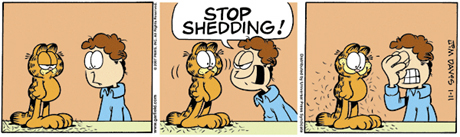
Original version: In the third panel, Garfield says, “Whoa! That loosened up some hair!” I like my version better, where he’s shedding intentionally and gleefully in response to Jon asking him to stop.

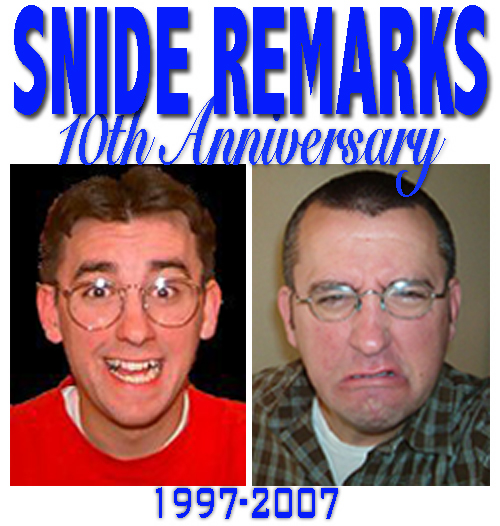
‘Snide Remarks’ 10th Anniversary Feature: My favorite angry letters

7

Alt text

[In lieu of the weekly “Snide Remarks” Classic, today we bring you a special anniversary feature. There will be more special features in the weeks to come, leading up to the official “Snide Remarks” 10th anniversary on Sept. 29, which is recognized by most major religions as a high holy day.]

Almost since the beginning, one of the most entertaining parts of “Snide Remarks” has been the angry letters that people sometimes write in response to it.

The perception is that I get these letters frequently. In truth it’s been ages since I got one. Ever since the column became online-only, where it could not assault unsuspecting readers from their morning newspapers, it’s been read pretty much only by people who like it, or who at least know what they’re in for.

But back in the old days, when it was in The Daily Universe, the student paper at BYU, angry letters were commonplace. In fact, of the 64 columns I wrote for the Universe (1997-1999), 22 of them got angry letters. That’s 34 percent! BYU is a hotbed of righteous indignation, and probably always has been.

I wrote 305 columns for the Daily Herald (1999-2003), of which 57 inspired angry letters. That’s only 19 percent, although it’s worth noting that the Herald’s website allowed people to post anonymous comments during much of that time, and nearly every column got at least one negative comment. In fact, there were some people who hated “Snide Remarks” so much, they read it every single time it was published, just so they could comment on how much they hated it. I AM NOT MAKING THAT UP.

(I only wish that, when the Herald administrators redesigned the website a couple years ago, they had not deleted all the old threads of anonymous comments. Many of them were classic.)

In all, 81 columns have elicited angry letters. Here I have chosen my favorite eight. I hope you find them as entertaining as I do.

Eric’s Sack of Mail: early movie screenings

8

A devoted reader named Sarah e-mailed me to ask the following.

I have a movie business-related question. Midnight showings of popular movies have been happening for years, but I thought it was very interesting that Pirates 3 started its showings as early as 8 p.m. on Thursday. I’d never seen a movie open like that before, so I suppose my question is: What is the reasoning behind that? Is it to purposely inflate the movie’s box office earnings and break records for opening day gross? Is it to create even more buzz for the film? (Not like Pirates really needs it, in my opinion.) I mean, it seems like once you start giving special showings of the movie at 8 o’clock, why not move the time back even further to 6 o’clock or whatever? Doesn’t that defeat the purpose of having a definitive release date at all?

You ask excellent questions, Sarah, and that kind of common-sense approach is why you could never make it in Hollywood.

You’re right that midnight “sneak previews” for big releases have been common enough for years. Ten o’clock screenings are not unheard of, either; I remember seeing “Batman Returns” that way in Los Angeles all the way back in 1992.

But if a film opens on Friday, May 25, yet has screenings (they don’t even bother calling them “sneak previews” anymore) as early as 8 p.m. on Thursday, May 24, then doesn’t that mean May 24 is the real opening date?

Eli Roth blames pirates for the failure of his crappy movie

23
Alt text

With his “Hostel Part II” having done poorly since its June 8 release, writer-director Eli Roth is pulling a Homer Simpson: “This is everybody’s fault but mine!”

And the primary reason for the film’s failure? Not its general lack of quality, or the fact that it’s an unimaginative rehash of the movie it’s a sequel to, or the fact that it wasn’t screened for critics (which drastically reduced the amount of opening-day publicity). No, Roth has determined that piracy is the reason “Hostel Part II” is flopping.

He writes on his MySpace page:

I want to thank all of you for your kind e-mails and incredible support for the film. However, piracy has become worse than ever now, and a stolen workprint (with uninished music, no sound effects, and no VFX [visual effects]) leaked out on line before the release, and is really hurting us, especially internationally. Piracy will be the death of the film industry, as it killed the music industry, and while it makes a smaller dent in huge movies like Spider Man 3, it really hurts films like mine, which have far less of an advertising and production budget.

‘Snide Remarks,’ but no podcast

0

This week’s “Snide Remarks,” entitled “Sein of the Times,” is now available for viewing. Usually there’s a Snidecast® recording of me reading the column aloud, but since this week’s is in script format — and since the characters are established characters with famous voices, rather than new fictions devised by me — I have forgone the recording this time. It would have required doing impersonations of all four “Seinfeld” characters, or reuniting the actors in my apartment, and neither scenario was feasible this weekend.

Sein of the Times

0

The landmark television program “Seinfeld,” which anyone with basic cable can now watch 15 times a day if they so choose, was famous for analyzing the minutiae of everyday life. Giving away unwanted gifts, double-dipping potato chips in a public dip bowl, pretending to admire ugly babies — it was all fodder for the “Seinfeld” writers.

The thing is, “Seinfeld” ceased production in 1998. American life has changed a lot since then, and the show never got a chance to comment on some of the things that are ubiquitous now. But what if “Seinfeld” were still on the air? What would it be like? I think it might go something … like … this …

JERRY: You got a new job? Why didn’t you tell us?

ELAINE: I posted it in my blog.

JERRY: Your blog?

ELAINE: Yeah, my blog.

JERRY: You have a blog?

ELAINE: What, you don’t read my blog?

JERRY: Why would I read your blog? I see you every day. What are you going to say in your blog that I don’t already know?

ELAINE: Well, that I got a new job, for one thing.

JERRY: So that’s what it’s come to? We don’t have to talk anymore, because I can just read your blog to see what’s new?

ELAINE: Pretty much.

JERRY: I don’t get this whole “blog” thing. Everyone’s gotta tell you what THEY think about the world. I don’t care what anyone thinks. Why would I care what some idiot in Florida has to say about the new sandwich at Subway?

ELAINE: You get some interesting perspectives sometimes on the blogs.

JERRY: I don’t buy it. The only difference between bloggers and those crazy guys who talk to themselves on the street is that the crazy guys don’t have computers.

ELAINE: So you don’t have a blog?

JERRY: No, I don’t have a blog. What do I need a blog for?

ELAINE: Everyone has a blog! Kramer has one.

JERRY: (to Kramer) You have a blog?

KRAMER: Oh yeah.

JERRY: (after a pause) You can type?

KRAMER: (waggling his fingers) 80 words a minute, my friend.

JERRY: What’s in your blog?

KRAMER: Oh, you know, this and that. Observations. Thoughts. Recipes.

ELAINE: See? Everyone has a blog.

JERRY: I barely understand him when I’m talking to him face-to-face. I can’t imagine what that blog of his is like. Does George have one?

ELAINE: Eh, George, who cares?

* * * * *

JERRY: So when are you seeing Karen again?

GEORGE: Karen? I’m not. We broke up.

JERRY: You broke up?

GEORGE: We broke up.

JERRY: Why did you break up?

GEORGE: She kept sending me text messages.

JERRY: What’s wrong with that?

GEORGE: All the time. Like 10 times a day.

JERRY: Ah. Did she write with those stupid abbreviations?

GEORGE: Yes! I didn’t know what the hell she was saying half the time! It’s just a random series of letters!

JERRY: Those are the worst!

GEORGE: “MT 7 CAF”? How am I supposed to know what that means?!

JERRY: It’s like all of a sudden everyone started speaking Esperanto, and we’re just supposed to pick it up as we go.

GEORGE: Yeah.

JERRY: So you broke up.

GEORGE: Yeah.

JERRY: When did this happen?

GEORGE: A couple weeks ago.

JERRY: A couple weeks ago? Your MySpace page still says you’re “In a Relationship.”

GEORGE: Yeah, I know. I hate to change it.

JERRY: But it’s misleading! People are going to think you’re in a relationship … if dating a woman who sends text messages like a 14-year-old girl can really be called a “relationship,” that is.

GEORGE: It’s so hard to change it. It’s like admitting the whole thing is actually over. It’s so … final.

JERRY: Going from “In a Relationship” to “Single.”

GEORGE: Yeah.

JERRY: So you’re saying if you were married, God forbid, and then you got divorced, it wouldn’t be signing the divorce papers that brought it home. It would be updating your MySpace that would really make it sink in that it was over?

GEORGE: Yeah, pretty much.

JERRY: You know, the MySpace has been great for dating. You can see what movies a woman likes, what she does in her spare time, and what she looks like in a bathing suit, all without talking to her — which used to be WHY we talked to women, to try to find those things out.

GEORGE: It’s much more efficient. It used to take me a month to be rejected by a dozen girls. Now I can be turned down by 10 girls a week, easy.

* * * * *

KRAMER: Jerry, you gotta see this!

JERRY: What is it?

KRAMER: It’s a video I downloaded from YouTube!

JERRY: What, I gotta go over to your house to watch it on your computer?

KRAMER: No, it’s here on my iPod.

JERRY: Nah, I can’t watch those things. The screen is too tiny.

KRAMER: But Jerry! It’s a high-definition screen! It’s got millions of pixels! Pixels, Jerry!

JERRY: I don’t care how many pixels it has, I’m not watchin’ some stupid video on your miniature little TV screen!

KRAMER: Why are you such a hater?

JERRY: I’m not a hater! I don’t get the whole iPod thing anyway. Why do I need to walk around with 5,000 songs in my pocket? I can only listen to one at a time. And where am I gonna be that I’m gonna be listening to music for 250 hours straight? Am I on the space shuttle? Am I in a coma?

KRAMER: OK, but you’re missing out.

JERRY: What’s the video, anyway?

KRAMER: It’s this comedian in a nightclub, and he totally freaks out and says the N-word over and over!

JERRY: OK, this I gotta see.

Friday movie roundup – June 15

14
Alt text

In this summer of sequels, is any film less-anticipated than “Fantastic Four: Rise of the Silver Surfer”? The 2005 original is widely regarded as one of the worst superhero films, and it grossed only $150 million at the box office. (That’s big money to you and me, but for a summer blockbuster franchise, it’s a flop. You may recall that “Spider-Man 3” made that much in one weekend.) But apparently they felt justified trying again, because here we are with a sequel … and it’s actually quite a bit better. Not quite “good,” but definitely better.

They didn’t screen it until last night in most markets, which is indicative of the amount of faith Twentieth Century Fox has in it. In some places, they had press screenings earlier in the week, but only for “legitimate” critics, i.e., those who write for daily newspapers. People at the weeklies and of course us no-good online critics had to wait until Thursday night, for a promo screening. At the Portland screening, they didn’t even bother taping off seats for the press, like they usually do. That’s how uninterested Fox is in dealing with the critics when it comes to this particular film.

Fido

0

The premise of “Fido” is so fantastic you almost forgive the shortcomings of the movie itself. It’s set in an alternate version of the 1950s, when zombies have risen up from the graves, warred with the living, and eventually been subdued into docility. Now every family on the block has a zombie as a household servant or groundskeeper.

We’re treated instantly to a fantastically sunny production design replicating the cheeriness of the ’50s. Everything is just as we remember it from Doris Day movies and “Leave It to Beaver,” with domesticated zombies added to the mix. And we meet young Timmy Robinson (K’Sun Ray), embarrassed because his family is the only one in the neighborhood without a zombie. Timmy’s shame is compounded when the head of security for ZomCon, which manufactures the zombie collars, moves onto his street. They have SEVERAL zombies working at their house!

But Timmy’s dad, Bill (Dylan Baker), doesn’t trust zombies, even with the radio collars that keep them passive. Timmy’s mom, Helen (Carrie-Anne Moss), wants one to help with housework, though, and she eventually persuades her husband to allow one in the house.

Most families don’t bother naming their zombies. Timmy calls theirs Fido. (Fido is played by Scottish comedian Billy Connolly, almost unrecognizable with short hair and pale, gray skin.) Fido has traits of a butler, a maid, and a dog. He does as he’s told, and he protects Timmy from bullies. Soon he’s Timmy’s best friend and confidante.

And then Fido’s collar malfunctions and he does something zombie-like to an old lady. Oh, and he has a crush on Timmy’s mom. Maybe Dad was right about these guys….

Canadian filmmaker Andrew Currie, writing with Robert Chomiak, has envisioned a film that lies somewhere between “Lassie” and “Dawn of the Dead,” intended as a parody more than an actual horror movie. There are horror elements — severed limbs and whatnot — but the idea is to amuse us more than scare us.

It does that (amuse us, I mean) fairly well for a while, but the sad fact is, as great a premise as we have here, it wears thin. Campy humor is difficult to sustain for any length of time because it remains, by definition, on the surface of the characters’ emotions and personalities. The plot becoming needlessly complicated near the end doesn’t do the film any favors either.

“Fido” has many laughs, and its satire of suburbia (and class relations, and the illegal-immigration debate, and so on) is often trenchant. Yet I found myself wanting to laugh more than I actually laughed. I suspect the concept would make a great 30-minute short.

Fantastic Four: Rise of the Silver Surfer

0

As far as “sequels to bad movies that no one wanted to see a sequel to” go, “Fantastic Four: Rise of the Silver Surfer” isn’t bad. It’s a vast improvement over 2005’s laughably dim-witted superhero tale, though it still lacks any major high-stakes excitement or surprises. In fact, it’s still not very good at all. But at least it’s not aggressively stupid! Baby steps, people.

Again directed by Tim Story, who apparently can never turn off the light touch he exercised on the comedies “Barbershop” and “Taxi,” even when he should, the sequel begins with Reed Richards (Ioan Gruffudd) and Sue Storm (Jessica Alba) preparing to marry. The Fantastic Four are media celebrities, though, and they live under constant scrutiny, making a private wedding hard to plan. Plus, they’re always being pulled away to save the world and whatnot.

Sue, who can turn invisible and make forcefields, wonders if she and Reed and can raise a family under these circumstances. Reed, whose body can stretch unbreakably in any direction, has a hard time getting out of scientist mode and cutting loose. Sue’s brother, Johnny (Chris Evans), uses his fame to date supermodels and secure endorsement deals. In fact, call him John: “Focus-testing showed that ‘Johnny’ skewed a little young,” he says. And Ben Grimm (Michael Chiklis), made of rocks and empowered with mighty clobbering capabilities, um, has a girlfriend. That’s sort of all that’s going on with him.

Into this mildly interesting realm of vague tension comes something slightly more dire: THE WORLD IS GOING TO BE DESTROYED! But don’t worry, not yet. In a few days. See, there’s this alien being called the Silver Surfer (body of Doug Jones; voice of Laurence Fishburne) who can move through solid things and change matter on a molecular level, and he has a pattern of going from planet to planet, and after he arrives at a planet, eight days later it’s toast. So, you know, they’ll need to stop him.

(By the way, the Silver Surfer character first appeared in the “Fantastic Four” comic books in 1966. I assume it happened because Stan Lee said, “Hey, you know what the kids are into these days? Surfing! Somebody work on that!”)

But what about Victor Von Doom (Julian McMahon), the Four’s archenemy, you ask? Turns out he’s not as dead as he was believed to be, and now, thanks to his possessing exactly one piece of useful information about the Silver Surfer, the U.S. military is letting him work with the Four on developing a plan to stop the madness. Naturally, he has a double-cross in mind.

The screenplay is by Mark Frost, who cowrote the last one, and Don Payne, who wrote “My Super Ex-Girlfriend.” That movie wasn’t very good, either, but it had its moments, and bringing Payne onboard puts the “Fantastic Four” on the right track. There are some actual laughs in “Rise of the Silver Surfer,” mostly situational, as the superheroes deal with using their powers in an ordinary world. The “Spider-Man” films, in particular, have shown how to mix the comic and dramatic in a superhero story, and it goes a long way toward making your audience feel connected to your characters.

So now that the humor angle is covered, what this franchise needs is to figure out how to raise the stakes and be deeply serious when deep seriousness is called for. Despite the fate of the world being threatened, nothing in the film ever feels tense or important. There are no epic battles, no real life-or-death scenarios. It could easily be a two-part episode of a “Fantastic Four” TV series — and a blockbuster summer action movie ought to be much more intense than that. These flat, emotionless characters just aren’t going to cut it.

Nancy Drew

0

It’s been nearly 70 years since a theatrical film was made about Nancy Drew, teen detective, so a new movie has the opportunity to introduce her to a whole new generation of moviegoers. Played with confidence and panache by Emma Roberts (Julia’s niece), the 21st-century Nancy is resourceful, old-fashionedly polite, and practically addicted to the fine art of sleuthing. I can see tween girls idolizing her all over again.

Simply called “Nancy Drew,” the new film brings Nancy and her dad, attorney Carson Drew (Tate Donovan), to Los Angeles for a few months for vaguely explained reasons. Nancy has promised her father that she will forsake all sleuthing (the word “sleuth” and its forms are used approximately 10,000 times over the course of the movie), yet she is powerless to resist investigating the mystery surrounding the previous owner of the house the Drews are renting during their stay in La-La Land.

It seems Dehlia Draycott (Laura Harring) was a promising young actress who disappeared for several weeks 25 years ago. After her return, she lived only a few months before winding up dead in her swimming pool. The murder, and its connection to her prior vanishing, was never solved. Why, it’s a tasty old-style Hollywood mystery!

Nancy busies herself with the Dehlia Draycott mystery, aided by her new sidekick and admirer, Corky (Josh Flitter), a squatty, comical 12-year-old who you think is going to be annoying but actually turns out to be pretty funny. Meanwhile, she’s trying to fit in at school, where her prim, old-fashioned clothing and general excellence at everything from athletics to math make her an outsider.

Fans of the Nancy Drew novels, mostly written in the 1930s and periodically updated since then, will find most of the basic elements intact, though the transfer from Midwestern burg River Heights to glitzy L.A. is an obvious departure. (The film’s first scenes are set in River Heights, where she appears to be the only person doing any actual police work.) Still, Nancy’s roadster is on hand, and so is her soon-to-be-boyfriend Ned Nickerson (Max Thieriot), who comes out to visit and to enjoy a session of hot sleuthing action. It’s probably impossible to capture the exact tone of the novels without setting the film in the ’30s, but the filmmakers seem to have done their best to be respectful to the old material.

The director, Andrew Fleming (“Dick,” “The Craft”), who cowrote the screenplay with Tiffany Paulsen, slips in the occasional sly joke about the conventions of murder mysteries. As the Drews are moving into the Draycott mansion, the real estate agent mentions, “Oh, there’s a stranger caretaker who lives in an apartment down the hill.” There’s always a strange caretaker in these stories, isn’t there? It’s nice to hear someone actually describe him in those words.

Later, Nancy’s resourcefulness has been modernized so completely that she can perform an emergency tracheotomy on someone with just a pen and a knife. The film has a wry, buoyant sense of humor, and you get the feeling that odd touches like that are intentionally funny.

Now, it’s only fair to mention that one of the perks of making a junior version of a Sherlock Holmes or Miss Marple story is that, since it’s the junior version, you don’t have to be quite so concerned about the details adding up, or connecting all the dots in the sleuth’s detective work. I could sit here all day and point out the flaws in Nancy’s logic, or the highly improbable events that lead her to various clues. The intended audience will surely delight in their heroine’s exploits, though, and who am I to spoil their fun?

Eagle vs Shark

0

“Eagle vs Shark” really, really wants to be the New Zealand “Napoleon Dynamite.” I mean REALLY. If “Napoleon Dynamite” were told from the point of view of Deb instead of Napoleon, and if everyone had Kiwi accents — and if you removed the filmmakers’ affection for their characters completely — you’d have “Eagle vs Shark.” But why would you want it?

The girl in this “geeks in love” story is Lily (Loren Horsley), a socially inept, crooked-smiling 20-something who works at a burger joint. Her parents are dead; she lives with her brother, Damien (Joel Tobeck), whose delusion — everyone in this movie has delusions — is that he’s a great celebrity impersonator and an all-around funny guy.

Lily’s crush is on Jarrod (Jemaine Clement), an electronics-store employee with a too-cool-for-school demeanor and a fondness for martial arts, both in real life and in video games. The joke, of course, is that he’s not cool at all. He’s a loser just like Lily and Damien. But he THINKS he’s quite a catch.

Jarrod has been preparing to return to his hometown and beat up the guy who bullied him in high school. Lily joins him in his quest, and we meet Jarrod’s family members, all cut from the same “get-a-load-of-what-dorks-they-are!” cloth.

In the meantime, Jarrod and Lily have an odd romance together. It’s odd not just because they both are, but because it seems to be founded on the principle that Jarrod can be a senseless jerk and Lily can be OK with that. For you see, Jarrod isn’t just immature and geeky; he’s genuinely insensitive, breaking up with Lily almost as soon as they arrive at his hometown, suddenly making her an unwelcome guest who has no way to leave. Lily, no doubt lacking in the self-esteem department, doesn’t seem to notice she’s being mistreated until the film is nearly over.

Written and directed by Taika Waititi (who appears in flashbacks as Jarrod’s dead brother, in whose shadow Jarrod still lives), the movie’s definition of “funny” is identical to most people’s definition of “random.” Referring to his nemesis, Jarrod says, “He’s gonna reap what he sowed, and it won’t be corn. Or wheat.” In discussing some of the festivities planned for an upcoming party: “My friend has a helmet, and he’s gonna let us chuck shoes at his head.” That kind of thing is funny here and there, but it’s not much to base an entire screenplay on.

Everyone speaks with that dry lack of enthusiasm that characterized “Napoleon Dynamite.” The difference is that “Napoleon” was genuinely quirky and seemed to be mocking its nerdy characters with some measure of affection; “Eagle vs Shark” is self-consciously odd and only wants to hold up its protagonists as objects of derision. There’s no compassion here, and not many laughs, either.

Bears: The latest in torture tactics?

12
Alt text

A devoted reader named Shawn e-mailed me with alarming news:

I just caught a commercial for “Captivity,” the upcoming horror movie with Elisha Cuthbert (one would assume that she plays a young girl in peril). It’s rated R, of course, but I was disturbed to see that it’s rated R for “strong violence, torture, pervasive terror, GRIZZLY IMAGES, language, and some sexual material.” I don’t know about you, but I find images of grizzlies highly offensive. Especially if they’re not eating Elisha Cuthbert.

I can only hope that no one notices the grizzly reference for a while. Someone needs to tell Stephen Colbert about this.

Sure enough, if you visit the movie’s official site, you’ll see that the film is rated R for the reasons Shawn cited, including “grizzly images.” The word should be “grisly,” of course — unless there are indeed images of grizzlies, and those images somehow contributed to the film’s being inappropriate for viewers under 17 unless accompanied by parent or guardian. Maybe the bears are doin’ it?

We’ll find out on July 13, unless the release date gets pushed back, as it has been twice already. In the meantime, stay alert, and keep watching the forests.

Bob Barker to ‘come on down’ to the unemployment office

17
Alt text

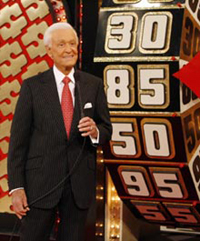
I have been watching “The Price Is Right” this week, because I wanted to see Bob Barker’s last few shows before he retires on Friday, and it is making me inexplicably wistful. I haven’t seen more than about 10 episodes in the last 20 years, but I watched it every day when I was kid. Bob has been hosting the show for literally my entire life. And now he’s going to stop. How can that be?! I’ve never known a world in which Bob Barker was not hosting “The Price Is Right.” I don’t even know what that world will look like!

So I’ve been TiVoing it this week, watching it while I eat lunch, and it’s easy to see why millions of people watch it all the time. You can complain if you want about how it promotes materialism, but I don’t care: Seeing people win money and prizes is exciting. I’d even say it’s uplifting. When someone is awarded a car or a bedroom set or whatever, they are genuinely happy about it, and it’s hard not to feel some of that joy yourself, too. It’s an hour of feel-good programming, five days a week.

Yesterday a father of four won a minivan, something he probably actually needs. He was ecstatic. What’s not to love about a show that brings people happiness?

Knives OK on planes; soft drinks still a terrorist threat

16
Alt text

The man and knife in question.

The Derby Telegraph in Derbyshire, England, reports that a man got a 7-inch knife past the security checkpoint at Birmingham Airport, while his daughter’s soda was confiscated.

The man, Nick White, says he’s a construction worker and he forgot he had the knife in his pocket when he and his 13-year-old daughter went to the airport. He realized it was with him when he approached the security checkpoint and, not knowing what else to do (he didn’t want to just throw it away), put it through the scanner along with the other stuff from his pockets. And no one said anything.

His daughter, meanwhile, had her soda taken away due to the ban on liquids on airplanes.

‘Snide Remarks’ Classic: ‘Humid Nature’

1

Alt text

Five years ago, I spent a few days visiting friends in South Florida. And wouldn’t you know it, I wrote a column about it when I got back, and that column — “Humid Nature” — is this week’s “Snide Remarks” Classic. It was column #279, published April 19, 2002.

If you’re just joining us, 2007 marks the 10th anniversary of “Snide Remarks,” and we’re commemorating it by spotlighting a good-but-forgotten column every Wednesday. Later this year we’ll do some best and worst lists and other retrospective-oriented stuff. Then we’ll have a big party, and there will be a giant cake, and former BYU president Merrill J. Bateman will jump out of it.

Update: Previously cited angry letter not actual angry letter

8

A few months ago, I reported that a student at Brigham Young University had written a letter to the editor of the school paper in which he swiped a joke of mine that I’d used in a “Snide Remarks” column in that very paper several years earlier. In the course of telling you about this, I also quoted (and made fun of) a letter that someone had written in response to the first guy’s letter, offended by some other, non-stolen joke he had made.

Well, the writer of the second letter has written to tell me this:

I googled my name for fun and was surprised to see that I’ve become “famous” for my “angry letter” in the Daily Universe. I just wanted you to know that Jon Harmon [the guy who wrote the first letter] happens to be my roommate and he wrote his letter so he could get out of a final…and I wrote mine as a joke to see if it would get published…I guess I suceeded in my endevor to appear as a “typical angry BYU student.” Just thought you might want to know.

Disney goes to hilarious lengths to prevent ‘Ratatouille’ piracy

9
Alt text

The studios have done a lot of comically inept things to combat movie piracy, but the funniest thing I’ve seen yet happened last week at the press screening for “Ratatouille.”

There was a sign-in sheet, which is common enough. You had to write down your name and what outlet you work for — makes sense. And then they wanted one additional piece of information: your driver’s license number.

This was so absurd that I was momentarily baffled, but I soon compiled a mental list of all the reasons that it was stupid to ask for the critics’ driver’s license numbers.

We’ll always have Paris … TO POOP ON!

17

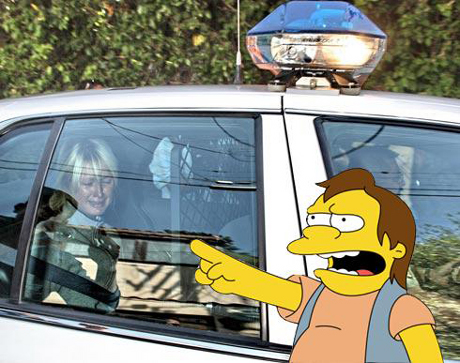
Two very funny pictures floating around the Internet this weekend, both reflecting the nation’s mood as a certain waste of space was sent back to jail on Friday.

My friend David Cornelius made this one:

Alt text

(See this pic to appreciate Dave’s inspiration.)

Meanwhile, this picture was sighted at this blog:

Alt text

You tell her, Nelson!

Typical Monday: a new ‘Snide Remarks’; a review of a bad movie

0

The weekend is gone, but there is still a reason to live: a new “Snide Remarks” column, entitled “Getting Tested,” with its corresponding podcast (which you can also listen to on the page itself).

This weekend was Portland’s 100th annual Rose Parade, or something. Apparently it’s a big deal. I didn’t go because I hate parades, and also because it was raining, and also because at the exact time the parade was starting I had to watch the new “Nancy Drew” movie. I do love Portland; I just don’t support its many, many parades.

I did, however, manage to see and review “Hostel Part II.” I do not recommend that you do the same.

Getting Tested

0

Well, I guess it’s official: After two years of living in Portland, I’m finally a true Oregonian.

I don’t mean that I’ve started doing something ridiculous like selling weed or voting for libertarians. I just mean that I’ve finally acquired an Oregon driver’s license (printed on 100% recycled hemp products), replacing the California license I’ve had since I was 19.

I got my first license at the usual age of 16, then got a new one with a new picture three years later. After that, California kept renewing it through the mail, even during the 10 consecutive years I lived in Utah. The last renewal, four years ago, even came with my Utah address on it. This confused every police officer and other authority figure who ever looked at it: a California license with a Utah address, not to mention a photo that no longer looked anything like me.

It was set to expire this year, and I had to go to the DMV to register my new car anyway, so I figured I might as well get it over with. After dealing with the auto-registration stuff, I told the nice DMV girl that I should probably get an Oregon license, and she thought that was a fine idea. She said the fee was $50, plus $5 to take the test.

The test! There was to be a test involved! I was very excited, and a little nervous. (Also a little perturbed that it costs $5 to take a test that costs the DMV $0 to administer.) She asked if I wanted to study before taking it, pointing to a rack of driver’s ed booklets lining the wall behind me. I said, “It’s probably not a very hard test, is it?” She said, “Well, I failed the first time I took it.” I looked her up and down and decided I was smarter than she was. “I’ll take my chances,” I said.

The test was administered via touch-screen computer. Very high-tech. You read the question, look at the four possible answers, and touch the one you think is right. It even tells you your score as you go, so you’ll know if you reach the point where you should just give up.

Most of the questions were, as I had predicted, absurdly easy. Either the correct answer was obvious from reading the question, or three of the multiple-choice answers were clearly wrong. There was stuff like this:

You’re approaching an intersection just as the light turns from green to yellow. What is the appropriate response?

A. Stop, unless it would be unsafe to do so.
B. Floor it and yell, “Wooooooo-hoo!”
C. Roll down your window and leap out, sending the car careening down the street unoccupied.
D. Chicken strips.

I got 32 of the 36 questions correct, passing with flying colors. It’s good to have it certified that I know how to drive, considering I’ve been doing it for almost 17 years. The questions I missed had to do with specific figures. In one, the computer asked what the penalty is for drunk driving the first time you are caught: suspended license for six months, suspended license for a year, or something else. I guessed it was six months; turns out it’s actually a year. I’m not sure why we have to know that, though, unless the thought process of an intoxicated person goes like this:

“You know, I might be a little too tipsy to drive. But hey, if I do drive, and I get caught, they’ll only suspend my license for six months. Bah! I can do six months standing on my head. Wait, what? It’s actually a year? Oh, eff that. I’m taking a cab.”

How’s this for an arrangement: I won’t drink and drive, and you don’t require me to know what the penalty is if I do. I don’t have room in my brain to store information that doesn’t matter! Where am I supposed to put all the lyrics to TV theme songs?!

Speaking of irrelevant information, one question went something like this:

You’re driving on a country road and you see someone riding a horse on the other side of the road, coming the opposite direction. The rider is holding up her hand to you. What does this mean?

A. The horse is alarmed and you must slow down until it is calm.
B. The horse is fine and you should proceed normally.
C. There is a herd of cows up ahead.
D. I don’t remember what D was, but it was something obviously wrong.

I correctly surmised that the answer was A, you should slow down and let the horse relax, but what, is this question left over from the 1910 driver’s test? Why am I driving on roads frequented by horses? More to the point, what is a horse doing on the freeway, which is the only place I ever drive? I think the question should be worded like this: “Do you ever drive on roads where there are liable to be horses?” And if you answer “no,” it skips all the horse-related questions for you.

It seems like much of the material on the driver’s test is outdated and has little to do with driving in a modern city. I propose new questions be written in this manner:

You’re driving with your cell phone in your left hand and a beverage in your right hand, your knee on the steering wheel. It becomes necessary to shift gears. Do you:

A. Balance the drink on your other knee and shift with your right hand.
B. Keep the drink in your right hand and use your wrist/forearm to shift.
C. Reduce your speed so that shifting is unnecessary.
D. Move the drink to your left hand while moving the phone to your right hand, then cradle the phone between your right ear and shoulder, thus freeing your right hand to shift.

What is the proper thing to say when the person in front of you is driving too slow?

A. “Come on, grandma!”
B. “Let’s go, idiot!”
C. “It’s the one on the right, genius!”
D. “Speed limit’s 45, retard!”

You are originally from State X, now living in State Y. Which of the following is true of State Y drivers?

A. They are the worst drivers in the country.
B. You thought State Z drivers were bad, but State Y drivers really take the cake.
C. Seriously, you’ve driven in lots of different states, and State Y natives are truly the worst.

Why do people become highway patrol officers?

A. Because they think there’s truly no greater good they can do in the world than to give people tickets for going 76 in a 65.
B. Because they couldn’t become real cops, the kind who actually fight crime and catch bad guys.
C. Because they have low self-esteem.
D. Because they are stupid jerks who have low self-esteem and couldn’t become real cops and now they’re just bitter and that’s why they write speeding tickets all day long and they get off on the fact that everyone hates them, and also they’re jerks.

Maybe the questions will have been updated the next time I take the test, in 2019.

Ocean’s Thirteen

0

The “Ocean’s” movies are getting sillier and sillier, with plots that rely increasingly on impossible technology and stunning coincidences to function. Yet in “Ocean’s Thirteen,” it’s more apparent than ever that Soderbergh, Clooney, and company don’t care — and that sense of gleeful nonchalance is contagious. Why, I didn’t care about anything while watching “Ocean’s Thirteen,” least of all “Ocean’s Thirteen”!

“Ocean’s Twelve” made the mistakes of setting too much of the action outside of Las Vegas, and of giving several of its actors nothing to do. Both problems are alleviated this time around. Ninety-five percent of the film takes place in Vegas, and despite the addition of two more major characters, everybody takes center stage at some point. The banter is still cool and snappy, the twists and double-crosses plentiful, the tone playful.

The caper: Reuben (Elliott Gould) has suffered a near-fatal heart attack after being swindled for millions by the nefarious Willie Bank (Al Pacino), whose new casino will be the swankiest, most opulent thing in all of Las Vegas. By way of payback, Danny Ocean (George Clooney) and the gang decide to ruin Bank financially — not by stealing his money, but by rigging all the games in his casino on opening night so that the house loses and all the players go home rich.

A swell idea! Impossible, sure, but who cares! (It’s amusing in these films to hear the characters readily embrace some ideas while dismissing others as impossible, when in fact ALL of them are impossible.) Many details must fall into place for it to work, and every man must play his part. Linus (Matt Damon), still anxious to prove himself useful, dons a disguise and woos Bank’s right-hand gal, Abigail Sponder (Ellen Barkin). Virgil Malloy (Casey Affleck) infiltrates the dice-making factory in Mexico and inadvertently causes labor unrest. Yen (Shaobo Qin) dodges high-speed elevators while moving through the hotel’s elevator shaft. Rusty (Brad Pitt) has to dress like a hippie. And so on!

All the regulars except for Julia Roberts are on hand, plus Eddie Izzard as a technical adviser on loan from England, Julian Sands as a high-tech-security expert, David Paymer as a hapless hotel critic, and Bob Einstein (aka Super Dave Oborne) as an FBI agent. Andy Garcia is back as another casino owner, and — “Godfather Part III” reunion alert! — he does get a scene with Al Pacino, who thankfully underplays his role, rather than being all big and crazy like he’s been in recent years. Once again, part of the fun is seeing so many celebrities pinballing off one another in the same movie.

Directed, as before, by Steven Soderbergh, who again serves as his own cinematographer, the film maintains the retro-glitz style of the previous installments. One of the first things we see is Brad Pitt walking against an impossibly blue night sky, and the whole film is full of those vibrant, catchy colors. David Holmes’ Rat-Pack-jazzy musical score once again adds to the effect.

And, once again, “Ocean’s Thirteen” is a film you want to love more than you do. The movie stars are having as much fun as ever, clearly enjoying every moment of their onscreen camaraderie (scripted by Brian Koppelman and David Levien), and that goes a long way toward making an audience have fun, too. But maybe it is a little smug of these famous actors to get together and horse around and expect the result to be entertaining to watch. But then again, maybe that would be a good point if they weren’t usually right. All I know is, these movies always make me want to go out and plan a heist, just for the fun of it. They make it look so easy!

Hostel Part II

0

If you enjoyed “Hostel,” last year’s torture-porn hit from Eli Roth, then one school of thought says you’re bound to enjoy “Hostel Part II,” because it’s almost exactly the same movie. Another school of thought, however, doesn’t like sequels that are merely repeats of their predecessors. That’s the school I go to.

Roth, raised on the classic slasher series, pays homage to them by retaining one character from the first “Hostel,” only to dispatch him within the first 10 minutes. Now we can REALLY get down to business!

The Slovakian recreational facility introduced previously is still operating at full capacity. Here men and women from around the globe can pay thousands of dollars for the privilege of torturing and killing a victim in a controlled environment. The victims, generally young backpackers, are plucked from a nearby hostel.

We know this already, and if we didn’t, we’d start to suspect it when the ominous music blares in conjunction with the first shot of the hostel. Our heroes this time are female — see, totally different from the first movie, where the victims were men! — and are three American art students studying in Rome. Lorna (Heather Matarazzo) is nerdy and spacey; Beth (Lauren German) is a rich, smart brunette; and Whitney (Bijou Phillips) is a temperamental blonde.

Through an elaborate and implausible plan involving several people pretending to be unconnected to each other but secretly working in tandem, the three girls wind up in Slovakia just in time for the Harvest Fair! And that’s where they get abducted. The lesson? Never trust strangers. Also, possibly: Never go to Slovakia during the Harvest Fair. It’s like the Eastern European version of Mardi Gras.

One thing the sequel does that the first film didn’t is introduce us to the torturers, who previously were just nameless sadists. Here they are Todd (Richard Burgi) and Stuart (Roger Bart), both American businessmen. Todd is a testosterone-fueled wannabe tough guy, while Stuart is a pushover who’s having second thoughts.

The reason you go to a movie like this, of course, is for the thrill of seeing the gruesome violence. In that regard, “Hostel Part II” is both better and worse than its predecessor. There seem to be fewer torture scenes this time around: just one major sequence, really, with a few abbreviated glimpses of others. But what we do see feels, at least to my memory (I have not re-watched the first “Hostel”), to be more distasteful and “offensive,” though I realize that word takes on a different meaning in a film where the whole point is to be offensive.

Roth breaks one of the unwritten rules of horror films by allowing a child — a little boy about 8 years old — to be murdered. It’s not shown graphically, but it’s there. Do we admire the filmmaker for going against the norm? Or do we point out that it doesn’t really take any courage or vision to break a rule like that — that Roth probably did it just for the sake of doing it?

A nude woman sits in a tub and slices open the live nude woman hanging upside-down above her and bathes erotically in her blood. A man’s genitals, fully visible to us, are cut off and disposed of. Both of these are unpleasant to watch, but as I said, that’s the whole idea. My observation is that if this kind of content doesn’t warrant an NC-17 rating, then apparently it is impossible to get an NC-17 rating for violence. Sex, sure. If the torturer had touched that man’s penis with anything other than a pair of scissors, that would have been sex, and then the MPAA would have been horrified and given it an NC-17. But since it was only violence, well, hey, there’s nothing wrong with that! We’ll give it an R, the same rating we gave “Pretty Woman,” “Rain Man,” “Billy Elliot,” and “The Matrix”!

But anyway. The MPAA’s flagrant and sustained incompetence is a matter for another time. Is “Hostel Part II” any good? Roth’s sense of humor is evident in a few instances (though the dialogue lacks the spark of the first film, or of his previous “Cabin Fever”), and he can build tension when he wants to. The problem here is that he usually doesn’t want to. There’s no suspense over who will wind up in the torture factory, and only a few mild surprises with regard to who lives and who dies and who does the killing. It is little more than a retread of the previous film, which makes it lazy on top of everything else.

Surf’s Up

0

There isn’t much to “Surf’s Up” beyond a basic “winning isn’t everything” message, and you will have to contend with the fact that it’s another @&#*@ cartoon with @&*&@ penguins in it. But this laid-back story from former Disney artists Ash Brannon and Chris Buck is too beautifully animated to be dismissed, and too aw-shucks earnest to be disliked.

The premise is a first for a feature-length cartoon: It’s made to look like a documentary, with the characters being followed around by cameras and interviewed by unseen directors. Our hero is an Antarctic teenage penguin named Cody (Shia LaBeouf), who has been an avid surfer ever since longboard champ Zeke visited the island years ago. Zeke mysteriously disappeared a while back, but his legacy lives on. Now Cody is headed for the tropics for the annual Big Z memorial surfing championship, where he will compete with other penguins from around the world.

Or mostly penguins, anyway. There might be some puffins; it’s hard to tell them apart when they’re cartoons. And there’s definitely one chicken, a typically stoned-sounding surfer dude named Chicken Joe, voiced by the typically stoned-sounding Jon Heder. Chicken Joe and Cody become pals. The bad guy, meanwhile, is Tank Evans (Diedrich Bader — what is this, a “Napoleon Dynamite” reunion?), a vain, arrogant showoff who is the current champion surfer of the world. Or at least of the flightless-bird world. Do humans even exist in this universe? It is unclear.

Cody washes out during an exhibition run and winds up in the island’s inner jungle, where he is Obi-Wanned by an aging surfer penguin who calls himself Geek (Jeff Bridges). Geek teaches Cody the Zen of surfing and helps him let go of pride and competitiveness, all of which makes him a better surfer.

Things progress in the standard fashion. Cody has a crush on a lifeguard named Lani (Zooey Deschanel); Chicken Joe gets into shenanigans and hijinks befitting a comedic sidekick; Cody must face off against Tank Evans in the finals. There’s nothing special about most of the jokes. Some are amusing; some aren’t. The middle section of the film is curiously less focused on humor than you’d expect, though it’s still lightweight and engaging even when it’s not laugh-out-loud funny.

The one hook the film has going for it is the documentary concept, which is handled with impressive attention to detail. Much of the “camerawork” is made to look shaky, as if shot with hand-held cameras. Archival footage looks impressively old. They even remembered to show drops of water splashed on the camera lens during aquatic scenes. In the more cinematic scenes, the visuals are excellent, with beautiful tropical colors and astonishingly realistic surfing action.

The film’s humor, if occasionally a bit naughty — Chicken Joe refers to his “nuggets”; Tank’s mom asks if he’s polishing his trophies, with double entendre intended — is as easy-going as a luau. Nothing about the movie marks it as one for the ages, but it’s a pleasant and amusing enough way to spend a “Shrek”-free afternoon.

La Vie En Rose (French)

0

After so many other biopics about drug-addicted popular singers, it is refreshing to see “La Vie en Rose.” It follows the same template as all the others but produces better-than-usual results, thanks to a shattering central performance.

It’s the story of French singer Edith Piaf, who rose to fame in the 1930s and died in 1963 after three car accidents, battles with alcoholism and morphine addiction, and a bout with liver cancer. It was said that her voice was “the soul of Paris,” and her records were bestsellers. Even on this side of the pond she was recognizable by her crystal-clear warble and the plaintive, heartbreaking way she could crank out a tune.

In the film, which jumps back and forth between her early-to-middle life and her declining years, she is played by Marion Cotillard in what is unquestionably the best performance by an actress so far this year. You don’t need to be familiar with the real Piaf to see how fully Cotillard inhabits her, nor do you need to have seen Cotillard in other roles to understand what a stretch this performance is. It’s all there on the screen: her commitment to the character in all her moods and stages of life, her passionate re-creations of Piaf’s concerts, her unselfconsciousness at appearing buffoonish when Piaf is older, stooped over, frail, her hands clawed, her face ridiculous with too much makeup. The difference between the beautiful chanteuse of the ’30s and the bent-over shell of the ’60s is so vast you can scarcely believe it’s the same character, let alone the same actress.

Edith appears to have led a rather bizarre life, which no doubt increases the film’s viability as a work of entertainment. (People with boring lives make for boring films, after all.) Her mother was an unreliable singer, her father was a freelance circus performer, she was blind from age 3 to 7, and she spent her formative years living at a brothel run by her grandmother. If Charles Dickens had lived a century later and in France, he’d have cribbed from Piaf’s diary to write his novels.

We catch the gist of all this before moving to the meat of the film, covering Edith’s professional career. While singing on the street for coins with her half-sister and best friend Momone (Sylvie Testud), she’s discovered by Louis Leplee (Gerard Depardieu), a nightclub owner with a flair for promotion. Soon Leplee has her singing to packed houses — and then, because nothing in Edith’s life is ever normal, Leplee is murdered and Edith is briefly considered a suspect.

As she becomes more famous, wealthy, and powerful, her life begins to take the more customary paths, and much of what director Olivier Dahan and his co-writer Isabelle Sobelman show us is the standard biopic material. At the height of her fame, Edith is a tottering diva, always looking like she’s about to fall down from too much laughter or liquor. She puts herself through hell to continue performing despite her failing health. Many of her songs are emotional ballads, and they reflect her life’s many tragedies, or vice versa. The love of her life is a boxer, Marcel Cerdan (Jean-Pierre Martins), who is already married.

There isn’t much flair in the film’s direction (though Dahan is obviously skillful), but that doesn’t matter. Cotillard never ceases to be captivating in her portrayal of the tortured, mercurial Piaf. She brings the singer to life in a way few actors have managed, transcending barriers of language and culture as she does so. Edith Piaf’s voice is immortal, and so is Marion Cotillard’s performance.

Friday movie roundup – June 8

7

There are three new wide releases this weekend, each catering to a different demographic. Find the movie that applies to you and win!

For grown-ups, there’s “Ocean’s Thirteen,” the third entry in the series of movies about celebrities who like to get together and make movies just for the hell of it. I gave it a B. In my memory, “Ocean’s Eleven” was a B+ while “Ocean’s Twelve” was a B-. Then I checked and found I gave them both B‘s. So that’s B’s across the board for the whole series, a straight 3.0 GPA. Good for them.

(By the way, it’s great to have Roger Ebert back on the job again, if only in a limited capacity. Here’s a typically great line from his lukewarm review of “Ocean’s Thirteen”: “I know full well I’m expected to Suspend My Disbelief. Unfortunately, my disbelief is very heavy, and during ‘Ocean’s Thirteen,’ the suspension cable snapped.”)

For children, there’s “Surf’s Up,” a good-enough animated film about a surfing competition for penguins. Why you would make a movie about a surfing competition for penguins, I don’t know. It’s very lovely to look at, though, and Napoleon Dynamite is in it.

And for 20-year-old boys, there’s “Hostel II,” the sequel to last year’s torture-porn hit I had mostly positive things to say about the first film, but I’m hearing the sequel is more unbearably gruesome. It wasn’t screened for critics, predictably, so the review is forthcoming.

If you’re a newcomer ’round these parts, you should know I send out an e-zine every Friday called “In the Dark” featuring the latest movie reviews, DVD releases, box office data, and other film-related merriment. There’s a podcast version of it, too, and today’s edition can be heard here.

Excel to distribute ‘Stalking Santa’; you can see it this weekend

3
Alt text

Chris Clark stars in “Stalking Santa.” Barely visible in the passenger seat is Daryn Tufts, who wrote the film and also appears in it.

Two months ago I mentioned a movie called “Stalking Santa,” a mockumentary about a man seeking to prove the existence of Kris Kringle. It was made by some friends of mine (and some people I don’t know) in Utah, and it’s gotten rave reviews at the film festivals it’s played at. But it still had no firm release date, nor even a distributor — tragic, when you consider “Wild Hogs” had a release date and a distributor before it was even made.

Now I bring you two bits of information:

1) The film has been picked up by Excel Entertainment and will be released in theaters in time for the holiday season. Excel has almost exclusively done Mormon-themed movies so far, so this will be a departure for them, as “Stalking Santa” has no Utah or Mormon content. Hopefully they don’t chicken out and only market the film in Utah just because that’s what they’re used to.

2) You can see the movie this weekend at the Utah Family Film Festival, being held at University Mall Cinemas in Orem. It’s screening Thursday at 5 p.m., Friday at 7:10 p.m., and Saturday at 6:10 p.m. Cast members will be in attendance each time to answer questions and stuff. Tickets are $5 if you buy them online ($6 at the door), which means it’s cheaper to see it now than it will be when it’s released in theaters later this year.

I don’t know much about the rest of the fledgling festival. The lineup of films looks reasonable, with more than just Utah-made films on the list. The schedule includes special screenings of “The Goonies” and “Napoleon Dynamite,” too, so that’s cool. If you find yourself in Utah Valley this weekend, maybe you should check it out.

Fogey misses point of joke, fears ‘Shrek’ promotes transvestite agenda

11
Alt text

The cause of your children’s sudden interest in cross-dressing.

Is there anything funnier in this world than people flying off the handle because they misunderstood a joke? I think not!

The Illinois Review is a conservative blog that I was unfamiliar with until Defamer pointed out a recent entry entitled: “Shrek: A Strange Setting to Promote Transgenderism.”

The writer, Fran Eaton, says she’s reluctant to sound like an ogre herself by spoiling everyone’s fun with “Shrek the Third,” but “there was [an] issue raised in the movie that I’ve seen no one yet address.” Of course, the reason no one has yet addressed it is that it only exists in Fran’s imagination. The issue? Cross-dressing. Specifically:

It’s the awkward inclusion of a transvestite and the uselessness of the character himself (herself?) in the story that is troubling.

Right in the midst of a warm “traditional family” setting, the film writers place a man dressed as a woman in with Sleeping Beauty, Cinderella, Snow White (the good gals).

‘Snide Remarks’ Classic: ‘Comfy KOSY Are We’

3

Alt text

Our celebration of the 10th anniversary of “Snide Remarks” continues with “Comfy KOSY Are We,” which is this week’s designated “Snide Remarks” Classic. It was column #232, published Dec. 12, 2001. It pertains to the Christmas season, and to a Utah radio station’s practice of playing nothing but Christmas music from Thanksgiving through Dec. 26. (I believe now they now they start even earlier, on Nov. 1, which is appalling.) Read and enjoy! I command you!

Further evidence that I am an uncle of cute children

8
Alt text

Since you aren’t here in person for me to show you the pictures in my wallet, I’ll have to brag about my adorable niece and nephew on my blog. Also, I don’t actually have any photos in my wallet, so being here in person wouldn’t help.

These were taken a couple nights ago. Here’s little Lindsay, 2 1/2 years old and so cute I want to devour her. Not in the creepy way that Hannibal Lecter devours people, but in the dignified way that you devour adorable children. You know what I mean.

And here is her new little brother Logan, born three months ago and apparently happy to just chill out. I have captioned the photo in a manner that seemed to reflect his mood, as if he were a lolcat.

AREN’T THESE CHILDREN CUTE???!!?!?! COULDN’T YOU JUST DIE?!??!!?!?

(P.S. I have another niece, and she is also cute, but I don’t have any pictures of her. You’ll have to take my word for it.)

Alt text

Regal lets you play hall monitor at the movies

17
Alt text

One of the main reasons problems in movie theaters don’t get fixed is that audience members are reluctant to leave the auditorium to report them. The picture goes out of focus, and everyone notices it, but you figure it will get fixed the second you leave, and then you’ll have missed some of the movie for nothing. And so it stays out of focus for much longer than it should, because no one wants to go tell someone. Sound familiar?

Now Regal Entertainment, the largest movie-theater chain in America, is launching a way to alleviate this problem. Starting last week, certain audience members in 114 theaters (up from 13 in the test run last year) are being given a little device that looks like a walkie-talkie with four buttons on it: “Picture,” “Sound,” “Piracy,” and “Other Disturbance.” If there’s a problem in the theater, you push the corresponding button and it alerts the manager, who then probably ignores it. But hey, at least you told someone, and you didn’t have to miss any of the film to do it.

It’s not clear how they choose who gets to be in charge

‘Mr. Brooks’ and ‘Gracie’ reviewed

0

As foretold in ancient times (this morning), the reviews of “Mr. Brooks” and “Gracie” are up. You may read them by first clicking your mouse on either of the links just provided, then scanning your eyes from left to right across the series of alphabetical symbols, which your mind will parse as words and sentences, the meaning of which your brain will interpret into ideas. But I’m sure I don’t need to explain reading to you! You probably do it all the time.

Rejoice over the glad tidings of a new ‘Snide Remarks’

0

After a couple weeks off, we have a new “Snide Remarks” column today, entitled “Two to a Womb.” You can listen to me read it by subscribing to the podcast, or by listening here, or simply by utilizing the space-age SnideCast® technology at the top of the column itself.

I have seen “Mr. Brooks” (good) and “Gracie” (meh), but I haven’t finished the reviews yet. Hopefully that will happen later today. If you find yourself tempted to see either one in the meantime, let “good” and “meh” be your guide.

Two to a Womb

0

Here is a heartwarming story that will warm your heart and fill your heart with warmth. It’s the story of a woman who just gave birth to a set of twins. Cute, right? But wait, there’s more! It’s the THIRD set of twins she’s had! And she had a regular kid before that! So she has seven children total, ages zero to 4 years. Quite a handful! That must be a busy operation there at her house, with all that pooping and crying, not to mention all the pooping and crying that the children are doing.

But wait, there’s even more! I haven’t told you the best part yet!

The mother is 20 years old, unmarried, unemployed, and on welfare! Hooray!

Her name is Amanda Gonzales, and she lives in Dallas. WFAA Channel 8 did a story about her recently (transcript here, video here) that walked the line between celebrating the novelty of having three pairs of twins, and scolding Amanda for being an example of everything that’s wrong with the world. You can imagine the conversations that took place in the newsroom. Rough drafts of the story probably looked like this:

Alt text

Artist’s rendering.

“Noted local tramp Amanda Gonzales was prepared to pop out two more future deadbeats Thursday….”

“When is a womb not a womb? When it belongs to Amanda Gonzales, and then it’s a Pez dispenser.”

“Good news, Dallas men! If you’ve always wanted to be a deadbeat dad, we know of a woman who will probably sleep with you — and we know she’s fertile!”

The father of the latest set of twins (it’s implied he is not the father of the other children) is 21 years old and also unemployed. What leads a 21-year-old guy to sleep with a woman who already has five kids? And what possesses them to spurn birth control, or to misuse it, or to get pregnant on purpose?

In other words, WHAT IS WRONG WITH THESE PEOPLE?!

There are so many people to blame that I scarcely know where to start. But let’s begin with…

HER MOTHER. She’s featured in the story. Her name is Joan. Amanda is aware that women in Texas are notorious for drowning or otherwise dispatching their own children, but she thinks she can handle the stress. Joan, her mom, agrees: “I’ve always talked to her and told her about it, if you ever get depressed that bad, you got people you can you can talk to, your sister, your brother, her boyfriend.” We’ll assume she meant to include herself as one of the people Amanda can turn to for help. And it’s awesome that she’s so supportive. Where was she five years ago, when Amanda was 15 and getting knocked up? What about a year later, and a year after that, when she got pregnant again and again? Where was Joan Gonzales when Amanda was a young teenager, when someone should have been teaching her maturity and responsibility? At Failed Parents R Us, that’s where, picking up some kits on how to fail at parenting.

HERSELF. I don’t know what kind of example Amanda had growing up. There may not have been any responsible men in her life, and her mother obviously wasn’t getting the job done. But regardless of what kind of lousy childhood you had, you’d have to be straight-up retarded not to know that you shouldn’t keep having babies when you have neither a husband nor a long-term partner nor a job nor an education. Were those first few babies she had super-easy to take care of? Was she like, “Hey, this isn’t as bad as every single person I know told me it would be! Turns out being a mother of three at 17 is a breeze! I bet I could have four more and not even break a sweat!”? How did she manage NOT to learn her lesson after the first pregnancy, let alone after the second and third?

In the news video, she says she always wanted to have kids. “I’ve always tooken care of kids since I was little, babysit, and I think that’s where I got it, when I used to babysit a lot of kids, I wanted to have my own, a lot of kids.” A fine sentiment, and elegantly stated. But what kind of idiot thinks having kids is so easy and harmless that she should have seven of them by the time she’s 20?

THE GUY. His name is Joshua Brown, for the record. Dude, you’re a moron. Birth control is not just the woman’s responsibility. I guess you know that now, unless you’re just as bad at learning lessons as your girlfriend is. And guess what? Even if the law can’t force you to stick around and be a good father to the babies you’ve spawned, if you walk out on Amanda and your children — and I can see it in your eyes that you want to — you’re a worthless man. Seriously. Men have a bad reputation as it is, with the wars we’re always starting, and our enslavement of other races, and our inability to put our own socks in the hamper. Don’t give us another black eye by abandoning your kids. We’ll come after you, we men will.

Alt text

Amanda Gonzales and her brood of adorable li’l bastards.

THE SYSTEM. I’m including a lot of entities in this category. The schools probably need to do a better job of teaching sex education — having it taught by actual teachers instead of gym coaches would be a good start — but that’s an issue for another day. The welfare system is a lifesaver in some cases, and I suppose it’s reasonable that Amanda wouldn’t have a job — how is she going to work when she has seven kids under the age of 5? — but there’s gotta be a limit somewhere. But how would that work? I mean, there are babies involved here. We can’t just say, “Sorry, we’re not gonna help you with those,” can we? That would be punishing the innocent kids, not their irresponsible mother.

The solution you’re probably already thinking of but don’t want to say it is to sterilize Amanda so she can’t get pregnant again. Admit it, that’s your gut instinct. But we don’t really do forced sterilization in the United States anymore. It’s had a negative connotation ever since the Nazis tried it. They ruined it for everyone, just like the square mustache and the goose-step.

So what can be done? We can’t force her not to have any more children, and we can’t in good conscience cut off her welfare. The state could take the children and put them in non-welfare-funded foster homes, but that seems a bit harsh. It’s not like Amanda is mistreating them. She seems to love them and want them. She just can’t, you know, support them. In other words, as usual, I don’t actually have any solutions. I just want to make jokes at the expense of the people who cause the problems.

I said earlier that Amanda’s an idiot for letting herself get pregnant so many times before she’s even out of her teens. But I should clarify that, because really, you know what? Have all the kids you want at whatever age you want. It’s not a wise choice, and it’s not what I would do, but hey, free country. Knock yourself out. None of our busines. Squeeze out all the babies you want — as long as you can support them. As soon as you start stubbornly insisting on having children despite having demonstrated that you can’t afford the ones you already have, that’s when it becomes our business, because we’re the ones who have to pay for them.

Shouldn’t the taxpayers have been consulted before Amanda got pregnant this last time? Shouldn’t there have been a referendum on the ballot or something? Isn’t this taxation without representation? After all, we’re feeding the kids, yet we get no say in how they’re raised, what schools they go to, what TV shows they watch, what their bedtime is. We have all the financial obligations of parenthood with none of the perks. That’s not fair. I want visitation rights. In exchange for the child support I pay through my tax dollars, I want the most adorable pair of twins to come stay with me for one weekend a year. Kids love me. I’m a great uncle. I do the thing where I push on their nose and make a “honk” sound, like a clown nose. Always gets a laugh.

So either I get a set of twins one weekend a year, or I stop paying taxes. That’s my final offer. Take it or leave it, federal government.

Friday movie roundup – June 1

3

One of the year’s best comedies opens today, and you should not take your mother to see it. Do not take my mother, either. Take no mothers! It’s “Knocked Up,” from the fine people who brought you “The 40-Year-Old Virgin.” I saw it at the South By Southwest Film Festival back in March, as described here (scroll down to Day 4), and then watched it again locally a couple weeks ago. I am ever so fond of it.

The other major release today is “Mr. Brooks,” a thriller starring Kevin Costner as a man with a murderous alter ego. MGM had a strange publicity pattern for it, screening it almost two weeks early in some cities while not screening it at all in others. I hope to have a review posted by Monday.

Finally, there’s “Gracie,” opening somewhat less widely today. It’s an inspiring sports drama about a teenage girl who wants to play soccer with the big boys. It’s apparently based on Elisabeth Shue’s personal story, no joke. I was out of town when the screening was held. Review to come.

You can subscribe to “In the Dark,” my freely weekly movie review e-zine, over here, and/or listen to this week’s podcast version of “In the Dark” right here. Click carefully, and have a nice weekend.

Knocked Up

0

One of the most impressive things about “Knocked Up” — an impressively funny and bawdy comedy from the man behind “The 40-Year-Old Virgin” — is that it’s basically just another “men and women are different” premise, yet it lays out both sides realistically and with far more depth than you’d expect from a movie called “Knocked Up.”

Just as Judd Apatow’s “The 40-Year-Old Virgin” had a surprisingly old-fashioned chastity message buried under all that raucous humor, “Knocked Up” dares to suggest that two people who accidentally make a baby should see it through together. It also derives laughs from men and women failing to understand each other, but the characters feel like real people, not like the cardboard joke-dispensers they could have been. It’s the thinking man’s R-rated sex comedy.

It begins with this nightmare premise: What if a drunken one-night stand led to a pregnancy? Alison Scott (Katherine Heigl) is a pretty E! Channel production assistant who’s just been given a shot at on-air work. Her career is starting to take off. Foolishly, she hooked up one night with Ben Stone (Seth Rogen), who’s average-looking and chubby, though he makes up for it by being funny. Ben and his several housemates, all in their mid-20s and going nowhere, have vague plans of launching a lucrative website that catalogs movie nudity for leering males. Specifics on how this site will operate or how it will make money have not yet been nailed down.

Alison and Ben’s liaison was a mistake, obviously, but the li’l fetus in Alison’s tummy means they must continue to interact. An abortion is not an option, of course, as it would end the movie immediately, and (though this is a lesser factor) because Alison doesn’t want one. Ben, a decent and honest guy underneath all the pot-smoking and general uselessness, says he’ll be as involved with the pregnancy and child-rearing as Alison wants him to be. He accepts responsibility for his actions, though not before going through the usual stages of anger and disbelief.

So Alison and Ben set out to get to know each other over the next eight months, to see if they could work as a couple, to determine how best to raise the child they’ve accidentally made. The comedy of two very different strangers being thrust together is abundant, and it would be sufficient for one movie. Heck, that’s the premise of most romantic comedies: We’re opposite, and we don’t like each other, but we’ll eventually fall in love. Apatow’s brilliant twist is to include another couple: Alison’s sister Debbie (Leslie Mann) and Debbie’s husband Pete (Paul Rudd).

Alison lives in Debbie and Pete’s pool house and is witness to their dull, crabby marriage, which has now produced two little girls (both played by Apatow’s real-life children; Leslie Mann is Apatow’s wife). Once Ben enters the picture, he and Pete become buddies. Alison and Debbie commiserate about their relationship woes, eating ice cream and complaining; Ben and Pete crack jokes and drive to Las Vegas, where they watch Cirque du Soleil while high on mushrooms. You can hear the resentment in Debbie’s voice when she asks why Ben and Pete don’t just get in a time machine and go back and have sex with each other, instead of Ben having sex with Alison.

“Who needs a time machine?” Pete says in a mock seductive voice while gazing at Ben.

Ben holds up a glass of booze and replies, “This is my time machine.”

And that’s the film’s big joke in a nutshell: Men get along with each other so much better than they do with women, and even better than women get along with each other. Apatow perfectly captures the camaraderie of young men — the idiotic bets (one of Ben’s friends has been dared not to cut his hair or shave his beard for a year), the vulgar but good-natured ribbing, the revelry-as-therapy that men use to work through their problems.

But for as male-centric as the movie could have been, it gives the women their due, too, making it one of the few battle-of-the-sexes comedies where both sides make good points. There are scenes dealing with Debbie’s fears of getting older and becoming less attractive, her love for her husband that keeps getting caught up on her fear of losing him. Alison is young and has unlimited potential, and now she has a baby on the way that could ruin everything. She’s scared, but she’s strong. She needs a man to step up and be a true partner. She needs Ben to quit being a lazy, unemployed 25-year-old and DO something.

The man-child-grows-up story is common these days, and so is the opposites-attract romantic comedy, and we’ve certainly seen our share of married-people-discover-marriage-is-sometimes-boring angst. But “Knocked Up” blends these familiar elements into something fresh and heartfelt, not to mention breathtakingly funny. It’s over two hours long, which is highly unusual for a comedy, and while I can identify scenes that could have been cut, to do so would have been to lessen the film’s impact. Most of the material surrounding Pete and Debbie’s marriage could have been eliminated, and the movie would have been 95 minutes long. But it also would have been a forgettable, throwaway sex comedy instead of the multi-layered relationship story it is.

Seth Rogen, from Apatow’s TV shows “Freaks and Geeks” and “Undeclared,” is perfectly cast as Ben. Ben is not handsome or ambitious, but with his good-natured sense of humor and unassuming demeanor, you can see why a girl would like him. By the same token, Katherine Heigl (of “Grey’s Anatomy”) demonstrates far more comedic agility than I’d have guessed she had in her, and makes Alison more than just the Pretty Blonde Who Gets Stuck with the Loser.

At some point in the last few years, without anyone noticing, Paul Rudd somehow became one of the funniest men in America, and Leslie Mann’s drunk driving scene in “40-Year-Old Virgin” is still one of that movie’s highlights. They add a pleasantly tart flavor to “Knocked Up,” ad-libbing and riffing as merrily as you please.

Let us also mention Martin Starr, Jonah Hill, Jason Segel, and Jay Baruchel as Ben’s housemates, all quick-witted and goofy and, at one point, stricken with pinkeye as the result of an ill-conceived flatulence prank. Numerous familiar faces — Harold Ramis, Joanna Kerns, Tim Bagley, “SNL’s” Bill Hader and Kristen Wiig, Loudon Wainwright, Alan Tudyk, Mo Collins, B.J. Novak, and Ken Jeong, to name several — pop up for one or two scenes each, steal some laughs, then scurry off again. It’s the kind of film where even if a character only has one line, chances are that one line is funny.

“Knocked Up” has some of the year’s funniest moments, some of them centered on hip pop-cultural knowledge (there are references to “Munich,” Matisyahu, and “Murderball”), and most of them verbal rather than physical. A second viewing didn’t yield quite as many laughs for me as the first one did — though it’s worth noting that even that second viewing was more enjoyable than 95 percent of all Hollywood comedies are on their first viewing. It’s a near-perfect mix of juvenility and intelligence, and of coarseness and sweetness.

Mr. Brooks

0

That Kevin Costner is a wily fellow. He’ll star in a string of terrible movies (I’m sure you don’t need a list), then surprise us with a good one (“Open Range”), then try a little comedy (“The Upside of Anger,” “Rumor Has It”), then turn around and play a schizophrenic serial killer. Here’s a man who’s famous for being inexpressive and bland, yet who manages to keep surprising us nonetheless. A wily fellow indeed.

He plays the title character in “Mr. Brooks,” a chewy morsel of psycho-killer intrigue that’s as unpredictable as Costner’s career choices. I’ve certainly seen smarter movies of this type, but one of the nice things about “Mr. Brooks” is that it doesn’t claim to be particularly clever. It strives instead for chilling semi-cheesiness, and it pulls that off just fine.

Earl Brooks is a successful and beloved businessman in Portland, Ore. He is also a serial killer, egged on by his imaginary partner/alter ego/Mr. Hyde/unbridled id, a man named Marshall (William Hurt). Marshall is essentially a voice in Mr. Brooks’ head, though the film takes it a step further by giving him a body and a face, too. It makes it that much more unsettling when Brooks has a conversation with him even while other people are in the room.

Brooks has a supportive wife, Emma (Marg Helgenberger), and a loving daughter, Jane (Danielle Panabaker), who has just dropped out of her first year of college and is at odds with her mother. They have no idea what Daddy does in his spare time, of course, and in fact the murders Brooks commits at the start of the film are his first in two years. He uses Alcoholics Anonymous principles to keep his addiction under control, and he loathes Marshall and his influence over him.

There was a witness to the latest killings, an unhinged loner who calls himself Mr. Smith (Dane Cook). He has pictures of Brooks at the crime scene, and he tracks him down and makes him a deal: Either Brooks takes Smith on a ride-along for his next murder to show him the ropes (Smith has aspirations of being a killer, too), or Smith takes the photos to the police. Marshall points out the obvious solution, which is to take Mr. Smith on his little outing and then kill him, too.

It’s not as simple as that, though, and another dimension is added when Brooks discovers that a cop named Atwood (Demi Moore) is getting awfully close to catching him. Brooks and Marshall have to string Smith along, get Atwood out of the way, and keep Emma and Jane in the dark, all without breaking a sweat or losing control. Mr. Brooks makes being a cold, calculating killer seem easy.

The film’s only significant flaw is a lack of focus. Director Bruce A. Evans, who wrote the script with Raynold Gideon (the two also penned “Jungle 2 Jungle,” “Stand By Man,” and “Starman”), has included a puzzlingly irrelevant subplot involving Det. Atwood’s messy divorce and her search for another serial killer who has recently escaped from prison. “Mr. Brooks” is reportedly intended as the first film in a trilogy, so perhaps all the attention paid to Atwood’s personal life is meant as set-up for later installments. Whatever the reason, it slows down what could have been a taut thriller.

Still, it’s almost always fun to watch movies about crazy people. There are a few choice moments when Mr. Brooks and Marshall laugh together, sounding like a parody of maniacal killers and, at the same time, like a legitimately creepy pair of maniacal killers. Costner gives the tormented Mr. Brooks enough layers and levels to make him sympathetic as a conflicted soul who wants to stop the madness, while William Hurt gets to have fun as Marshall, the embodiment of Mr. Brooks’ psychopathic tendencies.

Are some of the movie’s scenarios a bit ludicrous? Heavens yes. But even its most absurd ideas are tantalizingly creative and sinister, enough to make you want to see them through rather than scoff and turn away.

Gracie

0

Poor Gracie Bowen. All the 15-year-old wants to do is play soccer. But the boys and men in her town all say a soccer field is no place for a girl! Those meanies!

This is New Jersey, 1978, where the actress Elisabeth Shue grew up. Her brother Andrew helped conceive this story, basing it on their experiences as children; both Andrew and Elisabeth play supporting roles; and her husband, Davis Guggenheim, has directed it — directed it like the drippy, faux-inspirational sports drama it is.

Soccer is all the Bowen family cares about. When Dad (Dermot Mulroney) and the boys babble on and on about it at the dinner table, Mom (Elisabeth Shue) says, “Can’t we talk about something else?,” and Dad replies, “There is nothing else.” SO SHUT IT, MOM!

Even Gracie, the one Bowen daughter among three sons, is smitten with soccer fever. She practices frequently with older brother Johnny (Jesse Lee Soffer), the high school’s golden boy, and sometimes they use her skills to hustle neighborhood kids who don’t believe a girl could be any good at soccer.

But then there is tragedy, leading Gracie to declare that she will join the varsity soccer team next year and honor the memory of the person killed in the aforementioned tragedy! Whoever that might be. (No spoilers here!) Her parents think this is ludicrous, and for some reason when her dad makes her run drills in the backyard, she is suddenly horrible at it, thus sort of proving him right. She’s told to forget her stupid dream of playing soccer and get back to her normal life. (Did they not know that she used to play with Johnny all the time? Is her fondness for soccer a complete secret?) This leads to months and months of Gracie turning sullen and rebellious … or the family-friendly PG-13 version of rebellious, anyway; she smokes cigarettes, spray-paints walls, and very nearly goes to second base with a boy.

It is obvious to even the retardedest of observers that Gracie is acting out in this manner because she’s being denied the one thing she wants. Eventually her father realizes this, does a 180, and starts training her intensively so she can try out for the team — if the school board even lets her.

About one-half of all the lines of dialogue in the film mention the fact that Gracie is a girl. It is seemingly the only thing the movie is about. Yes, it’s her gender that’s creating such opposition to her soccer ambitions, but does it need to be stated every 10 seconds? The constant repetition can make a movie get old real fast.

The performances are all decent enough (especially Carly Schroeder’s sparky, Norwegian-looking Gracie), but the film gives them little to work with. Minds change instantly and without warning. Gracie’s mother’s purpose seems to be to second-guess and disparage everything that everyone does, her reasons never quite clear. In one scene Gracie and her best friend have a fight; in the next scene, they are pals again.

I should also mention the laughably obvious symbolism in the form of a bird Gracie keeps as a pet. “That bird will never fly!” her friend tells her dismissively early in the film. But you know what? Someday that bird WILL fly! And so will Gracie! Because the bird is a metaphor for Gracie! And at the end of the movie, they both fly, one literally and one metaphorically! It’s deep!

(It’s not explained why the bird’s flying abilities are in question. I mean, it’s not like she’s got a chicken in a cage. It’s a regular bird, the kind that flies. Why wouldn’t it fly? Was it injured? If it was, that would be a good thing to tell us. Otherwise, your ham-fisted attempt at depth is not only transparent, but illogical. I’m just sayin’.)

Mocking a movie as earnest as “Gracie” is probably bad form. It was obviously a labor of love for the Shue family, and more power to ’em. As labors of love go, this one is harmless enough. It’s just not particularly elegant or well-crafted, or even inspiring, to be worth seeking out. Unless you happen to be a Shue, too.

Day Watch (Russian)

0

Timur Bekmambetov’s “Night Watch” movies seem to wear their frenetic style and near-incomprehensibility as a badge of honor. Fans of the Russian dark-fantasy films — about vampires and other supernatural creatures living among us — take delight in the confusion they feel watching the films, reveling in the insane images being projected on the screen.

Myself, I’m not quite as able to give myself over to befuddlement, though there is certainly a lot to enjoy in “Night Watch” and now in its sequel, “Day Watch.” The films are easily the most Hollywoodized Russian movies I’ve seen, full of Michael Bay-style action sequences and thick with comic-book-inspired mythology. You can get a kick out of them even if you don’t always know what’s going on — but eventually that confusion starts to grate on the nerves, or at least it does mine.

“Day Watch” picks up more or less where “Night Watch” left off, and heaven help you if you have not seen “Night Watch.” The situation is this: The age-old truce between the Light Others and the Dark Others (measured by how evil they are, not their skin color) is increasingly fragile, and now elements are in place that could bring about war. Yegor (Dima Martynov), a 12-year-old boy with special Dark Other powers, is being trained by his masters, while Svetlana (Mariya Poroshina), a Light one and a rookie in the peace-keeping Night Watch force, has hidden powers that complement Yegor’s. For some reason, it is important to stop these two powerful Others from ever meeting.

Yegor’s father, Anton (Konstantin Khabensky), is a Light Other, and he’s Svetlana’s partner in the Night Watch. When Yegor’s teacher, Galina (Irina Yakovleva), is found dead in an apartment building’s stairwell, Anton is a suspect and goes on the run, with the Dark ones trying to prove his guilt while the Light ones try to prove his innocence.

Also, there is a gold-painted man who was guarding the Chalk of Fate, which is an actual piece of chalk that can be used to grant wishes, and now both sides want it for their own wish-granting purposes. Also, there’s a guy who can be a bird if he wants to. Also, at one point Anton and Olga (Galina Tyunina), a female coworker, trade bodies. This is ostensibly to help Anton hide from the Dark Others who want to arrest him, but that doesn’t make any sense. Wouldn’t they just arrest the person who looks like him, regardless of whose soul is currently inhabiting his body? “I’m not Anton! I’m someone else in Anton’s body!” Yeah, yeah. Tell it to the judge, pal.

The climactic scene takes place at Yegor’s birthday party, a grand event on the top floor of a hotel attended by all the Dark dignitaries and crashed by Anton and some of his colleagues. I cannot begin to describe the weirdness that takes place, except to say that you’ve never seen one drop of blood matter so much to so many people.

It’s a bizarre film, but it’s a mirthful one. Bekmambetov wants us to be entertained, not perplexed. While I’m sure he’s aware how bewildering his movies can be, I get the impression he wants that to be part of the fun. And so it is, I suppose. Wearying and hard to follow at times, sure, but fun.

Crazy Love (documentary)

0

Ideally, you would watch “Crazy Love” without knowing anything about it beyond what’s contained in these first few paragraphs. It is a documentary about two New Yorkers who met and fell in love in the 1950s, and the turbulence their relationship has endured since then. It’s a bizarre, riveting, and outrageously original story, and it’s 100 percent true. You’ll enjoy it more if you’re surprised by what happens, which you won’t be if you continue reading this review, or any other review or summary of the film, including the one-line plot outline at IMDb.com.

I would love to leave it at that, but it’s impossible to review the film without talking about some of its basic elements. And the fact is, despite knowing some of the story’s more jaw-dropping developments beforehand, I was still riveted and surprised by the movie. Reading a review won’t ruin it for you; you’ll just be slightly less flabbergasted when you see it.

“Crazy Love” does not mince words about its protagonists: These people are not right in the head, and their love for one another defies all reason. But then again, one is compelled to consider, doesn’t all love defy reason? Isn’t its irrationality part of what makes it true love?

(Here’s where you should stop reading and go see the film.)

So maybe we shouldn’t judge Burt Pugach and Linda Riss too harshly. Yes, in a fit of jealousy, the no-good Burt hired a man to throw acid in Linda’s face in 1959, permanently blinding her. And yes, after Burt served 15 years in prison for the deed, he and Linda got married and have been together ever since. But hey, love is blind — and if it isn’t blind already, that can be arranged.

Linda was a beautiful young woman in 1957, when Burt, a not-handsome, not-honest, but charming lawyer saw her sitting on a park bench in the Bronx. Their romance evolved like a storybook at first, with him sending her flowers immediately after meeting her, and both of them seeking respite from their less-than-ideal upbringings. Burt was raised by an abusive, smothering mother, while Linda lived most of her life with an aunt.

When we see them in the present, interviewed by director Dan Klores through the unforgiving lens of digital video, Linda’s eyebrows dance constantly above the rims of her dark sunglasses, her voice raspy from decades of smoking. Burt is still a larger-than-life, only-in-New-York ambulance-chaser type. They tell their story separately, each offering a different perspective.

Burt had, shall we say, ethical problems. His sharky law tactics had made him very wealthy, but he had run-ins with the bar association. Furthermore, while wooing Linda, he was still legally married to another woman in Alabama. When the first Mrs. Pugach wouldn’t grant him a divorce, he drew up fake papers to trick Linda into thinking she had.

The acid-throwing occurred after Burt and Linda’s on-again/off-again romance was off again, and she was engaged to another man. Burt went to prison for it, though you will marvel at the lengths he went to — remember, he’s a gifted attorney in his own right — to avoid it.

And that’s all I’m going to tell you about the lives of Burt and Linda. Their friends and family members are interviewed, too, most of them sharing that New Yawk honking accent that makes all characters, fictional and otherwise, seem more vivid. Their testimonies are expertly arranged by Klores (with co-director Fisher Stevens and editor David Zieff) to reveal the story piece by piece, one fascinating detail after another. The mark of a good documentary is when it tells its story as compellingly as the best fiction, and that’s what Klores does.

At the heart of it is this unconventional relationship between Burt and Linda, and our first inclination is to dismiss them both as emotionally unstable. Linda must have low self-esteem, we figure, to keep going back to a man who has proven to be such a scoundrel. And yet “Crazy Love” reminds us that life isn’t always black-and-white like that. Burt’s certainly not getting off easy, living his life now with the braying, hectoring Linda. If the crazy kids are happy, then hey, who are we to judge?

Eric is lucky, whoever he is

10

I got this strange e-mail:

Hi Eric,

My best friend is really in love with you when she heard about your car crash she was sad then happy that god saved you .SHE HAS ALL YOUR PICTURES!!!! and thinks your wife(or ex) was really lucky. Please email me saying hi or watever because I want to show her the emal as a birthday present because her birthday is in 2 days.

Thank You,
Zeena

At first I thought this was merely an instance of someone seeing a celebrity mentioned on this site and mistakenly (stupidly) believing the site to be affiliated with that person. But then I noticed: She addresses the e-mail “Dear Eric.” So the celebrity Zeena thinks I am is someone with the same first name as me.

And now I’m dying to know: Who did she think I was? Which celebrity Eric has recently suffered a car accident? So I Googled a few of the famous Erics I could think of off the top of my head, along with the words “car accident,” and discovered that Eric Bana crashed a car during a race a few weeks ago. Mystery solved. Except for the mystery of why Zeena thought EricDSnider.com was the website for Eric Bana.

Eric’s friends are amusing: Hailey Smith

3

My friend Hailey Smith (a performer in the previously mentioned Thrillionaires improv troupe) stars in this little video that is evidently going to be part of some marketing campaign. The site it touts isn’t functional yet, but the video is very funny on its own.

‘Snide Remarks’ Classic: ‘What You Missed’

1

Alt text

The “Snide Remarks” Classic column we’re spotlighting this week is one that I find terribly amusing but that may not be everyone’s cup of tea. It’s called “What You Missed,” it’s #229, and it was published on Nov. 30, 2001. It’s simply a parody of those listings you see in TV Guide and elsewhere where they summarize what happened on the daytime soap operas last week. So it’s a spoof of the conventions of soaps (evil twins, dead people coming back to life, etc.), as well as an excuse to engage in wordplay and other mischief.

These lines make me laugh: “Francesca joins the Navy” and “Monkeys, everywhere monkeys.” They’re better in context.

What do ‘the people’ want?

13

Mark Harris is by far the best of Entertainment Weekly’s three rotating back-page columnists. (Dalton Ross is too hipster-ironic-snarky, and why should I care what Stephen King has to say about anything other than books?) His entry in the June 1 issue is a prime example of his insight and intelligence. I nodded in agreement through the entire piece, and I’m not much of a nodder.

Entitled “Power to the People,” the column addresses this common Hollywood lie: “We’re just giving the people what they want.”

It’s the defiant lie told by those who want to pretend that their failures of ambition are your fault -— that because “the people” eat what they’re fed, they must like it. The moneymen behind Spiders of the Shrekibbean brag about meaningless numbers (Spider-Man 3 had the biggest opening weekend of all time!) and shrink from meaningful ones, like the fact that Spider-Man 3 cost more and will likely gross less than the first two.

Fox ‘apologizes’ for overlong ‘Idol’ finale being even more overlong than they thought it would be

16
Alt text

They could have started here. Snippy-snippy! I’m just sayin’.

“American Idol” viewers who worship at their altar via TiVo or a TiVo-like device were horrified to discover that the two-hour results show Wednesday night ran 10 minutes long, thus preventing them from seeing the giant girl win over the guy who does sound effects. In other words, they missed the whole POINT of the show.

Fox has responded by issuing a statement of apology — although it’s worth noting that the apology stops short of actually accepting responsibility for the mistake:

We’re sorry that DVR users may have missed the conclusion of the American Idol broadcast. It was always our intention to bring the show in on time, but just as with any live sports, variety, awards or entertainment event, there is no way to absolutely guarantee that the show will end exactly on the hour. Fox and the producers apologize to those viewers who were inconvenienced.

Comparing the “American Idol” finale to a sports or awards show sounds reasonable, until you realize that sports and awards shows have a lot of unpredictable variables: overtimes, time-outs, and the unscripted acceptance speeches. Everything about the “AI” finale, on the other hand, was completely scripted. The only ad-libbing was during the three “Golden Idol” award segments,

Steel City

0

The Lees are a family in crisis in Brian Jun’s “Steel City.” Carl Lee (John Heard) is in jail for his role in a fatal traffic accident, but the disintegration began some 15 years ago, when he walked out on his wife and two sons. Now he must do what he can to reconnect with his children, to salvage what’s left of the family before it’s too late for him.

The emotional stakes are high and every character is at risk in this piercing, respectable blue-collar drama. At the center is Carl’s son PJ (Tom Guiry), who was in the truck with him at the time of the accident and is haunted by it. PJ is maybe 20 years old, works as a bus boy at a restaurant, wants to be a police officer like his mom’s second husband Randall (James McDaniel). But he is mired in indecision, his growth stunted even further by this latest turn of events. Can he really escape the confines of his anonymous working-class town?

PJ’s older brother, Ben (Clayne Crawford), doesn’t offer much inspiration. He’s a bitter bully who doesn’t acknowledge Dad’s existence. He’s married to Maria (Jamie Anne Brown), but cheats on her with a bartender named Lucy (Heather McComb). He works in the town’s steel mill, a situation PJ is trying to avoid for himself.

With Dad in jail and the bills not being paid at the house, PJ goes to live with Dad’s brother, Uncle Vic (Raymond J. Barry). Vic gets PJ a job and regards the listless young man with a mixture of pity and compassion. He punctuates his kindliness with bluntness, but his crinkly old blue eyes give him away as a good man who appreciates the importance of family ties.

And so here are these people — I should also mention the boys’ mother, Marianne (Laurie Metcalf), and PJ’s tentative new girlfriend Amy (America Ferrera) — all spokes on a wheel whose hub is Carl Lee, a good man who has made many mistakes in his life. Writer/director Brian Jun portrays them honestly (albeit with one too many acoustic-guitar-accompanied montages), and uses the claustrophobia of the unnamed dead-end town the film is set in to great advantage. There’s a palpable sense of frustration among the primary characters as they wonder whether this is all there is, and whether they can be happy with it anyway. (Ryan Samul’s stark, grim cinematography helps. The weather always seems overcast in this town, even indoors.)

The performances are good because they don’t over-reach. No one is gunning for an Oscar here. There is a natural cohesion to the cast, everyone working together to present a sturdy, emotionally powerful drama. Whether the ending is “happy” or “sad” is irrelevant. It’s cathartic just to be along for the ride.

Pirates of the Caribbean: At World’s End

0

Against all odds, and despite being the longest film in the series, “Pirates of the Caribbean: At World’s End” is probably also the best. It’s less chaotic and exhausting than “Dead Man’s Chest,” more emotionally engaging than “Curse of the Black Pearl.” For the first time, I can see why many people LOVE this series. If only the first two films had actually been as good as their box office haul suggested they were!

“At World’s End” begins with things looking grim for nearly everyone. Jack Sparrow (Johnny Depp) has been sent off to Davy Jones’ locker, which turns out to be not just a metaphor for “death,” but an actual location, albeit on a different spiritual plane and apparently rather difficult to return from. England’s Lord Beckett (Tom Hollander) is cracking down big-time on piracy, with mass public hangings scheduled daily. Young lovers Elizabeth Swann (Keira Knightley) and Will Turner (Orlando Bloom) have parted company for reasons that were probably explained in the last film (well, as much as anything can be said to have been “explained” in the last film) but that I do not recall.

Now Elizabeth and the resurrected Captain Barbossa (Geoffrey Rush) have traveled to Singapore to get a map to Davy Jones’ locker from Sao Feng (Chow Yun-Fat), the chief pirate captain of the Orient. Later, Elizabeth somehow winds up in Sao Feng’s possession due to the latter’s mistaken belief that she is the sea goddess Calypso in human form.

OK, I said this film is less chaotic than the last one, not that it lacks chaos altogether. The story is still jam-packed with double-crosses, betrayals, and secret negotiations, but it’s a much more linear, straightforward story than before. Only occasionally must one pause and say, “Wait, what?” Mostly you can just smile blithely and enjoy it.

This is especially surprising given how much there is going on. The central plot has the world’s pirate lords assembling to discuss how to repel the British crackdown, but that barely scratches the surface. We learn more about the mortal life of the now-cursed Davy Jones (Bill Nighy), as well as the backstory on the mystical voodoo priestess Tia Dalma (Naomie Harris). There are issues of pirate politics to deal with, and it’s nice to see that, unlike the United Nations, pirate summit meetings often end in fisticuffs and stabbings. Other subplots involve the rules surrounding the Flying Dutchman and how one becomes its captain, and why a person might want that.

Regular “Pirates” writers Ted Elliott and Terry Rossio were obviously paying attention on the day of screenwriting class that talked about character objectives. Every person in “At World’s End” has a very specific thing that he or she wants. Elizabeth and Barbossa want to retrieve Jack from Davy Jones’ locker; Will wants to free his father from servitude on Jones’ ship; Beckett wants to learn where the pirate council is being held; Davy Jones wants to restore his mortality; Jack wants to drink rum and sail the world. The film even has a prop to simplify this concept: a magic compass that always points toward the thing you want the most.

What isn’t always covered is why people want the things they want. The overall objectives I’ve just named are self-explanatory, but some of the smaller steps they take toward accomplishing those goals aren’t clear. For example, one character is put to death and I literally have no idea why. The person responsible for it obviously felt it would help him achieve his own goals, though, so more power to him, I guess.

But despite being plot-heavy like its predecessors, “At World’s End” is mostly coherent and fluid, and it manages to make us care about some of the characters on an emotional level, too. Director Gore Verbinski has always shown a keen eye for visual details and spectacular set pieces; here he combines it with some genuine heart and humanity. I’ve always liked Jack Sparrow as a character, but this is the first time I’ve liked him as a person, too.

It all leads to a rousing, vertiginous climax set aboard two ships in the midst of a maelstrom. Sure, the film goes on for another 30 minutes after that “finale” (the “Return of the King” syndrome), but restraint has never been a hallmark of this franchise. The jolly performances, the lavish production design, the peculiar details and whimsical asides — it all adds up to an enjoyable and cohesive swashbuckling adventure. It’s about time.

Bug

0

“Bug” isn’t a horror film, nor is it a straight-up psychological thriller. It dwells instead in the twitchy, uncomfortable realm between those styles, with elements of a weird love story thrown in for good measure. Does it work? Yes, in a way. It’s hard to imagine how a movie with such jarring, disparate ingredients could succeed 100 percent, but “Exorcist” director William Friedkin — as qualified as anyone to take a stab at it — nearly pulls it off.

Adapted by Tracy Letts from his own play, the film takes place almost entirely in a seedy Oklahoma motel room, the home of Agnes (Ashley Judd), a waitress at a lesbian honky-tonk bar and the ex-wife of a convict. The con, Jerry (Harry Connick Jr.), has just been paroled, making the lonely, beaten-down woman more anxious than usual. She drinks vodka and snorts cocaine with the gusto of someone who doesn’t expect to live much longer, or who doesn’t have much to live for anyway.

Agnes’ friend and co-worker, R.C. (Lynn Collins), introduces her to Peter (Michael Shannon), a polite, awkward drifter who doesn’t drink or do drugs. They all hang out at the motel room for a while until R.C. goes home, leaving Agnes and Peter to get acquainted. Neither is looking for love, or even sex; companionship will do for now.

Peter says he’s more intuitive than most people, able to discern secrets and to see things most people don’t notice. He demonstrates this “vision” metaphorically by getting Agnes to admit some of her past sorrows — she and Jerry had a son who disappeared 10 years ago — and then literally by finding tiny bugs in the bed sheets. Aphids, he says, and they bite. And they’re everywhere. Do aphids really bite? Never mind. Can Agnes see them too? Never mind!

She sees them soon enough, all over herself and the room, and thus begins the film’s descent into unsettling craziness. Peter is your garden-variety paranoid nutcase, ranting about conspiracy theories and other madness, yet Michael Shannon — reprising his role from the London and New York productions — plays him with such reasonable-sounding passion that you almost believe him.

Agnes is certainly a convert. The film suggests, painfully, that we seek out elaborate conspiracy theories to explain things like 9/11 and the Oklahoma City bombing because they provide better, more satisfying explanations for events that are otherwise too monstrous to contemplate. You can use paranoia to explain away all your problems and fears, and that’s what a wounded soul like Agnes needs.

Judd and Shannon are both fearless and unselfconscious in their portrayals of these unhinged characters, and that’s where the film walks a perilous tightrope. Their increasingly impassioned rants probably play better on the theatrical stage, where the audience can be caught up in the moment more readily due to the immediacy of live theater. With film, it’s much harder to establish that intimacy, and thus much more likely that someone in the audience is going to laugh at histrionic lines like “I am the super mother bug!” And once one person laughs, it’s hard to take it seriously anymore.

That’s not a fault of the film, necessarily. The performances, the directing, and the editing all suggest that everyone involved was fully committed to treating the onscreen madness with dead seriousness. If you can be absorbed in it the way Friedkin intended, you’ll find yourself suitably disturbed by the horrific and inevitable conclusion.

Paprika (Japanese)

0

“Paprika” begins with a disorienting, action-packed dream sequence in which a detective is pursued by nightmarish circus figures through a series of movie-like scenarios. As an audience member, you’d be wise to get used to the feeling of not knowing what’s going on.

One of the trippier animated films to come out of Japan in recent years, “Paprika” — by director Satoshi Kon (“Tokyo Godfathers”) — is an intensely weird, brightly colored, cheerfully animated piece of adult science-fiction that revels in its own whacked-out craziness. Much of it takes place in a dreamworld, so it makes sense that those parts wouldn’t, uh, make sense. But even the scenes set in reality have a strangeness to them, as when a fat man becomes so fat that he gets stuck in an elevator.

The story centers around a device called the DC Mini that can track and record people’s dreams. It’s being tested for use in psychotherapy when it’s stolen — meaning the thief can control anyone connected to it, forcing dreams into their conscious minds even when they’re awake, leading to dangerous and deadly behavior.

It’s up to the scientists in charge of the device to figure out who stole it and get it back. Among them is Dr. Atsuko Chiba (voice of Megumi Hayashibara), a pretty young woman who has an alter ego named Paprika who exists as a sort of guide in the dreamworld. She’s secretly been helping that detective, Konakawa (Akio Otsuka), peer into his dreams in the hopes of finding clues to a murder case he’s working. Konakawa has a strange distaste for movies that figures into the story later on, at least to the extent that anything truly “figures into” this story.

Things become more dire as the device claims more victims. Chiba and her fellow scientists, including the fat guy, Tokita (Toru Furuya), must find the DC Mini before everyone’s dreams become reality and turn the world into a nightmare. The veil between dreams and real life is already stretching thin, and the characters frequently find themselves unsure which is which.

Or something. Honestly, I’ve seen the film twice and am still baffled by a good portion of it, yet the gleefully bizarre dream sequences and general oddness make it a fun ride. A recurring theme has a parade of objects — mailboxes, refrigerators, frogs playing band instruments, little girls’ dolls, etc. — marching merrily through the city, and one imaginative scene after another makes you scratch your head and say, “What the hell…?” Some have suggested that taking drugs first would enhance the experience, but really, I don’t see how hallucinogens could make the movie any weirder than it is.

Angel-A (French)

0

In “Angel-A,” Andre (Jamel Debbouze) is an American in Paris. That might sound romantic, but Andre spends most of his time being beaten up. He was born in Morocco and is now a U.S. citizen; neither nationality makes him very popular in France. He is a con man, but not a very good one, as he now owes gangsters 50,000 euros. He is without money or identification, so the U.S. consulate can’t help him. He needs — yes — a miracle.

That is the point in Luc Besson’s strange little comedy-drama when the title character arrives to save the day. Played by the Danish model Rie Rasmussen, Angel-A is a tall, leggy blonde who appears just as Andre is considering tossing himself off a bridge and ending it all. She exhibits a knack for talking bad guys out of things and coming up with enough money to keep Andre out of trouble.

Is she an angel? A prostitute? Both? Whatever the case, she’s there to help Andre, a figure who is in desperate need of help. Andre lies to himself (and us) regularly and falls for flattery very easily. He does not love himself, and you could argue that he has little reason to. But Angel-A sees his inner beauty.

This is Besson’s first film since 1999’s “The Messenger: The Story of Joan of Arc,” and the first in his native French since 1990’s “La Femme Nikita.” Fascinated, as ever, by strong, dominating women, he does some interesting things with gender roles here. Andre has the outward forms of masculinity, including wearing a beard, yet he’s out-manned by Angel-A in almost every way. She’s taller, better at fighting, and much better at negotiating than he is — yet she’s also the very picture of femininity, with a beautiful face and figure. Together, they comprise one perfect whole.

Besson’s regular cinematographer, Thierry Arbogast, has photographed the film in striking black and white. It’s possible that’s the most memorable thing about the movie. The story, despite its angelic overtones, is rather pedestrian. The acting is good enough: Jamel Debbouze makes for a likable loser, and Rasmussen gives some zip to what could have been an icy-cool character. It’s a wisp of a film, recommendable for a lark, but not nearly as ambitious or entertaining as you’d expect from Besson.

The Golden Door (Italian)

0

Interesting that in its native Italy, “The Golden Door” is called “Nuovomondo,” or “New World” — and the film is reminiscent of the works of Terrence Malick, whose most recent film was called “The New World.” Coincidence??

Well, yes. But Emanuele Crialese’s “The Golden Door,” the story of an Italian family emigrating to America circa 1900, does often feel like a Malick film, with its long, contemplative silences and the way it completely immerses us in the images and sounds of its world: the arduous, creaky journey, and the tedious testing, prodding, and scrubbing that immigrants undergo before being granted even temporary citizenship. We feel much of what the family feels, and it’s only fitting that we should, since so many of us are descendants of people who came to America in much the same way. Think of it as a virtual-reality tour of your genealogy.

Being like a Malick film also means that “The Golden Door” (whose title comes from Emma Lazarus’ Statue of Liberty poem) sometimes feels slow — not listless or boring, but slow enough to be disconcerting if it hasn’t sunk in yet what Crialese is trying to do. Once you accept the intention of making us share the characters’ experiences as viscerally as possible, you can relax and let the movie do its thing, however “slow” it may be.

The characters are the Mancuso family, rustic Sicilians who have barely left their tiny village before, let alone sailed the seas. At the head is Salvatore (Vincenzo Amato), a widower with two teenage sons, Angelo (Francesco Casisa) and Pietro (Filippo Pucillo). Pietro is mute but not deaf and apparently somewhat simple-minded. Angelo, the older of the two, is more useful to Salvatore as a worker and partner.

Salvatore’s ancient mother, Fortunata (Aurora Quattrocchi), a mystical and superstitious old woman, is accompanying them to the New World, perhaps for no better reason than that her relatives are going. Upon arrival, it becomes glaringly obvious that she is ill-suited to the modern, Western, highly structured American way of life.

The story itself is simple, but the characters are portrayed naturally and without affectation. Only a subplot in which an English woman (Charlotte Gainsbourg) wants to marry Salvatore to help with her own citizenship process feels forced and unnecessary. She is aided by an American played by Vincent Schiavelli, who died during filming, necessitating the reduction of his character’s role. I suspect the subplot would have felt more connected to the film if it could have been filmed in its entirety.

I mentioned the film’s attention to the sights and sounds of the Mancusos’ experiences. At the opposite end of the realism spectrum, we are also treated to occasional surreal images like a river of milk on which floats a canoe-sized carrot, or gold coins raining from the sky — fantasies about the wealth and opportunity that await the refugees in America. These amusing images are presented as normally as everything else (it’s not even apparent at first that they ARE fantasies, as opposed to actual events), giving the film a quality of magical realism. The whole picture, real and surreal, is hauntingly beautiful.

Friday movie roundup – May 25

5
Alt text

Yarr! Avast, mateys! And other assorted pirate things! The latest giant film in this summer of giant films is “Pirates of the Caribbean: At World’s End.” I think it’s the best film in the series — much less chaotic and much more coherent than the last one, in particular.

You know, I pride myself on being a fairly non-snooty movie critic. I like plenty of “popcorn movies” as well as the kinds of movies that film critics stereotypically like. And yet the whole “Pirates” things escapes me. I was surprised when the first one was a huge hit, and downright mystified when the second one became the 6th highest-grossing film of all time. It’s not that I don’t enjoy high-flying swashbuckling adventures; it’s that these particular high-flying swashbuckling adventures struck me as overlong, overcomplicated, and overproduced. And not in a fun way.

Anyway, I think the new one is better, and I enjoyed it quite a bit. Adding to my enjoyment was the fact

Another fun thing that happened in Utah County: The Thrillionaires

4
Alt text

I found myself in Provo, Utah, on Monday, and I went to see a performance by the Thrillionaires, an improv group started last year by some of my friends. It was the second show of theirs I’d seen, and I continue to be astounded at their level of talent.

It’s not just improv comedy, you see. Most of the performers are ComedySportz veterans, or alumni of other comic organizations, and they’ve mastered the improvisation skills. With the Thrillionaires, they take it to another level.

Usually the first half of the show is a 40-minute improvised play in a particular style. Past themes have included Oscar Wilde, Tennessee Williams, and film noir. This week it was John Steinbeck: dusty, impoverished people working on ranches in the 1930s, that sort of thing. The Thrillionaires’ on-the-spot creation was hilarious, multi-layered, and even a little touching.

In the second half of the show, they often do a musical. Improvising a musical is hard enough, and they tend to make it even more rigorous

A couple of fun literary things that happened

12
Alt text

I was in Utah for a few days last week, visiting friends and family in my old stomping grounds. It’s always nice to see my bros and hos in the Beehive State.

On Monday, a couple of fun things happened. I had a few minutes before I was supposed to be somewhere, so I stopped at the Barnes & Noble in Orem to browse. There was an exceptionally large crowd of people milling around, many of them youngsters, so I wondered if I’d happened upon a field trip of some kind. Then I saw that an autograph-signing was in progress, featuring Brandon Mull, author of the “Fablehaven” books.

Brandon and I are both BYU alumni, and we’ve occasionally crossed paths over the years. He was part of Divine Comedy, the sketch troupe that was inspired by my Garrens Comedy Troupe, and now of course we’re both writers. Except he writes fiction, and he has fabulously well-attended book-signings.

‘American Idol’ amuses me, briefly, then doesn’t

4

I stayed with a friend in Las Vegas last night, and he watches “American Idol.” I gave the show up back in 2005, during the season of Carrie Underpants and Bo Bice and that other guy who was Bo Bice but with a different name. I’m two years clean now, and I’m proud of it.

But I watched it last night with my friend, and I’m glad to report that doing so did not make me fall off the wagon and back into “American Idol” addiction. My thoughts were these:

– Apparently one of the two finalists is a guy who “beat boxes,” which means he makes annoying sound effects with his mouth, just like that guy in the “Police Academy” movies.

– Apparently this is considered by some to be a laudable skill even though it is hilarious and stupid.

‘Snide Remarks’ Classic: ‘Aging Bull’

0

Alt text

This week’s “Snide Remarks” Classic column (we’re spotlighting one every Wednesday in celebration of the column’s 10th anniversary) made me giggle a few times when I re-read it a few months ago, which means I had forgotten almost everything in it. It’s called “Aging Bull,” it’s #209, and it was originally published on Sept. 28, 2001. It makes fun of old people. When has that ever not been fun?

Eric’s Sack of Mail: Loretta is not a prude!

11

I got an amusing e-mail from someone regarding my review of the film “Children on Their Birthdays.” You almost certainly have never heard of this film. I’d forgotten about it. There was a press screening for it in the summer of 2002, and it was supposed to be released soon thereafter. Then it got pushed back and pushed back, and it was finally released on Oct. 18, 2002, but only in a handful of theaters. I don’t think it ever even played in Utah, where I lived at the time and where they had the press screening for us.

Anyway, I guess it’s on video now or something, because a woman named Loretta watched it, loved it, and took issue with my review. Her e-mail doesn’t qualify as an Angry Letter, but it is enjoyable for other reasons:

Frowny face emoticon: No ‘Snide Remarks’ today

4

As foretold last week, there is no new “Snide Remarks” column today. You can well imagine my sadness over this fact. I’m on the road, on a bit of a “vacation,” you might say, except that I’m still doing some work. Just not “Snide Remarks.” So very sorry.

There probably won’t be one next Monday, either, but you never know. As I’m lazing about my parents’ house later this week, the mood might strike me and I might dash off an exceptionally witty bit of commentary. On the other hand, next Monday is Memorial Day, so not publishing anything would be a perfectly justifiable action on my part. It is all part of the mystery of being me!

I’ll still have some blog entries this week, more or less one per day as usual, so don’t forget about me entirely.

Finally, did you know that one (1) spider monkey weighs the same as 9.41 placentas? Or that it would take 720 giraffes’ necks to equal the Golden Gate Bridge? It’s true! These and many other important facts can be found at Weird Converter. Go amuse yourself there for a while.

Using Wikipedia-editing powers for evil, not good

10

Devoted reader Joe sent me photographic evidence of something shameful he did recently, which was to edit (some would say “vandalize”) the Wikipedia entry on Utah Valley State College to reflect something I said about it in a recent column. The joke was OK when I wrote it; somehow it’s much funnier when it appears in an official-looking context. It’s at the bottom:

Alt text

Friday movie roundup – May 18

0

Sorry for the tardiness in today’s round-up. I got “In the Dark” sent out last night, and immediately after that is when the site’s server went down. So I went to bed, which is pretty much all the tech support I’m capable of.

Anyway, there’s not much to round up. “Shrek the Third” is the only wide release this week, the other studios apparently being terrified of opening anything against the Shrek juggernaut. The movie’s pretty funny, not that you really need my encouragement to go see it.

This week’s “In the Dark” podcast can be heard here, and you can plug this URL into your podcast-listening device to subscribe to it. And of course more details on the old-fashioned e-mail version are here.

Even Money

0

The purpose of “Even Money” is to tell us this: Gambling Is Bad. You people out there who are gambling, you better cut it out. CUT IT OUT, I SAID!!

Now, I like being lectured to in a somber, heavy-handed manner as much as the next guy. That’s usually why I go to the movies, in fact, because I want someone to pound a message into my skull for two hours, and to do it artlessly and dully.

But “Even Money” also has Kelsey Grammer wearing a fake nose and chin, hobbling on crutches and playing a hard-boiled detective. Why ruin a perfectly good lecture with something so funny?

Directed by Mark Rydell (“On Golden Pond”) from a screenplay by newbie Robert Tannen, “Even Money” blends several melodramatic stories of gambling fever into a giant casserole of Afterschool Special moralizing. Carol Carver (Kim Basinger) is a novelist, wife and mother who spends all her days at the slot machines, gambling away her family’s savings. Murph (Grant Sullivan) is a low-level bookie striving to hide his occupation from the woman he loves (Carla Gugino). Clyde Snow (Forest Whitaker) loves to bet on college basketball and has a beloved nephew, Godfrey (Nick Cannon), who’s coming up in the ranks as the next big NCAA star. And Victor (Tim Roth) is a high-powered underworld bookie who works for the elusive “Ivan” (and may actually BE Ivan, for all anyone knows).

Grammer, playing Det. Brunner, interacts with some of the lowlifes as he investigates a bookie’s murder, but that subplot is a red herring. The real attention is focused on Carol, who meets a magician-turned-con-man named Walter (Danny DeVito) who wants to help her make back the money she’s squandered. Her husband, Tom (Ray Liotta), growing suspicious of the fact that Carol goes to the coffeehouse every day to write yet is never any closer to finishing, is just a few steps away from discovering his life savings is gone, so Carol and Walter have to act fast.

Meanwhile, Clyde’s sports-betting debts are growing, and the type of people he borrows from aren’t known for their leniency or payment plans. They want him to persuade Godfrey to throw a game. The young man loves his uncle, but is this going too far?

Murph’s girlfriend finds out what he does for a living. He defends himself. “I give people dreams,” he says. “No, Murph,” she replies. “You take their dreams away.”

That’s some thick dialogue there, and “Even Money” is loaded with it. Basinger over-acts egregiously and Roth chews the scenery shamelessly, while Grammer actually underplays his character, who evidently walked in from the set of a film noir circa 1940. Forest Whitaker, who deserves an Emmy for the most recent season of “The Shield,” flirts with over-the-top hysterics here but mostly stays just this side of it.

It’s all so ham-fisted and clumsy, a movie whose agenda looms heavily over the proceedings. It shares a producer with “Crash,” Bob Yari, and matches that film’s obnoxious “look how important our message is” attitude. “Crash” had better performances, though. “Even Money” is a bust.

Shrek the Third

0

The cast of characters continues to expand in “Shrek the Third,” the latest rowdy adventure in the ever-amusing fairy-tale-spoof series. A petulant young King Arthur and a baffled old Merlin are among the new arrivals, while princesses such as Snow White and Rapunzel — previously referred to but not given much screen time — get a chance to demonstrate their unique skill sets. (We knew Snow White could summon birds with her voice. Who knew she could make them attack by singing Led Zeppelin’s “Immigrant Song”?)

This outing looks toward the next generation, as Far Far Away’s King Harold (John Cleese) is dying, and he’s named Shrek (Mike Myers) as his heir. The ogre doesn’t want the gig, though, and defers to Plan B: a royal nephew named Arthur (Justin Timberlake) who is presently a gawky teenager who gets picked on even by the Dungeons & Dragons geeks. (Shouldn’t there be a joke about playing Dungeons & Dragons at a time when there really ARE dungeons and dragons?) Artie doesn’t want the job either, once he learns how hard it is, so Shrek has to persuade him, lest he be saddled with it himself.

Meanwhile, Shrek’s beloved wife Fiona (Cameron Diaz) is pregnant, sending more ripples of panic into Shrek’s green heart. Ogres aren’t known for their nurturing, fatherly attributes, after all. Sure, Donkey (Eddie Murphy) and the dragon have spawned a litter of happy, if horrifyingly freakish, donkey-dragon hybrids. But is there any hope for a pair of swamp-dwelling ogres?

Meanwhile (there is a lot of meanwhile in this movie), Prince Charming (Rupert Everett) is enduring nightly humiliation playing himself in a bad dinner theater play. Determined to seize the throne once and for all, he rallies all the other fictional losers — Captain Hook, Snow White’s wicked queen, various witches, and so forth — and stages a coup while Shrek, Donkey, and Puss-in-Boots (Antonio Banderas) are off looking for Arthur. Fiona, Queen Lillian (Julie Andrews), and their bickering princess girlfriends are tossed into prison.

One of the few film franchises to retain a high level of quality even on the third outing, “Shrek the Third” is loaded as ever with anachronism-based jokes, raucous parodies, and good old-fashioned silliness. It’s fast becoming a “Simpsons”-like universe, where any member of the huge cast of characters can get a laugh just by delivering one line. Puss-in-Boots, the great discovery in “Shrek 2,” is used (but not overused!) to great effect here, and the Gingerbread Man (Conrad Vernon) has some of the film’s funniest non-sequitur moments. (You have not truly lived until you have seen a Gingerbread Man’s life flash before his eyes.) Likewise, there are winning cameos from the Three Pigs, Pinocchio, the apple-throwing “Wizard of Oz” trees, and a host of other familiar characters.

That said, it could be that the film (directed by regular “Shrek” contributors Chris Miller and Raman Hui, and written by a gaggle of scribes) emphasizes the auxiliary characters at the expense of the central ones. Fiona, for example, feels like a non-entity in this chapter. That’s a shame, considering her relationship with Shrek was the central element of the first two films.

Furthermore, several of the movie’s funniest elements — such as Arthur’s high school, where teens talk in a mix of King James English and modern slang, and the gaggle of diva-like princesses (voiced by various “SNL” alum, plus Amy Sedaris) — are gone before they’ve fully lived up to their comedic potential. And why go to the trouble of hiring Ian McShane (the terrifying villain on HBO’s “Deadwood”) to play Captain Hook if you’re only going to give him a few lines?

On the whole, there’s not nearly as much depth of emotion here as there was in the previous installments. Shrek is supposed to be the giant monster with a soft heart, and while he’s as lovable as ever, here the “tender” moments — as when he mentors young Arthur — feel obligatory. Which is a fancy way of saying the movie focuses more on laughs than on feelings, which probably won’t register as a very serious complaint.

Nor should it, really. It means the film doesn’t resonate as a classic, that’s all. For giddy, rude, daffy humor, it works just fine. Because really, once you’ve seen a chorus of frogs singing Paul McCartney’s “Live and Let Die” at the funeral for their king, whose body is in a shoebox floating away on a lily pad, what else do you need?

The Last Time

0

I sure miss Michael Keaton. While he can elevate bad material like “Herbie: Fully Loaded” and “First Daughter,” what he really needs to do is find some GOOD material to work on. Crap like “The Last Time,” a melodramatic disaster about salesmen, is a waste of his talent. Heck, it’s waste of everyone’s talent, even the people in it who aren’t very good.

Written and directed by TV scribe Michael Caleo (“The Sopranos,” “Rescue Me”), “The Last Time” wishes it were “Glengarry Glen Ross” so bad you can taste it. The script tries to recall the “gritty,” “realistic” language of wheeling-and-dealing salesmen … which really just means they swear a lot.

JAMIE: (hostile) All right, Mr. Number One salesman, what’s your advice?
TED: F*** you, that’s my advice.

Ted (Keaton) thinks he’s the Alec Baldwin character in “Glengarry Glen Ross.” He’s the top salesman for a high-tech company (we never learn what they actually make), and he’s ruthless, mean, cynical, and abrasive. Somehow, this translates into sales.

He’s saddled with a new partner, Jamie (Brendan Fraser), a fresh-faced younger guy who was the No. 1 seller back in Ohio but is struggling here in dog-eat-dog New York. He’s a naive idiot with no common sense, and you wonder how he ever sold anything, anywhere. His fiancee, Belisa (Amber Valletta), is a little more practical, and wonders if her husband-to-be will ever make anything of himself.

Naturally, the only option is for Belisa to have an affair with Ted. This occurs on Jamie and Belisa’s bed, with Jamie there next to them, passed out drunk.

The film gets less believable from there.

Caleo can’t keep a consistent tone. Fraser acts like he’s in a broad, farcical comedy; Keaton, as mentioned, thinks he’s in “Glengarry Glen Ross”; the musical score suggests steamy made-for-the-USA-Network late-night drama; the story is pure soap opera trash; the dialogue is generally too ridiculous to be real but not clever enough to be funny.

To top it off, there’s a huge twist in the last act that is hilariously bad, like something out of a parody of tawdry melodramas. Except there’s no parody here: Caleo really wants us to take this seriously.

The performances are not bad, and Keaton makes you glad to see him even when it’s in garbage like this. But why waste your time? You’ll be bored and annoyed by the 30-minute mark.

‘Snide Remarks’ Classic: ‘I PETA the Fool’

2

Alt text

What’s surprising to me is that “Snide Remarks” was around for four years before I made fun of PETA. PETA! A subject ripe for mockery if ever there was one, and I didn’t get to it until Sept. 7, 2001!

That column, called “I PETA the Fool,” is this week’s “Snide Remarks” Classic. I’ve written several PETA columns since then, but this one is my favorite

Incidentally, you’ll notice the date is just four days before 9/11. Isn’t it weird to look at pre-9/11 stuff now and remember how different things were then? There I was, blithely mocking PETA, and four days later the world changes. Of course, PETA remained the same; I’m pretty sure their major concern on 9/11 was whether any animals were harmed. But anyway.

Once

0

A musical for the modern age, “Once” is a lovely bit of Irish pleasantness in which two wandering young souls come together and make beautiful music together. The tunes tend to be of the shoe-gazing indie-folk variety, and the cinematography is natural and documentary-like. You get the sense that if the guy who plays guitar in the subway made a movie, it would look like this.

The characters are never named. The guy (Glen Hansard) is a street guitarist who works part-time in his father’s vacuum cleaner repair shop. The girl (Marketa Irglova) is a Czech girl who lives with her mother and young daughter and plays piano when she gets the chance. They meet; they become friends; they become musical collaborators; romance seems imminent.

That is basically the entire story there, and it’s the lack of more substance, plot-wise, that prevents me from completely loving the film. (Even at just 88 minutes, it still feels a little long.) But I certainly do like it! Hansard and Irglova are both musicians, not actors (though they act well enough, too), and their musical performances are genuinely impressive. When other characters in the film rave about how good their songs are, it’s a pleasant surprise to find that hey, they’re right. These songs ARE pretty good!

Writer/director John Carney let the actors improvise through many of the scenes, and the naturalness is a huge benefit to the film. It feels immediate and real, not removed and plastic the way many films (and especially musicals) often do.

I like also how the guy’s dad (Bill Hodnett) is sweetly supportive of his musical career, not dismissive the way movie fathers often are. In fact, there aren’t many conflicts in the story at all — and you don’t miss them. It’s a smiling, hopeful film, simply constructed and very emotionally appealing. It may not sound like much to hear it described, but I bet you’ll be surprised at how much you enjoy it.

Maybe our schools aren’t doing so well after all

17

When I was in Salt Lake City in January, I saw a truck pulling one of those combination trailer/billboards. The ad was in support of Utah’s new school voucher program, wherein the state will pay you money not to send your kid to public school, or something like that.

Here is a picture I took of the billboard in question:

Alt text

In case you can’t quite make it out, here’s an enlargement:

Alt text

This is a pretty good endorsement for the voucher program, actually. The people who made this sign were probably educated by public schools, and look where it got them.

Monday delights: crazy-professor-based ‘Snide Remarks’; ‘Delta Farce’ review

0
Alt text

Monday! Fie upon you! You vex me!

But on the bright side, there is this week’s edition of “Snide Remarks,” hot off the griddle, entitled “The Feminine Mistake.” You can hear me read it to you via the futuristic SnideCast© player on that page. Or you can listen to it here. Or you can subscribe to the podcast by feeding this address into your podcast-listening-to thingee and listen to it that way.

Also, I somehow managed to watch “Delta Farce” over the weekend, and it somehow managed to be even worse than I was expecting. Let my review stand as a testament against it at the last day.

Oh, but back to “Snide Remarks.” There probably won’t be one next week or the week after, as I’ll be traveling and might not have time to write it. I wanted to give you some warning, lest you visit the site next Monday as usual and be disappointed. But I’d still like you to visit the site, regularly and repeatedly, because it boosts my hit count. The daily blog entries and weekly movie reviews will still be published at the regular intervals.

(Remember, if you get on the “Snide Remarks” mailing list you’ll get a notice whenever a new column is published, so you don’t have to worry about missing one.)

OK, that is all I have to say to you right now. I must contend with Monday, that brutal mistress, for her needs are many.

The Feminine Mistake

0

I took some film-studies classes at Portland State University in 2005 and 2006, my first academic experience since graduating from Brigham Young University in 1999. PSU and BYU are very different from one another, obviously. At BYU, you can be expelled for smoking marijuana. At PSU, the school mascot is Cheech.

Another significant difference is that every PSU professor I had was liberal, compared to the conservative instructors I had at BYU. Some people at BYU talk about certain professors there being liberal, but the BYU version of “liberal” really just means having a mustache.

The most hyper-liberal, super-P.C. professor of my life was the instructor of a Portland State class I took called “Writing About Film.” We’ll call her Jackie. She was about 50 years old, married with children, always impeccably dressed and coifed. And to her, no matter what a movie was about, it was REALLY about women’s issues. It always came back to that with her. “Rashomon”? Women’s issues. “Casablanca”? Women’s issues. “Happy Gilmore”? You better believe that’s about women’s issues.
Alt text

Portland State University’s mascot.

For a class called “Writing About Film,” we did very little writing about film, or about anything else. Mostly we just talked about film. Actually, mostly we just talked — or, more exactly, mostly we just listened to Jackie talk, occasionally about writing, occasionally about film (though rarely the film we were supposed to be talking about), but mostly about other subjects altogether. The syllabus proved to be a fanciful, unreliable document bearing little resemblance to what we were actually doing in class every day. Considering I was taking the class because I was already doing a lot of writing about film and was hoping to learn some techniques or skills that could help me improve, all of this was a disappointment.

Adding to my frustration was the fact that if you ever disagreed with Jackie about something, you were wrong. Oh, she talked a good game. She would SAY that she was open to other viewpoints, and that so much of art was subjective, and so on. But then if you expressed an opinion different from hers, she would explain how your opinion was based on faulty logic, or how you were letting your emotions decide for you, or how you were missing key information that would have shaped your view into something else (i.e., more like hers). So while in theory it was possible to disagree with her and still be valid, in practice this was never known to occur.

There was also Jackie’s habit of jabbering rabidly about matters of political correctness. This often dovetailed with her always-rightness. It made it easy to predict what her opinions would be, so that you’d know what to say to make sure you were “right” (or, what to say to make sure she’d argue with you, if that’s the kind of person you were). Whatever the most P.C. point of view was, that was sure to be Jackie’s.

One time she mentioned Spike Lee for one reason or another, and then she asked, “How many of you are Spike Lee fans?” Only a couple of hands went up. She tsk-tsked and said, “Another sign we live in a racist society.”

Now, I thought she was joking. It was a funny thing to say, and I chortled. But I was the only one. She continued on with whatever she was talking about, and I never knew for sure whether she was kidding or whether she really did think that failing to be a Spike Lee fan was indicative of being stuck in a racist society. Did she believe that in a world entirely devoid of racism, Spike Lee would have legions of fans, and that the only reason he’s not as popular as Steven Spielberg now is that The Man is keeping him down? Really? I mean, there are plenty of white filmmakers I’m not a big fan of, too. And don’t even get me started on the Asians!

We students didn’t usually argue very extensively with Jackie. We knew it was pointless. She tended to get worked up and emotionally charged when someone disagreed with her, and she wasn’t always very tactful about expressing her dissension. So we tended to let her say whatever she wanted, and then we’d make fun of her in the hallway after class.

I had only one confrontation with her, and it was over the movie “Thelma & Louise.” This film actually is about women’s issues, of course, so it’s no surprise that we watched it in class, analyzed it, and wrote papers on it. It was the topic of discussion for many days, several days longer than the syllabus (which by this point we had given up on altogether) had said it should be.

In one of our class discussions, I said that a particular scene rang false to me, damaging what was otherwise a pretty solid movie. The scene in question goes like this:

Thelma and Louise, in their cross-country travels, have occasionally passed the same lewd truck driver, who would leer obscenely at them from his truck. Finally, the women flag him down. He gets out of his truck to come talk to them, clearly believing his attempts to woo them — which have all involved wagging his tongue — have succeeded and that he is going to be the meat in a Thelma-and-Louise sandwich. But instead, T&L demand to know why he’s behaving the way he is, how he gets off treating women that way, and so on. He’s confused. They demand an apology. He stubbornly refuses. Then Thelma or Louise (I forget which is which) pulls out a gun, points it at him, and INSISTS that he apologize. He yells, even more belligerently than before, “[SWEAR WORD] YOU!” So Thelma or Louise shoots the tires out on his tanker truck. This makes him yell and swear even more, so the woman who hadn’t already produced a gun pulls one out and they both shoot the truck itself, causing it to explode.

(You can watch the scene here, courtesy of some girl’s MySpace page, but be aware that it has some R-rated language and vulgarity. If you want to hear just the audio, with the swearing bleeped out, listen here.)

I said in class that the truck driver is played in such an exaggerated, cartoonish way that he’s not believable. He’s a one-dimensional villain. Yes, there are sexist men in the world; everything the guy did up until he got out of his truck was realistic. But I think that 90 percent of men, when actually confronted about their lascivious behavior, would get embarrassed or quiet or maybe defensive, not loud and angry the way this guy does. And I think that 100 percent of men, once a gun is pointed at them, would cease their belligerence and do whatever the gun-holder wanted them to do. There’s no way a guy, no matter how sexist and piggish he is, will yell “[SWEAR WORD] YOU!” at someone pointing a gun at him. I said I thought the real objective of the scene was that director Ridley Scott wanted there to be an explosion, so he had the truck driver keep egging the women on even when it no longer made sense for him to do so.

Alt text

The trucker, as hauntingly portrayed by actor Marco St. John.

Jackie, however, felt the character was perfectly true to life and that there are many men who would behave in exactly the same way in those circumstances. She then said:

“The reason you don’t want to believe there are men like that is that you’re a man, and subconsciously you feel guilty about the way men have treated women.”

I don’t know about you, but one of my least favorite things in the world is being told what I think. I am the world’s number-one authority on what I, Eric D. Snider, think, and I can assure you, this movie character’s lack of believability has nothing to do with my thoughts about women. It has to do with him yelling like Yosemite Sam even while someone’s threatening to shoot him. Maybe a trained therapist or psychologist could get to the root of why I feel this way. Maybe he or she would discover that I really am ashamed of my gender’s treatment of the fairer sex, and that it has produced a mental block wherein I refuse to acknowledge the realism of movie characters who yell obscenities at women even when their lives are in jeopardy. But that is for a trained mental-health expert to determine, not some feminism-obsessed English professor who would rather pull out her own hair than concede that someone else may have a valid, opposing viewpoint.

So I said:

“Oh, is that how I feel? Thanks for clearing that up for me.”

My mom always said that not everything needs to have a smart-aleck answer, and I believe her. But I think “The reason you don’t want to believe there are men like that is that you’re a man, and subconsciously you feel guilty about the way men have treated women” DOES need to have a smart-aleck answer. Jackie wasn’t listening, though. Once she had dismissed my point of view, there was no reason for her to keep paying attention to me, and the class discussion continued. Then Cheech came in to get us excited about that week’s football game, or maybe I’m just making that up.

Friday movie roundup – May 11

6
Alt text

Your assigned viewing this week is “Waitress,” which is in limited release, so it might not be playing where you live. Which will make your assignment a little more difficult, I know, because you might have to drive a couple hundred miles. But do it anyway! Or, OK, I guess you can wait if you have to. But if it is playing where you live, I implore you to see it at once.

I love this movie. I’ve seen it twice, once at Sundance and once at a local screening last week, and I just adore it. I’m almost afraid to talk about how much I love it, partly because I don’t want to oversell it, and partly because I don’t want to run the risk of hearing someone tell me they didn’t like it. That would make me so sad. It would be like telling me you didn’t like my puppy.

In wide release, your best bet

28 Weeks Later

0

One of the eerie things about “28 Days Later,” the remarkably scary zombie flick from 2003, was its ominously open ending. Yeah, some of the main characters had survived, but the so-called “rage virus” that had turned nearly every person in England into a frenzied killing machine had not been cured or contained. The story was far from over.

“28 Weeks Later” moves forward 6 1/2 months to show what came next, and though the original writer and director are gone (director Danny Boyle has stayed on as a producer), their replacements maintain the same grim tone and overcast skies (literally and figuratively). The sequel feels cut from the same cloth as its predecessor, and is nearly as good.

Most of England’s population was either killed by the zombies or became zombies themselves, at which point they starved to death when the food supply (i.e., other people) ran out. With Great Britain’s being an island having effectively quarantined it, the virus didn’t spread worldwide, and now London is slowly being rebuilt. A few thousand people have been let back in to a safe zone called District 1, on the Thames River’s Isle of Dogs, with tall apartment buildings, a few shops, and 24-hour electricity. Life is sort of starting to kind of get back to normal, except for the strong military presence in the form of U.S.-led NATO troops to maintain order.

Two young people are among the returning refugees: 12-year-old Andy (Mackintosh Muggleton) and his older sister, Tammy (Imogen Poots), the children of a District 1 administrator named Don (Robert Carlyle). Scarlet (Rose Byrne), the kindly American nurse who screens them for viruses before they enter, tells Andy he’s now the youngest person in the country. Andy and Tammy are thrilled to see their father again, but sad to know their mother didn’t make it. Don’s account of why that is doesn’t quite line up with what really happened, either.

Obviously, the mere fact of the film’s existence means there’s going to be a new outbreak of the zombie-making rage virus, but the creepy specifics of how that comes to be are chilling. Spanish director Juan Carlos Fresnadillo, who wrote the screenplay with three other men, is not content to merely rehash the plot of the first film, the way many sequels do. He breaks new ground, going in unexpected directions to find delightfully twisted new details: how the virus reappears, the cowardice that sometimes emerges in a crisis, the horrifying things that can go wrong when a government tries to control something it doesn’t understand.

We end up with Andy, Tammy, Scarlet the nurse, and an American soldier named Doyle (Jeremy Renner) leading a small band of people on the run not just from the zombies, but also from the military’s ill-conceived methods of containing the problem. (Is there an Iraq metaphor in the film? Some have said.) Recall that these are not zombies in the strictest sense, because they are not the reanimated dead. These are living people who have been infected with a virus that renders them animalistic and savage — but they still have all the strength, agility, and speed of regular people. Which means you can’t just walk briskly away; you gotta outrun ’em.

Fresnadillo paces the film well: slow, then fast, loud, then quiet. Some scenes are thrilling rather than scary; others result in sheer wide-eyed terror. (The film is especially smart with regard to knowing when to play music and when to remain silent.) With handheld cameras and natural-looking digital-video photography, he presents the crisis in a realistic way, with all the chaos and claustrophobia an outbreak like this would cause if it really happened.

The ending (except for a fantastic final shot) is rather anti-climactic, and there are minor plot holes. I don’t think I cared quite as much about these characters as I did the heroes of the first film, either. I gripped my armrest when their lives were in jeopardy, though, and I came out of the film with a few more gray hairs than I had going in. It’s been a dry year for horror so far, so this burst of well-made suspense is a welcome relief.

The Ex

0

Zach Braff, Jason Bateman, and Amanda Peet are all stars of highly praised but little watched TV shows: “Scrubs,” “Arrested Development,” and “Studio 60 on the Sunset Strip,” respectively. They do their darnedest to make “The Ex” work, and in the process demonstrate that talented actors can turn a so-so script into something mildly worthwhile, but come on, they’re not miracle workers.

In this uneven, occasionally farcical comedy, Braff and Peet play a married couple, Tom and Sofia, who have a baby and move back to Sofia’s Ohio hometown so that Tom can take a job at his father-in-law’s advertising agency. Called Sunburst, it’s one of those touchy-feely modern offices where they say things like “shift the paradigm,” ride Segways, and toss around an invisible “Yes Ball” as a means of inspiring creativity. Sofia’s father, Bob (Charles Grodin), doesn’t run the place, but he’s high enough up the ladder that he could secure a spot for his son-in-law.

Bob hands Tom’s training duties over to Chip Sanders (Bateman), a smarmy, wheelchair-bound man who dated Sofia back in high school. He’s like the son Bob never had, while Tom is like the directionless, financially insolvent son-in-law Bob does have.

Tom is inclined to be jealous of Chip anyway, considering he once dated (and slept with) Tom’s wife, but Chip makes it worse by being a smug jerk. He sabotages Tom’s work and plays mind games with him, using his disability to his advantage and making Tom appear insensitive. He does it all subtlely, of course, so that he remains spotless in the eyes of his other co-workers.

Meanwhile, Sofia is bored at home with the baby and unhappy not to have found any new friends since moving back to Ohio. She lets a neighbor kid, Wesley (Lucian Maisel), come hang out, just so she’ll have someone to talk to.

Written by newcomers David Guion and Michael Handelman, the film is best when it avoids the physical comedy and sticks with the verbal. SNL’s Amy Poehler and Fred Armisen wring laughs out of average dialogue as two Sunburst employees, and Bateman and Braff have amply proven their agility with comedic delivery already. They’re both playing their TV characters, really: Bateman’s Chip is smarter than everyone else and can insult you without you knowing it, while Braff’s Tom is all goofy and soft-voiced, even when he’s trying to be angry. Peet, sadly, isn’t given much to do, but she does it with her typical smart-pretty-girl boldness.

The film is considerably less inspired when it dabbles in slapstick, which director Jesse Peretz invariably stages in a way that is too big and broad for what is supposed to be a subversive, character-driven comedy. It’s not enough for Tom to get fired from a restaurant job for insubordination; it has to be a huge food fight between him and his boss (Paul Rudd in a brief cameo). The childbirth scene can’t be wacky in the usual ways; it has to involve Tom tackling an anesthesiologist to secure Sofia’s much-needed epidural. Not that any of the film is “believable,” particularly, but it’s usually closer to reality than that.

And so it goes. It’s good to see Braff doing something other than the mopey emo thing in movies (“The Last Kiss” — ugh), and it’s good to see Bateman in movies at all. Their efforts elevate “The Ex” into something worth watching. Just imagine what they could do with a script that was really good to begin with.

Georgia Rule

0

Jane Fonda stopped acting for 15 years. She returned from her hiatus to make “Monster-in-Law,” and has now followed that up with “Georgia Rule.” Evidently the plan for her golden years is to make bad movies exclusively.

She’s off to a great start with these stinkers, particularly “Georgia Rule,” which is sloppy and awkward and inappropriate, as if the most insensitive student in the class was put in charge of the report on a sensitive subject. Written by Mark Andrus (who co-wrote “As Good As It Gets” and penned the “Divine Secrets of the Ya-Ya Sisterhood” adaptation) and directed by notoriously ham-fisted schlock-maker Garry Marshall, “Georgia Rule” is crass when it should be subtle and jokey when it should be serious.

It’s a waste of three good actresses, too. Fonda, Felicity Huffman, and Lindsay Lohan play three generations of effed-up women, all emotionally impaired in different ways and for different reasons. Georgia (Fonda) is a tough old bird in a small Idaho town who runs her life by the book and will wash your mouth out with soap if you take the Lord’s name in vain. (The F-word is OK, though.) She’ll declare how something is supposed to be and then add, “Georgia rule,” meaning it’s the rule Georgia made up and that she expects everyone to live by while in her home. An example, uttered while a neighbor kid is eating with his hands at her dinner table: “The fingers are for holding the fork, the fork is for feeding your mouth. Georgia rule.” Um, Georgia? I think that’s pretty much a rule everywhere. You’re not being very creative with that one.

Georgia’s daughter Lilly (Huffman), a twice-married alcoholic, is exasperated by the rowdy behavior of her own daughter, 17-year-old Rachel (Lohan). As punishment, she drops her off at Grandma Georgia’s house for the summer in the hopes that living for two months in a dull town under strict supervision will straighten her out. Lilly hasn’t seen her mother in 13 years. Rachel barely remembers Georgia. Clearly this is an excellent plan.

Rachel dresses skanky, acts skankier, and is the kind of arrogant, abrasive, know-it-all teenager for whom a lifetime of being smacked in the face seems like the only acceptable treatment. But she’s also a smart girl, an avid reader with a strong knowledge of classical music. So why is she so wanton? Why is she throwing herself at every boy in Hull, Idaho, and particularly Harlan (Garrett Hedlund), the Mormon soon-to-be missionary who already has a girlfriend and is supposed to be celibate before marriage anyway?

The movie answers that question by having Rachel mention, apropos of nothing, that her stepfather (Cary Elwes) sexually abused her from the time she was 12. She drops this bombshell on Simon (Dermot Mulroney), the veterinarian whose office Georgia is forcing her to work in. (“You gotta have a job” is another Georgia rule.) Simon’s reaction is to be nonplussed, since they weren’t really talking about anything remotely related to that when Rachel mentioned it, and then to tell Georgia, who calls Lilly, who is horrified to hear that her husband molested her daughter.

Or did he? There are two possibilities here. One is that Rachel is a sociopath who delights in drug use, drinking, sleeping around, and lying, and that these accusations are merely an extension of that. The other is that the accusations are true, in which case they’re probably the reason she’s a sociopath.

All of this makes it sound like “Georgia Rule” is a sober, intense drama, doesn’t it? But no! It is a merry comedy! The skies are sunny and the characters are glib, except for when they’re sobbing. Leave it to Garry Marshall, who unintentionally made a mockery of mental handicaps with his awful “The Other Sister,” to do the same for child abuse here. There’s an off-putting gag where Rachel and the neighbor boy, who is no more than 10 years old, get into a wrestling match on Georgia’s front lawn, whereupon Rachel is disgusted to realize the boy has an erection. Ho-ho, what a jolly scenario! In a movie about a girl who may have been repeatedly raped by her stepfather, we’re getting jokes about buxom 17-year-olds producing sexual arousal in prepubescent boys. CHARMING.

The film wants to examine the relationships Georgia, Lilly, and Rachel have with each other, but it can do so only in superficial, melodramatic terms. Georgia was emotionally cold, so that’s why Lilly drinks. Lilly married a cad, and that’s why Rachel is screwed up. Georgia eats dinner at exactly 6 p.m. every night and goes to bed at exactly 10, no exceptions; Rachel doesn’t look at the picture on the box when assembling a jigsaw puzzle, because she prefers not to know how it’s going to turn out. Those traits are supposed to be glimpses into the characters’ psyches — Georgia is rigid; Rachel is haphazard — but seriously, is that the best you could come up with? A fixation with schedules and a distaste for puzzle boxes?

When the rape thing isn’t at the forefront, the movie is listless and prone to wandering. Why the tangent about Harlan’s undoing at the hands (well, mouth) of Rachel? Whence comes his sudden and unreasonable grown-up love for her? Why must Simon have had a fling with Lilly when they were teenagers? Why must Lilly be a situational alcoholic (i.e., drunk only when the movie thinks it will be funny or useful)?

Somewhere in all this is a good character study of a damaged young woman. For all her tabloid-worthy offenses, Lohan is a genuinely solid actress when she puts her mind to it, and Fonda’s and Huffman’s skills are already well-documented. What they need is a deeper script and a director capable of handling issues as serious as these. Garry Marshall is a nice guy, and he’s made films that were harmless, likable fluff. He needs to learn not to tackle subject matter that’s beyond him. “Georgia Rule” is uncomfortably clueless in its approach.

Delta Farce

0

I fear Larry the Cable Guy might be going all intellectual on us. His new film, “Delta Farce,” only has one fart joke in it. Doesn’t he know his fanbase would rather hear what comes out of his butt than what comes out of his mouth?

“Delta Farce” is an almost inconceivably bad movie, i.e., it is so bad that it is hard to conceive how someone could have conceived it. Directed by “Blue Collar Comedy” collaborator C.B. Harding and written by Bear Aderhold and Tom Sullivan (the first credit for each), the movie is even worse than you’d expect a movie to be when it’s been directed by someone named “C.B.” and written by someone named “Bear.”

It is feature-length, and it follows a plot, yet its main characters — three idiot Army reservists who defend a Mexican village thinking it’s Iraq — are not characters at all, but joke-telling machines with no consistent personality traits. They can be either clever or stupid, according to the demands of the joke; they might be lazy one minute and hard-working the next; bigoted for one joke and open-minded for another. They’re savvy enough to make references to Siegfried and Roy, Michael Jackson, and other cultural icons, yet they think the warring factions in Iraq are called Turds and Shitites. They can intelligently tell a war-torn village that they want to “help restore your infrastructure,” yet they can also bury someone alive because they never bothered to check his pulse.

They are like characters in a skit night at the community center. One of them says, “We’re in Iraq! The most dangerous place in the world — except maybe Detroit.” Another time: “I had more problems than a Cub Scout at the Neverland Ranch.” Who talks like that? Comics telling jokes in front of brick walls at third-tier comedy clubs, that’s who. Not real characters in a movie.

Do you see what I mean? You’ll notice I keep saying “they” even though there are three main characters involved. That’s because they all act the same, with no major discernible differences between them. You could reassign every man’s line of dialogue to one of the other men and it wouldn’t matter.

For the record, Larry the Cable Guy plays a guy named Larry, while fellow “Blue Collar Comedy” performer Bill Engvall plays a guy named Bill. Rounding out the trio is DJ Qualls (best known for being freakishly skinny) as Everett. All three are Georgia rednecks who get called up to Iraq and, through a series of events too stupid to explain, wind up in Mexico. They believe they are in Iraq. They continue to believe this for a very long time, despite the locals a) speaking what is obviously Spanish, b) having Spanish-sounding names like Lopez, c) feeding them tacos, and d) wearing sombreros.

The villagers actually do need the guys’ help, as they’ve been tormented by banditos led by Carlos Santana (Danny Trejo), no relation to the rock guitarist. In a very “Three Amigos” turn of events, Larry, Bill, and Everett fight off the bad guys and become the villagers’ heroes.

Meanwhile, Sgt. Kilgore (Keith David), whose pulse it was that didn’t get checked before burial, somehow survives being buried in desert sand for several hours, wakes up, digs himself out, and goes looking for his three lost soldiers. Following their trail from the wilderness into the village, he accidentally drinks a bottle full of Everett’s urine and eats an MRE with Larry’s tobacco juice in it. (Larry is never shown chewing tobacco before or after that; apparently he only chewed it once, when the joke required him to spit it into the MRE bag.)

A few of the things that the movie believes are automatically funny, no matter what:

– A man dressed as a woman. Two totally separate men in totally separate situations do this over the course of the film.

– A tough guy singing karaoke. Again, this gag is so funny the film uses it twice.

– A man believing he is in danger of being anally raped by another man. This is apparently even funnier than cross-dressing or karaoke-singing, because the movie goes there three times.

And yet only one fart. What were you thinking, Mr. The Cable Guy? Don’t let your fans down! Turn around and give them what they want!

DVD or Mormonad?

12
Alt text

Question for Mormons: Is this the cover photo for the “Because I Said So” DVD, or is it a picture from The New Era?

Angry letter: ‘Spider-Man 3’

10

My reviews are posted over at DVD Talk these days, and my take on “Spider-Man 3” elicited this strange response. I’m classifying it as an “Angry Letter” not because it’s particularly angry, but because it’s nearly incoherent, which is an attribute I associate with angry letters.

I read your review of ‘Spider-Man 3’ and can similarly recognize that you were not even a Marvel comic casual observer. Anytime a filmmaker steps outside the boundaries of what an epic was created to be does it become disheartened by it’s viewers. Spider Man III was believable and greatly followed the traditions of its creator. If it fails at the Box Office could only your tapestry of a double-minded review have merit or recommendation.

OK, then. Following is a list of words that, judging by their

‘Snide Remarks’ Classics: ‘I Think I Need a Loan Now’ and ‘Condomaximum’

1

Alt text

You get a twofer this week in the “Snide Remarks” Classic series (occurring each Wednesday in 2007 as we mark the 10th anniversary of “Snide Remarks”). They are closely related, to the extent that a paragraph in the second one was a leftover from the first one.

They are “I Think I Need a Loan Now” (#161, April 11, 2001) and “Condomaximum” (#163, April 18, 2001), and they deal with my purchase of a condo way back in 2001. The condo was brand-new at the time; it is probably shabby and rundown now. I know it’s still located in Orem, Utah, which is why I don’t live in it anymore.

Movie grades: an art, not a science

9

A question that comes up often is, “How come you gave this movie an A- yet there was nothing negative in the review? What stopped it from being an A?”

The answer is that grading movies ain’t exactly a science. It’s a gut-instinct kind of thing. Sometimes you love a movie, but something makes you hesitant to give it the very top grade. It’s all very subjective, as is the reviewing process in general.

That said, I do try to be consistent with the grades. From a very broad standpoint (and from Rotten Tomatoes’ point of view), anything with a B- or higher is “recommended.” More specifically, here’s a breakdown of how I perceive the grades in my head. This is what I generally stick to, though again, it’s not a science.

(Also, you should never, ever choose a movie based solely on the grade I gave it. You gotta read the review, too. Just because a movie is good doesn’t mean you’d actually be interested in seeing it, you know?)

A An instant classic. A movie that will stand up to repeat viewings. In general,

Kickin’ it really, really old school

3

The Zimmers are a British rock ensemble in which the members are an average of 78 years old. The lead singer, Alf Carretta, is 90, and there are 100-year-olds. The BBC is airing a documentary about them this month, coinciding with the release of their album. In the meantime, here’s a music video for their first single: “My Generation,” of course. This is inspiring enough to make me rethink my policy on old people (i.e., that I hate them). [youtube:http://www.youtube.com/watch?v=zqfFrCUrEbY]

(Thanks to Madam Dawn for the link.)

Queen-based ‘Snide Remarks’ column

0
Alt text

Pip pip and cheerio! Blimey but it’s Monday again, and yer steamin’ helpin’ o’ “Snide Remarks” can be found here!

Wow, writing in an accent is both difficult and annoying. The podcast — in which you can hear me talking the way I imagine the Queen talks — is available on the same page as the column, or you can listen to it here.

More blog stuff later today.

Windsor? I Hardly Knew Her

0

FACT: Queen Elizabeth II of England is currently in the United States, her first visit since 1991.
FACT: The Queen keeps a personal diary and is known to write in it frequently.
NOT FACT: Here are some excerpts.

Friday 4 May
weight 140 lbs., alcohol units 14, cigarettes 38, calories 2,500, beheadings 0.

It is our first visit to the colonies in 16 years, and not much seems to have changed. Still the same 13 colonies plus goodness knows how many extra, sub-colonies. (That gaudy American flag is littered with stars!) People still drive their automobiles on the right — which is to say the wrong — side of the road. The subjects continue to be v. casual and informal in their behaviour, even to the point of stubbornness. For example, the colony of Massachusetts has not paid me its Tea Tax in over 200 years! To me that sounds like good cause for a beheading.

The president is the same as in 1991, Mr George Bush, though he doesn’t remember our last visit together. He seems to have replaced his large, boxy wife with a younger one, too. Apparently his memory is fading, which is a shame, as he looks v. good for his age. The American president is roughly equivalent to our prime minister. They don’t have a direct equivalent for me, of course, as they do not have a monarchy. I am led to understand, however, that the person in America holding roughly the same status as myself is a certain Miss Oprah Winfrey. I shall see about arranging an audience with Miss Winfrey to discuss matters of state.

My first order of business here in the colonies was to speak at the ceremony commemorating the 400th anniversary of the Jamestown colony in Virginia. It was at least as dull as it sounds, perhaps more so. The Americans who were aware of the event were v. excited about it, as 400th anniversaries do not occur v. often over here, owing to this continent being rather young. In Europe, of course, everything is centuries and centuries old. A 400th birthday means nothing. I myself am two hundred and seventy-three.

The Jamestown ceremony was a bit awkward, as we had to acknowledge that while Jamestown was the first permanent colony established in the New World, it was accomplished only by pushing the Indians out of the way. The Americans have not yet fully come to terms with that part of their history. I am proud to say that my ancestors did not have to exploit and murder any natives to gain control of the land we now call Great Britain. No indeed, for the purpose of exploiting and murdering natives, we send our people to other countries and do it there. Why, there is scarcely a country or island on the earth that has not been raped by an Englishman at some point! I think my namesake, Queen Elizabeth I, would be proud of that accomplishment. I have a bag full of her bones back at the castle; I shall have to mention it to her the next time we speak.

Saturday 5 May
weight 141 lbs., alcohol units 22, cigarettes 36, calories 3,850, crown jewels lost in gambling 3.

Today Philip and I attended the Kentucky Derby. What an exciting race! Sadly, I lost 40 quid and three of the crown jewels on it, owing to a hunch which proved to be faulty. Nonetheless, we soldiered on, and the day was not entirely spoilt. I drank more than my share of mint juleps and nearly got into a fight with a vagabond. During the race I leant over to Philip and said, pointing to one of the horses, ‘I had no idea Camilla Parker Bowles could run so fast!’ Philip claims he is weary of jokes about Charles’ second wife’s equine appearance, but I thought it was a v. good joke.

Monday 7 May
weight 141 lbs, alcohol units 39, cigarettes 35, cigars 4, joints 2, calories 10,000 at least, minutes spent staring at the gap between Condoleezza Rice’s teeth 13.

What a bloody long day! Feel as though head will explode, in manner of character in Canadian film ‘Scanners.’ The major order of business was a state dinner at the White House hosted by Mr Bush. As it turns out, this is not the same Mr Bush as was president in 1991. It is the son of that man — which made it rather embarrassing when I tried to ‘remind’ him of the time he and I stripped to our underthings and attempted to outrun the Secret Service across the White House lawn.

What happened to the first Mr Bush, and why he abdicated his office, I cannot say. I can’t be bothered to pay attention to the minute details of American government. That’s what I have a prime minister for. Still, someone ought to have informed me. Believe me when I say that upon my return to London, Mr Blair will spend some time in the Tower.

The dinner was stifling and rigid, as usual. My demands that all in attendance kneel when I entered the room, and remain kneeling until I had finished dining, were met with uncomfortable silence. Such impudence among the colonists! Already I have sent orders to the Royal Navy to be prepared for a strike against the colonies if this level of insolence persists. I am prepared as well to cut off all exports of British teas, clothing, and actresses if need be.

I will say this for the Americans, though: They have elevated their consumption of alcohol to near-Irish levels. Mr Bush and I both were absolutely snockered by the end of the meal, he on Budweiser, I on port wine, old sherry, and Colt 45. I believe Mr Bush put it most succinctly and eloquently when he said, ‘The queen gots to have her brewskies!’ ‘Brewskies,’ he said! What a delightful figure of speech! I shall have to remember it for when I speak to the grandchildren.

Philip grew tired after dinner and went straightaway to the Lincoln Bedroom, where no doubt he was sawing logs and cutting biscuits within moments. My acid reflux prevents me from sleeping immediately after a large meal, so Mr Bush and I crept away to his study instead. We chatted in a friendly manner about matters of world politics, art, and literature. Mr Bush is a great fan of a performer called Foxworthy whose body of work consists of listing evidences and signs that one is a ‘redneck,’ with the implication being that if one finds one or more of these qualifications applying to one, then one is probably indeed a ‘redneck.’ From what I gather, the British equivalent of the American ‘redneck’ is a Scotsman.

After several minutes of this pleasant conversation, Mr Bush fetched a member of his staff to roll us a joint of marijuana. This we smoked with great enthusiasm. I do enjoy putting the ‘high’ in ‘Her Royal Highness.’ When we found ourselves beset with a compelling case of what Mr Bush called ‘the munchies,’ we hied directly to the White House kitchen, where we found crisps and biscuits in great abundance.

Tomorrow it is back to London and back to the old routine. I believe I have a full docket of sitting for portraits, smiling at peasants, and waving at people. I think I shall stir things up a bit by going out topless. What can they do? I’m the bloody queen of England!

Spider-Man 3

0

As an ardent admirer of the first two “Spider-Man” films, it brings me no pleasure to say that Part 3 is not great. It’s OK, and it seems to have been made uncynically (i.e., not just as a money-maker), but it’s not nearly as thrilling, funny, or emotionally powerful as it could be — no, as it should be, given the materials it has to work with.

It begins just months after Part 2. Peter Parker (Tobey Maguire) and Mary Jane Watson (Kirsten Dunst) are in love with each other, and all of New York is in love with Spider-Man. M.J. has a leading role in a Broadway show. Peter intends to propose marriage, and saintly old Aunt May (Rosemary Harris) has given both her blessing and her own engagement ring.

But danger lurks on the fringes of Peter’s life! Perhaps too much danger, actually, to be adequately addressed in one film. Peter’s erstwhile best friend Harry Osborn (James Franco) still blames him for his father’s death and is following in Dad’s footsteps on the path toward total insanity, re-creating his experiments and learning how to use the old man’s Green Goblin weaponry for himself. A low-rent criminal named Flint Marko (Thomas Haden Church) has escaped from prison, and while this initially means nothing to Peter, it becomes important when he and Aunt May learn that it was actually Marko who killed dear old Uncle Ben in the first film, not the thief Peter pursued and exacted revenge against. A brash young photographer named Eddie Brock (Topher Grace) is trying to replace Peter at The Daily Bugle, and has nearly persuaded J. Jonah Jameson (J.K. Simmons) to give him a full-time position — something Peter has never been offered.

There’s a hitch in Peter’s relationship with M.J., too. Her acting career hits a snag while Spider-Man’s star is on the rise, and Spidey gets cozy with a model named Gwen Stacy (Bryce Dallas Howard) during a publicity appearance, thus fueling M.J.’s fairly irrational jealousy and giving her more reasons to be the dour, whiny girlfriend she’s become since the last film.

Basically, every aspect of Peter Parker’s life — romantic, professional, familial, fraternal, and heroic — is thrown into turmoil all at once. And then? A mysterious black goo arrives from space via meteorite, infects Peter, and unleashes his selfish, vengeful, swaggering Id. Now he is at war with himself, along with everyone else. Yeesh.

It is too much. A multitude of villains and threats might sound like a good time, and I understand the urge to raise the stakes with each passing sequel. But part of this franchise’s success has lain in its ability to infuse even the bad guys with humanity, to make everyone seem real and relatable. With so much crammed into one film, even a very long film, no character gets the full attention he or she deserves. The only plot thread that is explored in depth is the least interesting one: the stormy romance between Peter and M.J., which is altogether too WB Network for my tastes.

While fleeing the police, Flint Marko stumbles into a particle physics experiment and comes out of it made of sand, with all the powers of, um, sand. As the newly christened Sandman, he wreaks havoc on New York and tussles with Spider-Man over his alleged involvement with Uncle Ben’s death — a bit of revisionist plot history that is way too lame for such a savvy, self-aware series of films. Between that and the outrageous amnesia subplot that affects another character, I have to wonder if director Sam Raimi and his brother Ivan, who co-wrote the screenplay with Alvin Sargent, have been cribbing from soap operas. What’s next? Evil twins? Interrupted weddings?

Ah, but I’m sounding more critical of the movie than I should. Despite these flaws (and some others — Aunt May is getting way too preachy; there’s not enough action; and so forth), I still essentially enjoyed the film, if not nearly as much as the previous ones. It has moments of great humor (Bruce Campbell makes his requisite cameo as a snooty French maitre d’; the sequence in which an emo-looking black-goo-infected Peter Parker struts around town is hilarious) and a few brief action scenes that are truly dazzling. There simply isn’t enough of it.

The frustrating part is that all the raw materials for a great film are here. Brock and Marko both have potentially fascinating backstories and motivations. The idea of a self-serving, revenge-minded Spider-Man is intriguing. There are themes of redemption and forgiveness woven throughout the movie, but they’re delivered tritely and without the deft touch that characterized the emotional aspects of the other films. Sometimes the film feels chaotic, as though scenes are missing, as if they’re still sorting out what to keep and what to throw away. Harry Osborn’s misconceptions about his father’s death are resolved in 30 seconds by a character we’ve never seen before — an outrageously simplified pay-off to his and Peter’s struggle. That’s the kind of thing I’m talking about.

But, again, it’s not that the movie is bad. It’s generally fun and generally pleasant. I can recommend it, halfheartedly. I just hope the other sequels to good movies that we’re expecting this summer don’t suffer from a similar decline in quality.

Lucky You

0

“Lucky You” is one of those hollow, false-sounding movies that’s full of pithy observations that are meant to sound wise, all centered around a particular theme. In this case, it’s poker, so everyone uses poker language to express deeper thoughts about Life in General. You have to know when it’s time to fold, and sometimes you have trust your gut and go all-in, and everyone has a “tell” that gives away what they’re thinking, and so on.

Curiously, before “Lucky You” began, I saw a trailer for a film called “No Reservations,” which looks to be the same type of movie. “No Reservations” is about a chef whose personal life is in disarray, so the movie’s tagline is “Sometimes life isn’t made to order.” Then the chef says, “I wish there was a cookbook for life,” and her friend says, “It’s the recipes you create yourself that are the best.”

GET IT?! Cooking is a metaphor for LIFE!

But no fair ripping on a movie that hasn’t come out yet. For all I know, “No Reservations” is a great film that just has a lousy trailer. Back to “Lucky You,” which is a lousy film that has a lousy trailer. It is the work of Curtis Hanson, the director who dazzled us with “L.A. Confidential,” successfully adapted a tricky novel with “Wonder Boys,” proved that Eminem can act with “8 Mile,” and made chick-lit come alive with “In Her Shoes.” His previous efforts have been good, often against the odds, but he does not fare as well with “Lucky You.” Here he has taken a fairly boring thing — watching other people play cards — and has made it, well, boring. And not just boring, but trite, with stock characters and generic dialogue.

The film stars erstwhile Hulk Eric Bana as Huck Cheever, a Las Vegas man who makes a living (more or less) by playing poker at the casinos. He’s on a first-name basis with the dealers and waitresses, and is known to the other players as a bold, expert gambler. He uses his poker powers in regular life, too, discerning people’s thoughts through their body language and talking people into things they don’t want to do.

His stubbornness and his obsession with gambling combine to make him broke most of the time. He’s not above a little theft here and there, or cheating if it’s possible. His father, L.C. (Robert Duvall), a world-champion poker player himself, taught him everything he knows. The two haven’t gotten along in years, owing to L.C.’s mistreatment of Huck’s mother, but there’s a grudging admiration between them for one another’s strengths when it comes to playing cards.

Huck meets a new girl in town, Billie (Drew Barrymore), whose sister Suzanne (Debra Messing) Huck already knows. “I had Huck’s number early on,” Suzanne warns her little sis. “What number is that?” she asks. “Hustle 10, commitment zero,” is the reply. That’s actually some of the better dialogue.

The story’s main thrust is that Huck wants to get a seat in the World Series of Poker (the film is set in 2003, back when poker-as-a-“sport” was just taking off) and needs $10,000 to do it. He cannot seem to resist gambling away every windfall he acquires, though, yet he doesn’t think he has a gambling problem.

And yet the film is not about his crippling gambling addiction. It’s more about his relationship with his father, although that doesn’t seem to be the central focus, either. (The focus is definitely not his romance with Billie, since she disappears for about half the film.) And that’s the strange thing. Despite being full of platitudes and aphorisms and neat, tidy dialogue that sounds like it’s summing up the themes, it’s STILL not clear what the movie’s point is. There’s a general sense, when it’s all over, that Huck has somehow changed or had an epiphany or learned something about himself — but darned if I know what it is.

And oy vey, the dialogue. It’s written by Hanson himself and Eric Roth (“Munich,” “Forrest Gump”), and it might be worth noting that this is the first time Hanson has directed his own screenplay since “L.A. Confidential.” Here’s a corker, uttered by Billie completely out of nowhere as she and Huck stand on a balcony looking at the people below: “You know what I think? I think everybody’s just trying not to be lonely.” That would be cheesy enough if it were part of a conversation, but it’s not. They’re just standing there, and Billie says it, apropos of nothing. What the…?

Billie has a little quirk where sometimes she gets expressions wrong, like calling someone a “sick pony” instead of a “sick puppy.” So when she and Huck are arguing over her failure to help him cheat in a stupid bet with one of his goofy gambler friends, and he says anyone would have done it, she exclaims, “You always have the hard answers!” And he corrects her, “Easy answers,” and she fires back, “No! The hard ones!” Then she runs off, leaving Huck and the audience to ponder the deep wisdom in what she has said. Ah, yes, the hard answers. Mmm, indeed. Oh, wait: THAT DOESN’T MEAN ANYTHING.

Another example. Huck and L.C. keep winning Huck’s mother’s wedding ring back and forth from each other in an ongoing battle to see who can be the bigger reprobate: the father, who would gamble his ex-wife’s wedding ring, or the son, who would then sell that ring to a pawn shop. Near the end of the film, in a heated exchange between the two, L.C. says his ex-wife eventually forgave him for leaving her, and gave him the ring as a token. It means a lot to him, he says. Huck asks why, then, does he keep gambling it away? L.C. says: “Because she’s your mother.” And again, that’s supposed to mean something significant and thought-provoking, even though it DOESN’T MAKE ANY SENSE.

And that’s the film. Lots of deep-sounding pronouncements, lots of contrived emotional exchanges, and scene after scene of people playing poker. Hanson even trots out the old trope where the ditzy dame sits with her fella at the poker table and doesn’t realize she’s not supposed to let the other players know, through her squeals and chatter, what his cards are. Is there any person on earth who doesn’t understand that card games involve secrecy? Isn’t that gag as old as film itself? To employ another one of the poker metaphors Hanson is so fond of, “Lucky You” acts like it’s holding a straight flush when all it really has is maybe a pair of threes.

Paris, Je T’aime (French)

0

Even for someone such as myself who has never been to the City of Light, “Paris, Je T’aime” is a masterful achievement, both as a film and as a heartfelt love letter to one of the world’s most romantic cities.

The two-hour film consists of 18 brief stories, each set in a different section of Paris and each made by a different filmmaker. Three vignettes were made by pairs, for a total of 21 directors involved in the project, plus a 22nd who worked on the brief transitions between films. The list is impressive, with men and women who are household names (Wes Craven, the Coen Brothers), popular in certain circles (Tom Tykwer, Gus Van Sant, Alexander Payne), known elsewhere but not in the U.S. (Olivier Assayas, Sylvain Chomet), and utterly unfamiliar (Oliver Schmitz, Vincenzo Natali). There are some who are primarily known for things other than directing, including actor Gerard Depardieu, writer Richard LaGravenese, and cinematographer Christopher Doyle. The directors hail from 10 different countries, from France to South Africa to Brazil to Japan.

Are you not intrigued to see how almost two dozen artists with very different backgrounds would approach the project? Can 18 directors or pairs of directors produce stories that will blend well with the other filmmakers’ work? When you make a stew, you can’t just randomly throw ingredients into the pot. Who’s to say an Alfonso Cuaron film will complement, rather than clash with, a Walter Salles production?

They evidently had free rein to do as they pleased, and among the 18 short films are to be found almost that many different styles, tones, and perspectives. The one thing they have in common is the Parisian setting and the general theme of love. And while not every one of the 18 vignettes is memorable, and while a few are more noticeably ill-fitting than others, as a whole they convey an extraordinary affection for Paris and a love of storytelling. Nobody’s making money on a low-budget art film with 22 credited directors. You do something like this purely for the fun of it — and when the filmmaker is having fun, so is the audience.

A sample of some of the film’s many pleasures:

– Isabel Coixet (“The Secret Life of Words,” “My Life Without Me”) presents a sweet story about a man (Sergio Castellitto) who is considering leaving his wife (Miranda Richardson) until he learns she has leukemia.

– Two mimes (Paul Putner and Yolande Moreau) fall amusingly in love, punctuated by sound effects to match their miming actions, in a contribution from Sylvain Chomet (“The Triplets of Belleville”).

– One segment has a horror/fantasy twist and involves vampires — and it’s not the segment directed by Wes Craven. His is a comedy about a humorless man (Rufus Sewell) who is inspired by the ghost of Oscar Wilde (Alexander Payne) to become funnier.

– Alfonso Cuaron (“Children of Men”) shoots his film entirely in one unbroken take, with a young woman (Sara Martins) discussing her life with her American father (Nick Nolte), who is visiting her and trying to speak French.

– An American actress (Maggie Gyllenhaal) looks for love and drugs from the same source.

– Joel and Ethan Coen use Steve Buscemi (one of their favorites) as a tourist who unintentionally comes between an amorous young couple at a subway station.

Recognizable actors such as Bob Hoskins, Ben Gazzara, Elijah Wood, Emily Mortimer, Gena Rowlands, Natalie Portman, Willem Dafoe, and Juliette Binoche appear in various scenes, as do a number of French actors who will be mostly unfamiliar to American audiences.

Though the characters don’t overlap from one film to the next, there is the sense that they all exist at the same time in the same city. We feel like they’re all connected somehow, joined by their common humanity and by their struggles, and by the fact that, like all humans, they want to love and be loved in return.

The last segment is from Alexander Payne (“About Schmidt,” “Sideways”), and it’s a poignant finale about a middle-aged Denver mail carrier named Carol (Margo Martindale) who comes to Paris on vacation by herself. In narration, we hear her reporting back to her adult-education French class, in her broken, humorous French, about the trip. The feeling of experiencing so much beauty but having no one to share it with is bittersweet, and it has a profound impact on Carol, as well as on the viewer.

Being a mixture of comedy and drama and of sadness and epiphany, Carol’s story is a fitting conclusion to the film, which has been a satisfying journey through all sorts of stories and emotions. It will send you out of the theater smiling, and maybe thinking that even if you’ve never been there, you love Paris a little bit, too.

Friday movie roundup – May 4

5

Alt text

The first weekend of Summer Blockbuster Season traditionally has one gigantic film, and one smaller film that is sacrificed to the box-office gods as “counter-programming.” As this year’s season begins, it is of course “Spider-Man 3” that is the 800-pound gorilla, while “Lucky You,” a rather bad gambling drama is offered up as something you can see if all the showings of “Spider-Man 3” are sold out.

“Spider-Man 3” has already set a new record, by the way, by opening in 4,252 theaters. Considering many of those theaters will be showing it on two or more screens, the actual number of screens is something like 8,000 — 1 in 5 of all the movie screens in America.

Sony Pictures demonstrated an unusual strategy

My first cease-and-desist letter!

0

I am flattered to have received today an e-mail from Gary Larson’s people with regard to my using a Far Side cartoon in this “Snide Remarks” column from last year. Apparently my reprinting of the comic infringed on their copyright (which was not news to me) and they noticed (which was news to me) and wanted it taken down. So it’s gone, replaced with a Ziggy that serves the same purpose in the context of the column. You can read the cease-and-desist letter in the “Comments & Reaction” section of the column.

‘Spider-Man 3’ review; Kentucky Fried Dancing

12

For you Eager Eddies and Impatient Imogenes out there, here is my review of “Spider-Man 3,” which officially opens tomorrow but which has 10 p.m. and/or midnight screenings tonight in lots of places. With the previous two films in this series, I liked them more the more I thought about them. This installment produces the opposite reaction: The more I ponder it, the more disappointed I am.

To brighten your spirits, though, here is footage of Miss Kentucky displaying her awesome dance/seizure talents at the 1993 Miss America Pageant.

[youtube:http://www.youtube.com/watch?v=s8AArN1NQVE]

Children’s Letters to Raven-Symone IX

15
Children’s Letters to Raven-Symone IX

For those of you just joining us, a while back I got annoyed with dumb people thinking that because I had reviewed someone’s movie, that must mean I had contact information for that person. In particular, Raven-Symone’s fans seemed certain I had her e-mail address and was simply holding out on them. So I registered a fake address, symone.raven@gmail.com, and posted it here, along with a clear disclaimer indicating it was NOT her actual address. I did this with the sure knowledge that people would write to it anyway. Which of course they did.

Over time, the address got passed around the Internet without my disclaimer, which means a lot of the people writing to “Raven” now are doing so in good faith, having no reason to know it’s not her real address. Those people we mock not for writing to Raven, but for doing so in such a hilarious and illiterate fashion.

In this super-sized edition, we start to see

‘Snide Remarks’ Classic: ‘Coming Up’

1

Alt text

If you like to read about illness and vomiting, you’ll definitely want to check out “Coming Up,” which is this week’s “Snide Remarks” Classic. (We’re spotlighting one every Wednesday this year in celebration of the column’s 10th anniversary.) The column is #145 and was published Jan. 26, 2001. Keep that date in mind — just a couple months after the notorious 2000 presidential election — because one of the jokes refers to it.

The 10th anniversary graphic to the right is a new addition. I put it together a couple weeks ago. (You can click it to see a larger version.) Originally, my plan was to make the same grinning face for the 2007 photo and put them side by side. But every shot I took looked awful. My eyes would squint up, or my chins would multiply, or my mouth would look crooked. That bug-eyed, large-mouthed expression is best left to very thin faces, which I had in 1996, when the original photo was taken, but which I do not have now. So my vanity got the best of me and I went a different route, which was to look bad on purpose. The resulting similarity to the comedy and tragedy masks, pointed out by a commenter last week, is but a blessed coincidence.

Waitress

0

There was significant buzz around “Waitress” when it played at Sundance in January. Its writer and director, Adrienne Shelly, had been murdered two months earlier, and some of us wondered if the film was being picked up for distribution simply because it had that salacious behind-the-scenes story. Was it a curiosity, or was it actually a good movie?

Turns out it’s the latter. “Waitress” is not just good, but great, a funny and warm-hearted story about finding happiness, and the things people do while slogging through the valleys that sometimes lead to it. Shelly’s screenplay is witty, even poetic, and she demonstrates an enviable understanding of human nature and an affection for her characters. She clearly understood that sometimes the most joyful happy endings only come after enduring some trials.

The title character is Jenna (Keri Russell), and she has indeed suffered her share of tribulation. She is young and pretty and an expert maker of pies, the envy of her friends and co-workers at Joe’s Pie Diner in the little Southern town where the film is set. But no one would trade places with her for a minute, because she’s married to Earl (Jeremy Sisto), a stifling lout who only knows how to love her by controlling her. She can’t own a car or even keep her own tip money. He changed after they got married, and she hasn’t loved him in years.

And so Jenna is sad, trapped in a bad situation where her only hope is to squirrel away enough cash to leave Earl and start over somewhere else. And then: Dang it, she gets pregnant. Earl got her drunk a few weeks ago, her defenses were down, and yep, now she’s with child. She’s not going to abort it, and she’s going to take care of herself while she’s pregnant, but she has no interest in this baby. The motherly feelings that are supposed to kick in? Not happening.

Jenna’s lifeline is her two friends, both fellow waitresses at Joe’s. Becky (Cheryl Hines), the saucier one, is married to a never-seen old invalid and is constantly sparring with Cal (Lew Temple), the grouchy restaurant manager. Dawn (Adrienne Shelly herself) is single and trying not to let her native optimism give way to despair as she continues to get older without finding love. The three women love and support one another through all their various trials, and they make some fine-looking pies all the while. (If you love pie, this movie will be like porn for you. It’s pie porn.)

As if being married to a jerk and pregnant with a baby she doesn’t want weren’t enough, Jenna’s life becomes more complicated when she meets her OB-GYN, Dr. Pomatter (Nathan Fillion). He’s married, handsome, nervous, and a little odd. Before you know it, he and Jenna are having an affair.

Now, I want you to withhold judgment. One of the things I like about the film is that it doesn’t denounce its characters’ questionable behavior, nor does it condone it. It just lets them be who they are, flaws and all. Jenna knows it isn’t right for her, a married woman, to be seeing Dr. Pomatter, a married man. But she also knows that Dr. Pomatter listens to her and cares for her. When she’s with him, she feels happy and safe — something she hasn’t felt in a long, long time. No, the situation isn’t ideal, and no, the movie isn’t saying you should go out and commit some adultery if you think it’ll help you feel better. What it’s saying is that happiness is not always where you expect to find it, and that our lives can change for the better through ways we would not have foreseen.

Take Dawn, for example. She’s plain-looking and simple, a down-home girl with damaged self-esteem. She’s been doing what she calls “5-minute dates,” so that if the guy turns out to be a dud, she doesn’t waste a whole evening. (“Have fun on your 5-minute date!” Becky chirps. “Be sure to use a 5-minute condom!”) One dud she meets is named Ogie (Eddie Jemison), a sweet but unremarkable man who has one thing going for him: endless enthusiasm. Ever-smiling, he shows up at Joe’s Pie Diner the next day, insisting Dawn is the love of his life and he will never relent in his pursuit of her. He improvises poetry for her: “All my life I met harlots, but you are a queen/Ba-DA-duh-duh DA-duh-duh something between.” And you know what? Eventually he wins her over. Their romance is a sunny contrast to the love-gone-wrong that exists in Jenna and Earl’s home, a reminder that happiness is out there somewhere.

Nathan Fillion, best known for his roles in TV’s “Firefly” and the film it spawned, “Serenity,” is at his best when playing characters who are mildly befuddled, as Dr. Pomatter is. His rugged good looks make you think he’ll be suave and confident, and then his delivery reveals hilarious uncertainty. Many of this film’s funniest moments are the result of his interaction with Keri Russell — another TV actor (“Felicity”) whose charm and grace demand to be seen by wider audiences. You will absolutely fall in love with her in “Waitress.”

Let me also mention Old Joe. He’s a cantankerous old coot who owns the diner and several other local businesses, and he uses his grumpiness to hide his soft heart. He likes to sit in his favorite booth, eat his favorite pies, and complain. He is played by Andy Griffith, whom you probably already love for other reasons but who proves here that even at 80 years old, he can still do something surprising. Here’s a character that could easily be a cliche — the cranky old guy who offers sage advice — and instead he’s bracingly colorful and vivid.

Also crucial to the film’s success is Jeremy Sisto’s performance as Earl. Again, it would be easy to stereotype him: the villainous, no-good husband. Do too much to humanize him and you deny the audience the satisfaction of watching a bad guy get his comeuppance. But make him too one-dimensionally sinister and you lose the realism. Sisto’s performance strikes a delicate balance between the two. We catch enough details about his insecurities to see him as a plausible character, but not so much that he becomes sympathetic. We believe him AND we hate him — which, if you think about it, is a rare combination in movies.

But back to Jenna and the doctor. From a storytelling standpoint, Shelly has painted herself into a corner. We want Jenna and Dr. Pomatter to wind up together, but how can that happen in a way that has no collateral damage (we know Jenna’s husband’s a jerk, but what about Pommater’s wife?), and that is also plausible? All the believable outcomes don’t sound very happy, and all the happy outcomes don’t sound very believable.

What a marvel, then, that Shelly pulls it off. The ending is both realistic and happy — and I do mean happy, as in, make-you-cry, exit-the-theater-skipping-and-dancing, that kind of happy. The viewer and Jenna feel the same way: that it would be impossible for this to end well. And then, unexpectedly, it does, and having been so close to defeat makes the victory that much sweeter. What a tart, lovable, literate, life-affirming movie this is.

Monday’s sweepings and debris

1

Here’s your Monday update, a little tardy today because I was finishing some of the materials.

“Snide Remarks” re: the Catholic Church’s new feelings re: limbo. Note that the column has visual aids, along with the SnideCast® audio recording (which you can listen to on the page, or here, or by subscribing to the podcast here).

I’ve recently started having a little more fun with the podcasts by including thematically appropriate songs at the beginning and end. Today edition, for example, uses a song about limbo and a song about the afterlife. Songs are fun!

By the way, there is a mailing list you can get on so you can be alerted every time a new “Snide Remarks” is posted, which is supposed to be every Monday but which sometimes is every other Monday, or every third Monday, or whatever. Or you can keep an eye here on the blog (which has an RSS feed), as I usually mention new columns here, too. The point is, I would hate for anyone to live a single day without knowing there was a new column to read.

It was a shockingly productive weekend for me, and I have reviews of three current films to offer you: “In the Land of Women” (meh), “The Invisible” (hmm), and “Kickin’ It Old Skool” (bleh). If that sounds like a lousy way to spend a weekend, well, it is. But I also watched “Reds” (1981), Warren Beatty’s excellent historical epic, and that at least partially made up for it.

Out on a Limbo

0

Good news, dead, unbaptized babies! Turns out there’s a chance you’re not going to hell after all!

This bit of cheery optimism comes courtesy of the Catholic Church, which is starting to do away with its teaching on “limbo.” Now they say that babies and young children who die unbaptized don’t go to limbo — which is a good place but is not in God’s presence — but instead are probably whisked straight to heaven, straight into the loving metaphorical arms of the incorporeal, unknowable three-part God.

This is a big deal, because it’s quite a switch from the previous policies. Officially, the church has no opinion on where unbaptized babies go. St. Augustine, the fifth-century bishop and philosopher, taught that anyone who dies without being baptized goes to hell, including children — but that kids would be “under the mildest condemnation of all.” So, you know, it’s hell … but it’s a slightly less hot version. You get the nicer room, maybe with air conditioning. St. Augustine was surely a lot of fun at parties.

The idea of babies going to hell, even the nicer neighborhoods of hell, never sat well with people who believed in a loving and merciful God, or who even just had an ounce of common sense. So over time, the idea of “limbo” emerged. Limbo is for people who led good lives but who died before Jesus’ time, and for infants and children who died without being baptized. It’s a nice place, full of perpetual happiness and lollipops and bunnies and so forth, but God isn’t there, so it doesn’t have quite the full awesomeness of heaven. Also, it’s near the interstate, so you get a lot of traffic noise.

Alt text

Limbo was never official doctrine, but it was what most Catholics went with, since the Bible is silent on the specifics of what happens to unbaptized babies. Of course, the Bible is also silent on baptizing babies at all, or on baptizing anyone by sprinkling rather than immersing them in water, or on the need to confess sins to a priest in order to be absolved, or on the notion of doing penance to obtain forgiveness, or on the idea of praying to saints or other intermediaries instead of directly to God, or on celibacy within the priesthood, or on papal infallibility, or on having popes in the first place. But still, limbo has been a commonly accepted Catholic belief for several centuries.

But now the Vatican’s International Theological Commission has issued a 41-page report called “The Hope of Salvation for Infants Who Die Without Being Baptized,” and the report says that limbo indicates an “unduly restrictive view of salvation.” The report has no doctrinal authority, but Pope Benedict XVI (who was never a fan of the limbo philosophy anyway) has endorsed it, leading some to speculate he might make an official papal statement on it at some point.

The report says: “Our conclusion is that the many factors that we have considered … give serious theological and liturgical grounds for hope that unbaptized infants who die will be saved and enjoy [God’s presence].” It is careful to add, however: “We emphasize that these are reasons for prayerful hope, rather than grounds for sure knowledge.” In other words, you should still baptize your newborns. Heck, baptize ’em twice, just in case. But if for some reason you don’t get around to it, and your baby goes teats up, don’t let guilt compound the feelings of agony already racking your soul! You have reason to prayerfully hope that your baby is in heaven, not in a place called “limbo” that some people sort of made up around the 13th century!

Alt text

The report says the impetus for examining the limbo question was that Pope John Paul II requested it, back in October 2004, because it had become a matter of some urgency to him. With so many abortions occurring worldwide, not to mention the thousands and thousands of infants who die in countries where Catholicism has not yet taken hold … well, that’s a lot of babies whose post-mortal status was unaccounted for. The pope wanted to get to the bottom of it, so he put his best theologians on the case. And it took them 2 1/2 years to come up with “we think they’re in heaven, but we still don’t know.” You gotta love committees.

There are two things that I find very interesting about all this.

1. The report says, “People find it increasingly difficult to accept that God is just and merciful if he excludes infants, who have no personal sins, from eternal happiness.” Well, duh. It took the church 1,600 years to realize that? Really? The blatant injustice in that arrangement never struck anyone as odd until now? And no one thought to research the matter until the pope specifically brought it up?

2. The commission doesn’t indicate how, exactly, it came to its new conclusion. There wasn’t any new scripture to analyze, unless they stumbled across some book that’s been hidden in the Bible all this time that no one noticed. Like maybe it was stuck between the pages between Matthew and Mark? Maybe it’s called Smartthew? The Gospel According to St. Smartthew? But no, probably not. So no new scriptures, and there doesn’t seem to have been a revelation from God. So what are they going by? They sat around and thought about it for a while, and this new arrangement just sounds better? OK, I guess. But I could have arrived at the same conclusion they did, and I’m not even Catholic.

The bottom line is: It looks like St. Augustine was probably wrong. Hell is probably not full of babies. Which is too bad, in a way, because I was hoping that that’s how people who refuse to take their crying babies out of movie theaters would be punished: by going to a hell full of crying babies. Maybe the really wicked babies still go there. YOU’RE NOT OFF THE HOOK YET, BABIES!

Cheney speaks at BYU; lightning fails to strike

9
Alt text

Vice President Dick “Richard” Cheney’s visit to Brigham Young University’s commencement ceremony on Thursday passed smoothly and without incident, though there had been much controversy beforehand. The cantankerous, go-F-yourself-encouraging veep, known in some circles as Bush’s “attack dog,” came across as likable and pleasant in his address to graduates and their guests. He didn’t say anything controversial or political (I don’t think anyone expected him to; it wouldn’t be the right forum for that), and he even earned a couple of laughs.

You can hear his entire speech here. Note the places where he got the biggest applause: when he extended President Bush’s well wishes to the graduates, and when he mentioned BYU’s consistent ranking as No. 1 in the category of “stone-cold sober” colleges.

He cracked a few jokes at his own expense. He said that in his own college career, he nearly earned a doctorate, lacking only the dissertation. “I’ll get started as soon as I come up with a topic,” he said.

Friday movie roundup – April 27

3

Do you hear that? It is the calm before the storm. This is the last weekend before the start of Summer Blockbuster Season, which begins May 4 and will be about half-over by the time summer actually begins. “Spider-Man 3” will kick off the festivities, to be quickly followed by a Shrek, and a Pirates, and an Ocean’s, and a Simpsons, and a Bourne, and a Rush Hour, and a Transformers, and a Die Hard — wow. Everyone’s predicting it will be the biggest summer in history, in terms of box office, and I don’t see how it could fail in that. These are such hotly anticipated titles that even if every single one of them sucks (and the more I think about “Spider-Man 3,” the more disappointed I am by it), they’ll still make hundreds of millions of dollars.

And so today is when the last few bits of non-summer crumbs get tossed out, movies that have only seven days to make money before “Spider-Man 3” destroys them all. Two of them are opening without screenings. The other two are middle-of-the-road efforts unlikely to attract much attention.

The better of the two is “Next,” starring Nicolas Cage as a man who can see into the future — but only his own personal future, and only two minutes ahead. It’s not brilliant sci-fi, but it’s fun.

The Invisible

0

It’s no surprise that “The Invisible” is a remake of a Swedish film. There’s enough brooding and angst to fill 10 somber Scandinavian pictures. And these kids aren’t moping about falling in love or finding a date for the prom, either. It’s Death itself that haunts them!

The American version is set in Seattle, which has appropriately gray skies and a high incidence of disaffected youth. (Seattle is the American version of Sweden, I guess.) Nick Powell (Justin Chatwin) is a sensitive and sober high school senior who writes poetry in his spare time and sells essays for cash. He is scorned by his peers, ignored by his imperious mother (Marcia Gay Harden), and admired by his loser best friend Pete (Chris Marquette). His grades are high enough that it won’t matter if he blows off finals for a writing workshop in London, which he plans to attend without Mom’s consent.

Meanwhile, also working her fellow students for cash is Annie Newton (Margarita Levieva), a thuggish girl who provides cell phones and other necessaries at marked-up prices. She spends her evenings with her too-old-for-her boyfriend, Marcus (Alex O’Loughlin), acting as his lookout while he steals cars and commits other acts of thievery. Her dad (Mark Houghton) is a former cop who’s now an overworked security guard; her stepmother (Desiree Zurowski) is lazy and useless. Her little brother (Alex Ferris) is her only solace in this harsh, cruel world.

Through a tragic sequence of unfortunate events and misunderstandings, Nick winds up dead, his body discarded in the woods near his home. To his surprise, Nick finds himself awake the next morning, going about his school day as usual except that no one can see or hear him. He quickly ascertains that he’s a ghost (or something), and he watches in frustration as the local police search for him, unable to hear his directions as he tells them where his body is and who killed him.

The film has been mis-marketed as a thriller when it’s actually just a supernatural drama, directed by frequent writer and occasional director David S. Goyer (who scripted “Dark City” and the “Blade” movies). Goyer yanks the teen-angst chords like a pro, filling the soundtrack with guitar-laden emo anthems and positioning Nick and Annie both as forlorn, misunderstood anti-heroes. They’re the sort of characters you’d expect to see cutting themselves. How can the teen audience fail to identify with them?

The teen audience will have to ignore certain things about the screenplay (adapted by Mick Davis and Christine Roum from Mats Wahl’s novel “Den Osynlige”). The detective investigating Nick’s disappearance stumbles quite accidentally onto the crime scene, and turns out to be a lifelong friend of Annie’s family, too, which is not only an astounding coincidence but completely irrelevant. The fact that he knows Annie and her dad never proves to be useful, nor does Annie’s dad’s past career as a cop. Those extraneous plot threads ought to have been cut.

I’m confused by some of Pete’s actions, too, with regard to Nick’s disappearance. I don’t want to give anything away, but he seems very easily convinced that he ought to be quiet about what he knows, even though he has no reason not to go to the police.

Screenplay ineptitude and general mediocrity aside, it’s not bad as far as teen-crisis dramas go. It straddles the line between appealing to young audiences and flat-out pandering to them, and it sometimes falls onto the wrong side of that line. Yet it deserves credit for focusing on young people without being gratuitously violent or sexual.

Next

0

Hollywood’s track record in adapting Philip K. Dick’s science-fiction stories is spotty at best, but one thing holds true: The ideas are always nifty. “Next,” based on Dick’s “The Golden Man,” is the latest adaptation, and while it’s no “Minority Report” or “Blade Runner,” at least it’s no “Impostor” or “Paycheck,” either.

The gimmick: Cris Johnson (Nicolas Cage) can see the future — but only his own, personal future, and only two minutes ahead. That eliminates the stock market and sports betting scenarios, but it does let him make a decent living as a two-bit magician in a seedy Las Vegas nightclub, “guessing” where people are from because he’s seen into an alternate future where he asks them. To supplement his income, he plays blackjack a lot, which he excels at for obvious reasons.

“Every time you look at the future, it changes — because you looked at it,” he tells us in a voice-over. The way it works is, he sees all the possible two-minute futures — the one where he plays this slot machine, or that one, or that one, or that one, and so forth — sees all the outcomes, and then acts on the best one. That means he can try out various pick-up lines with women, too, and go with the one that produces the most favorable results. He’s had this gift/curse all his life, so he’s gotten pretty good at it.

The FBI has noticed Cris’ abilities (don’t ask me how), and Agent Callie Ferris (Julianne Moore) wants to use him to find a stolen nuclear bomb before terrorists can deploy it. Cris avoids her, though, for two reasons. One, unless the bomb is going off nearby and in the next two minutes, he can’t help. Two, once you let the government know you can see the future, they’ll never leave you alone.

In the midst of getting out of town to avoid the Feds, Cris meets Liz (Jessica Biel), a beautiful woman who produces a strange anomaly with his psychic abilities: For some reason, when it relates to her, he can see much further into the future than just two minutes. In fact, he saw her enter this diner days ago, and has been wondering why ever since.

They quickly become friends, on the way to the inevitable romance (the very prominent 18-year age difference notwithstanding), and take off in her car for Flagstaff. The FBI is on their tail, and so are the terrorists who have the nuclear device. They’ve caught wind of the Feds’ pursuit of Cris and figure he must know something incriminating about them and hence should be killed. But it’s hard to kill a guy who can foresee (and thus prevent) his death.

I don’t buy Nicolas Cage and Jessica Biel as a couple even for a second, nor does it make any sense for Liz to trust Cris so immediately and so thoroughly that she’d embark on a road trip with him. On the FBI side, while I know Julianne Moore has played a Fed before (in “Hannibal”), she seems to have lost some of her mojo since then. All of her tough-gal lines (“You’re still alive. Let’s try to keep it that way”) sound amusingly false, like a kid playing cops and robbers.

Writer Gary Goldman (who scripted “Total Recall” and executive-produced “Minority Report”) was joined by Jonathan Hensleigh and Paul Bernbaum on the script, which has some weird loose ends. Why does Cris live in a garage with an old man played by Peter Falk? How does everyone wind up in L.A. for the finale when all the preceding action has been in Vegas and near the Grand Canyon? I suspect there are deleted scenes that explain some of this.

The director, Lee Tamahori, has mostly recently made “XXX: State of the Union” and “Die Another Day,” which suggests he has a fondness for bombastic, high-tech silliness. While there’s some of that here — gotta love Cris dodging an avalanche of debris as it rolls down a hillside toward him — it’s primarily just a fun, mind-bending story, not too brainy but not too stupid, either. You might predict the final twist, but probably not more than two minutes before it happens.

The Condemned

0

You’re familiar with “The Most Dangerous Game,” that old short story about a rich man who hunts humans for sport. There are tasteful ways you could update it for the modern era; “Series 7,” a dark and funny satire from 2001, does just that. “The Condemned” makes no attempt to be tasteful, or even clever. It goes the brutal route instead: Put 10 death-row convicts on an island, make them kill each other until only one is left, and make us watch every bloody minute.

Produced by WWE Films as a vehicle for Stone Cold Steve Austin, this is hack work at its lowest, directed and co-written by one Scott Wiper (tee-hee), his second feature and the first one not sent straight to video. I admit, though, that Austin himself is a droll, even intelligent figure. His deadpan delivery of some “up yours”-style lines early in the film is right on. He seems like he’s probably a friendly galoot in real life. I never thought I’d say a professional wrestler was “above” this kind of trash, but Austin is.

The modern twist (which was already mined by the aforementioned “Series 7”) is that the unwilling participants in the game, gathered from various Third World prisons, are going to have their actions broadcast live over the Internet for everyone to see. No TV network would show something this brutal, but the Internet is the Wild West. You can make a fortune showing snuff films on the Web!

The mastermind is Breck (Robert Mammone), an oily, handsome young millionaire who wants to become a billionaire. The live event will last 30 hours (or until nine of the cons are dead), and his people have been promoting it all over the Internet. Early buzz is good; he’s told that there’s “92 percent awareness.” Whatever that means, exactly — what, 92 percent of ALL Internet users know about the event? Is that even possible? — it’s not good enough for Breck. “I want 100 percent awareness across this Internet!” he declares, stupidly. “This Internet”? What about the other Internets? Do you want those people to know about it, too?

I have nagging concerns about Breck’s business model. He thinks it’s feasible to get 40 million viewers, just like the Super Bowl. If it were free, maybe. But he’s charging $49.99 for access to the site, which I think is going to eliminate most of the target audience for a show in which people murder each other in real time. It’s also a 30-hour event, and I don’t care how interesting something is, nobody’s gonna watch it for 30 hours.

Anyway, he’s set up shop on an obscure island near New Guinea, and now the convicts are let loose and told to have at it. No weapons are provided, at least not initially, but everyone has an explosive attached to his or her ankle, which opponents can detonate in a fight. (You get a 10-second warning after you pull the pin.) Some of the contestants simply try to escape one another and stay alive. Others, like the taunting Brit (Vinnie Jones) and his taciturn, agile Japanese friend (Masa Yamaguchi), use this opportunity as an excuse to torture and kill people.

Then there’s Stone Cold Steve Austin. His character, an American named Jack Conrad, was found in an El Salvador prison, where he’s been rotting for a year. He was on death row because he’s a CIA black-ops agent, and he was doing the Company’s business when the El Salvadorans caught him. He’s not a psycho like his opponents. He only kills when duty requires it. He’s a GOOD guy. He has a girlfriend back in Texas who doesn’t know what happened to him. He needs to win this contest and accept the prize: freedom.

There are several scenes of convicts fighting and murdering each other, occasionally in creative ways but mostly just by blowing each other up. The hand-to-hand combat is always shot with shaky hand-held cameras, the better to disorient the viewer. Two of the contestants are women, which makes the violence against them even more unpleasant. It gets so bad that Breck’s idiot crew members, back in the control booth, start to suffer pangs of conscience. Apparently they thought a live webcast of humans slaughtering each other would be fun, and now it’s turned out to be a real downer instead. Who could have predicted that?!

(It’s a shame they start to get cold feet, because they’re a very efficient crew. There’s only eight or nine of them, yet they’re somehow able to monitor the feeds from all 400 of the island’s cameras, find where the action is happening, and cut to the best shots, all without missing anything exciting.)

So the film is crass and appalling anyway, and then near the end it decides to give a big “F you” to the audience. A TV talking head who interviewed Breck before the event expresses sadness that so many people would be interested in watching such a grim, horrifying spectacle. Those people should be ashamed of themselves, she says. Her tone is serious, and we see viewers hang their heads. She has issued a scathing indictment of our cultural bloodlust.

But wait: If the people who would watch gratuitous, brutal violence on the Internet should be ashamed of themselves, what does that say about people who would go to a movie theater and watch gratuitous, brutal violence in “The Condemned”? You can’t make a social statement decrying the type of movie that YOU ARE! I mean, I guess you CAN — “The Condemned” has done it — but what kind of message is that? “Thanks for coming to our movie! You’re sick in the head for liking it, and you should be ashamed of yourselves! But hey, thanks for buying a ticket!”

You know what, movie? No. You don’t get to do that. You’re not Eastwood’s “The Unforgiven,” using violence to show how wrong violence is. You’re a sloppy, black-hearted pile of crap, calculated to titillate an audience of tools by giving them tough-guy dialogue, savage violence, and Nickelback songs. I have no use for you. Begone, movie!

Kickin’ It Old Skool

0

“Kickin’ It Old Skool” is an excruciatingly lazy and unfunny film, but it didn’t have to be. It’s about a 12-year-old boy who goes into a coma in 1986 and wakes up 20 years later, still mired in ’80s pop culture and out of place in 21st-century society. That’s not a bad comedy premise, and we’ve derived many a laugh in other films from characters who were plopped into unfamiliar time periods. Why, if young Justin had avoided that coma for another three years, he’d have seen Napoleon Bonaparte rolling gutter balls in “Bill & Ted’s Excellent Adventure,” to name just one example of this sort of thing being done right.

Where “Kickin’ It” goes wrong is in not doing anything interesting with its premise. Justin Schumacher (Jamie Kennedy), who wakes up in 2006 after a two-decade coma that was caused by a breakdancing accident, is a little confused by things like TiVo and the new MTV (“It’s just a bunch of girls talking and crying!”), but that’s about as far as it goes. A couple “gee, things sure are different from how they were in 1986” jokes, and not even very good ones.

Instead, the focus is on Justin’s childlike mind. He’s a 12-year-old in a grown-up’s body — except it’s the exaggerated, semi-retarded kind of 12-year-old that hack movie writers come up with. Think “Big,” if it had been made by people who got fired from a UPN sitcom.

I cite one example. Justin wanders through a mall’s toy store and, forgetting that he’s an adult and not a 12-year-old, strikes up a conversation with a boy whom he perceives as his peer. He asks what his favorite toys are, what games he likes to play, and so forth. To a passing security guard, Justin seems like a pedophile — a realistic misunderstanding, and therefore a potentially funny one. But because the joke was apparently too subtle and believable, the screenplay has Justin suggest the boy come over so they can play Army: “You could get in my foxhole, or I could get in your foxhole,” he says, a completely unnatural and contrived thing for a kid to say with regard to playing Army. That line would only be uttered by someone who was trying to sound dirty. The writers were hoping for double-entendre and got single-entendre instead.

Then the security guard runs and tackles Justin, not because there was any reason to tackle him — he wasn’t fleeing the scene; he didn’t even know he was being watched — but because, hey, it’s funny when people get knocked over!

(By the way, as soon as he comes home from the hospital, Justin starts wearing his 1986-era clothes, seemingly unaware that they are no longer fashionable. That makes sense at first blush, but then you realize: His clothes from 1986 wouldn’t still fit him. Did his parents buy him some adult-size ’80s garb in preparation for his homecoming? Or did the filmmakers just think it would be funny to have him wear laughably out-dated styles and then didn’t give it another thought?)

Justin fears his parents (Christopher McDonald and Debra Jo Rupp) will lose their house due to his massive medical bills, so he enters a reality TV show’s breakdancing contest where the grand prize is $100,000. For this he must reunite his 6th-grade dance crew, the Funky Fresh Boys. Luckily, they all still live in town, and they’re all still losers. Darnell (Miguel A. Nuñez Jr.), the black guy, wants to be an inventor but can only come up with really stupid ideas like the Jewbik’s Cube (a Rubik’s Cube, only with Jewish-themed pictures instead of colors). Hector (Aris Alvarado), the Mexican guy, is an obese parking-enforcement officer. Aki (Bobby Lee), the Asian guy, is a nerdy office drone who’s terrified of women.

Oh, and wouldn’t you know it? One of the TV show’s choreographers is Jen (Maria Menounos), whom Justin had a huge crush on when they were 12! And also in the wouldn’t-you-know-it? department, the show’s emcee is Kip (Michael Rosenbaum), who was a big jerk in 6th grade, and is still a big jerk, and is engaged to Jen!

With all the factors in place for a solidly mediocre film — the broad, not very likable good guys, the predictable and dull romantic subplot, the dance contest that will provide the inevitable climax — first-time director Harvey Glazer sets out to make it as bad as it can possibly be.

He lets Jamie Kennedy shuffle through the whole film slack-jawed and dead-eyed, mumbling in a soft whine, as if still in a coma. Kennedy clearly believes he is one of those performers whose every move is funny, who can keep an audience in stitches simply by falling down or looking confused. He is mistaken. He plays Justin so uniformly dull-witted and idiotic that it’s impossible to identify with him, much less root for him as the film’s hero.

I get the impression Glazer and the three credited writers have included a lot of things only because they’ve seen them in other comedies and so they figured they’d be funny here. For example, Justin’s friends want to help him prepare for his date with Jen, so they make Hector put on a wig and brassiere for practice. Why Hector? Because he’s fat, and we’ve seen fat people be funny in other movies. Why does anyone need to put on a wig and brassiere at all? Because we’ve seen men cross-dressing in other movies, and it’s sometimes funny when they do. (See also: the previously mentioned details of randomly tackling someone, and Justin wearing out-dated clothes. Those things are always funny, right? RIGHT??)

Are there gags involving urine, farts, and vomit? But of course. Does the film show waaaaaay too much of the dance tournament, and then waaaaaay too much of the final dance-off between the Funky Fresh Boys and some kids? The answer to that question is also yes. Are there bizarre cameos from Emmanuel Lewis and David Hasselhoff that DON’T EVEN MAKE SENSE, even within the surreal context of the movie? Indeed.

There’s something else I want to mention in closing. I wasn’t sure where in the review to include this, but since we’re talking about a slapdash, amateurish movie, I figured I could probably just throw it in anywhere. No reason the review should be more coherently structured than the movie, right?

Anyway, it’s this: The first scene is set in 1986, leading up to Justin’s breakdancing injury. Within a 60-second period, kids use the words “radical,” “wicked,” “psyche,” “spaz,” and “bogus.” There’s a Rubik’s Cube lying on a table. A Garbage Pail Kid is proffered as a token of esteem. What’s funny (and not for the reasons intended) is that all these details are crammed in randomly, the slang forced awkwardly into the dialogue, the props thrown in carelessly. It reminds me of those picture puzzles where you have to see how many things you can find that start with the letter “T,” or whatever. (“How many things from the ’80s can you spot in this scene?”) The picture doesn’t have to make sense; its only purpose is to be a repository for all the stuff they came up with during the brainstorming session. And that about sums up the movie as a whole.

The remnants of fall TV

29

Last fall, the TV networks introduced about two dozens new prime-time shows. I sampled the first episodes of nearly all of them, to see if any were worth adding to my roster. Of those that survived, here are the ones I’m still watching:

“30 Rock”
“Heroes”
“Friday Night Lights”

That’s it. Two dozen shows, and I only stuck with three. (There would be a fourth, “Help Me Help You,” but ABC canceled it.) It’s worth noting that all three are on NBC, which is currently suffering from some of its lowest ratings in history. Maybe being in last place has helped the network regain its will to live by seeking out quality programs? Or maybe it’s a coincidence.